I built a lender to 280 offices and 3,000 employees, then lost all of it in 2008. This is how to recover from business failure in four stages: triage, identity separation, capability inventory, and the small rebuild. Written from the other side, not from theory.
I built a lender to 280 offices and 3,000 employees. In 2008 it was gone. Here is how to recover from business failure in four stages, from someone who lived every one of them.
Key Takeaways
- Recovery runs in four stages: triage, identity separation, capability inventory, small rebuild.
- Skipping identity separation is why most founders rebuild the same fragile thing again.
- Stop saving the old business when you cannot name fix, cost, and proof date.
- Tell your family early, in numbers, with a 90 day plan only.
- Rebuild with one offer, one audience, one channel, and cash before infrastructure.
If you are reading this at 2am with a laptop open and a stomach full of acid, you are in stage one. That is not a judgment. That is a location. Knowing where you are is the first useful thing you can do tonight.
Want the frameworks I use with owners rebuilding right now? Join the newsletter and get the systems I wish I had in 2008.
How to Recover From Business Failure: The 4 Stages
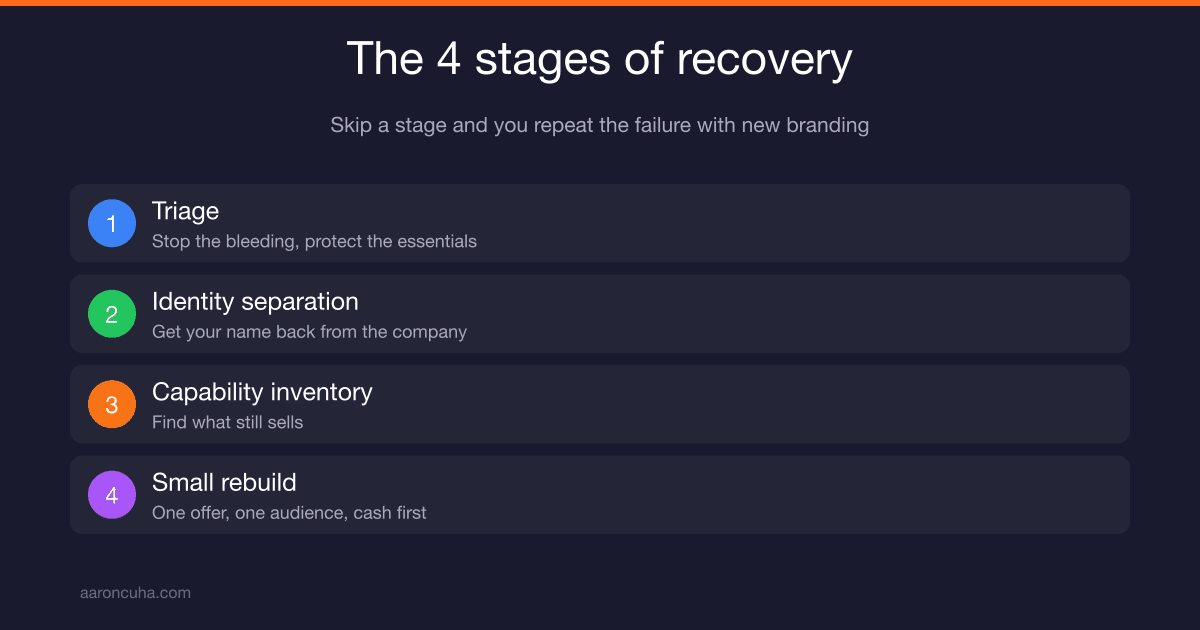
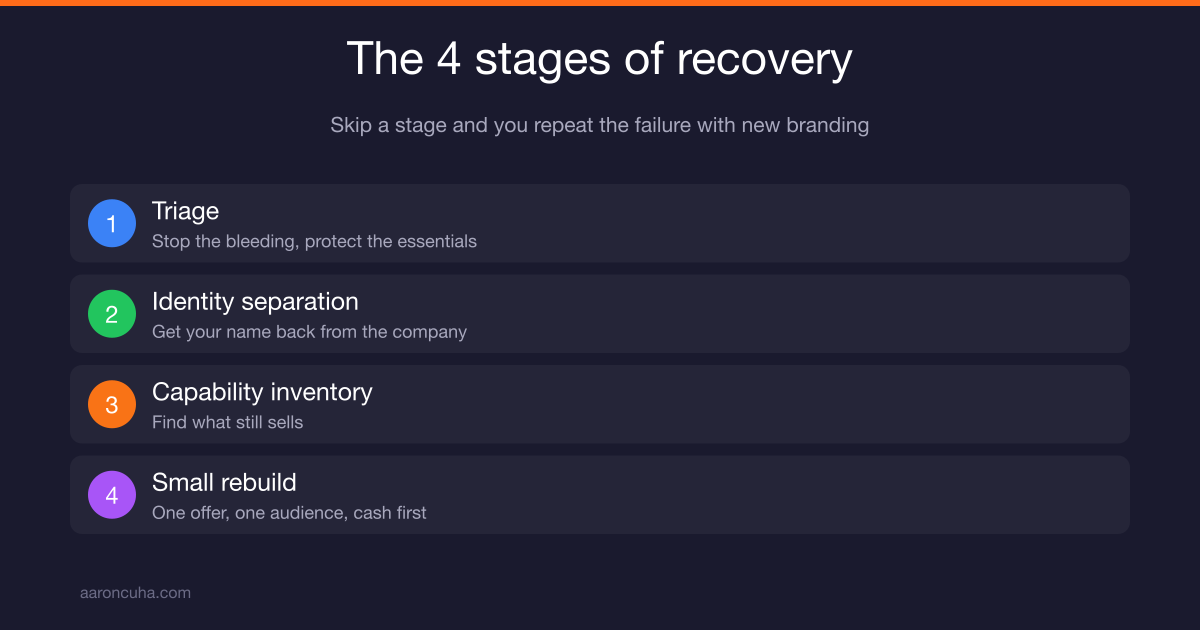
Recovery from business failure moves through four stages: triage, identity separation, capability inventory, and the small rebuild. The sequence matters. Skip a stage and you repeat the failure with new branding.
Most owners try to jump from triage straight to rebuilding. They stop the bleeding, then immediately chase a new deal to prove they are still who they were. That is not a rebuild. That is a rescue mission for your ego.
Stage two is the one people skip. Identity separation is slow, quiet, and produces nothing you can show anyone. So founders skip it and build the second company on the same foundation as the first, which was their own presence and their own nervous system.
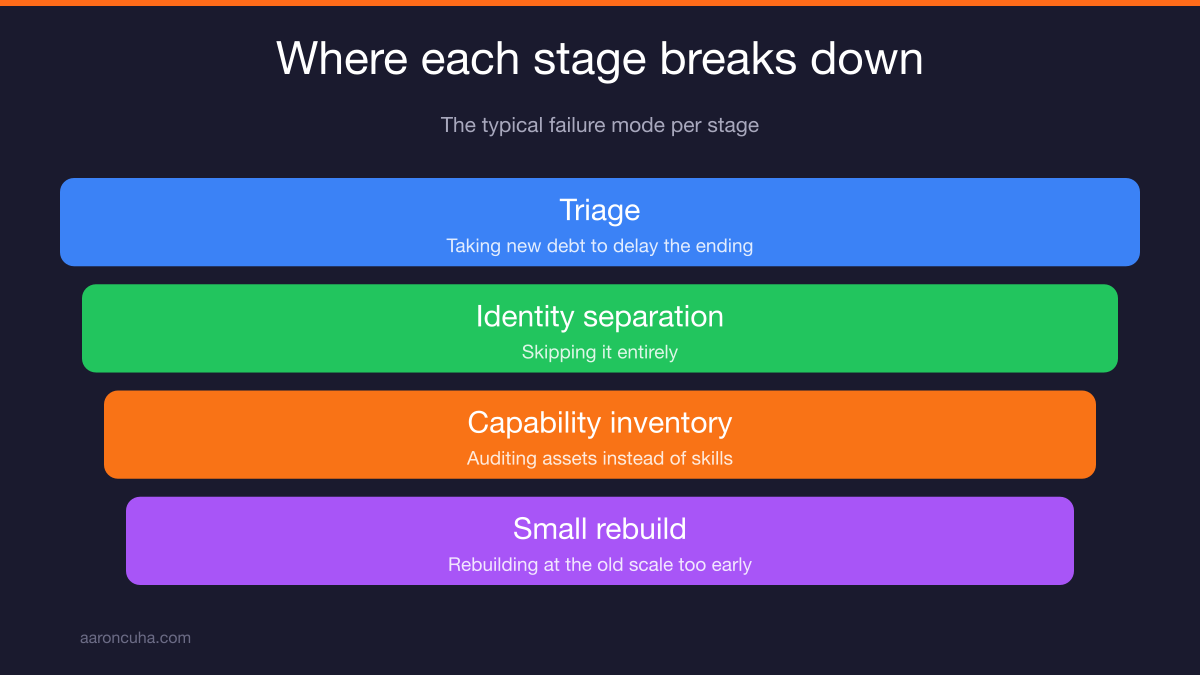
| Stage | Main Job | Typical Length | Failure Mode |
|---|---|---|---|
| 1. Triage | Stop the bleeding, protect the essentials | Weeks to a few months | Taking new debt to delay the ending |
| 2. Identity separation | Get your name back from the company | Longest stage, often years | Skipping it entirely |
| 3. Capability inventory | Find what still sells | Weeks | Auditing assets instead of skills |
| 4. Small rebuild | One offer, one audience, cash first | Ongoing | Rebuilding at the old scale too early |
You will move through these unevenly. You can be in stage three on Tuesday and back in stage one on Thursday when a letter arrives. That is normal.
What I Lost in 2008 and What Actually Came Back
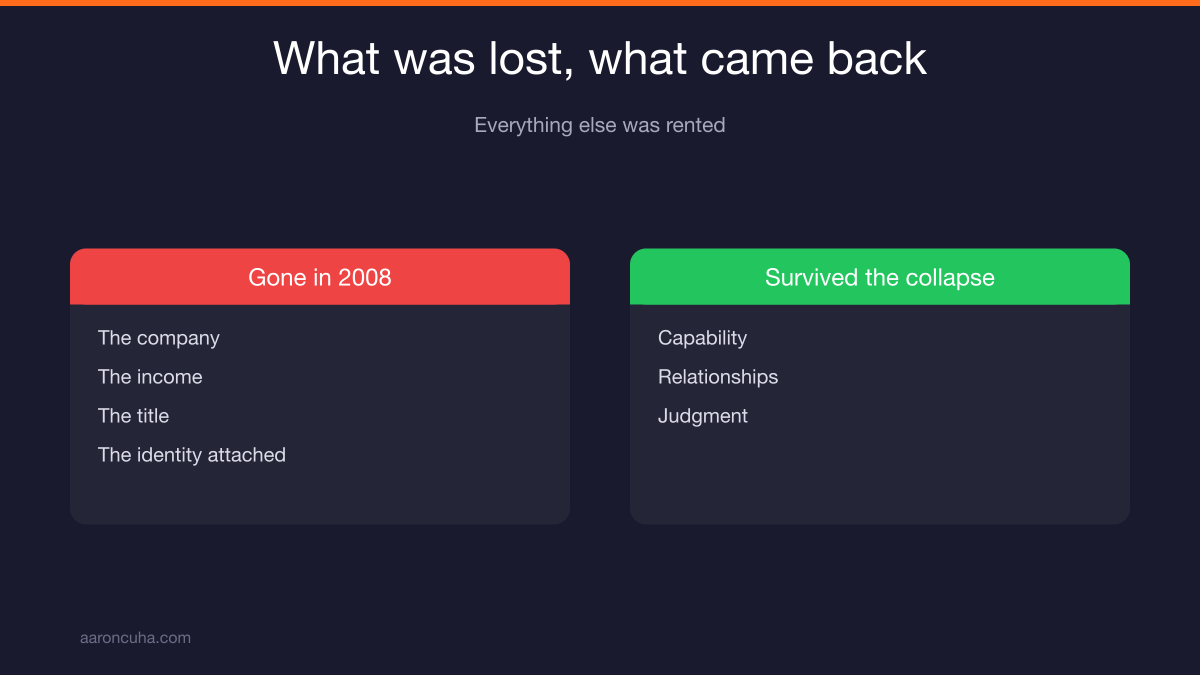
I lost the company, the income, the title, and most of the identity attached to all three. What came back was capability, relationships, and judgment. Those three things survive collapses. Everything else was rented.
DirectLender.com grew to 280 offices and 3,000 employees. Then the housing market broke, and lending broke with it. If you want the plain history of what happened, the Federal Reserve History archive covers the collapse better than any founder war story.
I did not rebuild right away. I spent close to a decade doing humanitarian work in Nepal. People assume that was a spiritual detour. It was actually the identity separation stage, and I did not have a name for it at the time.
Distance did the work that hustle could not. Away from the industry, I stopped introducing myself as the guy who used to run a lender. Eventually I just became a person who was useful to whoever was in front of me.
When I came back, I rebuilt as a coach. Five books later, 20,000 hours of one on one coaching later, the second build looks nothing like the first. It runs on systems instead of my presence. That difference is the whole point of this article.
Stage 1: Triage, the First 30 Days
Triage means stabilizing cash, mapping every obligation, and protecting your health. You are not solving the business in the first 30 days. You are making sure the next 90 days are still available to you.
Do these in order:
- Count the cash. Business and personal. What is actually available this week, not what is owed to you.
- List every obligation on one page. Loans, leases, vendors, payroll, taxes, and every personal guarantee you signed.
- Get real counsel. A bankruptcy or business attorney and a tax professional. Not a friend with opinions. The U.S. Small Business Administration lists free local advisory resources if cash is tight.
- Cut fixed costs to survival level. Subscriptions, office space, anything on autopay. Fixed cost is the thing that kills you slowly.
- Protect sleep and food. You will make worse decisions on four hours of sleep than you will with less information.
Now the refusals. These matter more than the checklist.
- Refuse new personal debt to buy time. Time you buy with debt is the most expensive time there is.
- Refuse revenge deals. Any deal designed to prove somebody wrong is a bad deal.
- Refuse the big announcement. You do not owe the internet a statement in week two.
Triage is boring. That is the point. You are trading drama for information.

How to Know When to Stop Trying to Save the Old Thing
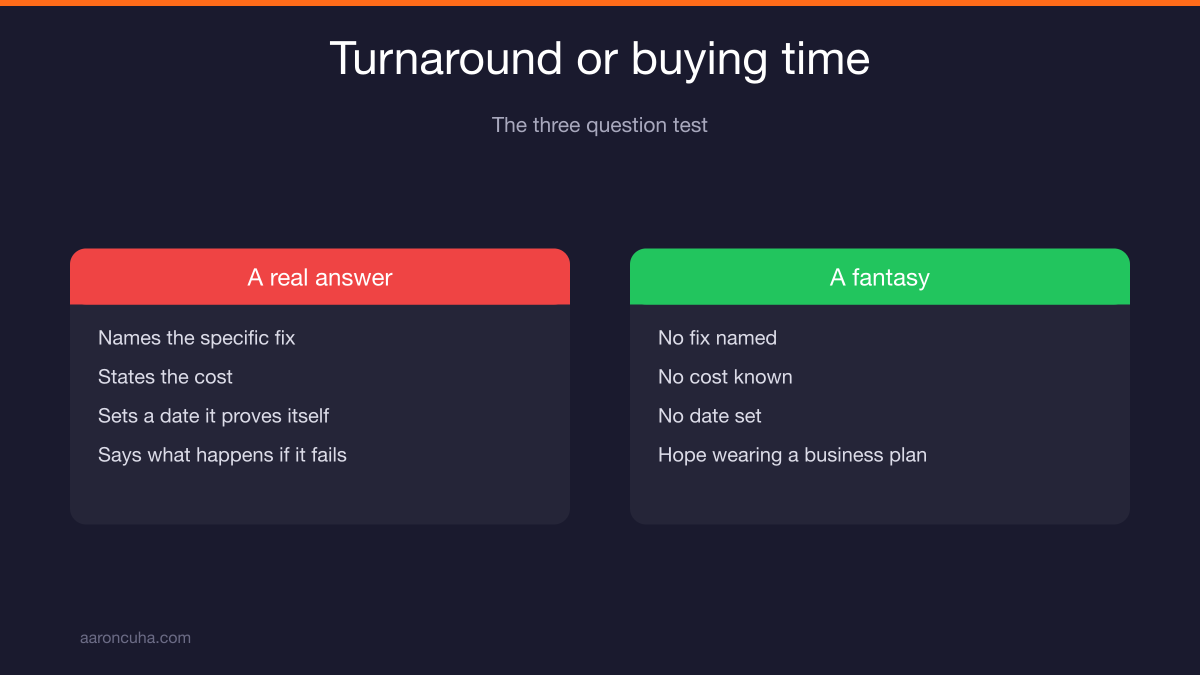
Use the three question test. Name the specific fix, the cost of that fix, and the date it proves itself. If you cannot answer all three in one sentence, you are buying time, not running a turnaround.
Here is what a real answer sounds like. "We cut two locations, which saves this much per month, and if collections do not clear the new break even by the fifteenth of next month, we close."
Here is what a fantasy sounds like. "If we can just get through this quarter, things will turn around." No fix. No cost. No date. That is hope wearing a business plan.
Founders almost always wait too long. Not because they are stupid, but because closing feels like an identity event instead of a financial decision. Every month you delay, you pull more personal money into a structure that is already failing.
Closing well protects three things: your credit, your relationships with vendors and staff, and your reputation. People forgive a business that failed. They remember a founder who went silent and stopped answering the phone.
So make the calls. Tell vendors the truth about what you can pay and when. Give your team as much notice as you legally and financially can. That behavior becomes your reference letter for the next ten years.
How to Talk to Your Family About It
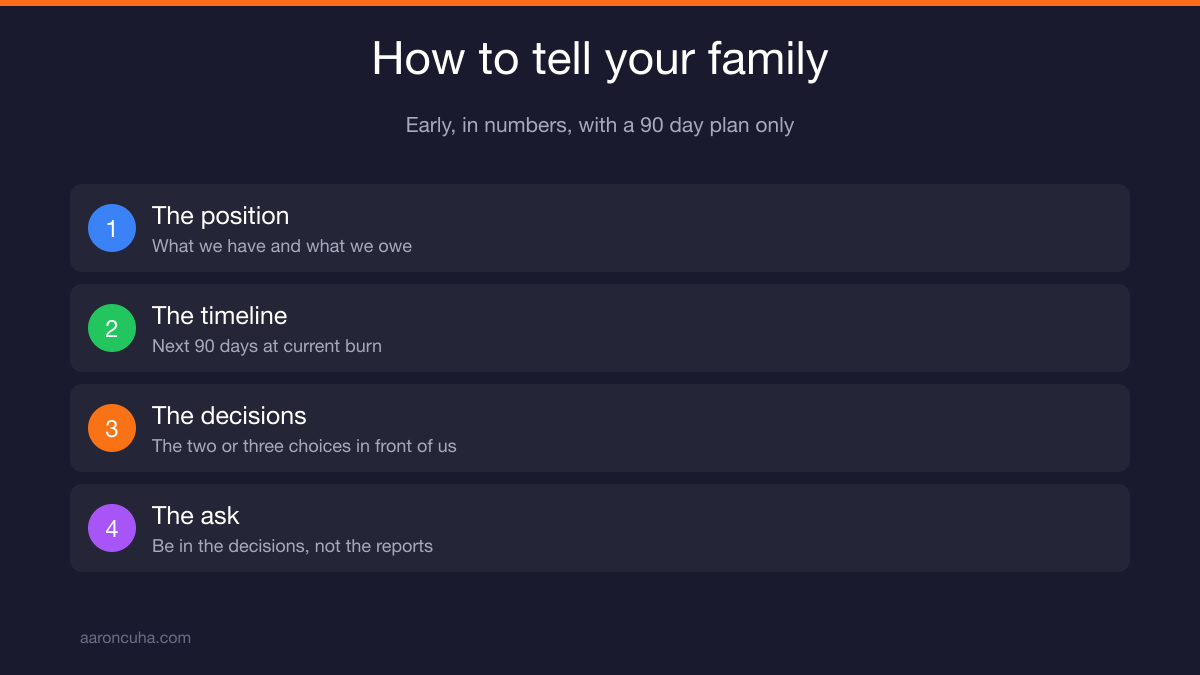
Tell them early, in numbers, with a 90 day plan only. Do not deliver a speech about the future. Deliver the current position, the next three months, and the decisions you need help making.
Most founders hide it. They hide it because they think they are protecting people. What actually happens is that your partner senses the stress, gets no information, and fills the gap with worse assumptions than the truth.
Use this structure:
- The position. "Here is where the business is. Here is what we have. Here is what we owe."
- The timeline. "Here is what the next 90 days look like at current burn."
- The decisions. "Here are the two or three choices in front of us."
- The ask. "I want you in these decisions, not receiving reports after I make them."
Do not promise outcomes. Do not say you will fix it by spring. Promise behavior instead: weekly updates, no hidden accounts, no new debt without a conversation. Behavior you control. Outcomes you do not.
Have the same conversation with your kids at their level. "Things at work changed, we are making some changes at home, you are safe, we will tell you what is happening." Kids can handle facts. They cannot handle a parent who is clearly frightened and pretending otherwise.
Secrecy costs more than the failure. Every founder I coach who hid the collapse from a spouse tells me the same thing later. The hiding did more damage to the marriage than the money ever did.
If you are past triage and trying to figure out what comes next, a one on one executive coaching conversation is the fastest way to get an outside read on your situation.
Stage 2: Identity Separation, Getting Your Name Back
The company was a container you poured yourself into. It was never you. Identity separation means learning to describe yourself without the title, the headcount, or the story of what you used to run.
This is the longest stage. Mine took most of a decade, and I was on a different continent doing work that had nothing to do with lending. You may not need that much distance. But do not expect it to resolve in a month.
Three exercises that actually move it:
- Separate role from skill. Write your old title on the left. On the right, list the concrete things you were good at doing. Recruiting. Reading a P&L. Calming a room. Those go with you. The title does not.
- Write the failure story in three sentences. What happened, what you owned, what you learned. Practice it until it is boring to say. A story you can tell calmly has stopped running you.
- Stop rehearsing the old title. When someone asks what you do, answer with the present tense. "I am rebuilding" is a complete answer. "I used to run" is a trap.
Watch for the tell. If you find yourself explaining the size of the old company to strangers, you are still in stage two. That is fine. Just know it, and keep doing the work.
Grief is part of this. You lost something real, and the people around you may treat it like a spreadsheet problem. It is not. Give it the weight it deserves, then keep moving. Both, not one or the other.

The Flat Middle: How Long It Usually Lasts and Why
The flat middle is the stretch where you are working hard and nothing visible happens. It usually lasts months, not weeks. Most people quit here because they are measuring outcomes when only inputs are available.
Here is why it exists. Outcomes lag effort. Trust takes time to rebuild. Pipelines take time to fill. Content takes time to compound. During that lag, your scoreboard reads zero while your effort reads maximum. That gap is where people break.
The fix is to change what you count. Stop tracking revenue during the flat middle. Track behavior you control.
Build a weekly scoreboard with four or five input metrics:
- Conversations had with potential buyers or partners
- Pieces of content published
- Offers made, not offers accepted
- Hours of focused work on the new thing
- Days you did the basics: sleep, movement, food
Score it every Friday. A green week during the flat middle means you did the work, regardless of what the bank account says. That is not a participation trophy. It is the only honest measurement available when outcomes lag.
About the 2am hours. They will come. Have a plan that does not involve your phone. Write the worry down, note the one action available tomorrow, and put the notebook down. Rumination at 2am has never produced a good decision in the history of business.

Stage 3: Capability Inventory, Finding What Still Sells
Audit skills, not assets. The building, the brand, and the balance sheet are gone. What remains is what you know how to do, who trusts you, and what problems you can solve this month for cash.
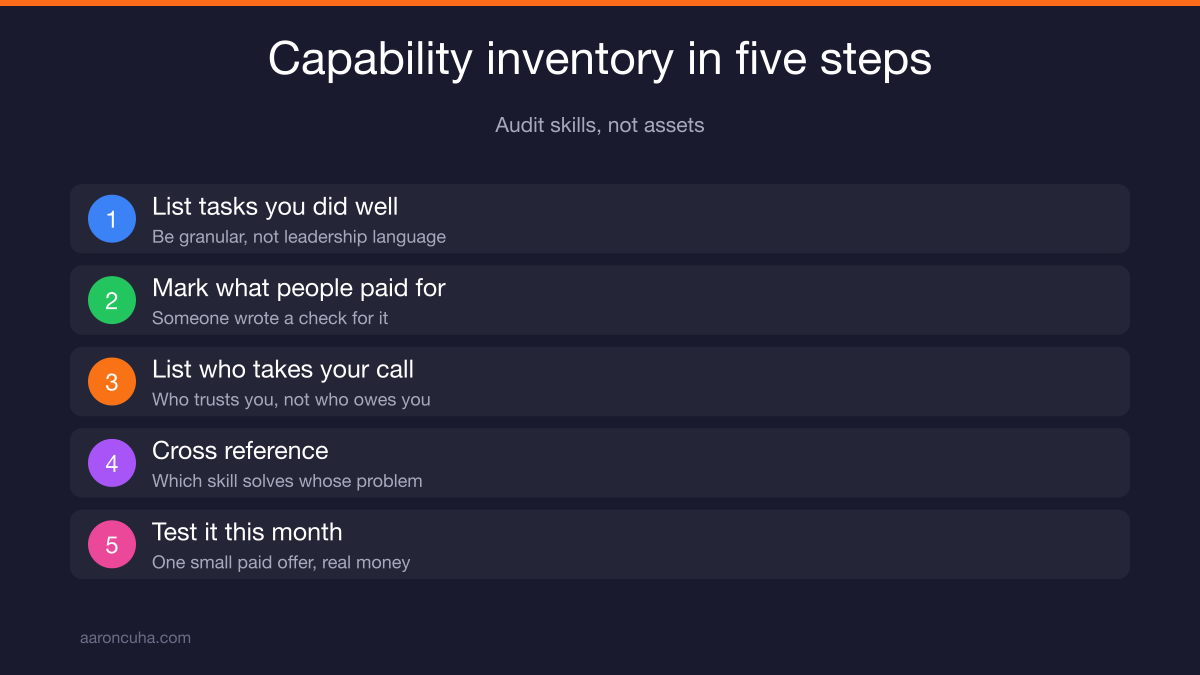
Run the inventory in five steps:
- List every task you personally did well in the old business. Be granular. "Trained new hires to close on the phone" beats "leadership."
- Mark which ones people paid for directly. Someone, somewhere, wrote a check because that task got done.
- List every relationship that would take your call today. Not who owes you. Who trusts you.
- Cross reference. Which skill on list one solves a problem for someone on list three?
- Test it this month. Make one paid offer. Small. Real money. Not a favor.
Prompts that surface hidden capability:
- What did people at the old company always come to you for?
- What could you teach someone to do in a single afternoon?
- What problem do you solve faster than almost anyone you know?
- What did you get complimented on that you assumed was ordinary?
The last one matters most. Founders undervalue their most transferable skill because it feels easy to them. Easy for you and hard for others is exactly where the money is.
If the answer points toward advising others, read how to pick a coaching niche that actually pays and how to build an online coaching business from scratch. Both walk through turning capability into an offer without building infrastructure first.
Stage 4: The Small Rebuild, One Offer and One Audience
Start deliberately small. One offer, one audience, one channel, cash before infrastructure. The rebuild fails when founders recreate the scale of the old business before they have proven the new one earns.
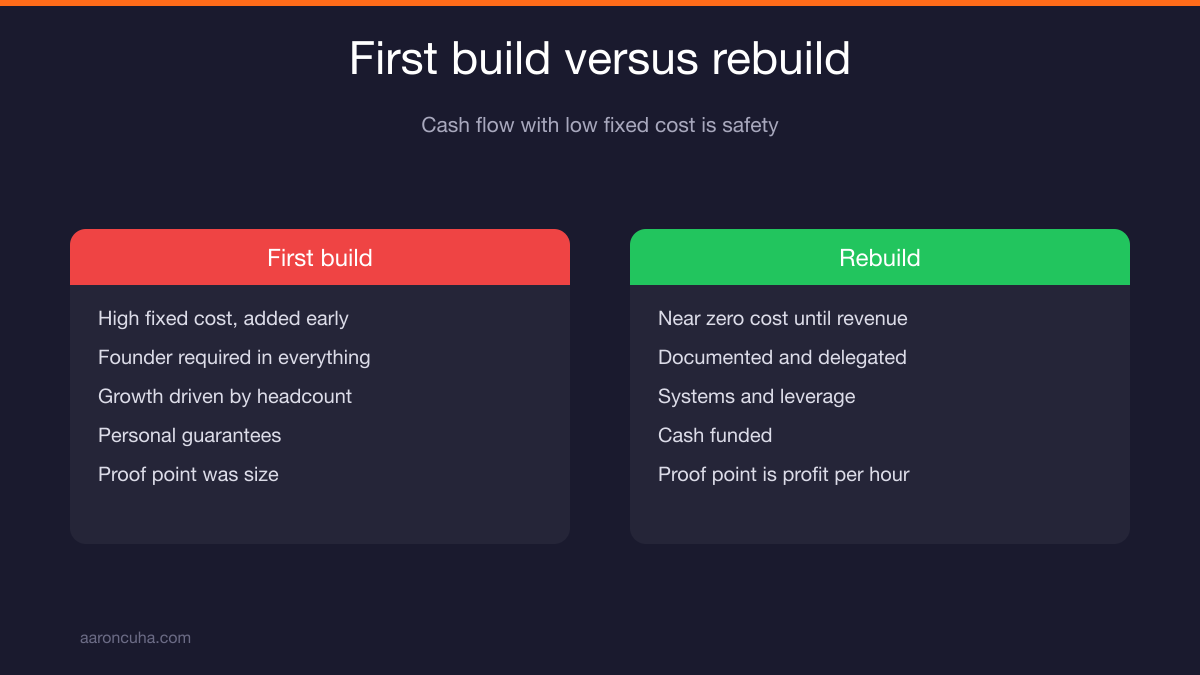
The instinct after a collapse is to go big fast, because size felt like safety. Size was never safety. Cash flow with low fixed cost is safety.
Four rules for the rebuild:
- One offer. A single thing you sell, at a single price, that solves a single problem. You can add later. You cannot focus later.
- One audience. A specific group you already understand. Your old industry counts, and often it is the fastest path.
- One channel. One place you show up consistently. Not five platforms at 20 percent effort each.
- Cash before infrastructure. No LLC stack, no logo project, no office, no hires until the offer earns. Revenue first, structure second.
Compare the two builds:
| First Build | Rebuild | |
|---|---|---|
| Fixed cost | High, added early | Near zero until revenue |
| Founder role | Required in everything | Documented and delegated |
| Growth driver | Headcount | Systems and leverage |
| Risk | Personal guarantees | Cash funded |
| Proof point | Size | Profit per hour |
A small business that pays you is not a consolation prize. It is a working machine. Machines can be scaled. Ideas cannot.
Why the Second Build Runs on Systems, Not Hustle
My first company depended on me. When conditions turned, there was no version of it that worked without my energy in the middle of it. That is a design flaw, not a market problem.
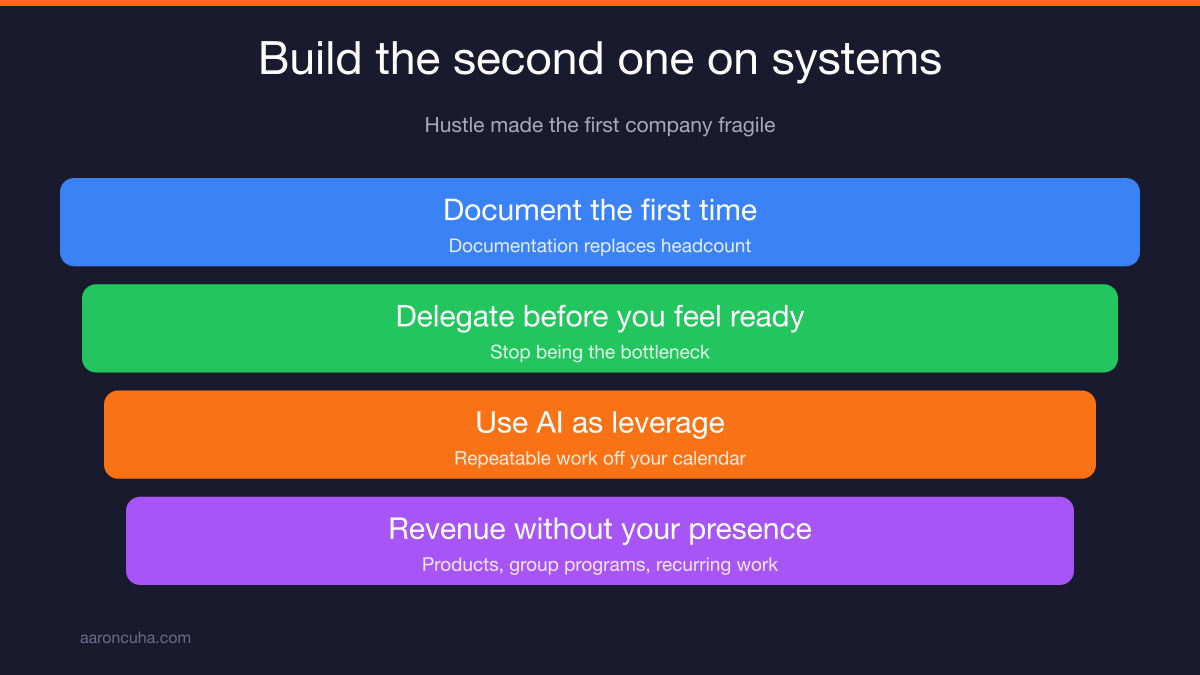
Hustle got the first company to 280 offices. Hustle also made it fragile, because everything routed through the founder. When the market broke, there was no system underneath to absorb the shock.
Build the second one to run without you from day one. That means four things:
- Document every process the first time you do it. Not later. The first time. Documentation is how you replace headcount.
- Delegate before you feel ready. The delegation playbook covers how to stop being the bottleneck without losing quality.
- Use AI as leverage, not decoration. Content production, follow up, scheduling, research. AI systems handle the repeatable work so your hours go to judgment calls.
- Build revenue that does not require your presence. Products, group programs, recurring work. One on one income is real, but it caps at your calendar.
The full framework is in Systems Over Hustle. It exists because I learned the cost of the alternative in the most expensive way available.
There is a version of you after this that works fewer hours than you did before and earns more reliably. That is not a motivational line. It is what happens when leverage replaces effort.
Building Authority While You Rebuild
Visibility shortens the flat middle. Publishing one video or article a week while revenue is small builds trust in public, so that when you are ready to sell, people already know who you are.
Here is the part most founders miss. The failure is content. Not as a pity play, but as expertise. You now know things about risk, cash, and collapse that people who never lost anything cannot teach.
Start with one channel and one format. Answer the questions your audience actually types into search. If you serve real estate or finance, YouTube for real estate agents and YouTube for financial advisors both lay out the format that works.
Consistency beats production quality. A weekly video shot on a phone with a clear answer to a real question outperforms a quarterly polished piece. Google's own helpful content guidance says the same thing in more words: usefulness wins.
One more benefit. Publishing forces you to articulate what you know, which accelerates stage two. You cannot teach a lesson clearly until you have stopped bleeding from it.
If you want the strategic version of this, how to become a thought leader in your industry covers turning experience into positioning.
Your First 90 Days: A Rebuild Checklist
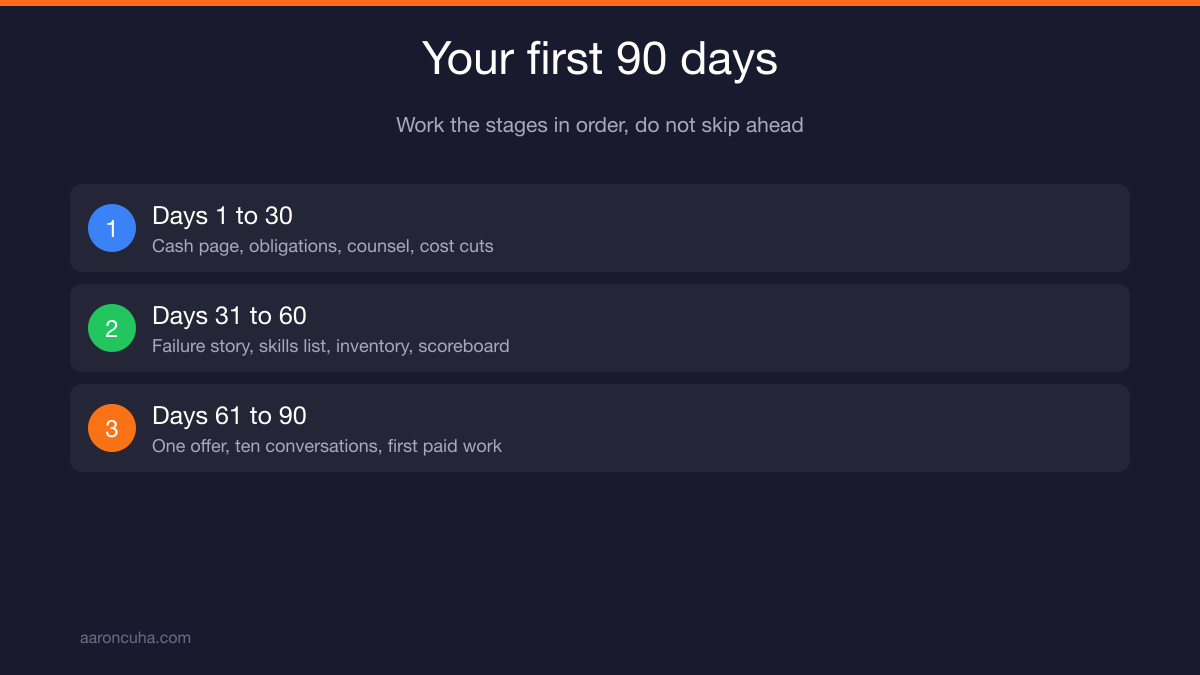
Work the stages in order across 90 days. Triage in month one, identity and inventory in month two, first paid offer in month three. Do not skip ahead because a stage feels slow.
Days 1 to 30, triage:
- Cash position on one page
- Every obligation and personal guarantee listed
- Attorney and tax professional engaged
- Fixed costs cut to survival level
- Family conversation held with numbers and a 90 day plan
- Three question test applied to the old business, decision made
Days 31 to 60, separation and inventory:
- Failure story written in three sentences and practiced
- Role versus skill list completed
- Capability inventory finished with cross referenced relationships
- Weekly input scoreboard started
- One channel chosen for publishing, first piece live
Days 61 to 90, small rebuild:
- One offer defined, one audience named, one price set
- Ten direct conversations with people in that audience
- First paid engagement delivered, however small
- Every process documented as you do it the first time
- Weekly publishing cadence holding
Three things to refuse permanently:
- Personal guarantees that can take your home.
- Any business model that only works when you are present every day.
- Growth that outruns your documented systems.
You are not starting from zero. You are starting from experience, which is a better position than the one you had the first time, even though it does not feel that way at 2am.
Ready to design the second build so it does not depend on you? Book a strategy session and we will map your one offer, one audience, and the system that runs it.
Frequently Asked Questions

Written by
Aaron CuhaAuthor of Crazy Simple YouTube, keynote speaker, and executive coach with 20,000+ hours logged. ICF PCC, NLP Master Practitioner, and DISC Certified. Aaron helps entrepreneurs replace hustle with AI-powered systems that generate leads, content, and revenue on autopilot.