Most stalled businesses are not short on opportunity. They are drowning in it. Here is how to say no to business opportunities using a five-question filter instead of gut feel, plus exact language to decline without damaging the relationship.
Your calendar is full. Your revenue is flat. That gap is not a work ethic problem. It is a filter problem. Here is how to say no to business opportunities, using a five question filter.
Key Takeaways
- Learn how to say no to business opportunities using a written five question filter.
- Score alignment, true time cost, reversibility, downside ownership, and compounding value.
- Multiply your time estimate by three before you commit to anything.
- Decline with a clear no, one honest reason, and one piece of value.
- Run a quarterly exit review to unwind the yeses you already gave.
Want the filter as a one page document you can print and keep on your desk? Grab it inside my free resource library and put it to work today.
Your Problem Is Not a Lack of Opportunity
Most stalled businesses are not starving. They are drowning. You have more offers, invitations, partnerships, and side projects than you can serve, and you are treating all of them like scarce gifts.
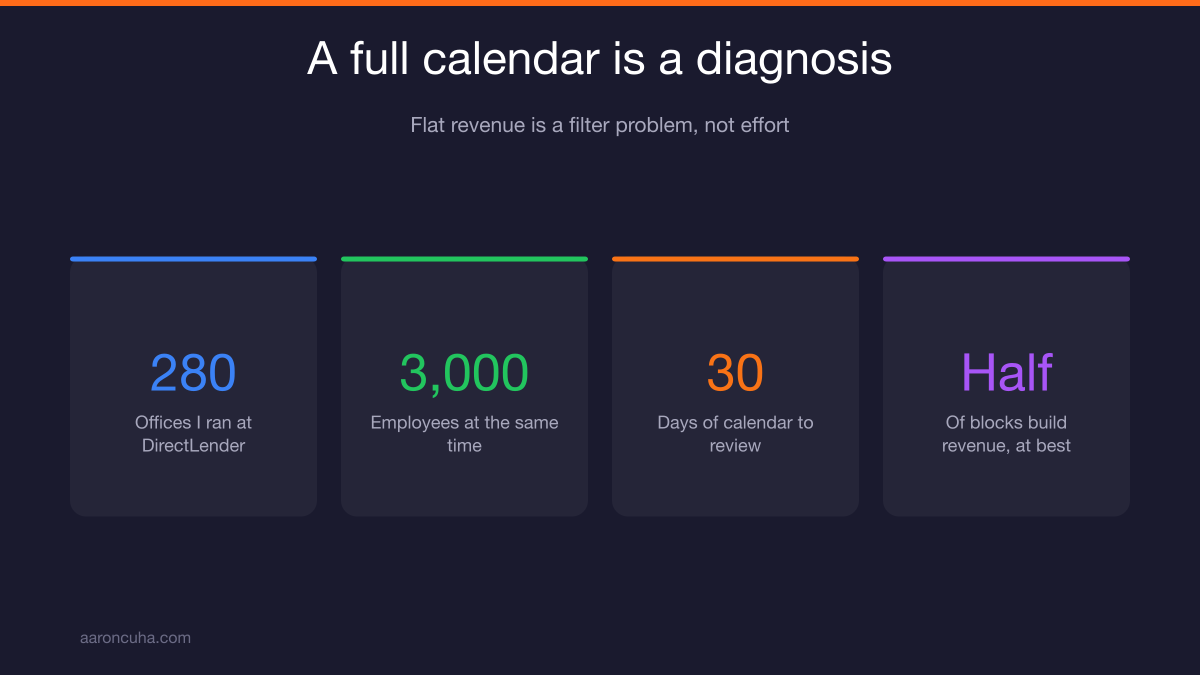
I ran DirectLender at 280 offices and 3,000 employees. In the growth years, every yes felt like proof. A new office, a new partner, a new product line. Motion looked like progress.
It was not. Some of those yeses were real growth. Others were weight. I could not tell them apart because I was deciding by feel, at speed, while exhausted.
A full calendar with flat revenue is a diagnosis, not bad luck. It means your inputs are not connected to your outputs. You are busy on work that does not sell anything, does not build anything, and does not end.
Here is the test. Open your calendar for the last 30 days. Highlight every block that directly produced revenue or built an asset that will produce revenue later.
Most owners I coach highlight less than half. Some highlight a third. Nothing on the unhighlighted side arrived by accident. You said yes to all of it.
That is good news. If you accepted it, you can change how you accept things. This is the same idea behind Systems Over Hustle, applied one step upstream. Before you optimize the work, decide what work is allowed in.
Why Gut Feel Is a Terrible Filter
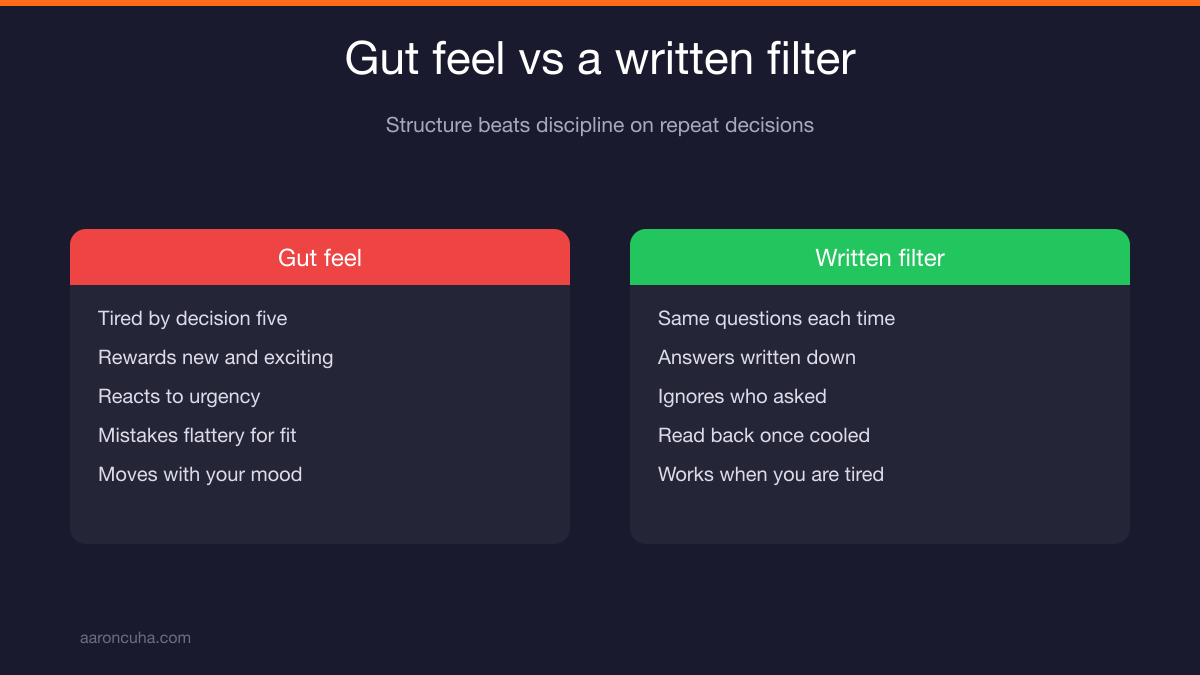
Gut feel works when you get one offer a month. It collapses when you get five a week. By the fifth decision of the day, you are not evaluating, you are reacting.
Decision fatigue is real. The more choices you make in a day, the worse your later choices get. The American Psychological Association has written for years on how mental load degrades judgment.
There is a second problem. Being asked feels good. Someone chose you. That flattery gets mixed into the evaluation and comes out looking like opportunity.
Three things reliably fake real opportunity:
- Excitement. New always feels better than unfinished.
- Urgency. "We need an answer today" is a pressure tactic, not a quality signal.
- Flattery. Being wanted is not the same as being paid.
None of those tell you whether the thing serves your business. They tell you how the ask was packaged.
A written filter fixes this because it does not get tired and it does not get flattered. You answer the same questions in the same order every time, and the answers do not care how charming the person on the other end was.
I wrote about the deeper version of this in The Willpower Lie. Discipline is not the answer to a decision you keep making badly. Structure is.
How to Say No to Business Opportunities: The 5-Question Filter
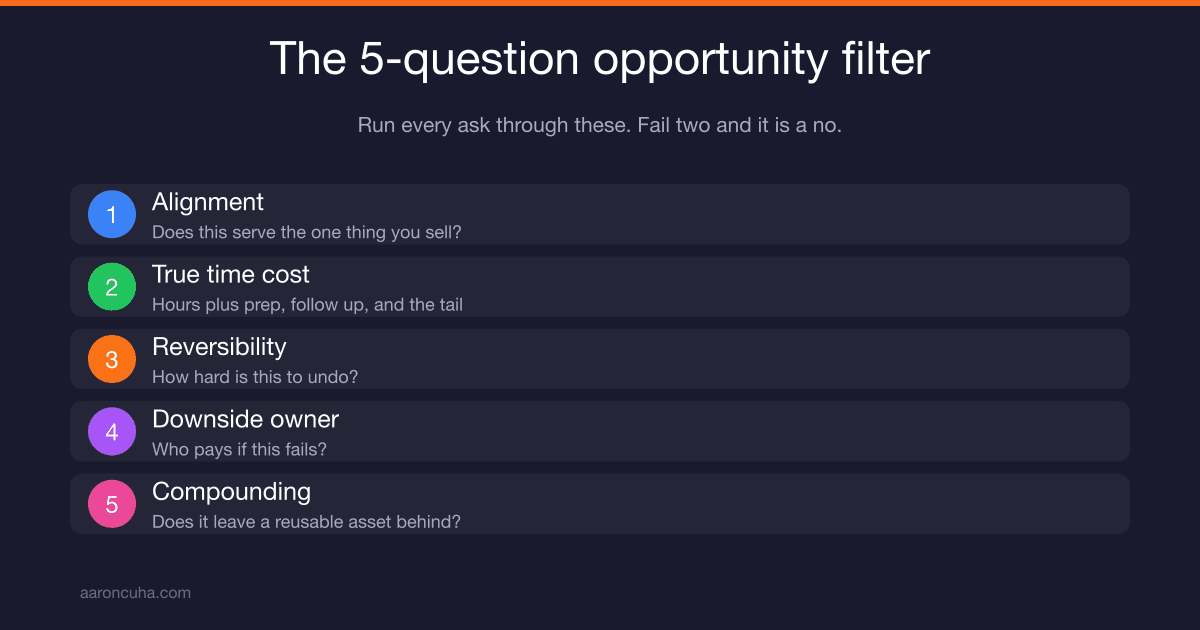
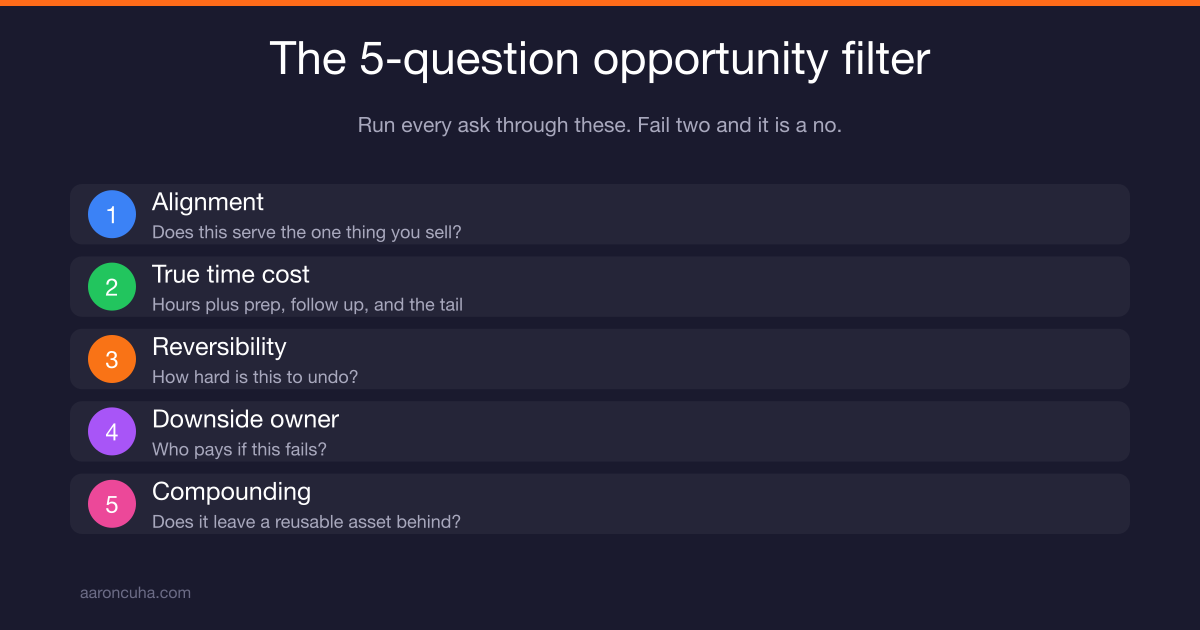
To say no to business opportunities without agonizing, run every ask through five questions: alignment, true time cost, reversibility, downside ownership, and compounding. If it fails two, it is a no.
The five questions, in order:
- Does this serve the one thing I sell?
- What is the true time cost, including the tail?
- How hard is this to undo?
- Who pays if this fails?
- Does this compound, or does it just consume?
Order matters. Alignment first, because a perfectly cheap, reversible, low risk project that has nothing to do with your business is still a distraction.
| Question | Pass signal | Fail signal |
|---|---|---|
| Alignment | Reaches or serves your primary buyer | Serves a different audience or product |
| True time cost | Cost is known and bounded | Open ended, no defined finish |
| Reversibility | You can exit in weeks, cleanly | Contracts, staff, or shared entities |
| Downside owner | Risk sits with the person holding upside | You carry risk, they carry upside |
| Compounding | Creates a reusable asset | Disappears the day it ends |
Write the answers down. Not in your head. On paper or in a note, in full sentences, so you can read them back tomorrow when the excitement has cooled.
Question 1: Does This Serve the One Thing You Sell
Define the single primary offer that pays your bills. Then ask whether this opportunity moves someone closer to buying it. If it serves a different buyer, you are starting a second business.
Most owners cannot name their one thing in a sentence. They name three. That is the root of the problem, because three offers means three audiences, three marketing systems, and three sets of "opportunities" that all look reasonable.
Write it like this: "I sell [offer] to [specific buyer] so they can [outcome]." One sentence. If you need a second sentence, you have not decided yet.
Now the trap. Adjacent work always looks aligned. A slightly different service for a slightly different client. A collaboration with someone in a related field. Each one is a small step sideways.
Take ten small steps sideways and you are running a business you never chose, with no leverage in any direction. Nothing you learn in one lane makes you better in the others.
Alignment is binary in practice. Either the work feeds your primary offer, or it feeds something else. Be honest about which, and if you are still deciding what your lane should be, start with picking a niche that actually pays before you accept anything new.
Question 2: What Is the True Time Cost
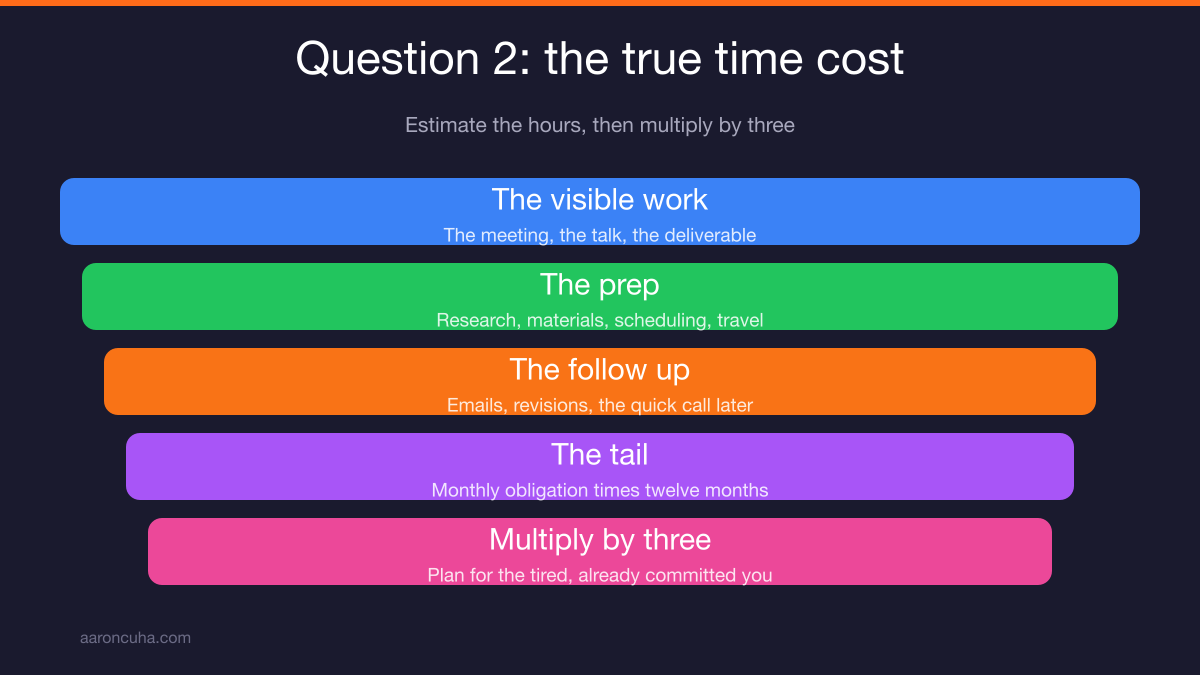
Estimate the hours, then multiply by three. The extra covers prep, follow up, context switching, and the maintenance tail that nobody mentions when they pitch you.
Every commitment has four cost layers, and most people only price the first:
- The visible work. The meeting, the talk, the deliverable.
- The prep. Research, materials, scheduling, travel.
- The follow up. Emails, revisions, the "quick call" that lands two weeks later.
- The tail. The ongoing obligation this creates for months after.
The tail is the killer. A one hour commitment that generates a recurring monthly check in is not a one hour commitment. It is an annuity you pay.
Here is the worked structure. Write the visible hours. Add prep hours. Add follow up hours. Then ask: does this generate any recurring obligation? If yes, estimate the monthly hours and multiply by twelve.
Compare that total against what those same hours would produce in your primary offer. Not against zero. The real cost of a yes is the best thing you would have done instead.
The 3x rule exists because we are consistently optimistic about our own future schedules. Plan for the version of you who is tired, behind, and already committed.
Question 3: How Hard Is This to Undo
Sort decisions by exit cost. If you can walk away in two weeks with a phone call, decide fast. If exit requires lawyers, partners, or staff, slow down and demand a much higher standard.
Jeff Bezos popularized the idea of one way doors and two way doors in his shareholder letters at Amazon. Most owners treat every door as one way, which makes them slow on cheap decisions and, strangely, careless on expensive ones.
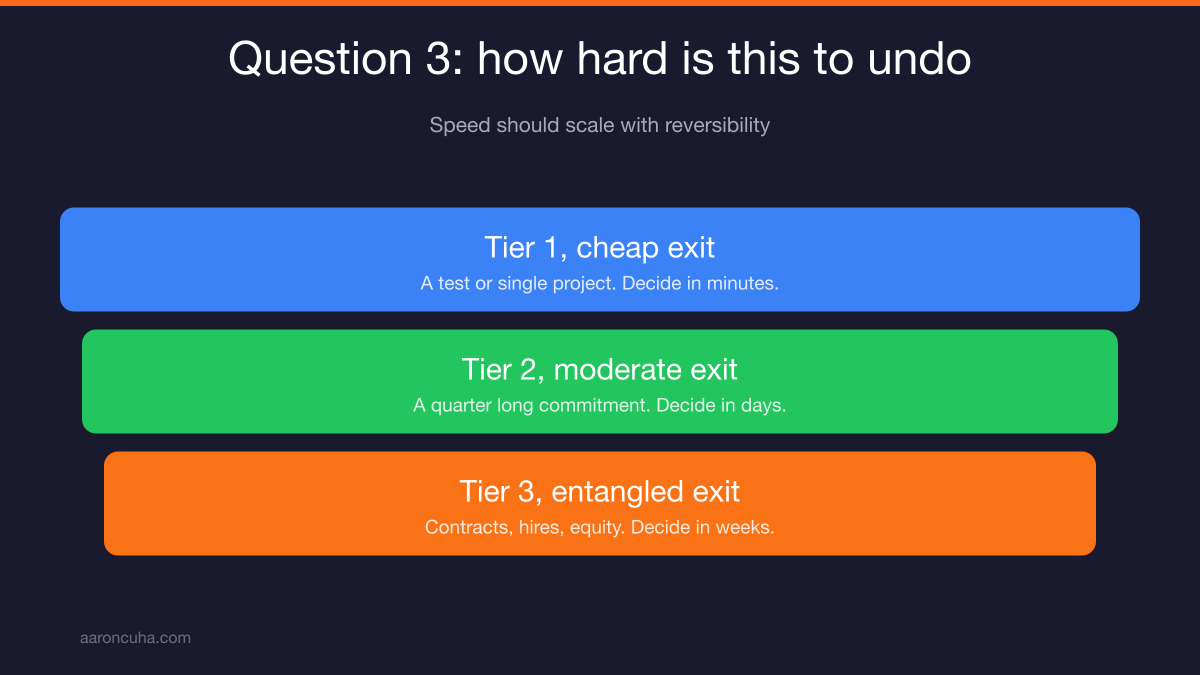
Use three exit tiers:
- Tier 1, cheap exit. A test, a single project, a trial post. You can stop and nobody is harmed. Decide in minutes.
- Tier 2, moderate exit. A quarter long commitment, a client with expectations, a recurring show. Exiting costs reputation and notice. Decide in days.
- Tier 3, entangled exit. Shared entities, hires, long contracts, revenue splits, equity. Exiting costs money and relationships. Decide in weeks, with counsel.
The mistake is applying Tier 3 caution to Tier 1 decisions. That is how owners spend three weeks debating whether to publish a video and three minutes agreeing to a partnership.
Speed should scale with reversibility. Cheap and reversible? Try it and learn. Expensive and entangled? Write the exit terms before you sign, not after the relationship sours.
Question 4: Who Pays If This Fails
Find out who carries the downside. If you carry the risk and someone else carries the upside, that is not a partnership. That is you funding their experiment.
I learned this the expensive way. When the market turned in 2008, I lost DirectLender. Some of what fell apart was the market. Some of it was commitments where I had quietly accepted the risk while somebody else held the reward.
Those deals never looked lopsided when I signed them. They looked like relationships. The imbalance only shows up when things go wrong, and by then the terms are the only thing that matters.
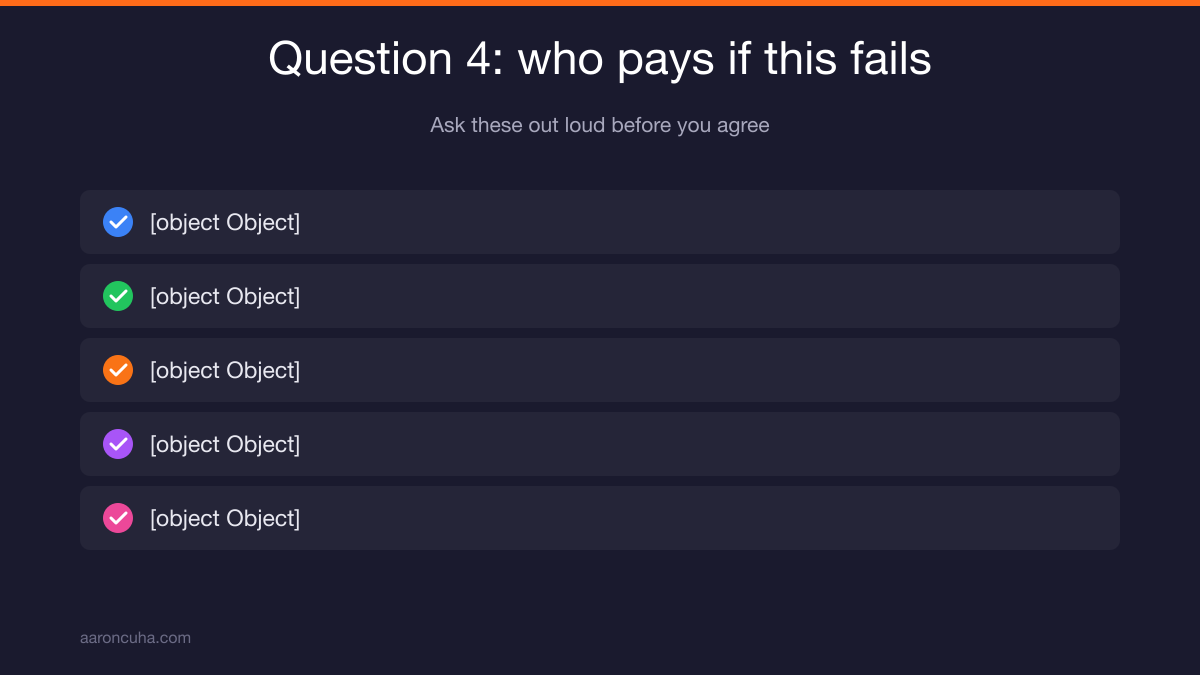
Ask these out loud before you agree:
- If this produces nothing, who has lost money?
- If this works, who captures the gain?
- If I stop, who is harmed and how loudly?
- Am I the only one with skin in this?
You do not need every deal to be perfectly symmetrical. You need to know the shape of it going in and price your yes accordingly.
Asymmetry is fine when it favors you and fatal when you did not notice it. Free work, unpaid advisory roles, and "we will figure out the split later" arrangements almost always put the risk on the person doing the work.
If your calendar is full but your revenue has not moved in two quarters, that is a structural problem, not an effort problem. Book a private executive coaching conversation and we will rebuild the filter together.
Question 5: Does It Compound or Does It Just Consume
Compounding work leaves an asset behind. Consuming work disappears the moment it ends. Given two equally aligned opportunities, always take the one that leaves something you can reuse.
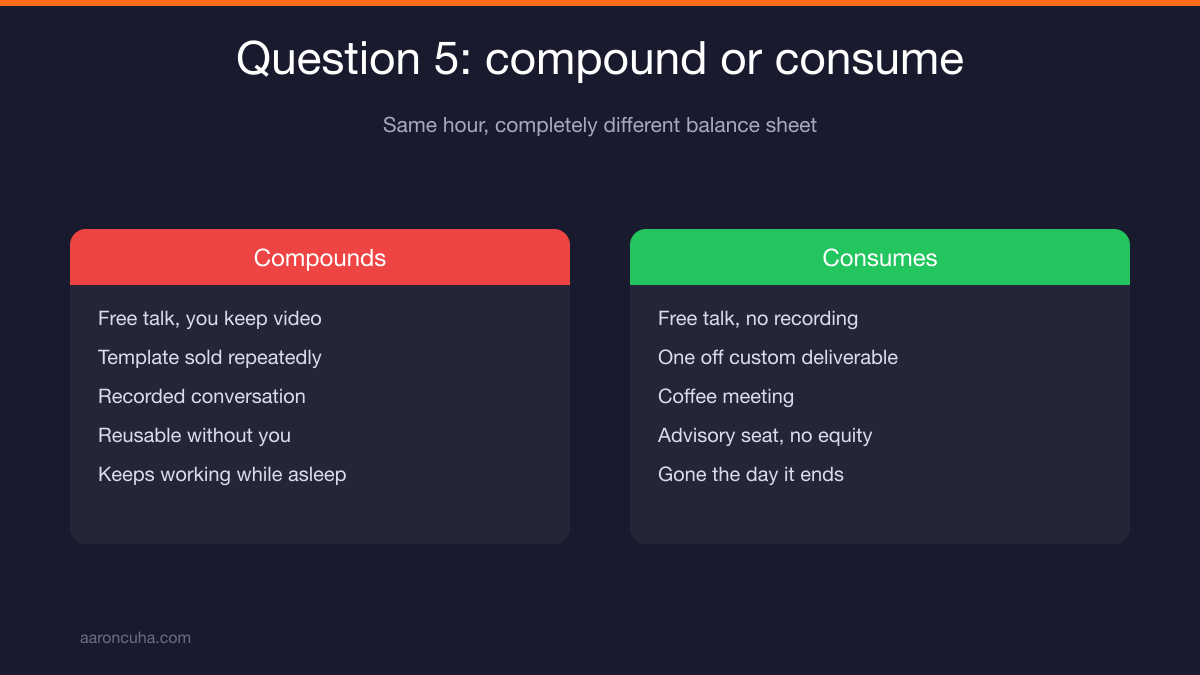
A one hour coffee meeting consumes. A one hour recorded conversation that becomes a video, a newsletter, and a dozen clips compounds. Same hour, completely different balance sheet.
Assets that compound share three traits. They are recorded or written down, they can be reused without you, and they keep working while you sleep.
That is exactly the logic behind the Authority Flywheel, where a single video becomes thirty pieces of content. It is also why repurposing existing content beats creating from scratch nearly every time.
Apply the test to common asks:
- Free speaking with no recording rights. Consumes.
- Free speaking where you keep the video. Compounds.
- A custom one off deliverable for one client. Consumes.
- A template you build once and sell repeatedly. Compounds.
- An advisory seat with monthly meetings and no equity. Consumes.
You will still say yes to some consuming work. Client delivery consumes, and it pays the bills. The point is to notice when your week is entirely consumption, because that is a business that resets to zero every Monday.
How to Score an Opportunity in Under Ten Minutes
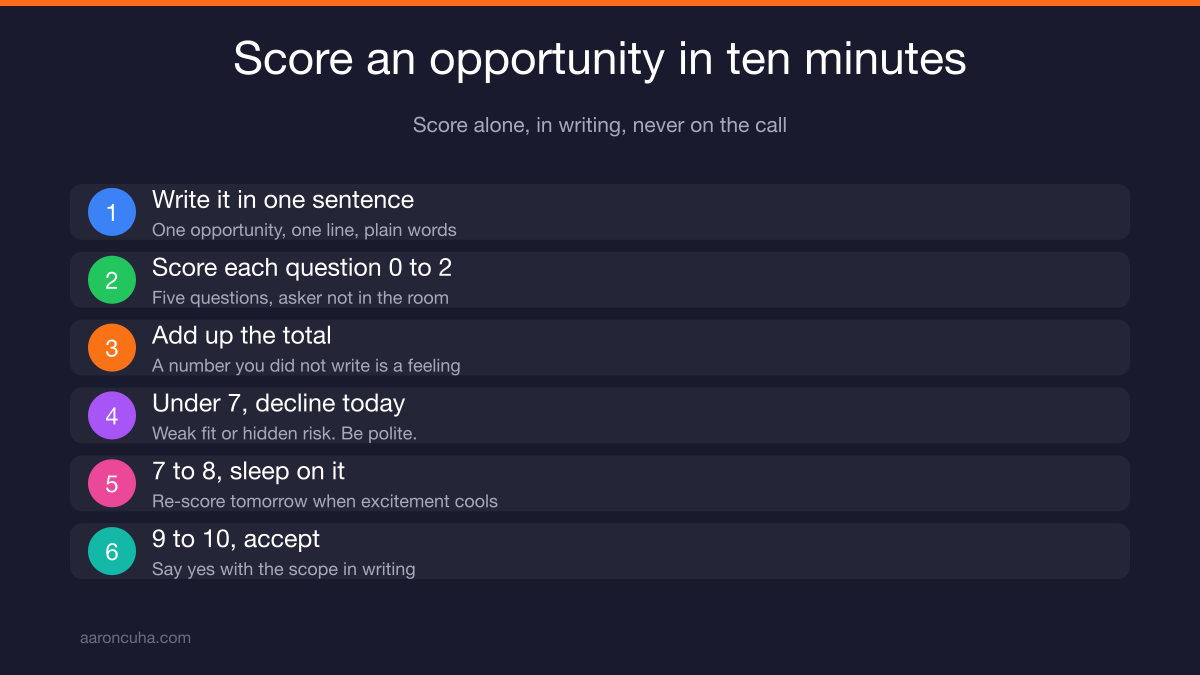
Write the opportunity in one sentence. Score each of the five questions from 0 to 2. Add them up. Anything under 7 is a no, and anything from 7 to 8 sleeps overnight.
| Score | Meaning | Action |
|---|---|---|
| 0 to 6 | Weak fit or hidden risk | Decline today, politely |
| 7 to 8 | Plausible, not obvious | Sleep on it, re-score tomorrow |
| 9 to 10 | Strong fit and compounding | Accept, with scope in writing |
Scoring rules that keep you honest:
- Score alone. Not on the call. Not with the person who asked in the room.
- Score in writing. A number you did not write down is a feeling.
- Any zero on alignment is an automatic no, regardless of total.
- Re-score anything you scored while excited. Excitement inflates every category.
The overnight rule does more work than the scoring itself. Almost nothing legitimate expires in 24 hours. When someone insists it does, that is your answer.
Keep a running log of scored opportunities with their outcomes. After a year you will see your own pattern, which categories you overrate, and where you consistently underestimate the tail.
Exact Language for Declining Without Burning the Relationship
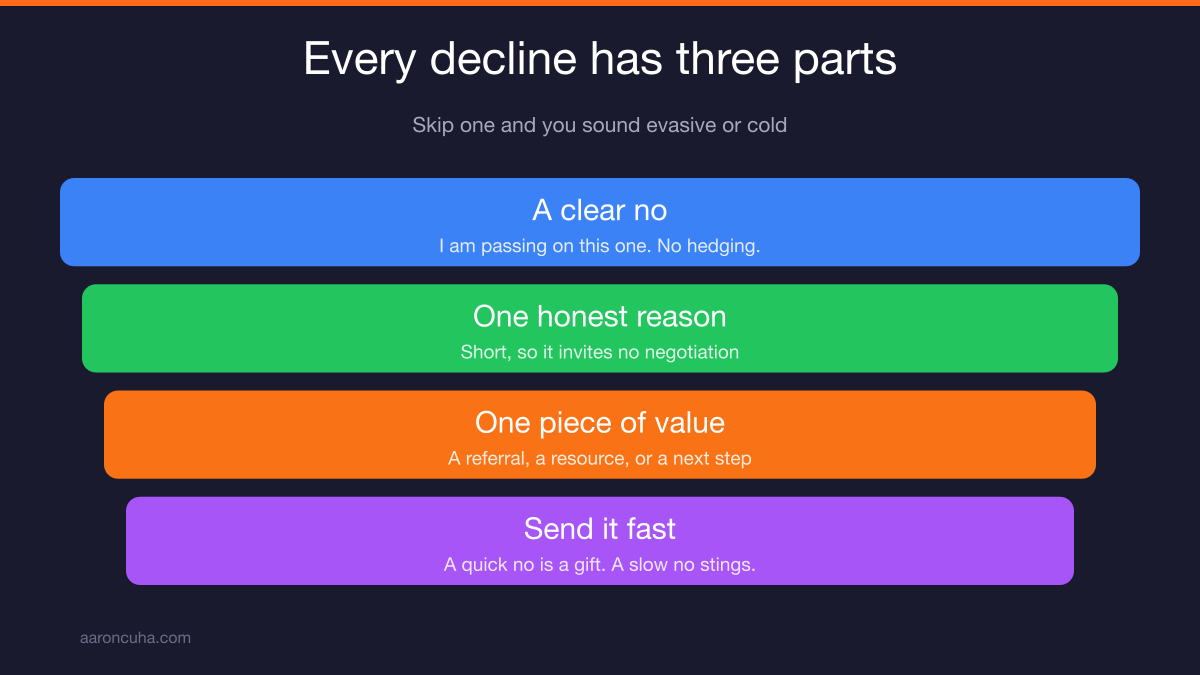
Every good decline has three parts: a clear no, one honest reason, and one piece of value. Skip any of the three and you either sound evasive or you sound cold.
Do not over explain. Long explanations invite negotiation, because every reason you give is a problem the other person can offer to solve.
Five scripts you can use today:
- Referral partner. "I am going to pass on this one. I am keeping my commitments narrow this quarter so I can serve the clients I already have. Here is someone I trust who does this work well."
- Existing client asking for out of scope work. "That falls outside what we agreed on, so I will say no to adding it here. I want to protect the results we are already getting. If you want it handled, here is what a separate engagement would look like."
- Speaking ask. "I am not able to take this date. My speaking calendar is set a few months out. If you send dates for next season, I will look at them properly."
- Partnership pitch. "I am passing. The risk and the upside are not balanced the way I need them to be. If the structure changes, send it again and I will look."
- Free work request. "I do not take on unpaid projects anymore. It is the only way I keep quality high for paying clients. Here is a free resource that covers most of what you are asking."
Say no fast. A quick no is a gift. A slow no, delivered after three weeks of vague replies, is what actually damages relationships.
What a Decade in Nepal Taught Me About What Deserves a Yes
Remove income pressure and status pressure, and your priorities get very simple very fast. Most bad yeses are not opportunities at all. They are fear responses wearing a suit.
After I lost the company, I spent about ten years doing humanitarian work in Nepal. No pipeline. No quarterly targets. Nobody I needed to impress.
What surprised me was how little I missed the volume. Back home I had been saying yes to things because saying no felt like admitting the business was not growing. That is scarcity thinking, and scarcity thinking is expensive.
Scarcity produces three predictable bad yeses:
- The insurance yes. You take it in case nothing better comes.
- The status yes. You take it because of how it will look.
- The guilt yes. You take it because they asked nicely and you feel indebted.
None of those relate to whether the work serves your business or your life.
When I came back and rebuilt as a coach, the filter came with me. It is the reason I can spend 20,000 hours in one on one coaching without being scattered across nine businesses. You can read more of that story on my about page.
Abundance is not a mood. It is what happens when your filter is strong enough to turn things down.

How to Unwind the Commitments You Already Accepted
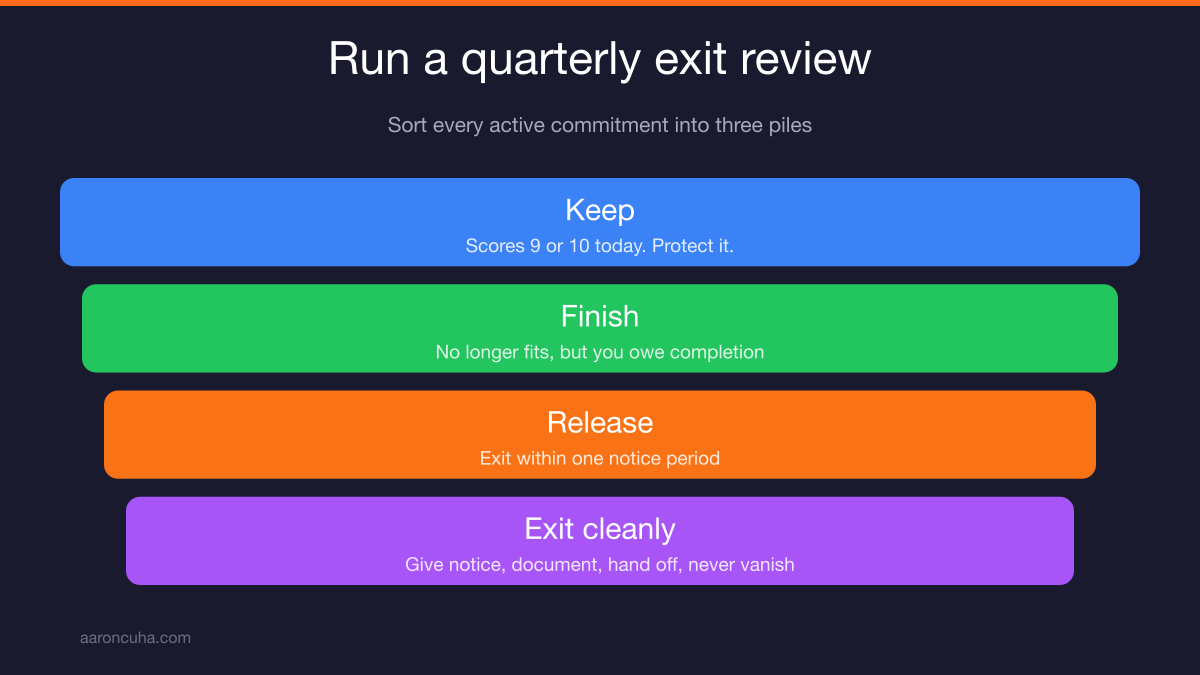
Run a quarterly exit review. List every active commitment, sort each one into keep, finish, or release, and give the release pile a real exit date within 90 days.
A filter only protects your future. The commitments already on your calendar need a separate process, because those are the ones eating your week right now.
The three buckets:
- Keep. It scores 9 or 10 today. Protect it.
- Finish. It no longer fits, but you owe a completion. Set the end date and stop renewing.
- Release. It fails the filter and has no natural end. Exit within one notice period.
Exit cleanly, because reputation outlives every project. Give the notice you promised. Document what you were handling. Introduce a replacement if you have one. Never disappear.
Say it plainly: "I am winding down my involvement here by the end of next month. I want to hand this off well. Here is what I will complete before I go and who I would recommend."
Some of what you release should not vanish, it should transfer. That is a delegation problem, and I cover the handoff mechanics in how to stop being the bottleneck. Small business exit and transition guidance is also available from the U.S. Small Business Administration.
Your Next 30 Days: Make the Filter a Habit
Spend one week writing the filter, one week auditing your calendar, one week practicing declines, and one week unwinding. By day 30 the filter runs automatically.
Here is the week by week plan:
- Week 1, build the document. One page. Your one sentence offer, the five questions, the scoring rules, and your standing decline template. Print it.
- Week 2, audit. Score every active commitment on your calendar. Sort into keep, finish, release. Do not act yet, just see it.
- Week 3, practice declining. Say no to three new asks using the three part structure. Keep them short. Notice that nobody is angry.
- Week 4, unwind one thing. Pick the largest item in your release pile and start the exit. One is enough to change your month.
Track one number as your scoreboard: revenue per working hour. You do not need software. Total revenue for the month divided by hours actually worked.
That number is honest in a way a full calendar never is. Add commitments that do not pay and it drops, no matter how impressive your week looked.
Pair the filter with a content system so the compounding yeses actually get built, not just approved. Content systems for entrepreneurs covers the publishing side. For broader thinking on decision quality under pressure, Harvard Business Review publishes consistently well on the topic.
Every yes is a purchase. You are spending hours you cannot get back. Start pricing them like it.
Ready to build the filter with people who will hold you to it? Join the Systems Over Hustle community and bring your three hardest decisions to the next session.
Frequently Asked Questions

Written by
Aaron CuhaAuthor of Crazy Simple YouTube, keynote speaker, and executive coach with 20,000+ hours logged. ICF PCC, NLP Master Practitioner, and DISC Certified. Aaron helps entrepreneurs replace hustle with AI-powered systems that generate leads, content, and revenue on autopilot.