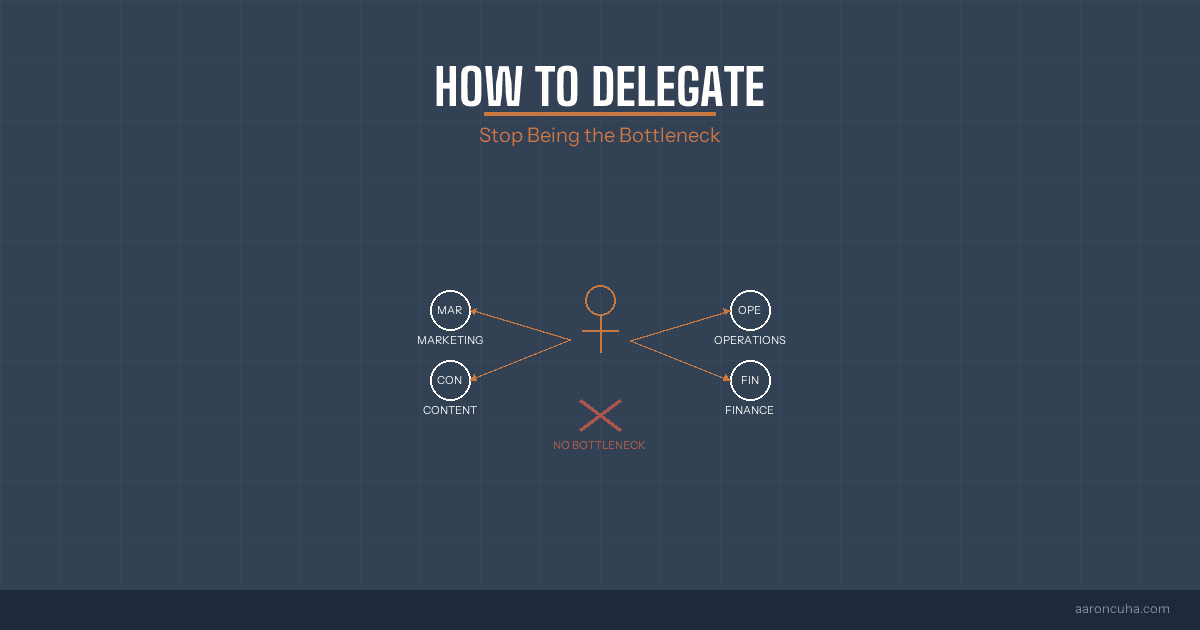
You are the biggest bottleneck in your business. Delegation is the skill that unlocks scale. Here is the framework.
Knowing how to delegate as an entrepreneur is the single most important skill for scaling a business beyond yourself. I learned this the hard way: when I built a 300-branch mortgage company, I tried to control everything. It nearly destroyed me. It was not until I mastered delegation that the business actually scaled. According to Harvard Business Review, CEOs who delegate effectively generate 33 percent more revenue than those who do not. And yet, most entrepreneurs resist delegation like it is a personal attack.
Here is the delegation framework I teach through our executive coaching service — the same framework that has helped hundreds of entrepreneurs reclaim their time and scale their businesses.
Why Entrepreneurs Struggle to Delegate
Before I give you the how-to, let me address the why-not. Entrepreneurs resist delegation for predictable reasons:
- "Nobody can do it as well as I can." Maybe true today. But if you never train someone, it will be true forever. And you will be stuck doing $20/hour tasks while your $500/hour work goes undone.
- "It takes longer to explain than to do it myself." Short-term, yes. Long-term, you are building a bottleneck. Every task you refuse to delegate is a task your business cannot do without you.
- "I cannot afford to hire help." You cannot afford not to. Calculate your hourly revenue rate. If you make $200/hour in revenue-generating activity, every hour you spend on a $25/hour task costs you $175 in opportunity cost.
- "I tried delegating and it went badly." Bad delegation is not a reason to stop delegating. It is a reason to learn how to delegate as an entrepreneur the right way.
The Delegation Matrix
Start by categorizing every task in your business using two dimensions:
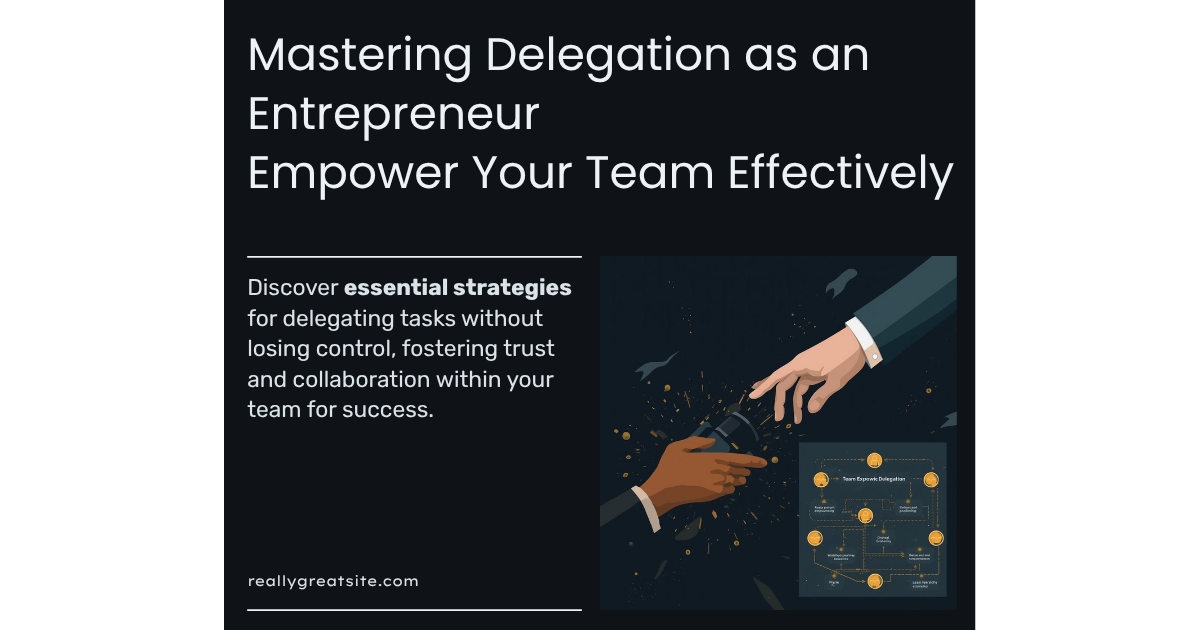
Skill level: Is this in your genius zone (you are the best person to do it) or your competence zone (you can do it, but someone else could too)?
Energy level: Does this task energize you or drain you?
This creates four quadrants:
- Genius + Energizing: KEEP. This is your highest-value work. Strategy sessions, key client relationships, creative direction, leadership.
- Genius + Draining: DELEGATE WITH TRAINING. You are uniquely skilled, but the work drains you. Train someone to handle 80 percent of these tasks, and you handle the remaining 20 percent.
- Competent + Energizing: DELEGATE CAREFULLY. You enjoy these tasks, but they are not your highest use. Delegate and find other ways to get the satisfaction.
- Competent + Draining: DELEGATE IMMEDIATELY. These are the tasks eating your life. Admin, bookkeeping, scheduling, data entry, repetitive content production. Get these off your plate this week.
I walk every coaching client through this matrix in their first session. Most entrepreneurs discover they spend 50 to 70 percent of their time in quadrants 3 and 4. That is why they feel busy but not productive.
The Five-Step Delegation Process
Once you know what to delegate, here is how to delegate as an entrepreneur effectively:
Step 1: Document the process. Before you hand anything off, create a simple SOP (Standard Operating Procedure). Record your screen doing the task. Write the steps. This does not need to be perfect — a rough video walkthrough is usually sufficient.
Step 2: Choose the right person. Match the task to the person's strengths. Not every task requires an expert — many tasks need a reliable person with good instructions.
Step 3: Teach, do not just assign. Walk through the task together once. Have them do it while you watch. Then let them do it solo with a review process.
Step 4: Set standards, not methods. Define what "done well" looks like, but do not dictate exactly how to do every step. Give people room to find their own approach — they might find a better one.
Step 5: Implement review cycles. Check results weekly at first, then biweekly, then monthly as trust builds. Reduce oversight gradually, never all at once.
What to Delegate First
If you are new to delegation, start with these tasks — they are low-risk, high-impact, and easy to systematize:
- Email management: Have an assistant triage your inbox, draft responses, and flag priorities. AI can help with this too — see my post on AI for entrepreneurs.
- Scheduling: Use a scheduling tool or assistant to handle all appointment booking.
- Content editing: Hire a video editor. Your time on camera is irreplaceable; your time editing is not.
- Social media posting: Create the content (or have AI draft it), then have someone else post and manage comments.
- Bookkeeping: This is almost never the best use of an entrepreneur's time. Outsource it immediately.
- Research: Whether it is market research, competitor analysis, or client prep, a VA can handle 80 percent of research tasks.
Each task you successfully delegate frees 3 to 5 hours per week. Delegate five tasks and you have reclaimed 15 to 25 hours — almost a full additional workweek for high-value activity.
Delegation to AI: The New Frontier
In 2026, delegation is not just about people. AI is the newest team member in your business. Many tasks that traditionally required a human assistant can now be handled by AI:
- Email drafting and triage
- Content repurposing (see The Authority Flywheel)
- Data analysis and reporting
- Lead scoring and follow-up sequences
- Social media content generation
AI delegation follows the same principles as human delegation: document the process, set clear standards, and review outputs. The difference is AI does not need motivation, does not take vacations, and works 24/7. Learn more about implementing AI delegation through our AI automation services.
The Delegation Mindset Shift
The hardest part of learning how to delegate as an entrepreneur is not the process — it is the mindset. You built your business by doing everything yourself. That identity as "the doer" feels core to who you are. Letting go feels like losing control.
But it is actually gaining leverage. And leverage is how you go from a $500K business that owns you to a $2M business that runs without you. As Forbes has noted, the most successful entrepreneurs are not the best workers — they are the best delegators.
The shift from operator to leader is the central work of entrepreneurial growth. It is exactly what I help clients navigate through executive coaching.
How to Delegate as an Entrepreneur: Start Today
Learning how to delegate as an entrepreneur is not optional if you want to scale. Start with the delegation matrix. Identify three tasks in quadrant 4 (competent + draining). Document them this week. Hire a VA or set up an AI tool next week. Free those hours for genius-zone work.
If delegation is the bottleneck in your business, that is exactly what our executive coaching is designed to fix. Book a strategy session and I will identify the three tasks you should delegate this month. Or join the Systems Over Hustle community for delegation frameworks and accountability.
Frequently Asked Questions
How do I find reliable people to delegate to?
Start with freelance platforms for specific tasks (editing, design, bookkeeping). For ongoing support, hire a virtual assistant through a reputable VA service. Always start with a small project to test reliability before committing to ongoing work.
What if the person I delegate to does not meet my standards?
Define standards clearly upfront. If they consistently miss the mark after clear instruction and feedback, it is a hiring issue, not a delegation issue. Replace the person, not the practice.
How much should I pay for a virtual assistant?
US-based VAs typically cost $25 to $50 per hour. International VAs cost $8 to $20 per hour. The right choice depends on the complexity of tasks and whether time zone overlap matters for your workflow.
Can I delegate too much?
Yes. Never delegate your genius-zone work, key client relationships, or strategic decision-making. These are the activities that make your business uniquely yours. Delegate everything else.
How long does it take for delegation to feel comfortable?
Most entrepreneurs feel uncomfortable for the first 2 to 4 weeks. After 90 days of consistent delegation, most cannot imagine going back. The time freedom becomes addictive in the best way.

Written by
Aaron CuhaAuthor of Crazy Simple YouTube, keynote speaker, and executive coach with 20,000+ hours logged. ICF PCC, NLP Master Practitioner, and DISC Certified. Aaron helps entrepreneurs replace hustle with AI-powered systems that generate leads, content, and revenue on autopilot.