Entrepreneur loneliness is not a mood problem. It is a structural problem. The higher you climb, the fewer people you can be honest with, and most owners try to get every kind of support from one person. Here is the four-relationship architecture that fixes it.
The higher you climb, the fewer people you can be honest with. That is entrepreneur loneliness, and it is not weakness. It is math. Here are the four relationships that fix it.
Key Takeaways
- Entrepreneur loneliness is structural, not emotional. Growth adds people and subtracts honesty.
- You need four separate relationships: peer, coach, confidant, and friend.
- Most owners try to get all four from one person, usually a spouse.
- The full circle costs about three hours a month once it is built.
- Build the circle before a crisis, not during one.
If you want a structured place to start, the Systems Over Hustle community exists so owners have peers who run something similar and will tell the truth about it. Come see how the conversations actually work.
Why Entrepreneur Loneliness Gets Worse As You Grow
Isolation grows because every relationship inside your business has a stake in your answers. So you start editing yourself. More people, less honesty.
Think about who you talk to on a normal Tuesday. Your team. Your partner in the business. Your top producer. Your lender. Your assistant.
Every one of them needs something from your mood. If you sound scared, they update their resume. If you sound uncertain, they hedge. So you manage your face all day.
That is not dishonesty. That is leadership. But it has a cost, and the cost compounds.
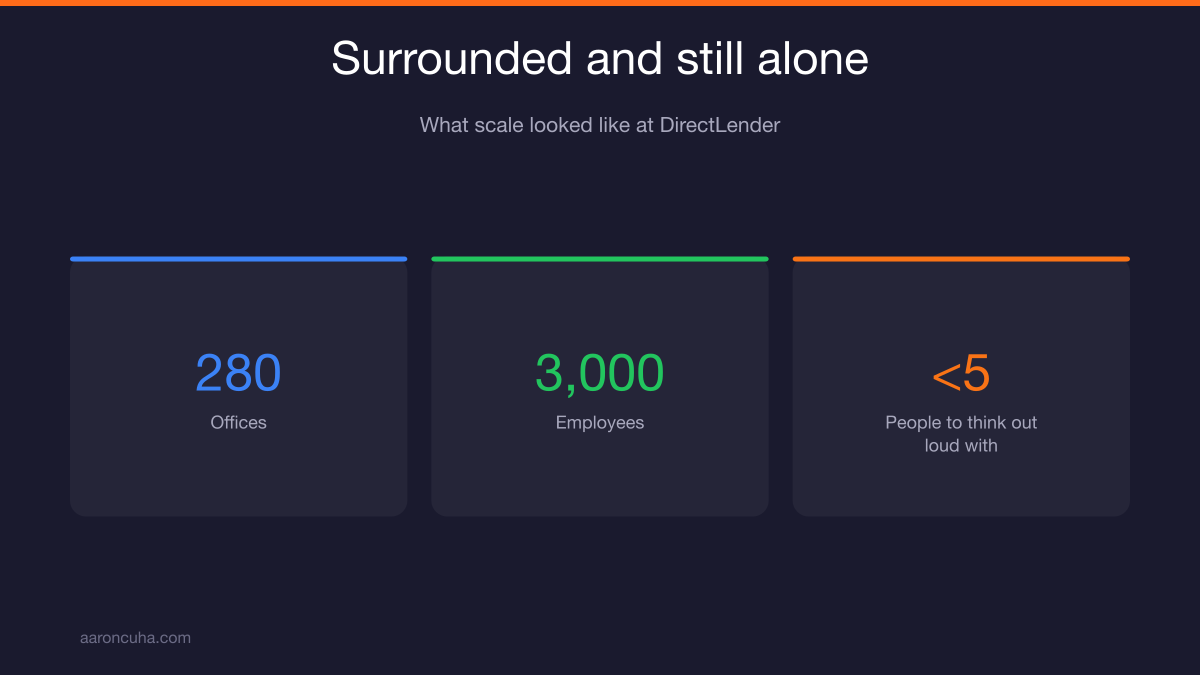
I ran DirectLender with 280 offices and 3,000 employees. On paper I was surrounded. In practice there were fewer than a handful of people I could say a hard sentence to without moving the market inside my own company.
When 2008 came, I had a lot of people to inform and almost nobody to think out loud with. That gap is the thing nobody warns you about.
The One-Person Mistake Almost Every Owner Makes
Most owners try to get peer support, coaching, emotional safety, and friendship from one person. Usually a spouse. That job does not exist, and asking one person to do it damages the relationship.
Here is what it sounds like. You come home at nine. You have been holding it together for eleven hours. You dump cash flow, a personnel problem, a lawsuit threat, and your own doubt on the person who loves you most.
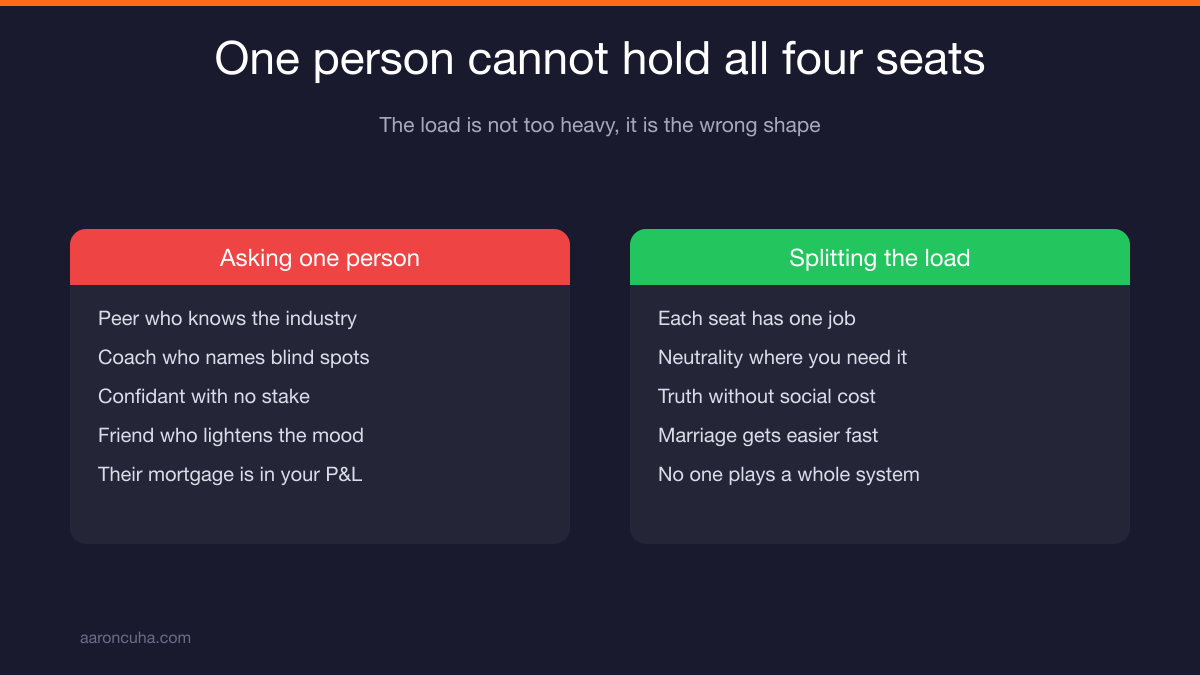
Then you ask them to respond as a peer who understands your industry, a coach who calls out your blind spot, a confidant with no fear of the outcome, and a friend who lightens the mood.
The load is not too heavy. It is the wrong shape.
Your spouse cannot be neutral. Your outcome is their outcome. Their mortgage is in your P&L. So when you say "I might have to let six people go," they hear something about their own life, and they should.
That does not make them a bad listener. It makes them the wrong seat for that specific conversation.
When you split the load across four people, your marriage gets easier almost immediately. You stop asking one person to be a whole system.
What Isolation Actually Costs You
Isolation does not show up as sadness. It shows up as bad decisions made in a vacuum, hard conversations you delay for months, and a body that finally sends the bill.
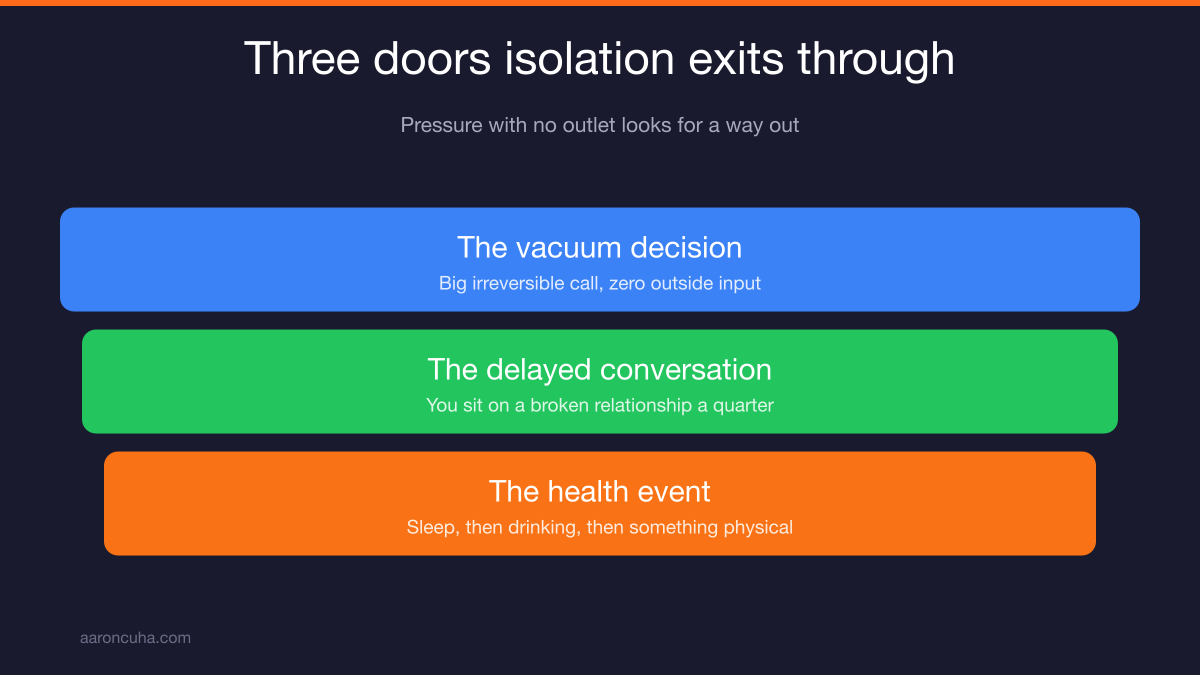
Pressure with no outlet does not disappear. It looks for an exit. In owners I coach, it usually exits through one of three doors.
- The vacuum decision. You make a large, irreversible call with zero outside input because you were tired of carrying the question alone.
- The delayed conversation. You know a partner, a hire, or a client relationship is broken. You sit on it for a quarter because saying it out loud makes it real.
- The health event. Sleep goes first. Then the drinking creeps. Then something physical that gets your attention in a hurry.
Social connection is not a soft topic. The CDC treats loneliness and social isolation as public health issues with real physical consequences, and the long running Harvard Study of Adult Development has spent decades pointing at relationship quality as a primary driver of long term health.
You already know this about your team. You would never let a key employee work alone with no feedback for three years and expect good output.
You are doing it to yourself.
The 4 Relationships Framework
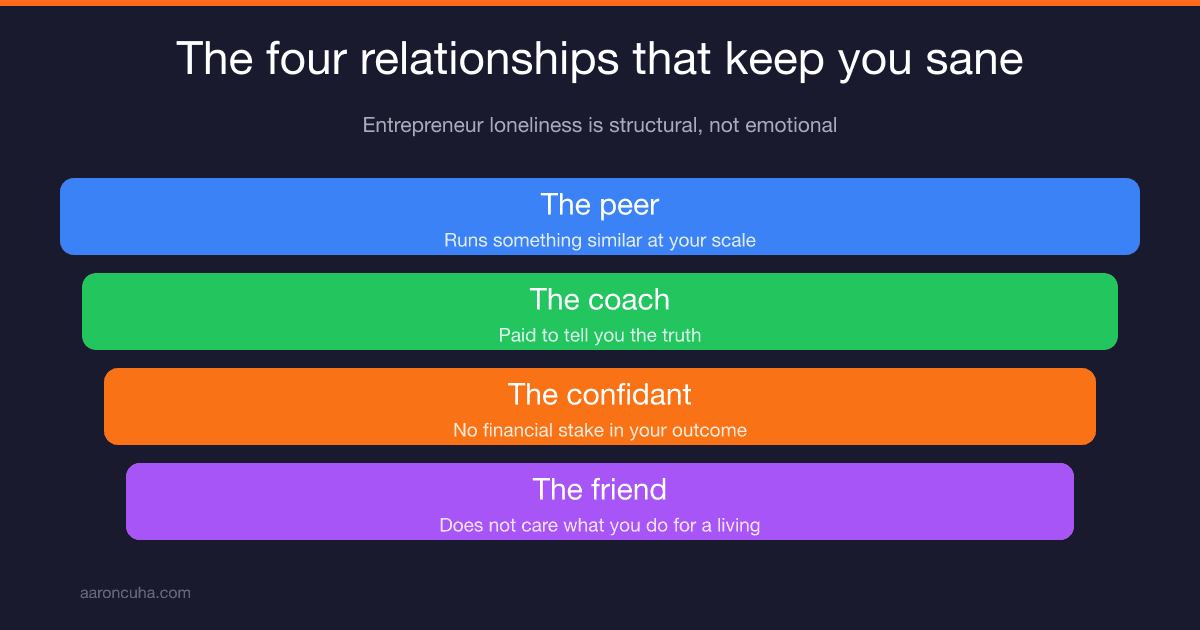
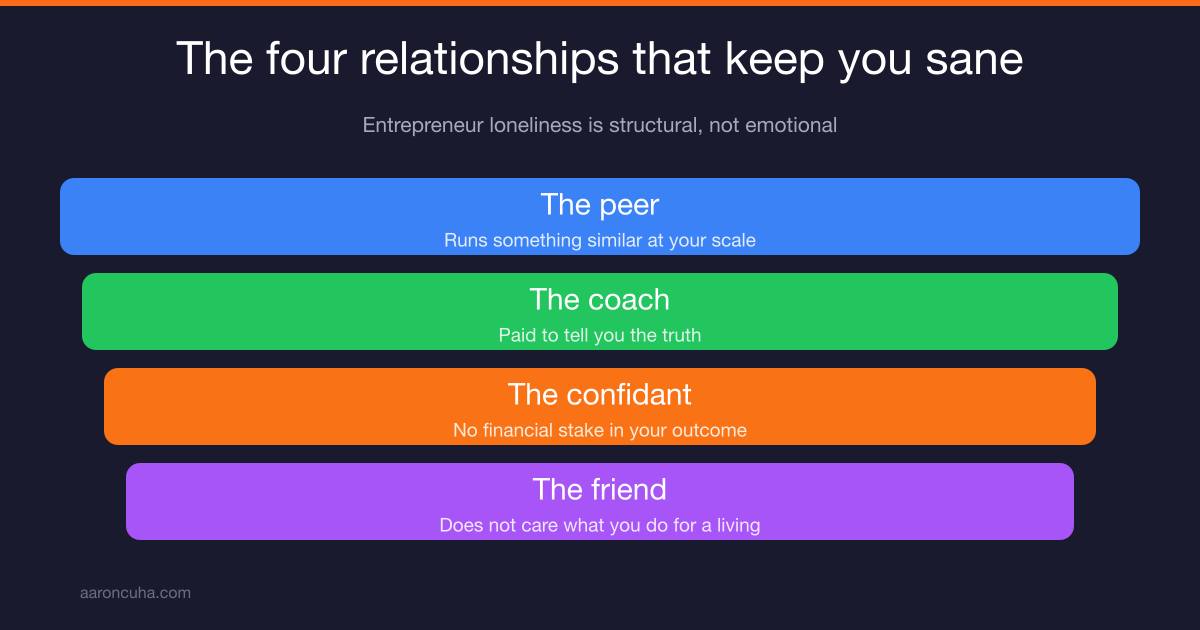
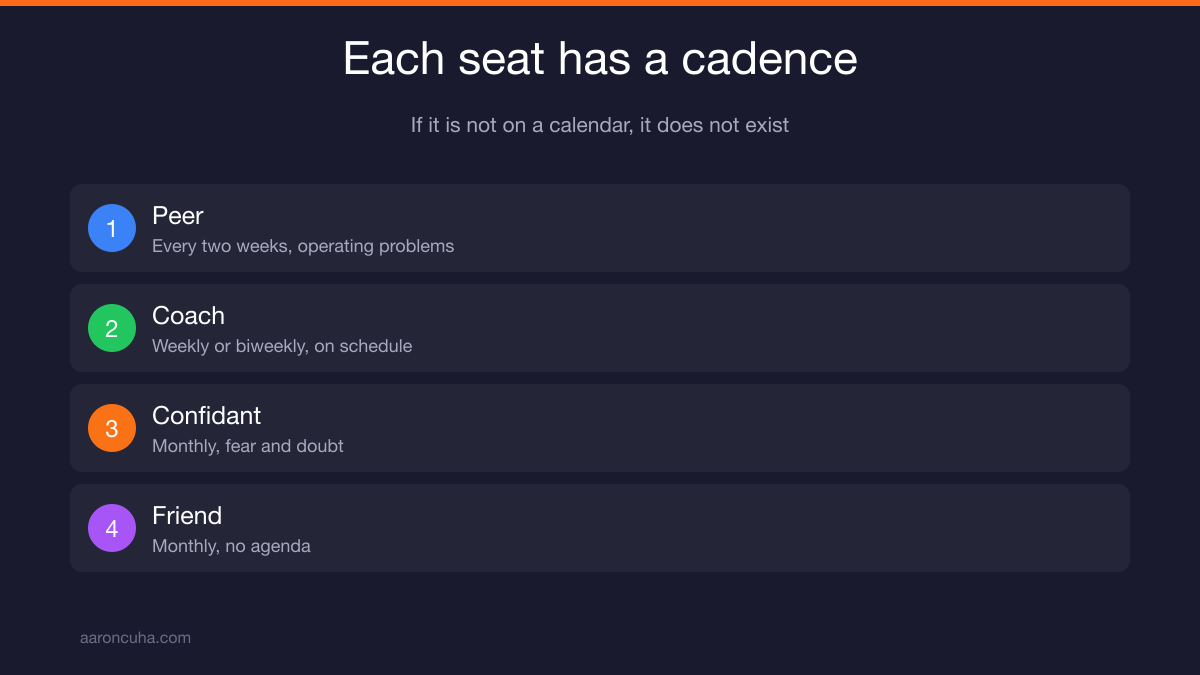
You need four distinct people: a peer who runs something similar, a coach paid to tell you the truth, a confidant with no financial stake, and a friend who does not care what you do for a living.
Each one holds a different weight. Mix them up and you get bad advice, hurt feelings, or both.
| Relationship | What you bring them | What you never bring them | Cadence |
|---|---|---|---|
| The Peer | Operating problems, pricing, hiring, market shifts | Deep personal shame, marriage issues | Every two weeks |
| The Coach | Strategy, blind spots, patterns you keep repeating | Requests for reassurance instead of truth | Weekly or biweekly, on schedule |
| The Confidant | Fear, doubt, the thing you cannot say at work | Tactical business advice requests | Monthly |
| The Friend | Nothing. You bring yourself. | Your business at all, ideally | Monthly, no agenda |
Notice the fourth column. This is a system, not a vibe. If it is not on a calendar, it does not exist.
I built my whole coaching practice on the idea that systems beat hustle. Your support circle is no different. Willpower will not keep you connected. Structure will.
Relationship One: The Peer Who Runs Something Similar
A peer is someone at roughly your scale and stage who carries the same weight you do. Their job is to normalize the problem and shorten your learning curve.
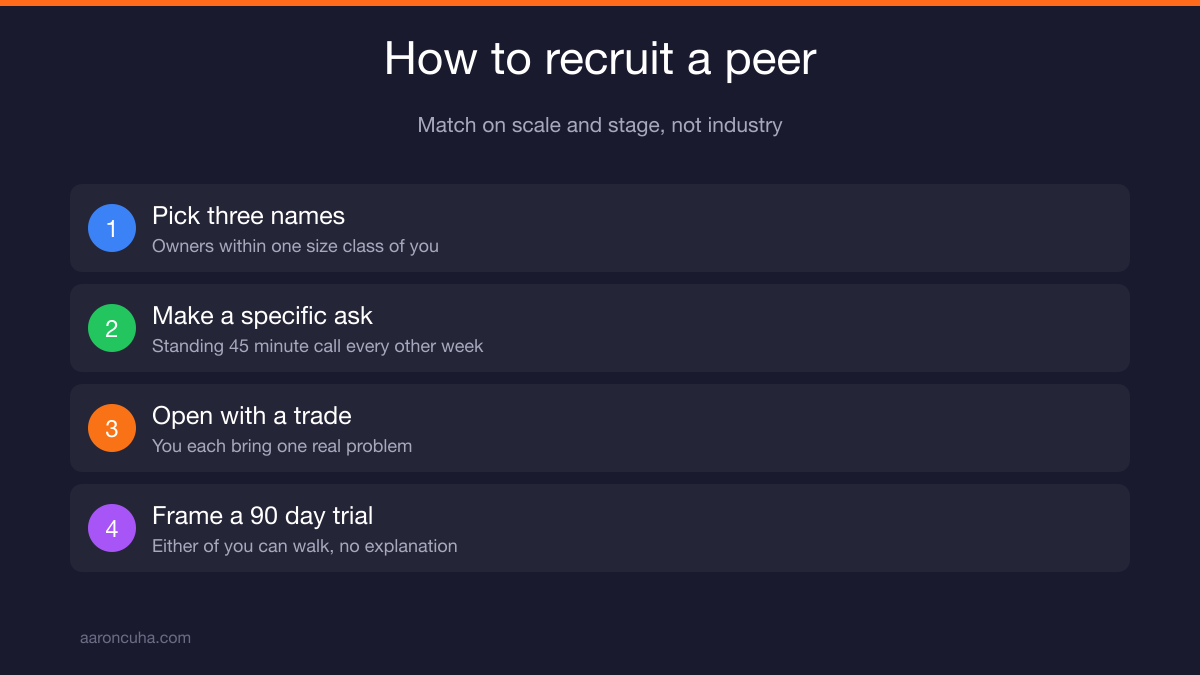
Match on scale and stage, not industry. An owner with 40 employees understands your payroll anxiety better than someone in your exact niche with two contractors.
Here is how to recruit one without it being awkward.
- Pick three names of owners you respect who are within one size class of you.
- Make a specific ask. Not "let's grab coffee sometime." Say: "I want a standing 45 minute call every other week where we each bring one real problem."
- Open with a trade. You bring one problem. They bring one problem. No pitching, no networking, no favors.
- Frame it as a 90-day trial. Either of you can walk at the end with no explanation. That lowers the stakes enough for a yes.
The trade rule is what makes it work. If you only take, it dies. If you only give, it becomes a coaching relationship you are not being paid for.
Peer calls fix a specific kind of crazy. You discover the thing you thought was your personal failure is just what the job looks like at your size.
What you do not bring a peer: your marriage, your worst shame, or anything you would not want repeated. Peers talk. That is fine. Just know the boundary.
Relationship Two: The Coach Paid to Tell You the Truth
A coach is the only person in your life financially incentivized to tell you what you do not want to hear. Payment removes the social cost of candor. That changes the quality of the conversation.
Your team cannot do this. Their livelihood depends on you liking them. Your friends will not do it because they want to stay your friends.
I have logged more than 20,000 hours of one-on-one coaching. The pattern I see most is not a strategy gap. It is a mirror gap. Owners cannot see the one behavior that is capping the whole business.
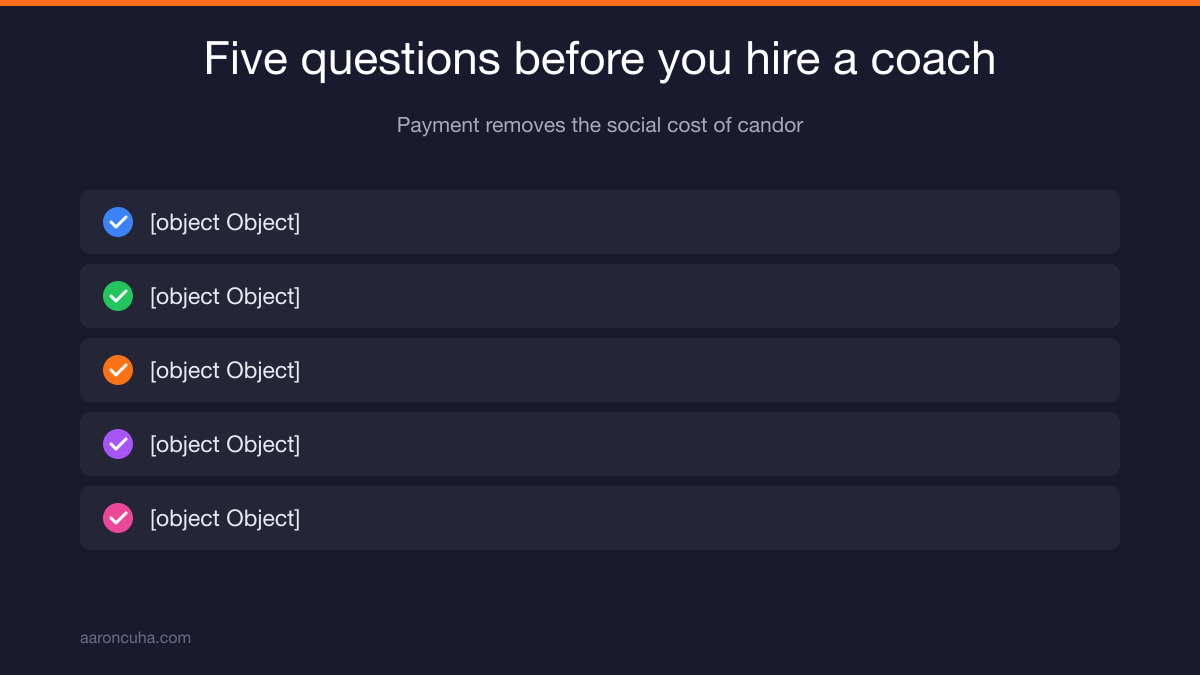
Ask these before you hire anyone:
- "Tell me about a client you fired and why." A cheerleader has never fired anyone.
- "What will you tell me that my team will not?" Listen for specifics, not slogans.
- "What does your process look like between sessions?" No accountability structure means no change.
- "Have you run something at my scale or larger?" Theory is cheap. Scar tissue is not.
- "What happens if I stop doing the work?" The right answer involves consequences, not encouragement.
Bring a coach your patterns, not just your problems. A peer helps with this week. A coach helps with the thing you keep doing every quarter that creates this week.
If you are weighing formats, read the breakdown on executive coaching versus group coaching before you commit budget.
If you want a straight, no-pitch conversation about where you are stuck right now, book a one-on-one executive coaching consultation and bring your hardest problem. That is the entire agenda.
Relationship Three: The Confidant With No Financial Stake
A confidant is someone who neither benefits nor suffers from your outcome. That neutrality is the whole point. You can say the ugly sentence and nothing in their life moves.
This is the seat most owners have completely empty.
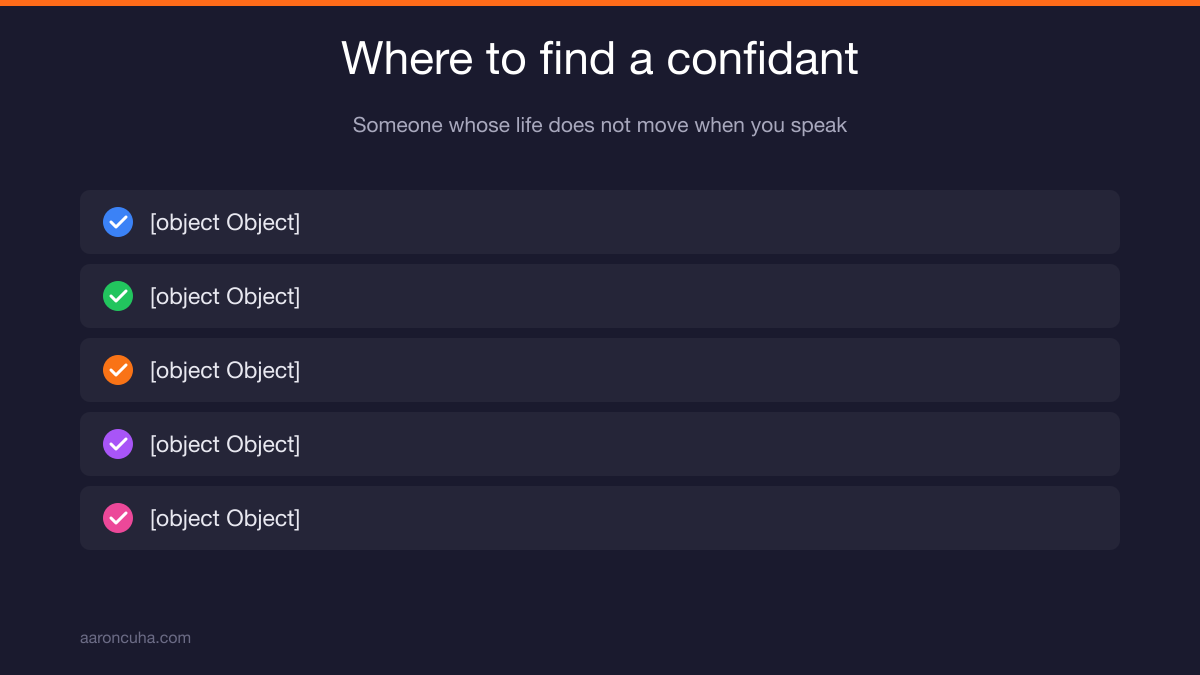
Where to find one:
- Someone from an earlier chapter of your life. College, first job, your hometown.
- Someone in a completely different industry who cannot use anything you say.
- A therapist or a faith leader. Both are trained for this and bound by confidence.
- A retired operator who is fully out of the game and has nothing to sell you.
The confidant conversation sounds different from the others. It is not "what should I do." It is "here is what I am actually feeling and I need to say it to a human."
You are not asking for a solution. You are asking to be witnessed.
That distinction matters. If you bring a confidant a tactical question, they will try to answer it badly and you will both leave disappointed. Tell them the role up front: "I do not need advice. I need to say some things out loud to someone who is not in it."
Most people are honored to be asked. Almost nobody gets invited into that seat, and it is one of the more meaningful things you can offer another person.
Relationship Four: The Friend Who Does Not Care What You Do
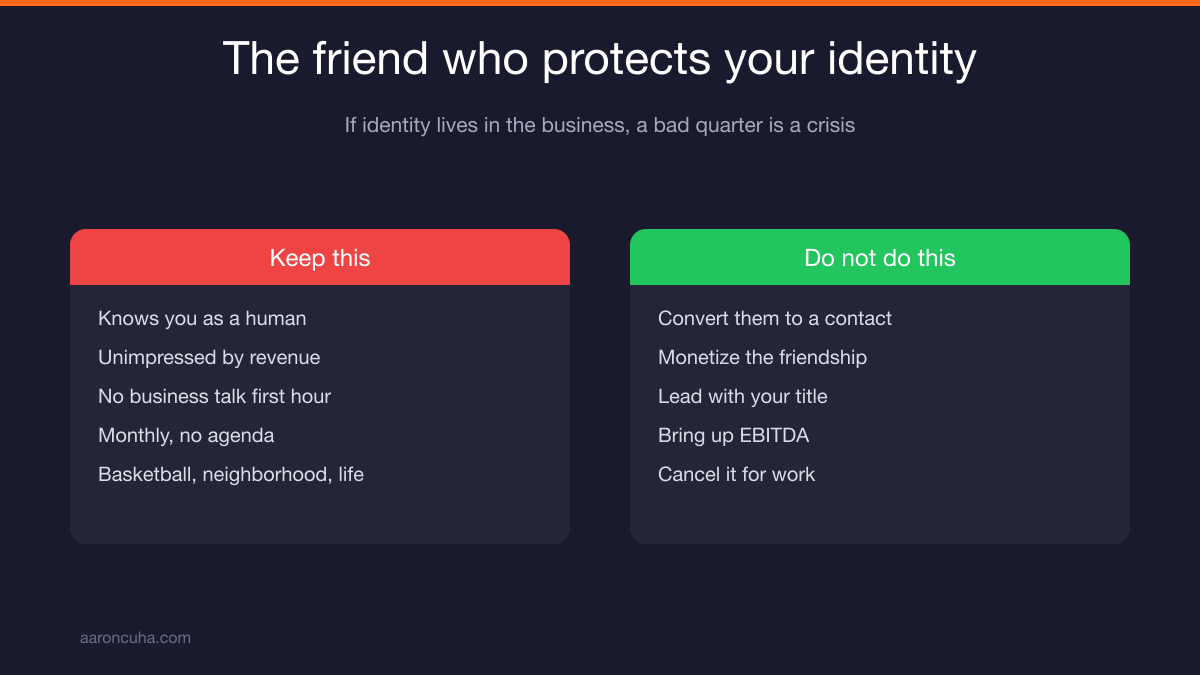
You need one person who knows you as a human, not a title. Someone unimpressed by your revenue and uninterested in your strategy. This relationship protects your identity when the business shakes.
After I lost DirectLender in 2008, I spent a decade doing humanitarian work in Nepal. Out there, nobody knew what a mortgage bank was. Nobody cared how many offices I used to run.
My title had zero purchasing power. What mattered was whether I showed up, whether I could carry something heavy, whether I was decent to be around.
That decade taught me the thing I now teach every owner: if your identity lives inside your business, a bad quarter becomes an existential crisis.
You need at least one relationship where the business is not the price of admission. Someone you play basketball with. Someone from your neighborhood. Someone who would think it was strange if you brought up EBITDA.
Protect this one. The temptation is to convert every relationship into a business asset. Do not do that here. The moment you monetize this friendship, you lose the only place where you get to just be a person.
One rule works: no business talk for the first hour. Usually the whole thing passes and you never bring it up. That is the win.
The Weekly and Monthly Rhythm That Keeps the Circle Real
The circle only works on a calendar. Peer every two weeks, coach on your paid schedule, confidant monthly, friend monthly with no agenda. That is roughly three hours a month.
Three hours. Less time than you lose to one badly run meeting.
Here are the calendar rules that keep it from collapsing.
- Recurring, not scheduled each time. If someone has to propose a time, it dies within two months.
- Same slot, same day. Friction kills consistency faster than lack of interest does.
- Never move it for work. You can move it for family. Work does not qualify.
- Reschedule immediately if you must cancel. Before you hang up. Not "I will text you."
Now the part most people get wrong. When the season gets brutal, you increase the cadence. You do not cut it.
Every instinct will tell you the opposite. Crisis makes you want to disappear into the work and handle it alone. That instinct is the exact thing that turns a hard quarter into a permanent mistake.
In a brutal season, move the peer call to weekly and the confidant to every two weeks. Keep the friend exactly as is, because that is the one keeping you human.
This is the same principle behind building content systems that survive busy weeks. Systems exist precisely for the weeks when motivation is gone.
What to Say When You Have Nothing Good to Report
Open with the truth in one sentence and stop talking. The first honest sentence is the hardest thing you will say this month and the cheapest thing you will ever do for yourself.
Shame is what actually keeps owners quiet. Not schedule. Not personality. Shame.
You skip the call because you promised progress and there is none. So you go dark exactly when you need the call most.
Use one of these three openers. Say it, then be quiet.
- "I have nothing good to report and I almost cancelled this call."
- "I need to say something out loud and I do not want you to fix it."
- "I have been avoiding you for three weeks. Here is why."
Every one of those works because it names the avoidance instead of performing around it. The other person relaxes instantly, because now they know what kind of conversation this is.
Nobody has ever lost respect for an owner who said a hard thing plainly. They lose respect for the owner who disappears and reappears with a story.
You already know how to do this. You do it with clients when a deal goes sideways. Point that same skill at your own life.
Warning Signs You Are Too Isolated
Four signals show up before a breakdown: withdrawal, unilateral decisions, physical symptoms, and exit fantasies. If two or more are present, make contact the same day.
Check yourself against these honestly.
- Withdrawal. You are cancelling plans, screening calls, and telling yourself you are just busy. You have been "just busy" for two months.
- Unilateral decisions. You made a large call recently and told nobody until it was done. That is not decisiveness. That is hiding.
- Physical symptoms. Sleep is broken. Jaw is tight. Drinking has crept up. Something hurts that did not hurt last year.
- Exit fantasies. You daydream about the business burning down, or about driving away and not coming back.
Two or more means you act today, not next week. Send one text to one person on your list. That is the whole assignment.
If the exit fantasies involve harming yourself, stop reading and reach out now. In the US you can call or text 988 to reach the 988 Suicide and Crisis Lifeline, and NAMI maintains a helpline and local resources. There is no version of this where the business matters more than you do.
I have watched capable, successful people go quiet and then make one irreversible choice. Every time, someone would have picked up the phone.
Your 90-Day Plan to Build the Circle
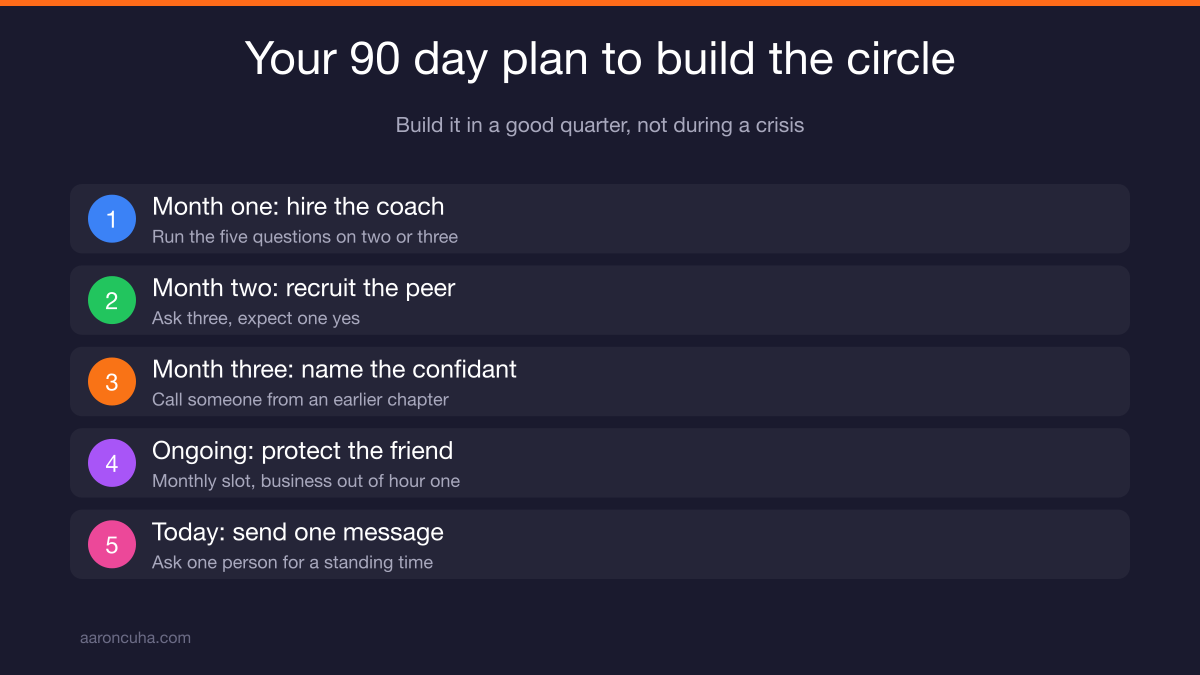
Build in order: coach in month one, peer in month two, confidant in month three, friend continuously. Coach first because a paid relationship starts fastest and holds you accountable to building the rest.
Month one: hire the coach. Run the five questions from earlier on two or three candidates. Pick one. Put the sessions on a recurring calendar block that you never move for work.
Month two: recruit the peer. List three owners near your scale. Send the specific ask with the 90-day trial framing. Expect one yes out of three, which is why you send three.
Month three: name the confidant. Think back to an earlier chapter of your life. Call that person. Tell them exactly what you are asking for and what you are not asking for.
Ongoing: protect the friend. This one you probably already have and have been neglecting. Put a monthly slot on the calendar and keep the business out of the first hour.
Here is your action for today. Open your phone. Send one message to one person in one of these four seats. Ask for a standing time. That is it.
The strongest operators I know did not build their circle during a crisis. They built it in a good quarter, when it felt unnecessary, which is exactly why it held when the market turned.
I built mine too late the first time. I do not recommend that path.
If you want the accountability seat filled properly and a structure that keeps the other three honest, start with executive coaching built for owners who carry the whole thing, or reach out through the contact page and tell me which of the four seats is empty. That one sentence is usually where the real work starts.
Frequently Asked Questions

Written by
Aaron CuhaAuthor of Crazy Simple YouTube, keynote speaker, and executive coach with 20,000+ hours logged. ICF PCC, NLP Master Practitioner, and DISC Certified. Aaron helps entrepreneurs replace hustle with AI-powered systems that generate leads, content, and revenue on autopilot.