Deep work for entrepreneurs is not about discipline or a better app. It is about building a system that protects two hours a day for the work that compounds. Here is the Growth Block framework I teach owners who feel busy but stuck.
Your calendar is full. Your company is flat. That is not a coincidence. The work that grows a business almost never shows up as an urgent notification, so it never gets done.
Key Takeaways
- Protect two hours a day for work that still pays you in six months.
- Use the Growth Block Framework: name, fix, strip, exit, log.
- Design your environment instead of relying on willpower to focus.
- Measure blocks completed and assets shipped, nothing else.
- Publish your availability so other people stop setting your schedule.
If you want help building the system that frees those two hours, start with a 90 minute strategy session and leave with a calendar you can actually defend.
What Deep Work for Entrepreneurs Actually Means
Deep work for entrepreneurs is uninterrupted time spent building assets that keep producing after you stop working. Not email. Not meetings. Not fires. Work that compounds.
Most owners already know the phrase. The term comes from Cal Newport, and the idea is simple. Cognitively demanding work done without distraction produces results that shallow work never will.
The problem is that owners apply it to the wrong tasks. They protect two hours and then spend them cleaning an inbox with great focus.
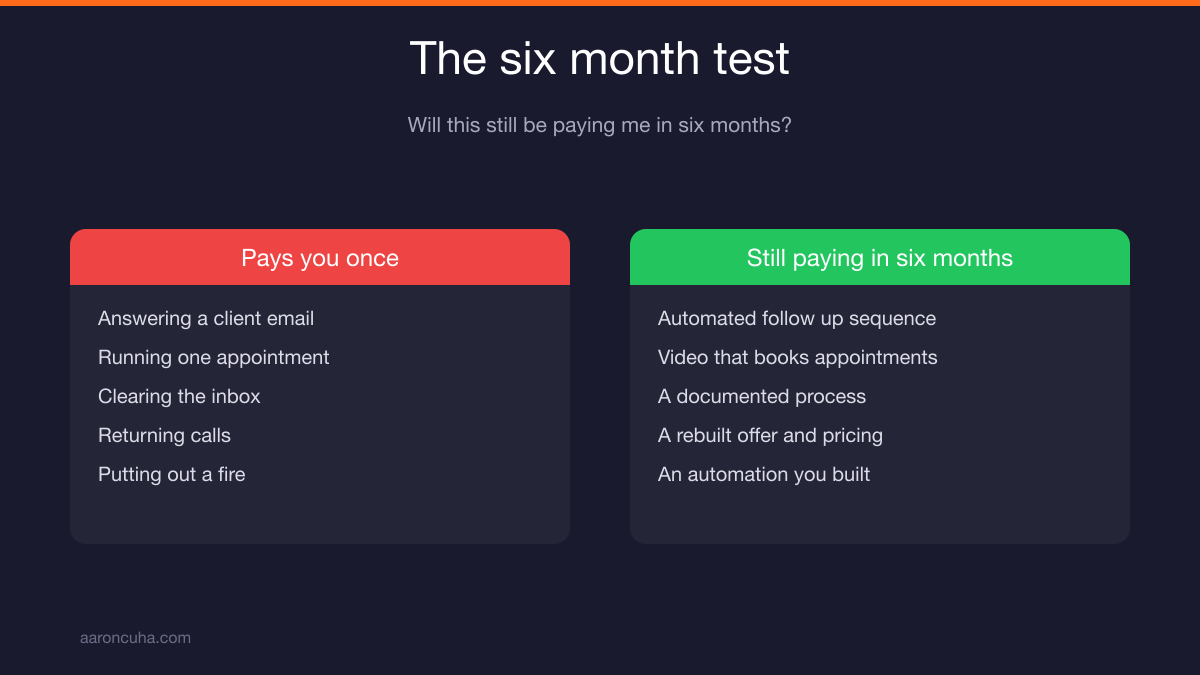
Here is the filter I use with clients. I call it the six month test. Ask one question about any task: will this still be paying me in six months?
- Answering a client email: no. It pays you once.
- Writing the follow up sequence that answers that email automatically for the next two years: yes.
- Running one listing appointment: no.
- Recording the video that books listing appointments while you sleep: yes.
Both types of work matter. Only one type builds a company. Motion is not progress. An owner can run at full speed for a decade and end up with the same revenue and a worse back.
Why Busy Owners Stay Stuck
Busy owners stay stuck because reactive work feels productive and pays out immediately. Growth work pays out later, so the brain keeps postponing it. Repeat that loop for a year and nothing has been built.
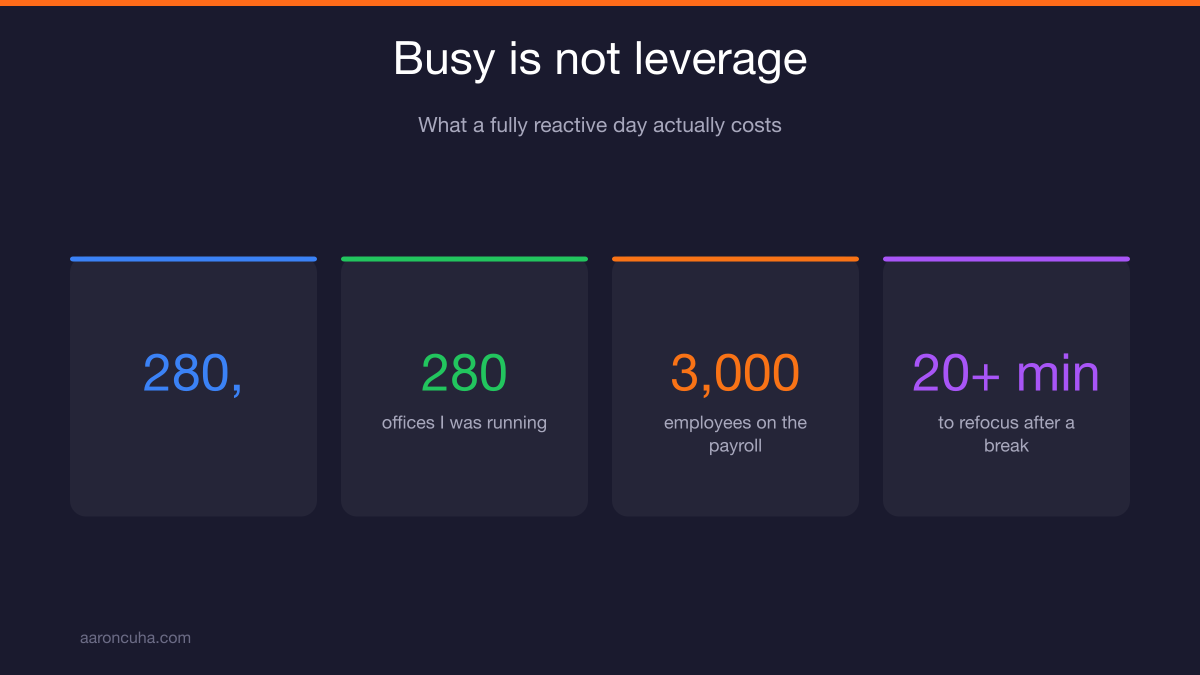
I lived this at scale. At DirectLender I had 280 offices and 3,000 employees. My day was a queue. Someone always needed a decision, an approval, a call returned.
I was busy every hour I was awake. I mistook that volume of activity for leverage. It was not. Leverage is what keeps working when you leave the room.
When 2008 hit, I found out exactly how much of that company depended on me being personally available. The answer was too much.
There is also a mechanical cost to the reactive day. Every time you switch tasks, part of your attention stays behind on the last one. The American Psychological Association has written for years about the cost of task switching. You do not get a clean start. You get a fogged one.
So an owner with eight hours of fragmented time does not have eight hours. Interruption research out of UC Irvine put the time it takes to return to an interrupted task at more than twenty minutes. He has forty short bursts and no finished work.
The Two Hour Rule: Why 2 Beats 8
Two protected hours beat eight scattered ones because focus has a ceiling. You cannot maintain hard cognitive work all day. You can maintain it for a short, defended window almost every day.
Owners resist this because two hours sounds small. That is exactly why it works. A two hour block is defensible. An eight hour block is a fantasy.
Try to protect a full morning and the first emergency kills it. Protect ninety minutes to two hours and you can move it, shrink it, or start it earlier without losing the day.
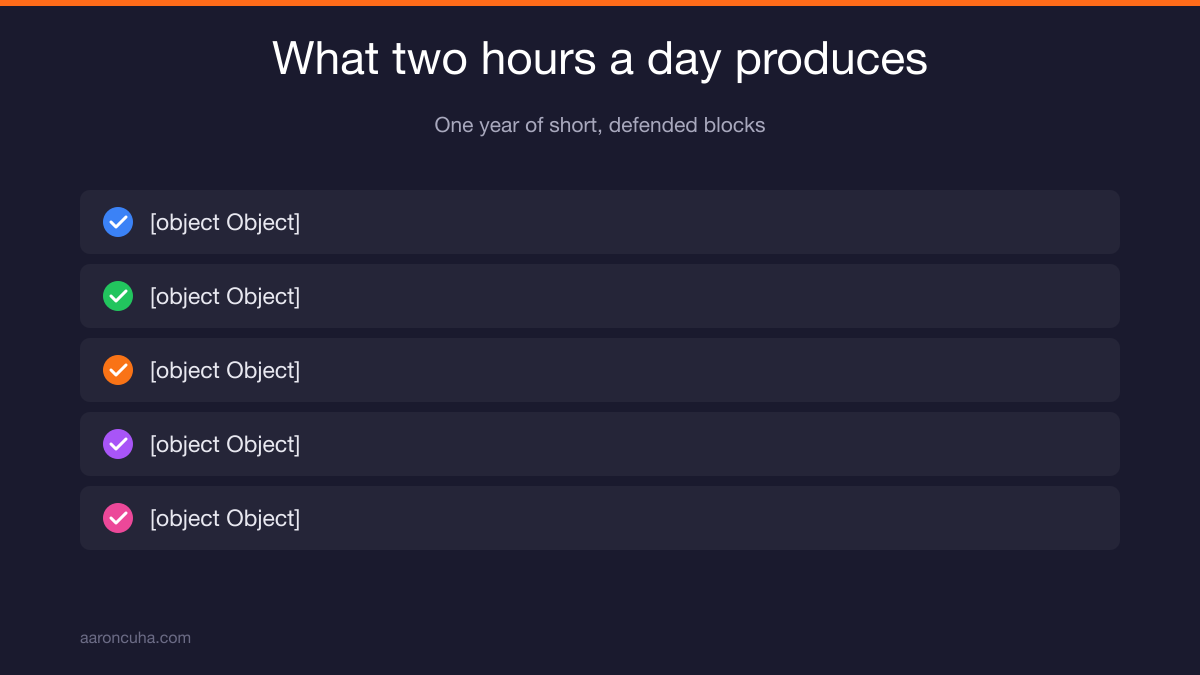
Think about what two hours a day actually produces over a year:
- One recorded video a week, plus the assets it becomes
- One documented process a week for the team
- One offer, rebuilt and tested every quarter
- One book manuscript, written in pieces nobody saw coming
I wrote five business books that way. Not in retreats. In blocks.
The second reason two hours wins is honesty. Most owners are not fighting for eight hours of creative time. They are fighting for any. Start where you can win.
The Growth Block Framework: 5 Steps
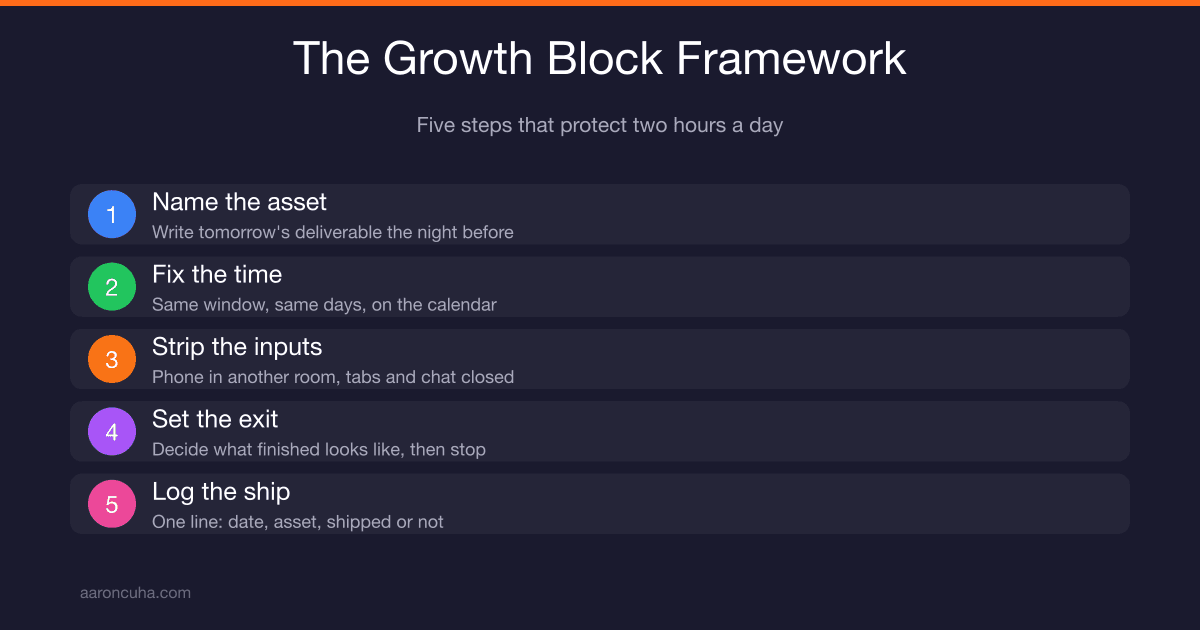
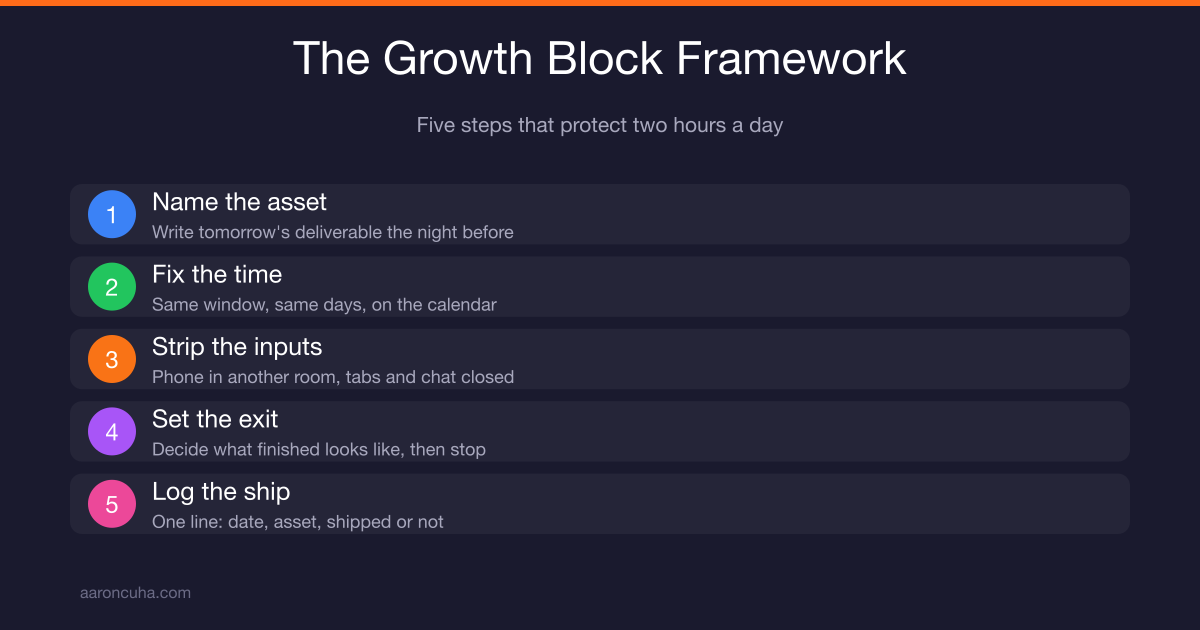
The Growth Block Framework turns deep work from an intention into a system. Five steps: name the asset, fix the time, strip the inputs, set the exit, log the ship. Run all five or the block dissolves.
1. Name the asset
Never enter the block with a topic. Enter with a deliverable. "Work on marketing" fails. "Script the buyer objection video" works.
Write the asset name the night before, on paper, where you will see it. You should be able to open your laptop and start typing within sixty seconds.
2. Fix the time
Same window, same days. Your brain stops negotiating once the time is not a decision. Most owners find the block before the world wakes up, which is why I built a morning routine that protects the first hours instead of surrendering them.
Put it in the calendar as a recurring appointment with a real title. Not "focus." Call it what it is: Growth Block.
3. Strip the inputs
Phone in another room. Not face down. Another room. Close email, close chat, close every tab you are not using.
You are not testing your discipline. You are removing the need for it.
4. Set the exit
Decide in advance what finished looks like. A draft, a recorded take, a documented process, a written sequence. When you hit it, you stop.
A block without an exit turns into scrolling with good intentions.
5. Log the ship
Write one line at the end: date, asset, shipped or not shipped. That log becomes the only productivity metric you need.
How to Choose What Goes in the Block
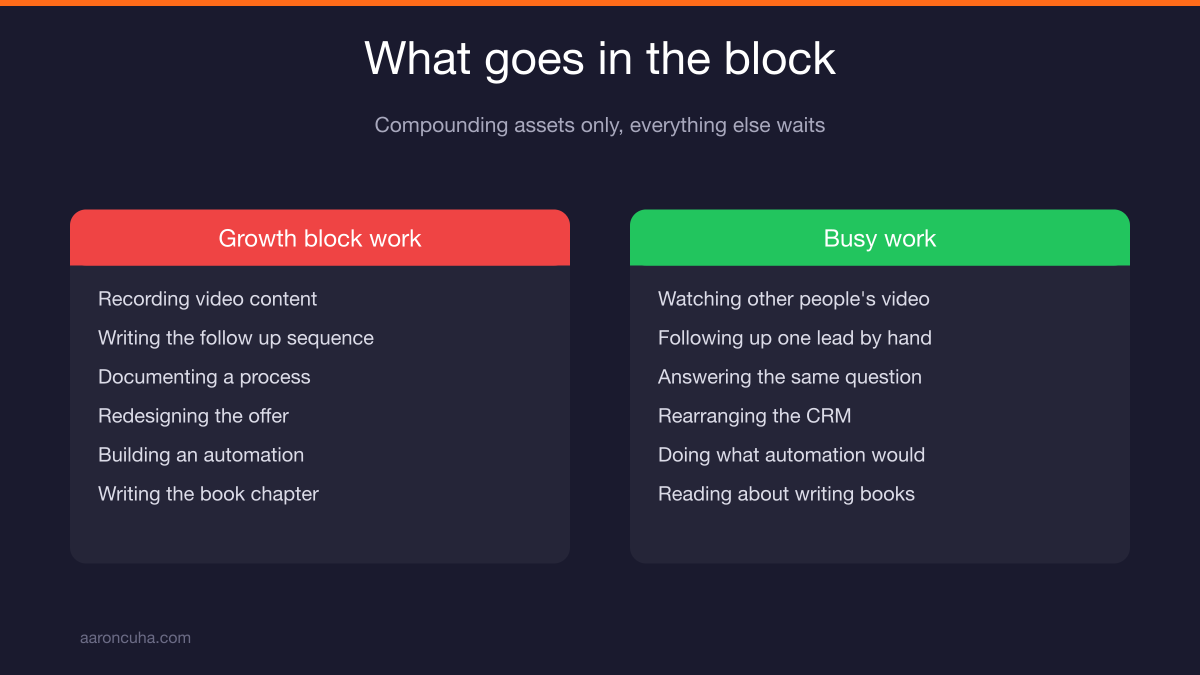
Put only compounding assets in the block. If the work produces something that can be reused, sold, taught, automated, or found later by a stranger, it qualifies. Everything else goes in the afternoon.
Owners get this wrong because urgent work is loud and compounding work is quiet. Nobody emails you asking when the SOP will be done.
| Growth Block Work | Busy Work |
|---|---|
| Recording video content | Watching other people's video content |
| Writing the follow up sequence | Manually following up one lead |
| Documenting a process for the team | Answering the same question again |
| Redesigning the offer and pricing | Rearranging the CRM |
| Building an automation | Doing the task the automation would do |
| Writing the book chapter | Reading about writing books |
If you are unsure what to build first, build the thing that answers a question you get every week. That is almost always a piece of content or a process document.
For most owners I coach, the highest leverage first asset is video, because one recording becomes thirty other assets without another hour of your time.
How to Protect the Block From Other People
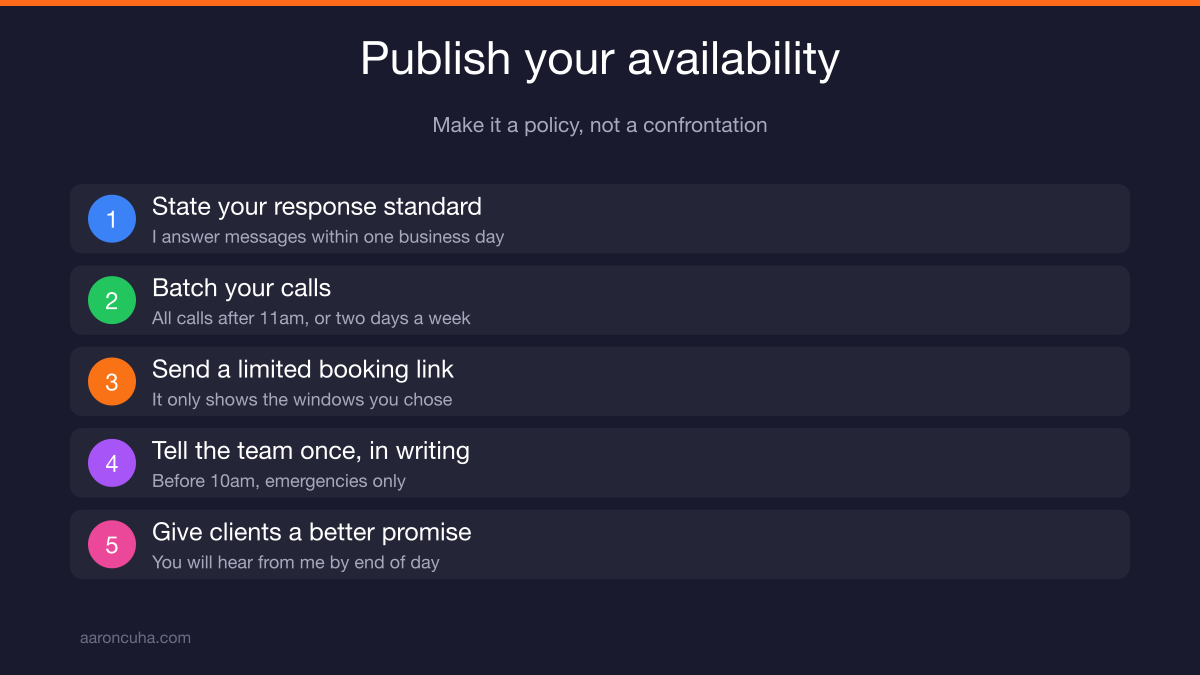
Do not defend your calendar. Publish it. When people know exactly when you are reachable, they stop testing when you are not.
Defending is exhausting because it makes every request a confrontation. Publishing makes it a policy. Nobody argues with a policy.
Here is what publishing looks like in practice:
- State your response standard. "I answer messages within one business day." Then hit it, every time.
- Batch your calls. All calls after 11am, or all calls on two days a week. Send a scheduling link that only shows those windows.
- Tell your team the rule once, in writing. "Before 10am, only call me if we are losing money or someone is hurt."
- Give clients a better promise. "I do not take calls in the morning because that is when I build the tools you use. You will hear from me by end of day."
That last line matters. Clients do not resent unavailability. They resent uncertainty. Trade one for the other.
Your team needs the same clarity. Most interruptions happen because people do not know what they are allowed to decide without you. Fix that and half the interruptions vanish. That is the same reason I teach owners how to stop being the bottleneck before they try to protect time.
Why Willpower Is the Wrong Tool
Willpower fails at exactly the moment you need it. Design does not. If your block depends on you feeling motivated at 6am, you have built a system that works on your best days only.
This is the argument at the center of my next book, The Willpower Lie. We were taught that discipline is a character trait. It is closer to an environment.
Every focused person I know is not more willful than you. They have removed more decisions.
Run this environment checklist before your first block:
- Task chosen and written the night before
- Phone charging in a different room
- Notifications off on the computer, not just quieted
- Browser open only to the tools you need
- Water and coffee already on the desk
- Door closed, or headphones on if you work in shared space
Six small setup decisions remove roughly forty in-the-moment ones. That is the whole trick.
This is also the core of Systems Over Hustle. Hustle asks you to be strong every day. Systems ask you to be smart once.
If your block keeps failing, do not add motivation. Remove friction. Every failed block is a design problem with a fingerprint on it.
Ready to stop running your business on willpower? Join the Systems Over Hustle community and build your block alongside owners doing the same work.
Systems and Delegation That Make the Block Possible
The two hours do not appear because you want them. They appear because you moved work off your plate. Delegation and automation are the funding source for deep work.
Most owners try to add a block on top of a full day. That fails within a week. You have to subtract first.
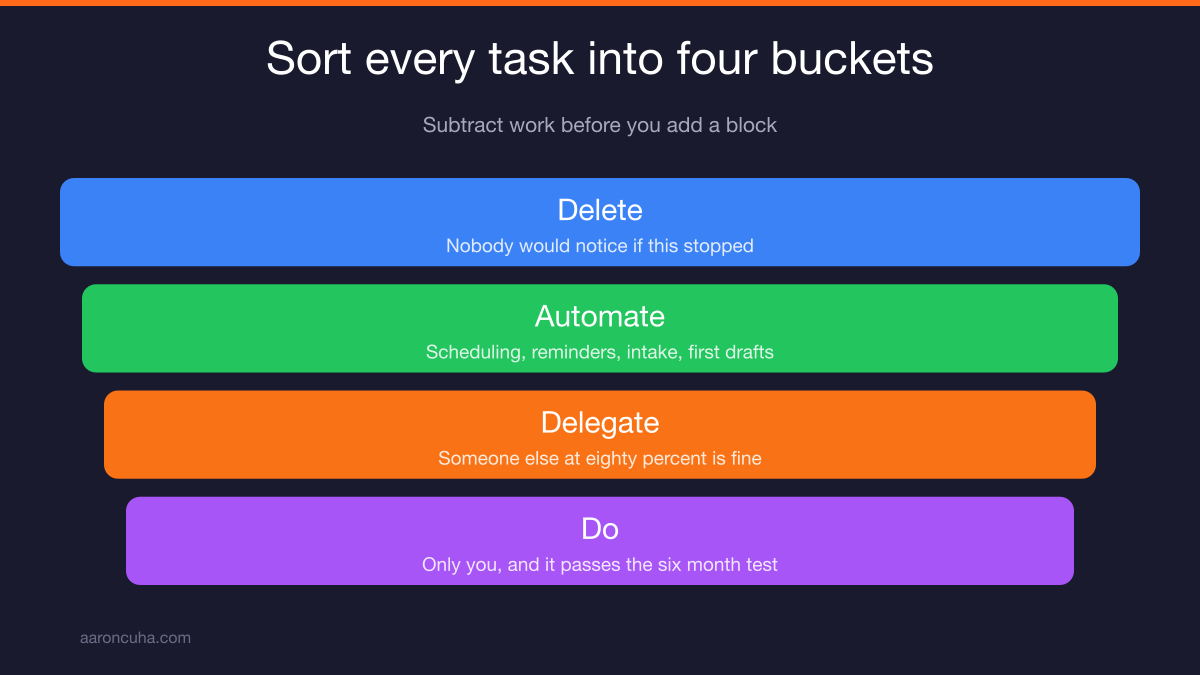
Start by tracking one normal week. Write down every task you touch. Then sort each one into four buckets:
- Delete. Nobody would notice if this stopped. More items land here than you expect.
- Automate. Rules based and repetitive. Scheduling, reminders, intake, first drafts, transcription.
- Delegate. Someone else can do it at eighty percent quality, which is fine.
- Do. Only you can do it, and it passes the six month test.
Bucket four is your Growth Block list. Everything else is somebody else's job or a machine's job.
The tooling here has changed fast. In the last two years I have watched routine drafting, intake, and summarising move from "a person has to do this" to "a tool does the first pass and a person edits it." Owners who use AI business systems for intake, drafting, and follow up recover hours a week without hiring. I walk through the specific stack in my guide to AI agents that run the back office.
Do not automate a broken process. Document it first, then automate it. Otherwise you are just producing bad output faster.
Your First Week: A Day by Day Start
Start with one block a day for two weeks. Not three blocks, not a full morning. One block, same time, one asset. Under promise to yourself so you can keep the promise.
Here is the five day rollout I give clients.
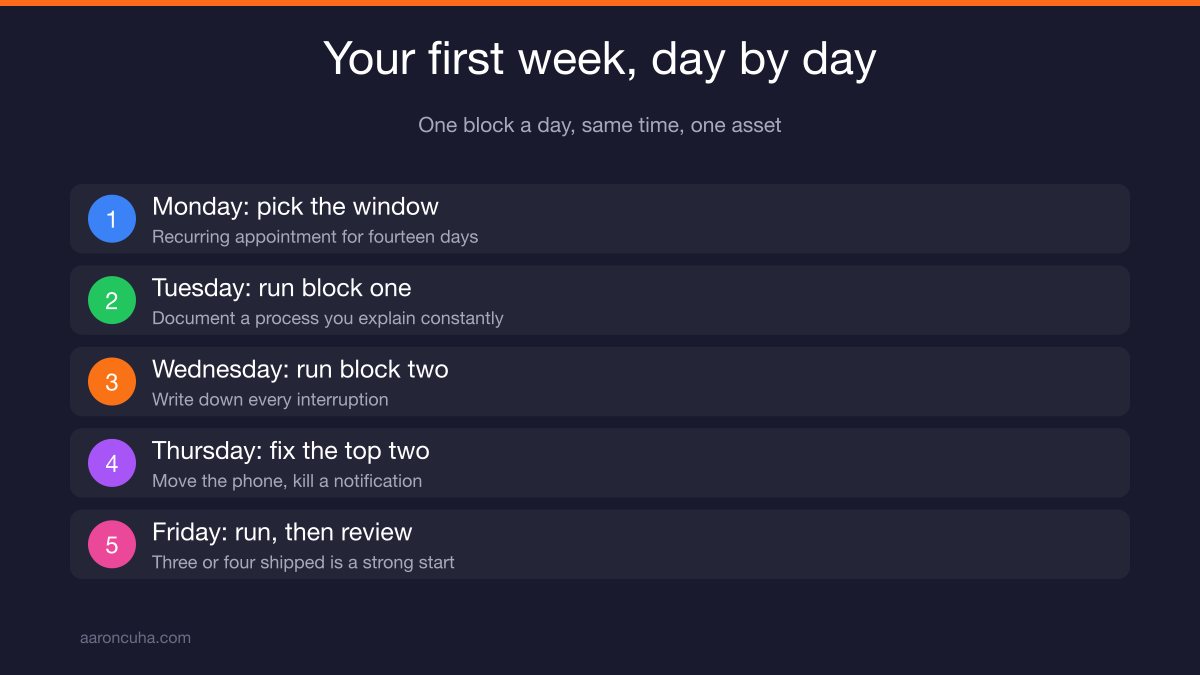
Monday. Pick your window and put it in the calendar as a recurring appointment for the next fourteen days. Tell your team and your family the rule in one sentence.
Tuesday. Run your first block. Pick something easy to finish, like documenting one process you explain constantly. Ship it. Log it.
Wednesday. Run block two. Notice what interrupted you. Write the interruption down. That list is your design work.
Thursday. Fix the top two interruptions from yesterday. Move the phone, kill a notification, publish your call window.
Friday. Run the block, then review the log. Three or four shipped assets in your first week is a strong start. Two is fine. Zero means the window is wrong, not that you are.
Expect the block to fail at least once in week one. That is not a sign to quit. It is data about where your day leaks.
Do not add a second block until you have hit four out of five days for two straight weeks.
How to Measure Deep Work Without Gaming It
Track two numbers only: blocks completed and assets shipped. Hours logged means nothing. Sitting at a desk is not the product.
Most productivity tracking fails because it rewards input. You can feel busy inside a block and produce nothing. The shipped count keeps you honest.
Every Friday, ask four questions:
- How many blocks did I complete out of the ones I scheduled?
- What did I actually ship?
- Which of those assets will still be working in six months?
- What killed the blocks I missed?
Two diagnoses come up constantly.
High blocks, low output. You are entering the block without a named deliverable, or the deliverable is too big. Break it down until one block finishes one thing.
Low blocks, high stress. You have not subtracted enough work yet. Go back to the delete and delegate buckets.
Once your assets start shipping, judge them by results, not by feeling. If you are building content, the numbers that matter are in your analytics, not your view count.
What to Do When the Block Breaks
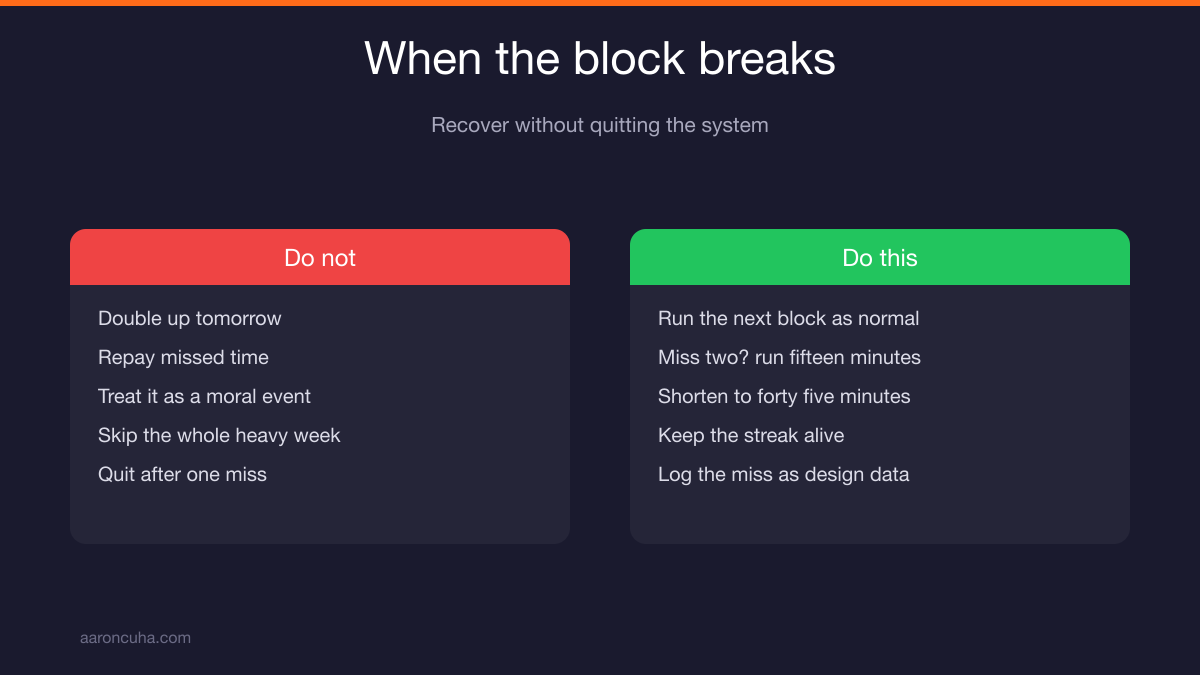
When you miss a block, do not double up tomorrow. Run the next scheduled block as normal. Doubling up creates a debt you will never repay and a reason to quit.
Blocks break. Deals close, kids get sick, a system goes down. The system has to survive real life or it is not a system.
Three recovery rules:
- Never repay missed time. One missed block is one missed block. It is not a moral event.
- Use the reset trigger. Miss two in a row and you must run a fifteen minute block, no matter how small the output. The point is the return, not the result.
- Shorten instead of skipping. In heavy seasons, cut the block to forty five minutes and keep the streak alive.
I learned the shortening habit in Nepal. Some days the work I planned was impossible. The only real choice was to do a smaller version of it or lose the thread entirely.
A shortened block keeps the identity intact. You are still someone who builds before the day takes over.
What Two Protected Hours Look Like After a Year
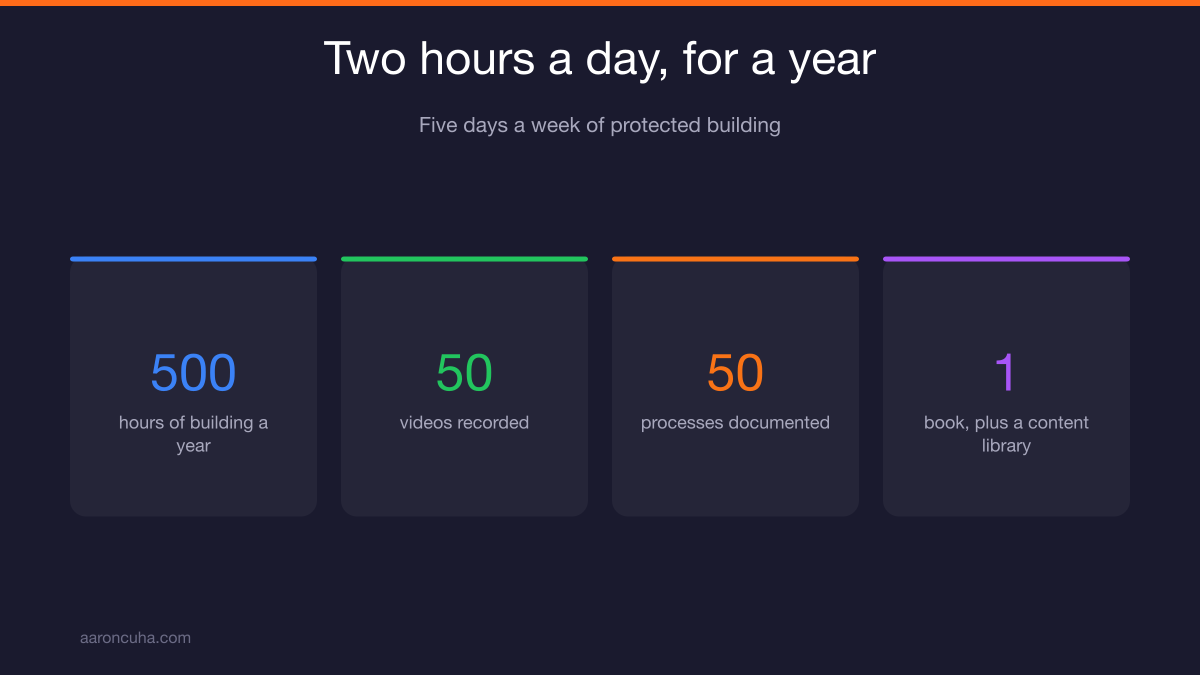
Two hours a day, five days a week, is roughly five hundred hours a year of building. That is not a productivity tip. That is a second company built inside your existing one.
Do the plain math on what that produces. Fifty videos. Fifty documented processes. Or one book plus a content library plus a follow up system that runs without you.
Nothing dramatic happens in month one. That is the part that breaks people. The assets look small while you are making them.
Then they stack. The video you recorded in February brings leads in November. The SOP you wrote in March trains a hire in August. The offer you rebuilt in April sets your pricing for two years.
I built DirectLender on activity. Volume, speed, presence, personal effort. It scaled and then it broke, and I lost it in 2008.
The decade I spent doing humanitarian work in Nepal taught me the thing my first career never did. Real results move slowly and then all at once. You do the same small work daily, in conditions that give you no feedback, and one day the whole thing is standing.
I rebuilt as a coach the same way. Twenty thousand hours of one on one work, five books, and a framework I use with every client. None of it came from a heroic month. It came from protected hours that nobody saw.
You do not need more hours. You need two that belong to you.
Pick your window tonight. Name tomorrow's asset on paper. Then run the block, log the ship, and do it again on Wednesday. That is the entire system.
If you want an outside read on where your two hours should go, book a Channel Audit and Plan and I will show you which asset to build first.
Frequently Asked Questions

Written by
Aaron CuhaAuthor of Crazy Simple YouTube, keynote speaker, and executive coach with 20,000+ hours logged. ICF PCC, NLP Master Practitioner, and DISC Certified. Aaron helps entrepreneurs replace hustle with AI-powered systems that generate leads, content, and revenue on autopilot.