One agent in Prague turned YouTube leads for real estate agents into five listing appointments a week and about $1 million in commission turnover. Here is the content mix, the publishing rhythm, and the team behind it.
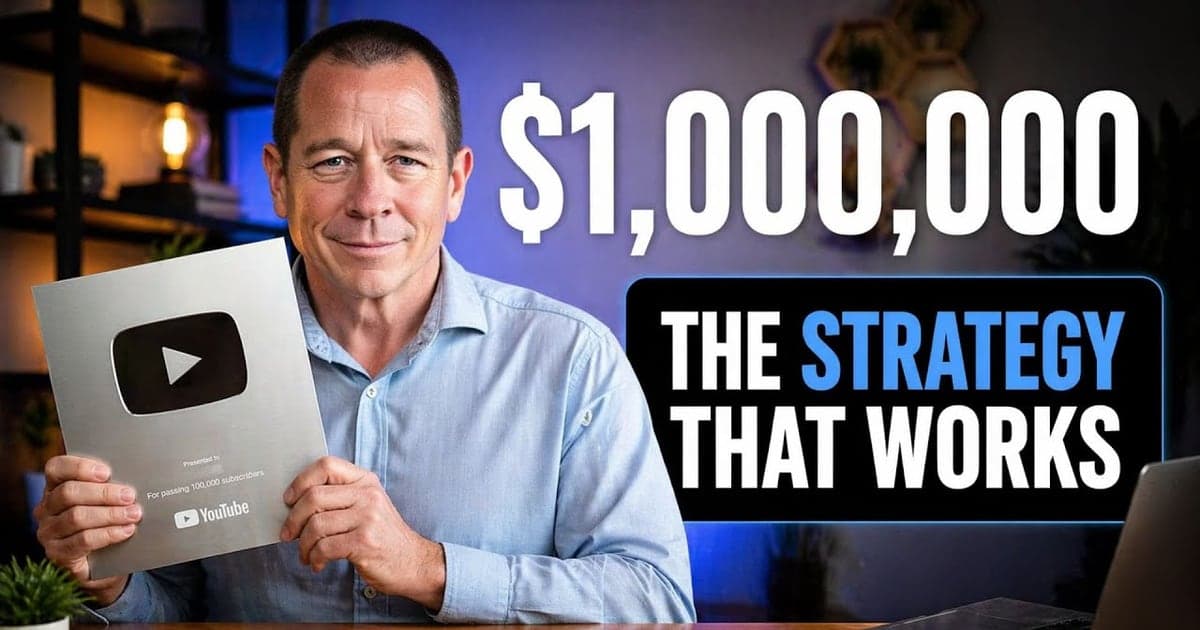
YouTube leads for real estate agents are usually treated as a nice extra. For one agent in Prague they are the whole business: about $1 million in commission turnover expected this year and more than 100 transactions, all of it traced back to a channel he has published for four years.
Key Takeaways
- Publish one video every week for years, not months. First real deals came after year two.
- Make the channel about your city, not about real estate listings.
- Extremes win: cheapest, most expensive, best lunch, luxury property tours.
- Every video takes 33 man hours. Delegate 21 of them.
- Five listing leads per week arrive warm, already sold on the commission.
If you want the same result, start with a plan instead of a camera. Book a Channel Audit and Plan and find out what your channel is actually missing.
The $1 Million Result That Started This
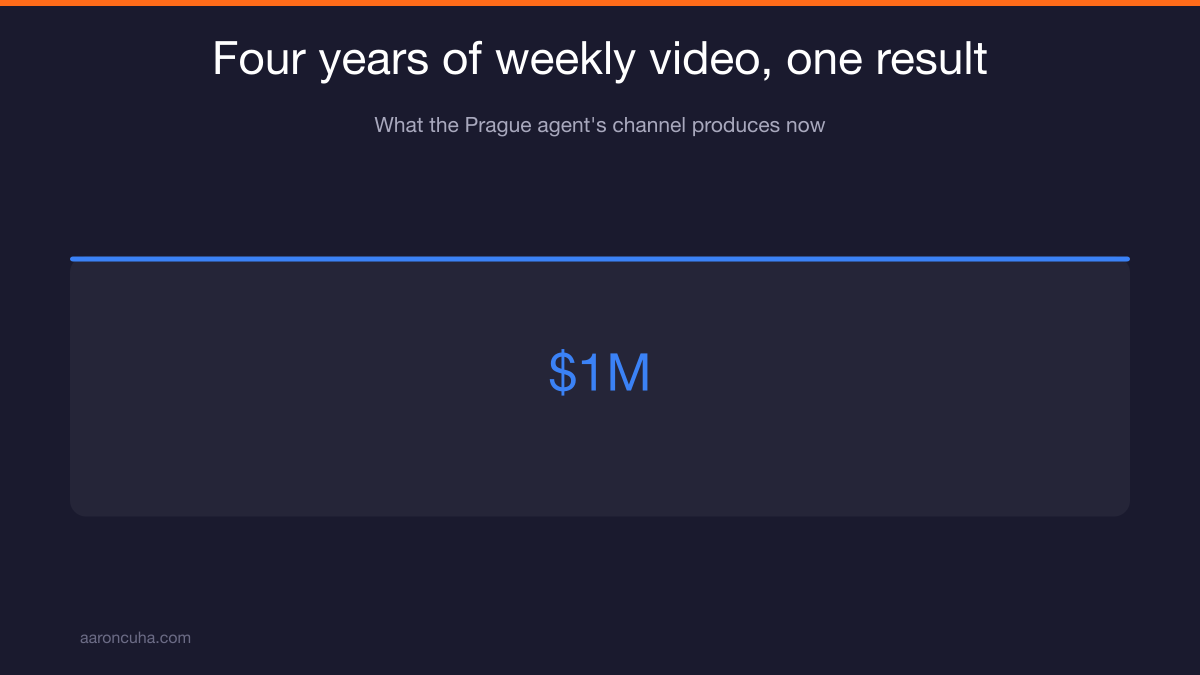
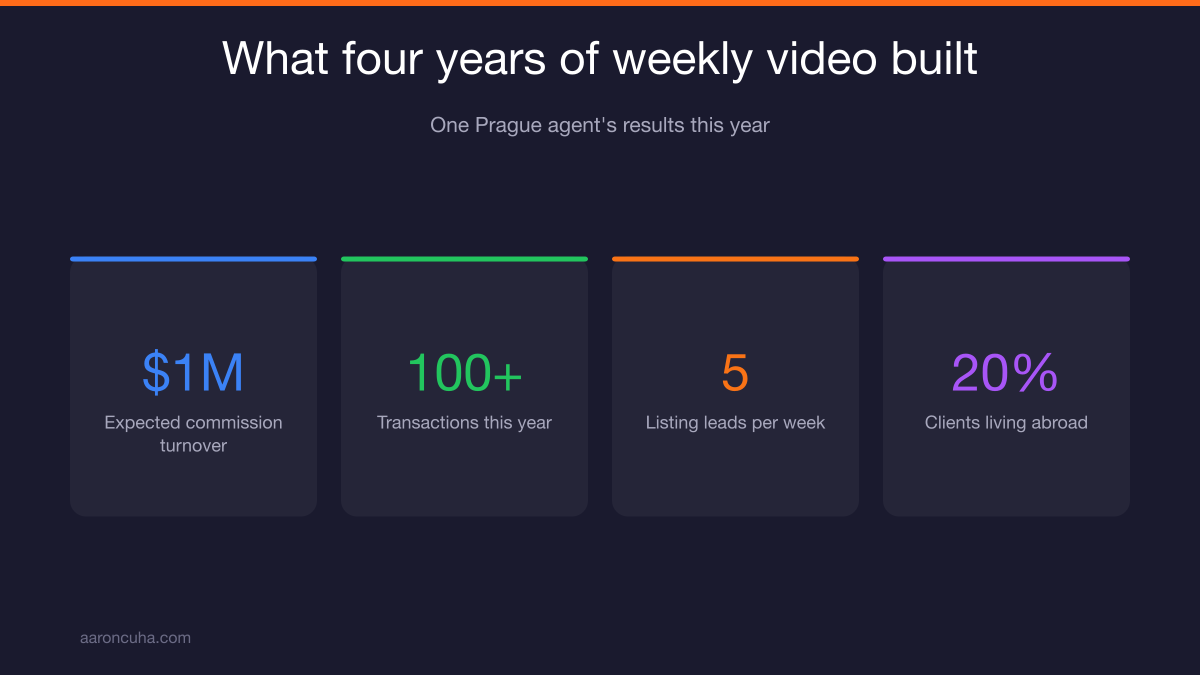
A Prague real estate agent expects roughly $1 million in commission turnover this year and over 100 transactions. He credits the YouTube channel he has run for four years.
The numbers behind that result matter more than the headline. He gets about five listing leads every week. Not cold contacts. Not scraped numbers. People who already watch him.
That changes the sales conversation completely. Most of them already know who he is. They accept his terms. They accept his commission. He describes them as easy clients.
Then there is the part that sounds impossible. Roughly 20% of his clients live in other countries. He has never met them face to face. They call, mail him the keys, and tell him to sell the property.
They do that because they watched enough of his videos to trust him completely. That is the whole point of this real estate YouTube strategy. Video builds trust at a scale that phone calls never will.
Why Market Conditions Make Listings the Prize
Prague is a seller's market. Many buyers, few listings, prices rising nearly every year. When inventory is that tight, whoever controls the listing controls the deal.
He puts it plainly. If you have a listing, you almost have money in your pocket.
Which means every agent in the city fights for the same thing. Listings are the scarce resource, so the competition for them is brutal.
That is where YouTube separates him from the pack. Other agents chase listings with calls, mailers, and door knocks. He has a stream of sellers who come to him already convinced.
Look at your own market and ask the same question. What is scarce where you work? If it is listings, YouTube is the highest leverage tool you have to win them, and the complete guide to YouTube for real estate agents walks through how that plays out market by market.
How YouTube Leads for Real Estate Agents Are Built, in Plain Terms
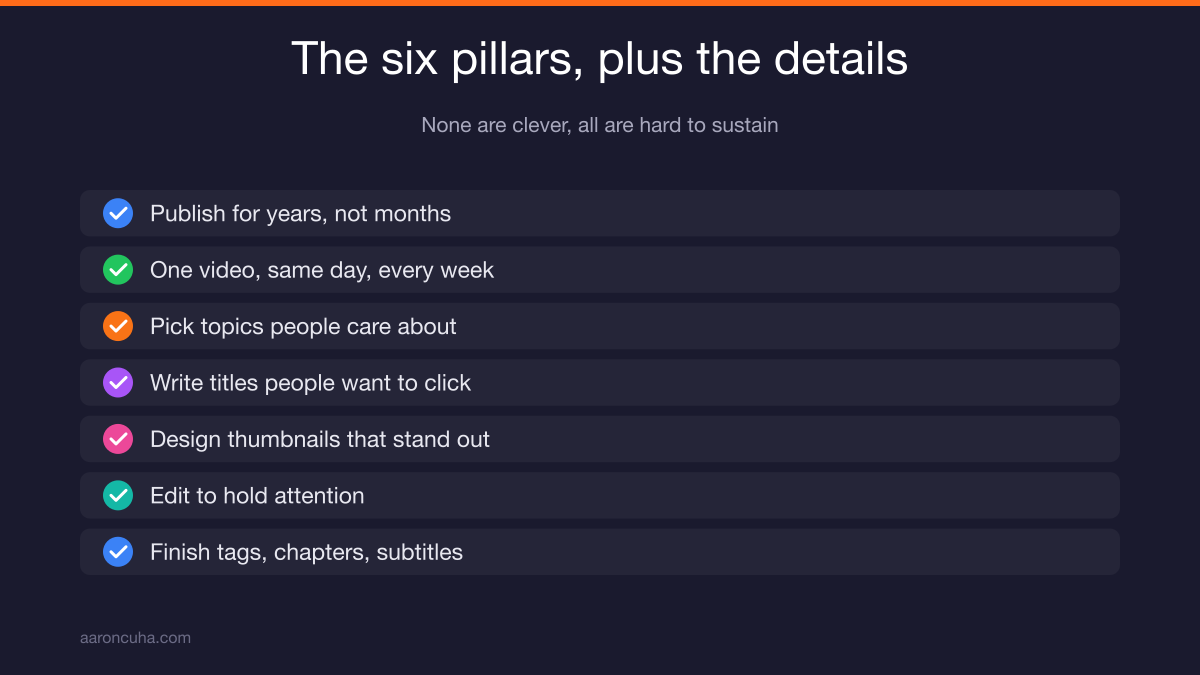
The strategy has six pillars: publish long term, publish weekly, choose topics people actually care about, write attractive titles, design attractive thumbnails, edit professionally, and finish every small detail before you hit publish.
None of those are clever. All of them are hard to sustain. That is exactly why they work.
Here is how he breaks each one down:
- Long term. Four years in, still improving. The first two produced almost nothing.
- Weekly. One video, same day, every week, no exceptions.
- Interesting topics. Not every subject earns views. You have to think about what the audience wants, not what you want to say.
- Attractive titles. People must want to click. If the title is flat, the video never gets a chance.
- Attractive thumbnails. He sees strong videos die behind boring thumbnails constantly.
- Professional edit. Part on camera, part voiceover over footage. The editor has to know how to hold attention.
- The small things. Descriptions, tags, subtitles, chapters. One to two hours per video, and it matters.
That last one is where most agents quit. The video feels finished, so they upload it raw and lose half the reach. Our breakdown of YouTube SEO tips for ranking videos covers why those details move the needle.
Why the First Two Years Look Like Nothing
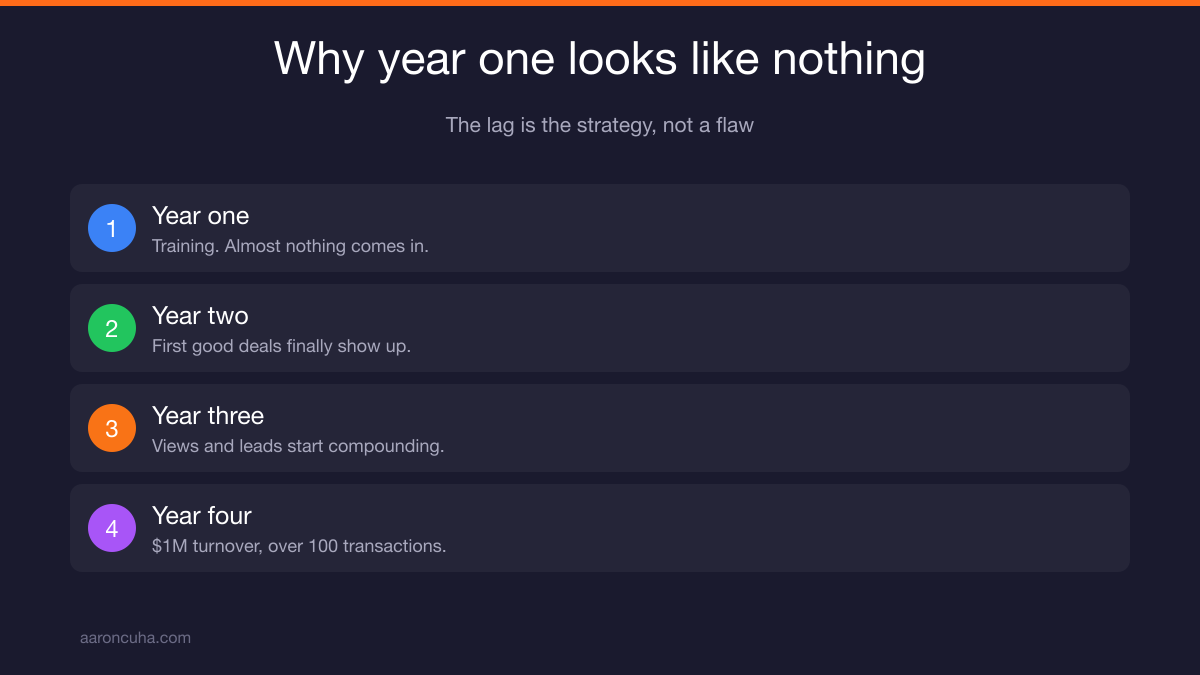
He published for two full years before the first good deals showed up. Four years in, the channel produces a million dollars in commission turnover. The lag is the strategy, not a flaw in it.
Most agents quit at month four. They see 200 views, decide YouTube does not work in their market, and go back to buying leads.
He had a conversation about this with the first Czech YouTuber to pass a million subscribers. That creator made a simple point.
Pick any creator you admire. Scroll to their oldest uploads. You will find bad videos. Bad framing, bad audio, bad delivery.
The difference is they kept publishing. They improved video by video until the work got good. Nobody starts good.
So reframe your expectations. Year one is training. Year two is traction. Year three and beyond is compounding. If you cannot commit to that timeline, spend your money somewhere else.
His own line on it: the longer he does it, the bigger the success gets. That is what a compounding asset looks like, and it is the same argument behind systems over hustle.
The Weekly Rhythm That Trains Both Algorithm and Audience
Publish one video every week on the same day. YouTube evaluates creators on consistency and recommends consistent channels to more people. Your subscribers learn the schedule and start waiting for you.
Those are two separate benefits and both matter.
The first is mechanical. Regular publishing earns better evaluation from the platform, which means more recommendations to more viewers. YouTube's official blog has said for years that the system rewards channels that keep viewers coming back.
The second is human, and it is more powerful. His subscribers know videos drop Wednesday evening.
People stop him on the street in Prague and tell him they are looking forward to the next video. That is not an audience. That is a relationship with a schedule attached.
You cannot manufacture that with a burst of six videos in one month and then silence. Rhythm creates anticipation. Anticipation creates trust. Trust creates listings.
Pick your day. Wednesday evening, Sunday morning, whatever fits your production cycle. Then defend it like a closing appointment. If holding the schedule feels impossible, content systems that prevent burnout is the fix.
The Mistake of Making a Real Estate Channel
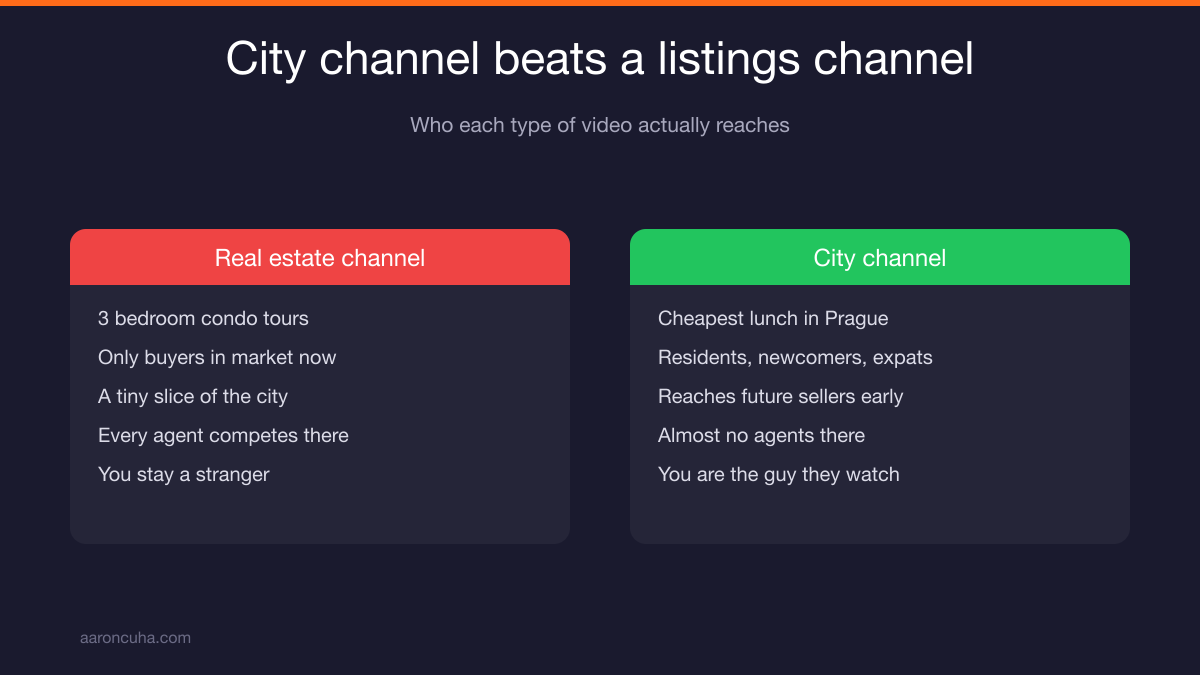
His channel is about living in Prague, not about property. Real estate content only reaches people already shopping for real estate. City content reaches everyone else, long before they need an agent.
This is the single biggest strategic difference between his channel and the ones that stall out.
Think about who watches a video titled "3 Bedroom Condo Tour." Buyers in market right now. That is a tiny slice of the population, and every other agent is fighting for it.
Now think about who watches "The Cheapest Lunch in Prague." Residents. Newcomers. Expats. People who will need an agent in two years and do not know it yet.
He says it directly. Because the channel is about the city, he gets in front of normal people. With real estate content alone, he never would.
By the time those normal people need to sell, he is not a stranger with a sign. He is the guy they watch every Wednesday.
Ready to build this properly instead of guessing? A 90 minute YouTube strategy session maps your topic rotation, your schedule, and your first 12 videos.
The Topics That Pull the Most Views
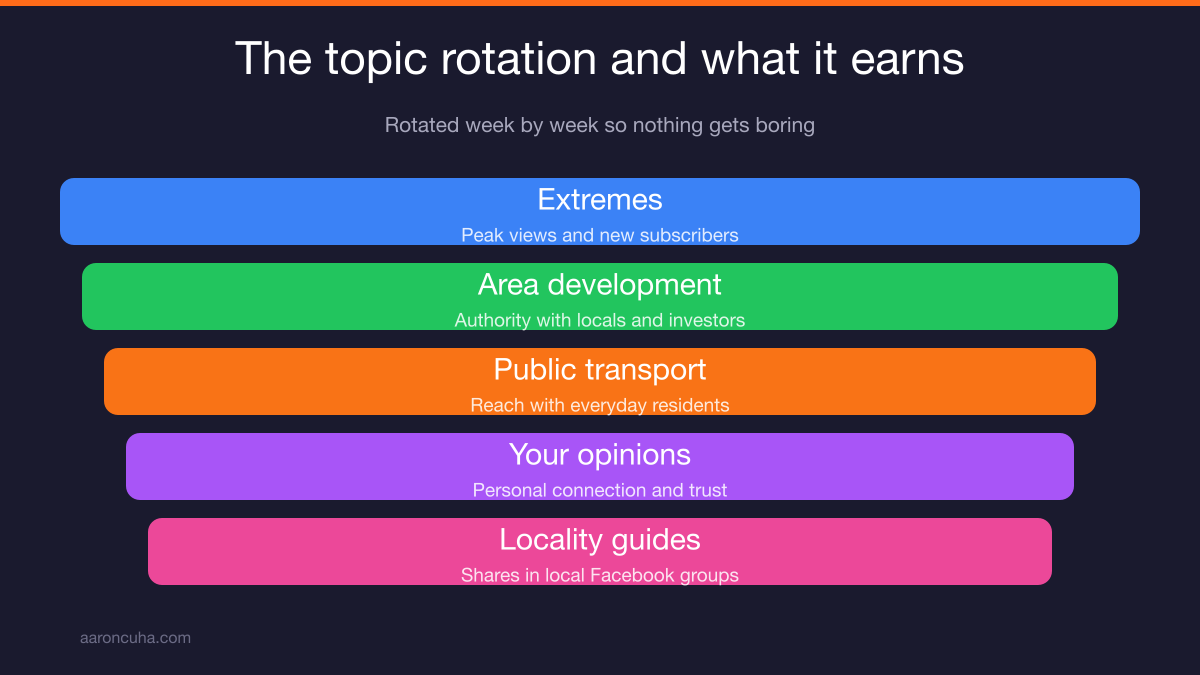
Extremes win. Cheapest apartment, most expensive house, best lunch, cheapest margarita, luxury listings. If a topic sits at the edge of a scale, people click.
That is his most reliable pattern. Use extremes and the audience shows up.
But he adds a warning that most agents ignore. You cannot only run top videos. A channel built entirely on clickbait extremes stops serving the audience.
Your job as a creator is to help people understand the city. Extremes get attention. Service content earns trust.
Here is the full rotation he uses and what each type actually does for the business:
| Topic Type | Example | What It Earns You |
|---|---|---|
| Extremes | Cheapest apartment, most expensive house | Peak views and new subscribers |
| Area development | New district project and its future impact | Authority with locals and investors |
| Public transport | Subway highlights and how the system works | Reach with everyday residents |
| Your opinions | Overtourism, traffic, homelessness | Personal connection and trust |
| Locality guides | Past, present, future of one neighborhood | Facebook group shares and local fame |
| Interesting properties | Historically significant buildings | Broad appeal beyond buyers |
| Real estate advisory | When to buy, how to negotiate | Direct listing leads |
He rotates through these week by week. One week the best margarita in the city. Next week an interesting property. Next week real estate advice.
The result is a channel that never gets boring, because viewers always get something different. For more angles, see these four content pillars that turn a channel into a lead machine.
Local Development, Transport, Opinions, and Neighborhood Deep Dives
Four content categories carry the channel between extremes: area development projects, public transport, personal opinions on city issues, and neighborhood deep dives shared into local Facebook groups.
Start with development. Every city changes. Private and public projects reshape neighborhoods, and almost nobody explains them clearly.
So he does. What the project is, what it will look like, and what it means for the future of that place. People care intensely about this because it affects their property value and their daily life.
Then public transport. Prague has an excellent system and residents are proud of it. He says you cannot imagine how many people are fans of the subway.
Cover the highlights, the quirks, the routes people do not know about. It sounds unglamorous. It performs.
Then opinions. Your subscribers want to know how you think, because that is how they get to know you as a person.
In Prague the issues are overtourism and traffic. In your city it might be homelessness, vandalism, crime, or the environment. Pick the real issue and say what you actually think.
Finally, locality deep dives. He covers one neighborhood at a time: the past, the present, the future, the best places, the great restaurants, all the highlights.
Then his team finds every Facebook group for that specific neighborhood and shares the video there. Residents love seeing their own area covered well. Now every person in that neighborhood knows who he is.
That last step is where a good video turns into a local reputation, and it is the same idea behind turning one video into 30+ assets.
Where Real Estate Advice Actually Fits
Real estate advisory is a slice of the rotation, not the whole channel. It reminds viewers what you do for a living without turning the channel into a sales pitch.
His advisory topics are the classics. When to buy. When to sell. How to buy. How to sell. How to value a property.
Then market outlook, what to check before buying, and how to negotiate. As he says, there are a million topics in that bucket.
The key is placement. It sits inside a mix that also includes food, transport, neighborhoods, and opinions.
He calls it the right mix: always put real estate advisory in there, but never let it take over. A viewer who came for the cheapest lunch stays for the market outlook because they already like you.
Consider pairing your advisory videos with reliable public data. Sources like the U.S. Census Bureau and the National Association of REALTORS give you real numbers to reference on market outlook videos, which raises your credibility fast.
The 33 Hours Behind Every Video
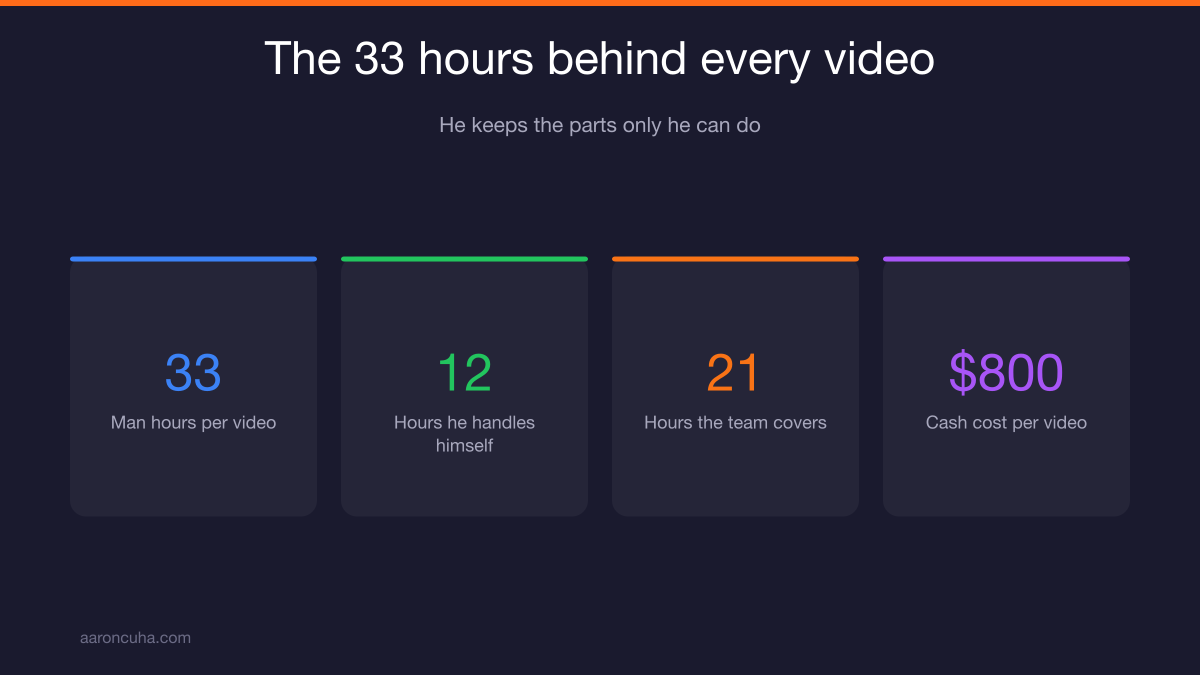
Every video costs about 33 man hours. He personally handles 12 of them. The other 21 belong to a four person team, and the direct cash cost is roughly $800 per video.
His reasoning is blunt. If he does the YouTube work himself, he cannot do real estate. So he built a team.
Here is the exact breakdown:
| Role | Responsibilities | Hours | Cost |
|---|---|---|---|
| Him | Topic selection, research, script, time on camera | 12 | His time |
| John | Rewrites script into YouTube language, defines on camera vs voiceover, final video amendments | 3 | $400 |
| Lucas | Camera, edit, thumbnail | 14 | $400 |
| Flower | Publishing, description, chapters, English subtitles, tags | 2 | Not stated |
| Martin | Social distribution, Reels, posting into related Facebook groups | Not stated | Not stated |
Notice what he keeps. Topics, research, script, and camera. The parts only he can do.
Notice what he says about John. Three hours per video and $400, which he calls expensive. Then he says he cannot imagine being successful without him, because John set all the fundamentals and coached him to hold to them from the start.
That is the honest version of this business. The strategist is the expensive line item and the one you cannot cut.
If you are still doing all 33 hours yourself, read how to stop being the bottleneck. Your camera time is not the problem. Your edit queue is.
What to Copy First If You Are Starting This Week
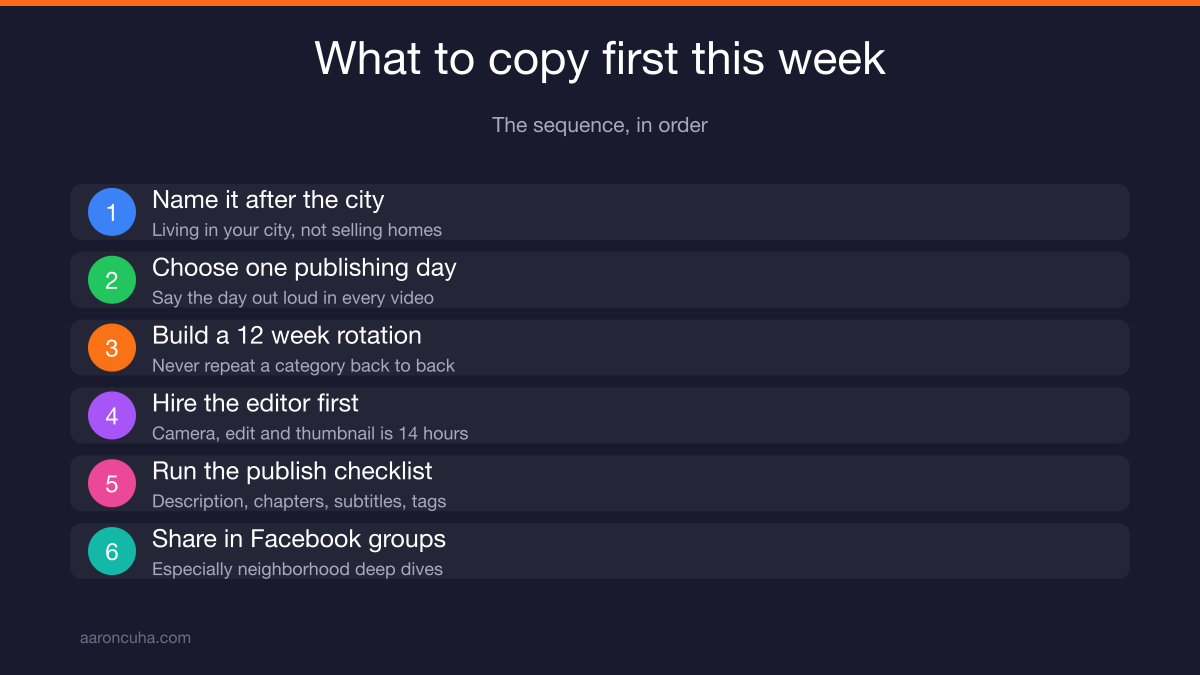
Copy the structure in this order: pick a city instead of a category, commit to one publishing day for 24 months, build the topic rotation, hire the editor before you buy a better camera, and finish every publish checklist.
Here is the sequence in detail:
- Name the channel after the place, not the profession. Living in your city, not selling homes in your city. This one decision determines who watches.
- Choose your day and write it down. One video per week. Same day. Tell your audience the day out loud in every video.
- Build a 12 week rotation. Three extremes, two locality guides, two development updates, one transport video, two opinion videos, two advisory videos. Do not repeat categories back to back.
- Hire the edit first. Fourteen hours of camera, edit, and thumbnail work is the largest block in the whole process. Buying that back frees you to sell.
- Run the publish checklist every time. Description, chapters, subtitles, tags. One to two hours. Never skip it.
- Distribute into local Facebook groups. Especially neighborhood videos. That is where the residents are.
Do not wait for good gear or a good script. His own point at the top: keep your mind open, get outside your comfort zone, and shoot whatever you can shoot.
Persistence over time is what turns a bad early channel into a business. If you want a starting library, our guide to starting a YouTube channel for business covers setup end to end.
The Real Lesson: Systems Over Hustle
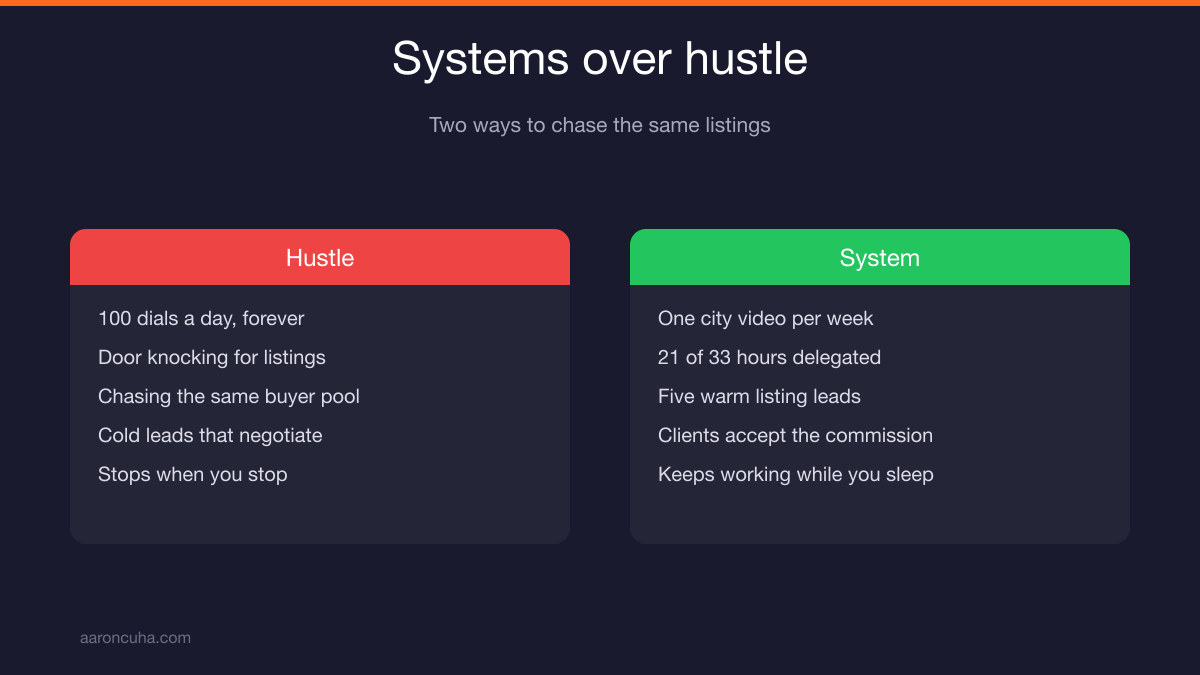
The million dollars did not come from working harder. It came from a repeatable weekly system, a deliberate content mix, and delegating 21 of the 33 hours to people better at those jobs than he is.
Think about what he is not doing. He is not door knocking. He is not cold calling for listings. He is not chasing the same buyer pool as every other agent in Prague.
He publishes one video a week about the city he lives in. That video attracts normal people. Those people build trust over months and years. Some of them mail him keys from another country.
That is a system. The output is five high quality listing leads per week that arrive pre sold on him and his commission.
Hustle would have him making 100 dials a day forever, and stopping the moment he stops dialing. The system keeps producing while he sleeps, because the videos stay online.
Here is the part worth sitting with. He is four years in and says the longer he keeps going, the bigger it gets.
Most agents never find out if that is true for them, because they quit in month six. The two year lag is not a bug in this strategy. It is the moat that keeps your competitors out.
Start now and you will be two years in before the agents who laugh at you decide to begin. For the framework behind all of this, read why most YouTube channels fail and the framework that fixes it.
You do not need four years of trial and error to figure out the rotation, the schedule, and the team. Get the real estate coaching program and build the system that turns your market knowledge into listings.
Frequently Asked Questions

Written by
Aaron CuhaAuthor of Crazy Simple YouTube, keynote speaker, and executive coach with 20,000+ hours logged. ICF PCC, NLP Master Practitioner, and DISC Certified. Aaron helps entrepreneurs replace hustle with AI-powered systems that generate leads, content, and revenue on autopilot.