Most agents run what Aaron calls the junk channel problem: random videos, no theme, no reason to subscribe. This real estate youtube channel strategy replaces the guessing with four content pillars and a posting split that builds a lead machine fast.
Your channel looks like a junk drawer. Random videos, no theme, no reason to subscribe. Here is the real estate youtube channel strategy that actually works, and I am done watching agents ignore it.
Key Takeaways
- Property tours drive growth. Make them 60 to 70% of year one content.
- Four pillars replace guessing: engine, magnet, advisor, anchor.
- Never put the property address in your title, description, or on camera.
- Shoot pending and sold listings. You generate leads, not sell houses.
- Searchable content beats shareable content until you have subscribers.
Want an outside read on what your channel is actually doing? Start with a Channel Audit and Plan and find out which videos are pulling weight and which ones are noise.
The Junk Channel Problem Is Killing Your Growth
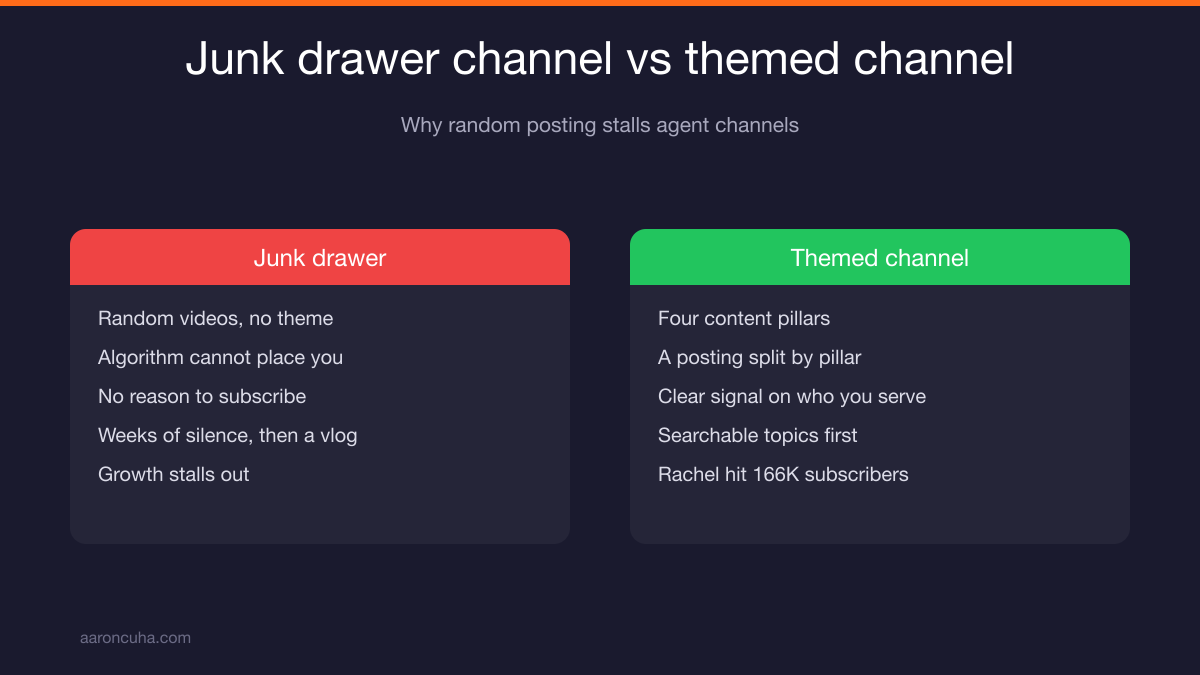
The junk channel approach is throwing content at YouTube and hoping something sticks. No theme. No direction. No reason for anyone to subscribe. It is the single biggest reason agent channels stall.
I see it every week. An agent posts a market update, then a random vlog, then a listing tour, then nothing for three weeks. The algorithm has no idea who to show that channel to, so it shows it to nobody.
The fix already exists. It is a real estate youtube channel strategy built on four content pillars, real YouTube SEO for realtors, and a posting split that tells the algorithm exactly who you serve. Call it a themed channel instead of a real estate youtube strategy grab bag.
One of my clients, Rachel out of Big Bear, California, ran the junk drawer approach for her first couple of years. She would say she did not know what to make, so she just made whatever. Then she buckled down and followed the framework.
She is at 166,000 subscribers now. She controls about 10% of her entire market in listings. When she blew past my own subscriber count, I was not thrilled about it, but that is what happens when someone commits.
The system works. Most agents just refuse to follow it. That stops today.
The Real Estate YouTube Channel Strategy That Replaces Guessing
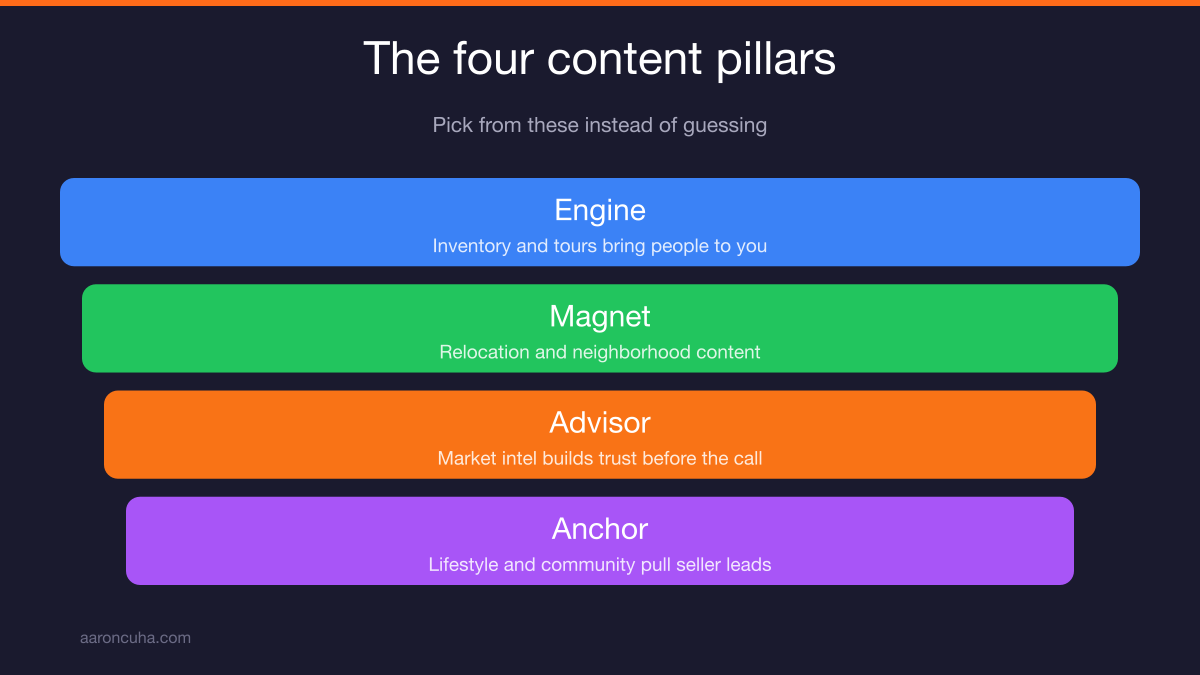
Instead of asking "what should I make a video about today," you pick from four pillars: the engine, the magnet, the advisor, and the anchor. Every successful real estate channel runs on these four content types.
Most agents sit down, stare at a blank page, and freeze. Or worse, they make whatever comes to mind. I have clients who have been with me for multiple years who still do this.
I have watched agents ignore this framework for one year. Two years. Three years. Then they finally start listening and we blow up their channel almost immediately.
Here is how the four pillars work together:
- The engine brings people to your channel. Inventory and property tours.
- The magnet makes them choose you. Relocation and neighborhood content.
- The advisor builds trust before they call. Market intelligence and education.
- The anchor generates seller leads. Lifestyle and community.
Are there big channels doing property tours almost exclusively? Yes. But they are shooting five tours a week at 25 minutes each. That builds fast, but it does not convert as well as it could because there is nothing on the channel that makes a seller pick up the phone.
You want the engine to bring them in and the other three to close the loop. If you want the deeper breakdown of the pillar system, read the four content pillars that turn a YouTube channel into a lead machine.
Pillar One: The Engine (Inventory and Property Tours)
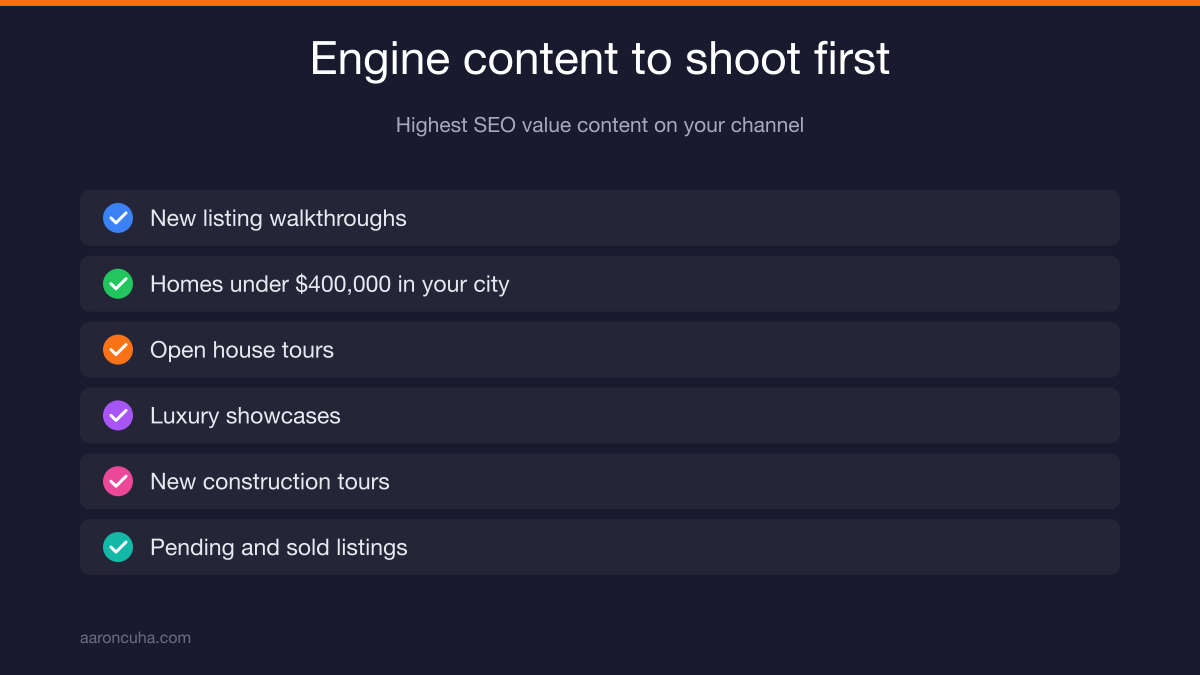
The engine is inventory and tours. It is the content that gets impressions and closes deals. It has the highest SEO value of anything you can post, period.
When you publish a property tour, YouTube puts a thumbnail of your video in front of someone searching, right next to 20 or 30 other results. You still have to earn the click with a strong thumbnail and a real call to action. But this is the content that puts you in the room.
Engine content includes:
- New listing walkthroughs
- Price point comparisons like "three homes under $400,000 in [your city]"
- Open house tours
- Luxury showcases
- New construction tours if you have builders in your market
Every one of those targets a transactional search term. That is the whole point.
In my experience tracking this across hundreds of agent channels, roughly 68% of buyer and seller searches on YouTube start with property tour related terms. "Houses for sale near me" alone runs around 380,000 searches a month nationally by my numbers.
People search for homes on YouTube the same way they search on Zillow. The National Association of Realtors has shown for years that nearly every buyer starts the search online, and video is where that search is moving. The difference is that on YouTube, they see you. Channels with no engine content do not get seen at all.
If you want the technical side of getting found, work through my YouTube SEO tips for ranking videos alongside this, and read what YouTube Help publishes about search and discovery so you are optimizing against the real system instead of a rumor.
Why It Does Not Matter What You Like Watching
The number one objection I hear is "I would never watch that content." I love you, but I do not care what you would watch. I care about generating business for you.
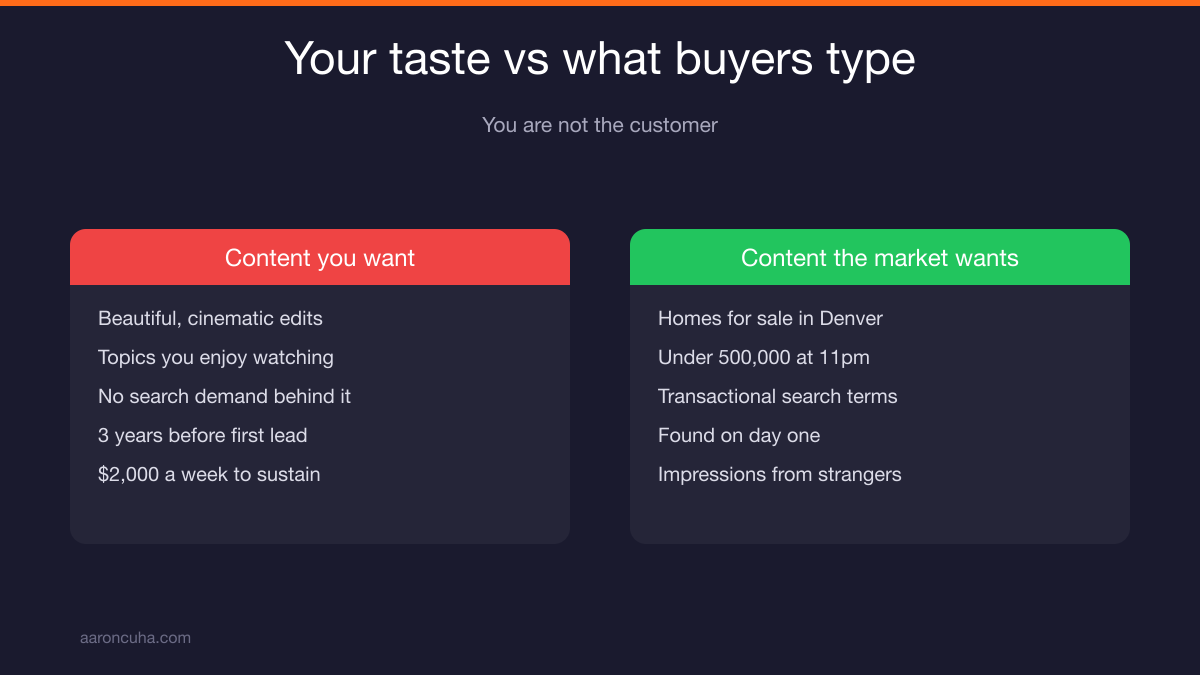
You are not the customer. The buyer typing "homes for sale in Denver under 500,000" at 11pm is the customer. Your taste is irrelevant to the algorithm and to your pipeline.
Look at Daniel Kutulas, my client in Prague. He skipped engine content. He made beautiful videos, but not the kind people were searching for.
We did not start generating leads on that channel until year three. To stay consistent for that long, he spent roughly $2,000 a week for more than two years on production.
If you are independently wealthy and want to fund your own creative preferences indefinitely, go ahead. Everyone else should make the content the market is already looking for.
This is the same trap I write about in why most YouTube channels fail. It is almost never talent. It is topic selection.
Pillar Two: The Magnet (Relocation and Neighborhood)
The magnet is relocation and neighborhood content. People find you through the engine, then they watch the magnet, and the magnet is what makes them choose you.
Think "living in [your city]," "best neighborhoods in [your city]," neighborhood guides, and cost of living breakdowns. Someone typing those terms is planning a move and planning to hire an agent.
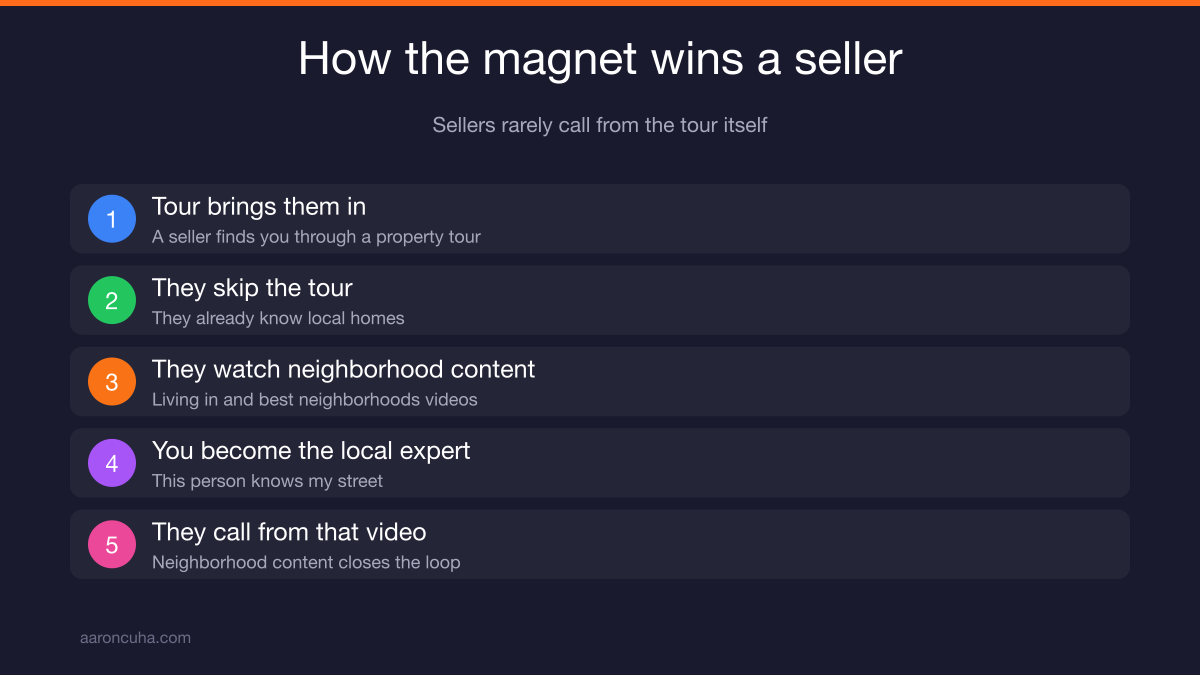
Here is what happens with sellers. Sellers already know what houses in their area look like. They do not watch the whole property tour. They find you through the tour, then they watch your neighborhood content, then they call you from the neighborhood content.
When a seller watches you cover their neighborhood, they think: this person knows my street. This is the real estate mayor of my neighborhood. I am listing with them.
When you highlight a local restaurant, they think: that is where we eat every week. They like my restaurant. I like them.
You may think that sounds silly. I have watched hundreds of leads come to my agents because they featured a restaurant a seller loved. It is not silly. It is human.
The magnet also catches people earlier in the funnel. The engine mostly catches buyers. The magnet catches the people who are still deciding whether to move at all.
Pillar Three: The Advisor (Market Intelligence and Education)
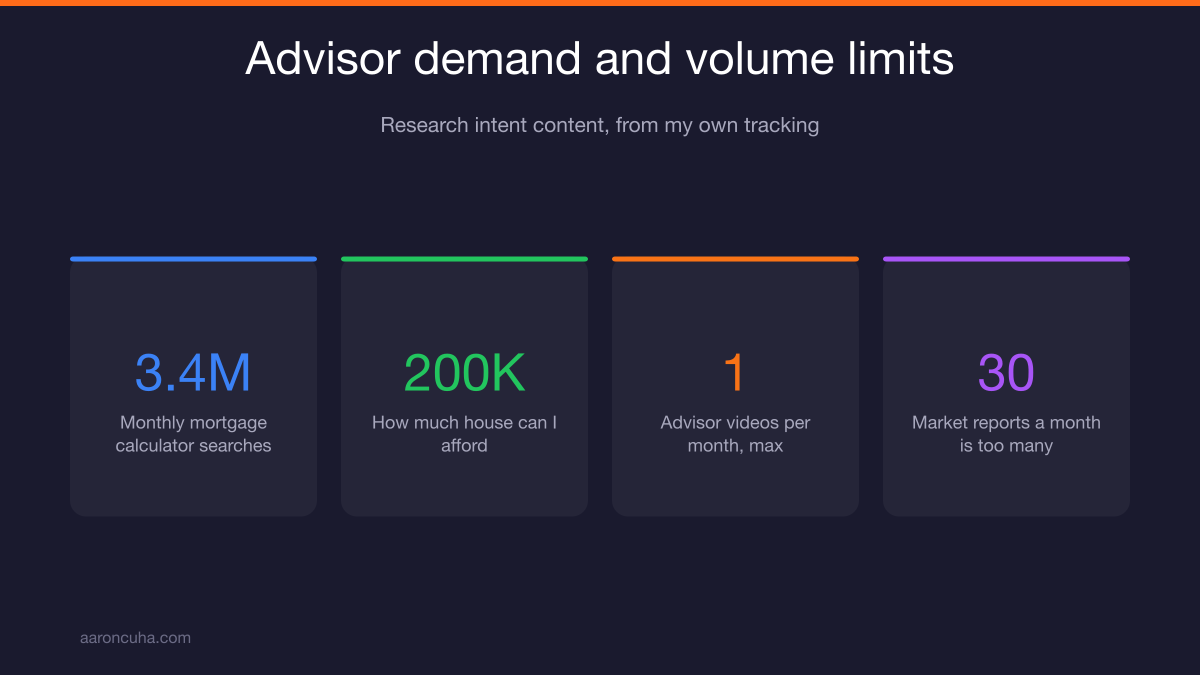
The advisor pillar is education and market intelligence. Most agents already do this well. The problem is volume. One video a month is the max.
I had a client doing a market intelligence report for every single city in the DC metro area. That is roughly 30 market reports a month. That is too much. It buries everything else on the channel.
Advisor content covers:
- Monthly market updates
- First-time buyer guides
- Seller process walkthroughs
- Mortgage explainers and calculator breakdowns
By my own numbers, mortgage calculator searches on real estate channels pull around 3.4 million a month nationally. "How much house can I afford" runs around 200,000 a month.
When you cover that material, get it right. The Consumer Financial Protection Bureau publishes plain language guides on affordability, loan options, and closing costs that you can use as your source material.
If you ignore that content, you are handing the earliest touchpoint in the buyer journey straight to Zillow. Someone else gets to be the first trusted voice.
This is research intent content. The viewer is not ready today. They are gathering information. When they are ready in 30, 60, or 90 days, you are the person they already trust.
That changes the appointment completely. They meet you and say they have watched all your videos. It is not an application anymore. It is a signing.
Fair warning: people will also recognize you at restaurants and grocery stores. Some of you will love that. It still makes me a little uncomfortable.
For a broader look at how education content compounds, see how to get clients from YouTube.
Pillar Four: The Anchor (Lifestyle and Community)
The anchor is lifestyle and community content. It is the pillar that generates the most seller leads, and almost nobody expects that.
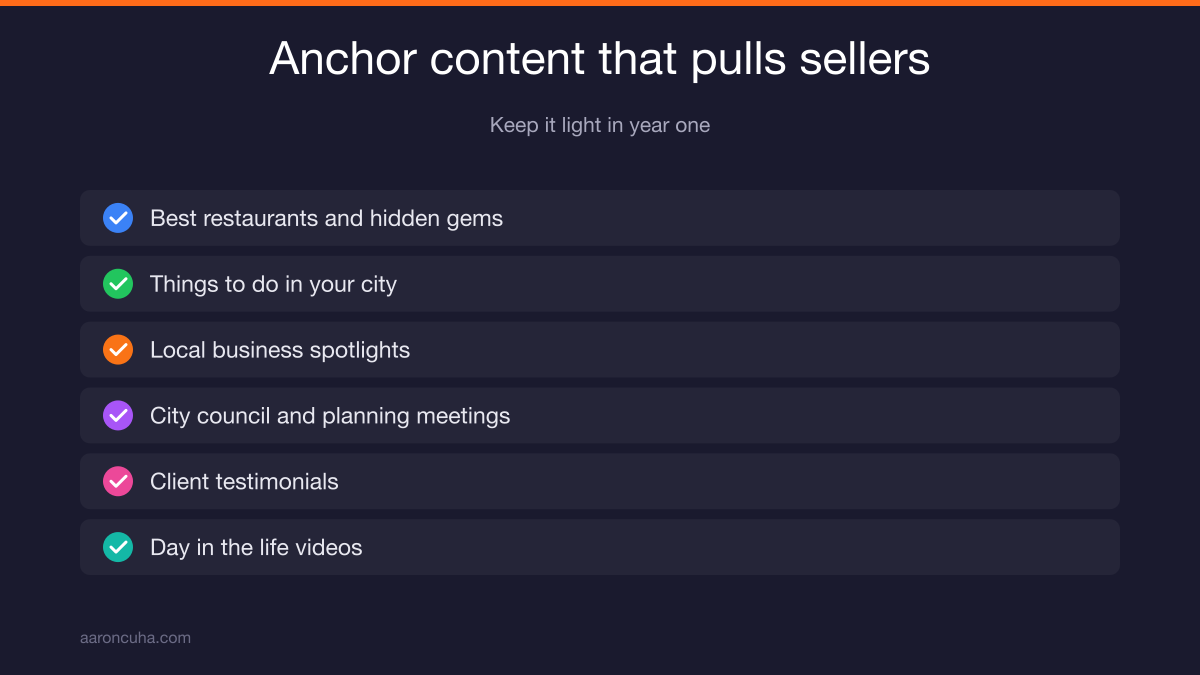
Anchor content includes best restaurants, things to do, hidden gems, local business spotlights, meetings with your city councilman or planning commission, client testimonials, and day in the life videos.
Day in the life is one of my favorites. I have had agents post "here is how I prep for a listing appointment" and get four or five calls off the first video. People watch and think: that is the level of detail I want on my house.
The people watching anchor content already live in your area. They share it with friends and family who are thinking of buying or selling. Then they use you when it is their turn.
Daniel in Prague runs nine out of every ten videos as lifestyle and community. He generated 100 listings last year, mostly on anchor content. Local news outlets now reach out to him because he scoops them, and the city feeds him inside information.
But here is the catch. In year one, keep the anchor light. Nobody is searching for it. If you flood your channel with anchor content early, people will not find you and you will not grow.
One anchor video every other month makes me happy in year one. If you are posting three times a week like Rachel, one or two a month is fine.
Year two is different. The anchor evolves into your primary content. Podcasts, collaborations, panel discussions, meeting other agents at events and posting it live. That is the natural progression.
The Posting Split: Engine Heavy in Year One, 4-2-2-2 in Year Two
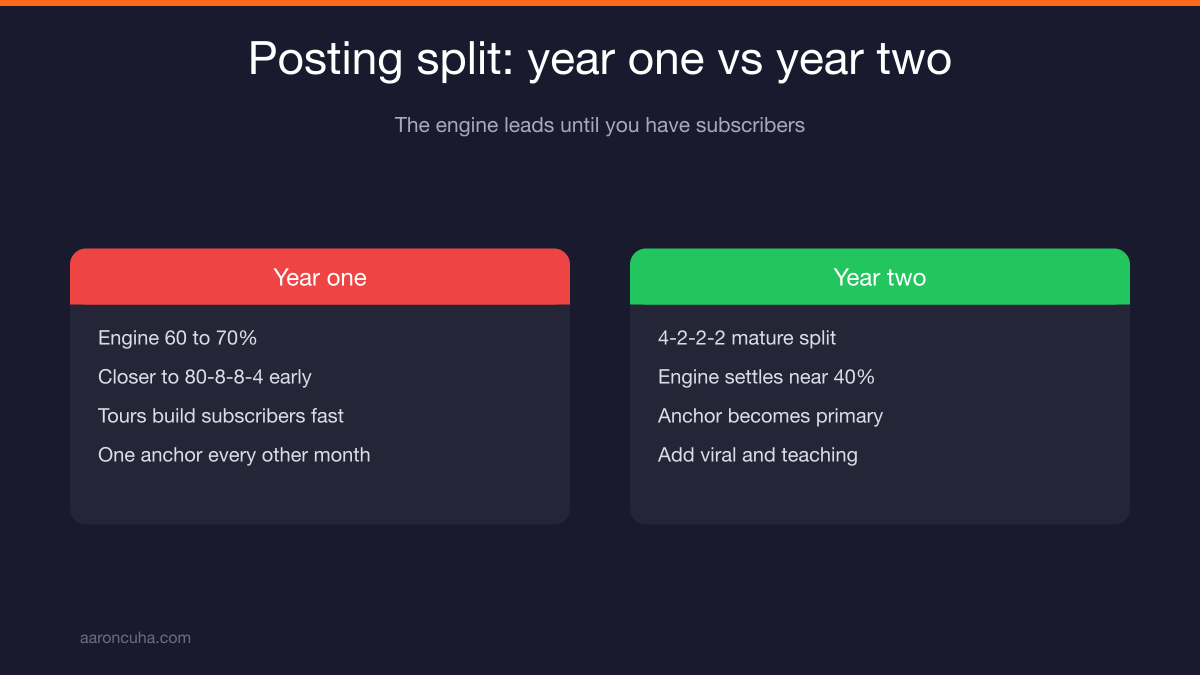
The mature split is 4-2-2-2: four engine videos, two magnet, two advisor, two anchor. In year one, the engine should be 60 to 70% of everything you post, settling to about 40% at the one year mark.
I will be brutally honest. On paper my published strategy looks like 40-20-20-20. In reality, for a new channel it should look closer to 80-8-8-4 for the first several months. Rachel will tell you the same thing.
The reason is simple. Property tours are the fastest way to get you to two, three, or five thousand subscribers. Once you are there, we can add viral content and teaching content and the whole thing opens up.
| Posting Frequency | Weekly Mix | What It Looks Like |
|---|---|---|
| 1 video per week | 3 engine + 1 other | Three property tours a month, then rotate advisor, anchor, magnet |
| 2 videos per week | Mostly engine + 1 other weekly | Six to seven tours a month plus one pillar video per week |
| 3 videos per week | 2 engine + 1 other, repeated | Two tours plus one pillar video, every single week |
The engine leads in year one for four reasons. It has the highest intent. It drives impressions. It trains the algorithm to show you to buyers and sellers in your market. And it builds your library fast, because every property is a new video.
Ready to stop guessing at your calendar? Book a YouTube strategy session and we will map your exact posting split for the next 90 days.
Two Property Tour Rules Most Agents Ignore
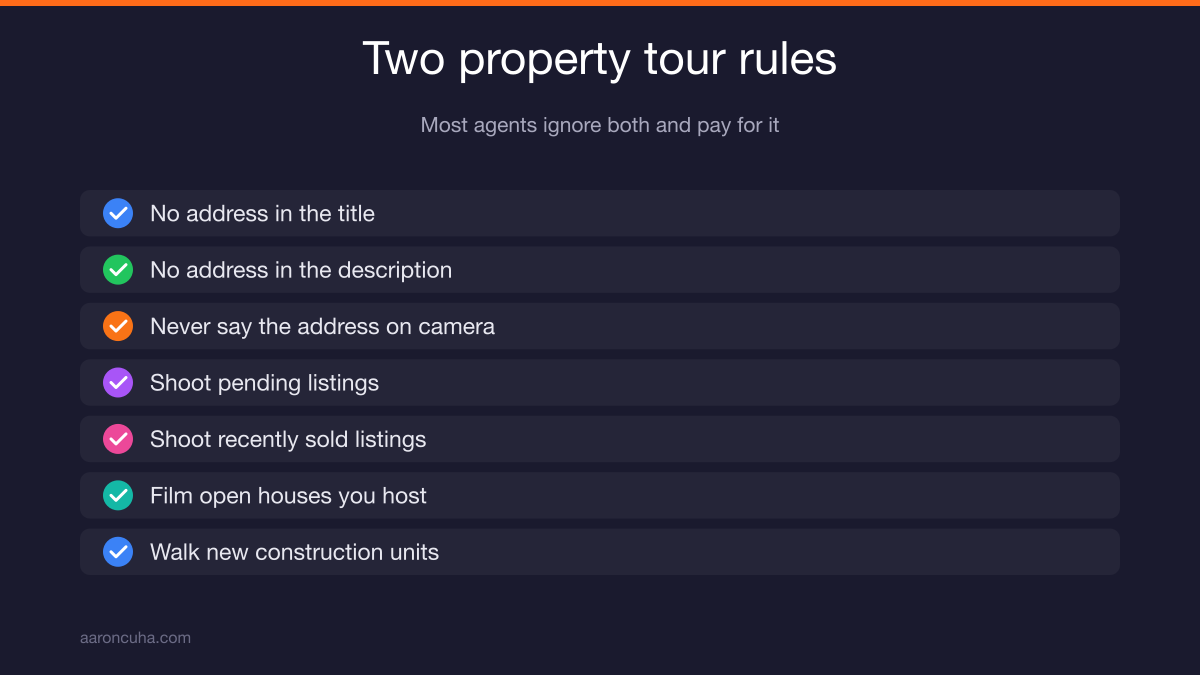
Rule one: never put the address in the title, in the description, or say it on camera. Rule two: shoot pending and sold properties too. Most agents ignore both and pay for it.
On the address, here is what happens when you give it away. The viewer pauses your video, searches the address on Zillow, and books a showing with whoever answers first. You did the marketing work and handed the lead to a portal.
This is the very top of the funnel. You want that viewer reaching out to you, not running a search. Keep the address off the video entirely.
On availability, I had a new client come in with a big team and 40 pending listings. I told them to go shoot every single one before closing.
They pushed back. Those homes are already sold. My answer: I do not care. You have 40 properties you still control, and each one is a video you can shoot fast.
You are not selling the property. You are generating leads. Once you understand that, your inventory problem disappears, because sold and pending listings count too.
Same logic applies to open houses you host for other agents and new construction you can walk. Every unit is a searchable asset. For more on turning single videos into multiple assets, read how to repurpose YouTube content.
Searchable vs Shareable vs Invisible Content
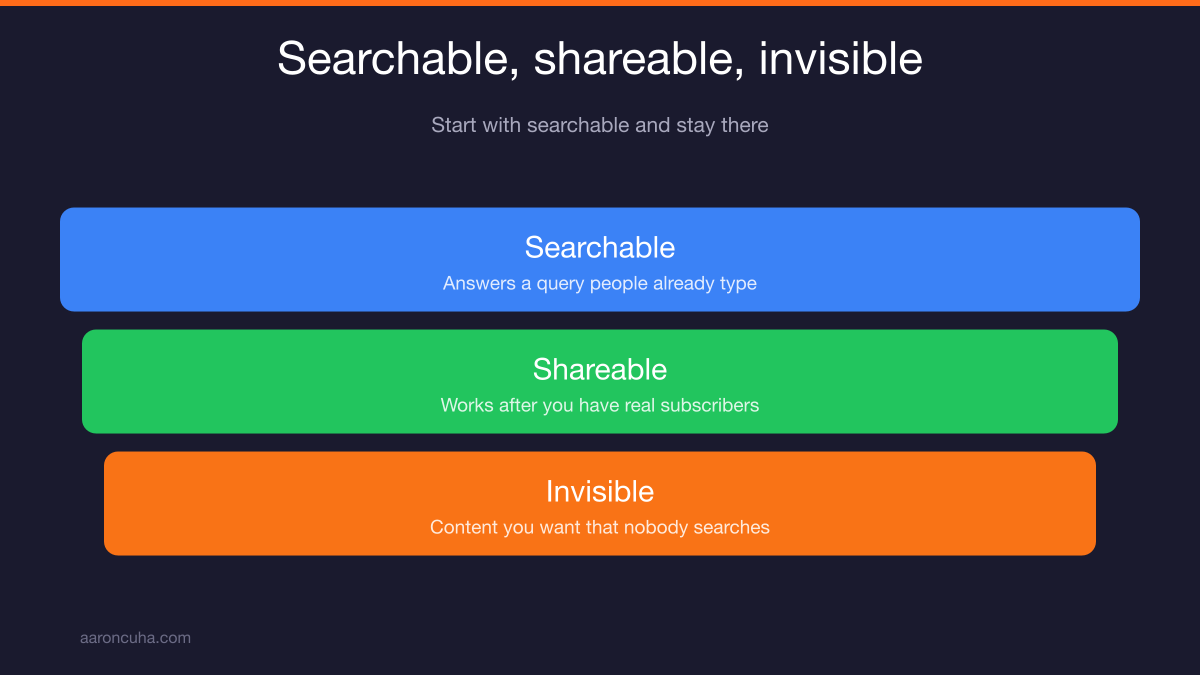
Searchable content answers a question people already type. Shareable content goes viral once you have an audience. Invisible content is what you personally want to make. Start with searchable.
Searchable means someone is already typing "homes for sale in Denver under 500,000" or "best neighborhoods in Austin for families" or "Austin home tours." YouTube puts your video in front of them. You do not need subscribers for that to work. You need YouTube to show your video, and then the subscribe follows.
Shareable is the reaction video. "My reaction to the craziest listing in Austin." "Do not buy here." "The dark side of Austin." People share that.
But viral content only works once you have a following. If you have 100 subscribers and your average video gets 50 views, your viral attempt might get 100 views. That is double, but it is not viral, because the algorithm is not pushing you far enough yet.
Compare that to a client of mine at about 15,000 subscribers. We ran a shareable play and the first video pulled 55,000 views, 2,000 comments, and roughly 10,000 new subscribers in about 10 days. Same tactic, different starting point.
| Content Type | What It Does | When To Use It |
|---|---|---|
| Searchable | Answers a query people already type | Day one, and forever after |
| Shareable | Sparks reactions, comments, shares | After you have real subscriber base |
| Invisible | Content you want to make that nobody searches | Rarely, and never as your foundation |
If you are not answering questions your market already asks, you are invisible. That is the whole rule. YouTube has explained on the YouTube Official Blog that recommendations follow viewer behavior, not your preferences, which is exactly why searchable content comes first. For how the ranking side works now, see how the YouTube algorithm really works in 2026.
You Do Not Need to Be Good on Camera
I think I am horrible on video. I hate watching myself. Most of my clients feel the same way. It does not matter, because my coaching channel is about to pass 100,000 subscribers.
People find me and think: he is like me. They do not mind that I make mistakes. They do not mind that I am awkward sometimes. When I forget what I was going to say, I skip it and move on. I do not fix it in the edit.
That is the part most agents get backwards. The imperfection is the trust signal. Polished, scripted, corporate video reads as an ad. Real reads as a person.
Production quality is the most common excuse I hear for not publishing. It is also the least valid one. Your camera is fine. Your lighting is fine. Your voice is fine.
What matters is whether you answered a question someone is typing. Everything else is a distant second. If you want proof of what consistency does over time, look at client case studies.
How to Build Your Next 10 Videos This Week
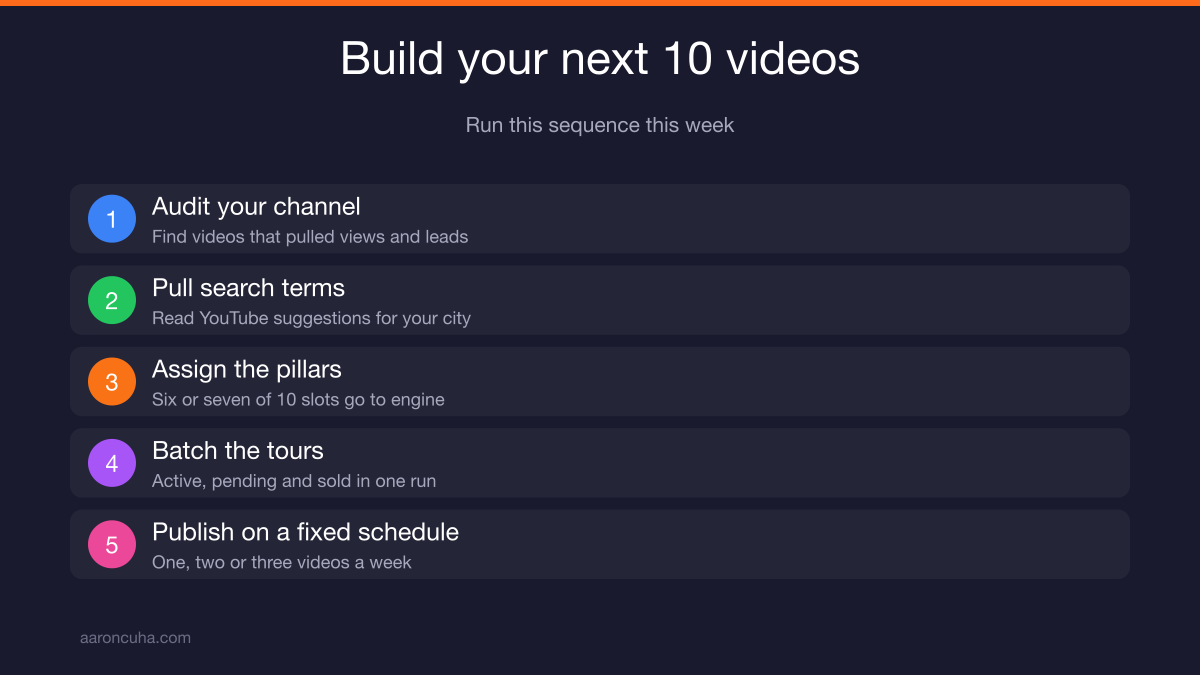
Run an audit, confirm what already works, pull the terms your market is typing, then assign each of your next 10 slots to a pillar. The engine should dominate that list.
Here is the sequence:
- Audit your channel. Find which existing videos actually pulled views and leads. Do more of that.
- Pull search terms. Type your city plus "homes for sale," "home tours," "living in," and "best neighborhoods" into YouTube search and read the suggestions.
- Assign the pillars. Out of 10 slots, six or seven go to engine. One or two to magnet. One to advisor. Maybe one to anchor.
- Batch the tours. Line up every active, pending, and recently sold property you control and shoot them in a run.
- Publish on a fixed schedule. Pick one, two, or three videos a week and hold it.
One warning. Do not build a specialty-only plan. I have had clients tell me they will do neighborhood tours exclusively because that is their niche.
I tell them the same thing every time: nobody will find you, and we will never grow. They tell me I do not know what I am talking about. Then a year later, the channel is flat and I get to say I told you so. I have written five books and coached 20,000 hours, and this pattern never changes.
The framework is not complicated. It is four pillars, a posting split, and the discipline to make content the market wants instead of content you want. That is systems over hustle applied to video.
Pick your 10. Commit to the split. Post them. Then come back and pick the next 10.
If you want a coach to build the plan with you and hold you to it, look at real estate coaching and let us map your next 90 days of content together.
Frequently Asked Questions

Written by
Aaron CuhaAuthor of Crazy Simple YouTube, keynote speaker, and executive coach with 20,000+ hours logged. ICF PCC, NLP Master Practitioner, and DISC Certified. Aaron helps entrepreneurs replace hustle with AI-powered systems that generate leads, content, and revenue on autopilot.