Most real estate YouTube content ideas fail because agents make videos they think are cool instead of videos buyers are already searching for. This system, the one Aaron Cuha walked Tom Ferry through on his podcast, starts with real search demand and turns one video a week into 15 pieces of content.
Most real estate YouTube content ideas fail for one reason: agents make the videos they want to make instead of the videos buyers are already searching for. That one mistake kills channels every day. Here is the system that fixes it.
Key Takeaways
- Build every video around keywords buyers search, not ideas you think are cool.
- Start with one 15-minute property tour per week, shot on your phone.
- YouTube trusts you after 10 to 15 consistent videos, so post before you polish.
- Videos over 10 minutes get a 250% algorithm jump, with 18 minutes as the ceiling.
- Turn one video into 15 pieces of content and 1,500 assets a year.
Want a professional set of eyes on your channel before you shoot another video? Start with a Channel Audit and Plan and find out exactly what is holding your videos back.
The One Mistake Killing Your Real Estate Channel
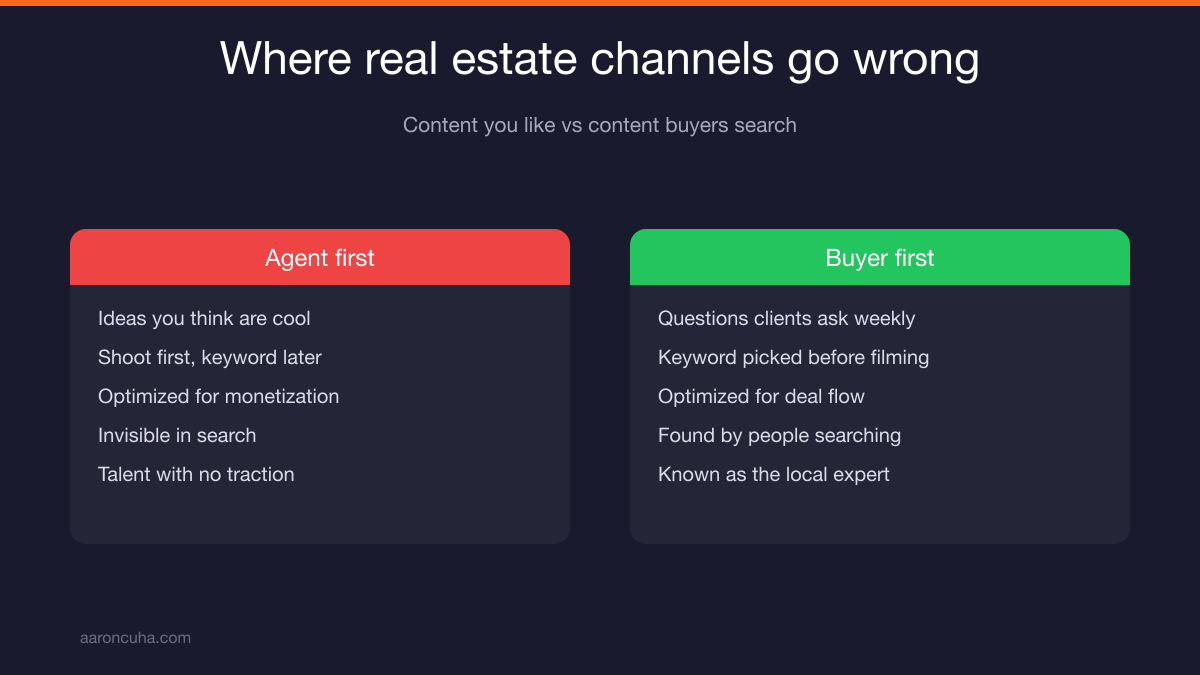
Agents chase content ideas they want to make instead of content their clients are searching for. That is the number one mistake I see, and it stops talented agents cold.
I do not care what you think is cool. I care about what has already worked in other real estate markets on YouTube, and how we can research that for your market.
I see agents with personality, great listings, and real talent going nowhere. The reason is always the same. They refuse to make content people are actually looking for.
Here is the test. Ask yourself what questions your clients ask you every week. Then make videos that answer those questions, with the question itself as the SEO. The question goes in the title. The question goes in the description. Then you answer it on camera.
Do that and you become the expert in your market. Skip it and you stay invisible.
The other thing to understand is what we are optimizing for. Most YouTube experts teach monetization. I do not care what your channel pays you. I care how many deals it creates. Deal flow is the scoreboard.
Once you are famous, make whatever cool stuff you want, as long as people are still finding you.
Why Real Estate YouTube Content Ideas Should Start With Search, Not Inspiration
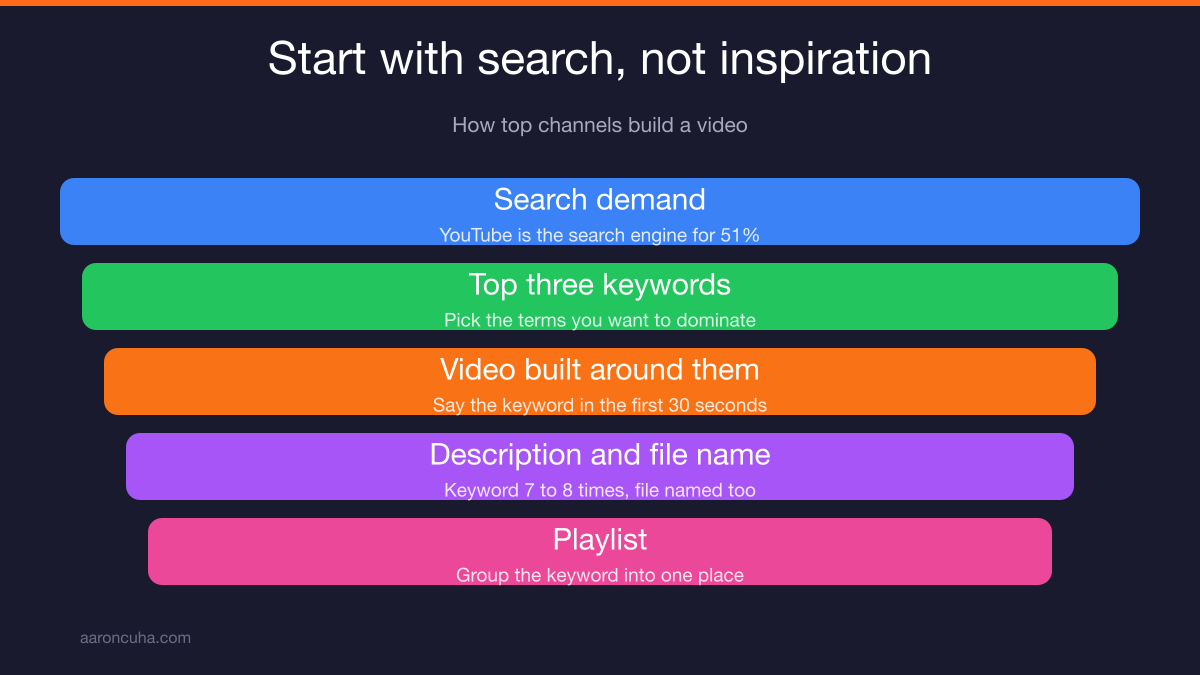
A working youtube real estate strategy starts with search demand. According to YouTube, it is the most popular search engine among 51% of home purchases. Half your buyers are already there.
Think about how famous YouTubers work. They pick the top three keywords they want to dominate. Then they build the video around those keywords.
They say the keyword in the first 30 seconds. They say it three or four times in the video. They put it in the description seven or eight times. The file is named with the keyword. They build a playlist around it.
Most agents do the opposite. They shoot a video first, then try to force it into a search term after the fact. That is backwards, and the algorithm knows it.
Design content people are searching for. Do not design content and then hunt for a search to attach it to.
If you want the deeper breakdown of how ranking actually works right now, read my guide to YouTube SEO and ranking videos.
How to Find What Buyers Are Actually Searching For
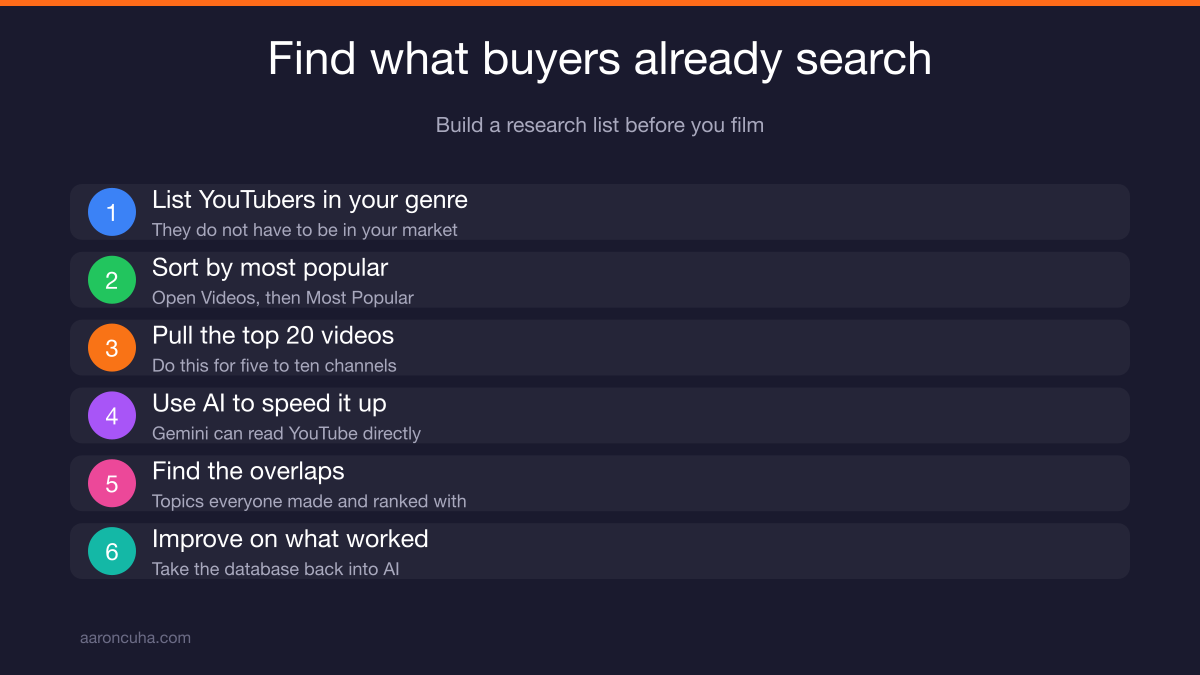
Build a research list. Find the YouTubers in your genre, pull their most popular videos, and look for the videos that everyone ranked with. Those overlaps are your content plan.
This is the exact set of instructions I give every client. Some do it on day one. Some take four years. The ones who do it early win faster.
- Make a list of YouTubers in your genre. They do not have to be in your market, but they can be.
- Go to each channel, click Videos, and sort by Most Popular.
- Pull their top 20 videos into a list. Use AI to speed this up. I use Gemini because it can read YouTube and pull the data directly.
- Look across five or ten channels and find the topics they all made and all ranked with.
- Take that database into AI and improve on what already worked.
The first time I ever made a video about coaching, I went straight to Tom Ferry's channel, sorted by most popular, and researched his top five videos. I would have been stupid not to.
You can also ask Gemini, Grok, or Perplexity who the most popular real estate professionals on YouTube are, excluding television celebrities. That gives you a clean starting list.
Step One: One 15-Minute Property Tour Every Week
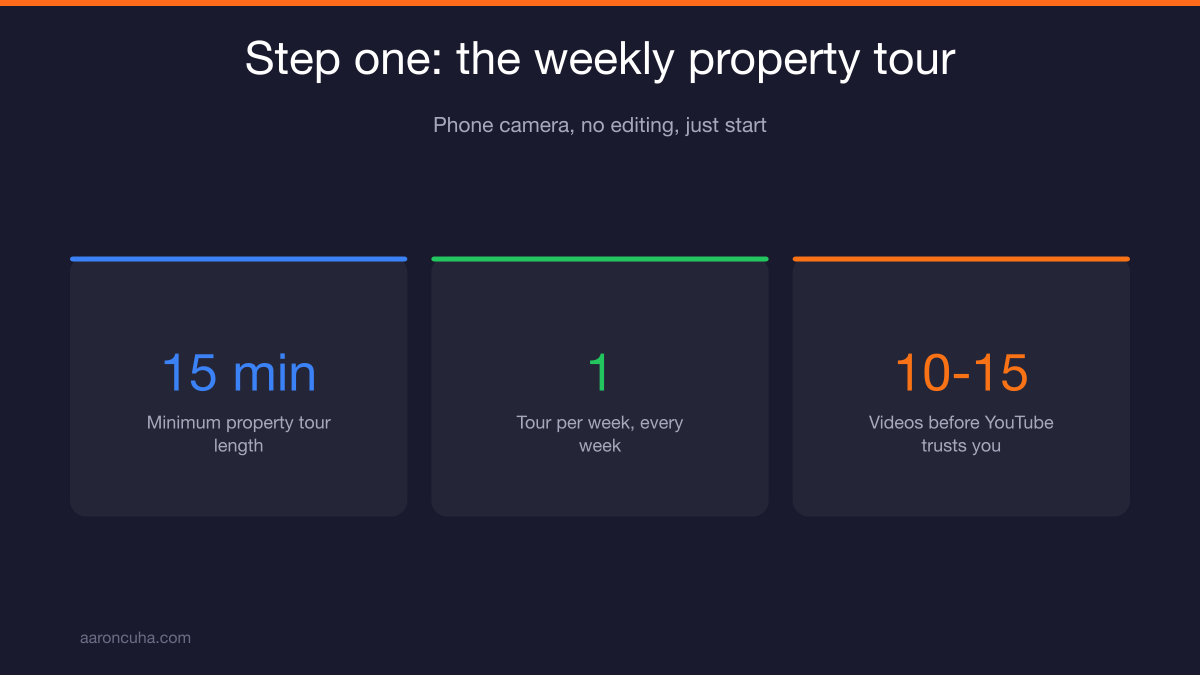
Every new client starts the same way. One 15-minute property tour a week, minimum. Phone camera is fine. No editing required. Just start.
We already know the number one search in every market without doing any research. Buyers search property tours. That is true in a city of 17,000 and true in Beverly Hills.
So we build volume and consistency first. YouTube wants to see 10 to 15 consistent videos before the algorithm trusts you. Until you clear that bar, nothing else you optimize matters much.
You can put as many properties in one tour as you want. One house works. So does a top five list, and people love lists. I have a client at 150,000 subscribers who just posted a 20-minute video on a 600 square foot cabin in Big Bear.
Here is the part agents get wrong. Property tours are not the number one conversion video. That is why so many say they are not converting.
Property tours bring people to the channel. Then your other videos, the ones that show you know the market and know your stuff, convert them. They come for the house. They stay for you.
Once you are consistent, we start adapting. Show me that you know me videos. Expert positioning. Podcasts if you want one. Better hooks, better value bombs. But if we try to cover all of that on day one, you will do nothing.
Put in the reps first. For a market specific playbook, see my full guide on YouTube for real estate agents.
Step Two: Study Agents Who Are Actually Like You
Step two is competitor analysis. Pick agents in similar markets with a similar style, not the celebrity channels. Then scale your volume week by week.
There are some wild real estate YouTubers out there. You do not have to duplicate Josh Altman or Ryan Serhant. Find the people where you look at the video and think, I could see myself doing that, and I like it.
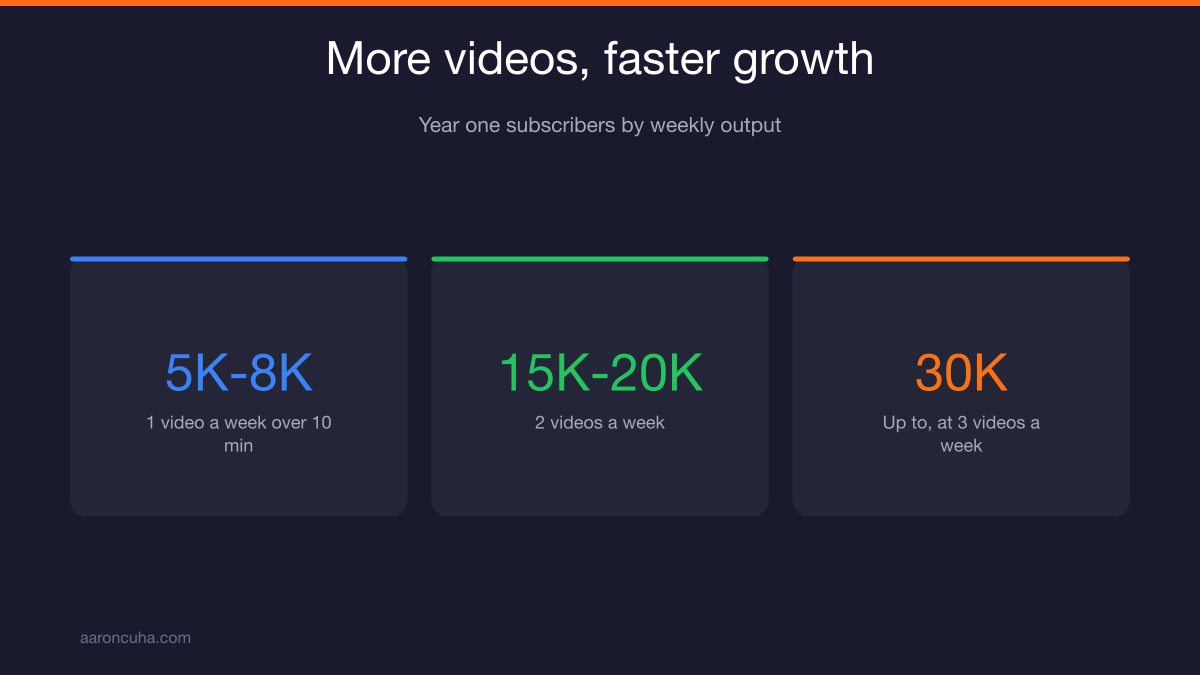
Then you scale. One video a week becomes two. Two becomes three. Growth follows quantity, and the numbers are pretty simple.
| Videos Per Week | Expected Subscriber Growth in Year One |
|---|---|
| 1 video (over 10 minutes) | 5,000 to 8,000 subscribers |
| 2 videos | 15,000 to 20,000 subscribers |
| 3 videos | Up to 30,000 subscribers |
Those numbers assume decent videos over 10 minutes long. Quantity is the lever.
There is a ceiling, and that is fine. Once you hit your total addressable market on YouTube, growth flattens. That is why big channels cut back from five videos a week to three. They do not need the extra volume anymore.
You are nowhere near that ceiling yet. So publish.
Step Three: Keyword Research With AnswerThePublic and TubeBuddy
Take the keywords from your research into AnswerThePublic for related searches. Then run them through TubeBuddy's SEO Studio for search volume, competition, and optimization strength.
AnswerThePublic shows you what else people search around your core terms. That expands one keyword into a content calendar.
TubeBuddy tells me the hard numbers. Searches per month. Weighted competition. Optimization strength. I am in TubeBuddy about 20 times a day with clients, reviewing keywords.
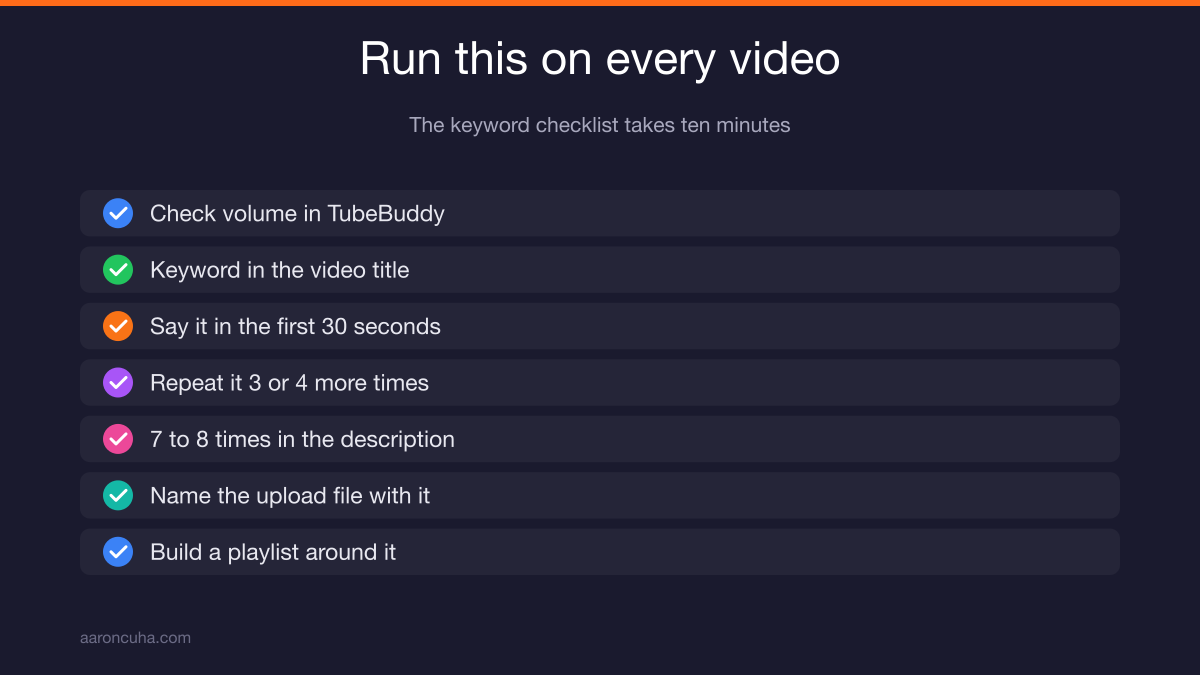
Once you have your keyword, run the on-page checklist every single time:
- Put the keyword in the video title.
- Say the keyword out loud in the first 30 seconds.
- Say it three or four more times during the video.
- Use it seven to eight times in the description.
- Name the uploaded file with the keyword.
- Build a playlist around the keyword.
That checklist is the difference between a video that gets found and a video that disappears. It takes ten extra minutes. Do it every time.
If you want more on how discovery works under the hood, the official YouTube blog is worth following, and I break down the current mechanics in my post on how the YouTube algorithm really works.
If you would rather have someone build this keyword map with you instead of guessing, book a YouTube strategy session and we will map your first 12 videos together.
Thumbnails: The Second Most Important Thing After Impressions
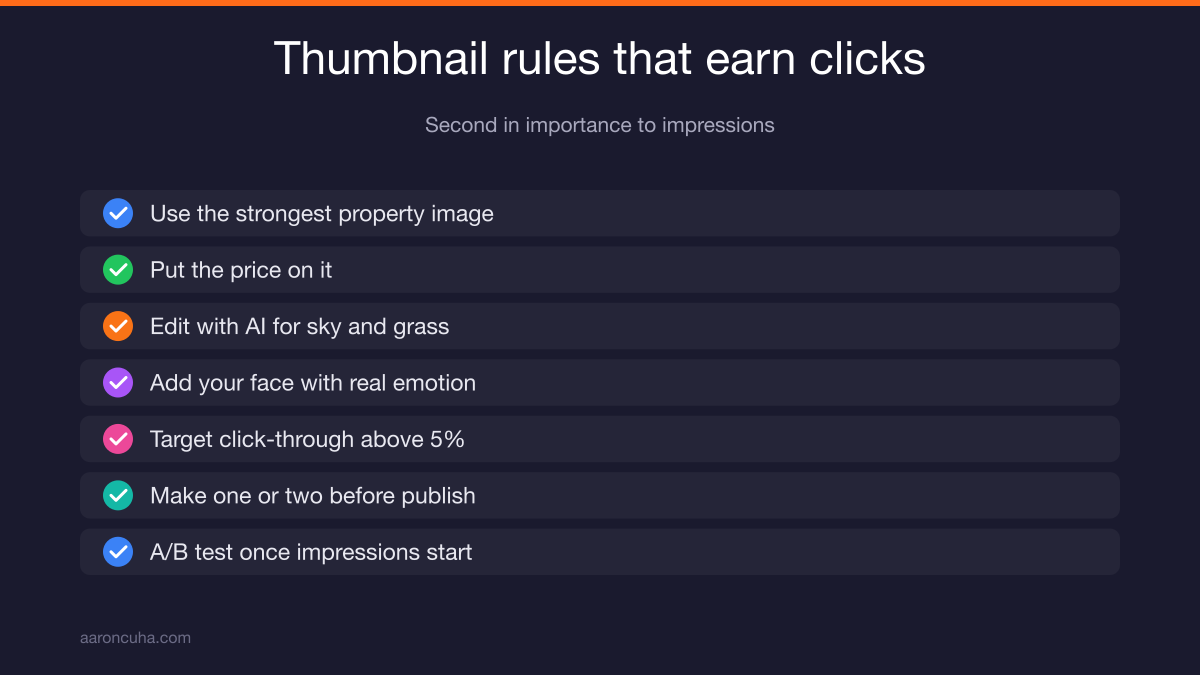
Once YouTube gives you impressions, your thumbnail decides everything. For a property tour, use the most beautiful image of the property you can get, edited with AI, with the price on it.
This is not the MLS. Nothing is stopping you from making it perfect.
Give me a blue sky. If the grass is brown, make it green. Use the kitchen, the view, or the front elevation, whichever is the strongest image on the property.
If you like being on camera, put your face in the thumbnail with real emotion. Faces with emotion get more clicks. That has held true across every market I work in.
Target a click-through rate above 5% on everything. That is difficult, which is exactly why it is worth chasing.
Here is the practical method. Make one or two thumbnails before you publish. Once the video is live and impressions start coming in, run split A/B tests and let the data pick the winner.
Then watch two numbers together. Impressions tell you if YouTube is showing your video. Click-through tells you if your thumbnail earned the click. For deeper design rules, read my YouTube thumbnail tips.
The Hook: The First 8 Seconds Decide Everything
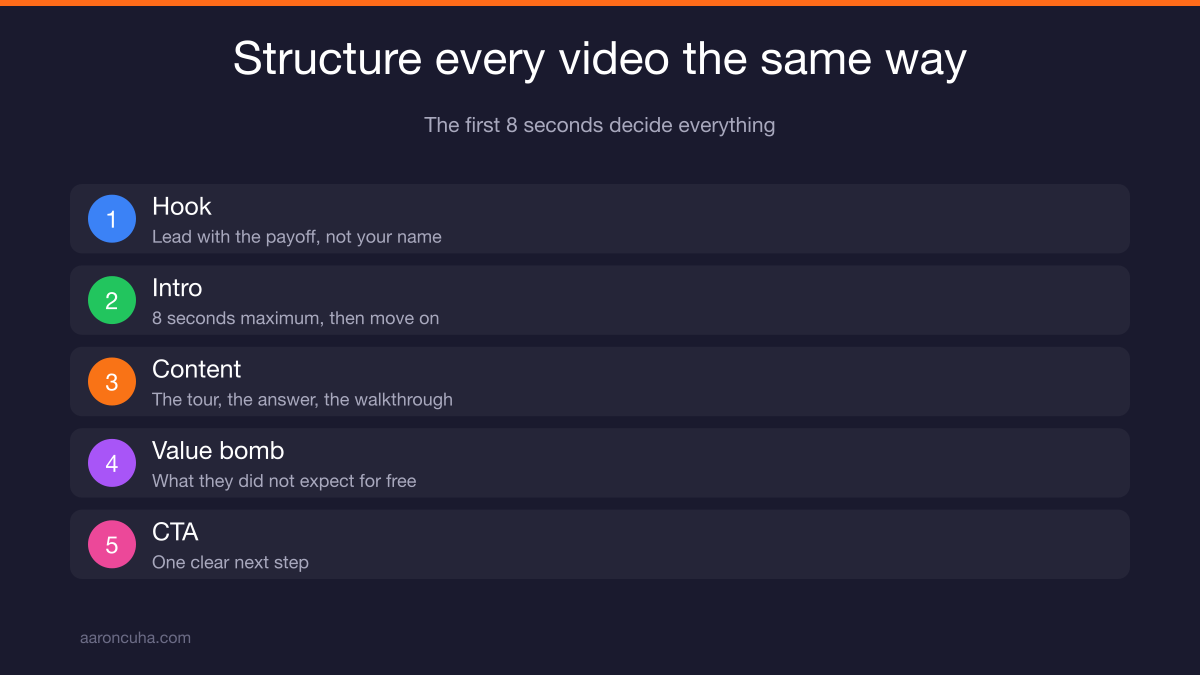
Never open with your name and brokerage. Open with the payoff. Tell them what they are about to see and why it matters, then give a maximum of 8 seconds of intro.
Bad opening: "Welcome everybody, I am Aaron with Banana Real Estate."
Good opening: "You are not going to believe the kitchen on this property. If you are a home chef, when I get to that kitchen it is going to blow you away."
See the difference? One asks for attention. The other earns it.
After the hook, you get eight seconds of intro. No more, or you lose them. Then go straight into the tour or the topic.
Structure every video the same way:
- Hook. The payoff, up front.
- Content. The tour, the answer, the walkthrough.
- Value bomb. The thing they did not expect to get for free.
- CTA. One clear next step.
That order works whether the video is three minutes or eighteen.
Video Length: Why 10 Minutes Is the Line and 18 Is the Ceiling
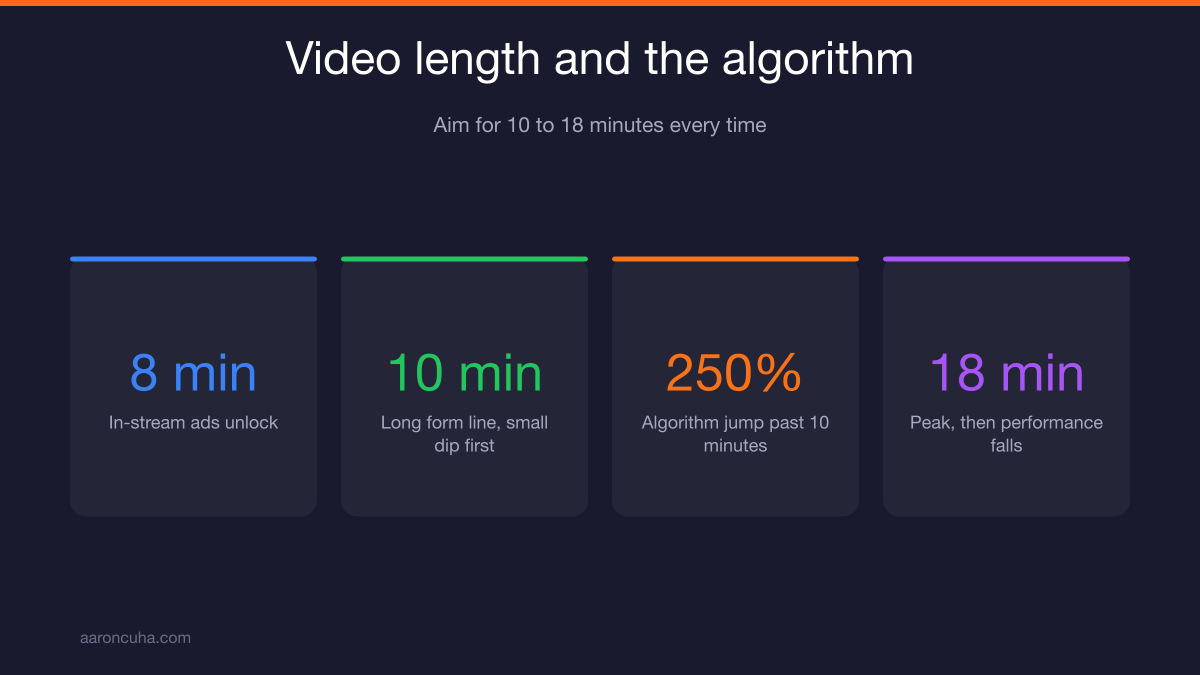
Long form means over 10 minutes, period. Crossing that line produces roughly a 250% jump in algorithm performance for that video. Performance keeps climbing to 18 minutes, then declines.
Here is the pattern. At 8 minutes you unlock in-stream ads. At 10 minutes there is a small dip, then performance climbs steadily. We ran an AI analysis across 10 million videos and the curve goes up and up until about 18 minutes.
Then it falls off. Every TED Talk is 18 minutes. There is a reason for that.
Now the exception that matters more than the rule. If you can only get a three minute video out this week, post the three minute video.
Missing a week costs you more than a short video does. The algorithm punishes gaps. A three minute upload beats nothing every single time.
So aim for 10 to 18 minutes. Protect the weekly release above all else.
The 2026 Distribution Plan: One Video, 15 Pieces of Content
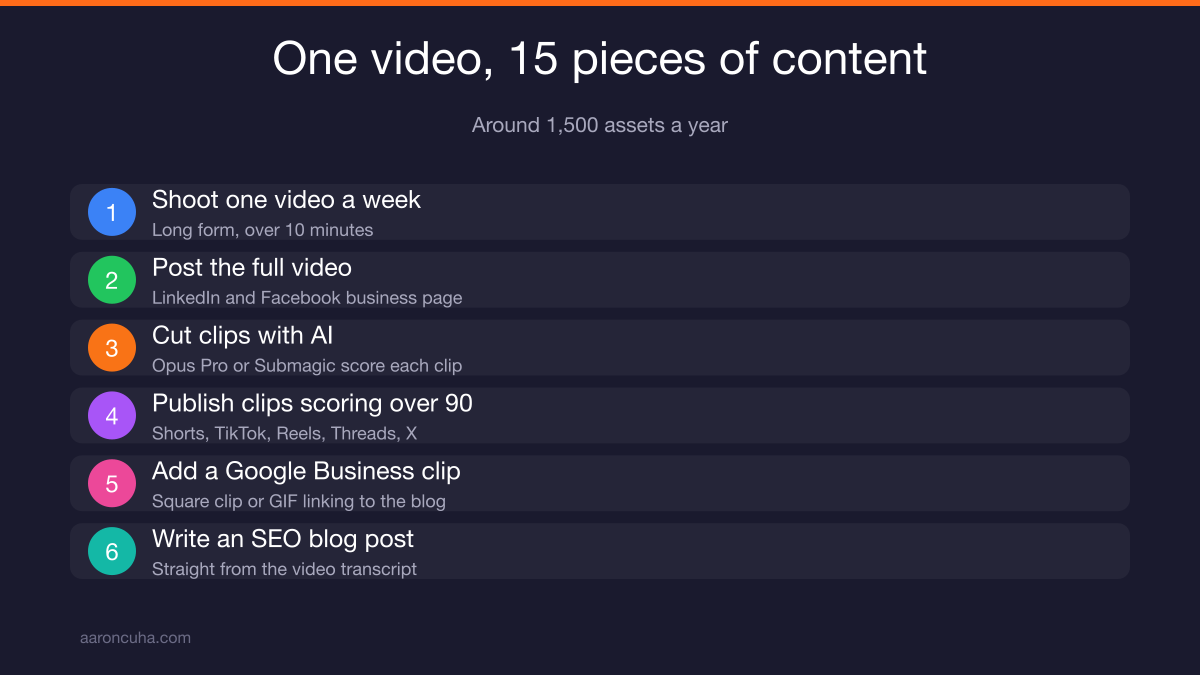
Shoot one video a week and turn it into 15 assets. The full video goes to LinkedIn and your Facebook business page. Then AI cuts it into clips for every short-form platform.
Post the long video on your Facebook business page, not your personal page. Then run the video through Opus Pro or Submagic. Those tools cut 20 or 30 shorts and score each one from 80 to 99.
Anything scoring over 90 goes out. Here is where it goes:
- YouTube Shorts
- TikTok
- Instagram Reels
- Facebook Reels
- Threads
- X
Then cut a square clip or a GIF for your Google Business Profile that links back to your blog post. Write a full SEO blog from the video transcript too.
Do not post to each platform by hand. Use one scheduler like SocialPilot or HubSpot, upload once, and push everywhere.
Run that math. Fifteen pieces of content per video, one video a week, and you produce around 1,500 pieces of content a year. That is complete omnipresence. Everybody starts telling you they see you everywhere.
Let perfection go. Volume plus consistency is what creates the feeling of being everywhere. I break the full workflow down in how to repurpose YouTube content and the Authority Flywheel.
What Results Look Like and Why Market Size Is Not an Excuse
With good SEO, good impressions, and good thumbnails, expect significant results in three to six months. The exact pace depends on your quantity.
Market size changes the math, but not the strategy. I have a client, Leah, in a city of 17,000 people. When we do something really good there, she gets 20 leads from it.
I have a client in Beverly Hills. We do something good and sometimes we get nothing, because the competition is brutal.
Small market agents often have the bigger advantage. Less competition means less to beat.
I have an agent in Jasper, Alabama with an average sale price around $150,000. We found a lake market 45 minutes away where the average was $1.5 million. We attacked it with YouTube. He is now the number two agent in that market.
The number one agent there does YouTube too, so we analyzed his channel. No SEO. No thumbnails. He was going to shoot for six months and quit. That market is wide open.
Speed is possible. I have a client who has been with me 45 days. We changed his entire strategy. He went from 3,000 to 10,000 subscribers, and from one lead a month to four or five leads a week.
Real estate is not slowing down either. The National Association of Realtors consistently reports that buyers begin their search online, and video is where that search now lives.
Consistency Beats Polish (The Bar Is Embarrassingly Low)
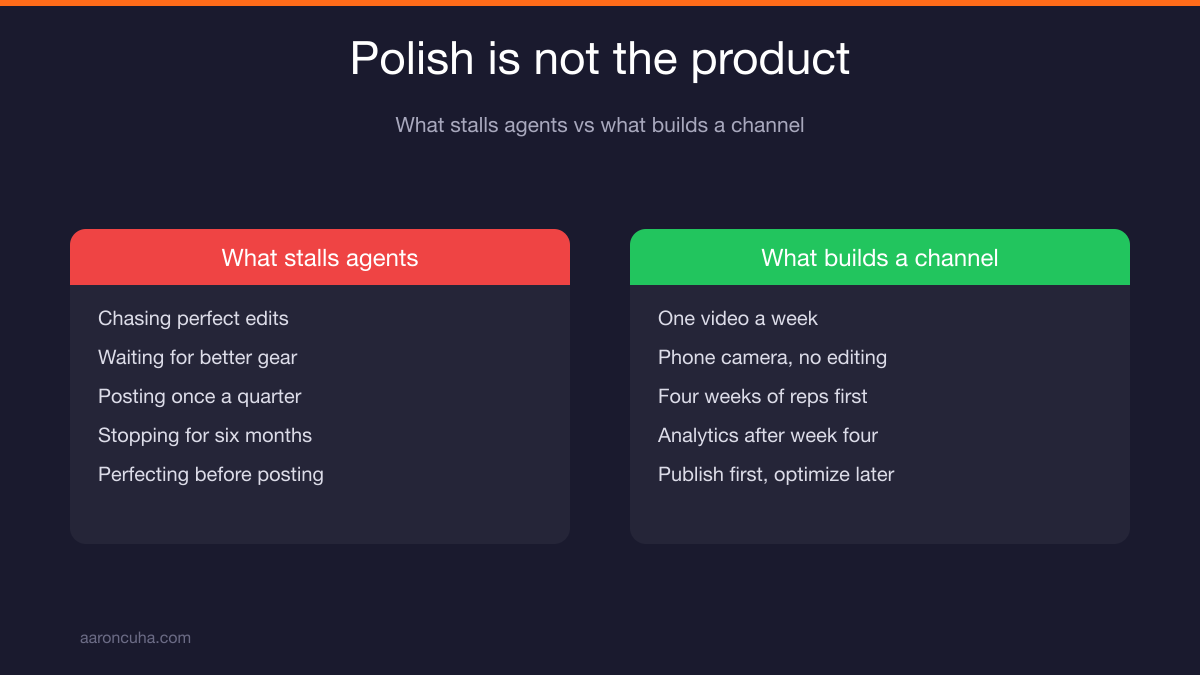
Most agents start a channel and then stop posting for six months. That is your opening. You do not have to be Spielberg. You have to be consistent.
The bar in real estate YouTube is embarrassingly low. There is room for the next person to elevate in every marketplace in the country.
I have clients who try to be really polished and get nowhere. Polish is not the product. You are.
Go out and be yourself. Drop the phone, pick it up laughing, and post it anyway. People are attracted to that.
Then something strange happens. You show up to a listing appointment and the seller runs out of the house and hugs you. You have never met. They have watched you for months.
Here is how to start. Give me one video a week for the next four weeks. That is it. Build the neural pathway of shoot and post.
After four weeks, get better. Study the analytics. How many impressions did the video get? What is the click-through ratio? What is the average view duration?
Most people try to perfect all of it at the beginning and end up doing nothing. Publish first, optimize second. For the metrics that matter, read my YouTube analytics guide.
Ready to build a channel that produces deals instead of vanity numbers? Grab a copy of Crazy Simple YouTube and start your first four weeks this week.
Frequently Asked Questions
How long does a YouTube real estate strategy take to produce leads?
With solid keyword research, strong thumbnails, and consistent uploads, expect meaningful results in three to six months. The pace depends on how many videos you publish each week. One video a week is the floor. Two or three speeds everything up.
What kind of video should real estate agents post first?
Start with one 15-minute property tour every week. Property tours are the number one search in every market, big or small. Shoot on your phone, skip the editing, and get 10 to 15 videos up so the algorithm learns to trust your channel.
Do property tour videos actually convert buyers into clients?
Not by themselves. Property tours bring people to your channel. Your market update, neighborhood, and cost of living videos convert them, because those show you know your stuff. They come for the house and they stay for you.
How do I find the right YouTube keywords for real estate videos?
Pull the top 20 videos from five to ten real estate channels, find the topics they all ranked with, then expand those terms in AnswerThePublic. Run the finalists through TubeBuddy to check search volume, competition, and optimization strength before you shoot.
What video length works best for real estate video marketing?
Go over 10 minutes. Crossing that line produces roughly a 250% jump in algorithm performance, and the curve keeps climbing until about 18 minutes. If a short video is all you can film this week, post it anyway. Missing a week hurts more.
Does YouTube real estate lead generation work in a small market?
Yes, and often better. One of my clients in a city of 17,000 gets 20 leads from a single good video, because almost nobody is competing for those searches. Small markets have less to beat, so your videos rank faster.
Do I need professional gear or an editor to start?
No. A phone and a weekly upload beat polished videos posted once a quarter. Polish is not the product, you are. Once the habit is built, add better hooks, better thumbnails, and clips through a Shorts strategy or hands-on real estate coaching.

Written by
Aaron CuhaAuthor of Crazy Simple YouTube, keynote speaker, and executive coach with 20,000+ hours logged. ICF PCC, NLP Master Practitioner, and DISC Certified. Aaron helps entrepreneurs replace hustle with AI-powered systems that generate leads, content, and revenue on autopilot.