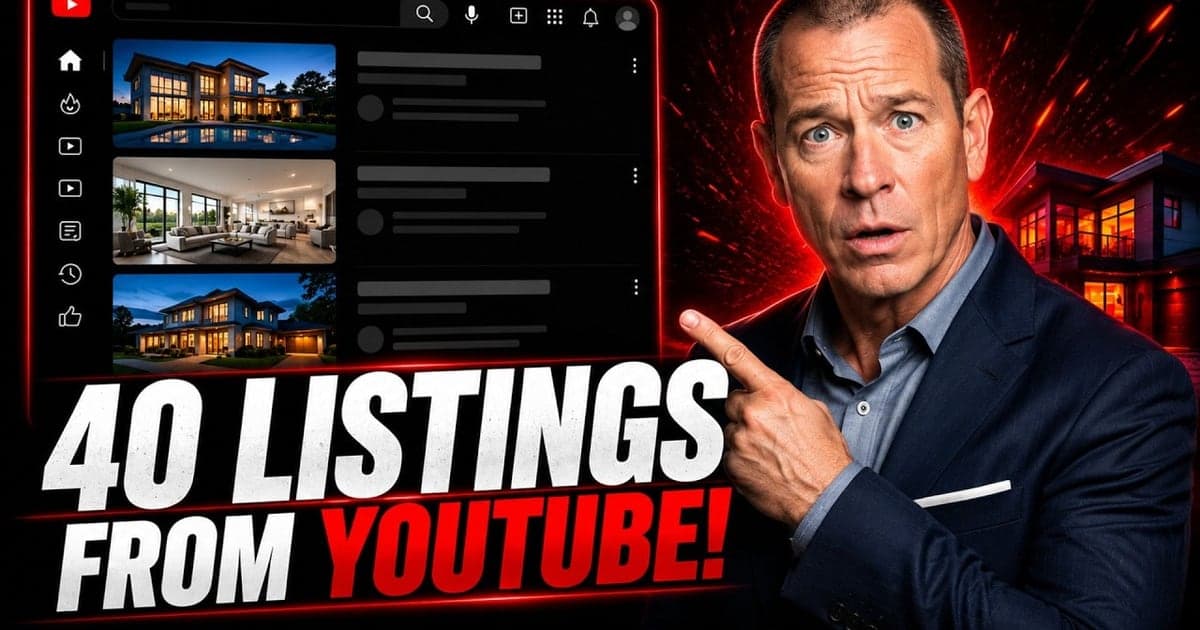
Nobody is searching your name. This breakdown of why real estate agents fail at YouTube covers the six differentiators that separate a real estate channel that books listings from one that stays dead, plus the AI channel analysis prompt I give my coaching clients.
Here is why real estate agents fail at YouTube: nobody is searching your name. Buyers search homes for sale, property tours, and best neighborhoods. Right now an agent with a six month old channel and a $200 phone is outranking you, and any youtube strategy 2026 worth running starts by fixing that.
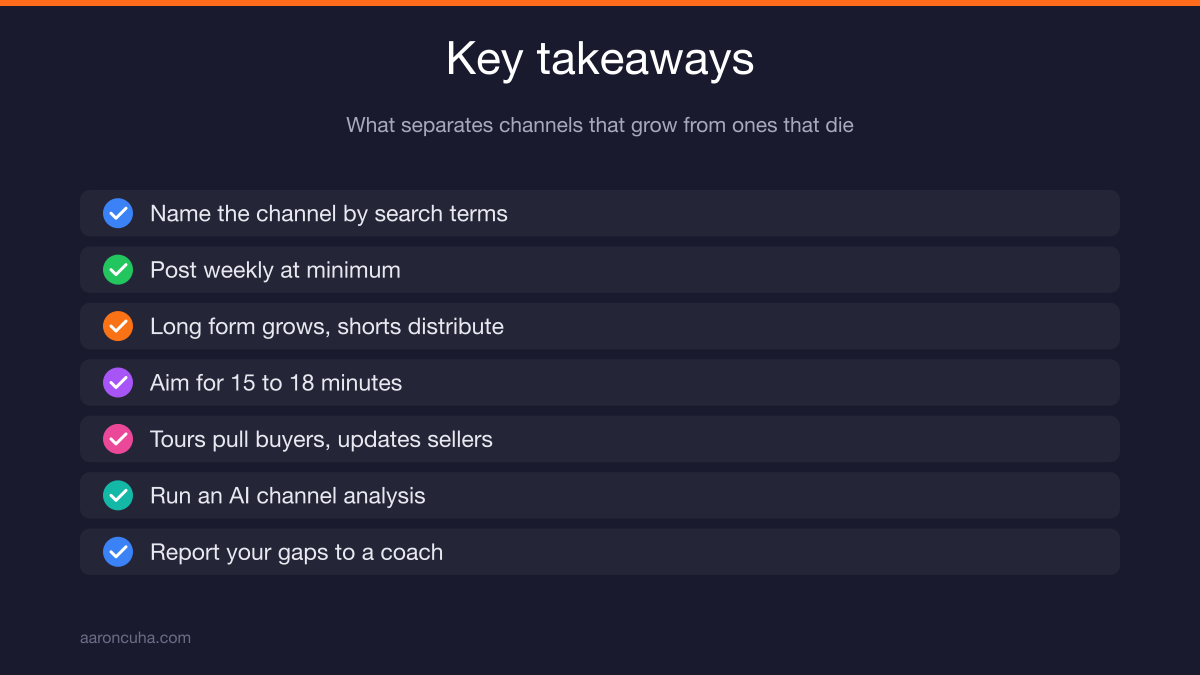
Key Takeaways
- Name your channel by market search terms first, your name second.
- Post weekly minimum. Twice a week beats once. The algorithm rewards patterns.
- Long form drives growth. Shorts distribute. Aim for 15 to 18 minutes.
- Property tours pull buyers. Market updates and interviews pull sellers.
- Run an AI channel analysis in Gemini, find three gaps, report to a coach.
Ready to see where your channel actually stands? Start with a Channel Audit and Plan and get a straight answer on what is holding your growth back.
Nobody Is Searching Your Name
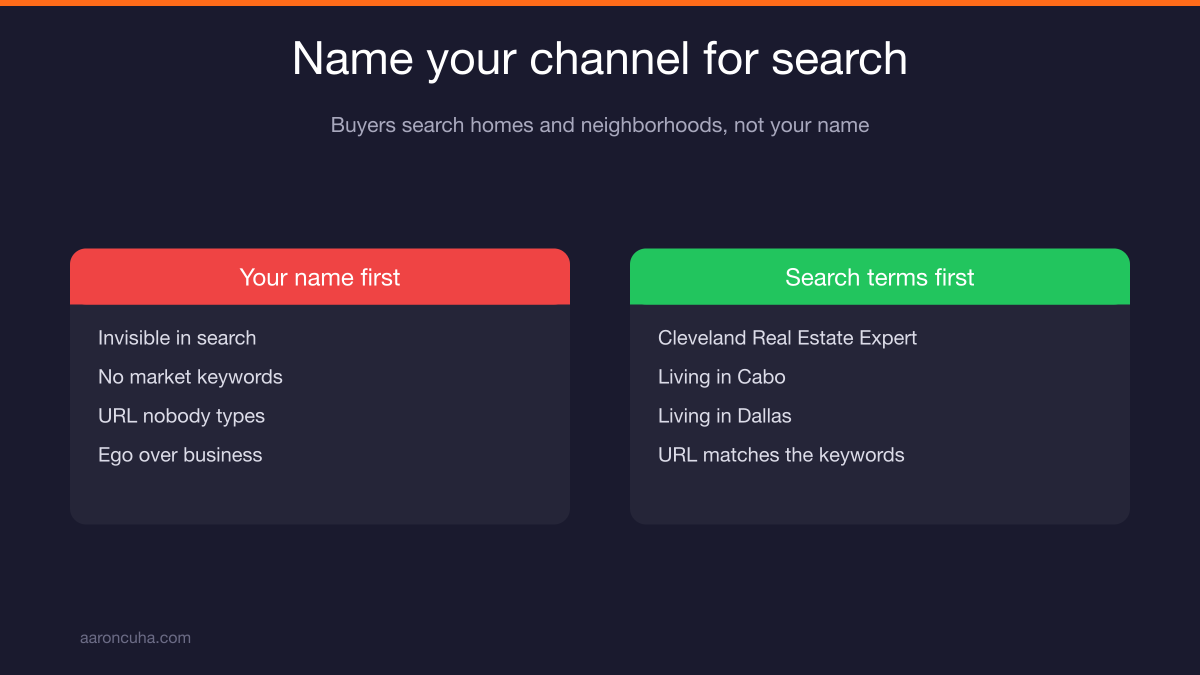
Your name is not a search term. Buyers and sellers type in homes for sale, property tours, and best neighborhoods. If your channel is named after you, you are invisible.
This is the first thing I fix with almost every agent I coach. They blame the algorithm. They blame the market. They blame their camera. Meanwhile a brand new channel in their city is ranking for every search term that matters.
Put the most important information first and your branding second. If Ashley works in Cleveland, her channel should read something like Cleveland Real Estate Expert, then a dash, then Ashley Gerber. Not the other way around.
I am launching a channel in Cabo San Lucas with a client right now. It is called Living in Cabo. Look at Levi in Dallas. Living in Dallas. The pattern is the same everywhere.
Ask yourself one question. What are the top search terms in my market? Then name your channel and your URL after the answer.
If you put your name first, that is your ego talking, not your business. Do not be a fool.
Why Real Estate Agents Fail at YouTube: The 6 Differentiators
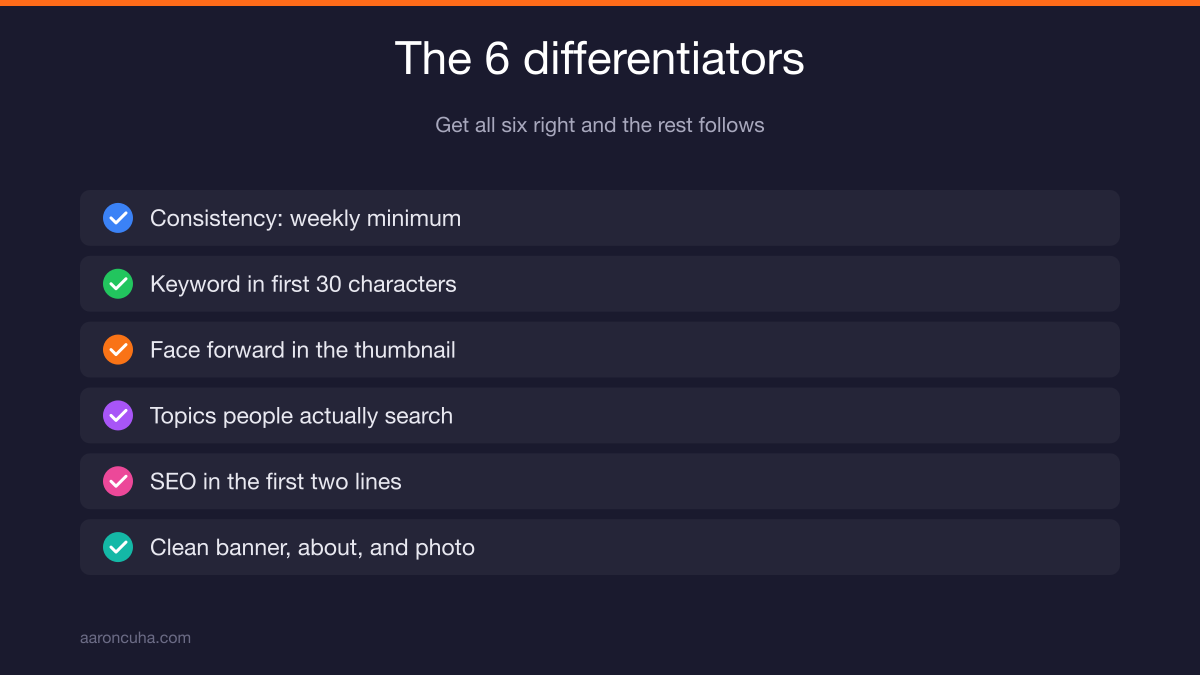
Six things separate a channel that works from a channel that dies: consistency, keyword-first titles, face-forward thumbnails, searched topics, real SEO, and clean branding. Get all six right and everything else follows.
Here they are in detail.
- Consistency. Weekly posting at minimum. The algorithm rewards patterns more than it rewards brilliance.
- Titles. Keyword first, always inside the first 30 characters. Clear and specific beats clever.
- Thumbnails. Your face up front, not way in the back. We need to see you and we need to see emotion.
- Topics people actually search. Property tours. Questions buyers and sellers really ask.
- SEO. Description, tags, and your keywords inside the first two lines. That is the key.
- Branding. Banner, about section, profile photo.
Someone decides in about five seconds whether your channel looks legit. Five seconds to decide if they are going to watch you or subscribe.
One more thing on your bio. Write it as if you are talking to a potential buyer or seller. Not a list of your awards. Tell them what you do for them.
If you want the deeper version of this, I broke it down in the complete guide to YouTube for real estate agents.
Why Weekly Posting Beats Monthly Every Time
The algorithm rewards patterns. Weekly beats monthly every single time. Twice a week beats once a week. Volume with rhythm is what moves a channel.
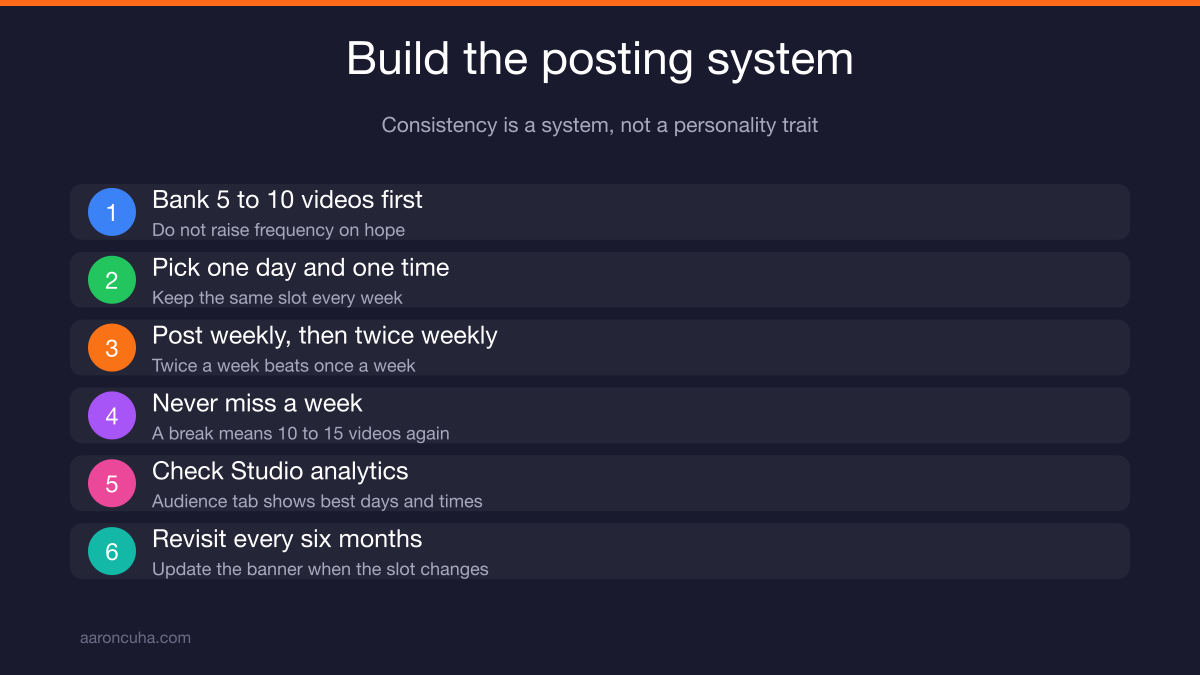
Here is the part most agents miss. Do not jump to two videos a week on hope. Get five to ten videos in the can first. Then increase frequency.
Why? Because missing a week resets you. This works like Hard 75. Mess up and you go back to zero. After a break, the algorithm wants to see 10 to 15 videos again before it starts showing you love.
Post the same day and the same time every week. If you add a second or third video, keep that slot fixed too.
YouTube Studio will tell you your best days and times under analytics and audience. If your channel is too new for that data, use Gemini to pick your two best posting slots.
Revisit that schedule about every six months based on what the analytics say. When you change it, update your banner so your audience knows.
Consistency is not a personality trait. It is a system. That is the whole argument behind Systems Over Hustle.
What This Looks Like in Real Client Channels
Agents who go all in on frequency get results fast. Agents who post once a month for two years get nothing. I have watched both play out inside my coaching for years.
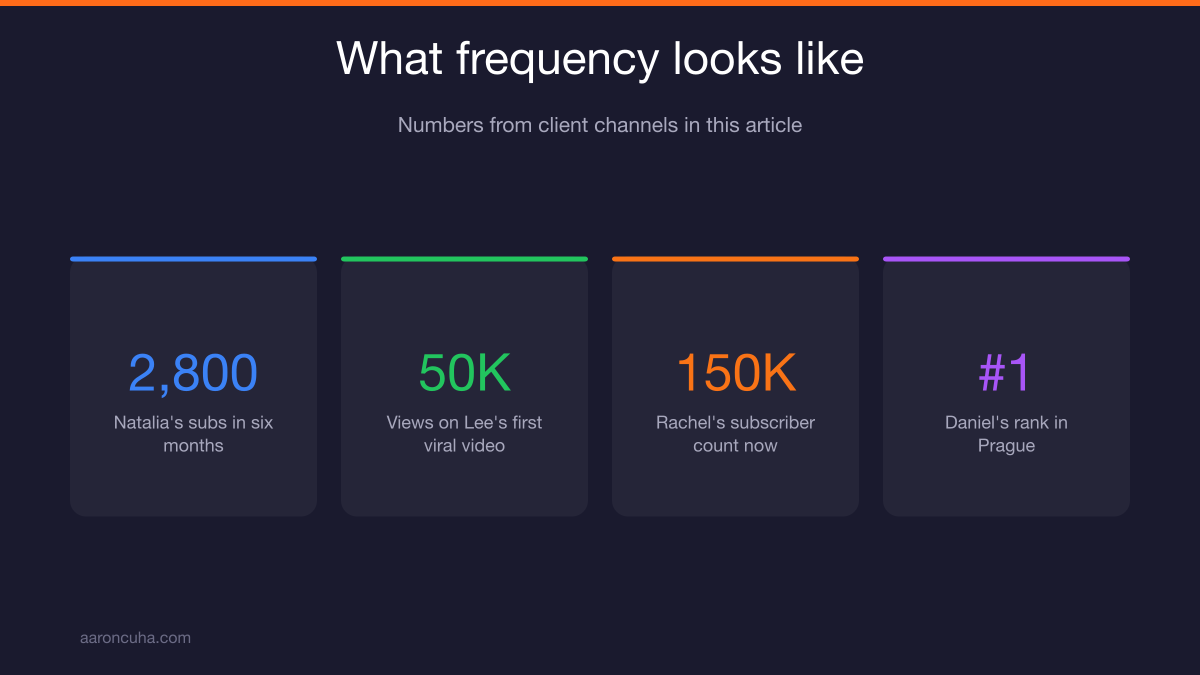
Natalia in Weston, Florida posts three videos a week. In six months she has grown to 2,800 subscribers doing exactly what the system calls for.
Lee Courage started with a solid base of a little under 20,000 subscribers. Then she leaned into viral content. Her first viral video hit 50,000 views. It brought her about 30 leads and six or seven deals between listings and buyers. She added roughly 4,000 to 5,000 subscribers in 30 days.
That video has around 1,700 comments on it. The algorithm saw the comment volume and pushed it hard.
Rachel Smith is the clearest before and after I have. For two years she did about one video a month and never really bought in. Nothing happened.
Just under two years ago she went all in. Three videos a week. Very little editing. Organic and authentic. She has a YouTube Silver Play Button for crossing 100,000 subscribers and now sits around 140,000 to 150,000. She blew past my big channel, which honestly bugs me.
She also has over 40 listings in a market with 400 total listings. That is 10 percent of her market. And she is a better agent now than when she started.
Patrick O'Connor took a different route. We went hard after paid promotion from a fairly small channel. He has grown two or three thousand subscribers in two months and his lead count has doubled or tripled. It pays for itself.
Daniel in Prague came to us around the 60th ranked agent in his city. Four years later, one video a week, he is the number one agent in Prague.
Long Form vs Shorts: What Actually Grows a Channel
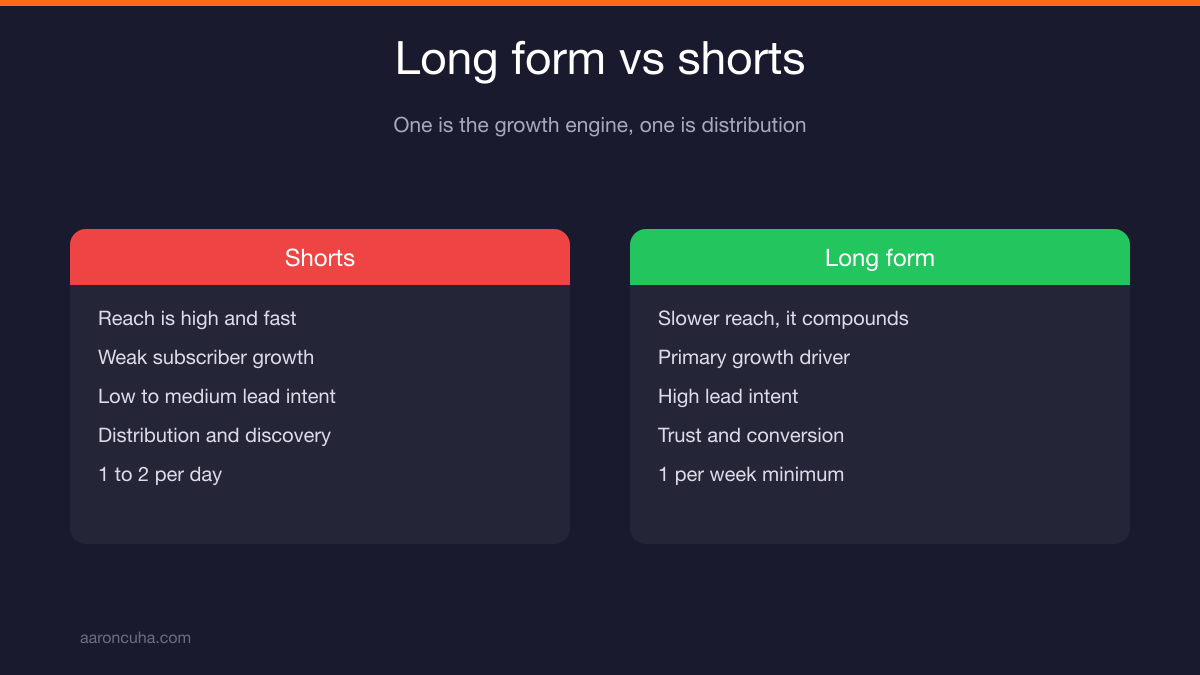
Long form is the growth engine. Shorts are distribution. They do not have the same impact and anyone telling you otherwise has not run the test.
I ran the test on my own channels. On my coaching channel we posted shorts only, every day, for a full year. It grew to about 2,000 to 3,000 subscribers. Decent. Not great.
On my other channel I posted one long form video every day for a year. That one grew to 10,000.
Then I combined both. Long form plus shorts on that little coaching channel, Got Coach. It is somewhere around 70,000 now.
If you posted one long form video a day plus three shorts a day, you would be at 30,000 or more at the end of year one. There is no amount of volume you cannot handle if you build the system for it.
| Factor | Shorts | Long Form |
|---|---|---|
| Reach | High and fast | Slower but compounds |
| Subscriber growth | Weak on its own | Primary driver |
| Lead intent | Low to medium | High |
| Role in the system | Distribution and discovery | Trust and conversion |
| Minimum cadence | 1 to 2 per day | 1 per week |
Your baseline is one long form video a week, preferably with four shorts pulled from it. More on how to do that in a minute.
I go deeper on the short form side in my YouTube Shorts strategy breakdown.
How Long Should Your Videos Be?
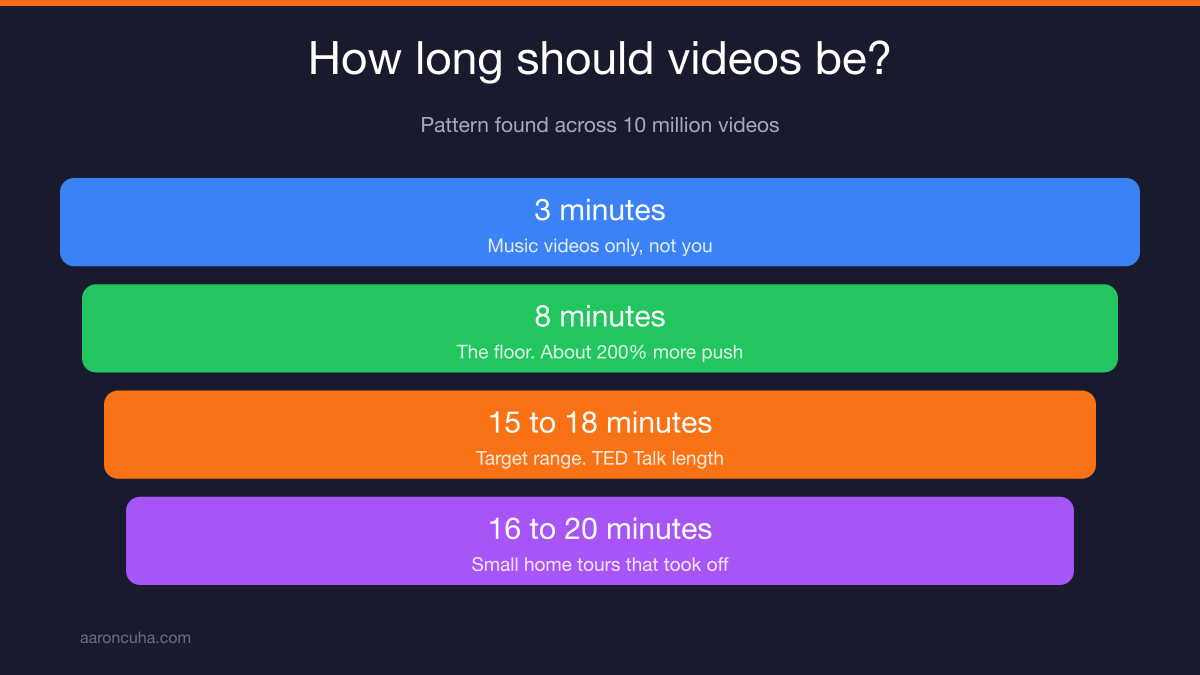
Eight minutes is the floor. Fifteen to 18 minutes is the target. Anything under eight minutes leaves algorithm reach on the table unless you are a musician.
We analyzed over 10 million videos with AI to find the pattern. The first peak sits at three minutes. That peak is music videos. If you are singing, you get three minute videos. If you are not singing, you do not.
The next big peak is at eight minutes. At eight minutes we saw roughly a 200 percent lift in algorithmic push. The reason is simple. YouTube runs mid-roll ads at eight minutes and YouTube is in the business of making money.
From there the curve keeps climbing to 15 to 18 minutes. Ever notice every TED Talk runs 18 minutes? There is science behind that number. Make 15 to 18 your magic range.
The pushback I always get is, what am I going to talk about for 10 minutes?
Go watch Rachel Smith tour an 800 square foot cabin in Big Bear. That video ran 16 minutes and went through the roof. Go watch my client Scott Himmelstein spend 20 minutes inside a 600 square foot shack.
It is not about what you want to show. It is about what your client wants to see. If they are shopping for that house, they want everything. Show the pantry. Open the closets.
One client told me he kept losing viewers every time he showed the dishwasher. I told him to say something funny at the dishwasher. Problem solved.
Want a personalized plan instead of guessing? Book a YouTube strategy session and we will map your title, length, and posting schedule together.
How to Multiverse One Video Across Every Platform
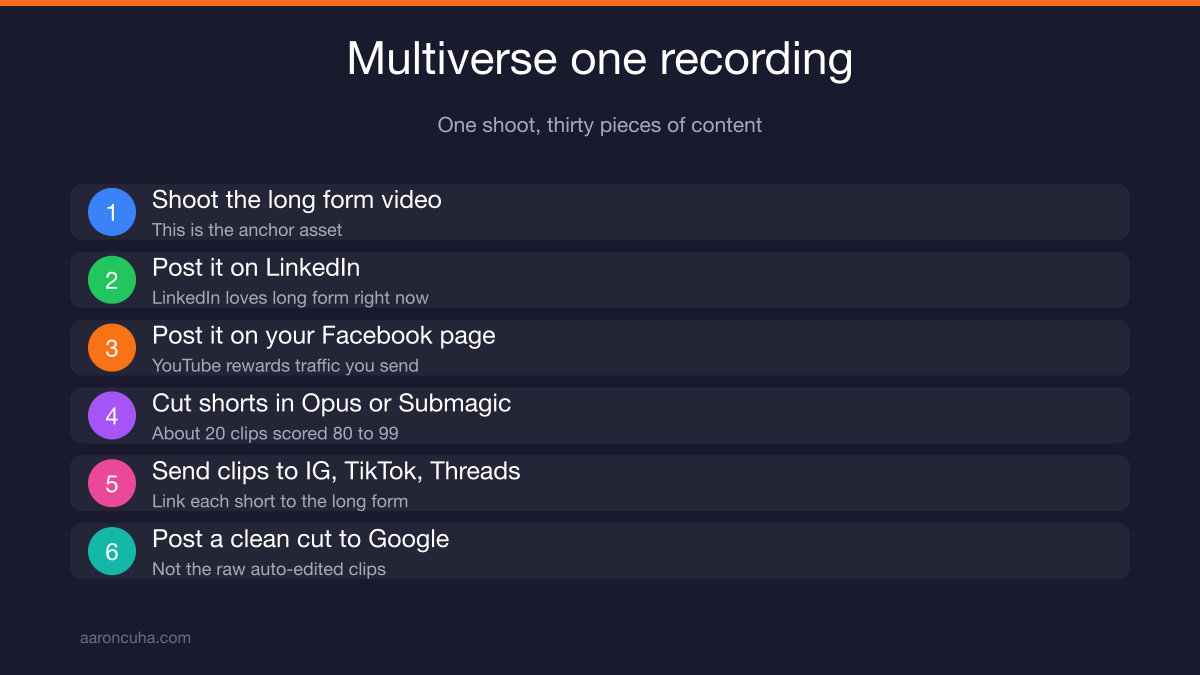
Shoot one long form video, then push it everywhere. YouTube gets the long form and the shorts. LinkedIn, Facebook, Instagram, TikTok, and Google Business Profile get their own cuts.
Here is the flow I use.
- YouTube long form. This is the anchor asset. Everything else comes from it.
- LinkedIn. Post the long form occasionally. LinkedIn loves long form right now.
- Facebook business page. Post the long form occasionally. YouTube tracks traffic you send from Facebook and rewards you for it.
- Shorts. Run the long form through Opus.pro or Submagic. You will get about 20 clips scored from 80 to 99. Anything above 90 performs well. The AI is dialed in on that.
- Instagram, TikTok, Threads. Same short form clips, distributed wide.
- Google Business Profile. Post video here, but not the raw auto-edited Opus clips. Build a shorter, cleaner cut for that audience.
One rule that agents skip: when you post a short on YouTube, link back to the long form inside that short. One click and they land on the full video.
Post at least one short a day, ideally two, all pointing back to your weekly long form.
Nobody knows exactly how Google Business Profile behaves as Google shifts to AI mode. Post there anyway. The cost is low and the visibility is real.
This is the whole idea behind the Authority Flywheel. One recording, thirty pieces of content.
What Kind of Leads YouTube Actually Generates
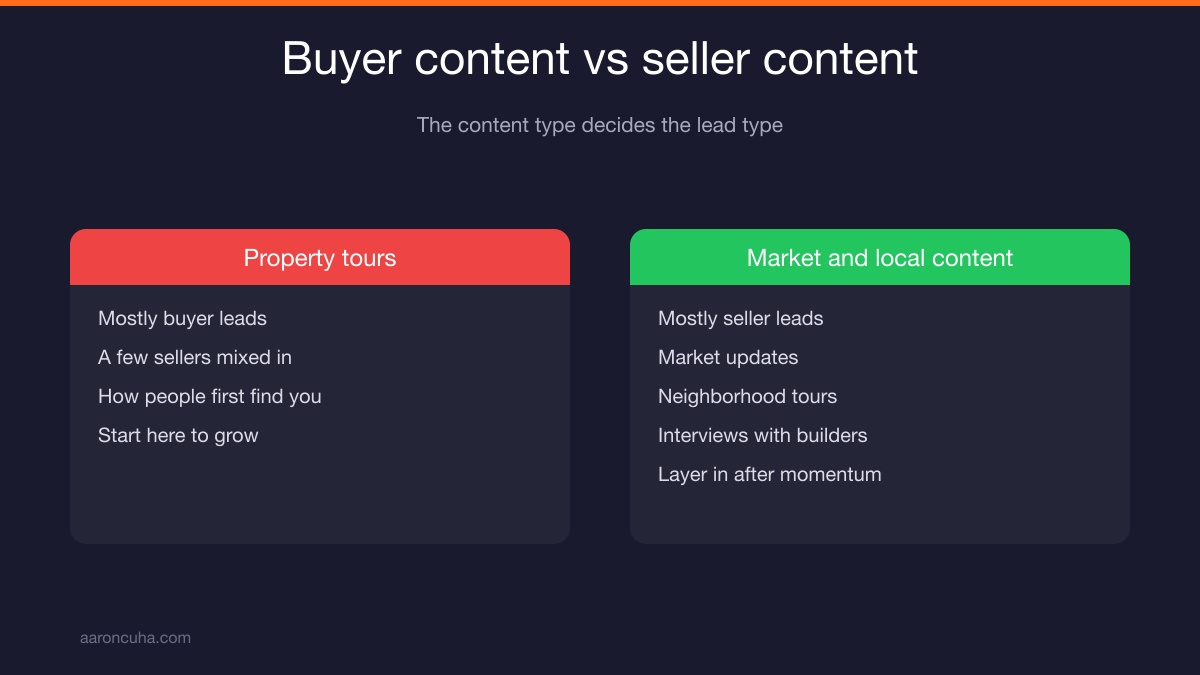
YouTube generates both buyers and sellers, and the content type decides which. Property tours pull mostly buyers. Market updates, neighborhood tours, and local interviews pull sellers.
Historically property tours bring in a heavy majority of buyers with a few sellers mixed in.
Seller leads come from content that proves you are the expert. Market updates. Neighborhood tours. Interviews with city council members, builders, and developers.
Here is the part people misunderstand. A seller does not need to watch property tours. They already know what their house looks like.
But they find you through the property tour. Then they watch you tour their neighborhood and think, this person knows my street. That is my agent.
Start with buyer content to grow the channel. Layer in listing content once you have momentum.
You cannot generate listings from a channel nobody watches. Growth comes first, listings come second. That order is not negotiable.
If your goal is deals and not vanity metrics, read how to get clients from YouTube next.
Should You Start a Second Channel or Use Playlists?
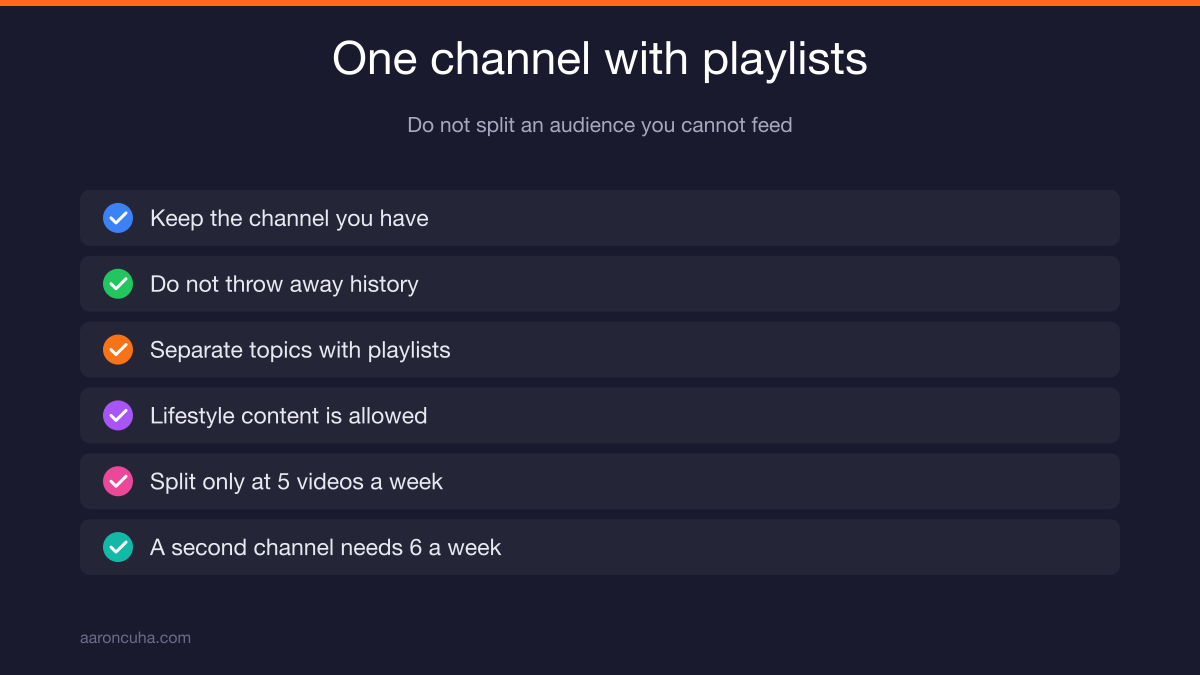
Use one channel with playlists. Do not start a second channel unless you are already producing five videos a week and ready to add two or three more.
I get this question constantly from agents with an old channel covering five to ten unrelated topics. Should they scrap it and start clean?
No. Do not throw away channel history and existing algorithm trust. Start posting real estate content on the channel you already have. You probably already have some love from the algorithm working in your favor.
Playlists handle topic separation just fine. That is what they are for.
And ignore the people who insist your channel must be 100 percent real estate. That approach worked for them. It is not the only way.
Daniel in Prague posts nine lifestyle videos for every one real estate video. He is the number one agent in Prague.
Scott Himmelstein does run two channels. His real estate base channel plus Eat Live Love San Fernando Valley, which covers local restaurants. Both are strong. But he records six videos a week to feed them.
That is the real cost of a second channel. If you are doing two or three videos a week, everything belongs on one channel. You are not recording enough to justify splitting your audience.
The AI Power Move: Run a Channel Analysis Prompt
Use an AI channel analysis prompt to score your branding, content strategy, titles, thumbnails, posting consistency, and SEO. Then let the AI tell you exactly how to close each gap.
You can run this in any large language model. I recommend Gemini.
Here is why. Gemini is owned by Google. It has direct access to video data in a way the others do not. When you are analyzing a YouTube channel, that matters.
The prompt takes your name and your channel URL. It returns a score across each category.
- How strong is the branding?
- How clear is the content strategy?
- How do the titles and thumbnails perform?
- How consistent is the posting schedule?
- How good is the SEO?
I ran it on a local channel I found recently. The result was what I see all the time. Not terrible anywhere, just slightly off across the board. Missing it everywhere by a little.
The best part of the prompt is what comes after the score. It tells you how to fix each item and gives you the tools to do it.
Then take it further. Run the same analysis on a competitor's channel in your market. Upload all your outputs back into Gemini and ask what is good and what is bad.
AI will not replace your judgment here. But an agent using it will beat one who is not. That is the whole point of why AI will not replace you.
Track, Measure, Report: The Karl Pearson Rule
What you track and measure improves. What you track, measure, and report improves exponentially. That single distinction is why your assessment goes to a coach instead of sitting in a folder.
Karl Pearson was a mathematician who worked alongside Albert Einstein. His work in the 1920s gave us this principle, and it has held up for a century.
Look him up. Then look at your own habits.
Most agents track nothing. A few track their views. Almost nobody reports their numbers to another human being who will ask why they slipped.
Reporting creates the accountability loop that speeds everything up. That is the only reason I ask clients to send their assessment to their coach.
The math is simple. Tracking alone gets you steady improvement. Tracking plus reporting compounds it.
If you want to know which numbers to watch, I covered it in my YouTube analytics guide.
Your First Week Action Plan
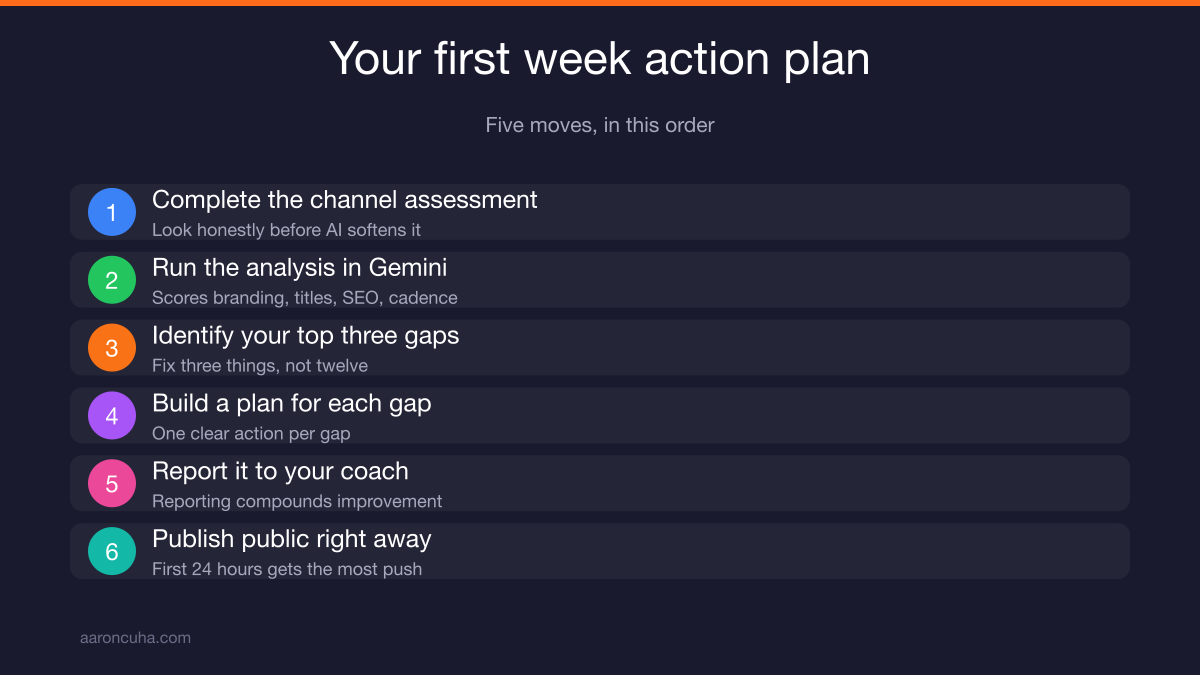
Five steps this week: complete the 10-point channel assessment, run the AI analysis in Gemini, identify your top three gaps, build a plan for those gaps, and report it to your coach.
Do them in that order. The self assessment first, because it forces you to look honestly before AI softens it. Then the channel analysis prompt. Then the gap identification.
Once you have three gaps, do not try to fix twelve things. Fix three. Build a plan for each. Hand it to someone who will hold you to it.
While you are at it, let me kill one myth. Some people say you should post a video private and flip it public after 24 hours.
That is not true. The first 24 hours is when YouTube gives you the most push.
Here is what actually happens. When you publish, YouTube pushes the video out to a test audience. It watches how many people comment, how long they stay, your average view duration, your click-through rate, and your impressions. Then it decides how far to spread it.
Lee Courage's viral video had around 1,700 comments. The algorithm saw that engagement and went all in. That does not happen if you hide the video for a day.
If you want to verify any of this yourself, run the question through Gemini or check the official YouTube Blog. There is a lot of misinformation out there.
Last thing. Pick one commitment coming out of this. Complete the scorecard. Run the AI analysis on your channel. Or run it on a competitor's channel. One thing, this week.
Then go deeper. If you are serious about turning your channel into a listing machine, grab Crazy Simple YouTube or come work with me inside real estate coaching and we will build the system together.
Frequently Asked Questions

Written by
Aaron CuhaAuthor of Crazy Simple YouTube, keynote speaker, and executive coach with 20,000+ hours logged. ICF PCC, NLP Master Practitioner, and DISC Certified. Aaron helps entrepreneurs replace hustle with AI-powered systems that generate leads, content, and revenue on autopilot.