Promoting an employee to manager is the fastest way to lose your best producer if you do it wrong. Here is the 7-step Promotion Bridge system I use with owners to test leadership before you hand over the title, protect income, and keep the relationship intact.
Your best producer is not your best manager. Promote them wrong and you lose two people at once: the producer you had and the leader you hoped for. Here is the system that prevents both losses.
Key Takeaways
- Run a 90-day leadership trial before you hand over the title.
- Build a pay bridge so nobody takes an income cut.
- Write the manager scorecard before day one, not after.
- Train one leadership skill per month, not all at once.
- A "no" is data, not failure. Build a senior producer track.
If you want a second set of eyes on your leadership bench before you make the call, book a strategy session and we will map your promotion plan step by step.
The Promotion Trap: Why Your Best Producer Breaks in Management
Production and leadership are two different jobs. Promoting an employee to manager without changing the job description sets them up to fail at both. That is the trap.
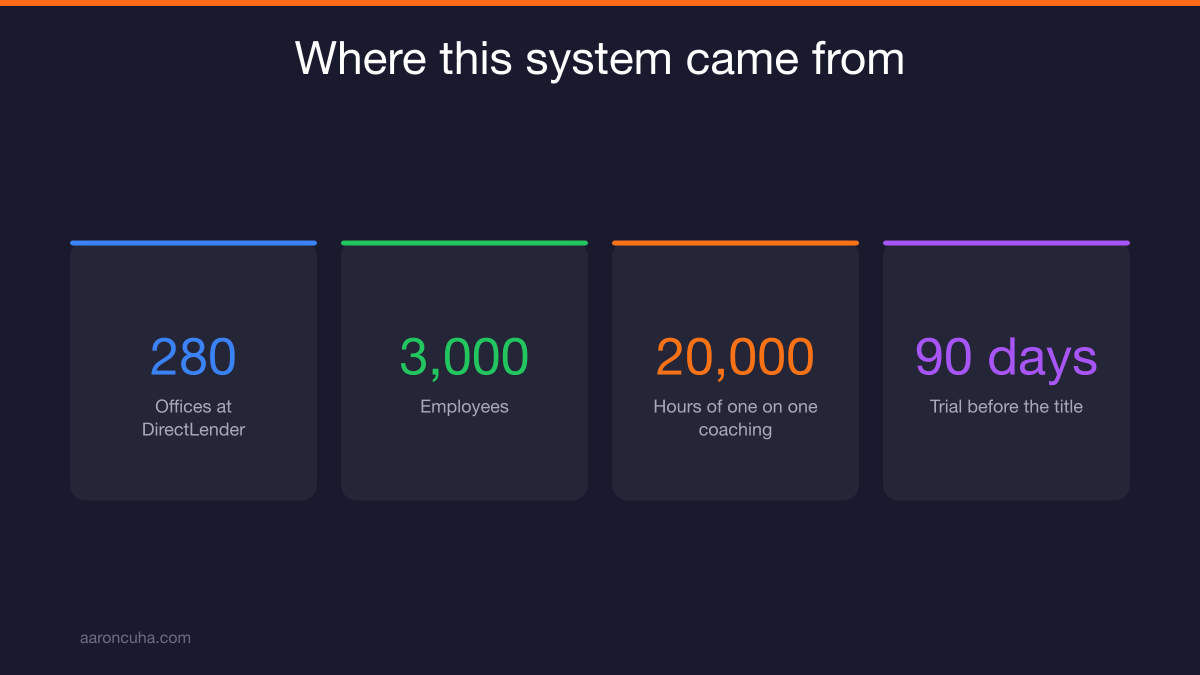
At DirectLender we grew to 280 offices and 3,000 employees. I promoted a lot of producers. Some became excellent leaders. Some quietly fell apart.
The ones who fell apart did not lack talent. They lacked a different set of skills that nobody taught them, and they lost the scoreboard that had told them they were winning for years.
Here is what actually happens. A top producer earns from personal output. They control their own calendar, their own pipeline, their own results. They know exactly what a good day looks like.
Then you give them a title. Now their results come from other people. Their calendar belongs to problems. Their income structure changes. And nobody has told them what a good day looks like anymore.
The producer skill set is individual execution. The manager skill set is transferring execution into other people. Those overlap far less than most owners assume.
So the promotion feels like a reward. To the person receiving it, it often feels like a demotion with a nicer title.
What Actually Goes Wrong When Promoting an Employee to Manager
Five things break: income drops, no scorecard exists, no training happens, peers resent the change, and the new manager keeps doing their old job. Fix all five or the promotion fails.
Let me take them one at a time, because most owners only fix one or two and then wonder why the promotion stalled.
Income drops. The producer walks away from personal production before team production replaces it. There is a valley in the middle, and nobody warned them about it.
No scorecard exists. Producers live on numbers. Managers often get handed a title and a vague mandate to "run the team." That is not a job. That is a fog.
No training happens. You would never hand someone a production role with zero onboarding. Yet management roles get handed over in a hallway conversation.
Peers resent it. Yesterday they were equals. Today one of them signs off on schedules. If you do not manage that transition out loud, it gets managed in the parking lot.
They keep doing the old job. This is the most common one. Under pressure, humans retreat to what they are good at. So the new manager takes the hard deals back and coaches nobody.

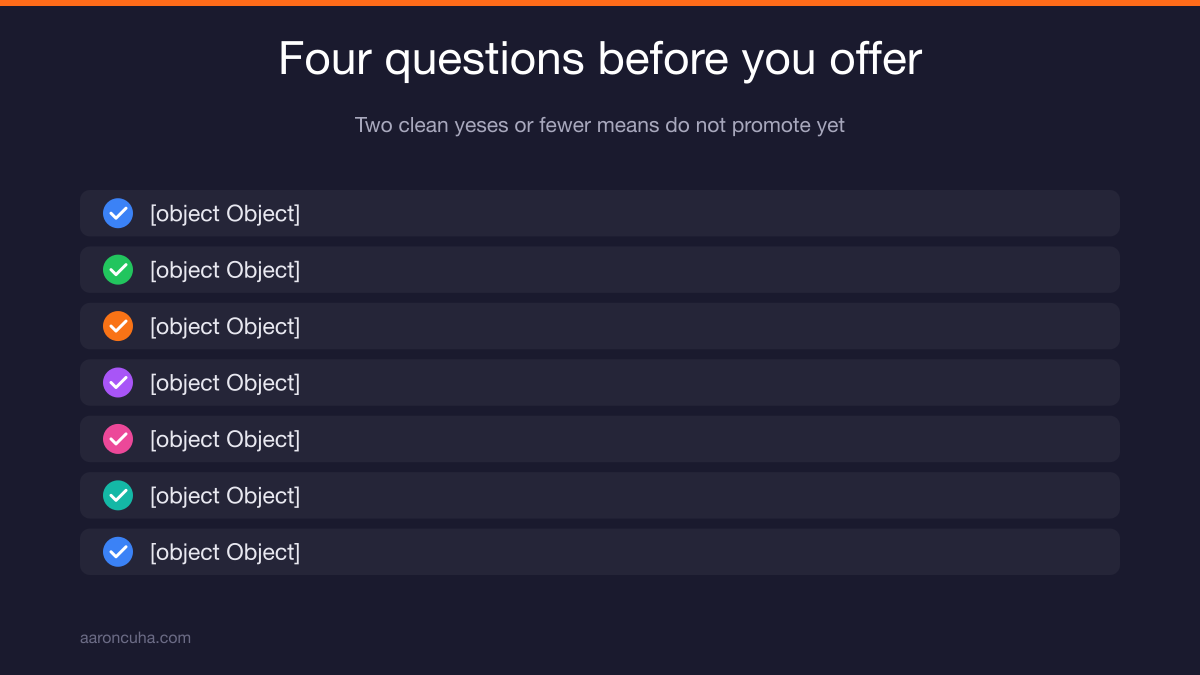
| Element | Producer Job | Manager Job |
|---|---|---|
| Source of results | Personal output | Team output |
| Daily win | Closed deal or completed task | Someone else got better |
| Calendar control | Mostly self directed | Mostly people driven |
| Feedback loop | Fast and obvious | Slow and indirect |
| Core skill | Doing the work | Transferring the work |
| Pay driver | Individual production | Team production and retention |
Read that table to your candidate before you make the offer. Half the time it changes the conversation entirely, and that saves both of you a year.
The 4 Questions to Ask Before You Make the Offer
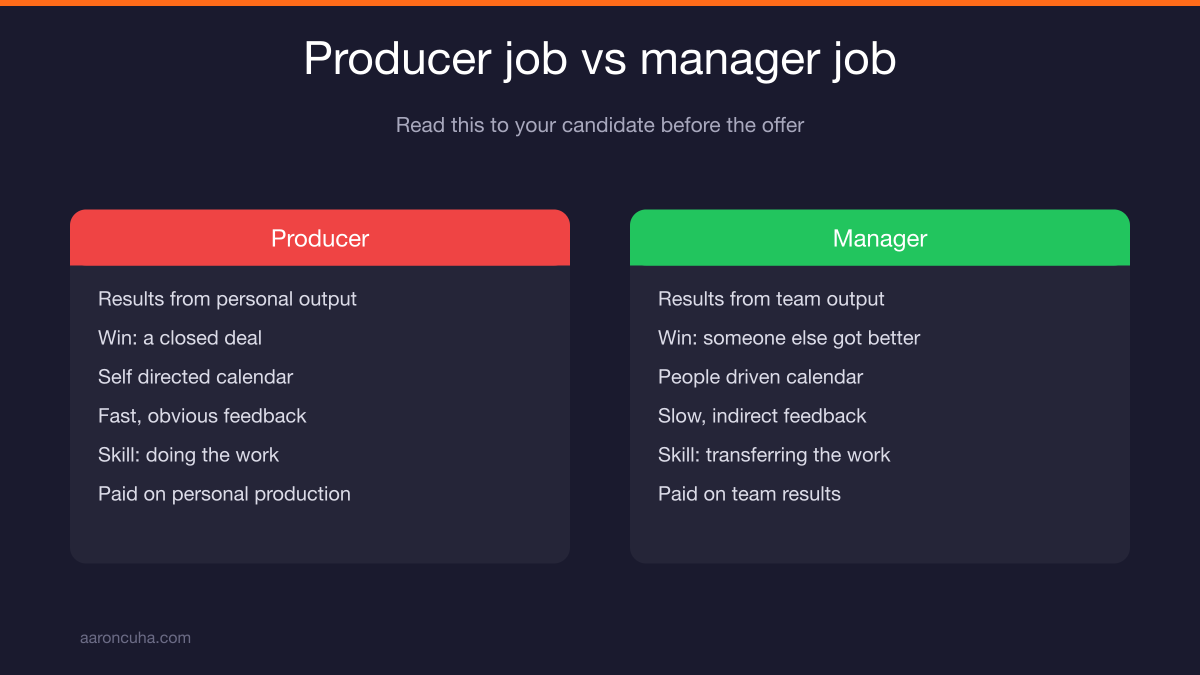
Before you promote anyone, run this filter. Four questions, asked directly, in a real conversation. If you get two clean yeses or fewer, do not promote yet.
- Do you want to lead people, or do you want the title and the money? Both answers are honest. Only one predicts success. Ask it plainly and let the silence sit.
- Do you teach naturally? Look at history, not intention. Has this person already trained new hires without being asked? Do teammates walk to their desk with questions?
- Do you take feedback without collapsing or arguing? Managers eat criticism weekly. If your candidate goes quiet for three days after correction, leadership will grind them down.
- Do you finish things you do not enjoy? Management is paperwork, difficult conversations, and follow up. Producers who only finish the fun parts struggle badly.
Notice what is not on that list. Production volume is not on that list. Tenure is not on that list. Likability is not on that list.
Those three things are how most owners actually choose, and they are the reason so many promotions fail. The best closer in the room may have zero interest in another human being's growth.
In more than 20,000 hours of one on one coaching, the strongest predictor I see is simple. Does this person already get satisfaction from someone else's win? If yes, you can teach the rest.
The Promotion Bridge: A 7-Step System
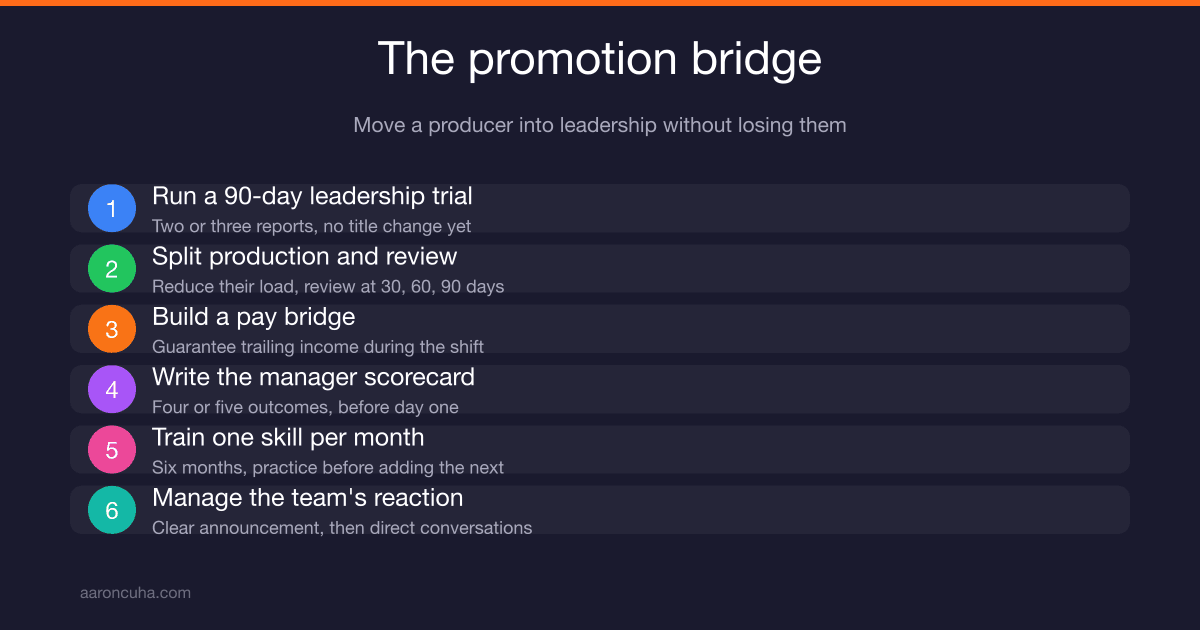
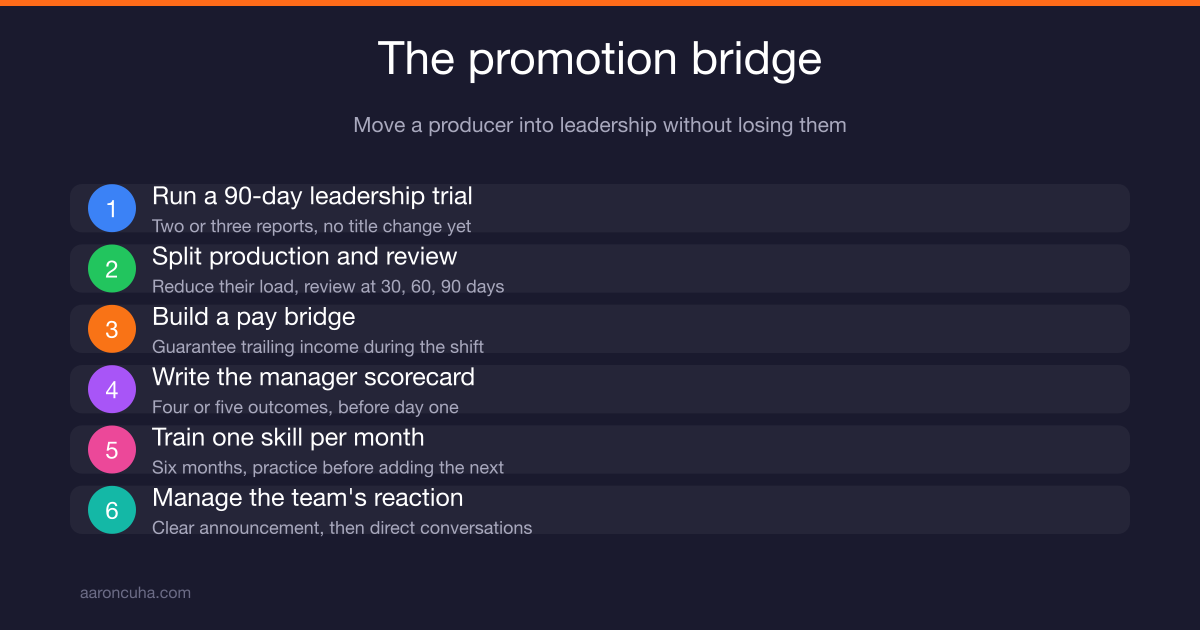
The Promotion Bridge moves a producer into leadership without dropping their income, their confidence, or your team results. Seven steps, run in order, over roughly two quarters.
Here is the whole framework in one place. Then I will unpack the steps that people get wrong.
- Run a 90-day leadership trial with a small group and no title change.
- Split production so they keep earning while they learn to coach.
- Review at 30, 60, and 90 days against written expectations.
- Build a pay bridge that guarantees trailing income during the shift.
- Write the manager scorecard before day one of the title.
- Train one leadership skill per month for the first six months.
- Manage the team's reaction with a clear announcement and direct conversations.
This is a Systems Over Hustle problem, not a motivation problem. Nobody fails at management because they did not want it enough. They fail because the structure around them did not exist.
Build the bridge first. Then walk them across it.
Steps 1 to 3: Run a 90-Day Leadership Trial Before the Title
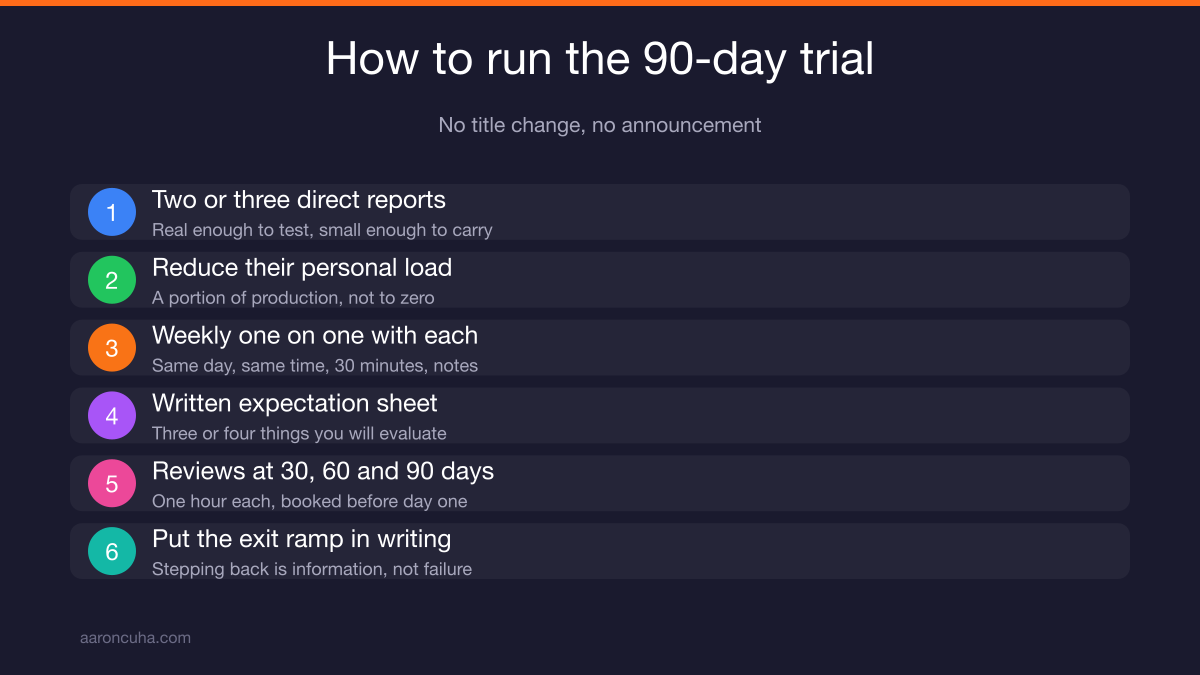
Give your candidate two or three people to coach for 90 days with no title change and no announcement. You both find out the truth before anything becomes permanent.
Structure it like this.
- Two or three direct reports, maximum. Enough to be real, small enough to survive alongside production.
- Production split. Reduce their personal load by a portion, not to zero. They need the income and you need the revenue.
- A weekly one on one with each person. Same day, same time, thirty minutes, written notes.
- A written expectation sheet. Three or four things you will evaluate. No surprises at the end.
- Reviews at 30, 60, and 90 days. One hour each, with you, on the calendar before day one.
Now the part almost everyone skips. Give them an exit ramp in writing.
Say it like this: "We are testing this for 90 days. At the end, either of us can say it is not the right fit. If you step back to full production, your income, your standing, and my respect for you stay exactly where they are. That is not a failure. That is information."
That sentence does two things. It removes the fear that makes people fake enthusiasm, and it makes an honest no possible.
An honest no in month three is cheap. A dishonest yes that unravels in month fourteen costs you a producer, a team, and a year.
Step 4: Build a Pay Bridge So Nobody Takes a Cut
A pay bridge guarantees the producer's trailing income while their compensation slowly shifts from personal production to team output. It removes the financial valley that kills most promotions.
Think of it in three layers.
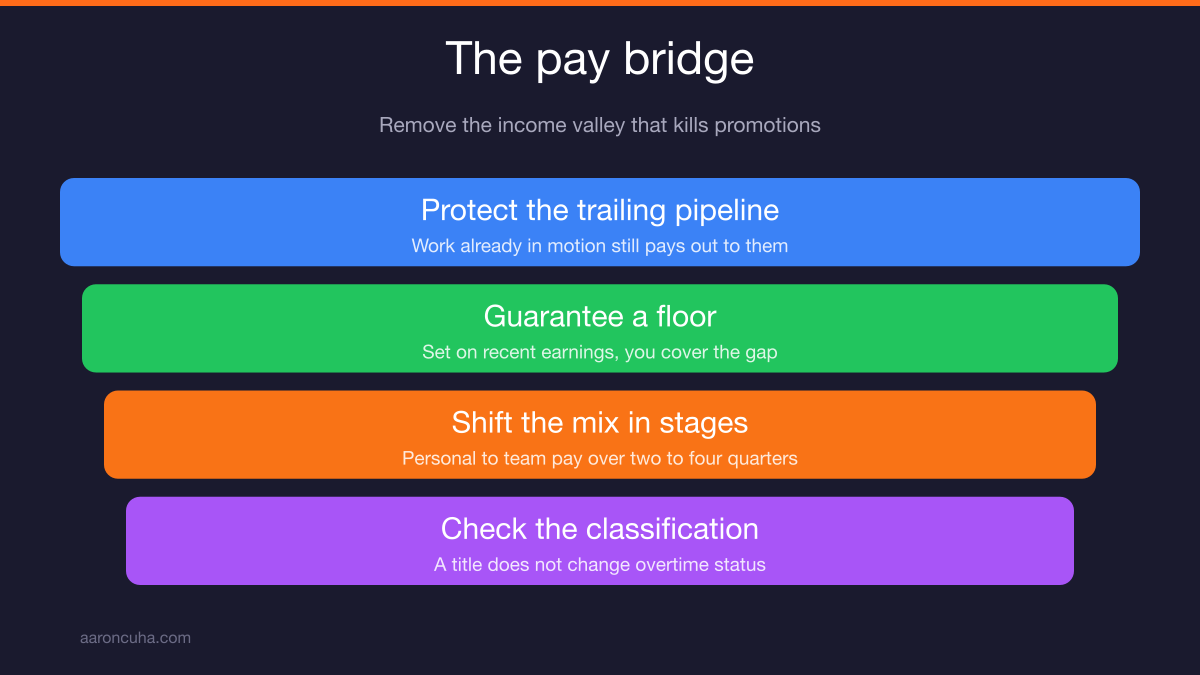
Layer one: protect the trailing pipeline. Work already in motion pays out to them as it always would. You do not claw back work they started as a producer. Ever.
Layer two: guarantee a floor. For the transition window, set a floor based on their recent earning history. If team output does not cover it yet, you cover the gap. This is an investment in a leader, not a gift.
Layer three: shift the mix in stages. Move compensation from personal production toward team results across two to four quarters. Publish the schedule in writing before they accept.
I will not hand you percentages, because your margins are not my margins. But the principle holds everywhere. People do not resist leadership. They resist uncertainty about their mortgage.
Also check the legal side before you restructure pay. The U.S. Department of Labor Wage and Hour Division publishes the rules on exempt and nonexempt classification, and a promotion to "manager" does not automatically change someone's overtime status.
Get that wrong and a promotion becomes a lawsuit. Talk to your employment attorney before the offer letter goes out.
If the pay conversation feels murky, that is usually a sign your business model needs a look too. Executive coaching is where I do most of that work with owners.
Step 5: Write the Manager Scorecard Before Day One
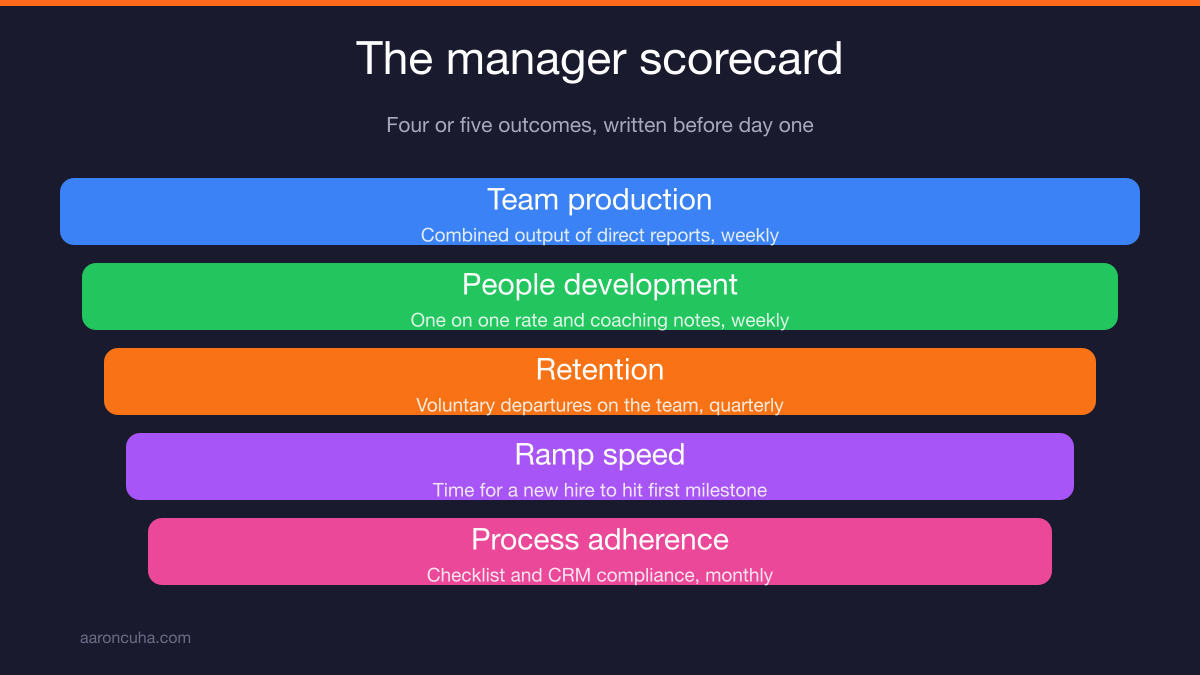
The scorecard names four or five outcomes the manager owns, how each is measured, and how often you review it. Write it before the title, not after the first bad month.
Producers know exactly where they stand every single day. Take that away and you take away their fuel. The scorecard gives it back in a new form.
| Outcome They Own | How It Is Measured | Review Cadence |
|---|---|---|
| Team production | Combined output of direct reports | Weekly |
| People development | One on one completion rate and documented coaching notes | Weekly |
| Retention | Voluntary departures on the team | Quarterly |
| Ramp speed | Time for a new hire to hit first milestone | Per hire |
| Process adherence | Checklist and CRM compliance across the team | Monthly |
Four or five rows. Not twelve. A scorecard with twelve rows is a wish list, and wish lists do not change behavior.
Two rules make this work.
- Only measure what they control. Do not score a new manager on something three departments decide.
- Review it on the same day every week. Predictable review beats intense review. The rhythm is what builds the habit.
Show the scorecard during the trial period, not after. Let them get comfortable being measured on other people's results before the title makes it official.
Step 6: Train One Leadership Skill Per Month
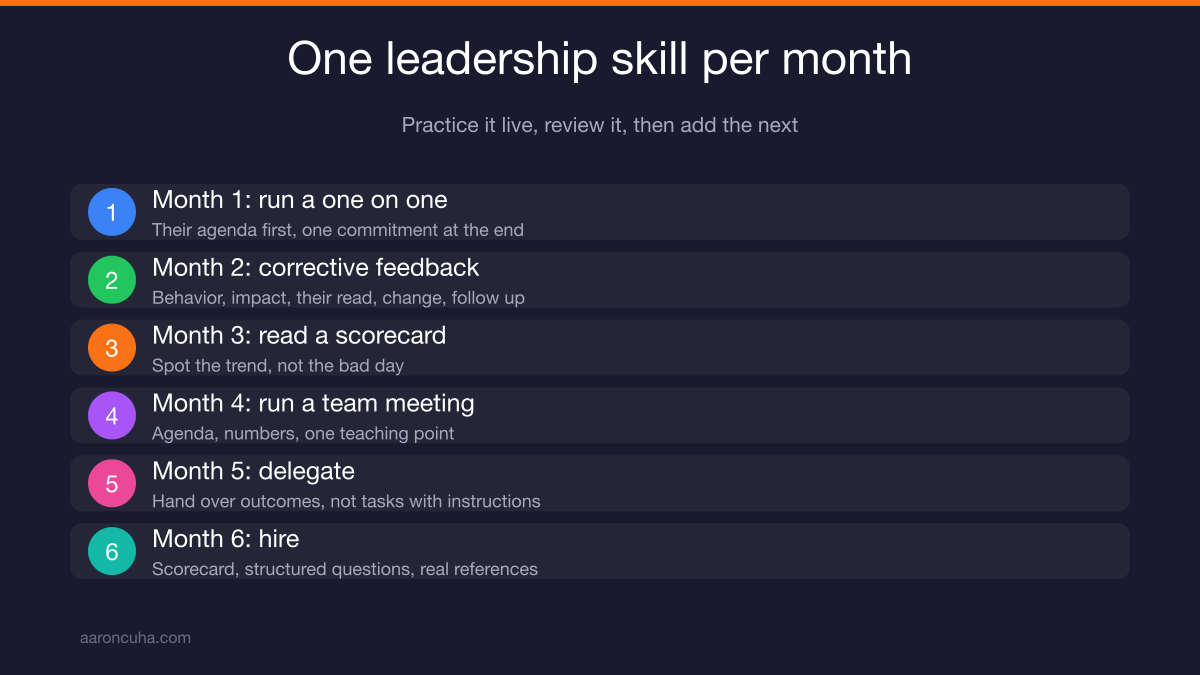
Do not teach leadership in a weekend workshop. Teach one skill per month for six months, practice it in real situations, and review it before adding the next.
Here is the skill stack in the order I teach it.
- Month one: run a one on one. Same time weekly. Their agenda first, yours second, written notes, one commitment at the end.
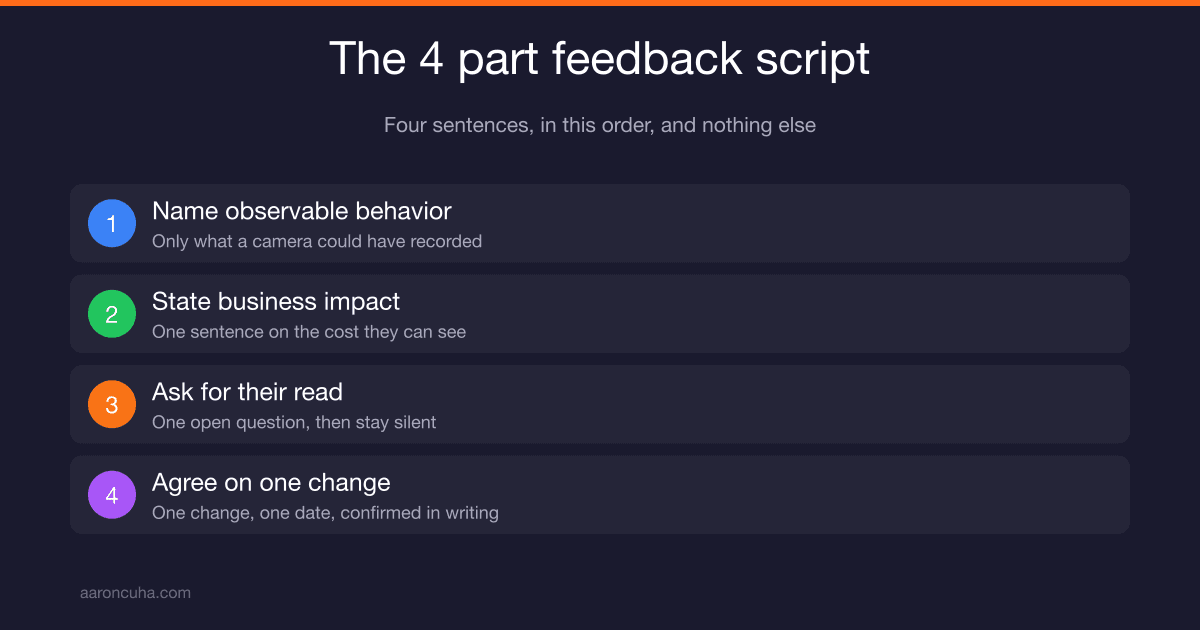
- Month two: give corrective feedback. Name the behavior, name the impact, ask for their read, agree on the change, set the follow up date.
- Month three: read a scorecard. Spot the trend, not the bad day. Ask what caused it before deciding what to do.
- Month four: run a team meeting. Thirty minutes, published agenda, numbers first, one teaching point, clear next actions.
- Month five: delegate. Hand over outcomes with a deadline and a check in, not tasks with instructions.
- Month six: hire. Scorecard first, structured questions, two interviewers, reference calls that actually happen.
Delegation is the one that decides everything. A manager who cannot delegate becomes the busiest person on the team and the least useful. I broke that down in detail in how to delegate as an entrepreneur, and the same rules apply one level down.
If you want a broader model for how owners and managers build skill without burning the calendar, business coaching for entrepreneurs covers the structure I use.
Step 7: Manage the Team's Reaction, Not Just the Promotion
Announce the change yourself, in person, with the reasoning. Then speak privately to anyone who wanted the role. Silence here creates a story you will not like.
Your announcement needs four parts.
- What changed. The role, the reporting lines, the start date.
- Why this person. Name the specific behaviors that earned it, not vague praise.
- What is expected of them. Say the scorecard out loud so the team knows the standard is real.
- What stays the same. People fear hidden changes more than announced ones.
Then handle the people who wanted it. Do it within 48 hours, one on one, and be specific. "Here are the two things I need to see from you before you are ready" builds a future. "It just was not your time" builds resentment.
Now the part that surprises owners. Your new manager will apologize for having authority. They will soften every request, over explain every decision, and avoid the first hard conversation for weeks.
Coach them out of it directly. Tell them their job is not to be liked by the team, it is to be trusted by the team, and trust comes from clarity plus consistency.
Then back them in public. If a team member goes around the new manager to you, send them back. One exception teaches everyone the title is decorative.
What to Do When Your Best Producer Says No
Treat a no as useful data, not rejection. Then build a senior producer track so your best people can grow in status and income without managing anyone.
This is the missing piece in most small companies. The only path up is management, so people take management jobs they do not want and you lose your top production.
Build a second ladder. A senior producer track can include:
- Title and status. Senior, principal, lead. Titles cost nothing and mean something.
- Better inputs. Priority on the strongest opportunities, better support, first access to new tools.
- A mentoring stipend. Paid to teach specific skills without owning anyone's performance reviews.
- Voice in the business. A seat in planning meetings and real influence over process.
- No direct reports. That is the whole point. Protect it.
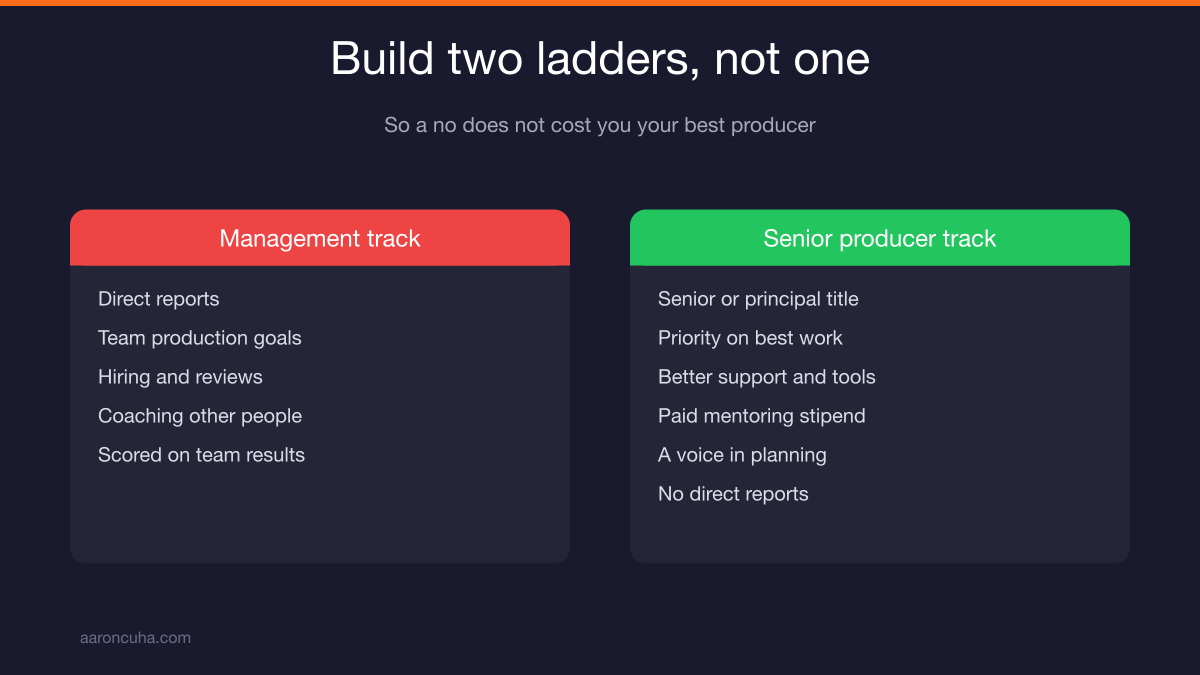
Two ladders keep two kinds of people. One ladder forces everyone through a door half of them should not walk through.
And be honest with yourself about why you want to promote them. Sometimes owners promote a great producer to keep them from leaving. That is a retention problem wearing a leadership costume, and a title will not fix it.
The Systems That Keep a New Manager From Drowning
New managers drown in admin, not in leadership. Give them a fixed weekly cadence, documented processes, and automation for reporting so their hours go to coaching.
Start with the cadence. Put it on the calendar as recurring blocks, not as good intentions.
- Monday: team meeting, numbers reviewed, week's priorities set.
- Tuesday and Wednesday: one on ones, back to back, thirty minutes each.
- Thursday: field coaching or live observation of the actual work.
- Friday: scorecard update, hiring pipeline, one hour with you.
Next, document the process. If the only copy of "how we do it here" lives in your new manager's head, they will spend every day answering the same questions.
Written checklists, recorded walkthroughs, and a simple internal library cut that load fast. The same repeatable thinking behind content systems for entrepreneurs applies to internal training.
Then automate the paperwork. Reporting, meeting notes, follow up reminders, and scorecard rollups can run largely on their own now. I walk through the build in AI systems and in AI business systems automation.
For a broader look at how leadership work is changing, the Harvard Business Review and the Society for Human Resource Management both publish solid, practical material on first time manager development.
Every hour of admin you remove is an hour of coaching you get back. That is the whole trade.
Your First 30 Days: The Plan You Can Start Today
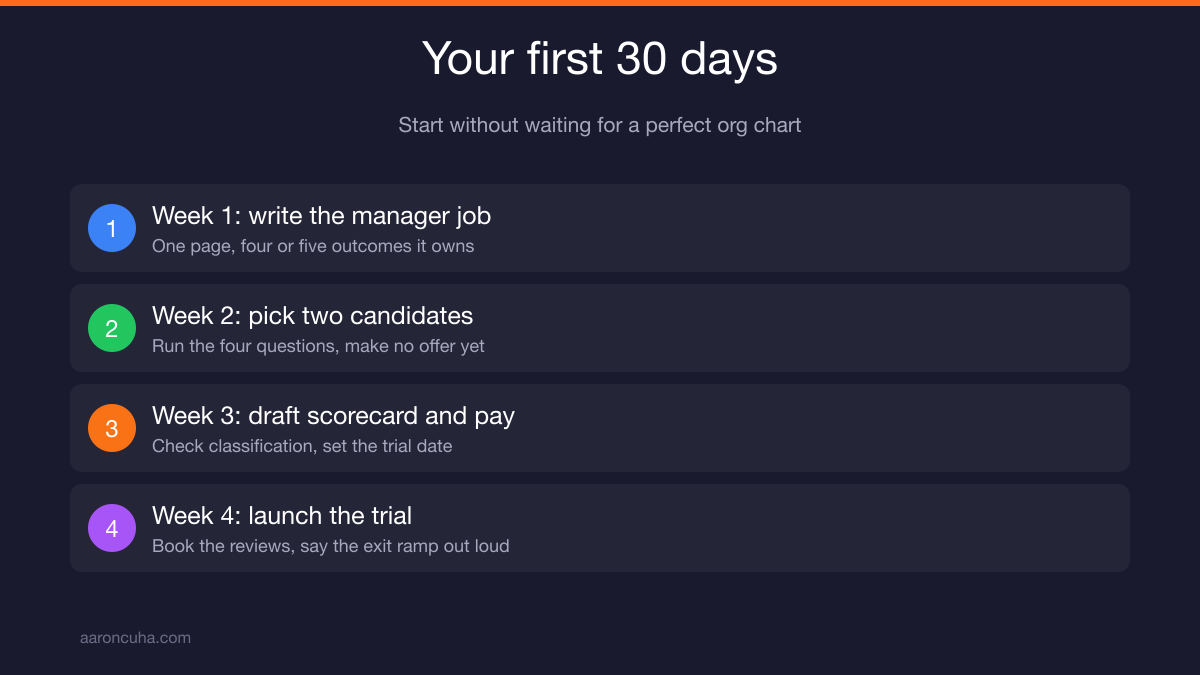
Do not wait for a perfect org chart. Run these actions over the next four weeks and you will know whether you have a manager on your bench.
Week one. Write the manager job on one page. List the four or five outcomes it owns. Then list every task that is production work and cross it off the manager list.
Week two. Identify two candidates, not one. Run the four questions with each of them in a real sit down conversation. Take notes. Do not make an offer.
Week three. Draft the scorecard and the pay bridge. Talk to your attorney or payroll advisor about classification. Set the trial start date.
Week four. Launch the 90-day trial with two or three direct reports. Put the 30, 60, and 90 day reviews on the calendar right now. Say the exit ramp sentence out loud.
I lost a company in 2008 that I had spent years scaling. I spent the decade after that doing humanitarian work in Nepal, and then I rebuilt as a coach. The lesson that carried across all of it is the same one here.
People do not fail because they lack willpower. They fail inside structures that were never built to hold them. Build the structure first.
Promotion is a structure problem. Solve it that way and your best producer becomes your best leader without losing what made them great.
Ready to build the leadership bench instead of hoping it appears? Join the Systems Over Hustle community and get the frameworks, templates, and coaching to make your next promotion the one that sticks.
Frequently Asked Questions

Written by
Aaron CuhaAuthor of Crazy Simple YouTube, keynote speaker, and executive coach with 20,000+ hours logged. ICF PCC, NLP Master Practitioner, and DISC Certified. Aaron helps entrepreneurs replace hustle with AI-powered systems that generate leads, content, and revenue on autopilot.