Most leaders wait until they are angry, then say too much. Here is how to give constructive feedback to employees using a four part script that names the behavior, states the impact, invites their read, and locks one change to a date.
Most leaders wait until they are angry to give feedback. Learning how to give constructive feedback to employees is not about courage. It is about a script. Here is the four part version.
Key Takeaways
- Name behavior a camera could record, never a trait or a motive.
- State one business impact in one sentence, then stop talking.
- Ask for their read and stay silent until they answer.
- Agree on one change with one date, and recap it in writing.
- If the same feedback repeats across people, fix the process instead.
If you want help building leadership systems that hold up under pressure, start with a strategy session and bring the one conversation you have been avoiding.
Why Most Feedback Breaks Trust Instead of Building It
Feedback breaks trust when it arrives late, loaded with emotion, and aimed at the person instead of the behavior. That is a process failure, not a character flaw.
I have spent more than 20,000 hours in one on one coaching. Behind closed doors, leaders tell me the same two things.
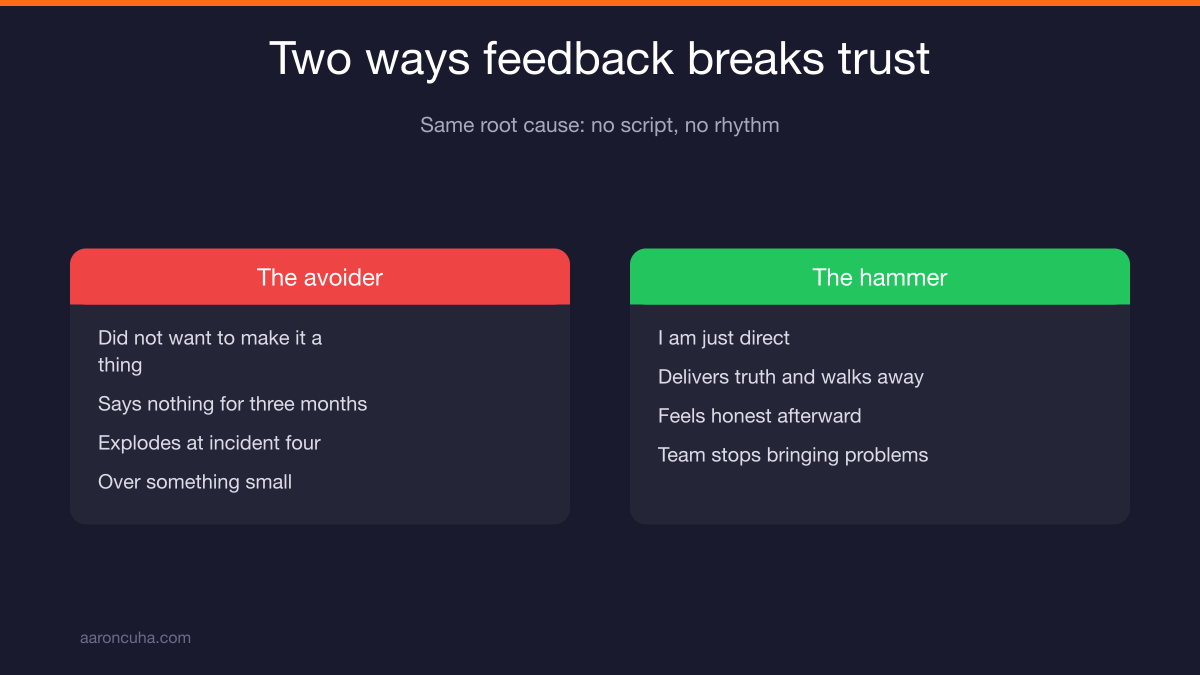
The first group says, "I did not want to make it a thing." So they said nothing for three months. Then the fourth incident hit and they exploded over something small.
The second group says, "I am just direct." They deliver the truth like a hammer, walk away feeling honest, and never notice the person stopped bringing them problems.
Both failure modes come from the same root. There is no script and no rhythm. When you have no system, you rely on mood. Mood is a terrible manager.
This is the core idea behind Systems Over Hustle. You do not need more courage. You need a repeatable structure so courage is not required every single time.
The Real Cost of Avoiding the Conversation
Silence is not neutral. When you say nothing, you teach the whole team that the behavior is acceptable. Standards you do not speak out loud stop being standards. Long running workplace research from Gallup keeps landing on the same finding: people who receive regular, meaningful feedback are far more engaged than people who are left guessing.
I learned this at scale. At DirectLender we grew to 280 offices and about 3,000 employees. At that size, an unspoken standard is not a standard at all. It is a rumor.
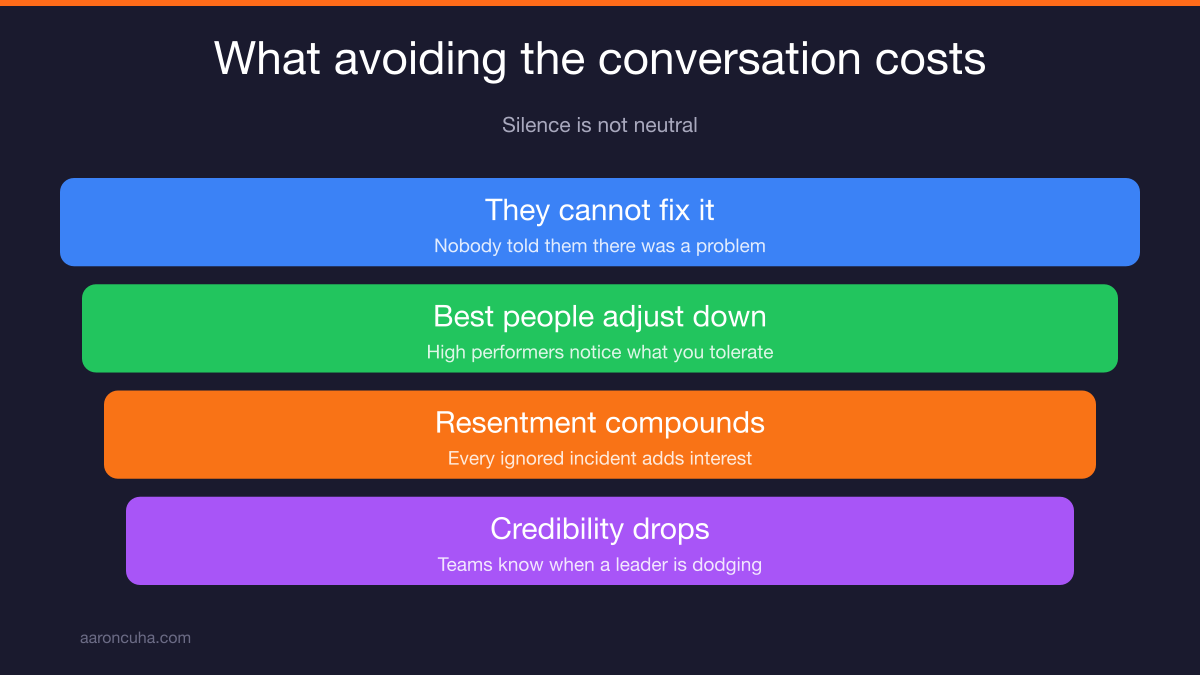
Here is what avoidance actually costs you:
- The person loses the chance to fix it. They cannot correct a problem nobody told them about.
- Your best people watch and adjust down. High performers notice what you tolerate.
- Resentment compounds. Every ignored incident adds interest. You pay it all at once.
- Your credibility drops. Teams know when a leader is dodging. They just stop asking.
Avoidance feels kind in the moment. It is one of the least kind things a leader does. You are protecting your own comfort and calling it grace.
How to Give Constructive Feedback to Employees: The 4 Part Script
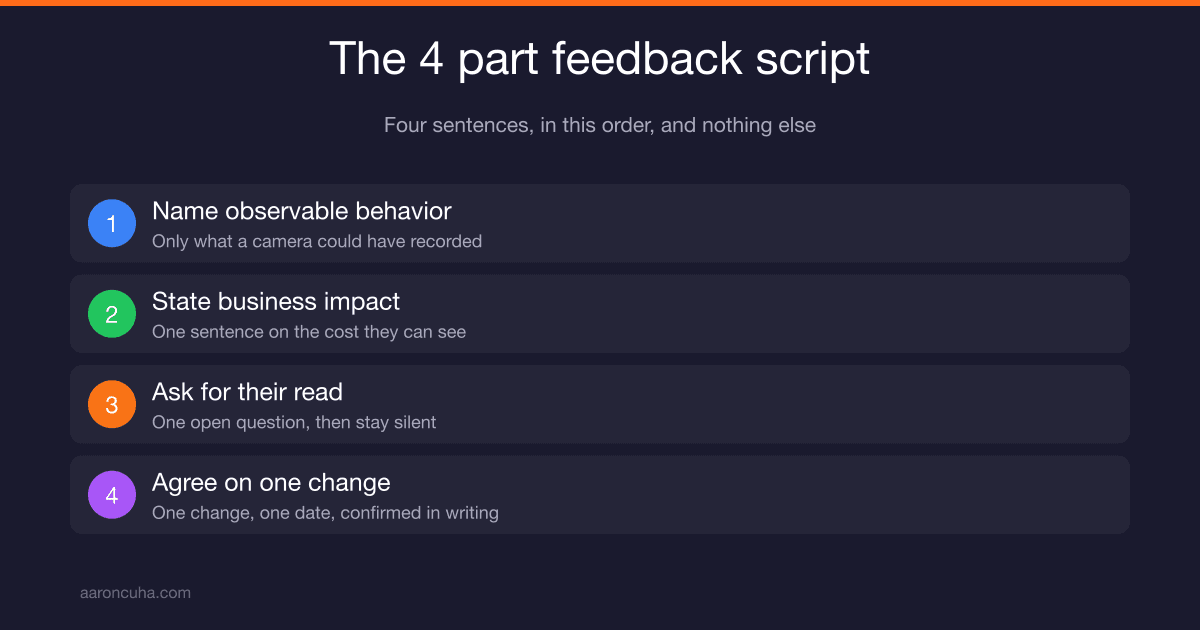
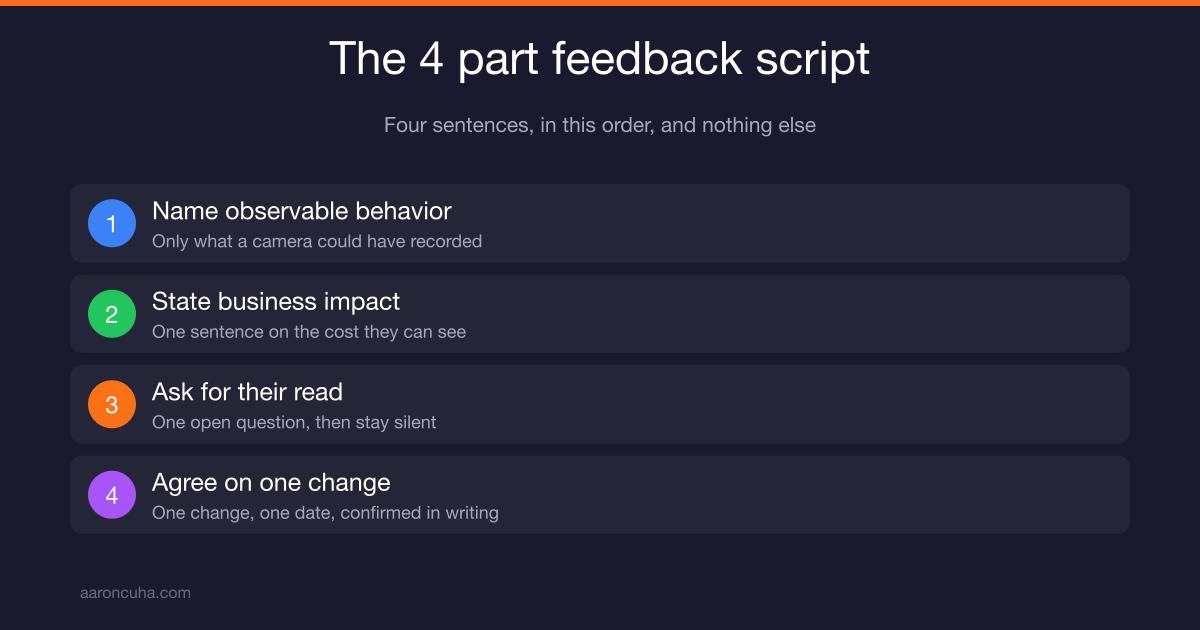
Learning how to give constructive feedback to employees comes down to four moves in order: name the observable behavior, state the business impact, ask for their read, and agree on one change with a date.
Four sentences. That is the whole conversation. Everything else is noise you add because you are nervous.
- Name the observable behavior. What a camera would have recorded.
- State the business impact. The downstream cost they can see.
- Ask for their read. Then be quiet.
- Agree on one change with a date. One. Not three.
Most serious leadership communication frameworks follow this same logic. The situation, behavior, impact model taught by the Center for Creative Leadership is built on the same order of operations: facts first, consequence second, dialogue third.
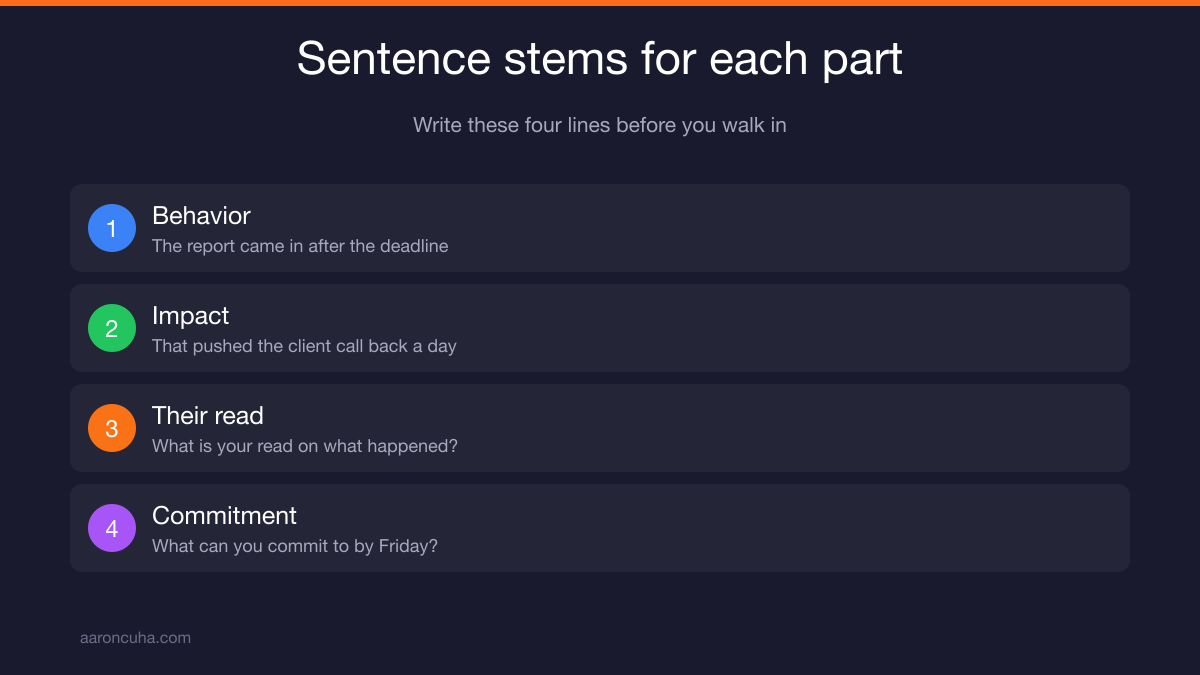
| Part | What It Does | Sentence Stem |
|---|---|---|
| 1. Observable behavior | Removes argument about facts | "On Tuesday, the report came in after the deadline." |
| 2. Business impact | Replaces blame with consequence | "That pushed the client call back a full day." |
| 3. Their read | Surfaces context you do not have | "What is your read on what happened?" |
| 4. One change, one date | Turns talk into an agreement | "What can you commit to by Friday?" |
Write those four sentences on paper before you walk in. Not a script you read aloud. A map so you do not wander.
Part One: Name the Observable Behavior
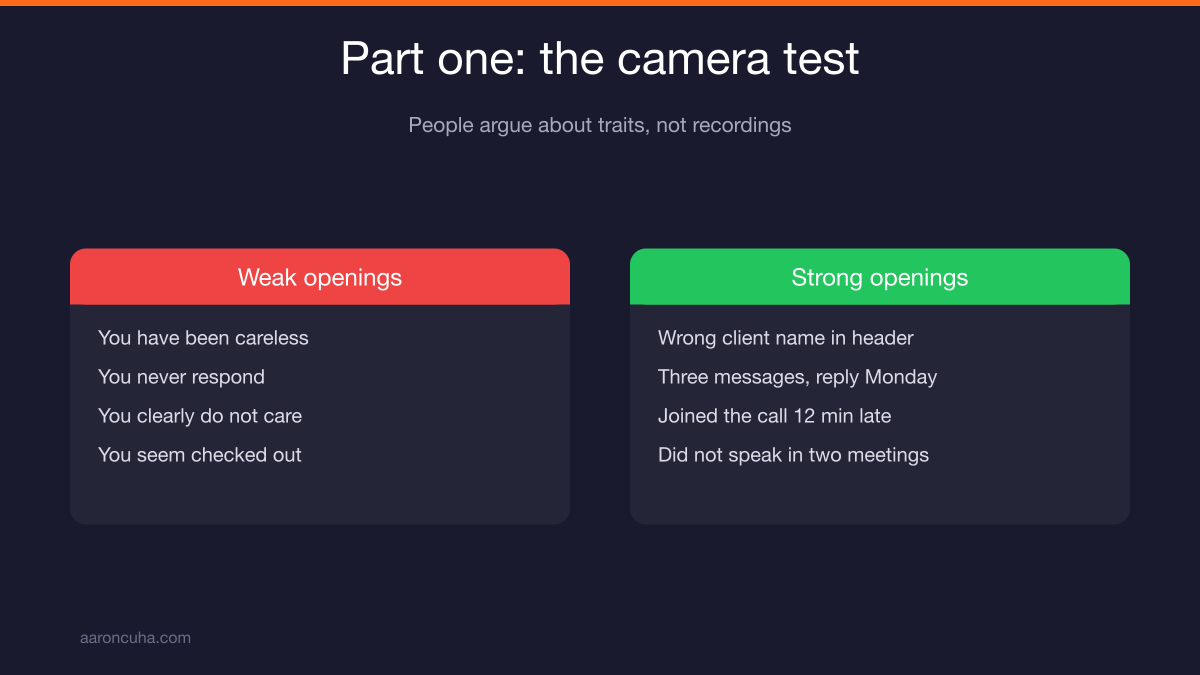
Describe only what a camera could have recorded. No traits, no motives, no adjectives about their character. If a camera could not capture it, it does not belong in sentence one.
This single rule prevents most defensiveness. People will argue about who they are forever. They rarely argue with a recording.
Weak openings:
- "You have been really careless lately."
- "You never respond to messages."
- "You clearly do not care about this account."
- "You seem checked out."
Strong openings:
- "The last two proposals went out with the wrong client name in the header."
- "I sent three messages Thursday and got a reply Monday morning."
- "You joined the client call twelve minutes after the start time."
- "In the last two team meetings, you did not speak."
Three rules hold the line here. No adverbs. "Constantly" and "repeatedly" are opinions. No always or never. One counterexample and you lose the conversation. No mind reading. You do not know what they meant. You only know what they did.
Part Two: State the Business Impact
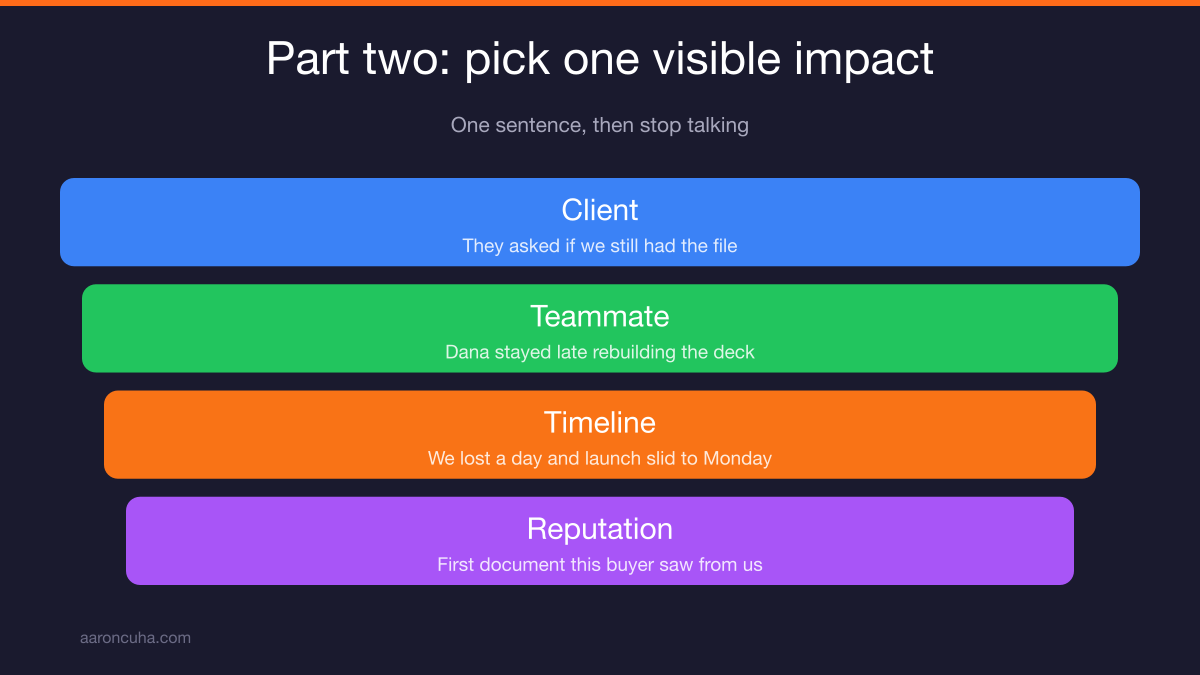
Say one sentence connecting the behavior to a cost the person can actually see. A client, a teammate, a timeline, money, or reputation. Then stop.
Impact is what makes feedback land without blame. You are not saying they are bad. You are showing them a chain of events.
Pick the closest visible link. The stronger the connection, the less you need to convince.
- Client: "The client asked me directly whether we still had the file."
- Teammate: "Dana stayed late rebuilding the deck to hit the send time."
- Timeline: "We lost the whole day and the launch slid to Monday."
- Reputation: "That was the first document this buyer saw from our company."
One sentence. Not four. Leaders pile on impact because they want the person to feel it as much as they do. That is the moment the conversation turns into a lecture.
Say your one impact sentence, then close your mouth and move to part three. The silence after impact does more work than another paragraph ever will.
Part Three: Ask for Their Read and Then Be Quiet
Ask one open question about their view of what happened. Then stay silent until they answer, even if it takes fifteen uncomfortable seconds.
This is where you either earn trust or lose it. Most leaders ask the question and then answer it themselves because the pause feels awful.
Use one of these stems:
- "What is your read on what happened?"
- "What am I missing here?"
- "Walk me through it from your side."
- "How do you see it?"
Then wait. Count to fifteen in your head if you have to. The silence is part of the script, not a gap in it.
Sometimes what comes back changes everything. The report was late because a vendor never sent the data. The call was missed because you moved it and the invite never updated.
When that happens, say it out loud: "I did not know that. That changes my read." Then fix the real problem. You just proved feedback in your shop is a conversation, not a verdict.
If nothing changes your view, do not retract. Acknowledge and hold. "I hear that the week was heavy. The deadline still needs to hold." Both things can be true.
Part Four: Agree on One Change With a Date
Close with one specific change and one specific date. Let them propose it first. Then confirm it in writing the same day.
Three changes equals zero changes. When you hand someone a list, they carry the weight of all three and complete none. Pick the one that matters most and let the rest wait.
Ask it this way: "What can you commit to, and by when?"
Let them answer first for a simple reason. A commitment they wrote is a commitment they own. A commitment you assigned is a task they resent.
If their proposal is too soft, negotiate the specifics, not the person. "Sooner would help. Can we make it Thursday?"
Test the agreement against four checks:
- Specific. "Be more organized" fails. "Send the tracker every Friday by noon" passes.
- Single. One behavior, not a category.
- Observable. You can tell from the outside whether it happened.
- Dated. A real day on a real calendar.
Then send a short recap the same day. Four lines: what we discussed, what you committed to, the date, and how we will check. That written recap turns a conversation into a system. It is the same discipline that makes delegation actually work.
Ready to build the operating rhythm underneath this? Get the Channel Audit and Plan or join the Systems Over Hustle community and workshop your hardest conversation with people who have already had it.
The Three Mistakes That Make People Defensive
Three habits create almost all defensiveness: the feedback sandwich, stacking saved up examples, and leading with intent instead of behavior. Each one is fixable today.
Mistake one: the feedback sandwich. You open with praise, slip the criticism in the middle, and close with praise. People learn to brace every time you compliment them. Worse, they often miss the real message entirely.
Do this instead: give praise on its own day, for its own reason. When correction is the point, make correction the whole conversation. Short and clean beats padded and confusing.
Mistake two: stacking saved up examples. You held four incidents for two months, then delivered them all at once. That is not feedback. That is an ambush, and it tells the person you were building a case.
Do this instead: raise it within a week. One incident, one conversation. If you truly need a pattern, name two examples maximum and say plainly that you should have raised the first one sooner.
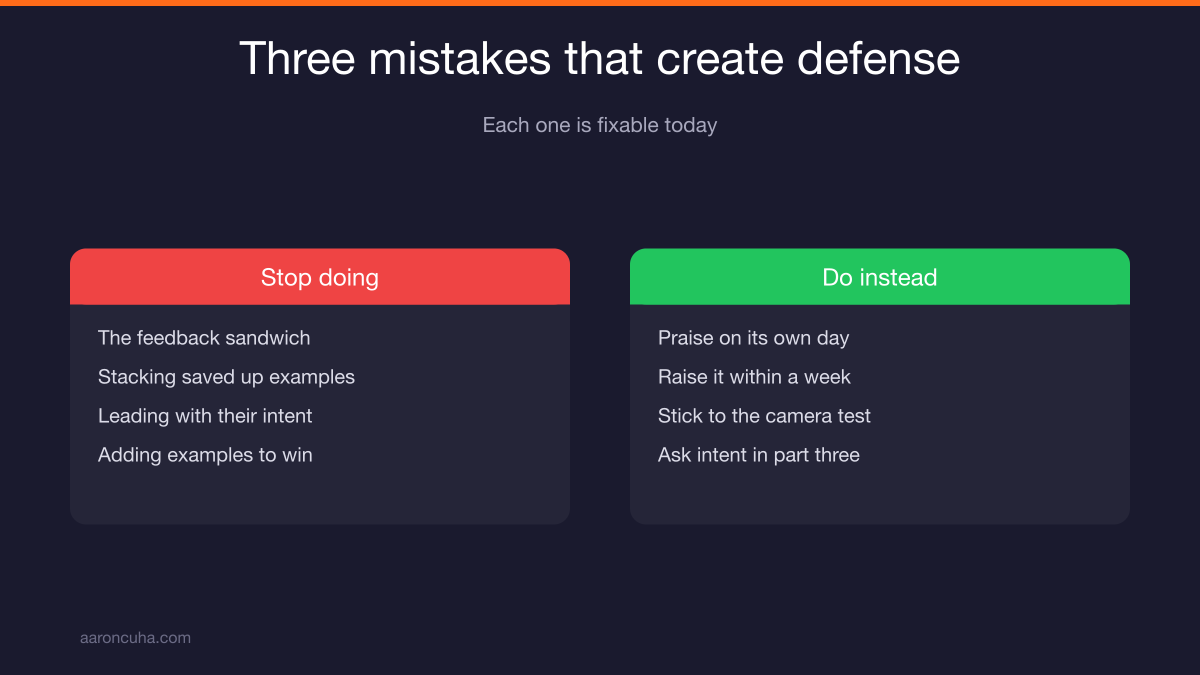
Mistake three: leading with intent. "You do not care about quality." "You are trying to avoid the hard accounts." You just told someone what is inside their head, and you got it wrong.
Do this instead: stick to the camera test in part one. If you genuinely want to know their intent, that is what part three is for. Ask, do not assign.
These three fixes cost you nothing and change most conversations immediately. Research groups like the Harvard Business Review have written for decades about why criticism aimed at identity backfires while criticism aimed at behavior does not.
What to Do When Someone Cries, Argues, or Shuts Down
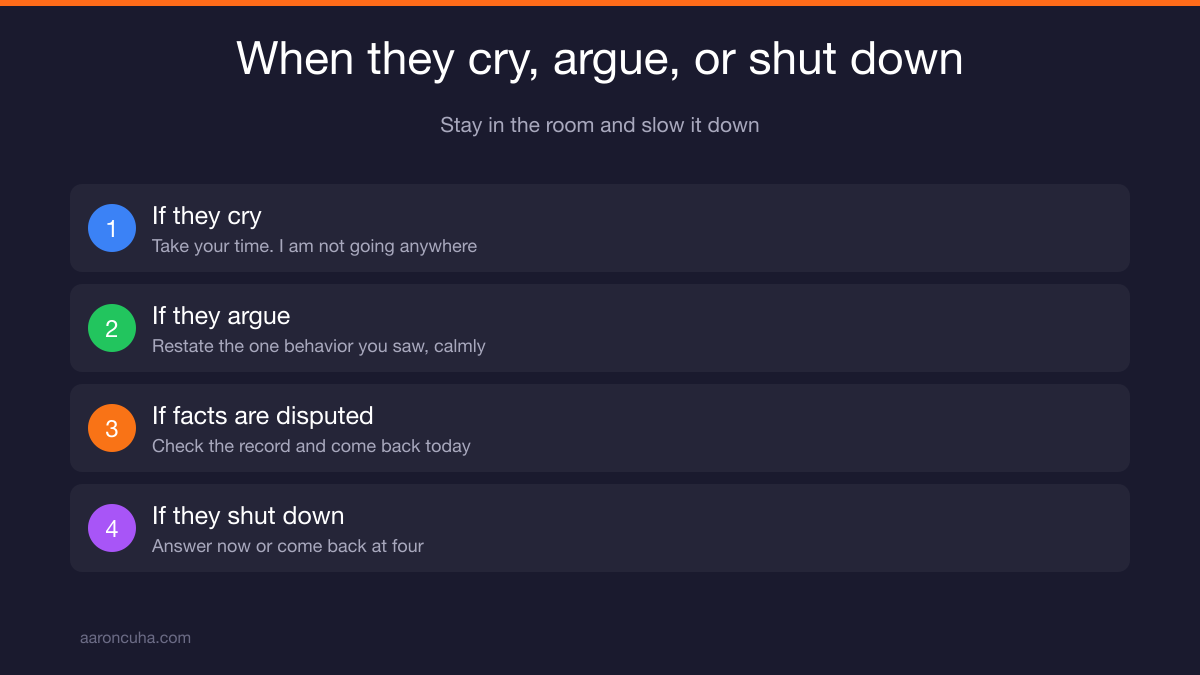
Stay in the room. Do not retract, do not debate, and do not fill the silence. Slow the conversation down instead of ending the standard.
Every leader I coach fears the same three reactions. Here is a scripted response for each.
If they cry: "Take your time. I am not going anywhere." Then wait. Do not apologize for the feedback, and do not soften what you said. Tears are not a verdict on your delivery. If they need a break, offer ten minutes and reconvene.
If they argue: "I hear you. Let me repeat the specific thing I saw." Restate the observable behavior once, calmly. Do not add new examples to win. If the disagreement is about facts, say, "Let me check the record and come back to you today."
If they shut down: "I need to hear from you before we close this. Do you want to answer now, or think and come back at four?" A dated follow up beats a forced answer.
The instinct in all three moments is to make the discomfort stop. That is why leaders take it back, joke it away, or start negotiating against themselves.
Ending early and following up beats caving. You can pause a conversation without dropping a standard. You cannot un-drop a standard.
When Feedback Is Not the Answer
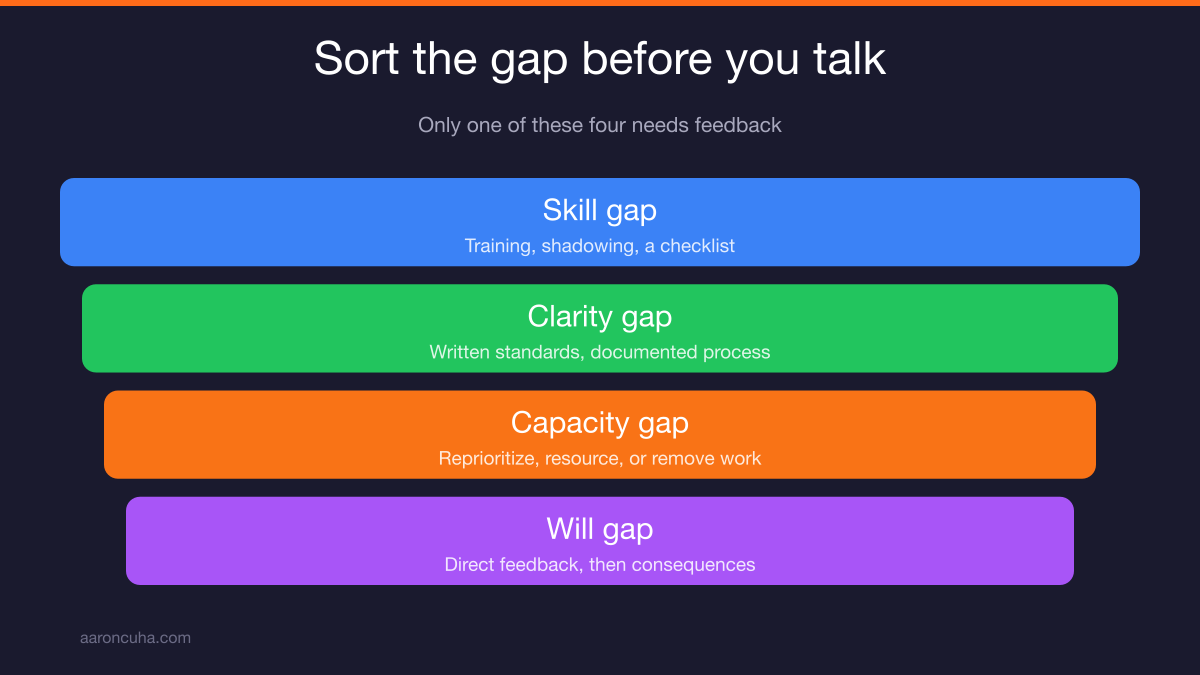
Feedback only fixes some problems. Sort the issue first: skill gap, clarity gap, capacity gap, or will gap. Three of the four need something other than a conversation.
This is the diagnosis step almost everyone skips. You cannot talk someone into a skill they were never taught.
| Gap | What It Sounds Like | What Actually Fixes It |
|---|---|---|
| Skill | "I did not know how." | Training, shadowing, a checklist |
| Clarity | "I did not know that was the standard." | Written standards, a documented process |
| Capacity | "I did not have the time or tools." | Reprioritize, resource, or remove work |
| Will | "I knew, and I chose not to." | Direct feedback, then consequences |
Feedback is the right tool for a will gap. For the other three, feedback alone just makes an honest person feel bad about a problem they cannot solve.
Here is the tell that it is not a people problem at all. If you are giving the same feedback to three different people, the process is broken, not the people.
Fix the process once instead of repeating the conversation forever. That is the entire premise of building systems that run without you. Write the standard down, build the checklist, automate the handoff.
Build a Cadence So Feedback Is Never a Surprise
Put feedback on a schedule. When you meet weekly, correction becomes routine maintenance instead of an event that signals something has gone badly wrong.
Four habits build the cadence:
- Weekly one on ones, same day, same time. Thirty minutes. Never cancel them for something urgent.
- Praise on its own. Give it in the moment, in public when appropriate, never bundled with correction.
- Standards in writing. If it is not documented, it is not a standard. It is a preference.
- Same day recaps. Every agreement gets four written lines. Every time.
The recap is the piece most leaders skip, and it is the piece that turns talk into a system. It removes memory from the equation and gives you a clean record for reviews. Practical performance management guidance from SHRM points the same direction: document the standard, document the agreement, and revisit it on a set date.
Government guidance on workplace performance from sources like the U.S. Office of Personnel Management has long emphasized ongoing performance conversations over once a year reviews. The annual review is not a feedback system. It is a summary of feedback you should have already given.
Cadence also protects you as you grow. Once you are past a handful of people, informal check ins stop scaling and unspoken expectations start drifting. If you are scaling beyond yourself, the rhythm is what holds the standard.
How to Practice This Script This Week
Pick one conversation you have been avoiding. Write the four sentences on paper. Run it, send the recap, and follow up on the date you agreed.
Do it in this order:
- Pick one person. The one you have been rehearsing in the shower. That one.
- Write sentence one. Observable behavior only. Read it back and cut every adverb and every "always."
- Write sentence two. One business impact. One sentence. Delete the second one you wrote.
- Write your question. Pick a stem from part three and commit to fifteen seconds of silence after it.
- Book fifteen minutes today. Not next week. Delay is how this dies.
- Send the recap before you go home. Four lines: discussed, committed, date, check in.
- Put the follow up date on your calendar. If you skip it, you taught them the agreement was optional.
You will feel the difference in the first conversation. Not because you found courage, but because you followed a structure.
That is the whole point of Systems Over Hustle. I built a company to 3,000 employees, lost it, spent a decade doing humanitarian work in Nepal, and rebuilt as a coach. The one lesson that survived all of it: the leaders who last do not rely on how they feel that day. They rely on what they built.
If you want a coach in your corner while you rebuild how your team communicates, explore executive coaching or reach out directly and tell me the conversation you are avoiding.
Frequently Asked Questions

Written by
Aaron CuhaAuthor of Crazy Simple YouTube, keynote speaker, and executive coach with 20,000+ hours logged. ICF PCC, NLP Master Practitioner, and DISC Certified. Aaron helps entrepreneurs replace hustle with AI-powered systems that generate leads, content, and revenue on autopilot.