Most owners wait months, get frustrated, then jump straight to firing. This is how to manage an underperforming employee with a structured middle step: a 30 day turnaround plan built on four moves you can start today.
Most owners tolerate an underperformer for months, say nothing measurable, then fire the person abruptly. Here is how to manage an underperforming employee with a real middle step. It takes 30 days.
Key Takeaways
- Name the performance gap in observable behavior, never in attitude language.
- Diagnose skill versus will with two questions before you invest in training.
- Agree on exactly two measurable weekly commitments, written down the same day.
- Hold three short checkpoints where the employee reports the numbers to you.
- By day 14 you will know if this is coachable. Act on that.
If you want a second set of eyes on the conversation before you have it, book an executive coaching session and we will build the plan together in one sitting.
Why Owners Wait Too Long, Then Swing to Firing
Owners wait because they have no middle step. There is frustration and there is termination, with nothing structured in between. So they tolerate the problem until they snap.
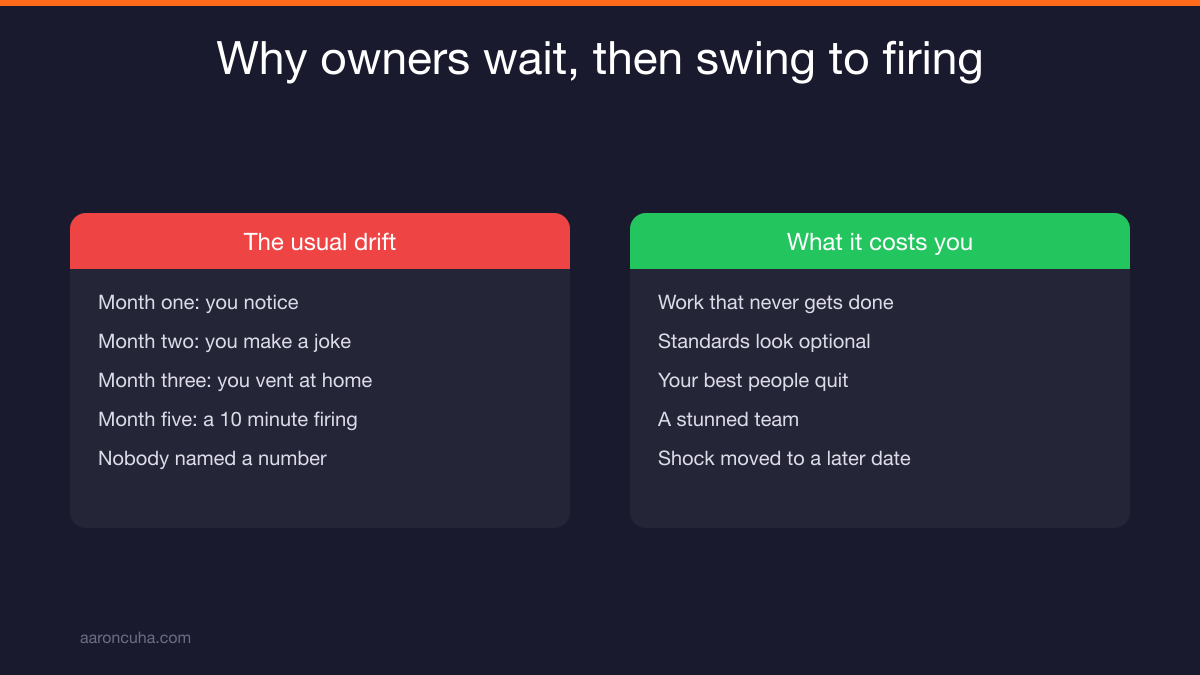
The pattern looks the same in almost every business I coach. Month one, you notice something is off. Month two, you make a joke about it. Month three, you complain to your spouse. Month five, you decide the person has to go, and you fire them in a ten minute meeting.
The employee is stunned. Your team is stunned. From their side, nobody ever told them a number they were missing.
I ran DirectLender.com with 280 offices and 3,000 employees. At that scale, you cannot manage by mood. I learned the hard way that the gap between annoyance and action is where money leaks. Every week you delay, you pay for the same underperformance twice: once in the work not getting done, and once in what your best people conclude about your standards.
That second cost is the expensive one. High performers do not quit over one weak teammate. They quit when they realize the standard is optional.
How to Manage an Underperforming Employee: The Four Moves
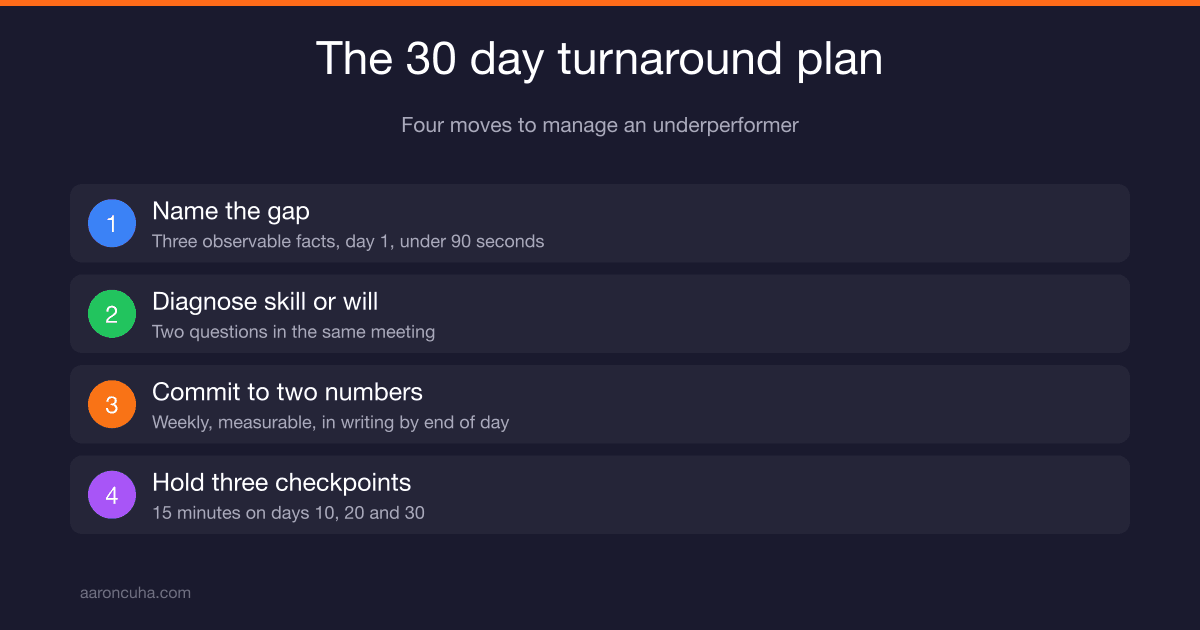
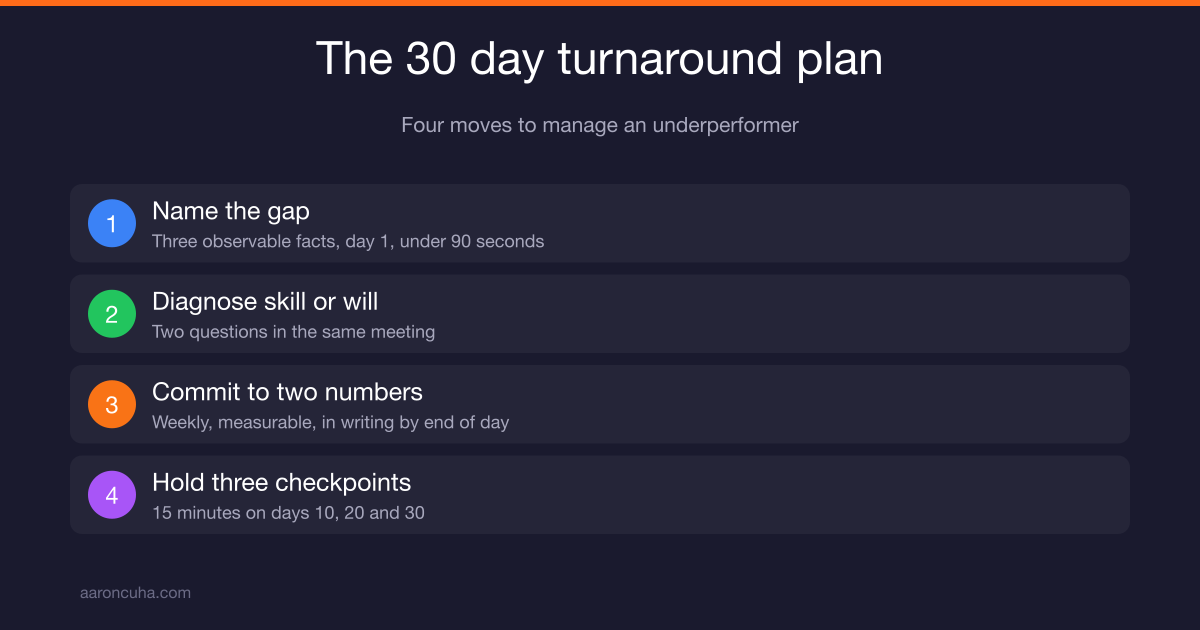
To manage an underperforming employee, run a 30 day turnaround with four moves: name the gap in observable behavior, diagnose skill versus will, set two measurable weekly commitments in writing, and hold three checkpoints.
That is the whole system. It fits on one page. It does not require an HR department, a scorecard software subscription, or a difficult personality.
Here is the timing.
| Move | What you do | When |
|---|---|---|
| 1. Name the gap | State three observable facts, no adjectives | Day 1, under 90 seconds |
| 2. Diagnose | Two questions to separate skill from will | Day 1, same meeting |
| 3. Commit | Two measurable weekly numbers, in writing | Day 1, confirmed by end of day |
| 4. Checkpoints | Three 15 minute reviews, they report | Days 10, 20, 30 |
Notice what is missing. There is no long speech, no list of nine improvement areas, no vague promise to "communicate better." Complexity is how these plans die.
This is the same principle behind my Systems Over Hustle framework. When results are inconsistent, you do not need more intensity. You need a repeatable process that runs the same way every time, whoever is in the chair.
Move One: Name the Gap in Observable Behavior
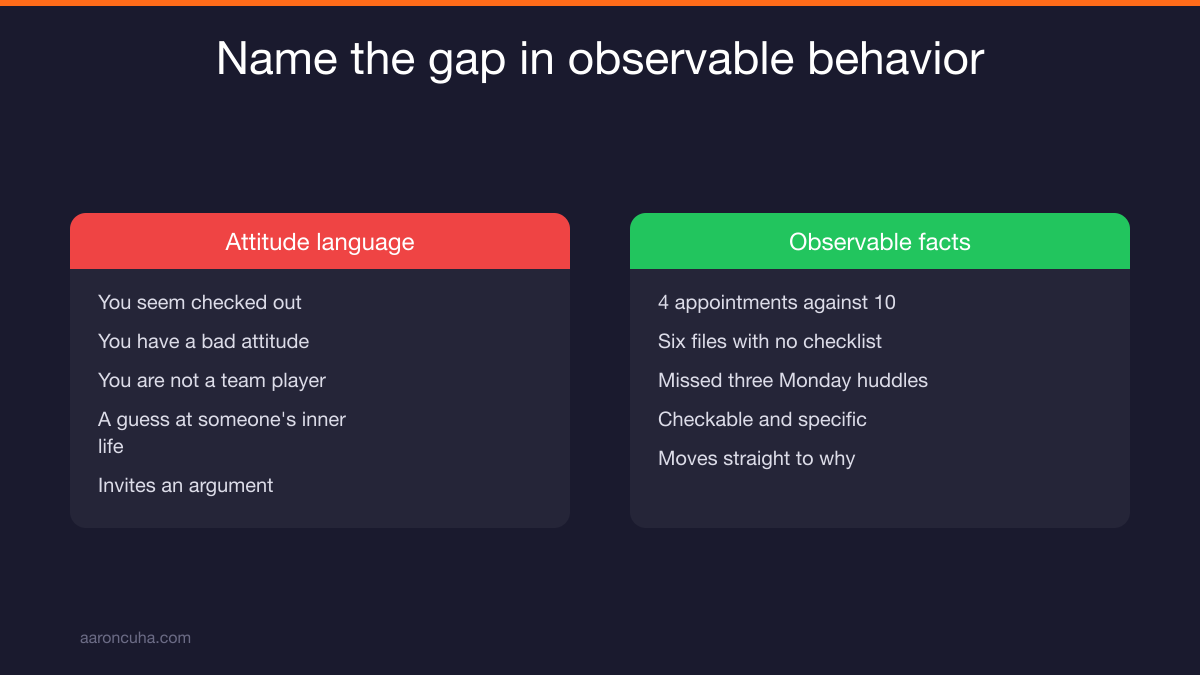
Describe what a camera would see, not what you think it means. Observable behavior invites problem solving. Attitude language invites defense. Bring three specific facts, then stop talking.
Here is the difference in practice.
- Weak: "You seem checked out lately." Strong: "You logged four listing appointments last month. The standard is ten."
- Weak: "You have a bad attitude about the new process." Strong: "The last six files came to me without the checklist attached."
- Weak: "You are not a team player." Strong: "You missed the last three Monday huddles without telling anyone."
The weak versions are guesses about someone's inner life. Nobody agrees to a guess about their inner life. They argue with it, and now you are debating character instead of results.
Facts are different. Facts are checkable. When you say "four out of ten," there is nothing to fight about, so the conversation moves straight to why.
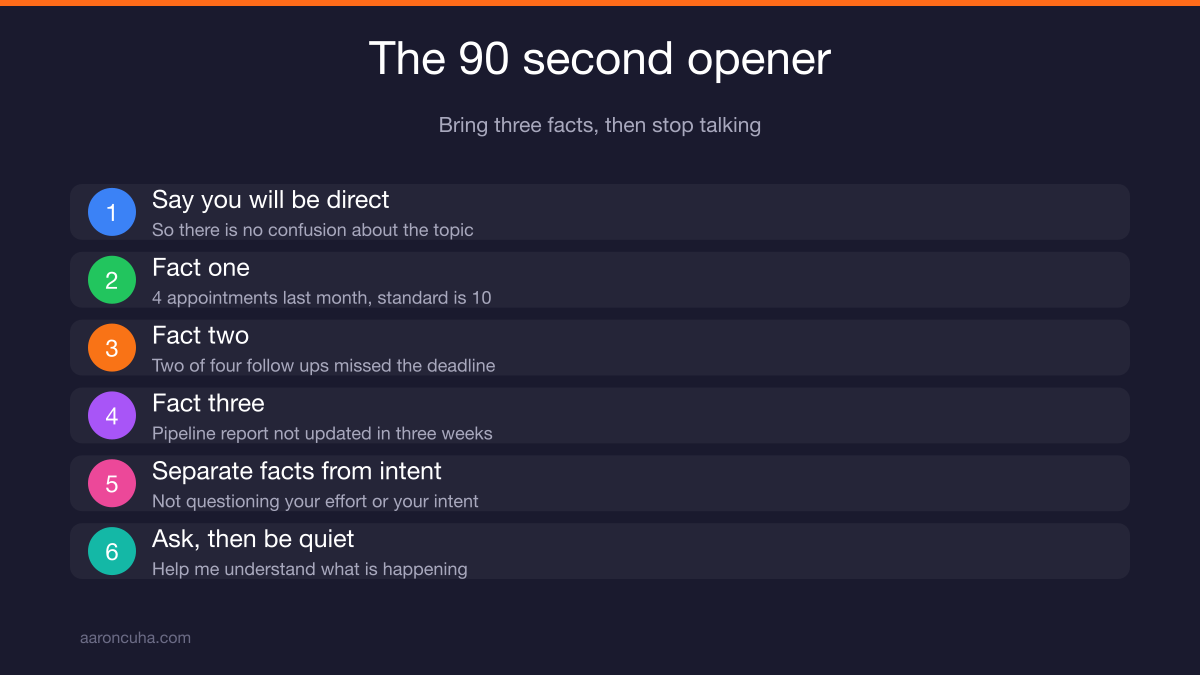
Here is a 90 second opener you can use today:
"I want to talk about performance, and I want to be direct so there is no confusion. Three things I am seeing. One, four appointments last month against a standard of ten. Two, two of the last four client follow ups happened after the deadline. Three, the pipeline report has not been updated in three weeks. I am not questioning your effort or your intent. I am telling you where the numbers are. Help me understand what is happening."
Then be quiet. The silence does the work.
Move Two: Skill Problem or Will Problem
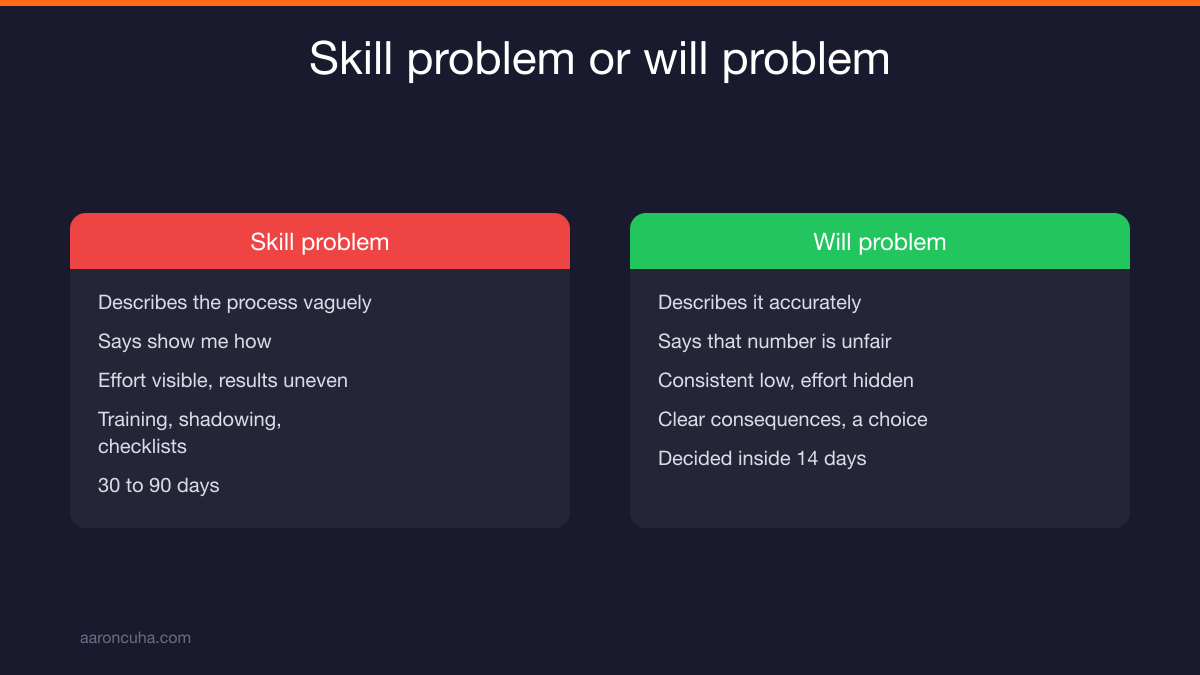
Ask two questions. "Walk me through exactly how you do this task." And, "If nothing changed about your workload, could you hit this number?" The first exposes skill. The second exposes will.
If the person cannot walk you through the process cleanly, you have a skill gap. They are guessing. More pressure will not help them guess better.
If they describe the process perfectly and then tell you the number is not realistic or not their job, you have a will gap. More training is a waste of a month.
| Signal | Skill problem | Will problem |
|---|---|---|
| Describing the process | Vague, missing steps | Accurate and confident |
| Reaction to the standard | "Show me how" | "That number is unfair" |
| Results pattern | Inconsistent, effort visible | Consistent low, effort hidden |
| What fixes it | Training, shadowing, checklists | Clear consequences and a choice |
| Realistic timeline | 30 to 90 days | Decided inside 14 days |
Most owners get this backwards. They send the will problem to a training course and put the skill problem on a warning. Both fail, and both take a quarter to fail.
Skill is a coaching job. Will is a decision job. You can teach someone to do the work. You cannot teach someone to want to.
Organizations like SHRM publish practical guidance on structured performance management, and it is worth reading before you formalize anything. The diagnostic step, though, is on you. No policy document can tell you whether the person in front of you wants the job.
Move Three: Two Measurable Weekly Commitments
Pick two numbers, not seven. They must be weekly, countable, and inside the employee's control. Two commitments get done. Seven become a wish list nobody tracks past week one.
Choose leading activity over lagging results. A salesperson does not control closings this month. They control conversations this week. Coach the input and the output follows.
Rules for what qualifies:
- Countable. You can write the number on a napkin with no interpretation.
- Weekly. Monthly targets hide four weeks of drift.
- Controllable. The employee can hit it without waiting on anyone else.
- Visible. The number lives somewhere you both can see it.
- Two only. If you need a third, one of the first two was not the real driver.
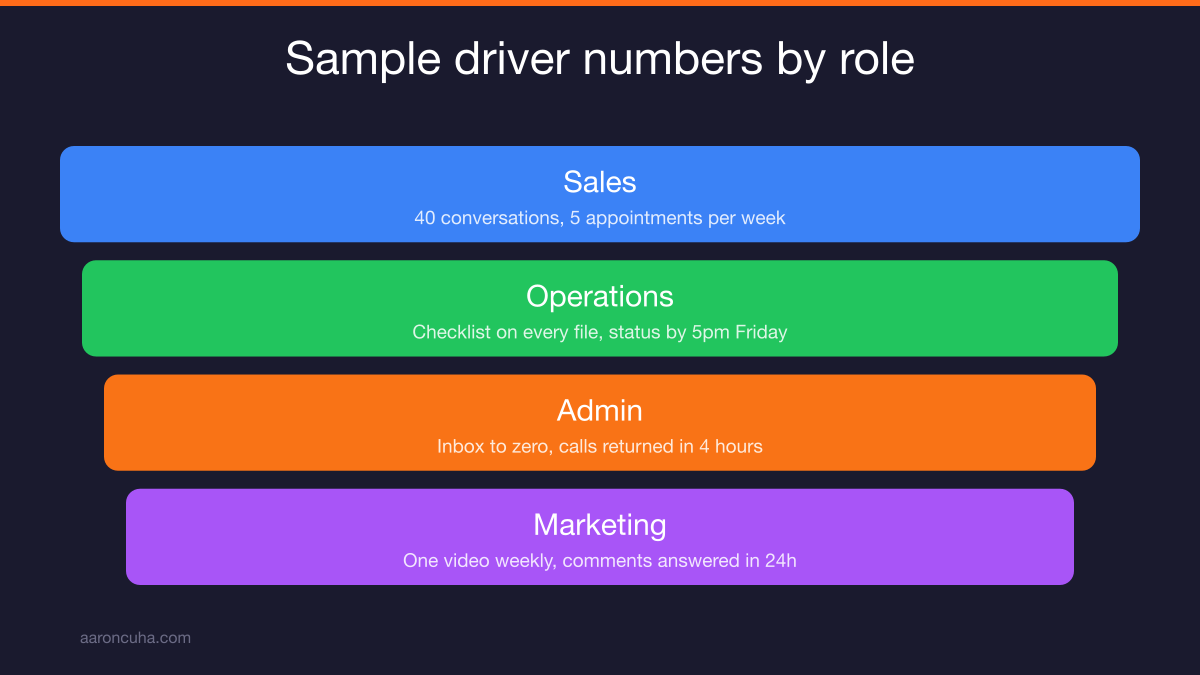
Sample commitments by role:
- Sales: 40 outbound conversations per week. 5 appointments set per week.
- Operations: Every file closed with the checklist attached. Status updated by 5pm Friday.
- Admin: Inbox cleared to zero daily. All client calls returned within four business hours.
- Marketing: One video published per week. All comments answered within 24 hours.
If you cannot name two driver numbers for a role, that is your gap, not theirs. Fix the role definition first. My guide on how to delegate as an entrepreneur covers how to define outcomes so people know what winning looks like before you ever have to correct them.
Put It in Writing the Same Day
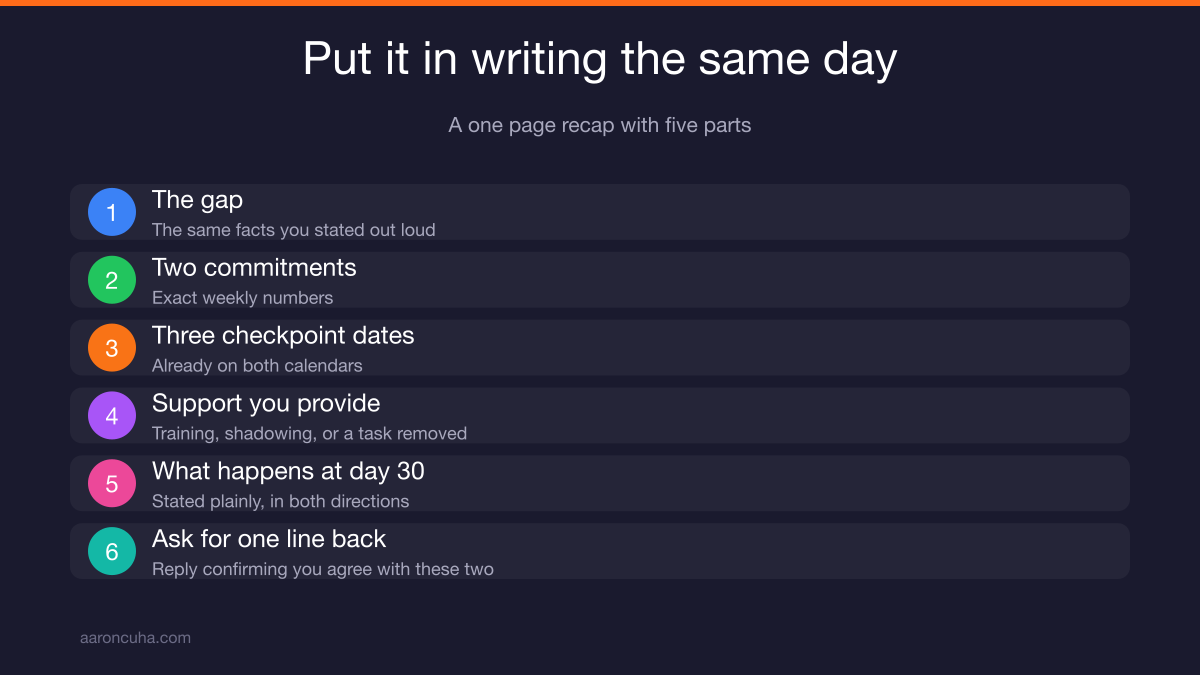
Send a one page recap before you go home. Verbal plans evaporate. Written plans create a shared reference so week three cannot turn into a memory contest.
Your recap has five parts and fits on one page:
- The gap, stated in the same observable facts you used out loud.
- The two weekly commitments with exact numbers.
- The three checkpoint dates and times, already on both calendars.
- What support you are providing, whether that is training, shadowing, or removing a task.
- What happens at day 30, in both directions.
Then ask for one line back: "Reply confirming you agree with these two commitments." That reply is the whole point. It converts your expectation into their commitment.
Do not soften the day 30 language. If continued employment depends on the outcome, say so plainly in the document. Ambiguity is not kindness. It just moves the shock to a later date.
One practical note. If you are creating a formal performance improvement plan tied to employment decisions, run your language past HR or employment counsel first. Requirements vary by state and by role. The U.S. Department of Labor is a reasonable starting point for federal basics, but it is not a substitute for advice on your specific situation.
The framework in this post is the management process. The legal wrapper is a separate conversation, and it is a cheap one compared to getting it wrong.
Move Four: Three Checkpoints Where They Report the Numbers
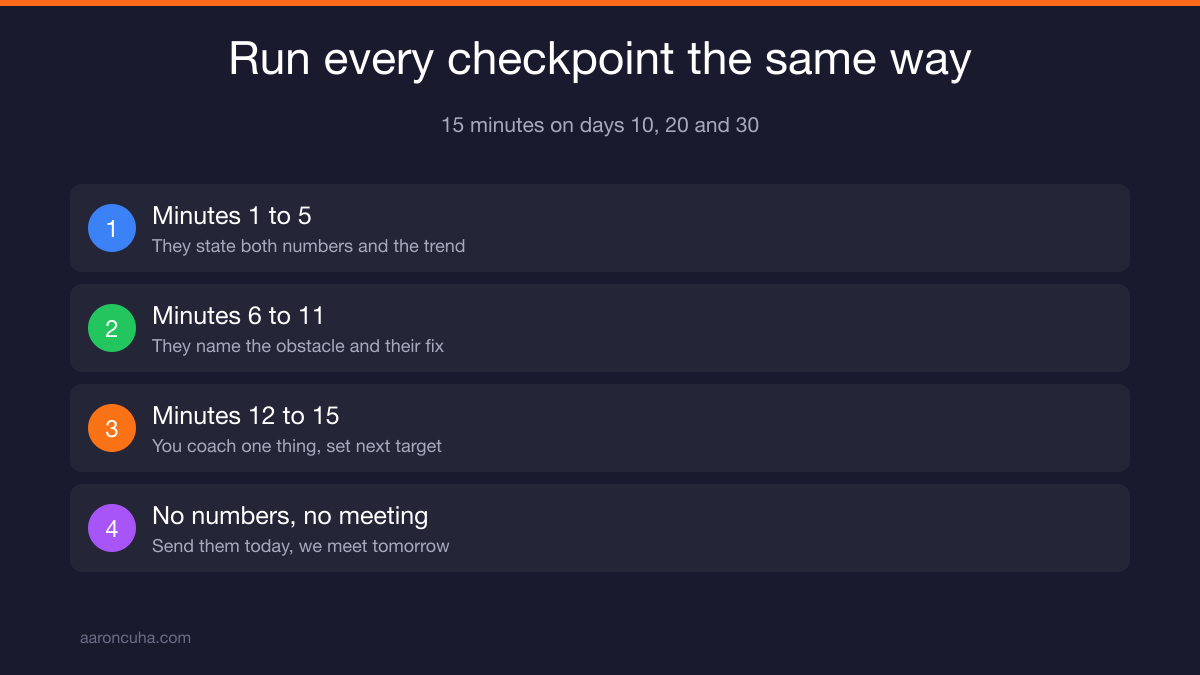
Fifteen minutes on days 10, 20, and 30. The employee reports their two numbers first. Then you coach. You never chase, gather, or calculate the numbers yourself.
That reversal is the most important detail in this entire plan.
When you pull the numbers, you own the problem. When they bring the numbers, they own it. Same data, completely different psychology.
Run each checkpoint in the same order every time:
- Minutes 1 to 5. They state both numbers and the trend versus last week.
- Minutes 6 to 11. They name the single biggest obstacle and their proposed fix.
- Minutes 12 to 15. You coach one thing, confirm next week's target, done.
Do not extend the meeting. Do not add a third metric because things are going well. Do not skip a checkpoint because you are busy. A skipped checkpoint tells the employee the plan was theater.
What if they show up without their numbers? Do not go find them. Say this: "We cannot have this meeting without the numbers. Send them to me by end of day and we will meet tomorrow at the same time." Then note it. Showing up unprepared to a performance meeting is itself performance data, and it usually points at will, not skill.
Research summaries from Gallup's workplace division consistently point to clear expectations and regular manager conversations as central to engagement. This structure gives you both in fifteen minutes a week.
The Week Two Honesty Test
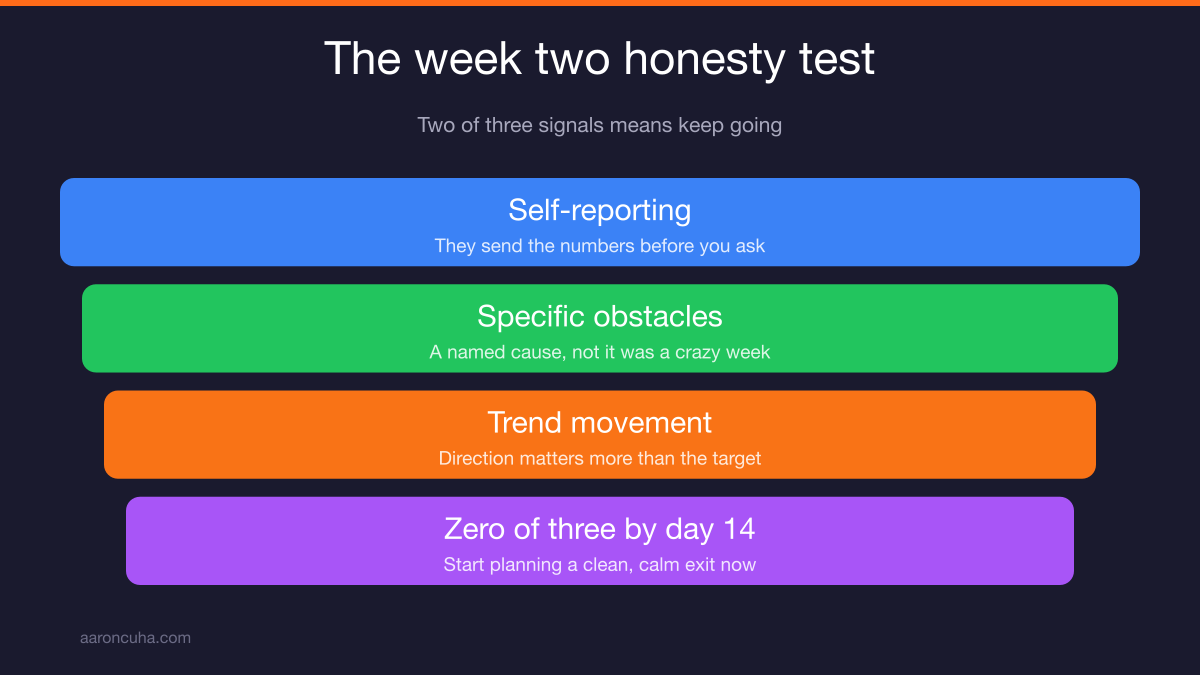
By day 14, look for three coachability signals: self-reporting before you ask, specific obstacles instead of general excuses, and any movement in the trend. Two out of three means continue.
Here is what each signal actually looks like.
Self-reporting. They send the numbers before the checkpoint, or they mention them in passing during the week. Coachable people want you to see progress. Uncoachable people want the topic to go away.
Specific obstacles. "I hit 32 conversations instead of 40 because Tuesday's system outage cost me three hours" is a specific obstacle. "It has been a crazy week" is a general excuse. Specific means they were paying attention. General means they were not tracking at all.
Trend movement. You are not looking for the target. You are looking for direction. Four to seven is a real signal. Four to four is also a signal.
Two of three, keep going and finish the 30 days. Zero of three by day 14, start planning a clean exit now. Not a dramatic one, not an angry one. A planned one, with the paperwork ready and a transition list drafted.
This is the part owners skip, and skipping it is why plans drag into month three. The 30 days is not a formality you owe someone. It is a real test with a real read at the halfway mark.
Want a coach in your corner while you make that call? Join the Systems Over Hustle community and bring the situation to a live session this week.
When the Problem Is You, Not Them
Before you launch any plan, audit yourself. Four questions. If you answer no to two or more, you do not have an employee problem. You have a management problem wearing a costume.
Run this list honestly:
- Was the standard ever stated as a number? "Do a good job" is not a standard. Ten appointments a month is.
- Were they actually trained, or just told? Watching you do it once is not training.
- Did you change priorities midstream? If you moved the target in week two, the miss is yours.
- Is the role wrong for the person? A great detail person in a cold calling seat will always look lazy. They are not lazy. They are misplaced.
I watched this repeatedly at scale. Whenever one branch produced weak results, the temptation was to blame the people. Almost every time, the real culprit was an unclear system. When the process was vague, good people looked bad. When we tightened the process, the same people improved without a single hard conversation.
Unclear systems manufacture underperformers. That is the core of Systems Over Hustle. Before you put someone on a plan, make sure they are not just the visible symptom of a process you never finished building.
If your answers came back mostly no, fix the system first and give it 30 days. You may not need the performance conversation at all.
How to Close the Plan Cleanly, Either Way
Day 30 ends with a decision and a clear statement. Either the numbers become the new permanent baseline, or the person exits with no surprise. Never let day 30 pass silently.
If they hit it, say this: "You committed to 40 conversations and 5 appointments. You delivered. Here is what changes now. These two numbers are your standing weekly baseline, not a temporary plan. We will keep reviewing them in our regular one on one. Thank you for taking this seriously."
Do not gush. Do not apologize for the plan. Lock in the baseline and move on. If you treat the plan as an unpleasant episode you both survived, the numbers slide back within six weeks.
If they did not hit it, say this: "Thirty days ago we agreed on two numbers and three checkpoints. The results are here in writing. We are not going to continue in this role. Here is your timeline, here is what I will do to support the transition, and here is what I need from you this week."
Short. Respectful. Zero new information. If they are surprised at day 30, the plan was run poorly, not the exit.
A clean close protects everyone still on your team. Your other employees are watching how this ends. They are not judging whether you were nice. They are learning whether standards in your company mean anything. As Harvard Business Review covers often, the credibility of a leader rests on follow through more than on tone.
Systemize It So You Stop Repeating This
If you run this plan three times a year, you do not have bad luck. You have a missing management rhythm. Turn the turnaround plan into how you manage everyone, all the time.
Three pieces make it permanent:
- Role scorecards. Every seat has two to four driver numbers, written down, known on day one of employment.
- Weekly numbers, reported up. Everyone sends their numbers before the meeting. You never chase data again.
- Delegation clarity. Outcome, deadline, standard, and decision rights defined before you hand off the task.
When those three exist, underperformance surfaces in week two instead of month five. You catch it while it is still small enough to coach.
This is also where automation earns its keep. A simple dashboard or a scheduled reminder can collect numbers, flag misses, and summarize trends without you playing detective. I break down how to build that layer in AI business systems and, for service businesses specifically, in AI automation for coaches.
The goal is not to remove the human conversation. The goal is to remove the chasing so the human conversation is about coaching, not about whether the report got sent.
You can grab the templates and checklists on my free resources page if you want a starting structure instead of a blank page.
Your First 24 Hours
Do not read this and think about it. Underperformance costs you every week you delay. Here is your same-day list, and it takes about 45 minutes total.
- Pick one person. Not three. The one costing you the most right now.
- Write three observable facts. Numbers and dates only. If you cannot produce three, you have a tracking problem to fix first.
- Run the manager audit. Four questions from earlier. If you fail two, fix the system before the meeting.
- Book the conversation. Within 48 hours. Fifteen minutes, private, no laptop.
- Draft the two commitments. Leading activity, weekly, countable, controllable.
- Put three checkpoints on the calendar. Days 10, 20, and 30. Send the invites now, before the first meeting.
- Set a day 14 reminder that says "run the honesty test."
That is the whole plan. Four moves, three checkpoints, one page, 30 days.
I lost a company with 3,000 employees in 2008 and spent a decade doing humanitarian work in Nepal before rebuilding as a coach. Across 20,000 hours of one on one coaching since, the pattern has not changed. Owners rarely fail because they lacked courage. They fail because they lacked a process, so the courage arrived too late and came out sideways.
Give yourself the process and the courage gets easy.
Ready to build the management rhythm that keeps this from happening again? Reach out to talk through your team and we will map your role scorecards, weekly numbers, and delegation structure in one working session.
Frequently Asked Questions

Written by
Aaron CuhaAuthor of Crazy Simple YouTube, keynote speaker, and executive coach with 20,000+ hours logged. ICF PCC, NLP Master Practitioner, and DISC Certified. Aaron helps entrepreneurs replace hustle with AI-powered systems that generate leads, content, and revenue on autopilot.