Most owners wait months too long, then handle it so badly the team stays scared for a quarter. Here is how to fire an employee using the Clean Exit sequence, a five step process built from leading 3,000 people and shrinking an organization in 2008.
How to fire an employee is a five minute problem. The damage takes a quarter. Most owners get that backwards, and the team pays for it.
Key Takeaways
- The termination meeting is five minutes. Preparation and the next 48 hours matter more.
- Document the gap as an observable standard, never a personality complaint.
- Run one clarity conversation first so the exit is never a surprise.
- Script the termination in three sentences, then stop talking.
- Brief your team the same day before rumor writes the story for you.
If you are reading this because someone on your team has to go, start with a plan instead of a feeling. Book a private executive coaching session and walk into the room prepared instead of anxious.
The Real Damage Is the Delay, Not the Decision
Most owners do not fire too fast. They fire six months late. The delay, not the decision, is what teaches your team what you actually tolerate.
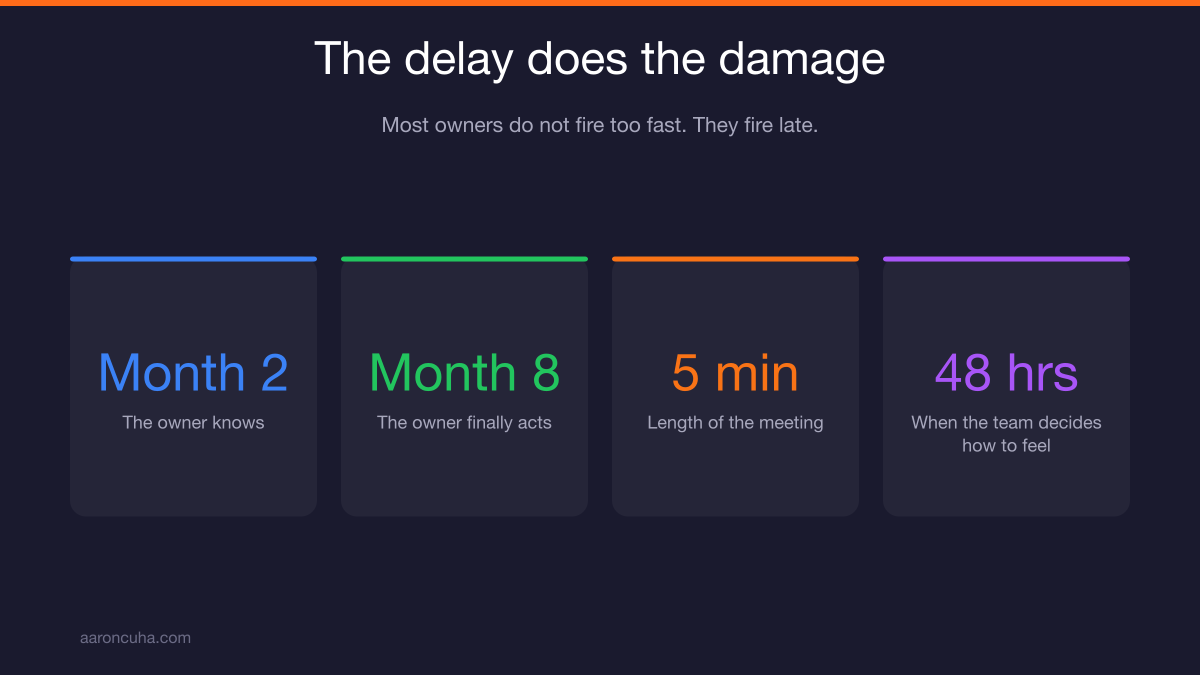
Here is the pattern I see in almost every coaching relationship. The owner knows by month two. The owner acts in month eight. In between, the owner runs a private negotiation with himself about hope, loyalty, and the fear of being the bad guy.
Meanwhile your best people are watching. They are not watching the underperformer. They are watching you.
Every week you keep someone you have already decided about, you send a message. The standard is optional. Effort is optional. The people who carry the extra load get nothing for carrying it.
That is how you lose an A player. Not to a competitor's offer. To the slow realization that excellence and mediocrity earn the same seat at your table.
I am not arguing for speed without process. I am arguing that the honest question is not "should I let this person go." You usually answered that months ago. The real question is "how do I do this cleanly, legally, and in a way my remaining team can respect."
How to Fire an Employee: It Is a Five Minute Event
The termination meeting itself should last about five minutes. You state the decision, name the reason, give the effective date, and move to logistics. Everything that determines the outcome happens before and after.
Owners get this wrong because they treat the meeting as the hard part. So they over-prepare emotionally and under-prepare operationally. They rehearse how to soften the blow and forget to plan who takes the client accounts on Monday.
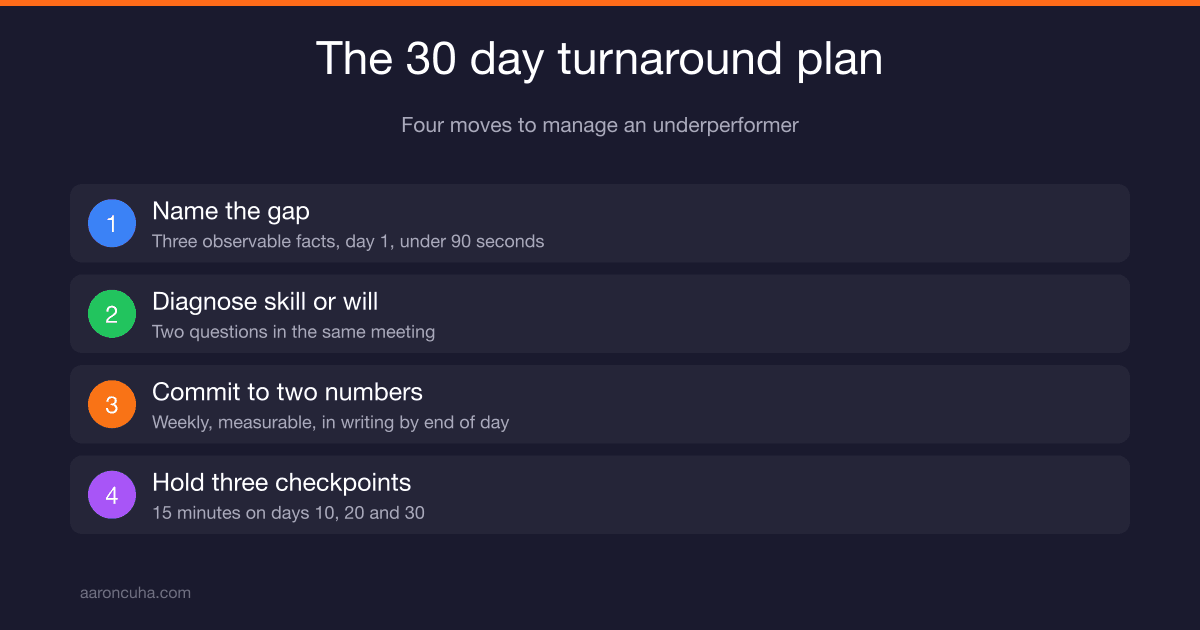
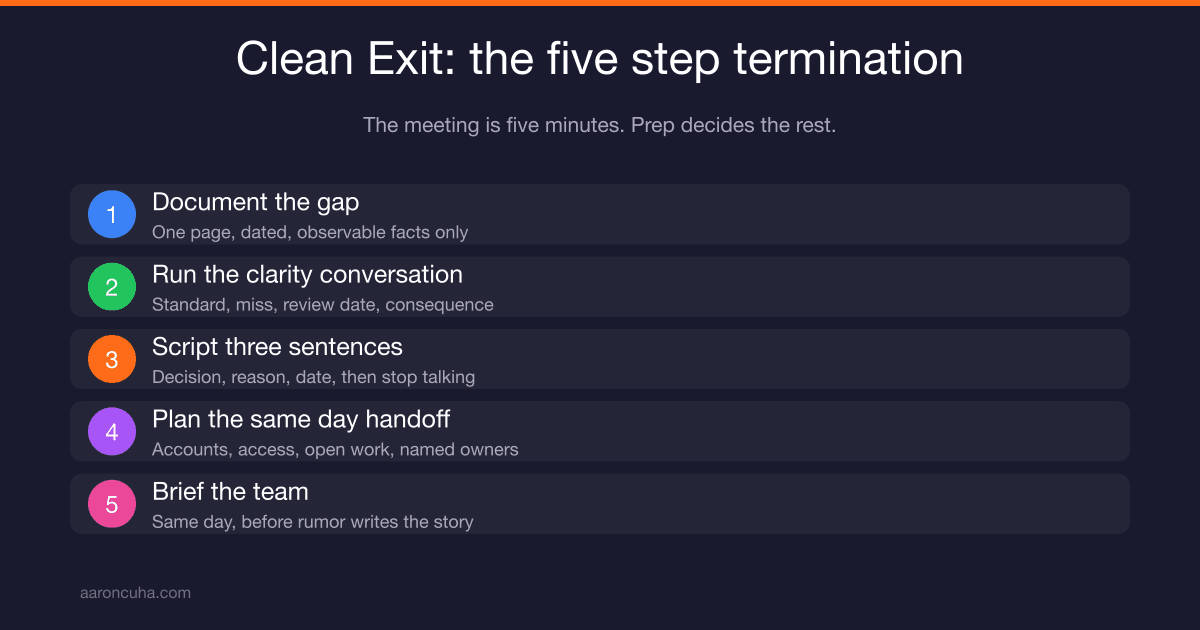
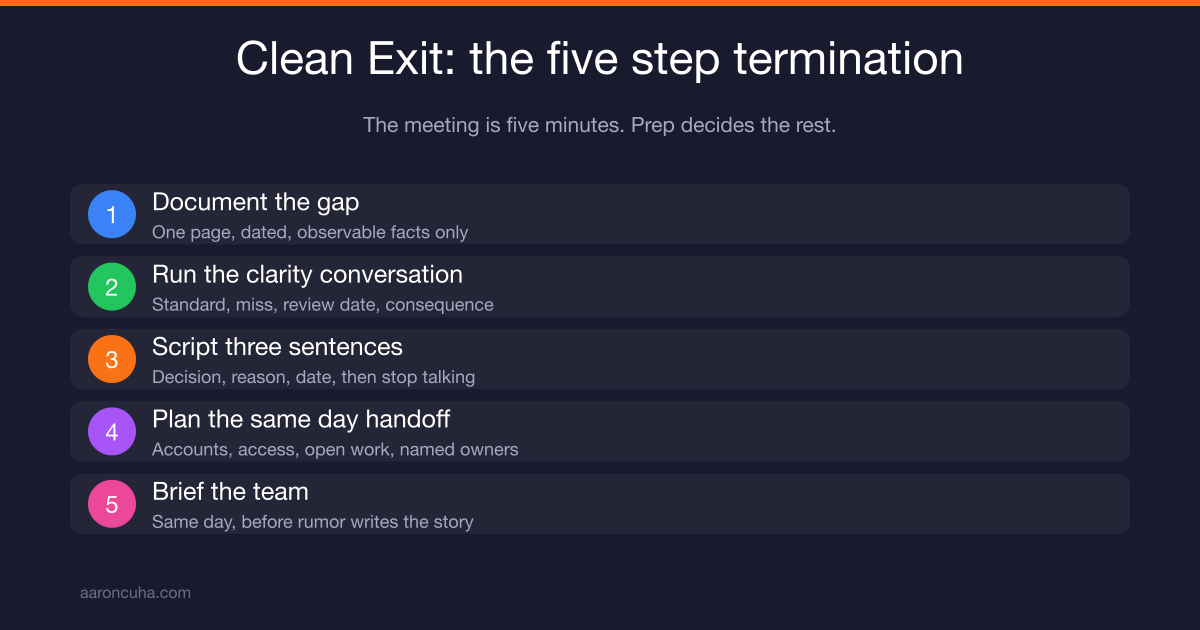
I teach a five step sequence called Clean Exit. It is not clever. It is repeatable, which matters more.
- Document the gap in writing, as an observable standard.
- Run the final clarity conversation so the exit is never a surprise.
- Script the termination in three sentences and stop talking.
- Plan the same day handoff of accounts, access, and in-flight work.
- Address the team before rumor fills the silence.
Run those five steps and the meeting becomes what it should be. Short, calm, and free of surprise for everyone in the room.
Skip them and you get the version most owners live through. A long emotional meeting, a scramble the next morning, and a team that spends three weeks whispering.
What I Got Wrong Shrinking a Company in 2008
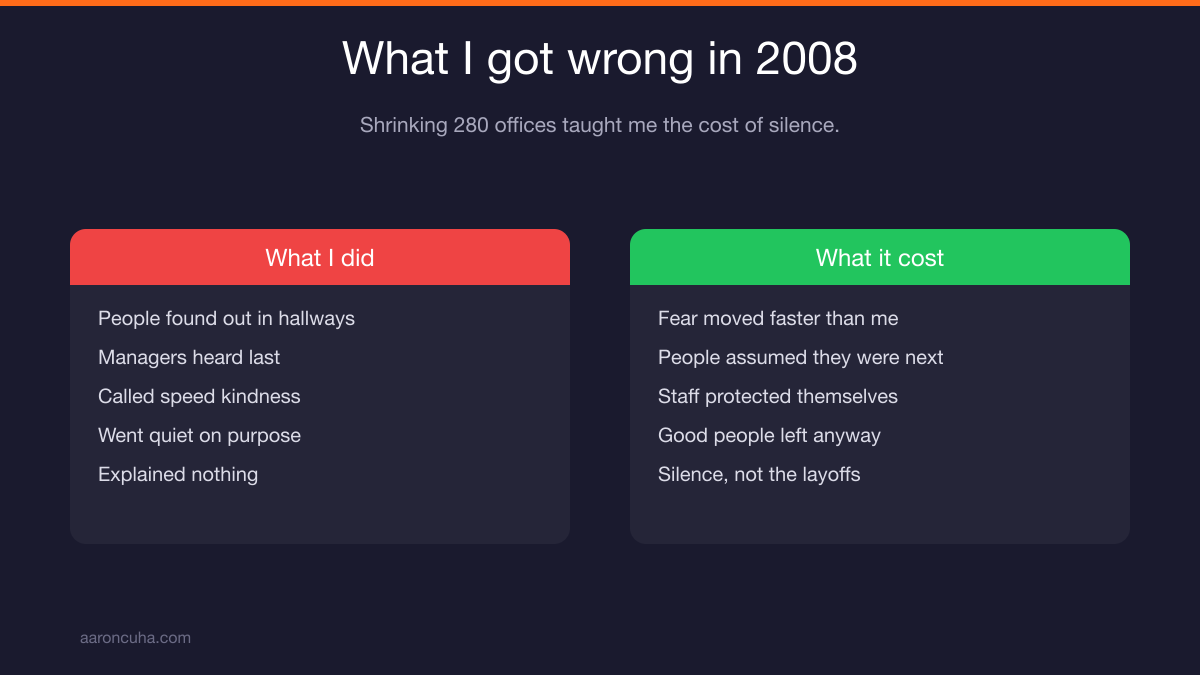
I built DirectLender.com to 280 offices and 3,000 employees. When the mortgage market collapsed in 2008, I had to shrink it. I handled a lot of those exits badly, and the lesson stayed with me.
What I got wrong was not the decision to reduce headcount. The market made that decision. What I got wrong was the preparation and the communication around it.
People found out in hallways. Managers heard the news after their own teams did. I told myself that speed was kindness and that explaining would only make it worse.
It made it worse anyway. Fear moved faster than I did. When leaders go quiet, people do not assume the best. They assume they are next, and they start protecting themselves instead of protecting the business.
Good people left who did not have to leave. Not because of the layoffs. Because of the silence around the layoffs.
I spent the next decade doing humanitarian work in Nepal, and one thing that period taught me is that dignity costs almost nothing to give and costs everything to withhold. When I came back and started coaching full time, this became one of the first things I teach owners.
Step 1: Document the Gap in Writing
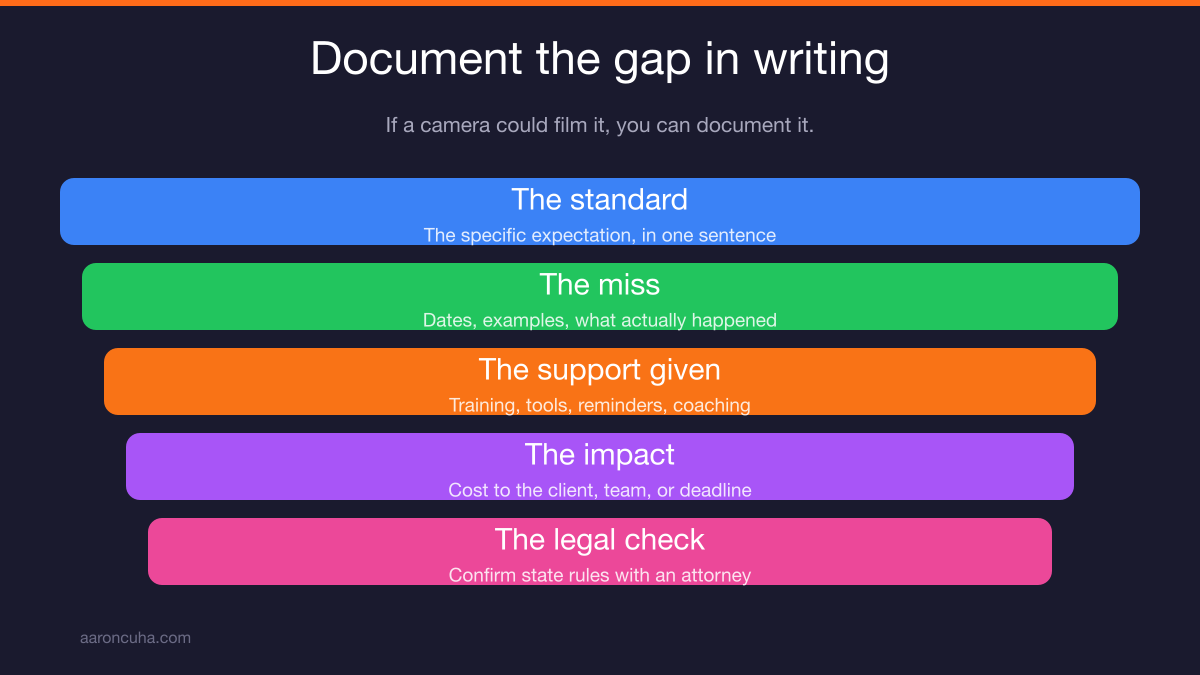
Write one page. Dated entries. Observable facts only. If a stranger read it, they should understand exactly which standard was missed and when.
The mistake almost everyone makes is documenting personality instead of performance. "Bad attitude" is not documentation. "Missed the Tuesday pipeline update on March 4, March 11, and March 18 after two reminders" is documentation.
Use this test. Could you film it? If a camera could capture the behavior, you can document it. If it lives only in your interpretation, rewrite it until it does not.
- The standard: the specific expectation, in one sentence.
- The miss: dates, examples, and what happened.
- The support given: training, tools, reminders, coaching.
- The impact: what it cost the client, the team, or the deadline.
Now the legal part, and I am not a lawyer. Employment rules vary by state and by country, and mistakes here get expensive. Talk to an employment attorney before your first termination and build a template you can reuse.
Start with primary sources rather than blog rumors. The U.S. Department of Labor covers final pay and notice basics, and the U.S. Equal Employment Opportunity Commission covers discrimination rules you must not trip over.
Step 2: Run the Final Clarity Conversation
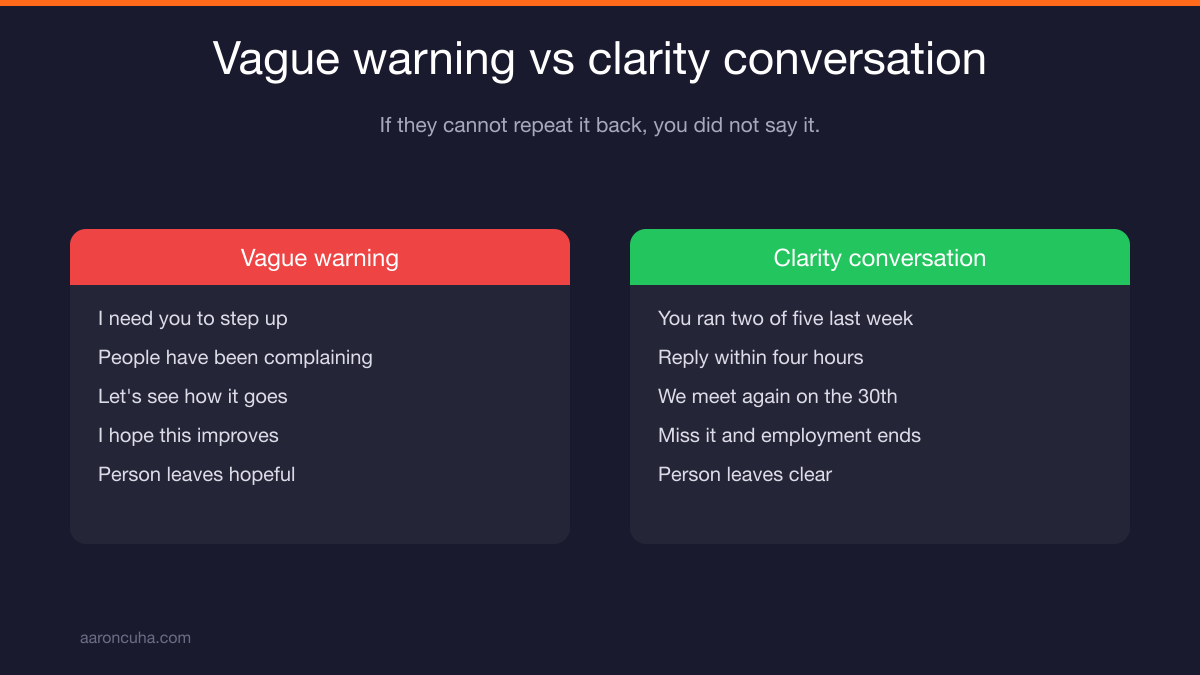
Before you fire anyone, have one conversation where you say the quiet part out loud. Name the standard, name the miss, define success, set a review date, and state the consequence. That conversation is what makes the exit fair.
Most owners think they have already done this. They have not. They have dropped hints, made jokes about it, or sent a passive message in a team meeting hoping the right person felt seen.
Hints are not management. If the person cannot repeat back what will happen and by when, you have not had the conversation.
| Vague Warning | Clarity Conversation |
|---|---|
| "I need you to step up." | "The standard is five listing appointments a week. You ran two last week and one the week before." |
| "People have been complaining." | "Two clients emailed me about response time. Our standard is a reply within four business hours." |
| "Let's see how the next few weeks go." | "We meet again on the 30th. I need four straight weeks at standard." |
| "I hope this improves." | "If we are not at standard by the 30th, we will end your employment here." |
| Person leaves confused and hopeful. | Person leaves clear, and holds the outcome in their own hands. |
Some people rise after this conversation. I have watched it happen more than once, and when it does, you just saved a good employee and a hiring cycle.
Most do not rise. And when they do not, the exit stops being your judgment call and becomes the outcome they chose. That distinction changes everything about how your team reads it.
If you keep hiring people who do not work out, the problem is upstream of the firing. Get an outside read on your structure with one-on-one leadership coaching and fix the intake before you fix the exits.
Step 3: Script the Termination in Three Sentences
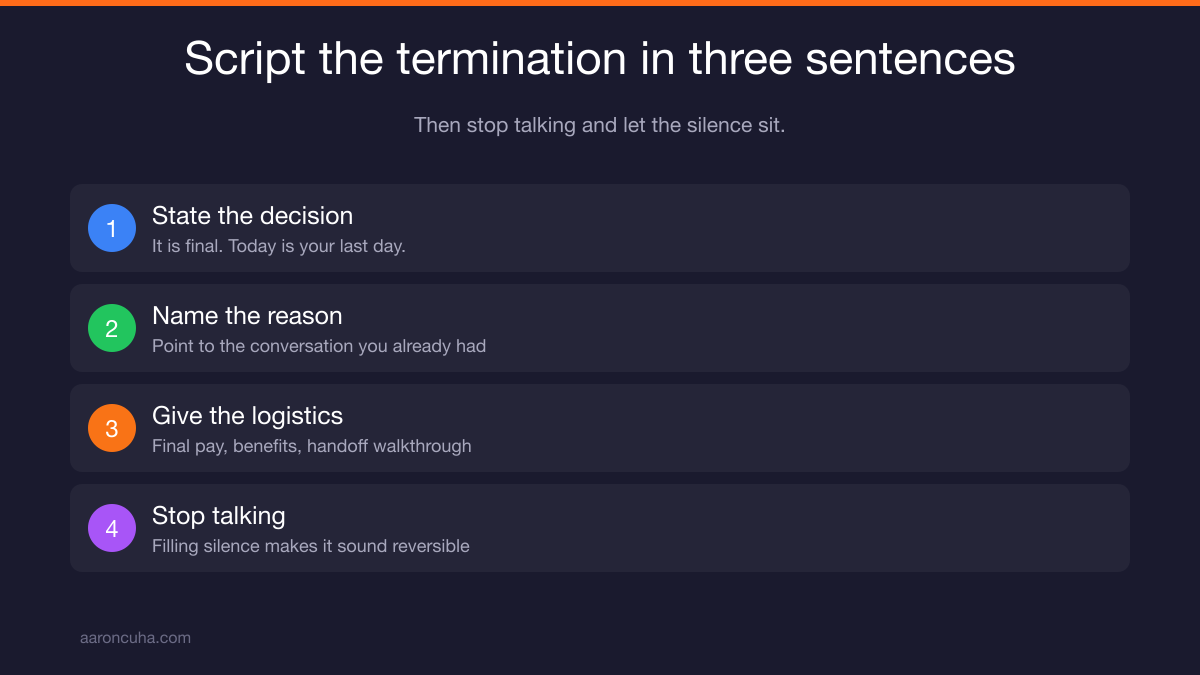
Three sentences. The decision, the reason, the effective date. Then you stop talking and let the silence sit.
Here is the structure, word for word:
- "I have made a decision about your employment, and it is final. Today is your last day with us."
- "We talked on the 12th about the listing appointment standard and the review date. We did not get there."
- "Your final paycheck and details on benefits will come through by Friday, and I will walk you through the handoff now."
That is it. The decision is stated first so the person is not left guessing during a long windup. The reason references a conversation they already had, which is why step two matters.
After sentence three, stop. Owners lose control of these meetings by filling silence. You start explaining, then apologizing, then negotiating, and suddenly the decision sounds reversible.
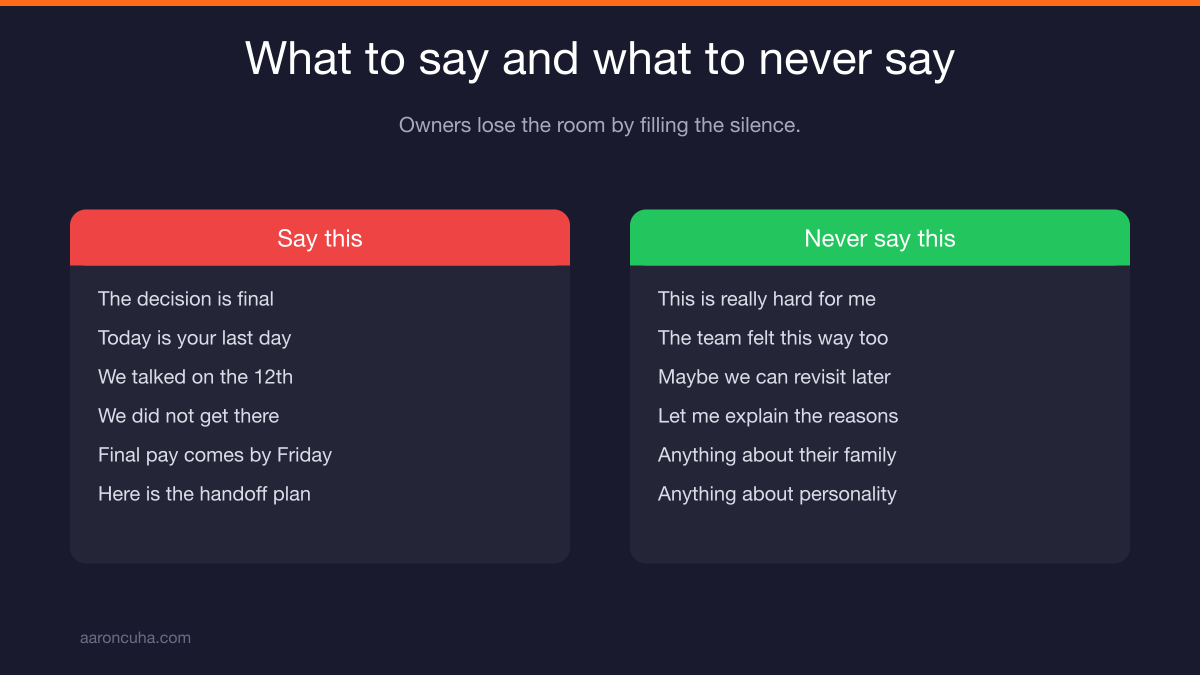
Never say these things:
- "This is really hard for me." It is harder for them.
- "The team felt this way too." Never hand your decision to someone else.
- "Maybe down the road we can revisit." Not unless you mean it.
- "Let me explain all the reasons." One reason, tied to the standard, is enough.
- Anything about their character, family, or personality.
Have one other person in the room. A manager, an HR lead, or a business partner. They take notes, confirm what was said, and keep the meeting from turning into a two hour debate.
Do it early in the day, in a private room, and never over a group video call. Remote teams get a scheduled one-on-one video call, camera on, same three sentences.
Step 4: Plan the Same Day Handoff of Accounts and Access
Build the handoff plan before the meeting, not after. Every account, login, key, and open project gets assigned to a named person on paper. Access gets revoked during the meeting, not that evening.
This is the step owners skip, and it is the one that creates chaos. Monday morning arrives, three clients call, nobody knows who owns them, and your team learns that leadership does not plan.
Run this checklist the day before:
- Logins and systems: email, CRM, phone system, file storage, social accounts, payment tools.
- Physical items: keys, badge, laptop, phone, company card, signage, lockbox codes.
- Client relationships: every active client named, with the new point of contact named next to them.
- In-flight work: open deals, deadlines, promises made, and where each one stands.
- Files and knowledge: anything living on a personal drive or in someone's head.
Assign a name to every line. Not "the team." A person. Unassigned work becomes nobody's work by Wednesday.
Coordinate access removal with whoever runs your IT so it happens while the meeting is in progress. This is not an insult to the person leaving. It is standard practice, and the calm ones expect it.
Send the client transition emails within 24 hours. Short, warm, no drama. "Sam is now your point of contact and has full history on your file."
Step 5: Address the Team Before Rumor Fills the Silence
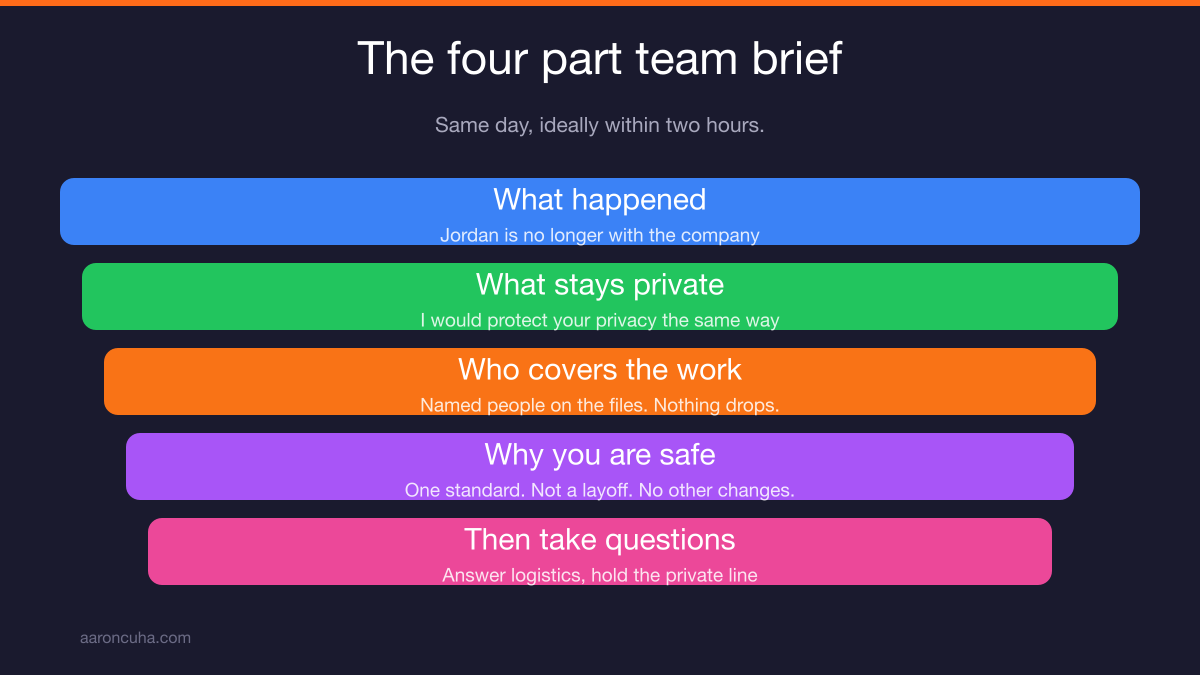
Brief your team the same day, ideally within two hours. Four parts: what happened, what stays private, who covers the work, and why the rest of them are safe.
Silence is not neutral. Silence is a story your team writes without you. And the story they write is always worse than the truth.
Here is the brief:
- What happened: "Jordan is no longer with the company as of today."
- What stays private: "I am not going to discuss the details. I would protect your privacy the same way."
- Who covers the work: "Sam is taking the active files. Priya has the Tuesday reporting. Nothing drops."
- Why you are safe: "This was about one specific standard we talked about directly, more than once. This is not a layoff and no other changes are coming."
Then take questions. Answer the logistics honestly and hold the line on the private details. Holding that line is what tells your team you would protect them too.
Do not badmouth the person who left. Ever. Every word you say about someone who is gone gets heard as a preview of what you would say about the people still in the room.
And do not overexplain. One clear paragraph beats twenty minutes of justification. Confidence in a leader reads as safety.
The 48 Hours That Decide Your Team's Next Quarter
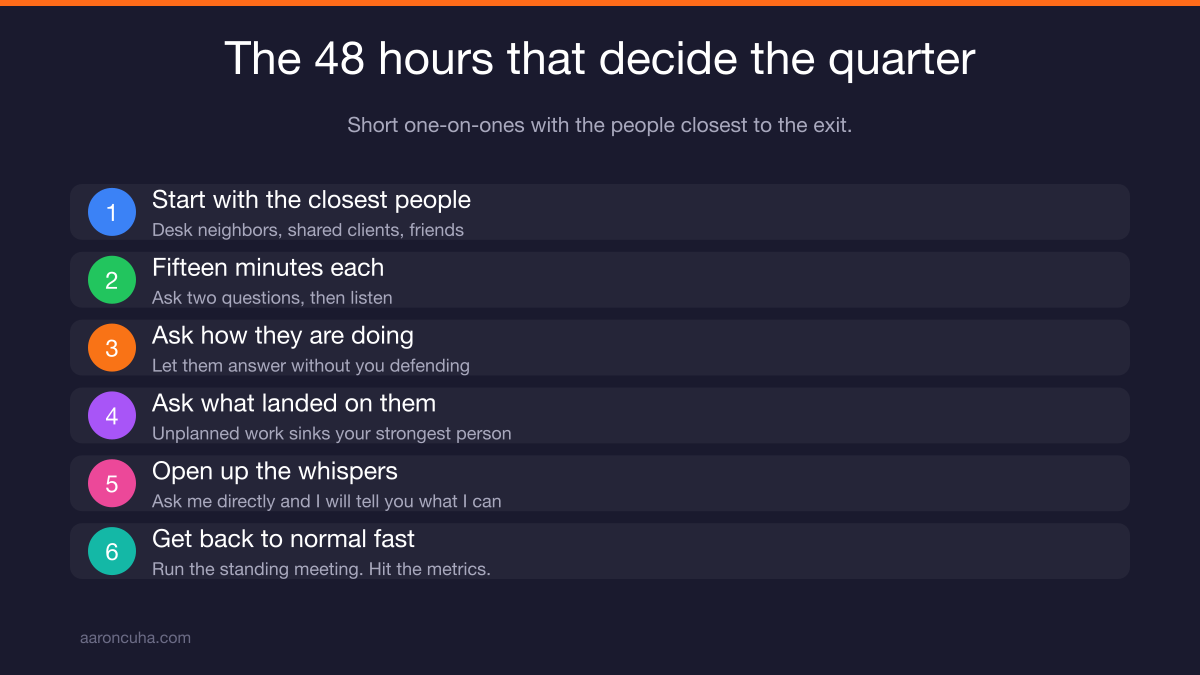
Your team decides how to feel about this within two days. Spend those 48 hours in short one-on-ones with the people closest to the exit, watching for workload panic and shutting down the whisper network.
Start with whoever sat next to the person, shared their clients, or was their friend. Fifteen minutes each. Ask two questions and then listen.
- "How are you doing with this?"
- "What landed on your plate that we did not plan for?"
The second question protects you from the most common post-termination failure. Work quietly falls on the strongest person, they absorb it because they are loyal, and eight weeks later they resign.
Watch for the whisper network too. If two people keep stepping out to talk, address it in the open. "I know there are questions. Ask me directly and I will tell you what I can."
Resist the urge to overexplain in these one-on-ones. You will feel pressure to prove you were right. That pressure is your ego, not your leadership.
Then get back to normal fast. Run the standing meeting. Hit the metrics. Normalcy is the fastest reassurance there is. This is the same principle behind building systems that keep running when people change.
Seven Mistakes That Make the Remaining Team Afraid
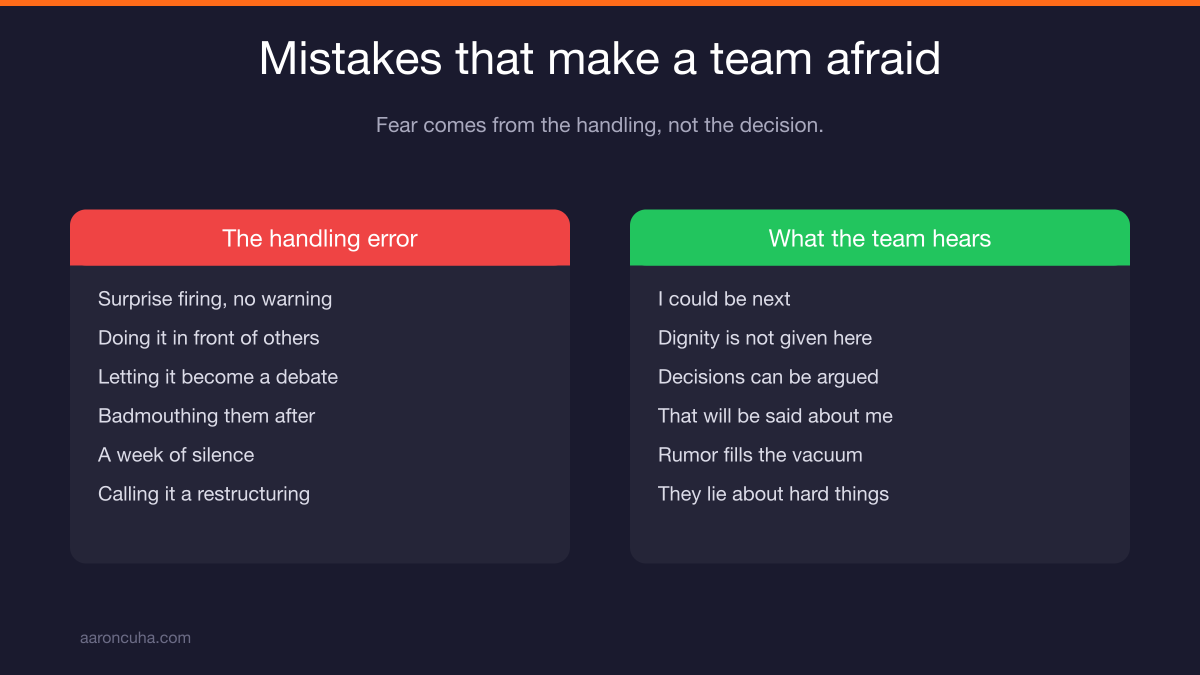
Fear in a team almost never comes from the firing itself. It comes from seven specific handling errors that signal the process was arbitrary.
- The surprise firing. No warning, no clarity conversation. Everyone left assumes they could be next without notice.
- The ambush audience. Doing it in front of others, or in a room with a glass wall. Dignity is the cheapest thing you can give.
- The negotiation. Letting the meeting turn into a debate. If the decision is reversible, you were not ready to hold it.
- The badmouthing. Explaining their flaws to the team afterward. Everyone hears their own future performance review.
- The silence. Saying nothing for a week and hoping people figure it out. Rumor always fills a vacuum.
- The instant backfill. Posting the job the same afternoon. It reads as disposable, and it skips the question of whether the role was even designed right.
- The fake reorganization language. Calling a performance termination a restructuring. Your team knows. Now they think you lie about hard things.
Every one of these is avoidable with preparation. None of them require you to be a warmer person. They require you to be a more organized one.
Why Good Systems Reduce How Often You Fire Anyone
Most terminations trace back to a system failure, not a character failure. Unclear roles, no scorecard, no onboarding, and no delegation structure produce underperformance in people who would have succeeded elsewhere.
This is the core of my Systems Over Hustle framework. When something breaks repeatedly, the answer is rarely more effort or a better person. It is a better structure.
Ask these four questions before you blame the person:
- Does this role have a written scorecard with three to five measurable outcomes?
- Did we onboard them into a process, or hand them a login and hope?
- Do they get feedback weekly, or once a year?
- Am I still the bottleneck on every decision they need to make?
If you answered badly on two or more, you have a leadership design problem showing up as a people problem. Firing this person will get you the same result with the next one.
Research from Harvard Business Review and workplace data from Gallup both point in the same direction on clarity of expectations. People need to know what winning looks like before you can judge whether they won.
Fix the upstream problem and read how to stop being the bottleneck in your own company. The owners I coach who build real scorecards fire far fewer people, because they hire and manage against a defined standard from day one.
Your Same-Day Checklist for a Hard Termination
Run this list today. It takes about two hours to prepare and five minutes to execute.
- Write the one page gap document. Dated facts, observable behavior, standard named.
- Confirm state rules and final pay requirements with your employment attorney.
- Confirm you ran a real clarity conversation with a review date. If not, run it now instead of firing today.
- Write your three sentences and read them out loud twice.
- Build the handoff sheet. Every account, login, key, and open project assigned to a named person.
- Coordinate access removal to happen during the meeting.
- Book the room, book the witness, book it early in the day.
- Write the four part team brief before the meeting, not after.
- Schedule your one-on-ones for the next 48 hours.
- Put the standing team meeting back on the calendar for tomorrow.
You will not enjoy any of this. That is fine. The goal is not comfort, it is fairness.
Here is what I learned the hard way in 2008 and have taught for the twenty thousand coaching hours since. Dignity and clarity are the same skill. Being clear is what lets you be kind, because the person is never blindsided and never confused about why.
The people who stay learn something too. They learn that standards are real, that leadership handles hard things directly, and that you would protect their privacy the same way you protected someone else's.
That is what you are actually building in those five minutes. Not an exit. A standard.
If you are carrying a decision you already made months ago, stop carrying it alone. Book a leadership coaching session, or join the Systems Over Hustle community and talk it through with owners who have run this exact play.
Frequently Asked Questions

Written by
Aaron CuhaAuthor of Crazy Simple YouTube, keynote speaker, and executive coach with 20,000+ hours logged. ICF PCC, NLP Master Practitioner, and DISC Certified. Aaron helps entrepreneurs replace hustle with AI-powered systems that generate leads, content, and revenue on autopilot.