If your coaching business depends entirely on your one-on-one calendar, you have built a job, not a business.
There is a moment in every coaching business when you realize you have hit the ceiling. Your calendar is full. Your income is strong. But you cannot take on another client without dropping one. You are trading time for money at a higher rate, but you are still trading time for money. After spending over 20,000 hours coaching business owners and helping hundreds of coaches scale their practices, I have seen this ceiling stop more talented coaches than any other obstacle.
The solution is not working harder. It is not raising your prices again (though you probably should). The solution is building systems that deliver your expertise without requiring all of your time. That is what scaling means. Let me walk you through the exact framework I teach inside our executive coaching program.
Understanding the One-on-One Ceiling
Let me quantify the ceiling so we can see it clearly. A typical high-performing one-on-one coach operates like this:
- 20 client sessions per week (maximum before quality drops)
- $300 to $500 per session or $2,000 to $5,000 per month per client
- Maximum capacity: 15 to 20 concurrent clients
- Revenue ceiling: $30,000 to $100,000 per month
That sounds great — until you factor in the reality. You are working 40 to 50 hours per week with zero margin for sick days, vacations, or creative projects. Your business stops when you stop. And if a few clients churn simultaneously, your income drops by 20 to 30 percent overnight.
The goal of scaling is not to replace one-on-one coaching entirely. It is to build additional revenue streams that are less time-dependent while keeping your highest-value one-on-one engagements for premium clients.
The Scalable Coaching Model
The model I recommend has four tiers, each serving a different segment of your audience at a different price point and time commitment:
Tier 1: Content (Free)
YouTube, podcasts, blog posts, social media. This is your top-of-funnel. It builds authority, attracts potential clients, and pre-sells your expertise. Content is fully scalable — one video can be watched by 10 or 10,000 people with the same time investment. I cover YouTube content strategy for coaches in my YouTube for coaches guide.
Tier 2: Community ($29 to $199 per month)
A paid community where members get access to weekly group calls, a library of resources, peer support, and periodic direct access to you. Our community is an example of this tier. A community of 100 members at $99 per month generates $9,900 in monthly recurring revenue with 4 to 6 hours of your time per week.
Tier 3: Group Coaching ($500 to $2,000 per month)
Small group coaching programs with 8 to 15 participants. Weekly or biweekly group calls, structured curriculum, and peer accountability. You deliver your methodology to multiple clients simultaneously. Group coaching at $1,000 per month with 12 participants generates $12,000 per month from one weekly call. For more on structuring group programs, see my comparison of executive coaching vs group coaching.
Tier 4: One-on-One Premium ($3,000 to $10,000+ per month)
Keep 5 to 8 premium one-on-one clients at your highest price point. These are your most committed clients who want maximum access and personalized attention. By reducing volume and increasing price, you protect your time while maintaining your highest-value relationships.
The 5 Systems You Need to Scale
Scaling a coaching business is not just about adding revenue tiers. It requires operational systems that maintain quality as you serve more people. Here are the five non-negotiable systems:
System 1: Client Acquisition Funnel
You need a predictable, automated flow of qualified leads. For most coaches, this means a YouTube channel feeding into a lead magnet, which feeds into an email nurture sequence, which feeds into a discovery call. Read my YouTube lead generation strategy for the complete funnel breakdown.
System 2: Onboarding Automation
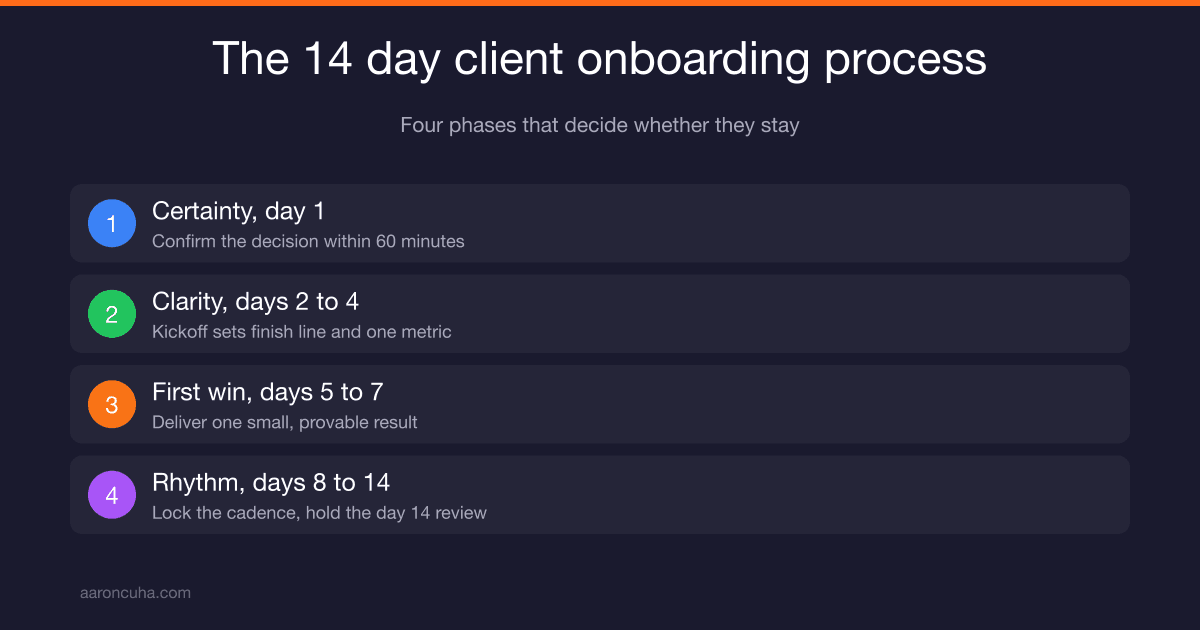
When a new client joins any tier, they should receive automated welcome emails, access credentials, intake questionnaires, and scheduling links without you touching anything. Tools like Zapier, ActiveCampaign, and Calendly handle this. Our AI Systems service can build custom onboarding automations that feel personal while running on autopilot.
System 3: Content Delivery System
Your coaching methodology should be documented and accessible. Create a curriculum library — video lessons, frameworks, templates, and exercises — that clients can access between live sessions. This reduces the need to repeat yourself and ensures consistent delivery of your core material.
System 4: Progress Tracking
As you serve more clients, you cannot track everyone's progress in your head. Use a CRM or project management tool to track each client's goals, milestones, and action items. Automated check-in surveys (weekly or biweekly) keep you informed without requiring individual follow-up conversations.
System 5: Team and Delegation
At a certain scale, you need support. Start with a virtual assistant handling scheduling, email, and community management. Then add a junior coach who can lead group sessions and handle lower-tier clients. I cover delegation strategies in my post on how to delegate as an entrepreneur.
Revenue Math: What Scaling Actually Looks Like
Let me show you the concrete numbers. Here is a comparison between a maxed-out one-on-one practice and a scaled coaching business:
Before Scaling (One-on-One Only)
- 20 clients at $3,000 per month = $60,000/month
- Time required: 40 to 50 hours per week
- Revenue per hour: approximately $300 to $375
After Scaling (Four-Tier Model)
- Community: 150 members at $99/month = $14,850/month
- Group coaching: 24 clients (2 groups of 12) at $1,000/month = $24,000/month
- One-on-one premium: 6 clients at $5,000/month = $30,000/month
- Digital products: $5,000/month passive = $5,000/month
- Total: $73,850/month
- Time required: 25 to 30 hours per week
- Revenue per hour: approximately $615 to $740
More revenue. Less time. Better margins. That is what scaling looks like. And notice that the one-on-one tier is still there — it is just no longer the entire business.
Common Scaling Mistakes
Mistake 1: Scaling Too Fast
Do not launch all four tiers simultaneously. Add one tier at a time. Perfect the delivery. Get testimonials. Then add the next. Most coaches should start by adding a group program to their existing one-on-one practice.
Mistake 2: Diluting Quality
Scaling does not mean lowering your standards. Your group program should deliver a structured, excellent experience. If group clients get a watered-down version of your one-on-one coaching, they will not get results and they will not refer others.
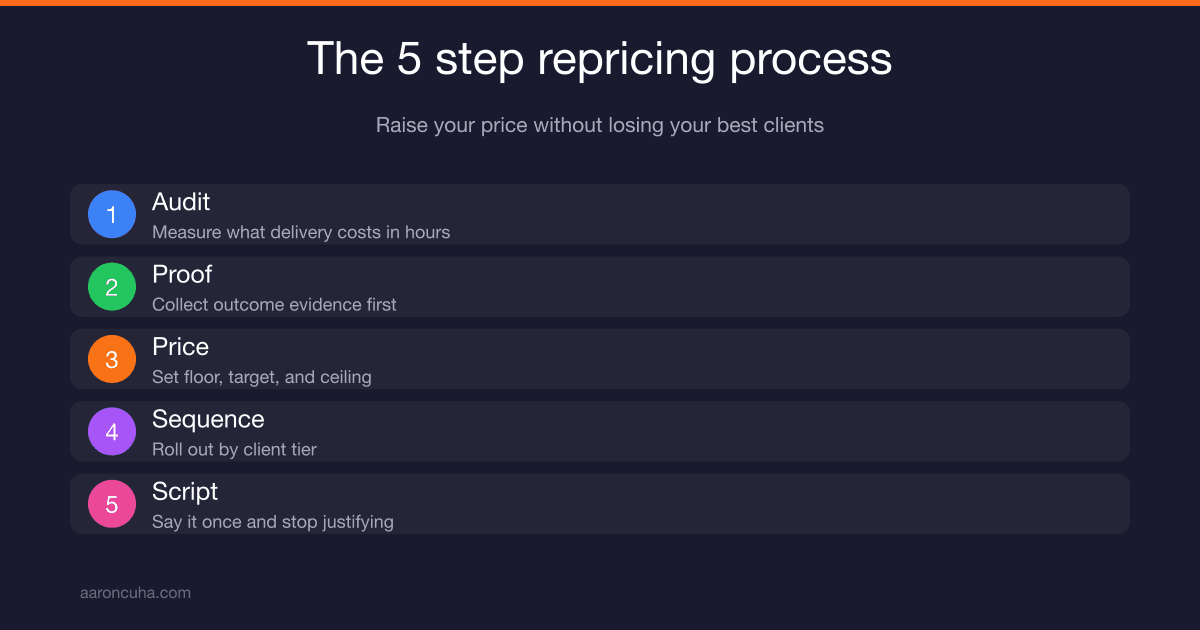
Mistake 3: Not Raising One-on-One Prices
As you add lower-priced tiers, raise your one-on-one prices. This naturally reduces one-on-one demand to a sustainable level while increasing per-client revenue. If clients can get 80 percent of the value from your group program at a fraction of the cost, the ones who stay one-on-one are paying for the premium of personal attention.
Ready to scale your coaching business? Book a strategy call and I will help you map out the exact scaling plan for your practice. Or join our Systems Over Hustle community where I teach these frameworks live every week.
Frequently Asked Questions
When should I start scaling my coaching business?
When you consistently have a waitlist or are turning away potential clients. If you have 10 or more active one-on-one clients and steady inbound demand, you are ready to add a group coaching tier or community.
How do I maintain quality while scaling?
Document your methodology into a structured curriculum. Quality comes from the system, not from improvisation. When your frameworks, exercises, and processes are documented, any delivery format — group, community, or course — can maintain your standard of excellence.
Should I stop doing one-on-one coaching when I scale?
No. Keep a small number of premium one-on-one clients at your highest price point. These relationships are your most valuable — they generate the best case studies, deepest insights, and highest revenue per hour.
How much revenue should I expect from a group coaching program?
A group of 10 to 15 clients at $1,000 to $2,000 per month generates $10,000 to $30,000 in monthly recurring revenue from approximately 4 to 6 hours of your weekly time. Most coaches can fill a group within 30 to 60 days of launch using their existing audience and client base.

Written by
Aaron CuhaAuthor of Crazy Simple YouTube, keynote speaker, and executive coach with 20,000+ hours logged. ICF PCC, NLP Master Practitioner, and DISC Certified. Aaron helps entrepreneurs replace hustle with AI-powered systems that generate leads, content, and revenue on autopilot.