An entrepreneur sabbatical is not a reward. It is the most honest audit your business will ever get, because everything that breaks while you are gone is something you were personally holding together. Here is the six week sequence to leave for 30 days and come back to a stronger company.
You think your business runs on systems. It probably runs on you. An entrepreneur sabbatical, 30 days genuinely away, is the only test that tells the truth, and most owners have not taken one in years.
Key Takeaways
- An entrepreneur sabbatical is 30 days genuinely unreachable, not a working vacation.
- Spend six weeks preparing. The preparation is the real product.
- Write decision rules with limits, not step by step instructions.
- Name one acting decision maker in writing, never a committee.
- Everything that breaks while you are gone was something you were holding together.
If reading that made your chest tighten, good. That reaction is data. Let me show you how to run the entrepreneur sabbatical audit properly and come back to a business worth more than the one you left.
Want help building the systems that make a sabbatical possible? Start with a Channel Audit and Plan so you can see where your business depends on you personally.
Why a Real Absence Is the Only Honest Audit of Your Business
A real absence is the only honest audit because it removes the variable you cannot measure while you are present: you. Everything that breaks while you are gone is something you were personally holding together.
You can run process maps all day. You can write SOPs until your team stops reading them. None of it tells you the truth, because you are still in the building, answering the question before anyone realizes it was a question.
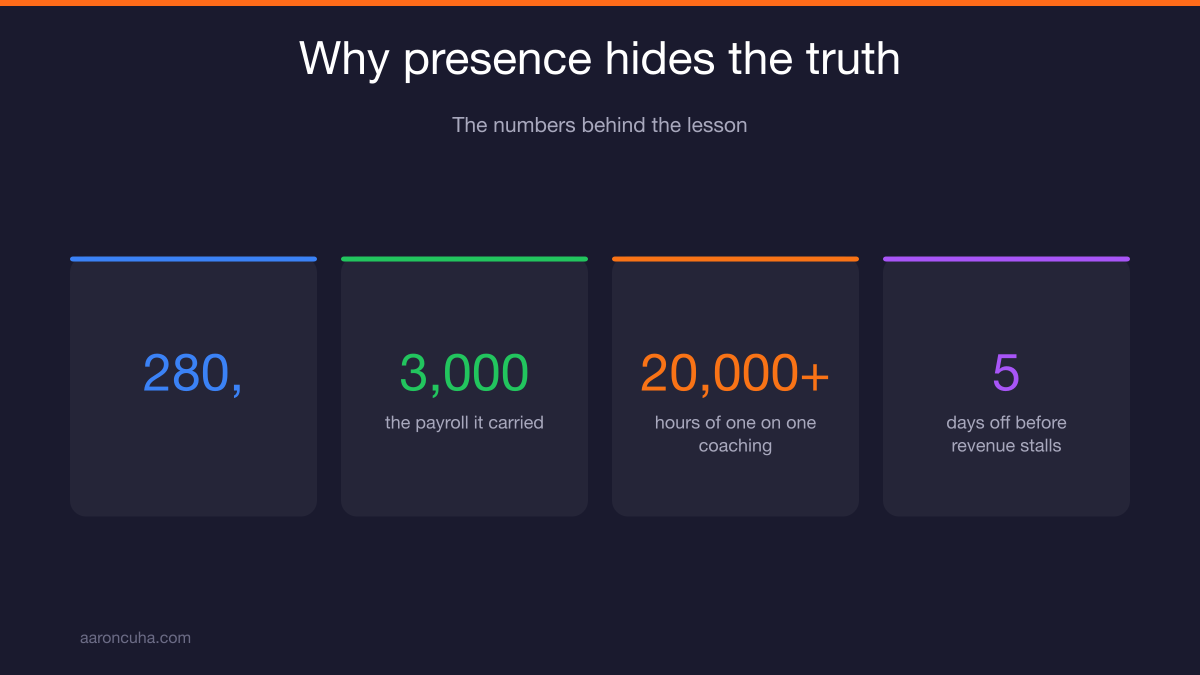
I learned this the hard way. I built DirectLender to 280 offices and 3,000 employees. On paper that is a machine. In 2008 the machine collapsed, and I found out how much of it had been running on my personal judgment, my relationships, and my willingness to work more hours than anyone else.
Then I spent a decade doing humanitarian work in Nepal. Not a sabbatical. A full stop. No company to check on, no dashboard to refresh, no one calling me for approval.
That gap taught me something no business book did. The parts of my identity that were load bearing had nothing to do with being needed. And the parts of the company that had needed me daily were never assets. They were liabilities with my name on them.
In 20,000 plus hours of one on one coaching, I see the same pattern constantly. An owner tells me the business is systemized. Then they take five days off and revenue stalls, three decisions sit unmade, and two clients get nervous. That is not a vacation problem. That is a design problem.
What an Entrepreneur Sabbatical Actually Is (And Is Not)
An entrepreneur sabbatical is 30 consecutive days where you are genuinely unreachable for business decisions. No email, no Slack, no "quick call." One emergency channel with written criteria, and nothing else.
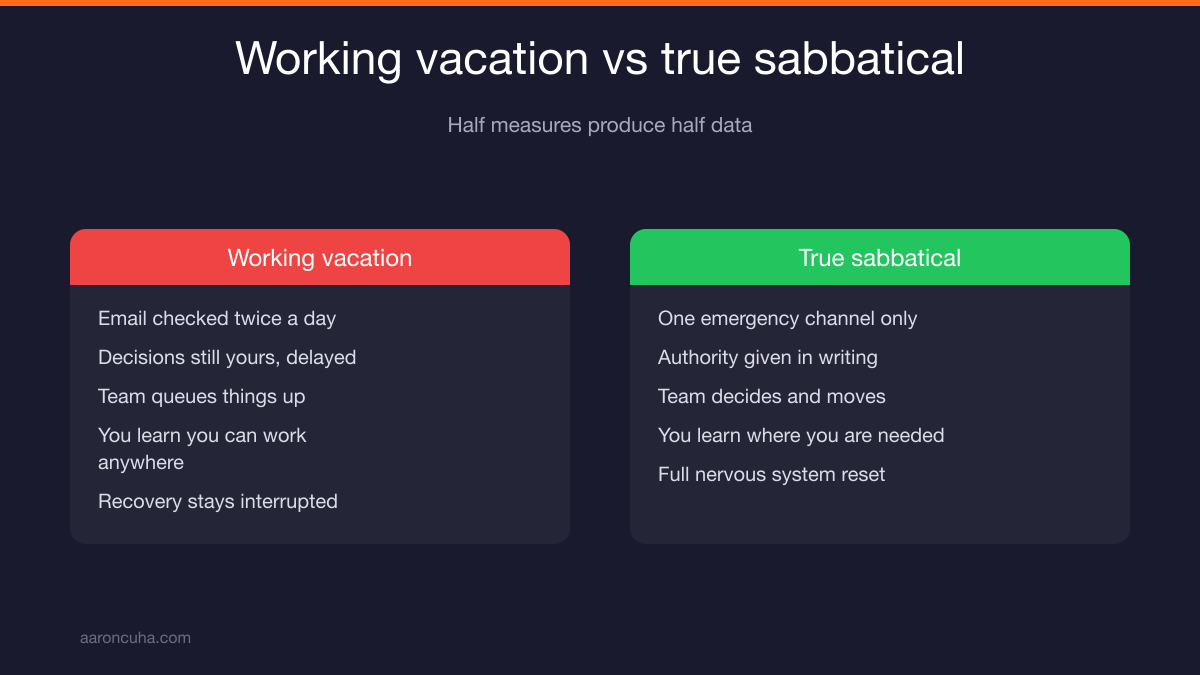
Most owners think they have done this. They have not. They took a trip and checked email twice a day from a beach. That is a working vacation, and it teaches you nothing, because your team never had to operate without you.
| Factor | Working Vacation | True Sabbatical |
|---|---|---|
| Reachability | Email, texts, "just one call" | One emergency channel, written criteria only |
| Decision authority | Still yours, delayed by time zones | Transferred in writing to a named person |
| Team behavior | They wait for you | They decide and move |
| What you learn | That you can work from anywhere | Exactly where your business depends on you |
| Recovery | Partial, interrupted | Full nervous system reset |
The distinction matters because half measures produce half data. If your team knows you are checking messages, they will queue things up instead of solving them. You come back with a full inbox and zero information.
This is not about the beach. It is about running a diagnostic you cannot run any other way.
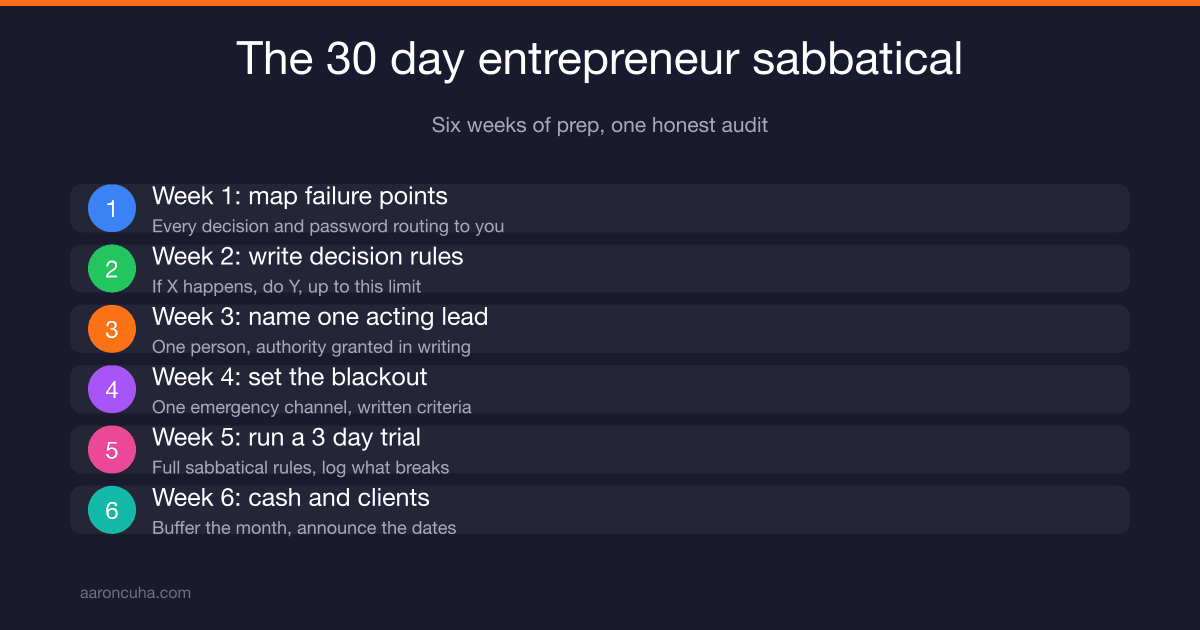
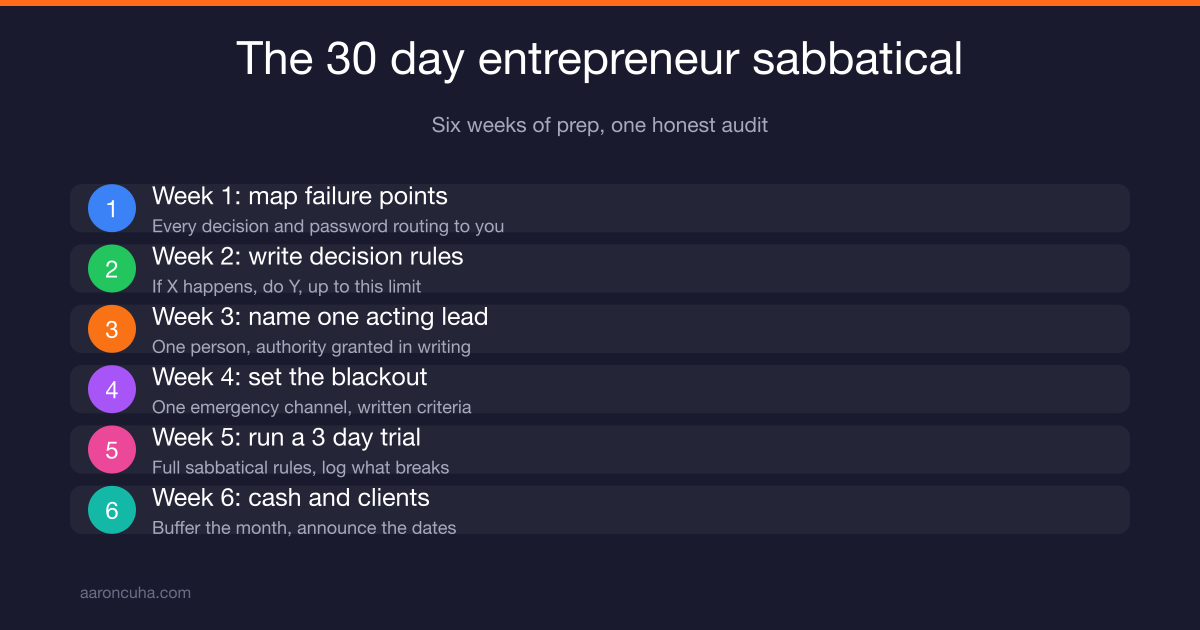
The Six Week Preparation Sequence at a Glance
Six weeks of structured preparation makes a 30 day absence survivable. Each week has one job. Do them in order, because each week depends on the one before it.
- Week one: Map every single point of failure that routes through you.
- Week two: Write decision rules with limits, not instructions.
- Week three: Name one acting decision maker and grant authority in writing.
- Week four: Set the communication blackout and define emergency criteria.
- Week five: Run a three day trial absence and log what breaks.
- Week six: Prepare the cash, pause what needs you, and tell the clients.
Here is the part most owners miss. The preparation is the product. Even if you canceled the trip, running these six weeks would make your company more valuable, because you would have converted personal knowledge into transferable authority.
That is the core of the Systems Over Hustle framework. Effort that only works when you apply it is not a system. It is a habit you cannot sell.
Week One: Map Your Single Points of Failure
Spend two weeks logging every decision, approval, password, and relationship that passes through you. Then sort each item into three buckets: transfer, document, or delete.
Keep a running note on your phone. Every time someone asks you something, write it down. Every time you approve something, write it down. Every time you are the only person who knows a login, a vendor contact, or the reason something is done a certain way, write it down.
Most owners are shocked at the list length. Not because the items are big, but because they are small and constant.
This exercise is closer to continuity planning than to delegation. The federal guidance on building a business continuity plan is a useful checklist for the operational items owners forget to write down.
The categories people forget:
- Passwords and account ownership. Domain registrar, payment processor, ad accounts, phone system, the bank's second factor device.
- Vendor and partner relationships. The people who only respond because it is you asking.
- Undocumented exceptions. The client who gets different terms, and only you remember why.
- Emotional labor. The team member who needs a check in, the client who calls you when nervous.
- Final aesthetic approval. Anything where you are the taste.
Now sort. Transfer means hand it to a named human this month. Document means write down the rule so anyone can apply it. Delete means the approval never needed to exist and you were creating work by requiring it.
Delete is usually the biggest bucket. That surprises people every time. If you want a deeper method for the handoff itself, read how to delegate as an entrepreneur.
Week Two: Write Decision Rules, Not Instructions
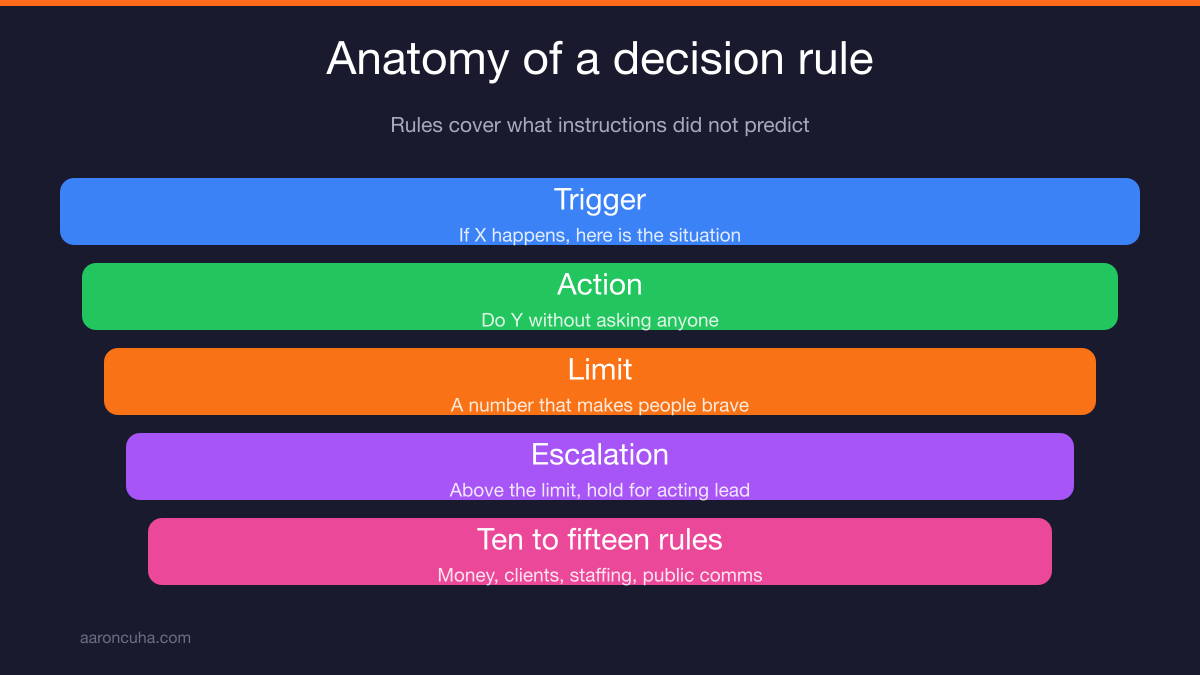
Instructions cover the situations you predicted. Rules cover the ones you did not. Write decision rules in the format: if X happens, do Y, up to this limit, otherwise escalate.
This is why standard operating procedures fail during a real absence. An SOP says "here is how to process a refund." It does not say "here is how to decide whether to give one when the client is technically wrong but has been with us four years."
Your team does not lack process. They lack permission with boundaries.
Three sample rules to model yours on:
- Refunds: If a client requests a refund within the stated window, approve it without discussion. Outside the window, approve up to a set dollar limit at your discretion. Above that limit, hold for the acting lead.
- Discounts: If a prospect asks for a discount, you may adjust terms up to a set percentage. Below that price, the answer is no. You do not need approval to say no.
- Hiring: No new full time hires while the owner is away. Contractors may be engaged up to a set monthly amount to keep committed work delivered.
Notice what each rule contains. A trigger, an action, a limit, and an escalation path. The limit is the part that makes people brave. Without a number, everyone escalates everything, because nobody wants to be wrong.
Write ten to fifteen of these. Cover money, clients, staffing, and public communication. Put them in one document, not scattered across tools.
Week Three: Name One Decision Maker
Name one person as acting lead for the full 30 days. Not a committee, not co leads, not "whoever is closest to the issue." One name, granted authority in writing, announced to everyone.
Committees stall. When two people share authority, both wait for the other to move, and both feel comfortable doing nothing because responsibility is diffuse. A single named person cannot hide.
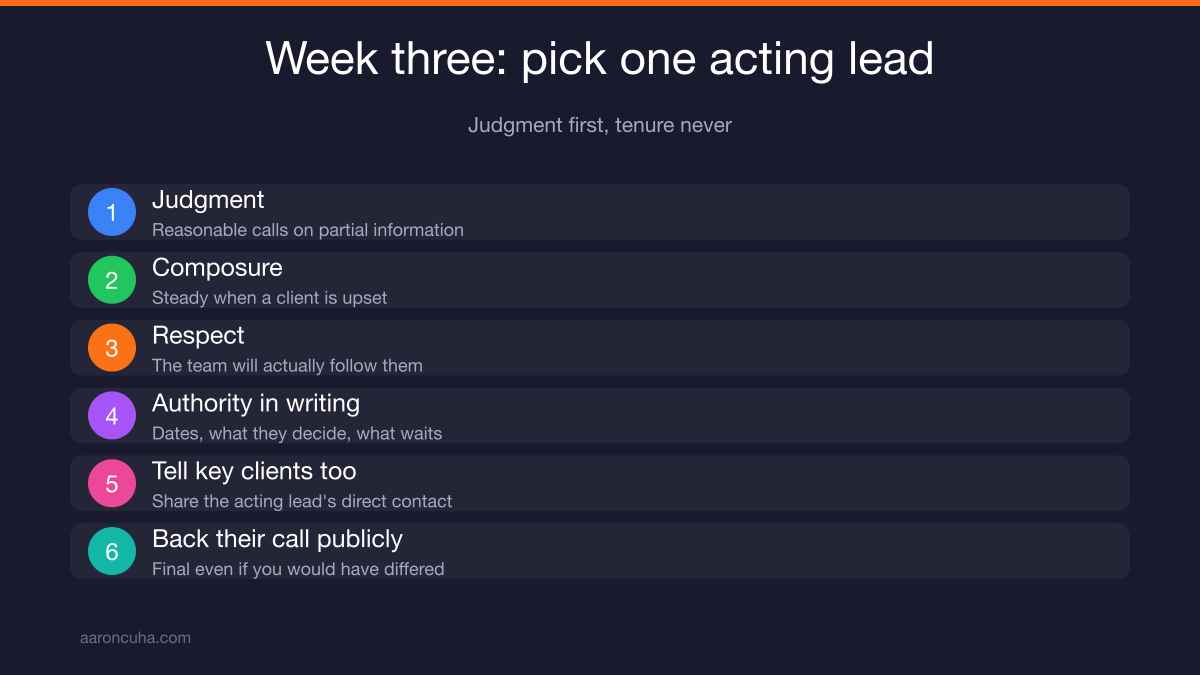
Choose based on three things, in this order:
- Judgment. Do they make reasonable calls when information is incomplete?
- Composure. Do they stay steady when a client is upset?
- Respect. Will the rest of the team actually follow them?
Tenure is not on that list. Neither is title. The best acting lead is often not the most senior person.
Put the authority in writing and send it to the whole team. State the dates. State what the acting lead can decide alone. State what waits for your return. Then say the sentence that makes it real: their decision is final and I will back it even if I would have chosen differently.
Send a version to key clients too, with the acting lead's direct contact. If clients do not know who to call, they will call you, and you will answer, and the whole thing collapses.
Ready to build a business that runs without you in the room? Explore executive coaching and get an outside read on where you are still the bottleneck.
Week Four: Set the Communication Blackout and Emergency Criteria
Define what counts as an emergency before you leave, in writing, using three tests. Then set one emergency channel and close every other door.
The three tests. Something qualifies as an emergency only if it passes all three:
- Irreversible. The damage cannot be undone after I return.
- Existential. It threatens the survival of the business, not a quarter's numbers.
- Owner only. No one else has the legal or financial authority to act.
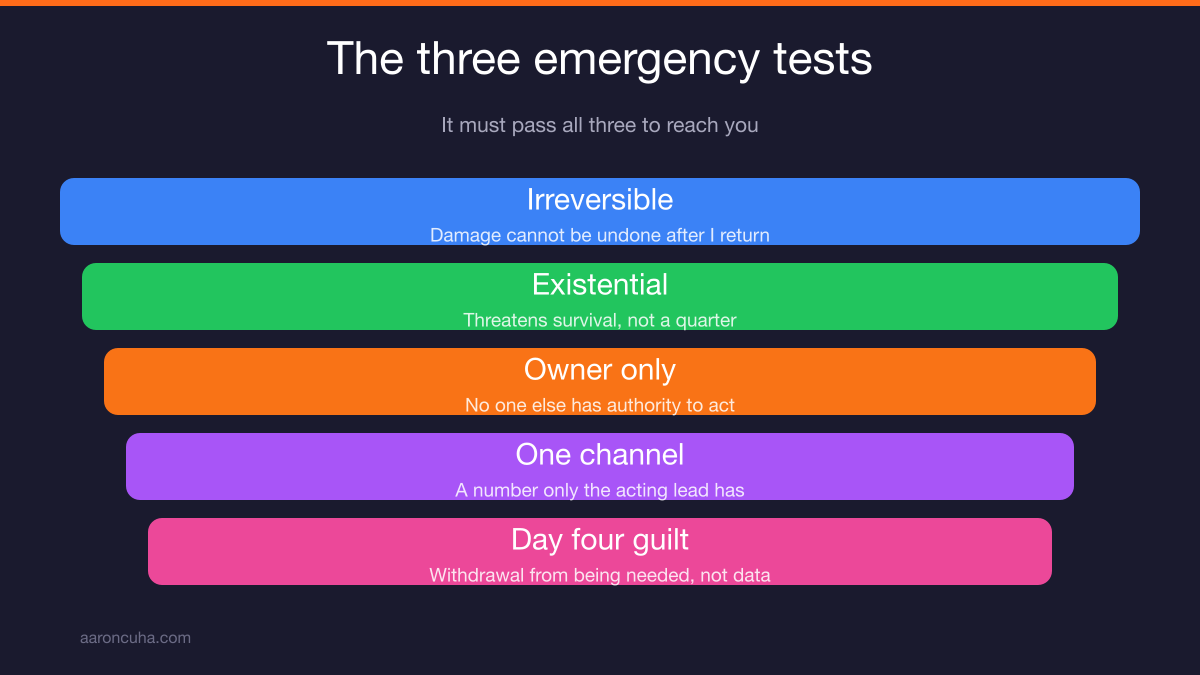
Almost nothing passes all three. That is the point. A lost client does not. A bad review does not. A resignation does not. A lawsuit filing, a data breach, or a death might.
Pick one channel. A single phone number that only the acting lead has. Not email, not Slack, not text from six people. Email is the worst of all options, because checking it once puts you back on the hook for everything in the inbox, and your team learns you are reachable after all.
Set an out of office that names the acting lead and states clearly that you are not monitoring messages. Turn off notifications. Remove the apps from your phone if you know yourself.
Now the guilt. You will feel it around day four. You will think something is on fire and nobody wants to tell you. That feeling is withdrawal from being needed, and it is not information. Sit with it. It passes.
Week Five: Run a Three Day Trial Absence
Run a three day dress rehearsal under full sabbatical rules. Your team logs everything that breaks. You fix the top three failures and ignore the rest.
Three days is long enough for real problems to surface and short enough that damage stays small. Do it on a normal week, not a slow one. A quiet week proves nothing.
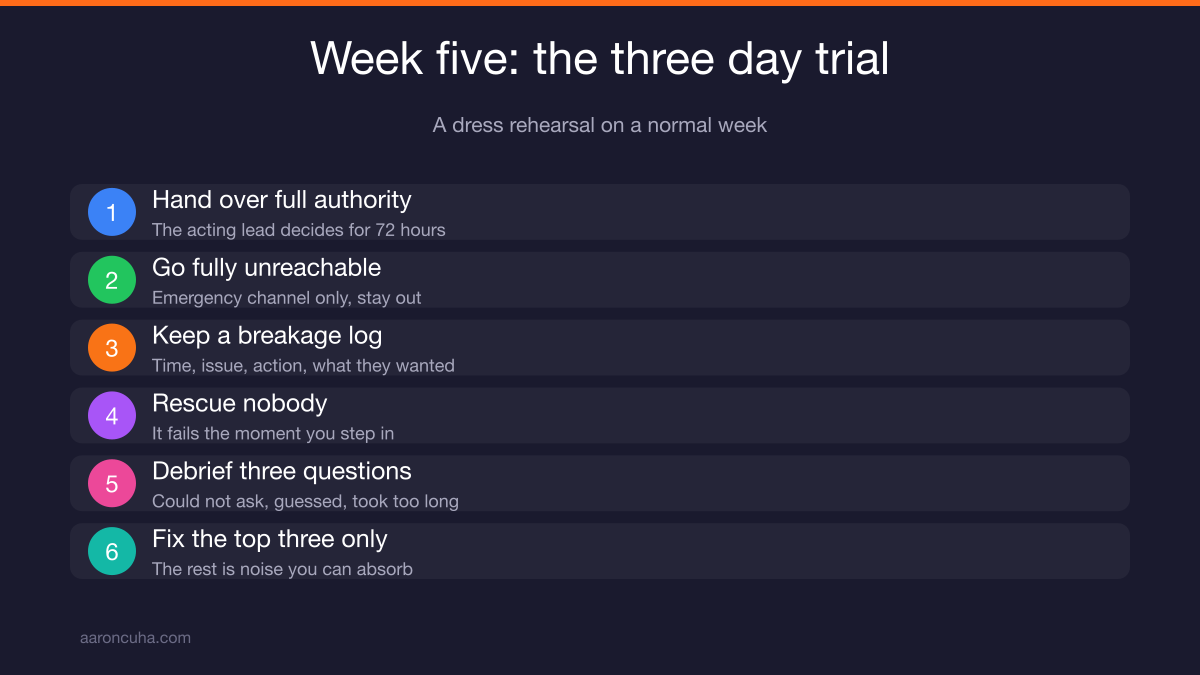
Trial rules, same as the real thing:
- Acting lead has full authority for 72 hours.
- You are unreachable except through the emergency channel.
- The team keeps a breakage log with time, issue, what they did, and what they wished they had.
- Nobody saves anything for your return. If it comes up, they handle it.
Do not go to the office. Do not answer "just this one." The trial fails the moment you rescue someone.
When you come back, run a debrief with three questions:
- What did you want to ask me and could not?
- Where did you have to guess at a rule?
- What took longer than it should have, and why?
Fix the top three items only. The rest are noise you can absorb over 30 days. Owners who try to fix everything before leaving never leave.
Week Six: Prepare the Money and Tell the Clients
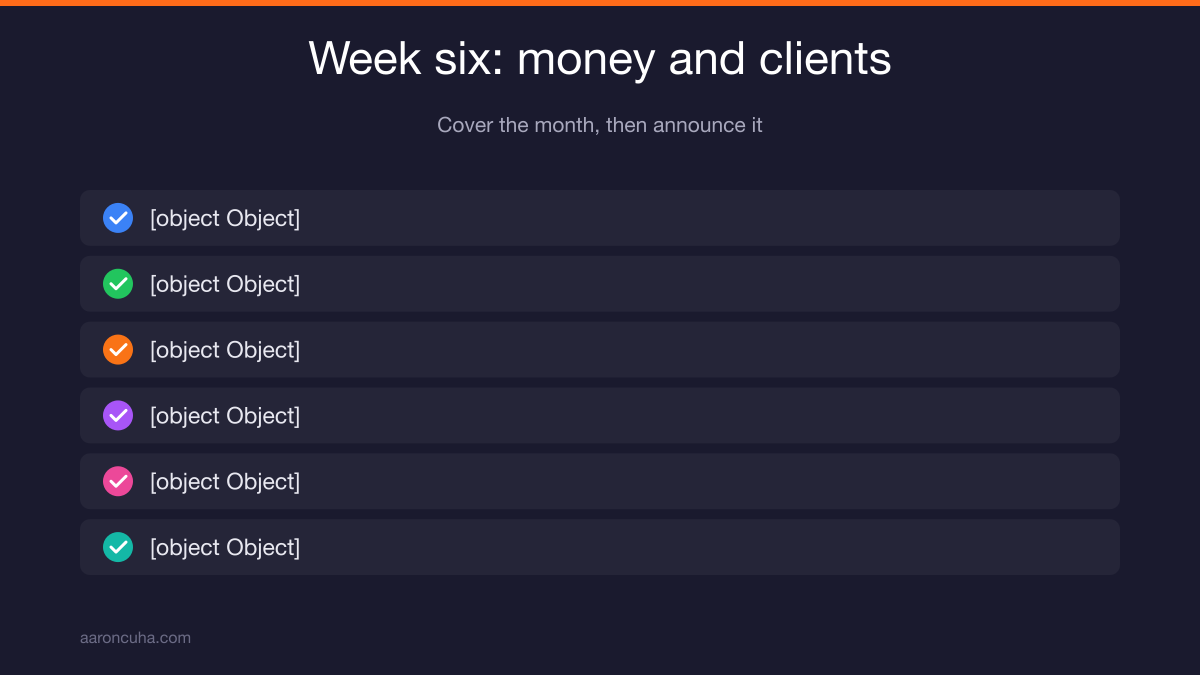
In the final week, secure a cash buffer, pause anything that requires your daily judgment, pre schedule your marketing, and send one clear client announcement with dates and a named contact.
Cash first. Look at your fixed obligations for the month and make sure they are covered without new revenue arriving on schedule. Sales usually slow when the owner is gone. Plan for that instead of hoping. If your reserves are thin, the U.S. Small Business Administration guidance on managing business finances is a straightforward place to pressure test your numbers.
Pause what needs you. New product launches, custom proposals, complex negotiations, anything where you are the taste or the closer. Restarting is cheaper than a bad outcome.
Pre schedule the marketing. This is where a real content system earns its keep. If you have been publishing consistently, you should already have a library. Batch and schedule the full 30 days before you go, and let the authority flywheel keep producing while you are unreachable.
If your marketing dies the moment you stop personally posting, that is another single point of failure. Fix it with content systems that publish without you.
The client announcement. Keep it short and confident:
"I will be out of the business from [date] to [date]. During that time, [name] has full authority to make decisions on your account and can be reached at [contact]. I am not monitoring email or phone. [Name] has everything needed to take care of you, and I will be back on [date]."
Do not apologize and do not over explain. Confidence in the announcement transfers confidence to the client. If you sound worried, they will be. For context on how strong operators communicate through absence, the Harvard Business Review archives on leadership transitions are worth an afternoon.
What to Do While You Are Actually Gone
Your only job while gone is to not solve anything. No checking, no scorecard, no fixing from a distance. Let the business recover on its own, because the recovery is the data.
This is harder than the preparation. Preparation feels productive. Absence feels like abandonment.
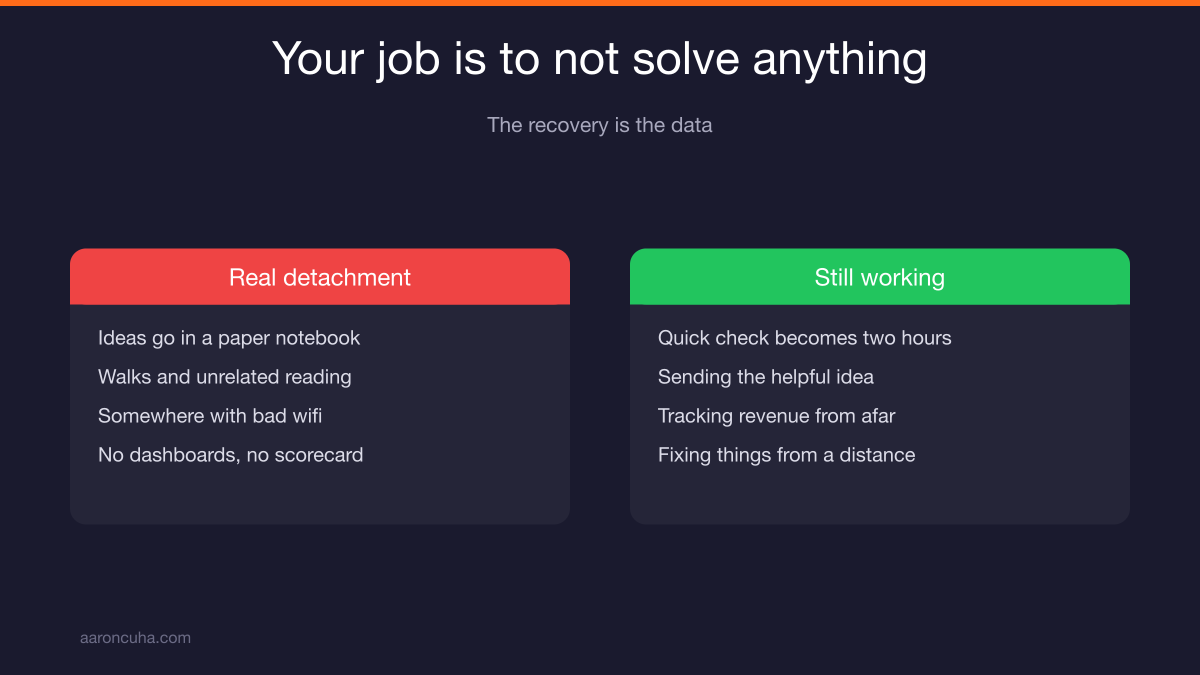
You will be tempted in three specific ways. First, the "quick check" that turns into two hours. Second, the helpful idea you want to send while it is fresh. Third, the anniversary of some regular event that makes you wonder if anyone remembered.
Write ideas in a notebook. Not a shared doc, not an email draft. A notebook nobody else can see until you are back.
Do not keep score. If you track revenue daily from a distance, you are working. You are also flooding your nervous system with exactly the input a sabbatical is designed to remove. The American Psychological Association is clear that real recovery requires genuine detachment from work, not lighter work.
Here is what I learned in Nepal, and it took years. When the company was gone entirely, I was still here. My identity had been fused to being the person who solves things, and losing DirectLender ripped that fusion apart. What was left underneath was more durable than what I had built on top of it.
You do not need to lose a company to learn this. Thirty days will show you a version of it. And the man or woman who comes back is calmer, clearer, and much harder to rattle.
Use the time for something with no output. Walk. Read things unrelated to your industry. Be somewhere with bad wifi. The National Park Service site is a decent place to start if you want a location where checking in is genuinely difficult.
The Re-Entry Week: How to Read the Audit
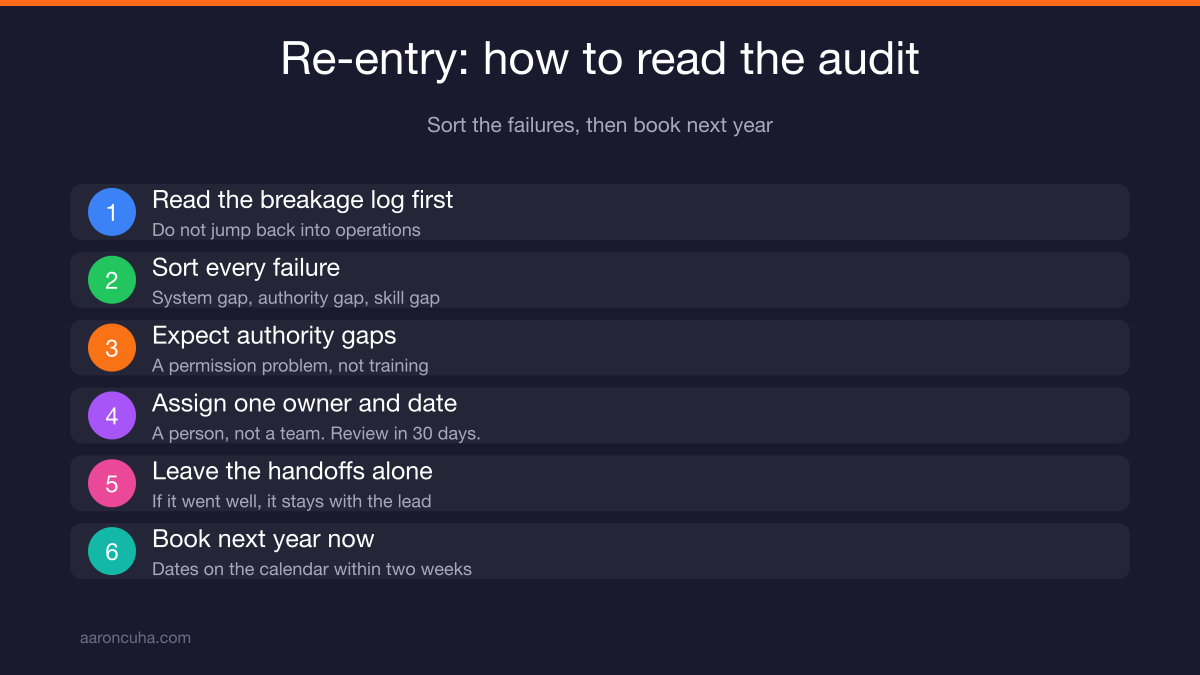
Do not jump back into operations on day one. Spend your first day back reading the breakage log and sorting every failure into three categories: system gaps, authority gaps, and skill gaps.
This is where the value gets captured. Owners who skip re entry analysis have taken a nice trip. Owners who run it have completed an audit no consultant could have produced.
| Gap Type | What It Looks Like | The Fix |
|---|---|---|
| System gap | Nobody knew the process existed or where to find it | Document it once, store it where work happens |
| Authority gap | They knew what to do but did not feel allowed | Write a decision rule with a limit |
| Skill gap | They were allowed and willing but could not execute | Train, pair, or hire |
Most failures are authority gaps. Owners assume they have a training problem when they have a permission problem. Your people usually know the answer. They are waiting for someone to say the decision is theirs.
Assign a single owner and a due date to each gap. Not a team, a person. Review in 30 days.
Then resist the urge to reclaim everything you handed off. The acting lead kept those decisions for a month. If they went well, leave them there permanently. That is the compounding return of the whole exercise.
Make It Annual: Turning One Sabbatical Into a System
Schedule next year's sabbatical before the feeling fades. Put the dates on the calendar within two weeks of returning, and tell your team.
The first one takes six weeks of preparation. The second takes three. By the third, your business is designed to run through your absence, so preparation becomes a checklist instead of a rebuild.
That is the real outcome. Not the trip. The design.
A business that requires you daily is not an asset. It is a job with unusual paperwork and worse hours. You cannot sell it, you cannot scale it, and you cannot get sick without consequences. This is the whole argument behind Systems Over Hustle, and a sabbatical is the most honest test of whether you have actually applied it.
The owners I work with who do this once never go back. They discover their business is worth more, their team is more capable, and their own thinking got sharper in the silence.
If you want to build the systems that make a 30 day absence boring instead of terrifying, look at AI systems for your operations or join the Systems Over Hustle community and plan your first sabbatical with people doing the same thing.
Frequently Asked Questions

Written by
Aaron CuhaAuthor of Crazy Simple YouTube, keynote speaker, and executive coach with 20,000+ hours logged. ICF PCC, NLP Master Practitioner, and DISC Certified. Aaron helps entrepreneurs replace hustle with AI-powered systems that generate leads, content, and revenue on autopilot.