Why willpower doesn't work is the wrong question to feel guilty about. Willpower is a finite state, not a character trait, so every goal built on it has an expiration date. Here is the four part Environment Stack to build instead.
You did not fail because you are weak. You failed because you built a goal on top of willpower, and willpower is a state that runs out. Here is what to build instead.
Key Takeaways
- Willpower is a fluctuating state, not a fixed character trait you own.
- Motivation based goals usually collapse within three weeks, on schedule.
- The Environment Stack replaces discipline with four structural layers.
- Remove the decision, book the time, add a witness, shrink the first action.
- Diagnose collapses by layer, never by character.
If you keep restarting the same routine and quitting by week three, you already know why willpower doesn't work in practice. What you probably do not know is that the collapse is structural, not personal. You can fix structure. You cannot fix a character flaw you never had.
Ready to stop rebuilding the same broken routine? Start with the free resources library and grab the tools I give my coaching clients before their first session.
Why Willpower Doesn't Work: It Is a State, Not a Trait
Willpower is a state that rises and falls with sleep, stress, hunger, and how many decisions you have already made today. It is not a personality trait you either have or lack. That is why it feels reliable on Monday and absent on Thursday.
Think about your own week. You make the 6 a.m. workout on a night you slept eight hours and nothing broke at the office. You skip it after a bad client call and four hours of sleep.
Same person. Same commitment. Different state.
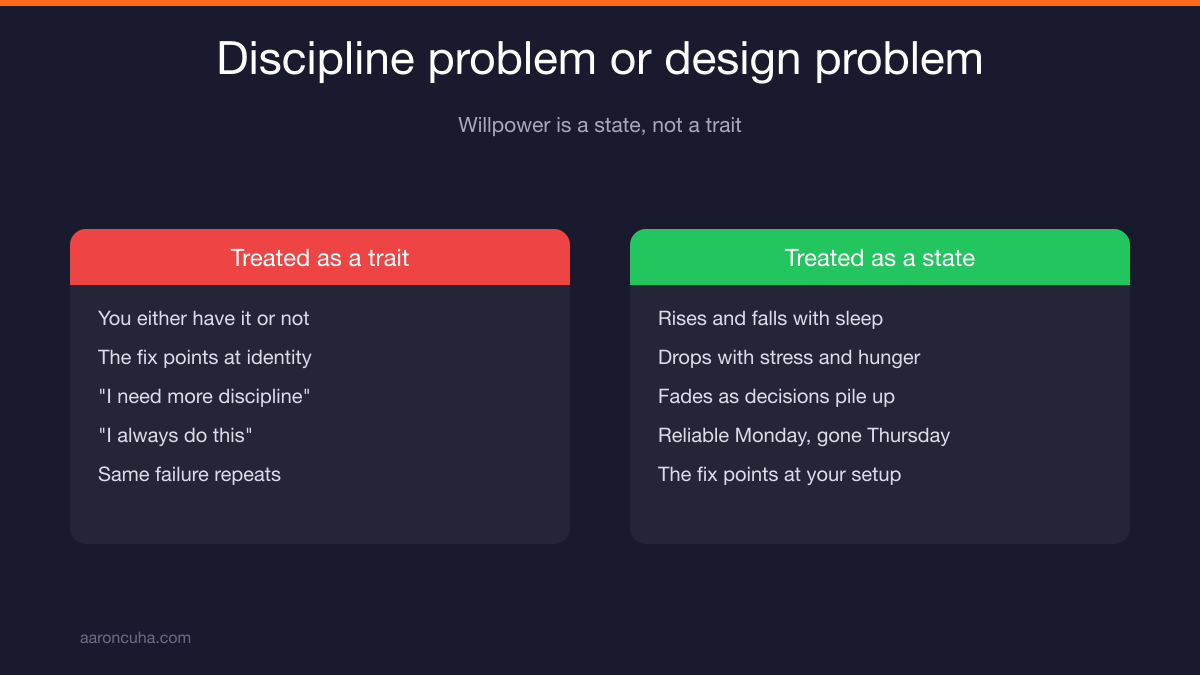
Most owners I coach treat this like a moral issue. They say things like "I need to be more disciplined" or "I always do this." That framing guarantees a repeat, because it points the fix at your identity instead of at your setup.
Here is the reframe I use in every first session. If your behavior changes when your conditions change, you do not have a discipline problem. You have a design problem.
The American Psychological Association has published for years on self control as a limited state influenced by fatigue and stress. You do not need a study to prove it though. You have your own calendar as evidence.
The Three Week Expiration Date on Every Motivation Based Goal
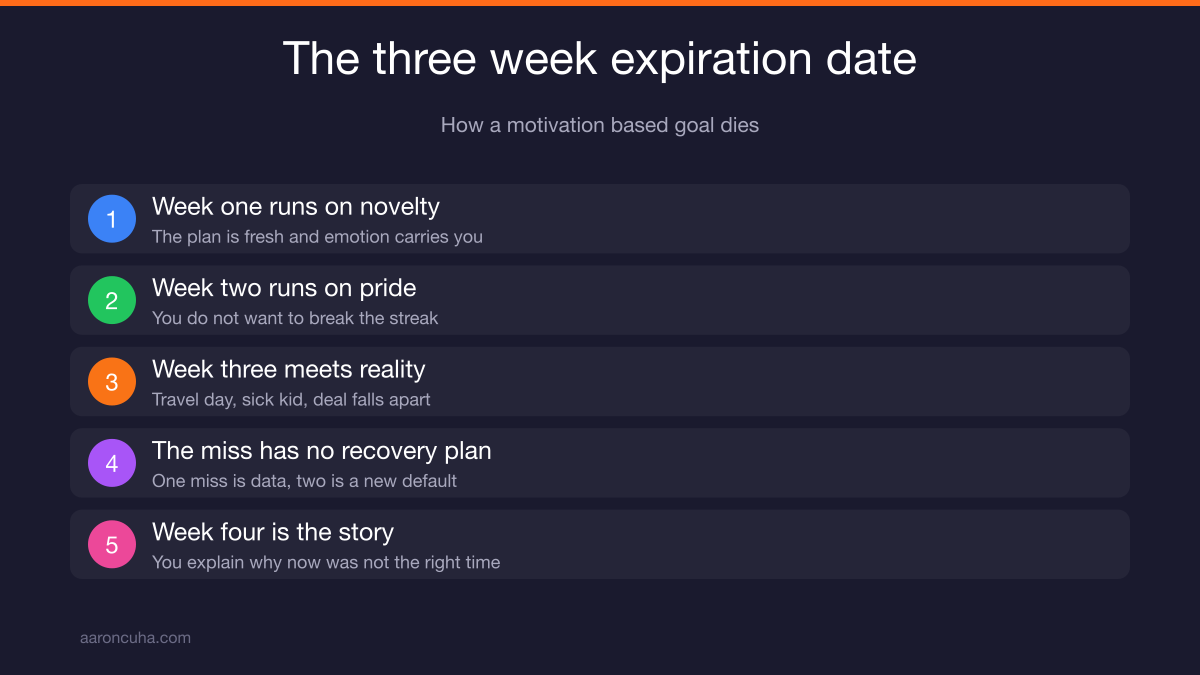
Goals powered by motivation tend to die inside three weeks. Not because you stopped caring, but because the initial emotional charge fades faster than the habit can install itself.
I have logged more than 20,000 hours of one on one coaching. The single most repeated conversation in all of it goes like this. A high performer sits down and tells me about a goal they have already promised me twice before.
Same goal. Same words. Same confidence in their voice.
Here is the pattern I see almost every time:
- Week one runs on novelty. The plan is fresh and the emotion carries you.
- Week two runs on pride. You do not want to break the streak you started.
- Week three meets reality. A travel day, a sick kid, a deal falling apart.
- Week four is the story. You explain to yourself why now was not the right time.
What breaks first is never the desire. It is the first missed rep with no recovery plan attached to it.
One miss is a data point. Two misses in a row is a new default. Systems survive the miss. Motivation does not.
What Losing 280 Offices Taught Me About Discipline
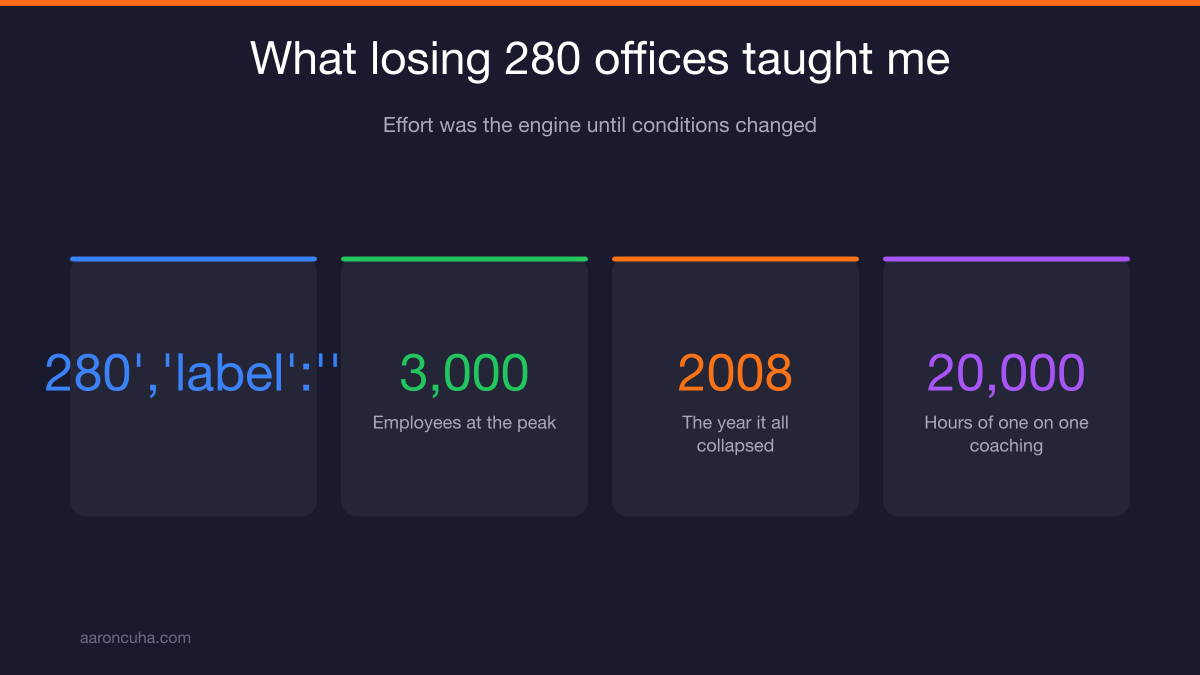
I built DirectLender.com to 280 offices and 3,000 employees. I lost all of it in the 2008 collapse. The lesson was not that I needed to grind harder. It was that I had built a company that only worked when conditions were good.
For years I believed my effort was the engine. I outworked everyone. I answered every call. I made every decision personally.
Then the market changed and my effort stopped mattering. The structure underneath it could not hold weight it was never designed to carry.
I spent the next decade doing humanitarian work in Nepal. That was not a business sabbatical. It was a rebuild of how I think about durability.
In Nepal I watched people run daily systems with almost no resources. Water gets carried at the same time every day by the same person on the same path. Nobody wakes up and decides whether they feel motivated to have water.
That is the whole idea. When the behavior is structural, the mood becomes irrelevant.
When I came back and rebuilt as a coach, I stopped selling effort. I started selling structure. That became the Systems Over Hustle framework, and it started with my own morning, not with anyone's business.
The Hidden Cost of Trying Harder
Every failed restart charges you interest. You lose a little self trust, and less self trust means the next attempt requires more willpower than the last one did. That is why attempt five feels heavier than attempt one.
Most people think guilt is fuel. It is not. Guilt is a tax you pay on the same goal over and over while receiving nothing in return.
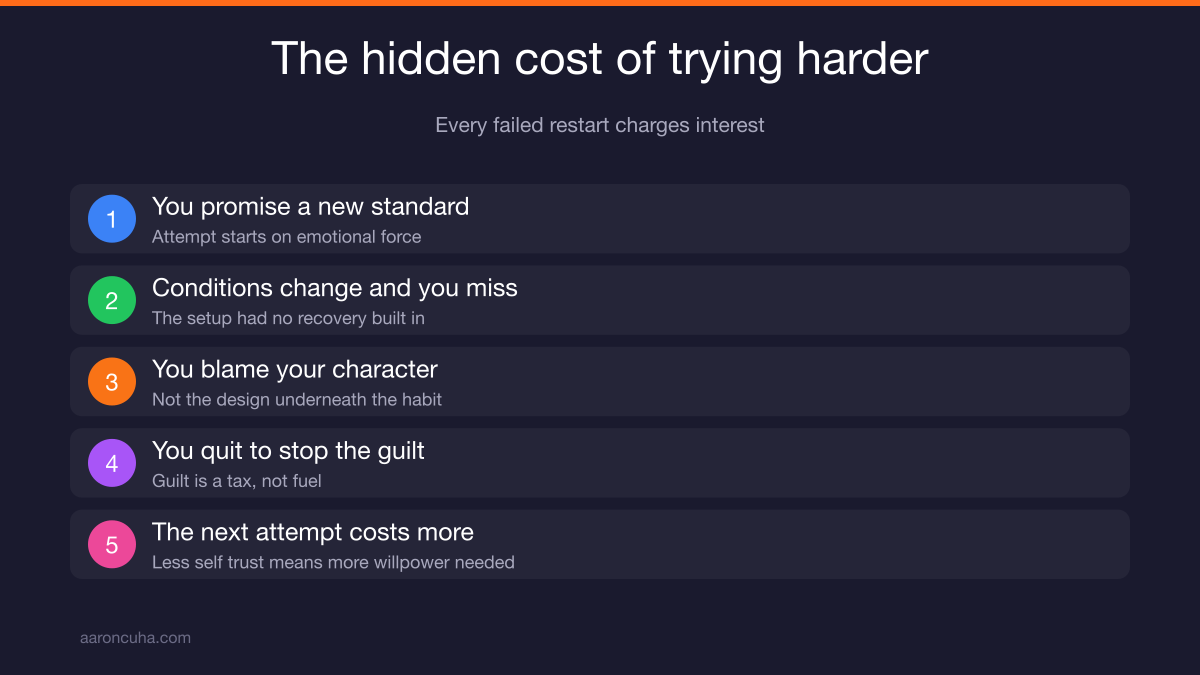
Watch how the loop runs:
- You promise yourself a new standard.
- Conditions change and you miss.
- You blame your character instead of your setup.
- You quit to stop feeling the guilt.
- The next promise now needs more emotional force to start.
By the fourth or fifth cycle, your brain has learned something dangerous. It has learned that your promises to yourself are negotiable.
You cannot willpower your way out of a willpower problem. You have to change what the behavior depends on.
That is what the rest of this post gives you. Four layers that carry the behavior when you are tired, distracted, traveling, or having a genuinely terrible week.
The Environment Stack: A Four Part Replacement for Discipline
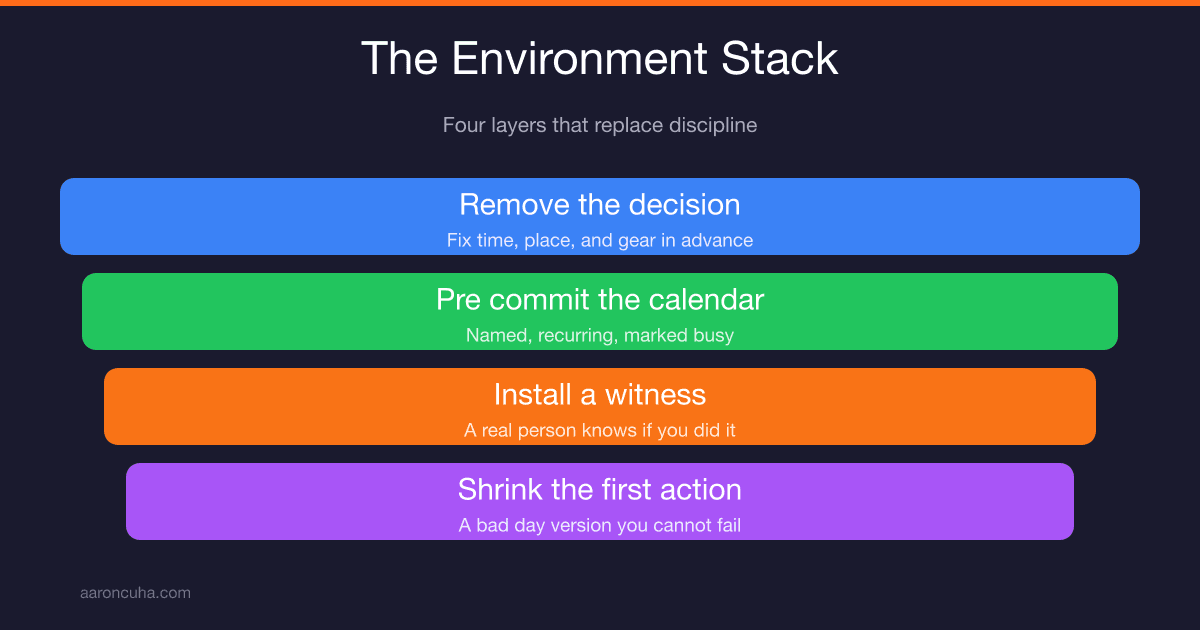
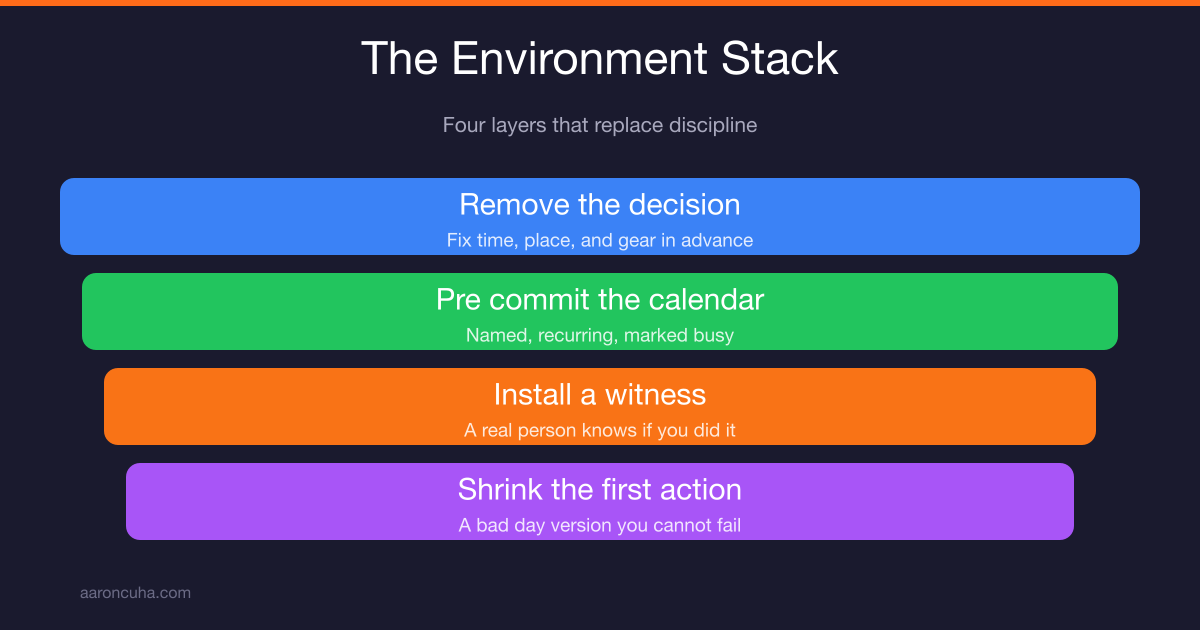
The Environment Stack is a four layer structure that makes the right behavior the easy behavior. Remove the decision. Pre commit the calendar. Install a witness. Shrink the first action. Each layer covers a different failure point.
Most people install one layer and wonder why the habit still dies. One layer is a preference. Four layers is a system.
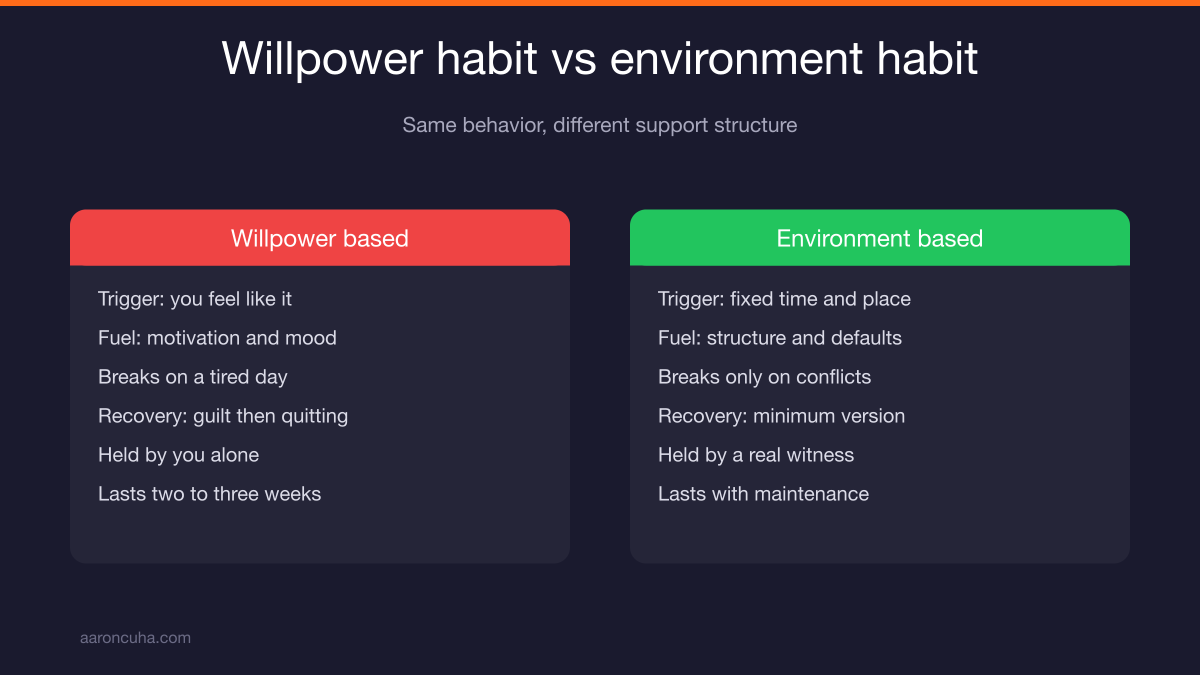
Here is how a willpower based habit compares to an environment based one.
| Element | Willpower Based Habit | Environment Based Habit |
|---|---|---|
| Trigger | You remember and feel like it | Fixed time, place, and cue |
| Fuel source | Motivation and mood | Structure and defaults |
| First failure point | A tired or stressful day | A schedule conflict you can reschedule |
| Recovery after a miss | Guilt, then abandonment | Pre planned minimum version |
| Who holds you | Only you | A witness with a real check in |
| Typical lifespan | Two to three weeks | Indefinite, with maintenance |
The goal is not to feel more disciplined. The goal is to need less discipline for the same result.
Layer One: Remove the Decision
Every decision in the moment is a chance to say no. Layer one deletes the decision entirely by fixing the variables in advance and adding friction to the alternative.
Decisions cost you when your state is low. So make them once, while your state is high, and let the setup carry them.
Do these today:
- Fix the time. Same clock time every day, not "in the morning."
- Fix the place. One room, one desk, one chair. Your brain learns the location.
- Stage the gear the night before. Clothes out, camera set, notebook open to the page.
- Delete the choice menu. Pick the workout, the video topic, or the call list in advance.
- Add friction to the escape route. Phone charging in another room. Social apps logged out.
- Set defaults on your devices. Notifications off during the block. Browser opens to the tool you need.
I use this for content production. My filming day has a fixed time, a fixed room, a fixed lighting setup, and a topic list built the week before. On camera days I do not decide anything except what I say.
If your work involves publishing, this is the same principle behind content systems that let you publish consistently without burning out.
Layer Two: Pre Commit the Calendar
Anything living on a to do list is optional. Layer two moves the behavior onto your calendar with a start time, a duration, and a defense against people who want that slot.
A to do list is a wish. A calendar block is a decision that already happened.
Build the block correctly:
- Give it a start time and an end time. Open ended blocks get eaten.
- Name it like a meeting. "Filming Block" beats "work on content."
- Set it to recur. Recurring blocks survive weeks where you forget to plan.
- Mark it busy. If your calendar is shared, nobody should be able to book over it.
- Write the reschedule rule. If it moves, it moves inside the same 48 hours or it does not move.
The defense matters more than the block. Most owners protect client time perfectly and give away their own time instantly.
Here is the line I teach. When someone asks for that slot, you say "I have a commitment then, I can do this time or that time." You do not have to explain that the commitment is to yourself.
If you keep being the person everyone must interrupt, the deeper issue is capacity, and you should read how to stop being the bottleneck in your business.
Layer Three: Install a Witness
Observed behavior behaves differently. Layer three puts a human being on the other side of the commitment so missing it costs you something real instead of something private.
Private commitments break quietly. That is the entire problem.
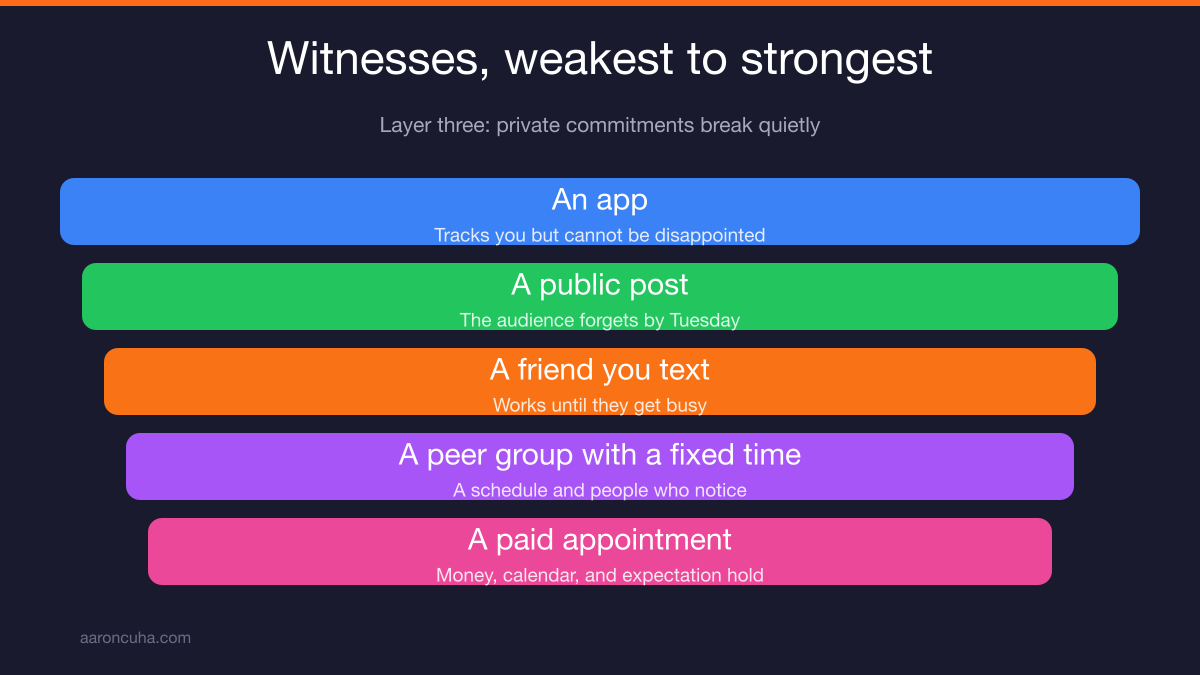
Witnesses are not equal. Here they are ranked from weakest to strongest:
- An app. Tracks you but cannot be disappointed. Weakest form.
- A public post. Some social pressure, but the audience forgets by Tuesday.
- A friend you text. Better, until they get busy or stop asking.
- A peer group with a fixed meeting time. Now there is a schedule and other people notice.
- A paid appointment with a coach. Strongest. Money, calendar, and another person's expectation all hold at once.
A real check in is not "how did it go." A real check in has three parts. Did you do it, what got in the way, and what changes before next week.
Paid appointments hold best for a simple reason. You cannot silently cancel on someone who has your time on their calendar and your payment on their books.
If you want that structure without one on one pricing, the Systems Over Hustle community gives you a group with a fixed rhythm. If you want direct pressure, look at executive coaching or compare executive coaching against group coaching before you choose.
Want a witness on your business, not just your habits? Book a 90 minute strategy session and leave with a plan someone else is holding you to.
Layer Four: Shrink the First Action to Something You Cannot Fail
Set a minimum version so small that failing is nearly impossible. One page. One set. One camera take. The tiny rep protects the identity, and the identity protects the streak.
Most people set the bar at their best day. Then they meet a bad day and skip entirely, because anything less feels like failure.
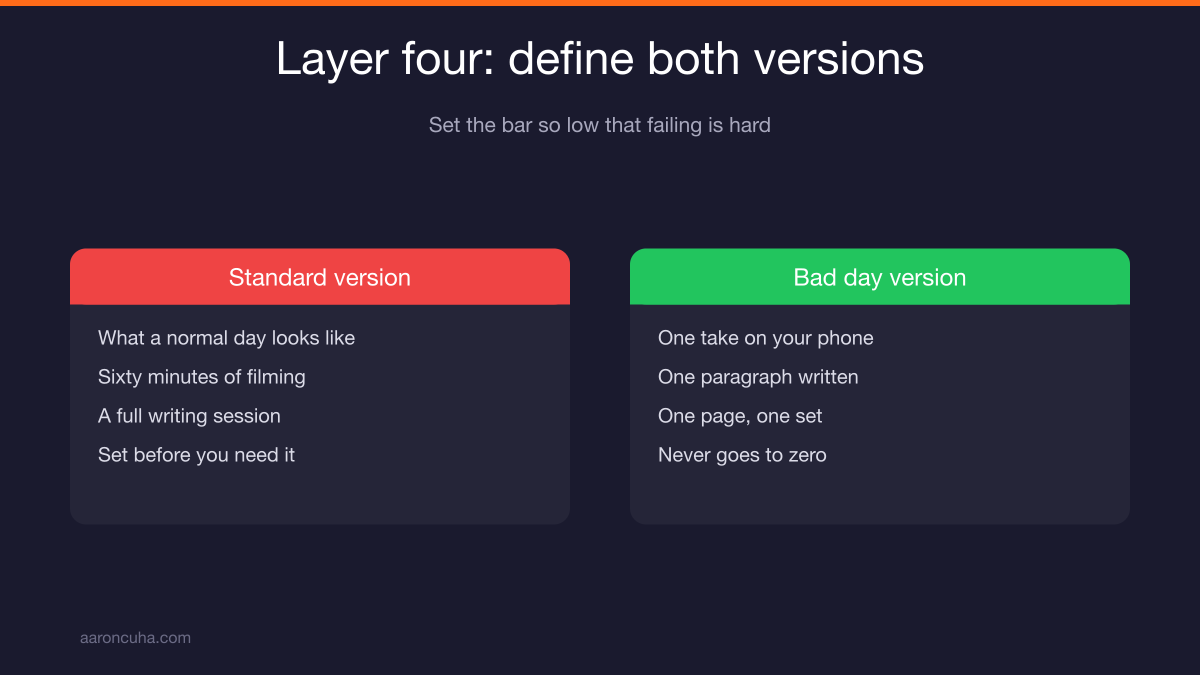
Define both versions in advance:
- Standard version. What you do on a normal day. Sixty minutes of filming.
- Bad day version. What you do when everything went wrong. One take on your phone.
The bad day version is not a compromise. It is the mechanism that keeps you from becoming a person who quits.
Here is the identity argument. Every rep, even a two minute rep, casts a vote for who you are. You are not chasing results on the hard days. You are protecting the claim that this is what you do.
I write with this rule. On book days I aim for a full session. On travel days I write one paragraph. The Willpower Lie got written in second pass edits because the minimum never went to zero.
If you are working on a book yourself, the same structure applies in the authority building playbook for writing a book.
The Seven Day Build: Install the Stack on One Behavior
Pick one behavior and install all four layers over seven days. One behavior, not five. The stack works because it is complete, not because it is broad.
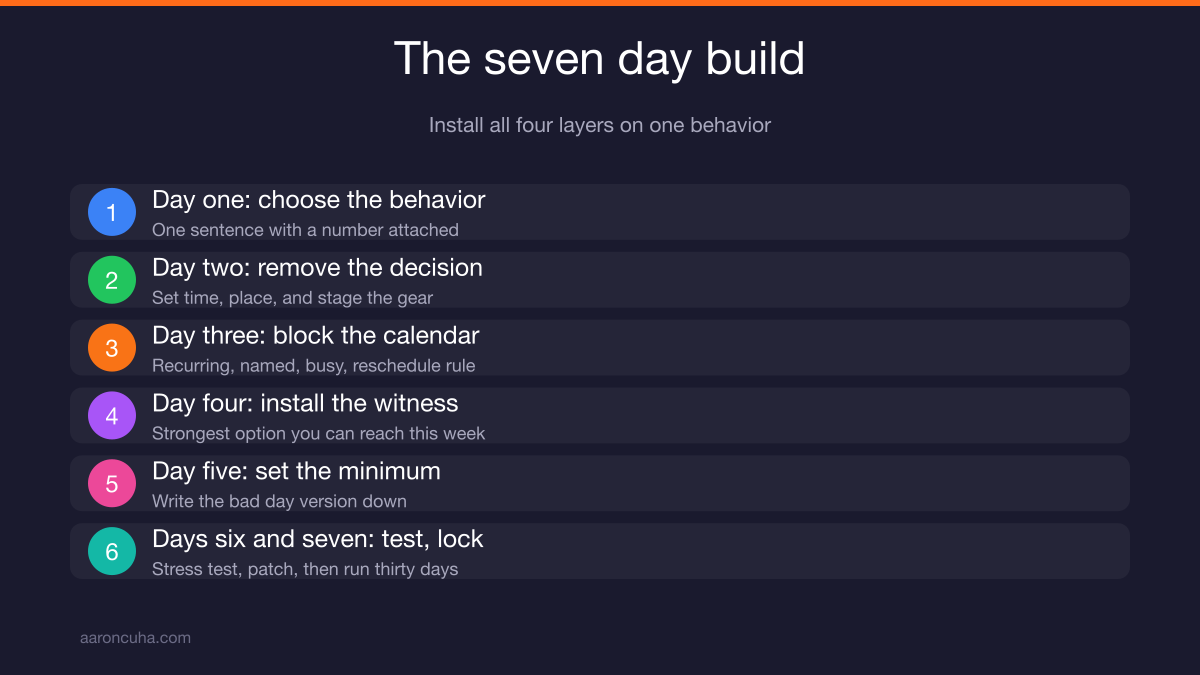
- Day one: choose the behavior. Pick the one that changes your business or health the most. Write it in one sentence with a number attached.
- Day two: remove the decision. Set the time, the place, and stage everything you need the night before.
- Day three: block the calendar. Recurring, named, marked busy, with a reschedule rule written down.
- Day four: install the witness. Pick the strongest option you can access this week and schedule the first check in.
- Day five: set the minimum. Define the bad day version in writing before you need it.
- Day six: run a stress test. Do the behavior on purpose at a bad time. Find out where the setup breaks.
- Day seven: patch and lock. Fix the weak layer from day six. Then run it for thirty days without changing anything.
Measure two things only. Did the block happen, and did the minimum get done.
Ignore outcomes for the first thirty days. Weight, revenue, subscribers, and views lag behind behavior, and watching them early makes you quit during the normal flat part.
If your behavior is publishing video, pair this with the framework for why most channels fail so your reps point at the right target.
How to Diagnose a Collapse in Under Five Minutes
When a habit dies, do not audit your character. Audit the four layers. One of them is missing, and it is usually the same one.
Ask these four questions in order:
- Did I have to decide anything in the moment? If yes, layer one is missing.
- Was it on the calendar with a defended time? If no, layer two is missing.
- Did a real person know whether I did it? If no, layer three is missing.
- Did I have a bad day version written down? If no, layer four is missing.
In my coaching, the most common missing layer is the witness. People will design a beautiful morning, block it perfectly, and then keep the entire thing private.
Private goals get renegotiated in your own head at 5:40 a.m. with nobody in the room to object.
The second most common gap is the missing bad day version. Without it, one hard week takes out three good months.
Run this audit on the last three habits you abandoned. You will find the same hole in all three. That is good news, because it means one repair fixes everything downstream.
Where This Fits in Systems Over Hustle
The Environment Stack is Systems Over Hustle applied to one person. Same principle, smaller scale. Remove decisions, schedule the work, install accountability, and define the minimum that never goes to zero.
Look at what those four layers become inside a company. Removing the decision becomes standard operating procedures. Pre committing the calendar becomes an operating rhythm of weekly meetings. Installing a witness becomes accountability and reporting. Shrinking the first action becomes a minimum viable process that runs when your best people are out.
I lost a 280 office company because I was the layer holding everything up. When my state changed, the structure had nothing else to stand on.
That is the same reason your 5 a.m. routine died in week three. Not weakness. Load placed on the wrong support.
Tools follow the same logic. When you use AI business systems to automate operations, you are removing decisions and defaults at machine speed. The framework does not change. Only the leverage does.
The National Institutes of Health and CDC both publish public guidance on sleep and stress, and both point at the same conclusion I reached in coaching rooms. Your capacity for self control depends on conditions you can control at the environment level.
The Willpower Lie makes one central argument. Discipline is not something you have. It is something you build outside yourself and then stand inside. Every high performer I have coached who kept a change for more than a year did it that way, whether they had a name for it or not.
Stop relying on the version of you who is well rested and inspired. Build for the version who is tired, behind, and still shows up because the setup made showing up the easy path.
Pick one behavior today. Install all four layers this week. Then run it for thirty days without editing anything.
If you want the framework applied to your whole operation instead of one habit, read the full Systems Over Hustle breakdown or reach out directly and tell me which layer keeps failing.
Frequently Asked Questions

Written by
Aaron CuhaAuthor of Crazy Simple YouTube, keynote speaker, and executive coach with 20,000+ hours logged. ICF PCC, NLP Master Practitioner, and DISC Certified. Aaron helps entrepreneurs replace hustle with AI-powered systems that generate leads, content, and revenue on autopilot.