Most weekly meetings are status theater. Everyone reports, nobody decides, and the business keeps running on the owner's memory. Here is the weekly team meeting agenda I install with owners who have two to twenty people, five fixed blocks in 60 minutes.
Most weekly meetings are theater. Everyone reports what they did, nobody decides anything, and the business keeps running on the owner's memory. Here is the weekly team meeting agenda that fixes it.
Key Takeaways
- Run a fixed 60 minute weekly team meeting agenda in five blocks, same time every week.
- Only invite people who own a number or a priority.
- Solve one issue to a decision instead of five issues badly.
- Every decision becomes one name, one deliverable, one date.
- If an issue returns three weeks straight, it is a system problem.
Want help installing an operating rhythm across your whole business, not just one meeting? Start with a look at executive coaching built around systems and see what changes when decisions stop routing through you.
Why Most Weekly Meetings Are Status Theater
Status theater is a meeting where people report activity instead of making decisions. It feels productive. It produces nothing. The business still runs on what the owner remembers.
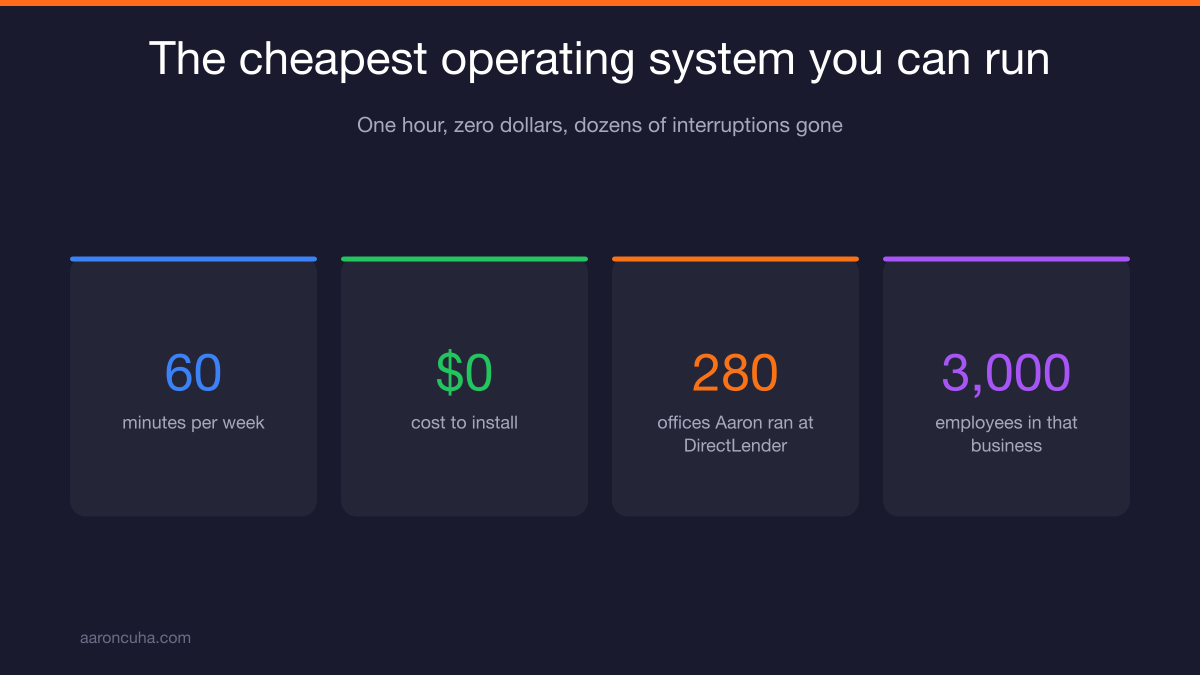
I ran DirectLender at 280 offices and 3,000 employees. I know what it feels like when every decision funnels through one person. It works right up until it does not, and then it fails all at once.
Here are the signs your meeting is theater:
- People go around the room and describe their week.
- Nobody writes anything down.
- The same topic comes up week after week with no resolution.
- You do most of the talking.
- The meeting ends and someone asks you, privately, what they should actually do.
The test is simple. If you canceled the meeting for a month, would anything break? If the honest answer is no, you are not running a meeting. You are running a ritual.
The fix is not more discipline. It is structure. A weak agenda makes strong people look scattered.
The Weekly Meeting Is the Cheapest Operating System You Can Install
A weekly meeting costs you one hour and zero dollars. Done right, it replaces dozens of interruptions, creates a home for decisions, and gives your team a rhythm they can plan around.
Most owners think an operating system means software. It does not. It means a repeatable place where numbers get checked, problems get solved, and commitments get recorded.
This is the core of the Systems Over Hustle framework. You do not fix a chaotic business by working more hours. You fix it by installing rhythms that hold without you pushing on them.
Think about what the meeting replaces. Every "got a second?" in the hallway. Every text at 9 p.m. Every decision that waits three days because you were on a plane.
When people know there is a Monday slot where issues get decided, they stop interrupting you on Wednesday. That alone changes your week. Work published by MIT Sloan Management Review has tracked how meeting load and constant interruption quietly drain the focused hours a small team actually has.
The meeting also creates a record. Over a year you build a written history of every decision your company made and why. That record is worth more than most owners realize when you go to hire, delegate, or sell.
The Weekly Team Meeting Agenda: Five Blocks in 60 Minutes
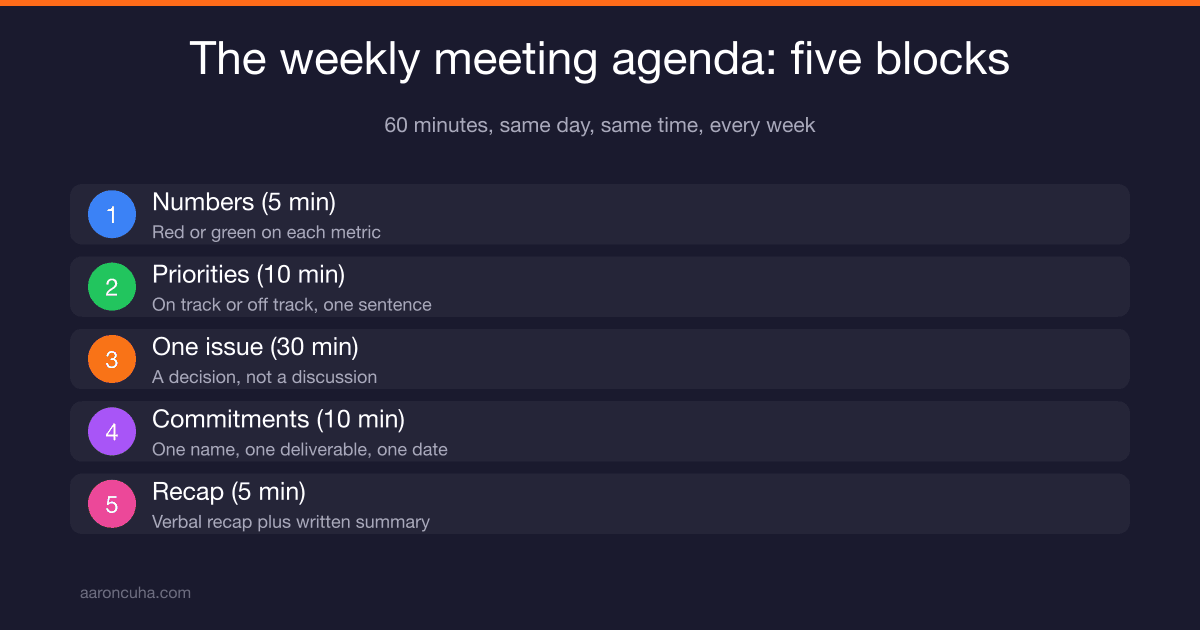
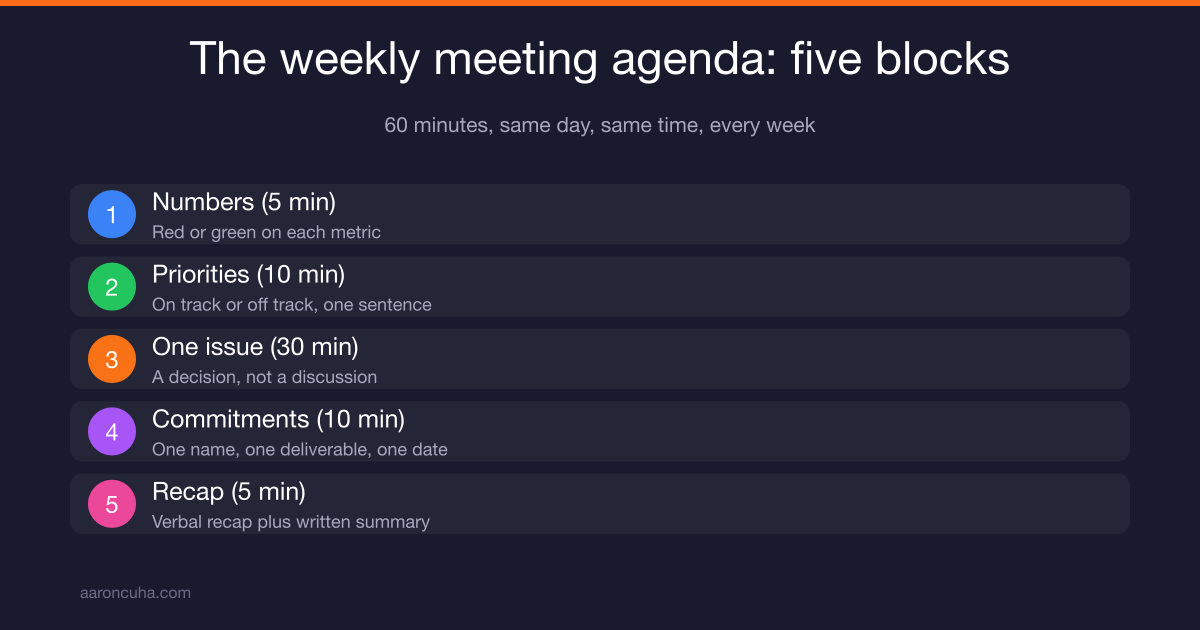
The weekly team meeting agenda has five blocks: numbers, priorities, one issue solved to a decision, written commitments, and a closing recap. Sixty minutes, same day, same time, every week.
Here is the full structure. Copy it before your next meeting.
| Block | Minutes | Who Runs It | Output |
|---|---|---|---|
| 1. Numbers | 5 | Facilitator | Red or green on each metric |
| 2. Priorities | 10 | Each owner | On track or off track, one sentence |
| 3. One Issue | 30 | Facilitator | A decision, not a discussion |
| 4. Commitments | 10 | Note taker | Name, deliverable, date |
| 5. Recap | 5 | Facilitator | Verbal recap plus written summary |
Three rules make this work. Start on time even if people are missing. End on time even if you are not finished. Never move the slot.
Moving the meeting teaches your team that the meeting is optional. Once it is optional, it is dead.
Pick a facilitator who is not you if you can. The owner talking first kills honest input faster than anything else in the room.
Who Should Be in the Room (And Who Should Not)
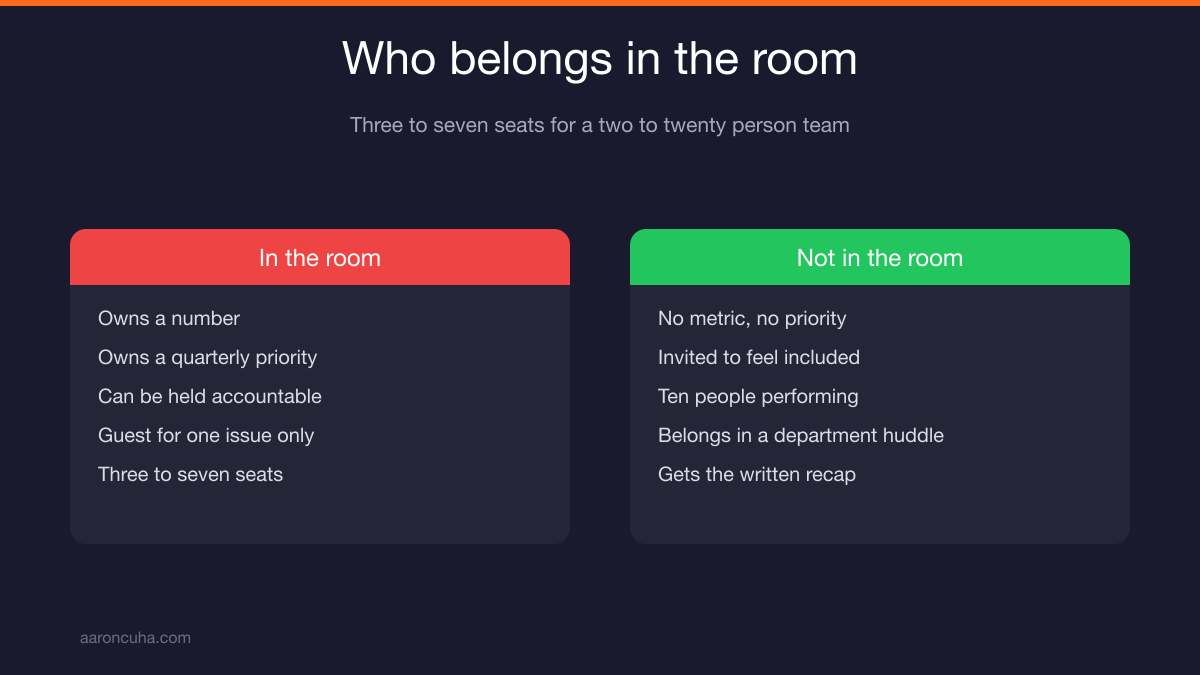
Invite only people who own a number or own a priority. For a company of two to twenty people, that is usually three to seven seats. Everyone else gets the recap.
The instinct is to include everyone so nobody feels left out. That instinct destroys the meeting. Ten people in a room means ten people performing instead of deciding.
Use this filter. If a person cannot be held accountable for a metric or a quarterly priority, they should not be in the leadership meeting. They belong in a department huddle instead.
For one-off topics, use a guest slot. Bring the person in for the issue block, let them give context, thank them, and let them leave. They get fifteen minutes back and you get the information you needed.
If you are a solo operator or a two person shop, run the same agenda with a contractor, a virtual assistant, or an accountability partner. The structure still holds. Aaron covers the team side of this in more depth in the guide on how to stop being the bottleneck in your own company.
Block One: The Numbers Review in Five Minutes
Read five to seven leading indicators. Each one is red or green. No storytelling, no explanations. Red numbers go straight to the issue list.
The mistake owners make is treating numbers as a discussion. Someone says a number is down and then talks for four minutes about why. Now you have burned the whole block on one metric.
Set a target for each number before the quarter starts. Then reading the number takes three seconds. Hit or miss. Green or red.
Track leading indicators, not just lagging ones. Revenue is a lagging number. It tells you what already happened.
Depending on your business, leading indicators might include:
- New conversations started this week
- Appointments set
- Proposals sent
- Content published
- Open support tickets past 48 hours
- Cash on hand versus a floor you set
The U.S. Small Business Administration publishes plain guidance on financial basics if you are still deciding which numbers matter for your model.
Keep the scorecard visible to everyone all week, not just in the meeting. When people see their number daily, the meeting stops being a surprise.
Block Two: Priorities, Not Progress Reports
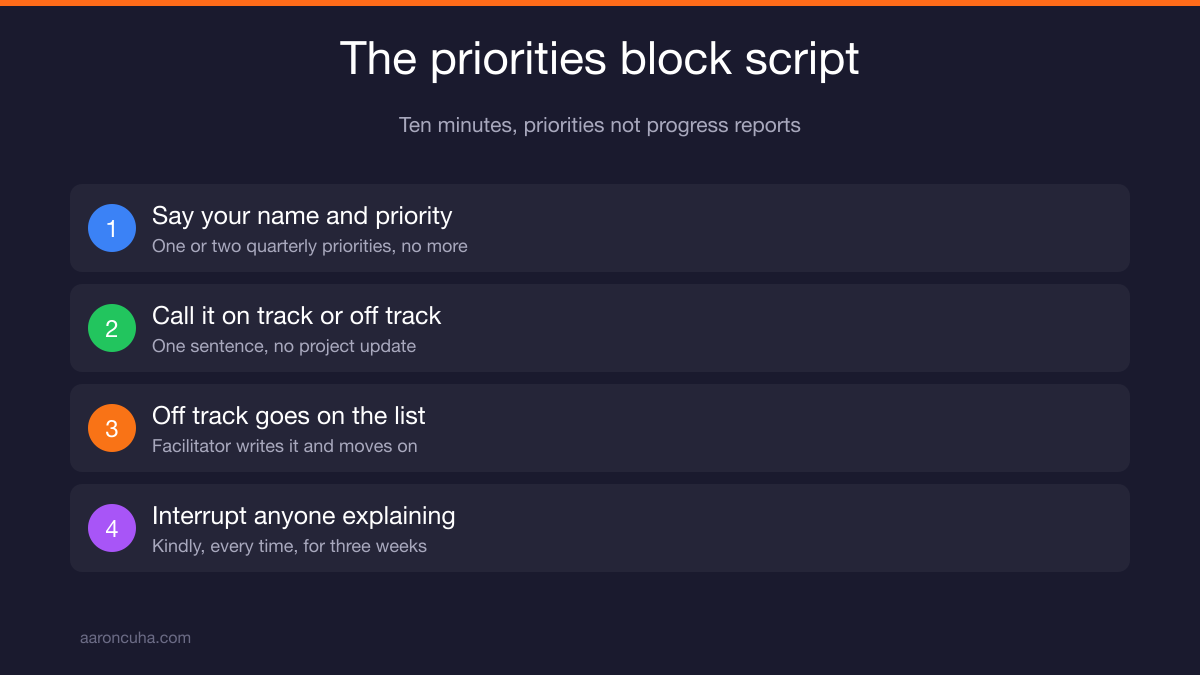
Each person confirms whether their one or two quarterly priorities are on track or off track. One sentence each. Off track goes on the issue list. No updates.
This is where most meetings collapse back into theater. Someone says "on track" and then explains the whole project. Cut it.
The script is: name, priority, on track or off track. That is it. If it is off track, the facilitator writes it on the issue list and moves on.
Limit people to two quarterly priorities. If someone has six priorities, they have none. A priority is a thing that will not happen unless it gets protected time. Workplace research from Gallup keeps landing on the same finding: a large share of employees are not clear on what is expected of them, and clarity is the cheapest fix available to a manager.
Ten minutes is plenty for five people if you hold the line. The first three weeks you will have to interrupt people mid sentence. Do it kindly and do it every time.
You are training a habit here. The habit is: we do not report, we decide. Most owners I coach need about a month before that habit sticks.
Block Three: Solve One Issue to a Decision
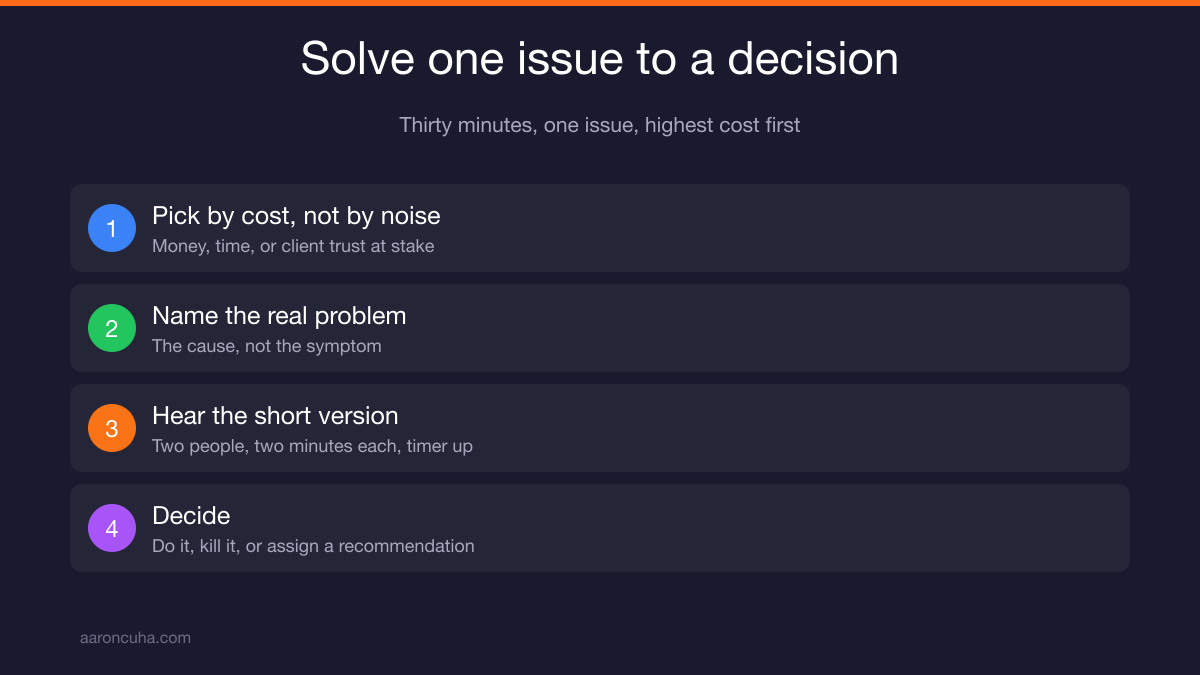
Take the highest cost issue on the list. Name the real problem, hear the shortest version of the context, then decide. Thirty minutes, one issue, one decision.
Owners resist this. They want to cover five issues. So they cover five issues badly and none of them close.
One issue solved completely beats five issues discussed. Next week you solve the next one. Over a quarter that is roughly thirteen real decisions your business did not make before.
Pick by cost, not by noise. Ask which issue is costing the most money, time, or client trust right now. The loudest issue is rarely the most expensive one.
Then run three steps:
- Name the real problem. Not the symptom. If leads are not converting, the problem might be lead quality, follow up speed, or a broken handoff. Get specific before you debate solutions.
- Hear the short version. Two people, two minutes each. Set a visible timer. The person closest to the work speaks first.
- Decide. Do it, kill it, or assign a written recommendation with a deadline.
That third option matters. Sometimes you genuinely lack information. In that case the decision is not "let's discuss it more next week." The decision is "Sarah brings a one page recommendation by Thursday and we decide it next Monday."
Use a visible clock. When the room can see the time, people compress on their own.
Ready to build the systems that hold your whole business together, not just Monday morning? Join the Systems Over Hustle community and get the operating templates other owners are already running.
Block Four: Written Commitments With Owners and Dates
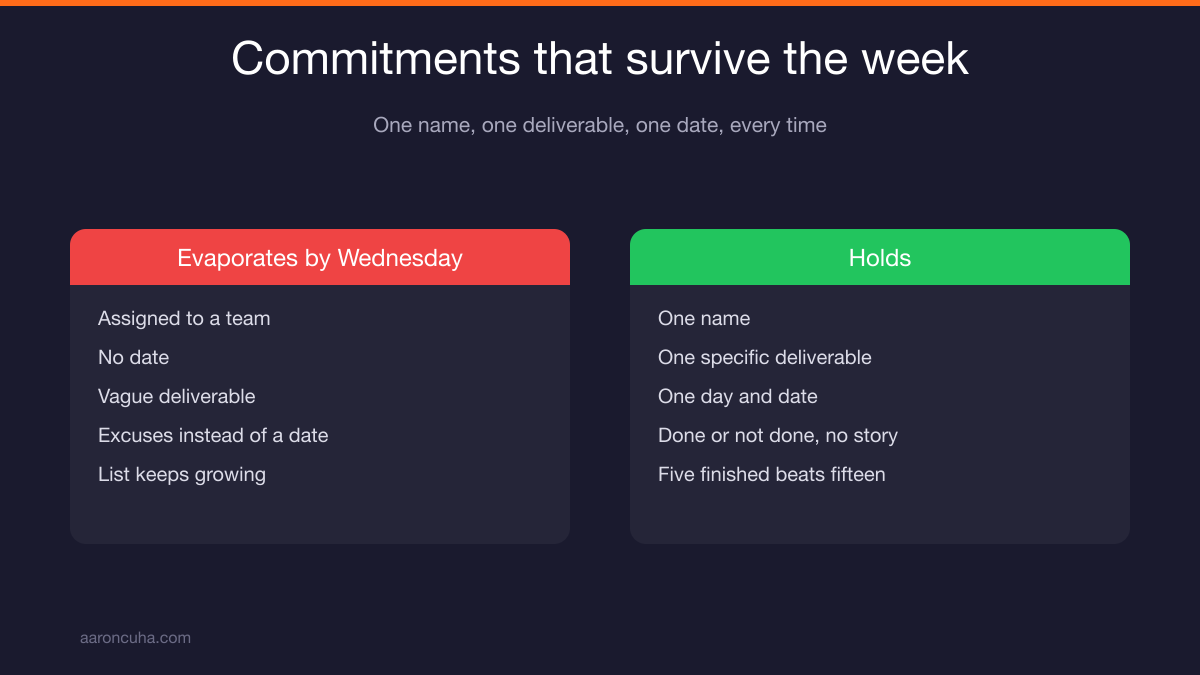
Every decision becomes a commitment: one name, one deliverable, one date. Never assign anything to a team. Read last week's list out loud before you add new ones.
This block is the difference between a meeting and a machine. Decisions without owners evaporate by Wednesday.
The format is fixed: [Name] will [specific deliverable] by [day and date].
Bad commitment: "Marketing will look into the landing page."
Good commitment: "Dana will publish the rewritten pricing page by Thursday the 14th."
Reading last week's list first is the enforcement mechanism. Each item gets one word: done, or not done. No excuses in the meeting.
If something is not done, it does not get a story. It gets a new date, and if it misses twice, it becomes the issue for next week's block three.
Keep the list in one shared place everyone can see. A doc, a board, a task tool. The tool matters far less than the fact that there is exactly one list.
Aim for a high completion rate, not a long list. Five commitments finished beats fifteen commitments carried.
Block Five: The Closing Recap and Who Needs to Hear It
Spend two minutes reading back the decision and the commitments out loud. Then send a written recap within the hour to everyone in the company who is affected.
The verbal recap catches misunderstandings while people are still in the room. You will be surprised how often two people heard the same decision differently.
The written recap should contain four things:
- The decision made and the reason in one sentence
- The commitment list with names and dates
- Any red numbers the team should know about
- What is on deck for next week
Leave out the debate. Nobody outside the room needs the arguments. They need the outcome.
Then apply the cascade rule. Every person in the meeting is responsible for telling their direct reports what changed within 24 hours. Not "if it comes up." Within 24 hours.
This is how a seven person meeting keeps a twenty person company aligned. The recap travels down one level and stops.
The Three-Week Rule: When the Same Issue Keeps Coming Back
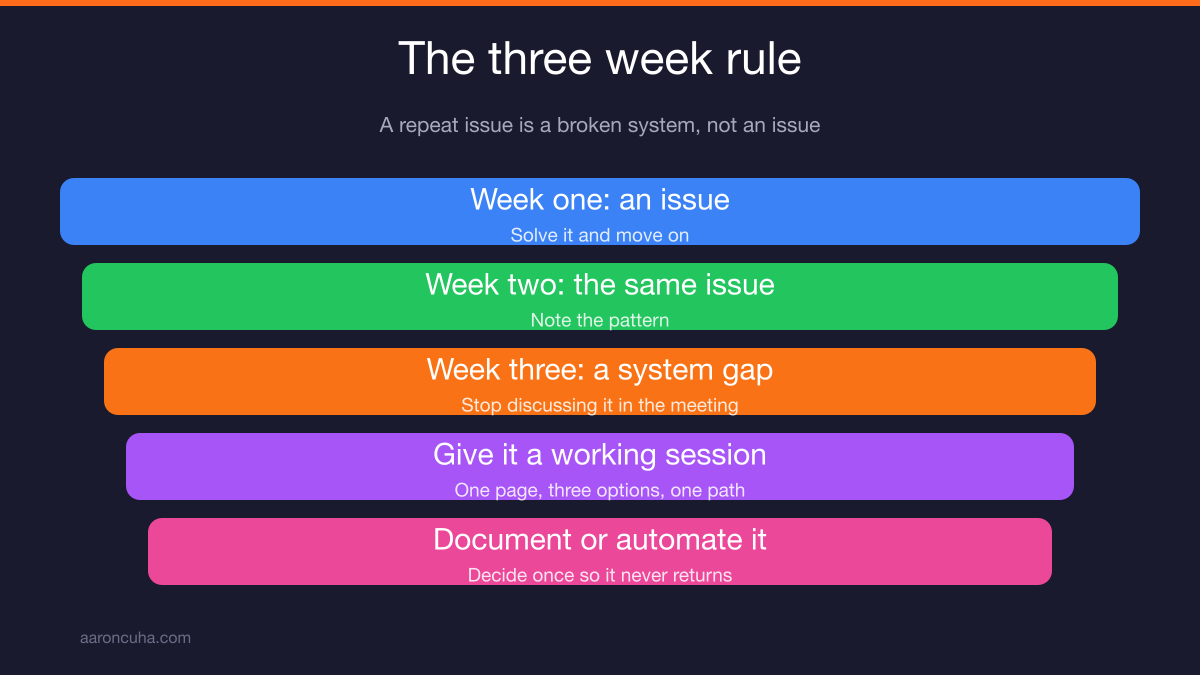
If the same issue shows up three weeks in a row, it is not an issue. It is a broken system or an ownership gap. Stop discussing it and fix the underlying cause.
Recurring issues are the most useful signal your meeting produces. They tell you exactly where your business has no process.
When you spot one, do three things:
- Pull it out of the meeting entirely. It gets its own working session.
- Assign one person to bring a written recommendation with a deadline. One page, three options, one recommended path.
- Decide once, then document the process so the decision never needs to be made again.
Ask the ownership question directly. Who owns this outcome? If more than one name comes up, that is your answer. Shared ownership is no ownership.
Sometimes the fix is automation rather than a person. Repetitive follow up, reporting, and handoffs are exactly where AI systems for small business operations earn their keep. A process that runs the same way every time does not need a human deciding it every time.
Track your recurring issues in a separate list. After a quarter, that list becomes your process documentation roadmap.
How to Install This in Your Next Four Weeks
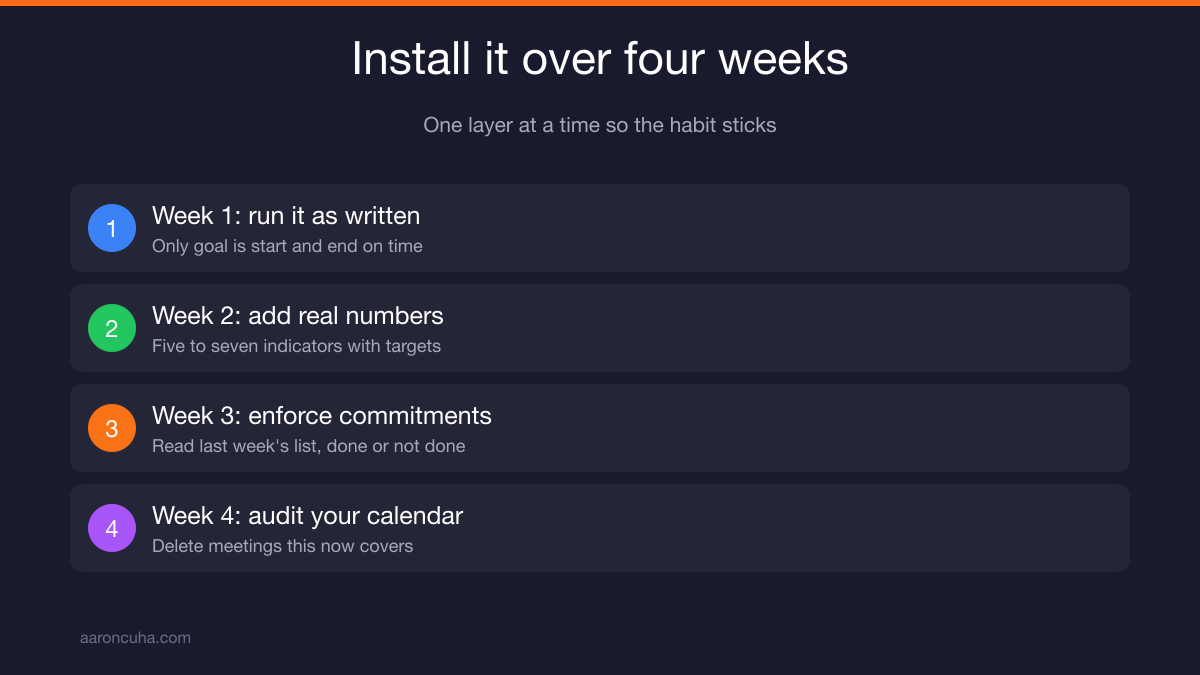
Do not launch all five blocks at full strength. Roll it out one layer at a time over four weeks so the habit sticks before the pressure arrives.
Week one: Run the agenda exactly as written. Do not customize it yet. Use a placeholder for the numbers if you do not have a scorecard. The goal this week is only to start and end on time.
Week two: Add the real numbers. Pick five to seven leading indicators and set a target for each. Expect the numbers block to run long. Cut it off anyway.
Week three: Enforce commitments. Read last week's list first. Mark each done or not done with no discussion. This is the week people find out you are serious.
Week four: Audit what you canceled. Look at every other recurring meeting, check in, and standing call on your calendar. Most owners find two or three they can delete because the weekly meeting now covers them.
Here is what breaks. Somebody will miss. Somebody will try to move the time. Somebody will bring a project update disguised as an issue.
Hold the structure anyway. The structure is the product. If you bend it in week two, you are back to theater by week five.
Seven Ways Owners Break Their Own Meeting
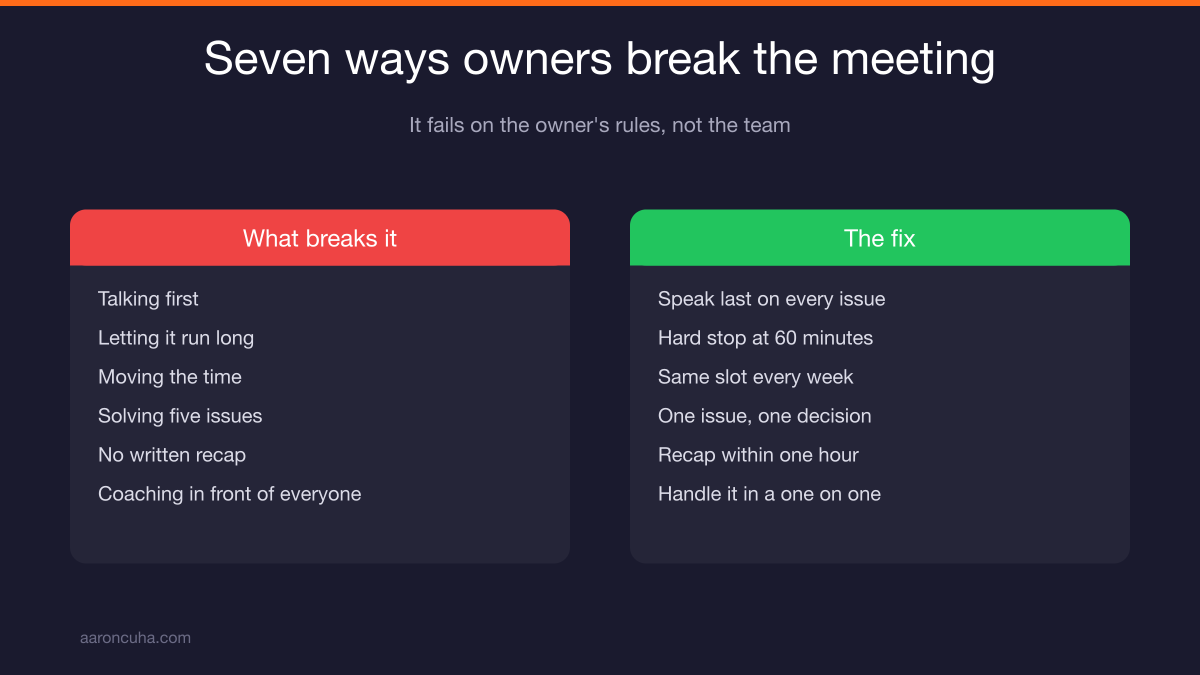
The meeting almost never fails because of the team. It fails because the owner breaks the rules they wrote. Here are the seven most common, with the fix for each.
| Mistake | Why It Kills the Meeting | The Fix |
|---|---|---|
| Talking first | Everyone anchors to your opinion | Speak last on every issue |
| Letting it run long | People stop protecting the hour | Hard stop at 60 minutes, no exceptions |
| Moving the time | Signals the meeting is optional | Same slot every week, run it without you if needed |
| Solving five issues | Nothing actually closes | One issue, one decision |
| No written recap | The decision does not survive the week | Recap sent within one hour |
| Inviting everyone | People perform instead of deciding | Only number and priority owners |
| Coaching individuals | Wastes six people's time | Take it to a one on one |
The last one is the sneakiest. You spot a performance problem in the meeting and start coaching in front of everyone. Now the person is defensive and the other five are watching a private conversation.
Write it down. Handle it in a one on one that afternoon. Research from institutions like Harvard Business Review has covered meeting effectiveness for years, and the pattern is consistent: unclear purpose and the wrong people in the room do more damage than length.
If your meeting also serves as a coaching forum, it will always drift. Keep the lanes separate. There is a useful breakdown of the difference in the piece on executive coaching versus group coaching formats.
From Meeting to Machine: What Changes After 90 Days
After roughly a quarter of holding the rhythm, three things change: interruptions drop, decisions get made without you, and you have a written record of how the business actually operates.
The interruption drop is what owners notice first. When people know there is a place for issues, they stop bringing every issue to your door.
The second change is bigger. Your team starts making decisions in the meeting that they used to escalate. That is the beginning of a business that runs without you sitting in the middle of it.
The third change is the one nobody expects. After 90 days you have twelve weeks of decisions, commitments, and recurring issues in writing. That is the raw material for process documentation, onboarding, and eventually automation.
I learned this the hard way. I built a company to 280 offices and lost it in 2008, then spent a decade doing humanitarian work in Nepal before rebuilding as a coach. Twenty thousand hours of one on one coaching later, the pattern is always the same. The businesses that survive pressure are the ones with rhythms, not the ones with heroes.
A meeting is the smallest rhythm you can install. It costs nothing. You can start it Monday.
Once the rhythm holds, layer on the rest. Content systems, delegation, automation. There is a full walkthrough of that progression in the guide to building content systems that run without burning you out and the deeper dive on automating operations without losing control.
If you want a system for consistent output alongside your operating rhythm, Crazy Simple YouTube lays out the same principle applied to content.
Ready to install the full operating rhythm instead of one meeting? Book a strategy conversation with Aaron and map the systems your business needs next.
Frequently Asked Questions

Written by
Aaron CuhaAuthor of Crazy Simple YouTube, keynote speaker, and executive coach with 20,000+ hours logged. ICF PCC, NLP Master Practitioner, and DISC Certified. Aaron helps entrepreneurs replace hustle with AI-powered systems that generate leads, content, and revenue on autopilot.