Most owners treat word of mouth like weather. It shows up or it does not. This post shows you how to get more referrals with a repeatable system: named advocates, scheduled touchpoints, a timed ask, and a tracking sheet that shows who actually produces.
Referrals are not luck. They are not charm. They are a system with triggers, and when the system goes quiet, it is because nobody is running it. Here is the system I run.
Key Takeaways
- Learn how to get more referrals by naming 20 advocates, not hoping for volume.
- Schedule five touchpoints per client year so contact beats memory.
- Ask at the moment of highest goodwill, for one named person.
- Write the forwardable message yourself so the intro takes 30 seconds.
- Close the loop within 24 hours. That is what produces the second referral.
Want a second set of eyes on your client pipeline and your content engine? Book a 90 minute strategy session and we will map your referral triggers and your visibility plan in the same sitting.
How to Get More Referrals: Treat It as a System, Not Luck
You get more referrals by building triggers, not by being likable. A referral happens when a specific person, at a specific moment, has an easy way to say your name. Everything else is hope.
Most owners I coach can name the last three referrals they got. Almost none can tell me what caused them. That gap is the whole problem, and it is expensive. Research covered by Harvard Business Review found that referred customers stay longer and deliver higher margins than customers acquired any other way.
When the market is hot, the gap hides. Deals come in and you assume your reputation is doing the work. Then a slow quarter arrives, the phone goes quiet, and you discover that your word of mouth was riding on volume, not on process.
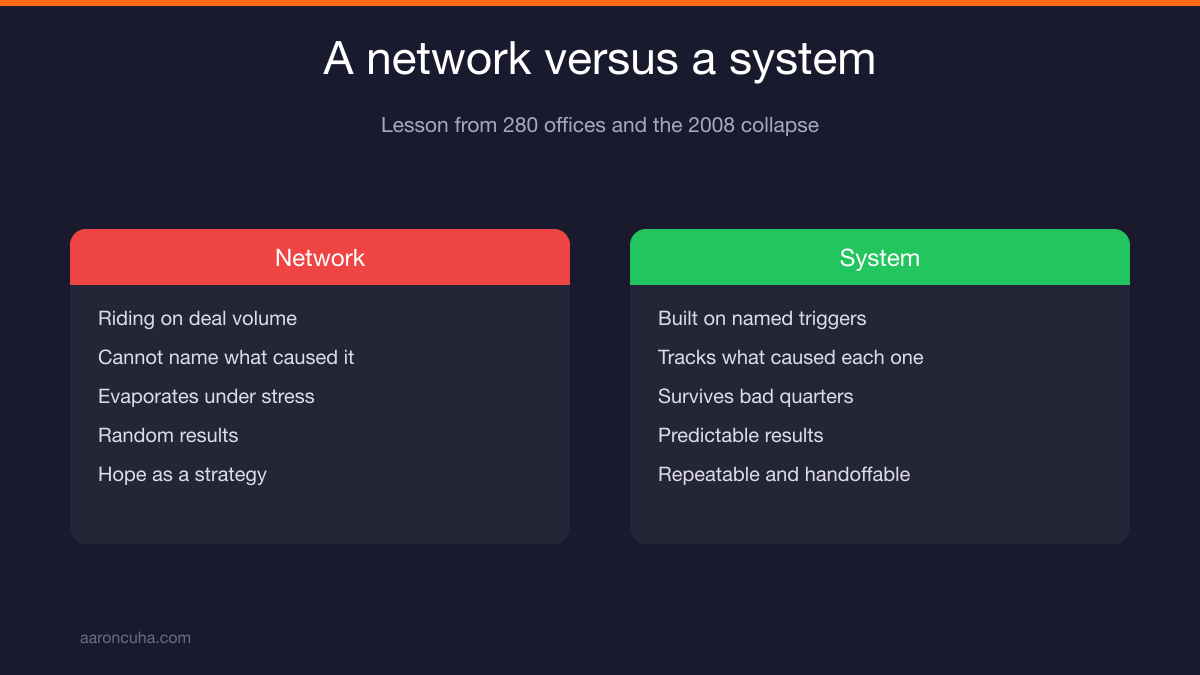
I lived this at scale. At DirectLender we grew to 280 offices and 3,000 employees, and a huge share of that growth came from introductions. Loan officers knew agents. Agents knew builders. Builders knew developers.
What I did not do well enough was track it. When the 2008 collapse hit and I lost the company, one of the hard lessons was that I had a network, not a system. A network evaporates under stress. A system does not.
That is the same principle behind Systems Over Hustle. Effort without structure produces random results. Structure turns effort into something you can predict, repeat, and hand to someone else.
Why Your Word of Mouth Goes Quiet
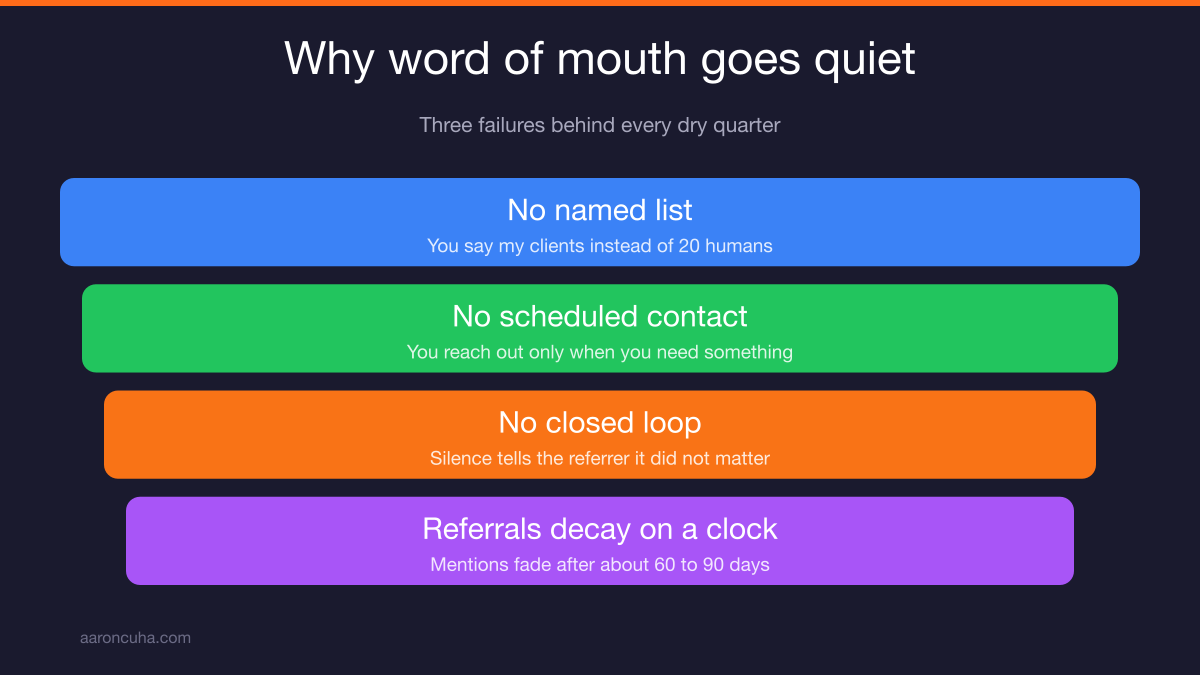
Word of mouth dries up for three reasons: you have no named list, no scheduled contact, and no closed loop. Fix those three and the flow restarts. Skip them and you wait. That matters more than most owners think, because Nielsen's global trust research keeps finding that recommendations from people you know outrank every paid channel available to you.
Here is what actually happens. A client has a great experience with you. For about 60 to 90 days, they mention you when your category comes up in conversation. Then life moves on and you fade.
Referrals decay on a clock. Not because people stop liking you, but because they stop thinking about you. Being liked and being top of mind are two completely different assets.
The three failures look like this:
- No named list. You say "my clients" instead of naming 20 humans. Vague inputs produce vague outputs.
- No scheduled contact. You reach out when you need something, which every advocate can smell.
- No closed loop. Someone sends you a name, hears nothing back, and quietly decides not to risk their reputation again.
That last one is the silent killer. A referrer put their credibility on the line for you. Silence tells them it did not matter.
The Referral Engine: Five Parts
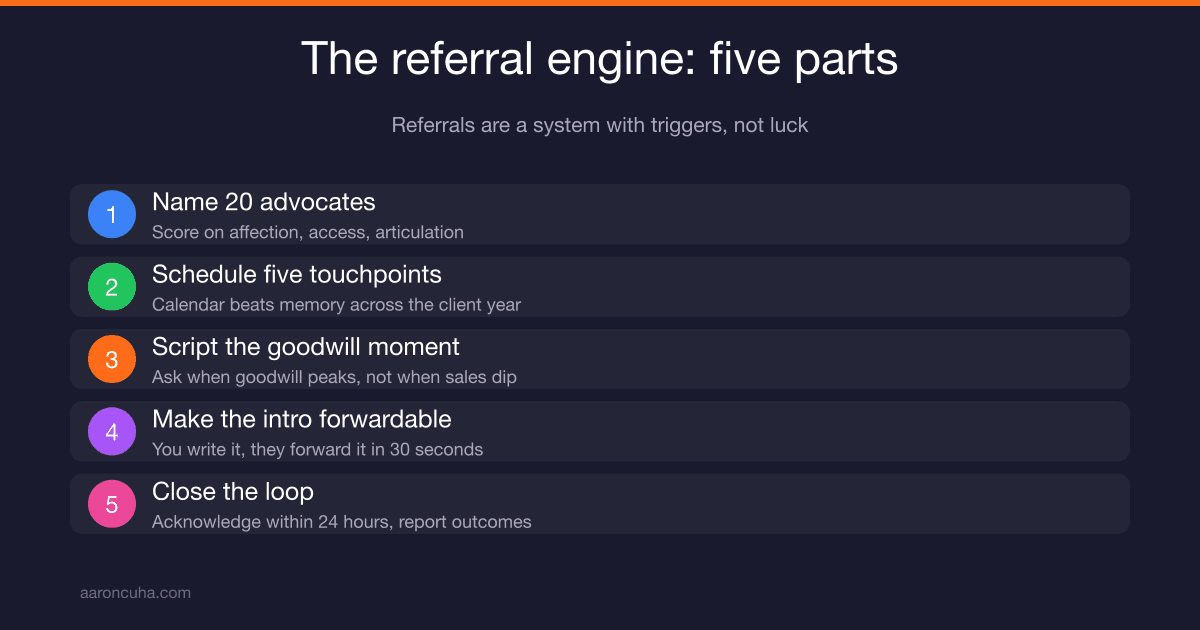
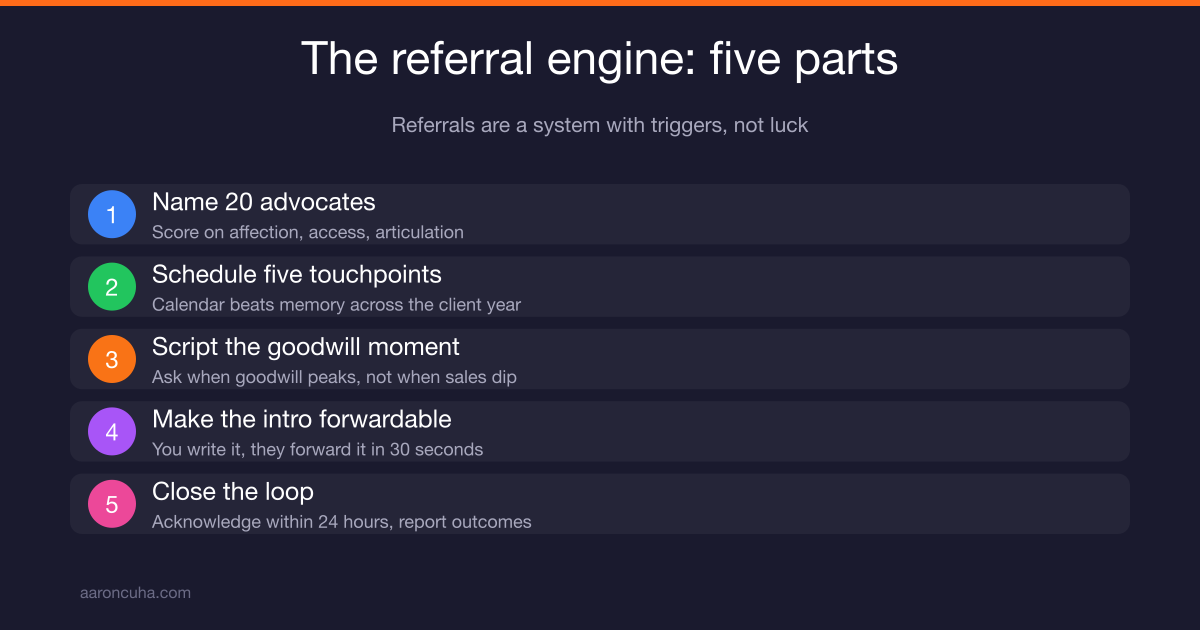
The Referral Engine has five parts: name your advocates, schedule five touchpoints, script the goodwill moment, make the introduction forwardable, and close the loop. Each part fails alone. Together they compound.
Run it in order:
- Identify your top 20 advocates. Twenty names, scored, written down.
- Build five scheduled touchpoints across the client year, on a calendar, batched in advance.
- Script the moment of highest goodwill so the ask lands naturally instead of awkwardly.
- Make the introduction effortless with a message they can forward without writing a word.
- Close the loop every time so the referrer sees what their name produced.
Notice what is missing. There is no gimmick, no gift basket strategy, no referral contest. Those are tactics people reach for when the system underneath is broken.
You can run this entire engine in a spreadsheet and a calendar. If you want it running with less of your own hands on it later, layer in automation the way I describe in AI business systems. Build the process first. Automate second.
Step 1: Identify Your Top 20 Advocates
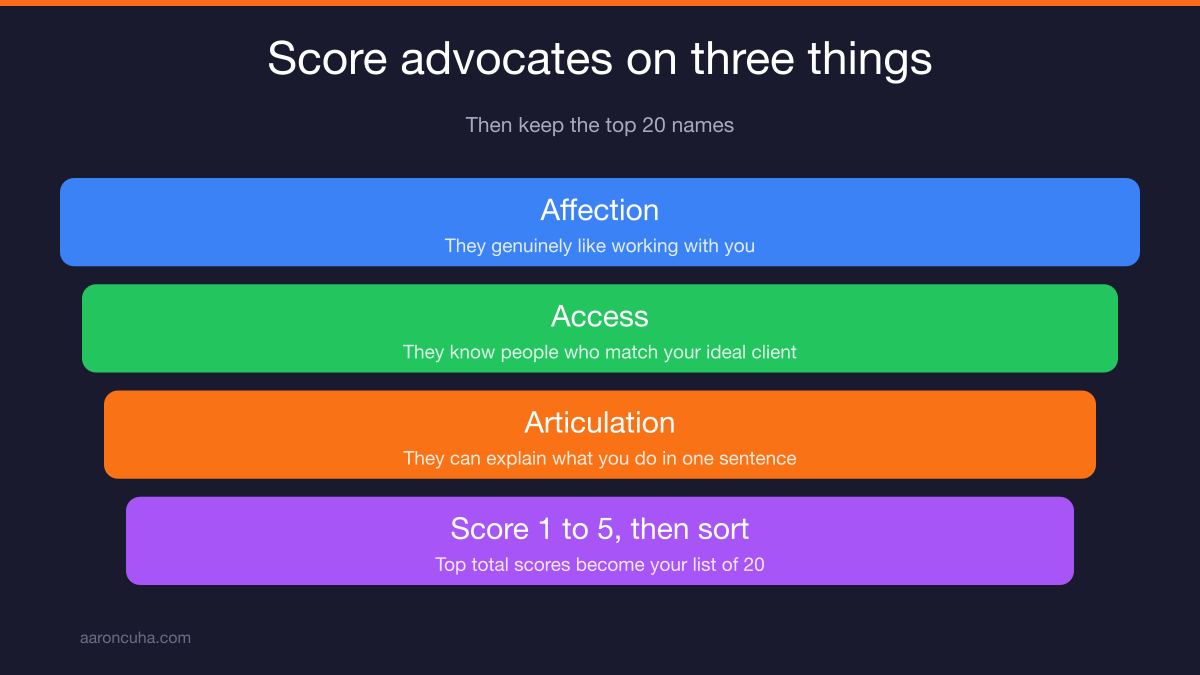
Score every past client and partner on three things: affection, access, and articulation. The top 20 names become your list. Everyone else gets your newsletter, not your calendar.
Affection means they genuinely like working with you. Access means they know people who match your ideal client. Articulation means they can explain what you do in one clear sentence.
That third one gets ignored constantly. Someone can love you and still describe your business so badly that no introduction ever happens. If they cannot articulate it, your job is to teach them the sentence, not to blame them.
Score each name 1 to 5 on all three, then sort by total.
| Tier | Profile | Contact Cadence | What You Expect |
|---|---|---|---|
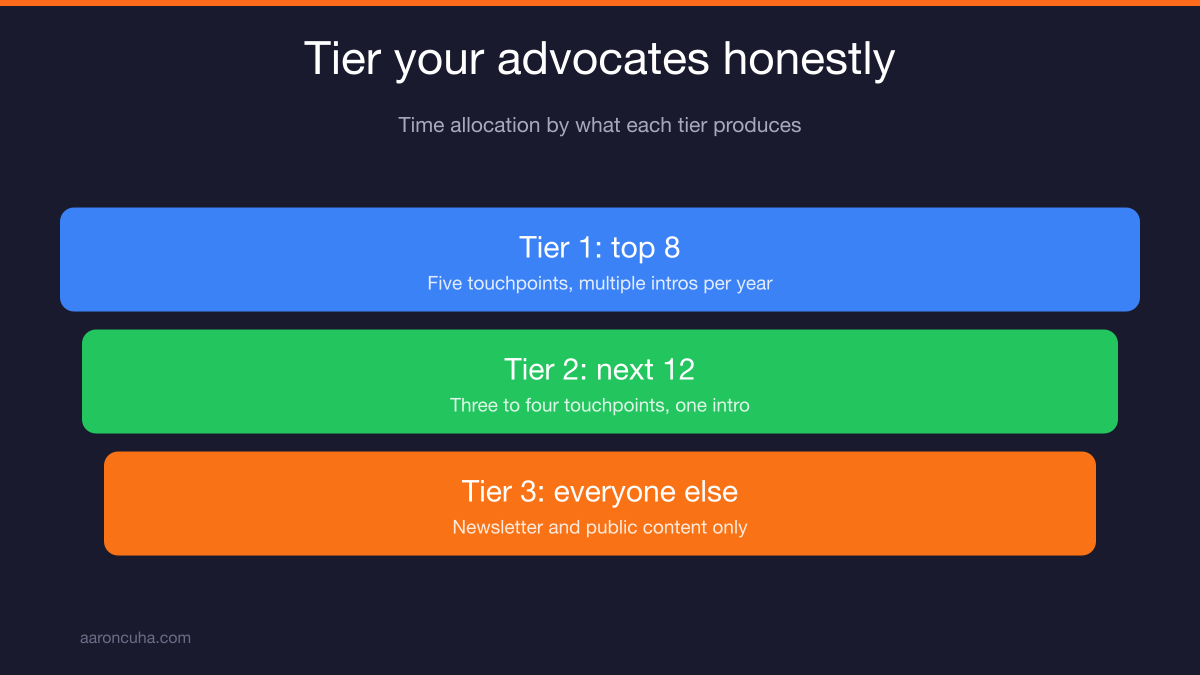
| Tier 1 (top 8) | High on all three scores. Has already sent someone or clearly would. | Five scheduled touchpoints per year plus real conversation | Multiple named introductions annually |
| Tier 2 (next 12) | Strong on two of three. Usually needs the sentence taught. | Three to four touchpoints per year | One introduction, plus reputation defense |
| Tier 3 (everyone else) | Happy clients with limited access or limited clarity. | Newsletter and public content only | Occasional inbound, no active management |
The point of tiering is honest allocation of your time. You do not owe everyone the same access to you. You owe everyone good work.
Step 2: Build Five Scheduled Touchpoints Across the Client Year
Five contacts per year, on the calendar, is the minimum to stay top of mind without becoming annoying. Calendar beats memory every time. Memory always loses to a busy week.
Here are the five I use and teach:
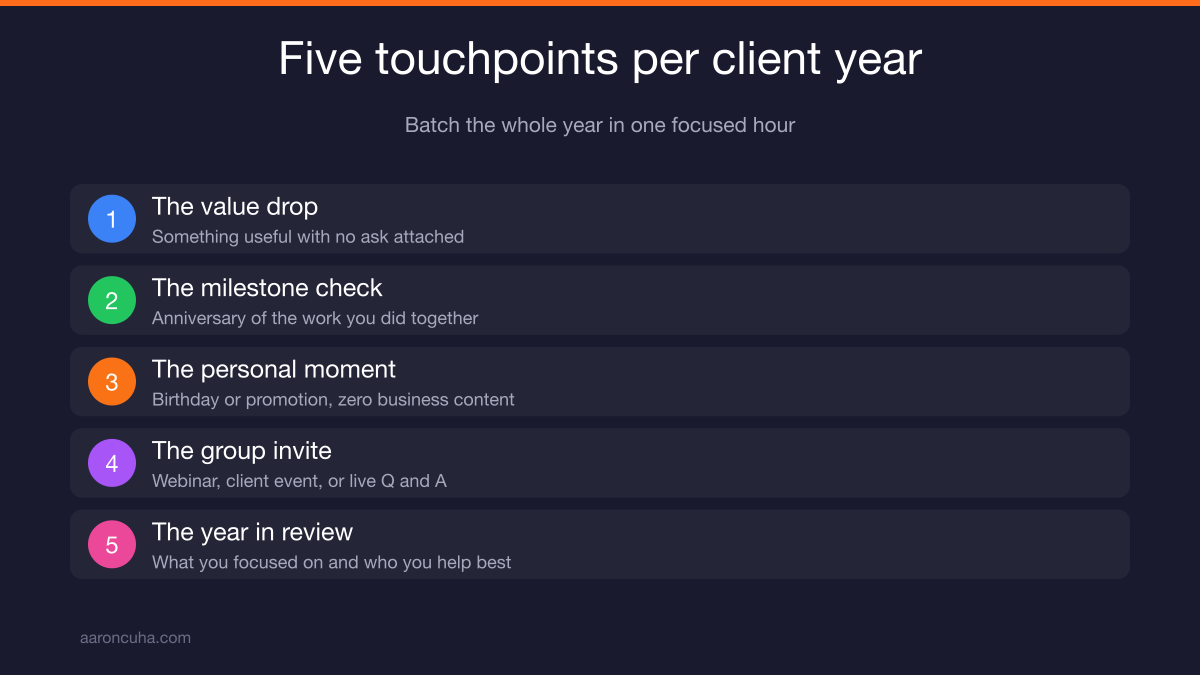
- The value drop. Something useful with no ask attached. A market update, a checklist, a video you made that answers a question they had.
- The milestone check. Anniversary of the work you did together. "One year ago this month we closed. How is it going?"
- The personal moment. Birthday, a promotion, a kid's graduation. One sentence, zero business content.
- The group invite. A webinar, a client event, a live Q and A. Group settings create introductions on their own.
- The year in review. A short note on what you focused on this year and who you help best.
That fifth one does double duty. It reminds people what you do now, which matters more than owners realize, especially if you have narrowed your niche.
Batch the whole year in one sitting. Open your calendar, drop 100 reminders across 12 months, and write the value drop assets once. One focused hour buys you a full year of contact.
If you already publish content, the touchpoints get easier. A single video becomes an email, a text, and an invite. That is the same logic behind the Authority Flywheel and repurposing one video into 30 assets.
Step 3: Script the Moment of Highest Goodwill
Ask when goodwill peaks, not when your pipeline dips. The goodwill window opens the moment a client says something positive out loud. That is your cue, and it is short.
Goodwill moments are easy to spot once you look for them. A client thanks you unprompted. A problem gets solved. A result lands. They say "this was so much easier than I expected."
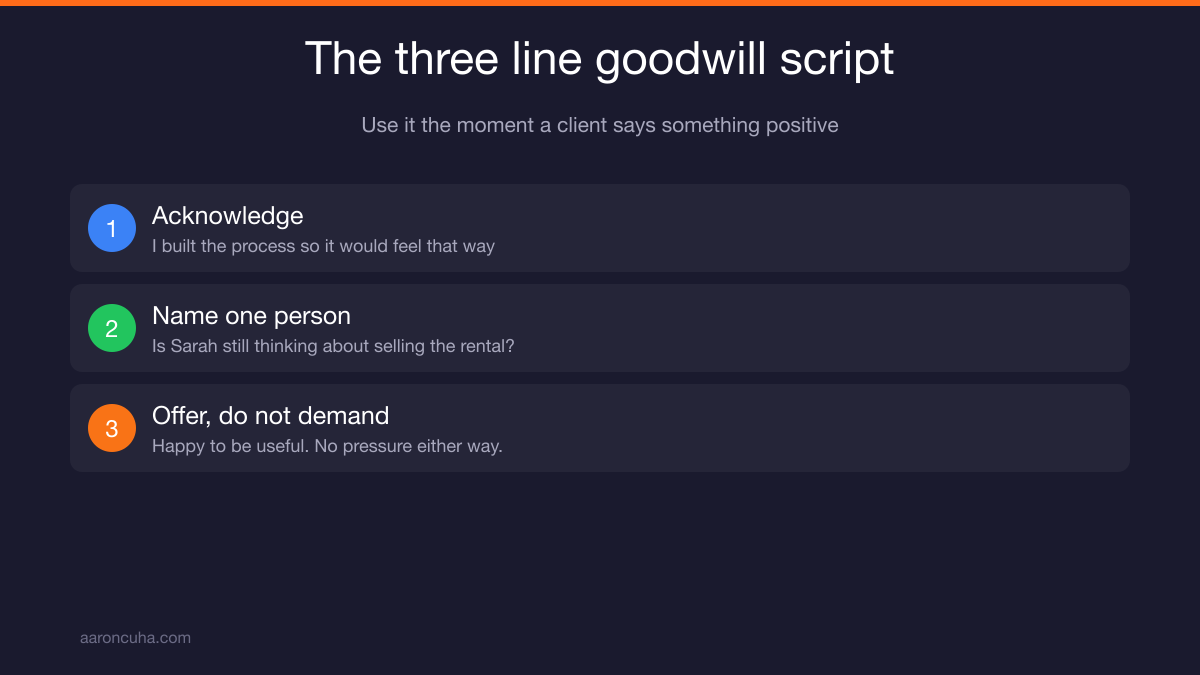
Do not let that pass. Use three lines:
- Acknowledge. "That means a lot. I built the process specifically so it would feel that way."
- Name one person. "Quick question. Is Sarah still thinking about selling the rental?"
- Offer, do not demand. "If it makes sense, I am happy to be useful to her. No pressure either way."
The critical move is naming one person. "Do you know anyone who needs my services?" makes their brain search an empty room. A named person turns a search problem into a yes or no question.
So do your homework before the conversation. Look at their social profiles, their company page, people you have heard them mention. You only need one name.
If they hesitate, do not push. Say, "Totally fine. If it ever comes up, I will make it easy on you." Then close the topic and go back to serving them. Pressure costs more than the referral is worth.
Ready to build the whole engine with support instead of guessing? Join the Systems Over Hustle community and get the frameworks, templates, and accountability in one place.
Step 4: Make the Introduction Effortless With a Forwardable Message
Friction kills good intentions. Your referrer meant to send that email and then a week passed. Write the message for them so the introduction takes 30 seconds, not 30 minutes of drafting.
The rule is simple. You write the message. They forward it. Never ask a busy person to compose something on your behalf.
The forwardable email has four parts:
- Context line. "I worked with Aaron on X and it went well."
- One sentence on who you help. Plain language, no title stacking.
- One specific outcome. What changes for the person after working with you.
- A low pressure next step. "Worth a 15 minute call if it is relevant."
Keep it under 100 words. Long intros feel like a sales pitch the referrer has to co-sign.
The text version is one line: "Hey, this is the person I mentioned. Here is their info, and I told them you might reach out."
Then remove every remaining obstacle on your side. A clear page they can send, a booking link that works on a phone, a response time measured in hours. Speed matters more than most owners believe, and the classic lead response time research shows how fast qualification odds drop after the first hour. If your conversion system is clunky, referrals leak out the bottom no matter how many come in the top.
Step 5: Close the Loop So the Referrer Sees What Happened
Closing the loop is the most skipped step and the highest leverage one. Acknowledge within 24 hours, report the outcome when you have it, and thank them in a way that costs nothing but attention.
Run three beats:
- The 24 hour acknowledgment. "Got it. Reaching out to her today. Thank you for thinking of me."
- The outcome update. "We talked. She is a fit and we are starting next month," or "We talked, timing is not right, but it was a good conversation."
- The thank you. Specific, personal, and about them. "You did not have to put your name on this. I do not take that lightly."
Report the misses too. Telling someone the referral did not convert is what proves you handle their people well regardless of outcome. That builds trust faster than a win does.
You do not need a gift. In many regulated industries you legally cannot give one for a referral, which we will get to. What you can always give is respect and information.
Closing the loop is what produces the second referral. The first one is a test. How you handle it decides whether there is another.
The Referral Tracking Sheet That Shows Who Actually Produces
Track seven columns in one sheet and review it monthly. The sheet ends the guessing about who your real advocates are and who you have been over servicing out of habit.
| Column | What Goes In It | What It Tells You |
|---|---|---|
| Source name | Who sent the referral | Your actual producers |
| Referred name | Who was introduced | Pipeline record |
| Date received | When it came in | Seasonality and gaps |
| Trigger | Which touchpoint or moment preceded it | What actually causes referrals |
| Status | Contacted, in conversation, won, lost | Where things stall |
| Loop closed | Yes or no, with date | Your follow through discipline |
| Last touch to source | Date of your most recent contact | Who is going cold |
Read it monthly and look for two patterns.
The over serviced non-producer. You take their calls, answer their questions, and give free advice, and the referral column is empty year after year. That is not a villain. That is a Tier 3 relationship you have been funding at Tier 1 cost. Move them down and reclaim the hours.
The quiet high producer. Someone who sends people consistently and never asks you for anything. These get neglected because they are easy. Move them up. Call them. Ask what they need.
The trigger column is the one that pays for the whole sheet. Over six months you will see which touchpoint reliably precedes an introduction. Then you do more of that one.
What to Do When Referrals Stop Cold
A dry quarter is a diagnostic, not a mystery. Check four things in order: delivery quality, touchpoint gaps, loop closure, and whether you changed your positioning without telling anyone.
Work the checklist:
- Delivery quality. Has your service slipped as you got busier? People stop referring long before they complain. Ask three recent clients directly what felt weakest.
- Touchpoint gaps. Open the sheet. If the last touch column shows six months of silence across your top 20, that is your answer.
- Loop closure. Find the last five referrals you received. Did each source get an acknowledgment and an outcome? If not, you trained them to stop.
- Positioning drift. Did you narrow your niche? If you used to take anything and now only serve one segment, your advocates are still describing the old you and sending the wrong people, or nobody at all.
Positioning drift is the sneakiest one. It looks like a referral problem and it is actually a communication problem. Fix it by sending a short note that says exactly who you serve best right now.
Visibility helps here too. When your advocates see you publishing consistently, they remember what you do without you calling. That is one of the underrated benefits of building a personal brand on video and why invisible leaders lose business even when the work is excellent.
Six Referral Mistakes That Kill Trust
Most referral damage comes from six repeatable errors. Avoid these and you will outperform competitors who are working harder on the wrong things.
- Paying for introductions in regulated fields. In real estate and mortgage lending, referral fees and kickbacks are restricted under federal law. Read the rules at the Consumer Financial Protection Bureau before you offer anyone anything of value. The same caution applies to financial advice, law, and healthcare.
- Mass emails asking for referrals. "Do you know anyone?" sent to 800 people signals desperation and produces almost nothing.
- Vague asks. Anyone, someone, whoever comes to mind. Empty search, empty result.
- Asking before you deliver value. No result, no ask. Goodwill has to exist before you spend it.
- Ignoring the referred person's timeline. If they say six months, put it on the calendar for six months. Pushing burns two relationships at once.
- Never thanking the source. Free, fast, and skipped constantly.
One more note on incentives. If you publicly promote reviews, testimonials, or referral rewards, disclosure rules apply. The Federal Trade Commission publishes clear guidance on endorsements, and it is worth 20 minutes of your time.
Also check your state licensing board. Rules vary, and "everyone in my market does it" has never been a legal defense.
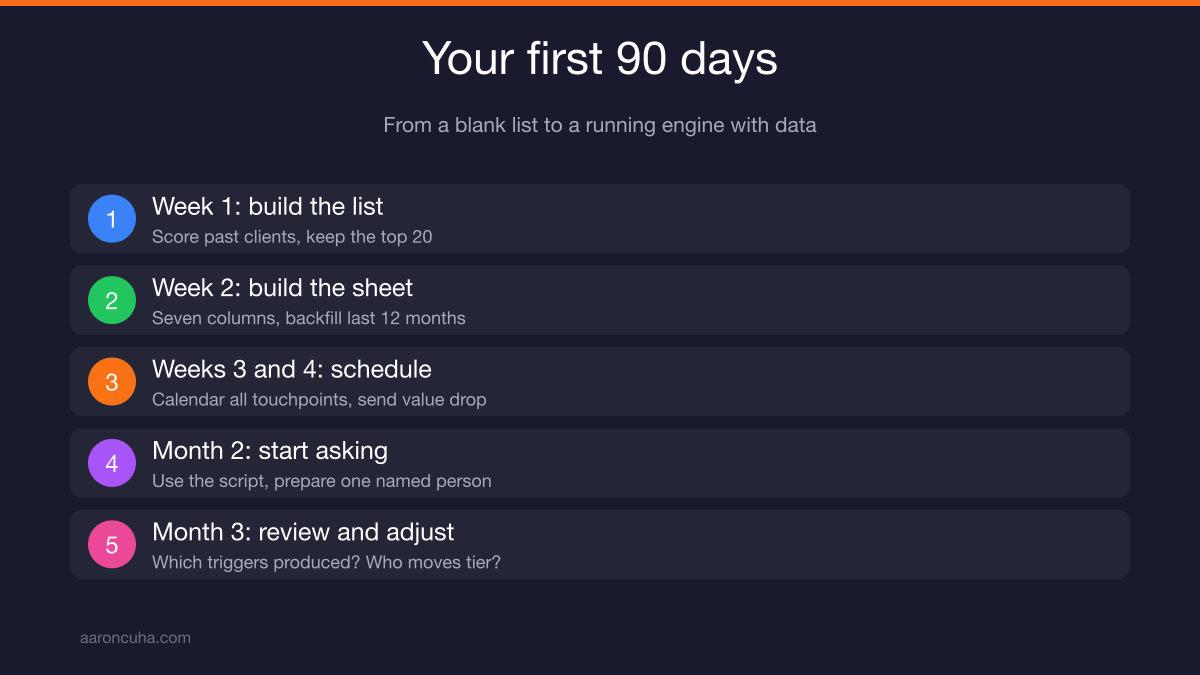
Your First 90 Days With the Referral Engine
Start today with a list of names. In 90 days you will have a running engine with data. Here is the week by week rollout I give clients.
Week 1: Build the list. Open a blank document. Write every past client and partner you can remember. Score each on affection, access, and articulation. Keep the top 20. This takes about an hour.
Week 2: Build the sheet. Seven columns, one tab. Backfill your last 12 months of referrals from memory and your inbox. Ugly data beats no data.
Weeks 3 and 4: Schedule and send. Drop all five touchpoints for all 20 people onto your calendar for the next 12 months. Then send the first value drop. No ask attached. None.
Month 2: Start asking. Watch for goodwill moments and use the three line script. Prepare one named person before each client conversation. Write your forwardable email template once and reuse it.
Month 3: Review and adjust. Open the sheet. Which triggers produced? Who moved up a tier? Who is a Tier 1 in your head and a Tier 3 in reality? Adjust the cadence and run it again.
Ninety days gets you a working engine. A year gets you predictable introductions, which is a different business than the one you have now.
None of this requires more hustle. It requires structure, which is the entire argument of my work on simple systems and the reason I rebuilt after losing everything in 2008. Systems survive bad quarters. Personality does not.
If you want help installing this alongside a content engine that keeps you top of mind between touchpoints, start with a Channel Audit and Plan and we will show you exactly where your authority is leaking.
Frequently Asked Questions

Written by
Aaron CuhaAuthor of Crazy Simple YouTube, keynote speaker, and executive coach with 20,000+ hours logged. ICF PCC, NLP Master Practitioner, and DISC Certified. Aaron helps entrepreneurs replace hustle with AI-powered systems that generate leads, content, and revenue on autopilot.