Most owners undercharge because they fear the conversation, not the number. This guide shows you how to raise your prices with a 5 step repricing process, including the scripts, the timing, and the value proof that makes your best clients say yes.
Learning how to raise your prices is not a math problem. It is a nerve problem. Most owners know they are underpriced, and they still send the same invoice every month because the conversation scares them.
Key Takeaways
- Audit delivery hours before you touch the number. Cost drives the floor.
- Build a value proof file first so the increase lands as evidence, not opinion.
- Set three numbers: floor, target, ceiling. Use round, confident pricing.
- Sequence the rollout. New clients first, renewals second, legacy last.
- Say the number, stop talking, and let silence do the work.
If you want a second set of eyes on your offer and your delivery load before you reprice, book a 90 minute strategy session and we will pressure test the number together.
Why Owners Undercharge (It Is Not the Market)
You are not underpriced because the market is soft. You are underpriced because you have never rehearsed the conversation, and your identity is quietly attached to being the affordable option.
I hear the same three reasons every week. The market is tight. My clients cannot afford more. I do not want to seem greedy.
None of those are pricing reasons. They are fear reasons wearing a business costume.
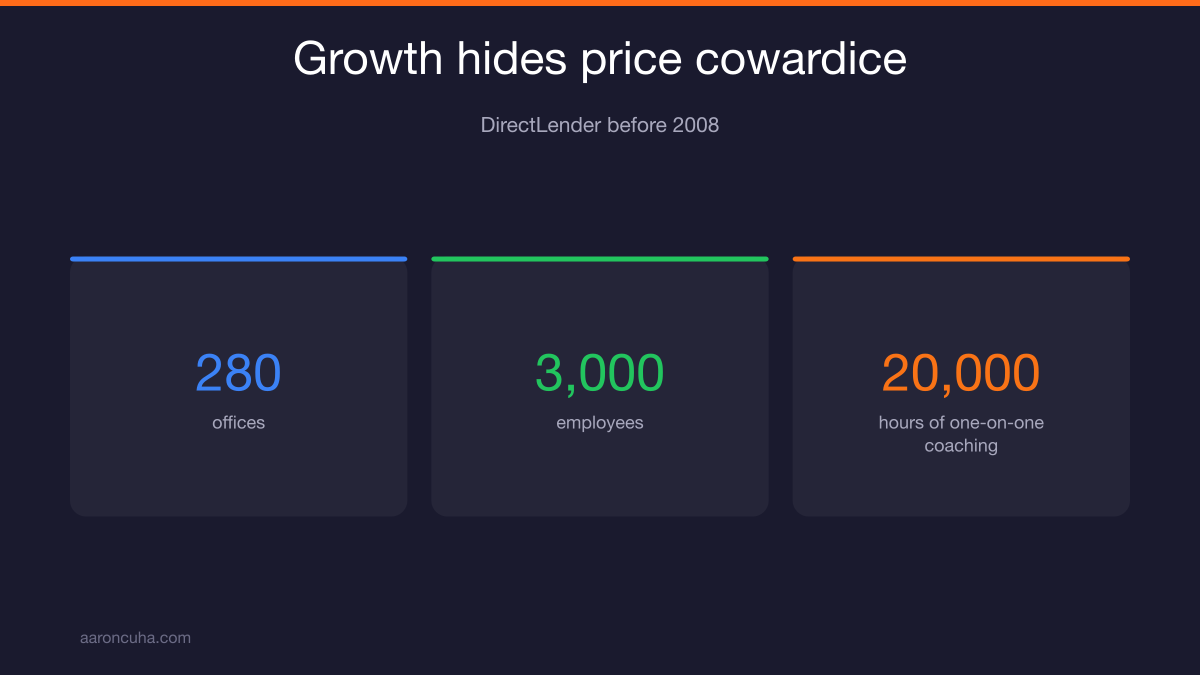
At DirectLender we grew to 280 offices and 3,000 employees. Volume covered a lot of sins. When you are adding branches every quarter, nobody audits margin per client, because the top line keeps making you feel smart.
Then 2008 arrived and took the volume away. What was left was the truth about the economics underneath it. Price cowardice hides inside growth. It only shows up when growth stops.
The second cause is the mortgage-payment mindset. You price for what you need this month instead of what the work is worth over a year. That turns you into a hostage of your own calendar.
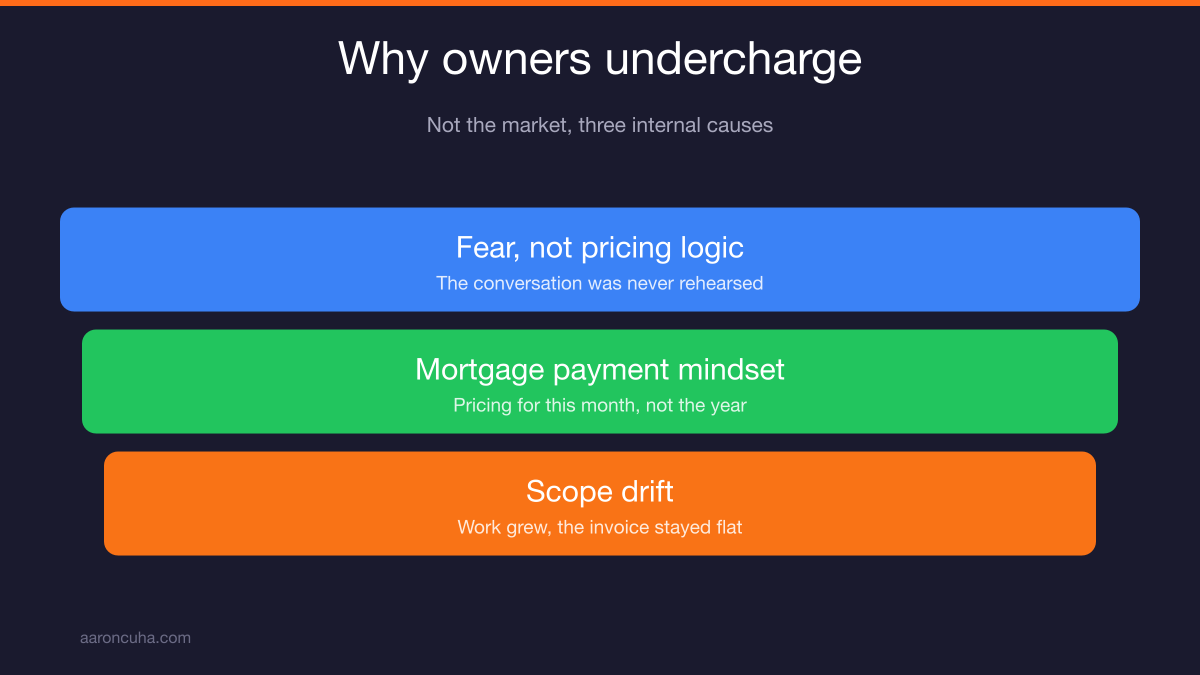
The third cause is scope drift. You quoted a job. Then you added the extra call, the extra revision, the weekend text. The price stayed flat while the work grew a second body.
Fix the fear, the mindset, and the drift, and the number moves almost on its own.
How to Raise Your Prices: The 5 Step Repricing Process
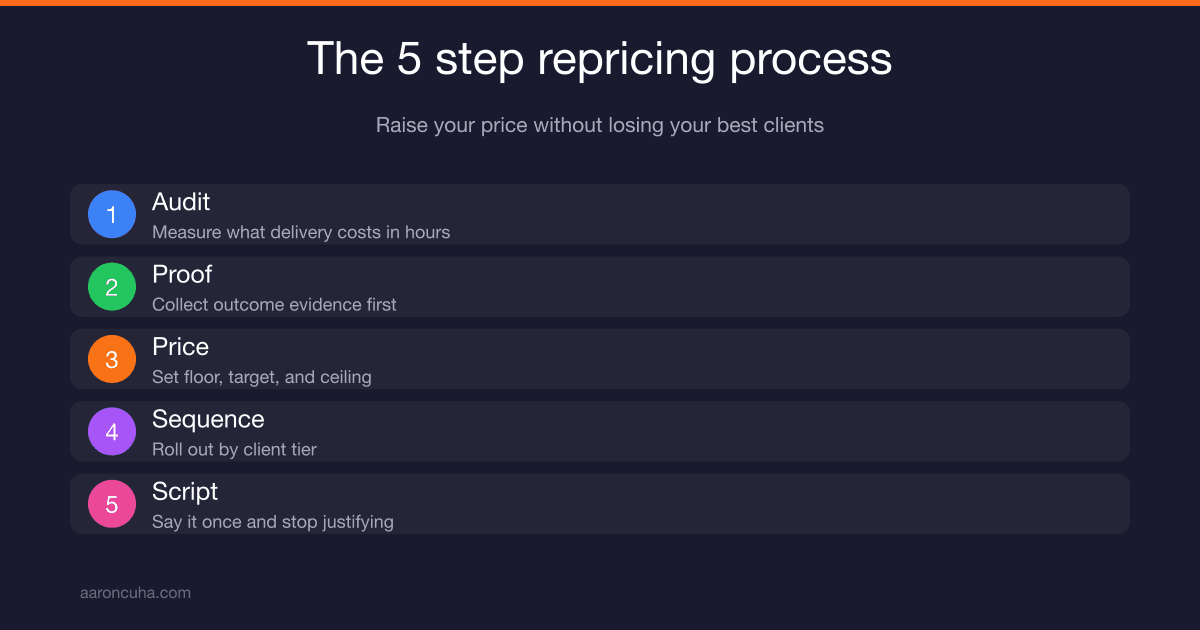
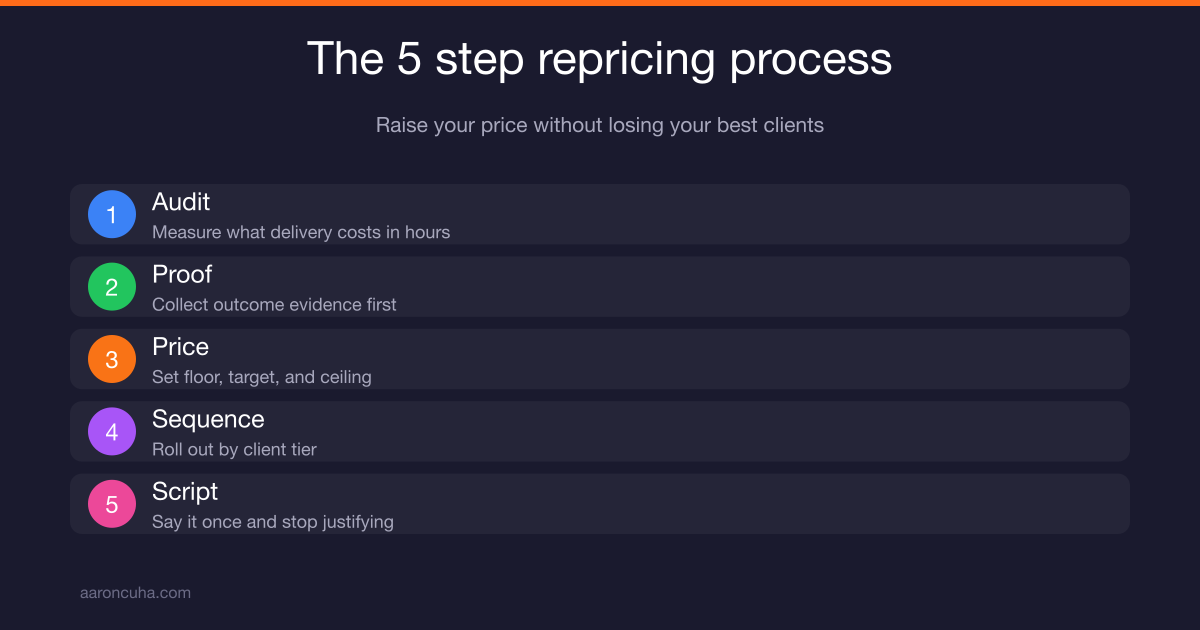
Here is how to raise your prices without losing your best clients: audit delivery cost, build proof of outcomes, set a floor and target and ceiling, sequence the rollout by client type, then deliver the conversation without apologizing.
Five steps. In order. Skipping any of them is why most price increases go sideways.
- Audit. Measure what delivery actually costs you in hours and attention.
- Proof. Collect the outcome evidence that makes the new price obvious.
- Price. Set three numbers, not one, and pick round over clever.
- Sequence. Roll out by client tier with clear notice windows.
- Script. Say it calmly, once, and stop justifying.
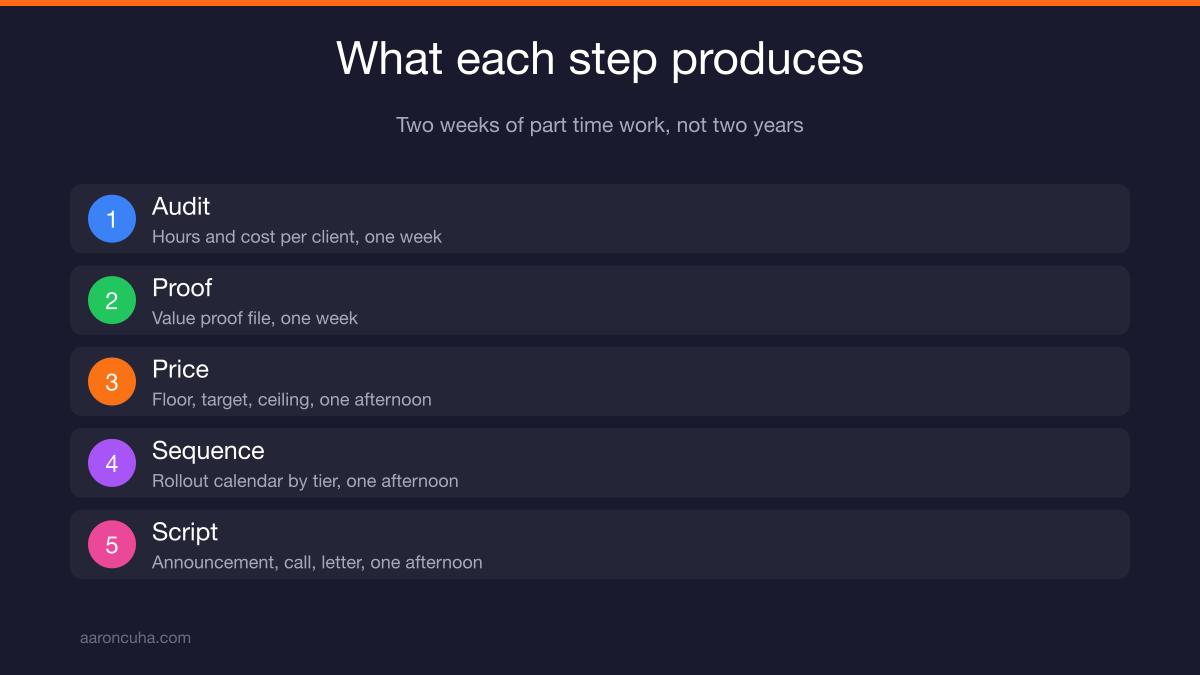
| Step | What you produce | Time to complete |
|---|---|---|
| 1. Audit | Hours and cost per client | One week |
| 2. Proof | Value proof file | One week |
| 3. Price | Floor, target, ceiling | One afternoon |
| 4. Sequence | Rollout calendar by tier | One afternoon |
| 5. Script | Announcement, call, letter | One afternoon |
You can finish the whole process in two weeks of part time work. Most owners spend two years thinking about it instead.
Step 1: Run the Delivery Audit Before You Touch the Number
Do not pick a new price until you know what the old one costs you. Track two weeks of delivery time per client, add your own hourly value, and find the accounts that are funding your overwork.
This is the least glamorous step and the one that changes the most minds. Owners who resist repricing usually cave the moment they see their own hours on paper.
Log this for every active client:
- Scheduled hours per month, including prep and follow up
- Unscheduled hours: texts, emails, quick calls, emergencies
- Team hours spent on that account
- Hard costs: software, contractors, materials, travel
- Number of scope items added since the original agreement
Then divide revenue by total hours. You now have a real rate per client, not the one on your website.
Your own costs have moved too, and you do not have to guess by how much. Pull the actual change from the Bureau of Labor Statistics Consumer Price Index and compare it to the last time you changed your rate.
The pattern is always the same. Your lowest paying clients consume the most unscheduled time. They ask more, worry more, and email more, because low price signals low stakes.
Mark every account with a status. Healthy, tight, or underwater. Underwater accounts are not clients. They are subsidies.
I have logged more than 20,000 hours of one-on-one coaching. The single most common thing I find in a delivery audit is a scope that grew by half while the invoice never moved once.
If your delivery load is the real problem, read how to stop being the bottleneck in your own business before you raise anything.
Step 2: Build the Value Proof File
A price increase without proof feels like a demand. A price increase with proof feels like a correction. Spend one week gathering outcome evidence before you announce anything.
Your value proof file is a single document. It is for you, not for the client, though pieces of it will show up in your conversations.
Put five things in it:
- Outcomes you can name. What changed for clients since they hired you. Use their words from your own session notes.
- Before and after snapshots. Where the client started, where they are now, in plain description.
- Delivery upgrades. Everything you added since you set the current price. New templates, faster turnaround, better reporting, added team support.
- Your own investment. Certifications, tools, training, systems you built that improved the work.
- Demand signals. Waitlist length, referral volume, inbound requests you turned down.
Read the file out loud when you are done. If you still feel guilty about the increase, you have not gathered enough. Go back and add more.
One caution. Never invent or inflate anything here. Use only what you can point to. A price increase built on a stretched claim collapses the first time a client tests it.
If you have been publishing content, your archive is proof too. A visible expert defends a higher number more easily than an invisible one, which is exactly why invisible leaders keep losing business.
Step 3: Set the New Price With a Floor, a Target, and a Ceiling
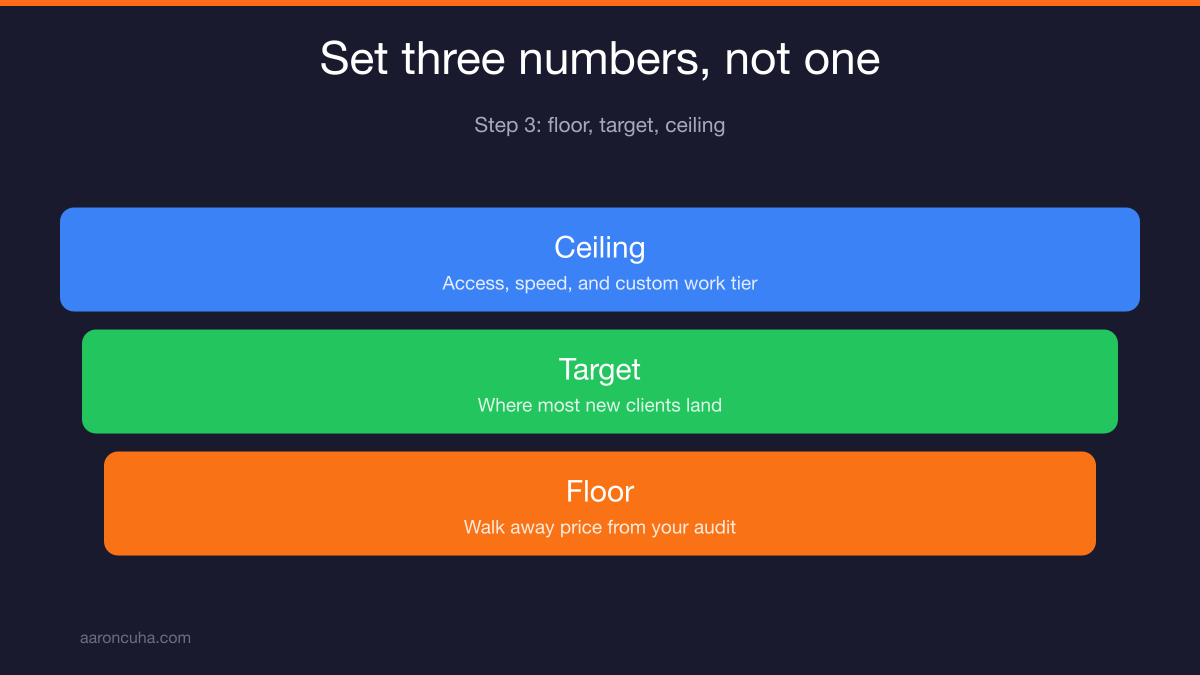
Set three numbers instead of one. The floor is your walk away price. The target is what you expect to get. The ceiling is what you charge your highest touch tier. Then pick round numbers.
Single-number pricing makes you brittle. When a client pushes, you either hold and feel rigid or drop and feel used. Three numbers give you room to negotiate scope instead of value.
The floor comes from your delivery audit. It is the number below which you would rather have the free time. If you would not enthusiastically take on a new client at that number, it is too low.
The target is where most new clients land. It should feel slightly uncomfortable to say out loud. That discomfort is a good signal, not a warning.
The ceiling serves clients who want access, speed, or custom work. Some people always buy the top option. If you do not build one, you leave that money on the table.
The research on value based pricing keeps landing in the same place. Small moves in price swing profit harder than equivalent moves in volume. The Harvard Business Review pricing archive is a useful place to test your assumptions before you commit to a number.
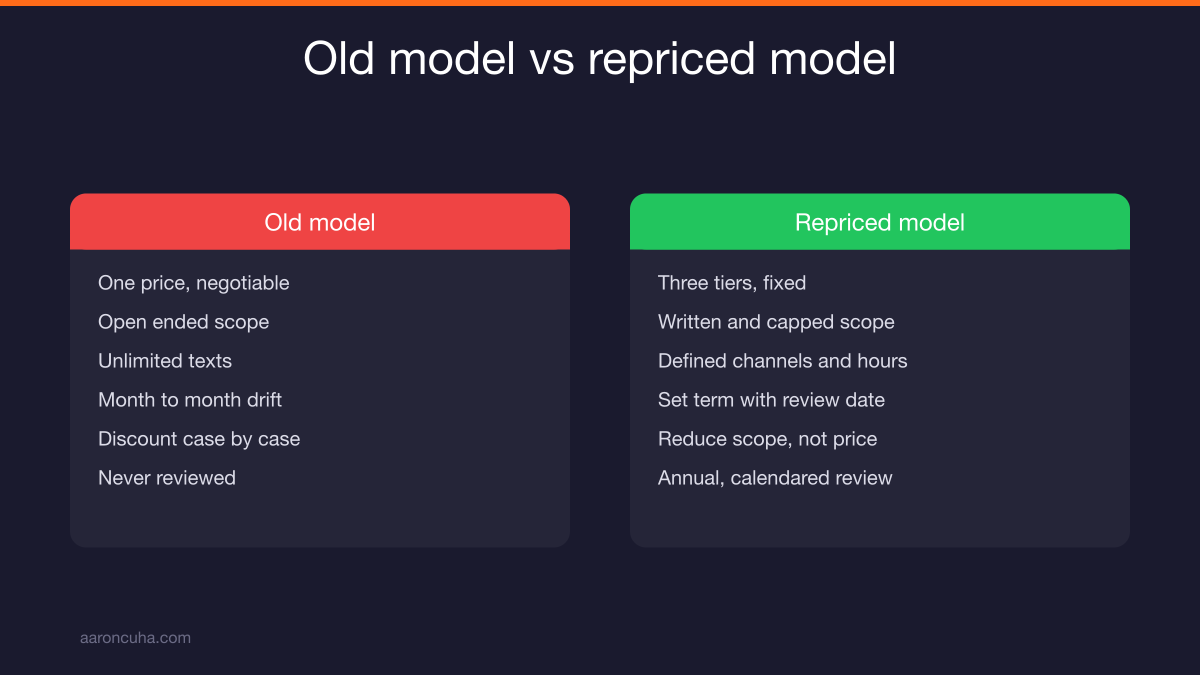
| Element | Old model | Repriced model |
|---|---|---|
| Structure | One price, negotiable | Three tiers, fixed |
| Scope | Open ended | Written and capped |
| Access | Unlimited texts | Defined channels and hours |
| Term | Month to month drift | Set term with review date |
| Discounting | Case by case | Scope reduction only |
| Review cadence | Never | Annual, calendared |
Now use round numbers. Clever pricing that ends in odd digits signals retail discounting. Round pricing signals professional judgment. You are not running a clearance rack.
One more rule. Never discount price. Discount scope. If someone cannot reach your target, remove something. That protects your rate and teaches the market what your work costs.
If you are still deciding who you serve, get that settled first with a coaching niche that actually pays. Niche and price move together.
Step 4: Sequence the Rollout So Nobody Feels Ambushed
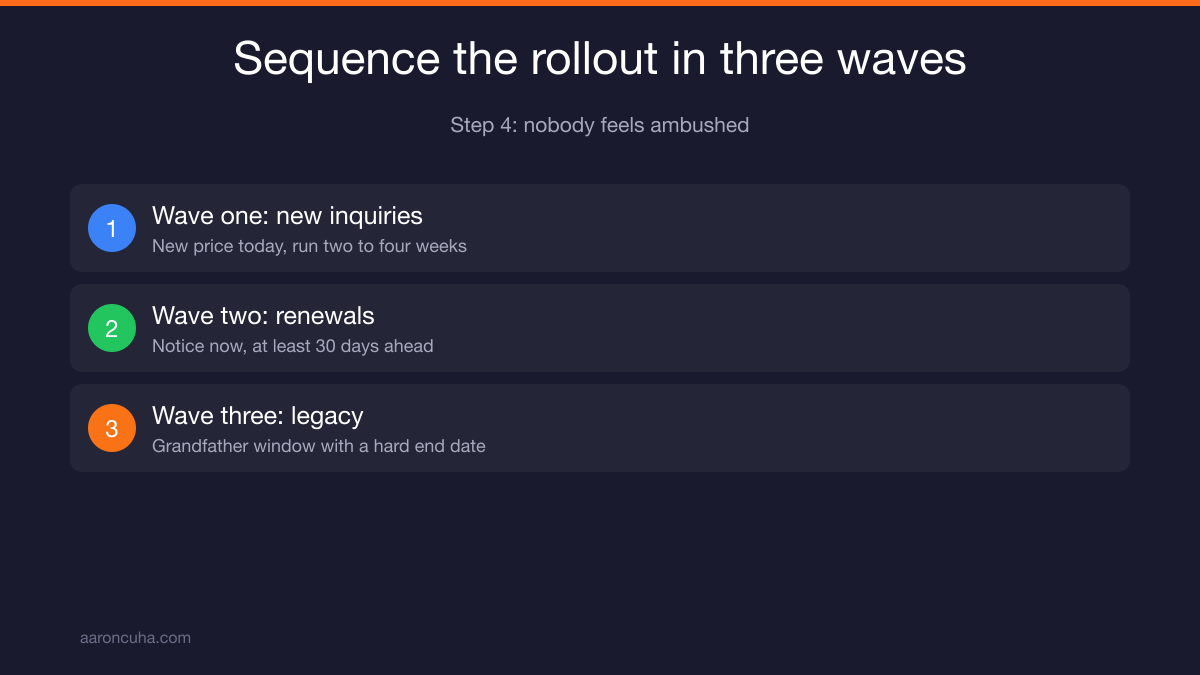
Roll out in three waves. New clients get the new price immediately. Renewals get it at their next term with notice. Legacy clients get a grandfather window with a hard end date.
Sequencing is where most owners panic. They imagine announcing to everyone at once and losing half the book on a Tuesday. That is not how this works.
Wave one: new inquiries. Starting today, every new prospect hears the new number. No exceptions, no old-price favors. This costs you nothing and gives you live data on how the market responds.
Run this for two to four weeks. You will close some at the new price. That evidence makes wave two much easier to deliver.
Wave two: renewals. Anyone whose term ends in the next 90 days gets notice now. Give at least 30 days, more if their planning cycle is long. The new price applies at renewal, not mid term.
Wave three: legacy clients. These are your longest relationships. Give them a grandfather window with a date attached. Six months is fair for most service businesses.
The word "date" matters. A grandfather clause without an end date is not a courtesy. It is a permanent discount you will resent.
Timing rules that reduce friction:
- Announce at the start of a month, not the end
- Avoid holiday weeks and your client industry's crunch season
- Never announce the same week you deliver bad news on a project
- Send written notice first, then be available for calls
Want help building the rollout and the delivery systems behind it? Start with a free channel and authority audit, or join the Systems Over Hustle community where owners work through exactly this.
Step 5: Deliver the Conversation Without Apologizing
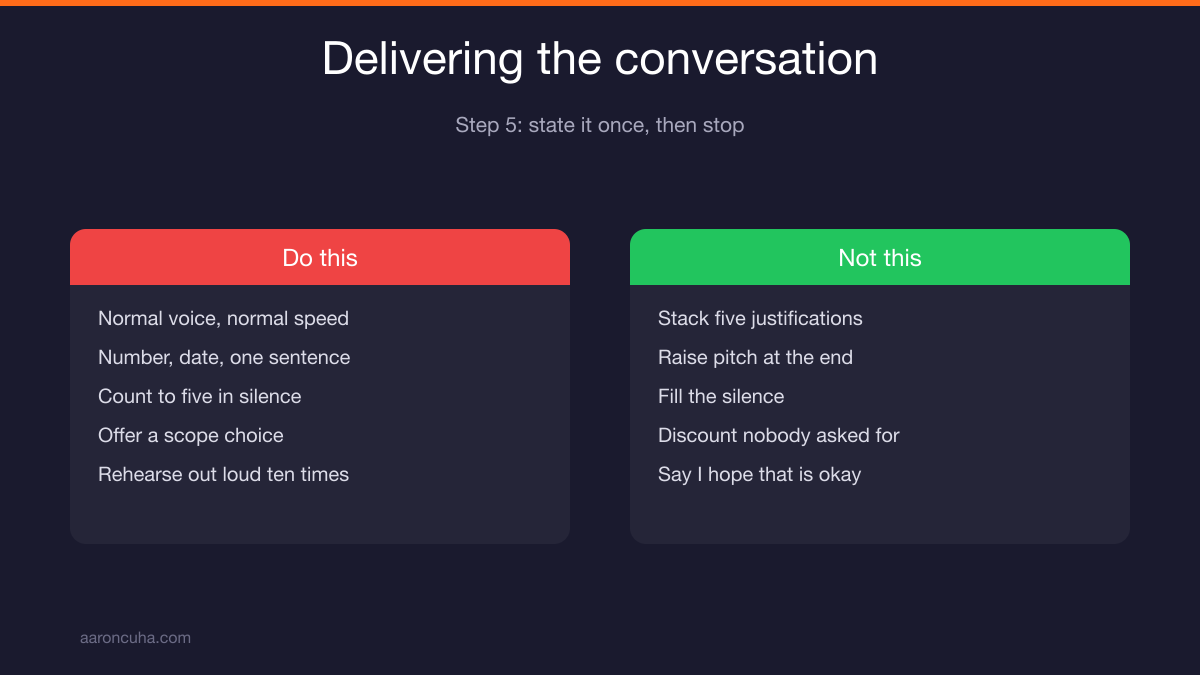
State the new price, the effective date, and one sentence of context. Then stop talking. Justification stacking is what turns a routine business update into a negotiation.
Most owners lose the increase in the delivery, not the decision. They pile on five reasons, and every extra reason sounds like an apology looking for permission.
The written announcement. Short. Three paragraphs maximum. Something like this structure:
- Paragraph one: thank them and name the relationship specifically.
- Paragraph two: state the new rate and the effective date. One line.
- Paragraph three: tell them what stays the same and how to reach you with questions.
That is your price increase letter to clients. No essays about inflation. No long list of upgrades. If they want detail, they will ask, and then your value proof file does the work.
The one-to-one call. Use it for your top accounts. Call before the letter lands so they never hear it secondhand.
Open with the outcome you have created together. Say the number. Give the date. Then pause and let them speak first.
Tone rules that hold under pressure:
- Say the number in a normal voice, at normal speed.
- Do not raise your pitch at the end. That turns a statement into a question.
- Do not fill silence. Count to five in your head.
- Do not offer a discount that nobody asked for.
- Never say "I hope that is okay."
Rehearse it out loud ten times before the first real call. Confidence here is not a personality trait. It is repetition.
The Three Responses You Will Hear and What to Say
You will hear three things: silence, a budget objection, or a comparison to someone cheaper. Acknowledge, restate the outcome, then offer a scope choice. Never defend the number itself.
Response 1: Silence. The client goes quiet after you say the number. This is the most common one and it feels the worst.
Do nothing. Silence is processing, not rejection. If you speak first, you will discount. Wait.
Response 2: "That is outside our budget." Acknowledge it, then move to scope. Say something like: "I understand. The rate reflects the full scope. If budget is the constraint, let us look at a smaller version that still gets you the core outcome."
Now you are designing an offer instead of defending a number. Completely different conversation.
Response 3: "I can get this cheaper elsewhere." Agree with them. They can. Say so.
Then restate the specific outcome you produce and let them choose. "You absolutely can. What you would be trading is the part that got you the result last year. I want you to make the choice with clear eyes either way."
Three rules for all three responses:
- Never argue. Arguing signals the price is arguable.
- Never compare yourself to a competitor by name.
- Never move the number in the same conversation where you announced it.
If someone needs time, give it. "Take a week. I will send the terms and we can talk Friday." Calm people get paid more.
The Clients You Should Be Willing to Lose
Decide your acceptable attrition before you announce, not after. If you know which accounts you are willing to release, no single cancellation can shake you into reversing the decision.
Here is illustrative arithmetic, not a claim about your business. Say you have ten clients and you raise your price by 20 percent. If two clients leave, you have eight paying 20 percent more, which is roughly 96 percent of your prior revenue with 20 percent fewer delivery hours.
Nearly the same money. Significantly more capacity. That freed capacity is where new business at the new price gets built.
Run that arithmetic with your own numbers before you send anything. Write down the number of departures you can absorb. Then commit to it in writing.
Criteria for accounts you should be willing to release:
- They consume the most unscheduled hours and pay the least
- They renegotiate every single agreement
- They ignore your recommendations, then blame the results
- They treat your team poorly
- They have never referred anyone and never will
- You feel a small dread when their name appears on your phone
Release them cleanly. Thank them, offer a referral to someone else, transition the work well, and close the file with respect. Your reputation is worth more than the last invoice.
Losing DirectLender taught me something about attachment. You can hold on to a structure so tightly that you stop asking whether it still works. Some clients are structures like that.
Make Price a System, Not an Act of Courage
If repricing requires courage every time, you will do it once and then avoid it for years. Put price on a calendar, guardrail your scope, and collect proof automatically.
This is the core of the Systems Over Hustle framework. Anything that depends on your emotional state on a given Tuesday is not a business process. It is a mood.
Build these four systems:
- Annual price review. Same month every year. It goes on the calendar as a recurring block. You review the audit, adjust, and notify. No debate about whether it is the right time.
- Scope guardrails. Every agreement lists what is included and what triggers a change order. Written scope is the cheapest price protection there is.
- Proof on autopilot. Ask one outcome question at the end of every engagement and file the answer. In a year you will have a proof library without any special effort.
- Renewal calendar. Every client has a review date. Nobody drifts on an old rate because nobody noticed.
Automation helps here. Intake forms, reminder sequences, and reporting can all run without you. Start with AI business systems that automate operations without losing control, and if you coach, look at AI automation built for coaching workflows.
For the tax and contract side of any pricing change, check the guidance at the U.S. Small Business Administration and confirm your agreement language with your own attorney.
Consumer facing businesses should also know the disclosure rules around pricing and fees. The FTC Business Guidance section is the plain language starting point.
Your First 90 Days at the New Price
Week one you audit. Week two you build proof. Week three you announce. Then you hold the line for the remaining eleven weeks without renegotiating with yourself.
Week 1: Audit week. Log delivery hours for every client. Calculate real rate per account. Mark healthy, tight, or underwater.
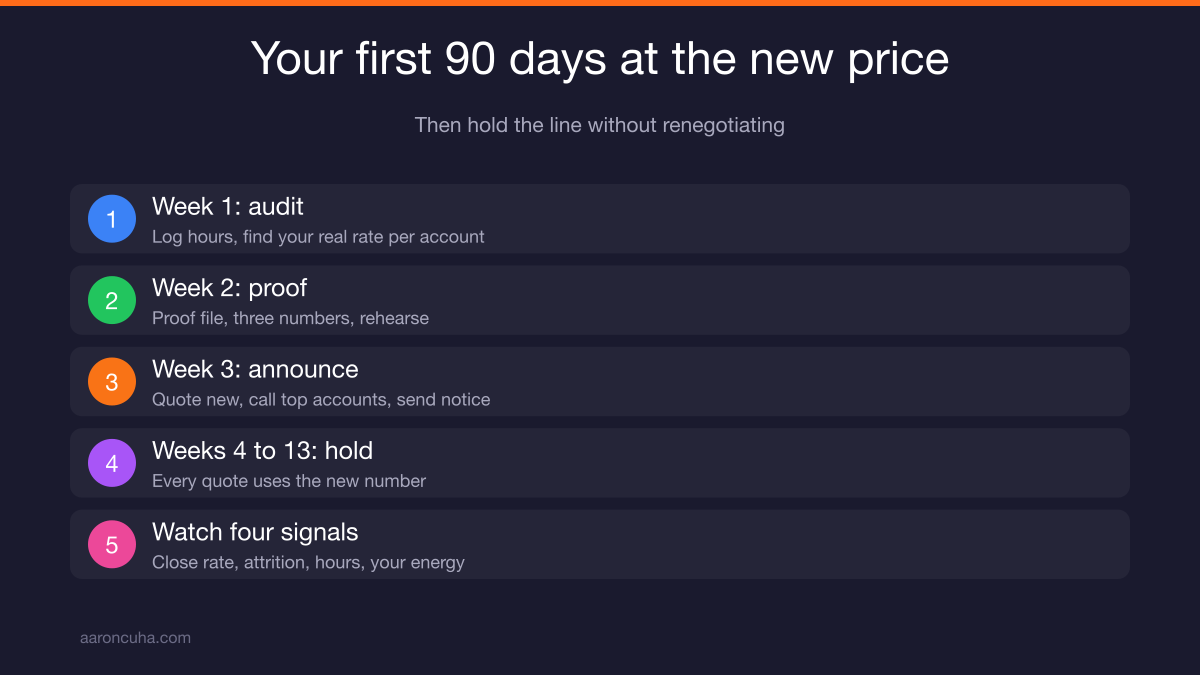
Week 2: Proof week. Build the value proof file. Set your floor, target, and ceiling. Draft the announcement letter and the call script. Rehearse out loud.
Week 3: Announcement week. Quote all new inquiries at the new price. Call your top accounts. Send written notice to renewals. Set grandfather end dates for legacy clients.
Weeks 4 through 13: Hold week. The only job is consistency. Every quote uses the new number. Every request outside scope gets a change order.
Watch these four things:
- Close rate on new inquiries. If it drops slightly, that is normal. If it goes to zero, your proof is thin, not your price.
- Actual attrition versus your predicted number. Compare it to what you wrote down in advance.
- Delivery hours per client. They should fall as scope tightens.
- Your own energy. Better priced work makes you a better practitioner.
Protect delivery quality above everything in these 90 days. A higher price with the same service is a promise you did not keep. Add one visible improvement in month one so clients feel the upgrade.
Then keep building demand so the price holds on its own. Owners with an audience negotiate less, which is the whole argument in how to become a thought leader in your industry and in my book Crazy Simple YouTube.
Ready to make this permanent instead of a one time act of nerve? Grab the free systems and templates library, or bring your numbers to executive coaching and we will build the pricing system, the scripts, and the rollout calendar together.
Frequently Asked Questions

Written by
Aaron CuhaAuthor of Crazy Simple YouTube, keynote speaker, and executive coach with 20,000+ hours logged. ICF PCC, NLP Master Practitioner, and DISC Certified. Aaron helps entrepreneurs replace hustle with AI-powered systems that generate leads, content, and revenue on autopilot.