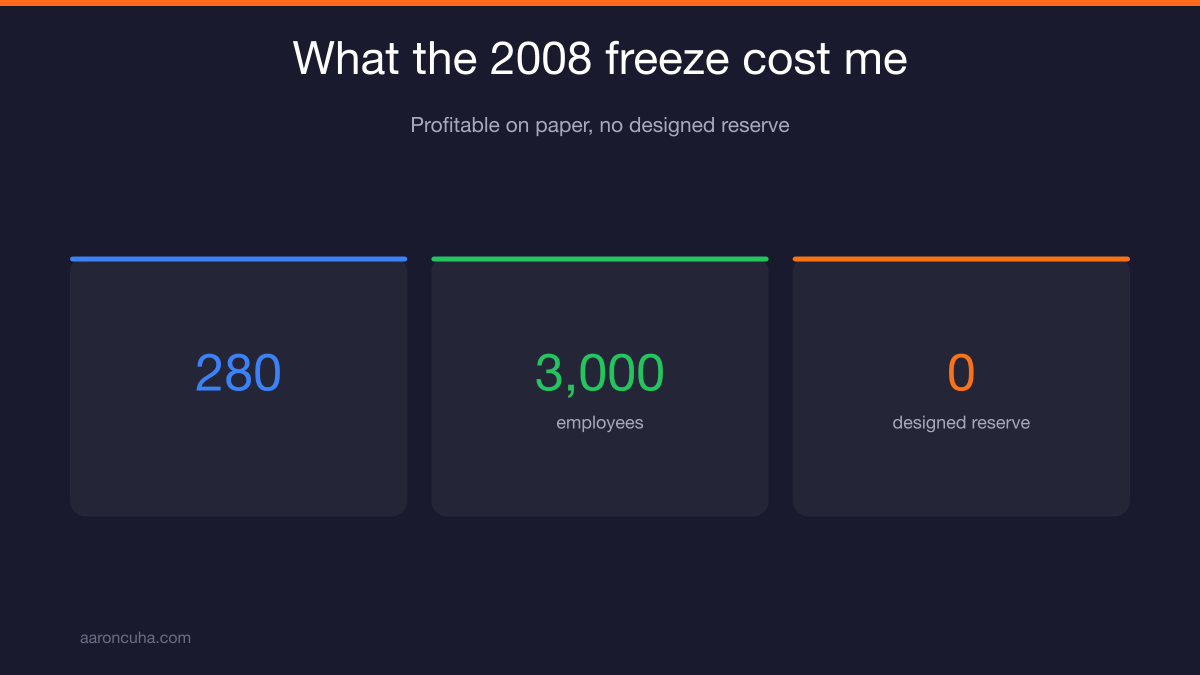
Most owners treat their small business cash reserve as whatever is left over at the end of the month. I ran a lender with 280 offices and 3,000 employees and lost it in 2008. Here are the three buffers I now require, and how to size each one from your real numbers.
I ran a lender with 280 offices and 3,000 employees. We were profitable on paper. Then credit froze, and I learned what a real cash reserve is for.
Key Takeaways
- Build three separate buffers: operating, shock, and opportunity.
- Size your operating buffer in payroll cycles, not vague months.
- Size your shock buffer to fixed obligations only, not total spend.
- Sweep a fixed percentage of every deposit the day it lands.
- Write trigger rules before you need them, not during the panic.
A small business cash reserve is not the money left over at the end of a good month. It is a designed number you fund on purpose, before you pay yourself, because your future self is a creditor you have not met yet.
Here is the system I use with every owner I coach.
Ready to build the operating systems that protect what you have built? Start with the Systems Over Hustle community and get the frameworks I teach my private clients.
What Losing 280 Offices Taught Me About Cash
My company did not die because we were unprofitable. It died because credit disappeared faster than our cash could cover the gap. We had growth, revenue, and no designed reserve.
When you scale fast, cash flows in and right back out. Payroll, leases, licensing, technology, marketing. Every dollar has a job before it arrives.
That feels efficient. It is actually fragile.
In 2008, the lending market did not slow down. It stopped. Warehouse lines vanished. Buyers for loans vanished. Our receivables were real, but they were not liquid, and liquidity is the only thing that matters when the music stops.
I had built an income statement. I had not built a balance sheet defense.
The Federal Reserve has written extensively about how quickly credit conditions tightened that year. I lived it from the inside. What I remember most is how normal everything looked right up until it did not.
Then I spent a decade doing humanitarian work in Nepal, which is a different kind of education in what happens when systems have no slack in them.
Now I coach owners on the thing I did not have. Not a savings account. A system.
Why "Whatever Is Left Over" Is Not a Reserve
Leftover cash never becomes a reserve because there is always something more urgent. A reserve only grows when you treat it as a bill you owe yourself and pay it first.
Most owners I coach describe their reserve the same way. "We keep a cushion." Ask for the number and the answer is a shrug.
That is not a reserve. That is a mood.
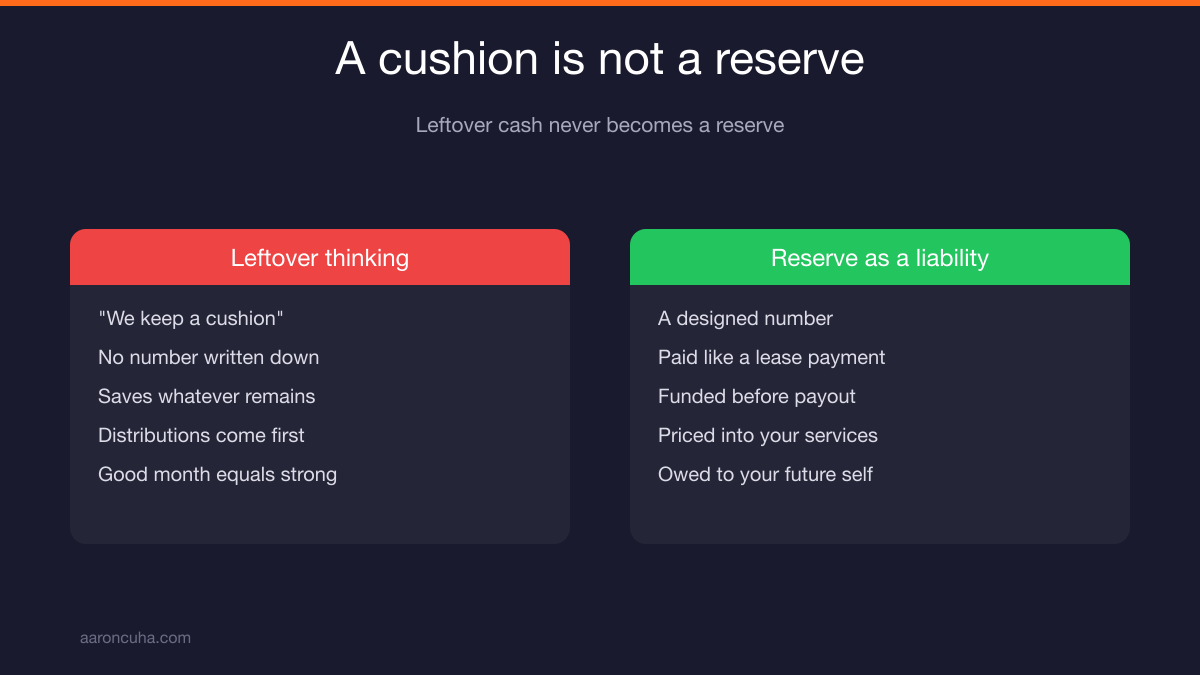
Here is the reframe that changes behavior. Your reserve is a liability, not an asset. You owe it to the version of your business that exists during the next disruption.
You would never skip a lease payment because the month was tight. Fund your reserve with the same discipline.
Three things happen when you make that switch:
- You stop asking "can I afford to save" and start asking "what has to change so I can."
- You price your services against your real cost of operation, including the reserve line.
- You stop confusing a good month with a strong business.
Profit distributions come after the reserve is funded. Not before. That single ordering rule separates businesses that survive shocks from businesses that get surprised by them.
This is the same logic behind Systems Over Hustle. Effort is not the constraint. Design is.
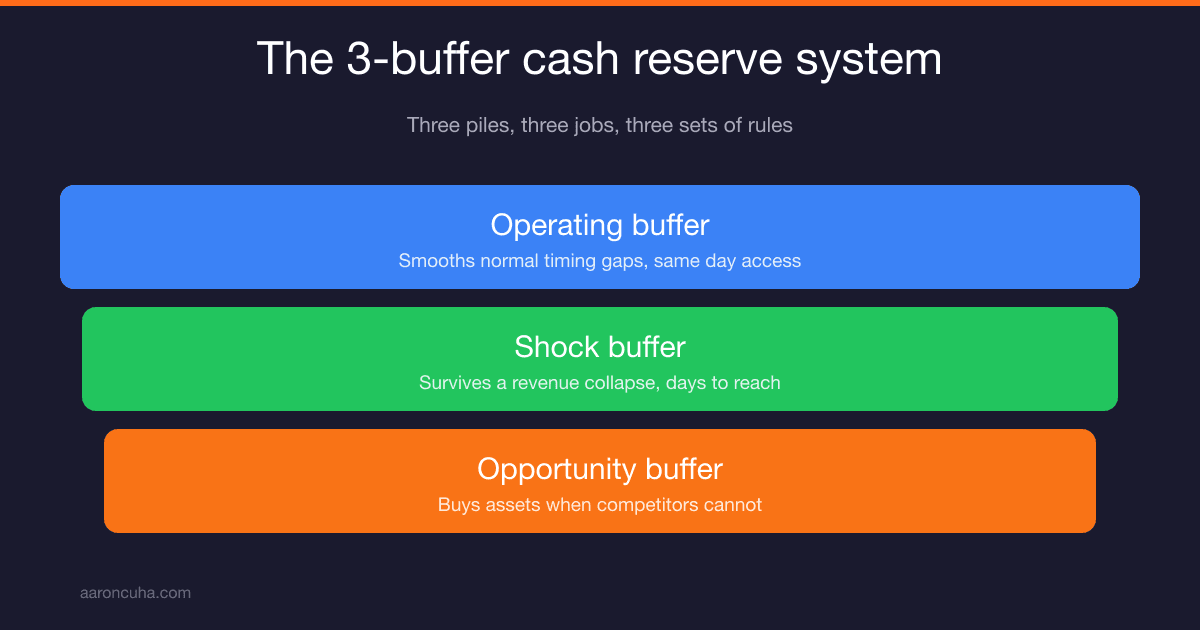
The 3-Buffer Small Business Cash Reserve System
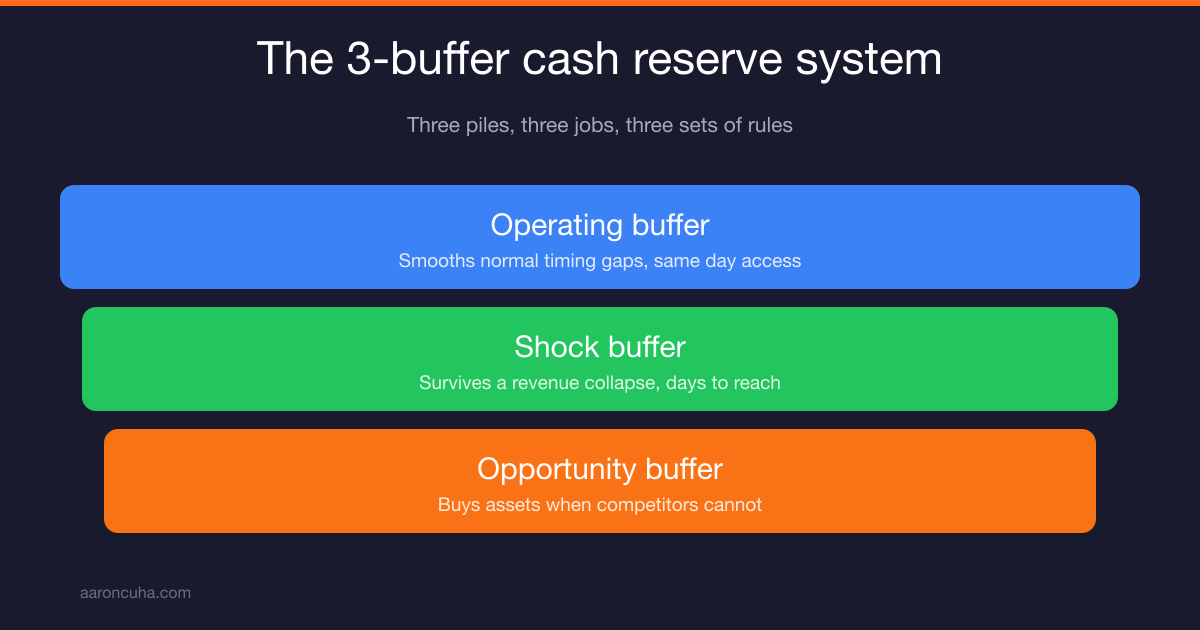
One pile of cash tries to do three jobs and does none of them well. Split your small business cash reserve into an operating buffer, a shock buffer, and an opportunity buffer, each with its own size, location, and rules.
Different jobs need different access speeds. Your payroll buffer has to move today. Your opportunity buffer can sit for two years and should.
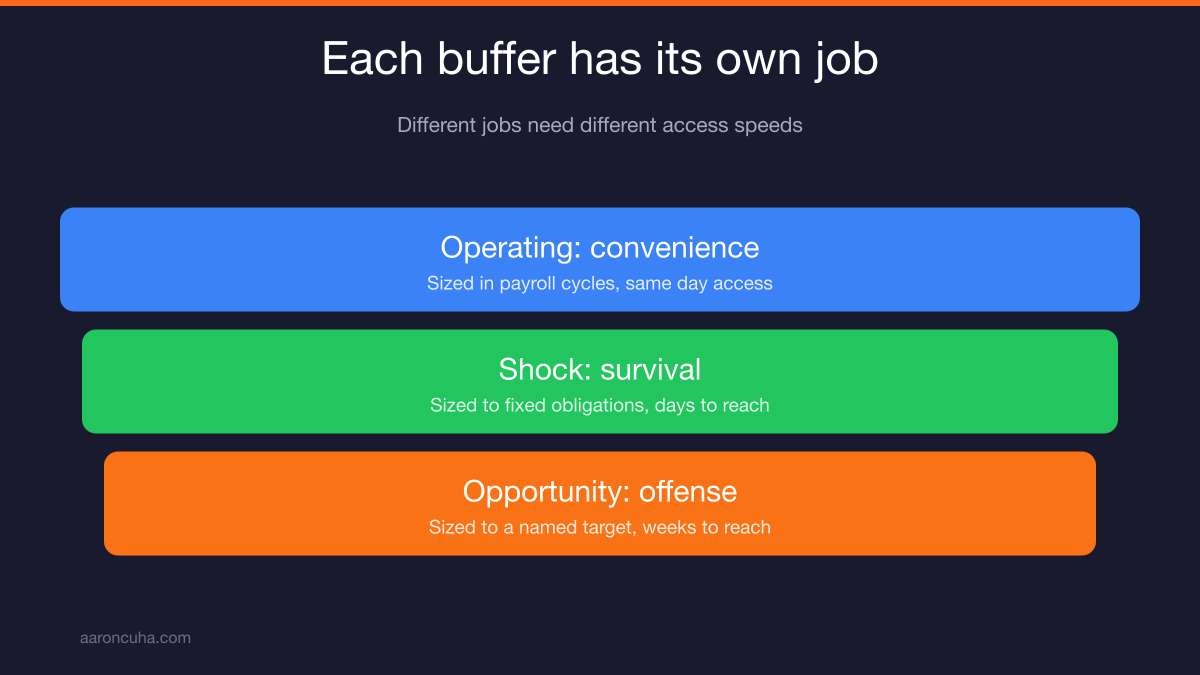
| Buffer | Purpose | How It Is Sized | Where It Lives | Access Speed |
|---|---|---|---|---|
| Operating | Smooth normal timing gaps | Payroll cycles | Checking or linked savings | Same day |
| Shock | Survive a revenue collapse | Fixed obligations only | Money market or short Treasuries | Days |
| Opportunity | Buy when others sell | A named target | Slightly longer instruments | Weeks |
Notice that only the first buffer is about convenience. The second is about survival. The third is about offense.
Most owners have a partial version of the first one and nothing else. That is the gap I want to close today.
Each buffer gets its own account. Separate accounts are not accounting theater. Physical separation is what stops mental borrowing.
Step 1: Separate Fixed Obligations From Variable Spend
Pull twelve months of expenses and sort every line into fixed, semi-fixed, or variable. Every buffer calculation depends on this one sort, so do it before you calculate anything.
Do not estimate. Export the real data from your accounting software.
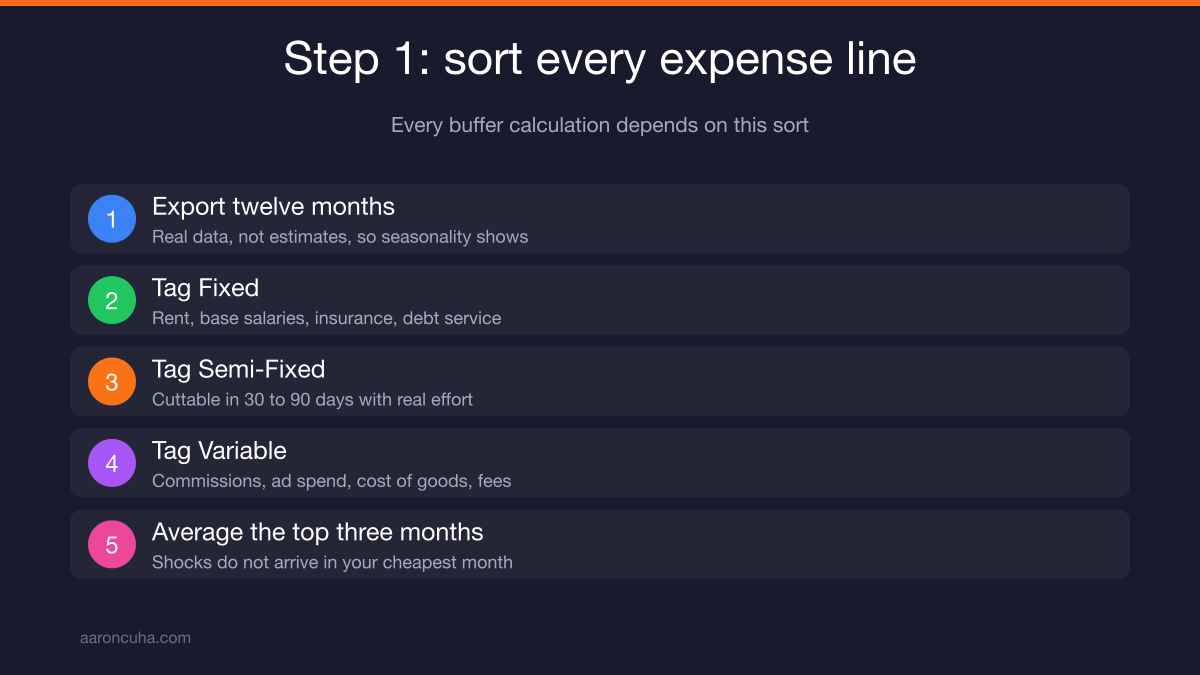
Here is the process:
- Export twelve months of expense detail to a spreadsheet. Twelve months, not three, so seasonality shows up.
- Tag every line as Fixed, Semi-Fixed, or Variable.
- Fixed means it hits whether or not you sell anything. Rent, base salaries, insurance, debt service, core software, licensing.
- Semi-Fixed means you could cut it in thirty to ninety days with real effort. Contractor retainers, some tooling, non-core subscriptions.
- Variable means it scales with volume. Commissions, ad spend, cost of goods, transaction fees.
- Total each category monthly and take the average of your three highest months, not the mean of all twelve.
Use the high three because shocks do not politely arrive during your cheapest month.
This sort surprises people. Owners consistently underestimate how much of their spend is truly fixed. Software creep and headcount creep are quiet.
If the sort itself feels overwhelming, that is a delegation problem, not a finance problem. Here is how to delegate as an entrepreneur without losing control of the numbers.
Step 2: Size the Operating Buffer in Payroll Cycles
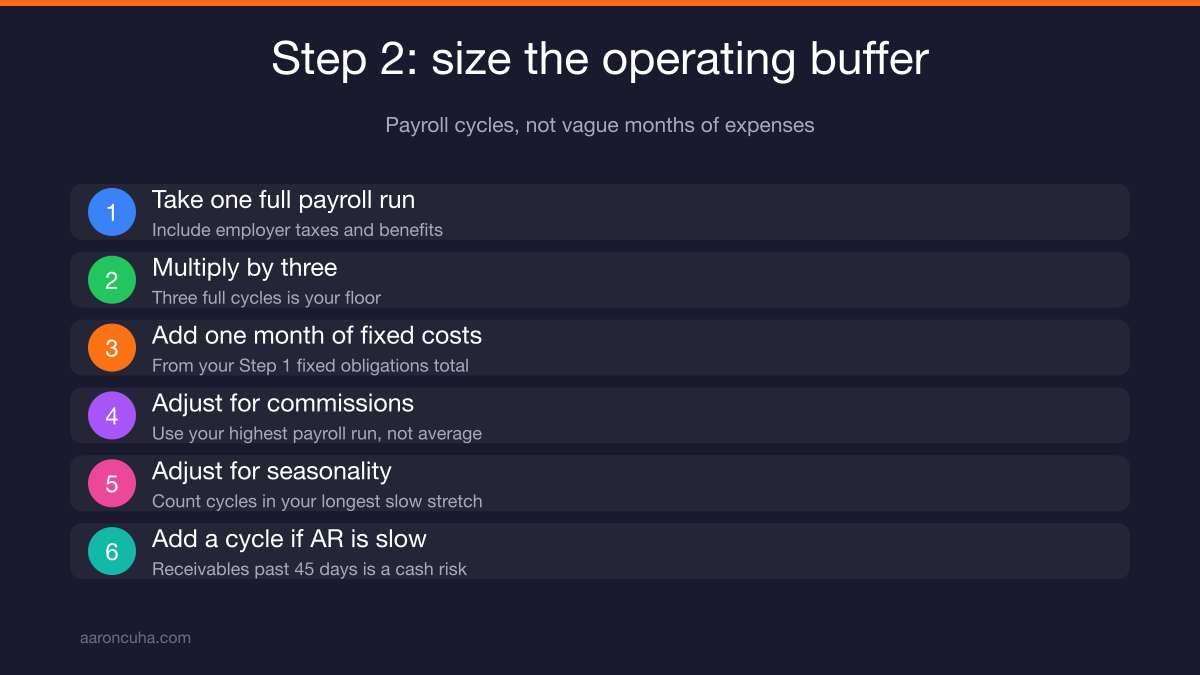
Measure your operating buffer in payroll cycles, not months of expenses. Minimum three full cycles of payroll plus payroll taxes, sitting in cash you can move the same day.
Why payroll cycles? Because payroll is the obligation that ends your business fastest when you miss it.
Vendors will wait. Landlords will negotiate. Your team will leave, and they should.
The calculation:
- Take one full payroll run including employer taxes and benefits.
- Multiply by three. That is your floor.
- Add your average monthly fixed obligations from Step 1, one month's worth.
- That total is your operating buffer target.
Adjust up in three situations. If your team is heavily commissioned, your payroll swings hard in good months, so use your highest payroll run, not your average.
If you are seasonal, count the payroll cycles inside your longest slow stretch and use that number instead of three.
If your receivables run past forty five days, add one more cycle. Slow collection is a cash risk even when sales are strong.
Most owners between 250K and 10M in revenue land somewhere between three and six cycles. Pick your number, write it down, and stop guessing.
Step 3: Size the Shock Buffer to Fixed Obligations Only
Your shock buffer covers three to six months of fixed obligations only, not total expenses. It answers one question: what does a stripped down version of this business cost to keep alive?
This is the buffer I did not have.

People size reserves against total expenses and then decide the number is impossible, so they save nothing. Sizing against fixed obligations makes the target achievable and more accurate.
In a genuine shock, variable spend collapses with revenue. Ad spend stops. Commissions stop. Cost of goods stops.
What does not stop is rent, base salaries, insurance, and debt service. Those are the numbers to defend.
Push toward six months if any of these are true:
- You carry meaningful debt with fixed monthly service.
- Your revenue depends on a market that can freeze, like credit, construction, or real estate transactions.
- Three or fewer clients make up most of your revenue.
- You have long lease commitments you cannot exit.
- Your sales cycle runs longer than ninety days.
Three months is the floor for a business with diversified revenue, no debt, and short leases. That is a small club.
The U.S. Small Business Administration publishes solid guidance on cash flow planning and disaster preparedness if you want a second reference point.
Want a set of eyes on how your business is actually structured? Book an executive coaching conversation and we will pressure test your numbers together.
Step 4: Fund the Opportunity Buffer So You Can Buy in a Downturn
The opportunity buffer is the offensive one. It is sized to a named target you actually want to buy, not to a formula, and it exists so you can move when competitors cannot.
Every downturn transfers assets. Someone sells a book of business at a discount. Someone's best producer becomes available. Equipment goes to auction.

In 2008, I watched buyers with cash acquire in weeks what took a decade to build. I was not one of them. I want you to be.
Size this one differently. Write down the specific thing you would buy at the right price:
- A competitor's client list or book of business.
- A senior hire you cannot currently justify but would take instantly at a discount.
- Equipment or property that only becomes cheap under stress.
- Twelve months of runway for a new product line.
Estimate the cash portion of that acquisition. That is your target. It is a real number attached to a real ambition, which makes it far easier to fund than an abstract percentage.
Three rules protect it. The opportunity buffer may not fund payroll gaps, may not fund normal growth, and may not fund your own optimism.
Normal growth comes from operating profit. If growth requires the opportunity buffer, the growth is not funded, it is gambled.
Where to Hold Each Buffer
Access speed determines account type. Operating cash sits in checking or linked savings, shock cash sits in a money market or short Treasuries, and opportunity cash can sit in slightly longer instruments.
The point is friction. You want your shock buffer to take a few days to reach.
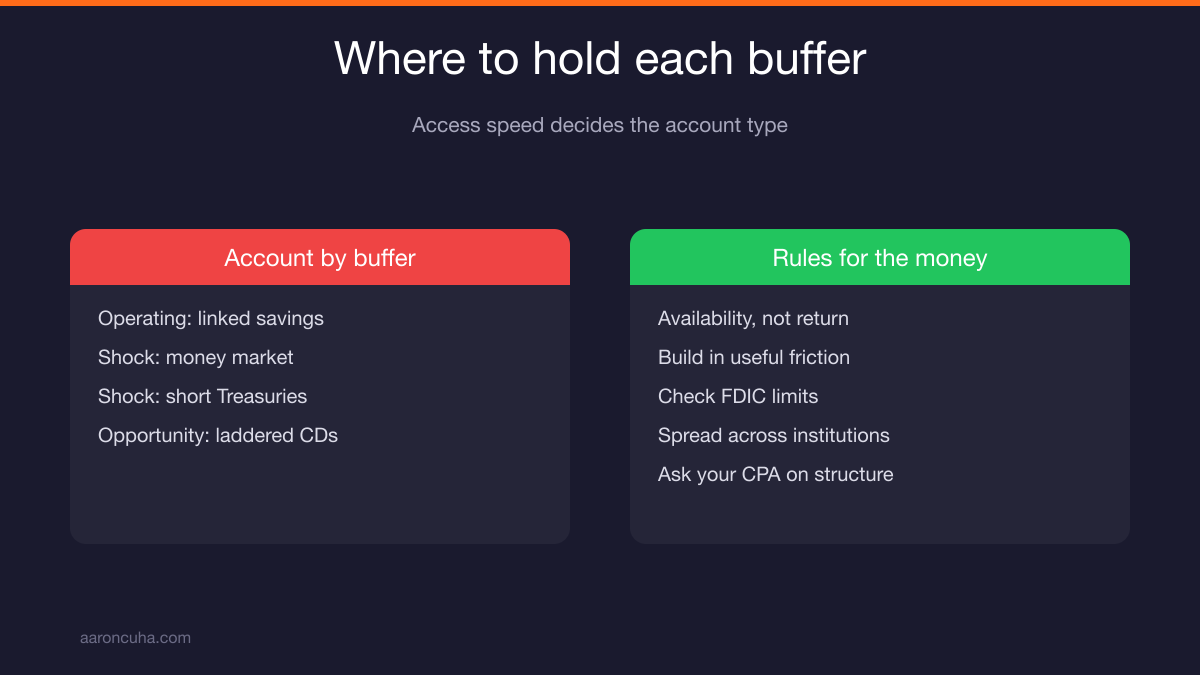
| Buffer | Account Type | Why |
|---|---|---|
| Operating | Business savings linked to checking | Same day transfer, visible daily |
| Shock | Money market or short term Treasuries | Yield plus useful friction |
| Opportunity | Laddered short Treasuries or CDs | Better yield, planned availability |
Two practical notes.
First, check FDIC coverage limits per depositor per institution. If your reserve exceeds the limit, spread it across institutions or use a sweep product that does it for you.
Second, you can buy Treasuries directly through TreasuryDirect. Talk to your CPA about which structure fits your entity.
Do not chase yield with reserve money. The job of this cash is availability, not return. If it can drop 20 percent in the exact month you need it, it is not a reserve.
The Sweep Rule: How to Actually Fund It
Sweep a fixed percentage of every deposit into your reserve accounts the day the money lands. Automatic, before anything else, in the same way payroll taxes get set aside.
Monthly saving fails because by month end the money is gone. Daily sweeping works because you never see it as spendable.
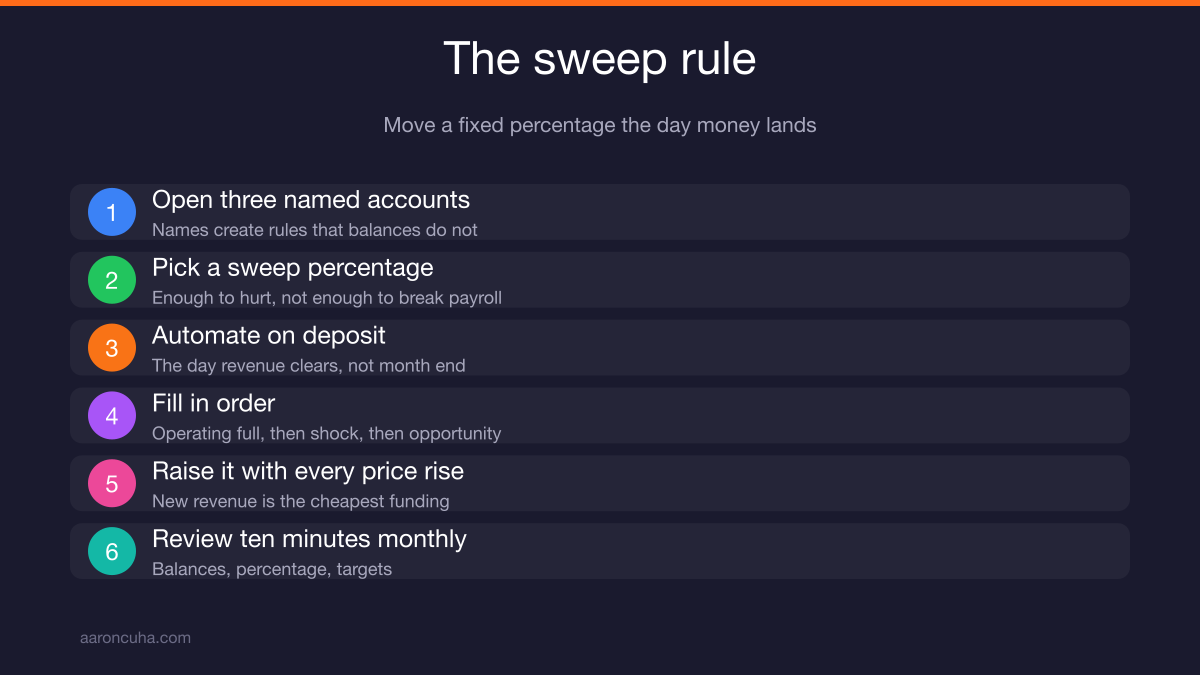
The funding system:
- Open three named accounts. Label them Operating Buffer, Shock Buffer, Opportunity Buffer. Names matter because names create rules.
- Pick a sweep percentage. Start where it hurts a little but does not break payroll. Many owners start low and raise it every quarter.
- Automate the transfer the day revenue clears, not on a monthly schedule.
- Fill in order. Operating buffer to full first. Then shock buffer to full. Then opportunity buffer, which is never really full.
- Raise the percentage every time you raise prices or land a retainer. New revenue is the cheapest reserve funding you will ever get.
- Review monthly for ten minutes. Balances, percentage, targets.
If margins are too thin to sweep anything, you do not have a savings problem. You have a pricing or cost problem, and the reserve exercise just exposed it.
That is useful information. Most owners I coach discover the reserve math forces a pricing conversation they have avoided for years.
Sequence matters here too. Fund the operating buffer completely before you start the shock buffer. A half funded buffer in three places protects nothing.
Trigger Rules: When You Are Allowed to Touch Each Buffer
Write the withdrawal rules before you need them. Each buffer gets written conditions, a refill deadline, and for the shock buffer, a mandatory cost reduction plan in the same week.
Without rules, reserves leak. Slowly, reasonably, one justified withdrawal at a time.
Operating buffer triggers. Use it for timing gaps only, meaning a client paid late or a receivable slipped a cycle. Refill within sixty days. If you draw on it three months in a row, it is not a timing problem, it is a revenue problem.
Shock buffer triggers. Use it only when revenue drops materially and the drop looks structural rather than seasonal. Any draw requires a written cost reduction plan within seven days, covering what gets cut at 30, 60, and 90 days.
That rule exists so the buffer buys you decision time instead of denial time. A shock buffer without a cut plan just funds a slower death.
Opportunity buffer triggers. Use it only for an asset purchase you can describe in one sentence with a price. Never for payroll. Never for a marketing experiment. Refill from operating profit on a written schedule.
Put all of this in one page. Sign it. Share it with your bookkeeper and your second in command so it is not just your memory.
Rules you have not written down are preferences, and preferences bend under pressure.
The Quarterly Reserve Review
Block thirty minutes every quarter to recalculate targets, check your sweep percentage, and confirm balances. Your reserve targets move every time your fixed costs move.
New hire? Target moves. New lease? Target moves. New equipment loan? Target moves.
The agenda, in order:
- Re-run the fixed obligations total from Step 1.
- Recalculate the operating buffer in current payroll cycles.
- Recalculate the shock buffer at your chosen month count.
- Confirm every balance and note the gap to target.
- Decide whether the sweep percentage goes up.
- Review any withdrawals and whether refill deadlines were met.
Thirty minutes. Four times a year. That is two hours annually to make your business considerably harder to kill.
This belongs in your operating rhythm alongside your other recurring reviews. If you are building that rhythm from scratch, the same discipline applies to content systems for entrepreneurs, where consistency beats intensity every time.
Five Mistakes I See Owners Make With Reserves
The most common failures are treating a line of credit as a reserve, sizing to total expenses, holding reserves in the operating account, raiding reserves for growth, and never writing the rules down.
Take them one at a time.
1. Confusing a line of credit with a reserve. A line of credit is someone else's promise, and promises get withdrawn in exactly the conditions you need them. I watched credit lines disappear in 2008 from institutions that had been partners for years. Cash you hold is the only cash you control.
2. Sizing to total expenses. The number looks impossible, so owners quit before starting. Size the shock buffer to fixed obligations only and the target becomes real.
3. Keeping it in the operating account. A balance you see every day is a balance you will spend. Separate accounts at a separate institution create the friction that protects the money.
4. Raiding reserves for growth. Growth funded by reserves is growth with no downside protection. If the hire or the campaign does not work, you have lost the expansion and the defense in one move.
5. Never writing the rules down. Unwritten rules bend under pressure, and pressure is precisely when you will be making the decision. One page, signed, shared.
There is a sixth I should mention. Some owners build the reserve and then never revisit the target as the business grows, so a buffer sized for a five person team quietly stops covering a twelve person team.
Your First 60 Minutes
You can set every buffer target today. Export twelve months of expenses, sort them, calculate three numbers, open the accounts, and set the sweep percentage.
Here is the hour, broken into blocks:
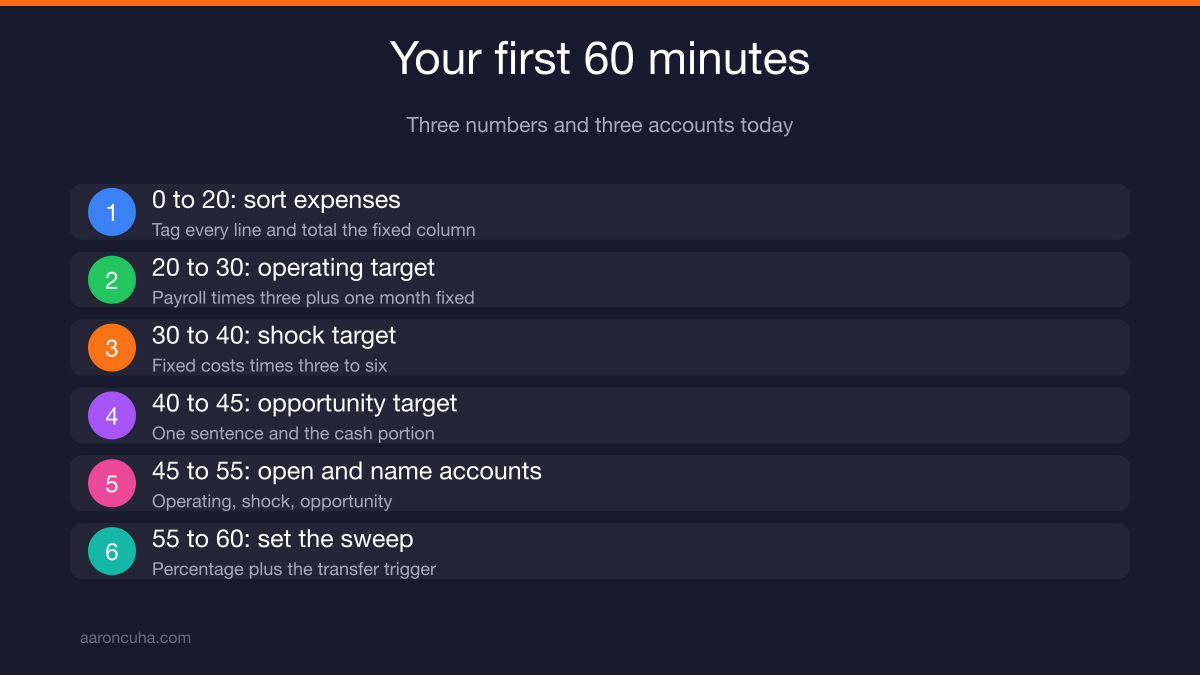
- Minutes 0 to 20. Export twelve months of expense detail. Tag each line Fixed, Semi-Fixed, or Variable. Total the fixed column.
- Minutes 20 to 30. Pull one full payroll run including taxes. Multiply by three. Add one month of fixed obligations. That is your operating buffer target.
- Minutes 30 to 40. Multiply monthly fixed obligations by three, four, five, or six depending on your risk factors. That is your shock buffer target.
- Minutes 40 to 45. Write one sentence describing what you would buy in a downturn and what the cash portion costs. That is your opportunity buffer target.
- Minutes 45 to 55. Open the accounts online and name them.
- Minutes 55 to 60. Set the automatic sweep percentage and the transfer trigger.
You now have three numbers you did not have this morning, and three accounts pointed at them.
The gap between your target and your balance might be large. That is fine. Knowing the number is most of the work, because you cannot close a gap you have never measured.
I built a company with 280 offices and lost it because I optimized for growth and never designed the defense. The reserve system in this post is what I would have done differently, and it is what I require of every business I coach now.
Money is one system. Attention is another. If you want the full operating approach behind both, read why working harder is not the answer or grab the templates on the free resources page.
If you want help building the financial and operating systems that make your business hard to kill, reach out and tell me where you are stuck. I will tell you honestly whether coaching is the right next step.
Frequently Asked Questions

Written by
Aaron CuhaAuthor of Crazy Simple YouTube, keynote speaker, and executive coach with 20,000+ hours logged. ICF PCC, NLP Master Practitioner, and DISC Certified. Aaron helps entrepreneurs replace hustle with AI-powered systems that generate leads, content, and revenue on autopilot.