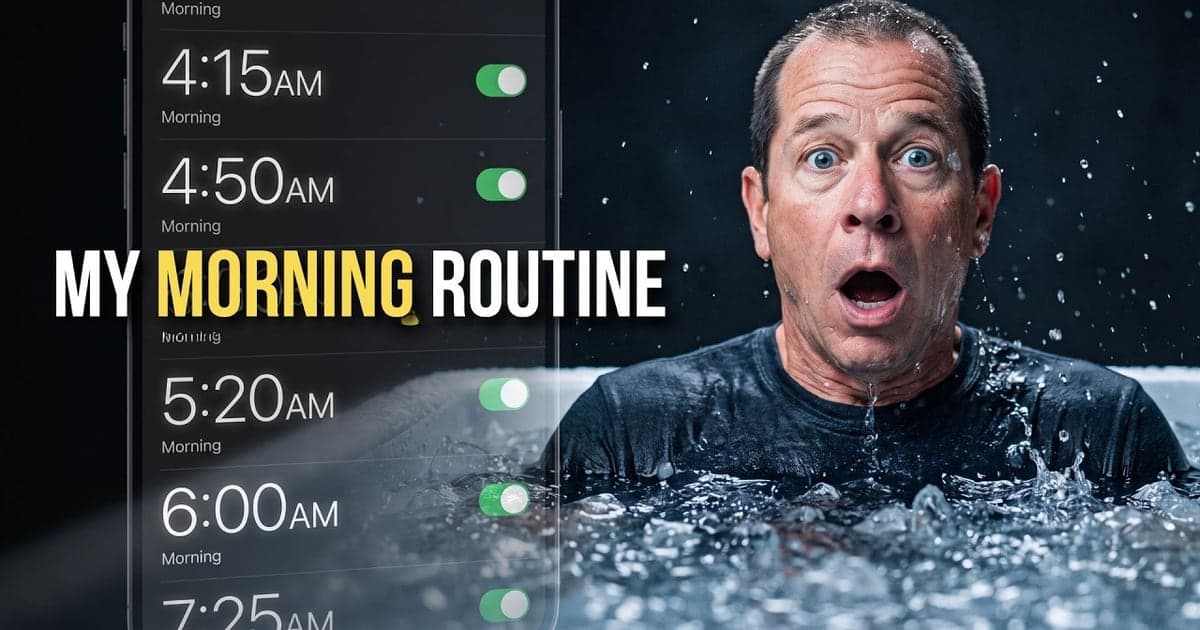
Most morning routine advice online is incomplete or invented. This is my actual science-backed morning routine, block by block, from 3:45 AM to my first coaching call at 6:00 AM. Every step has a physiological reason and an order that matters.
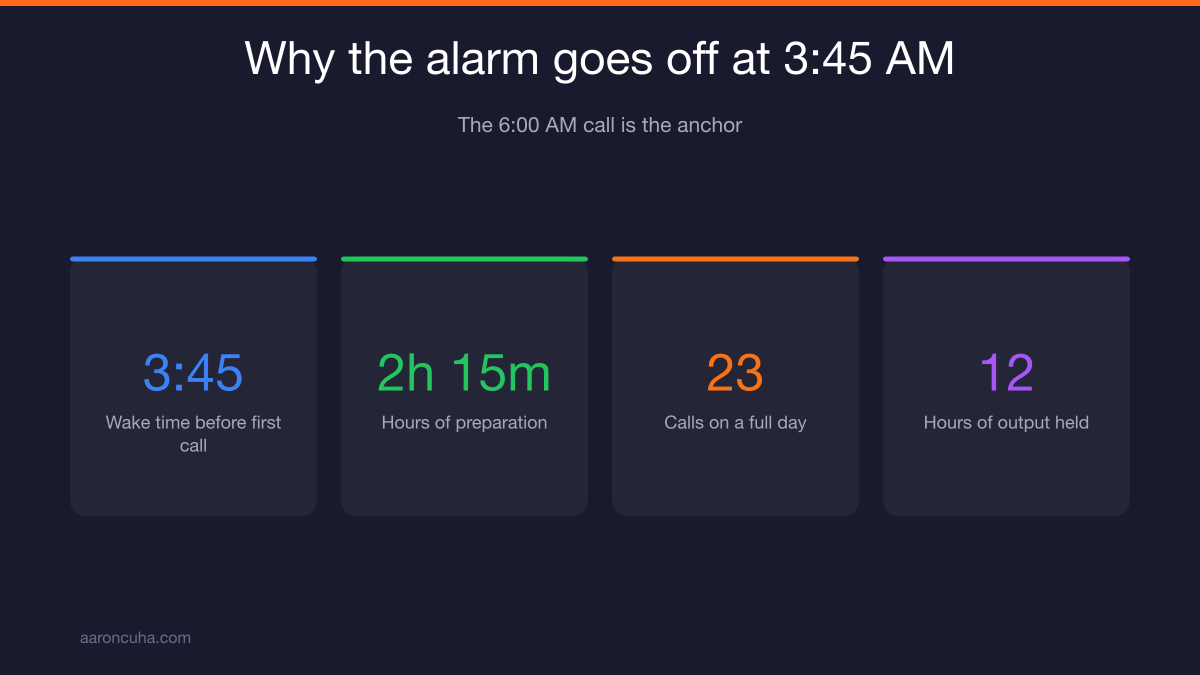
My alarm goes off at 3:45 AM. By 6:00 AM I am on my first coaching call. Everything in between is biology, not motivation. Here is the science behind every step.
Key Takeaways
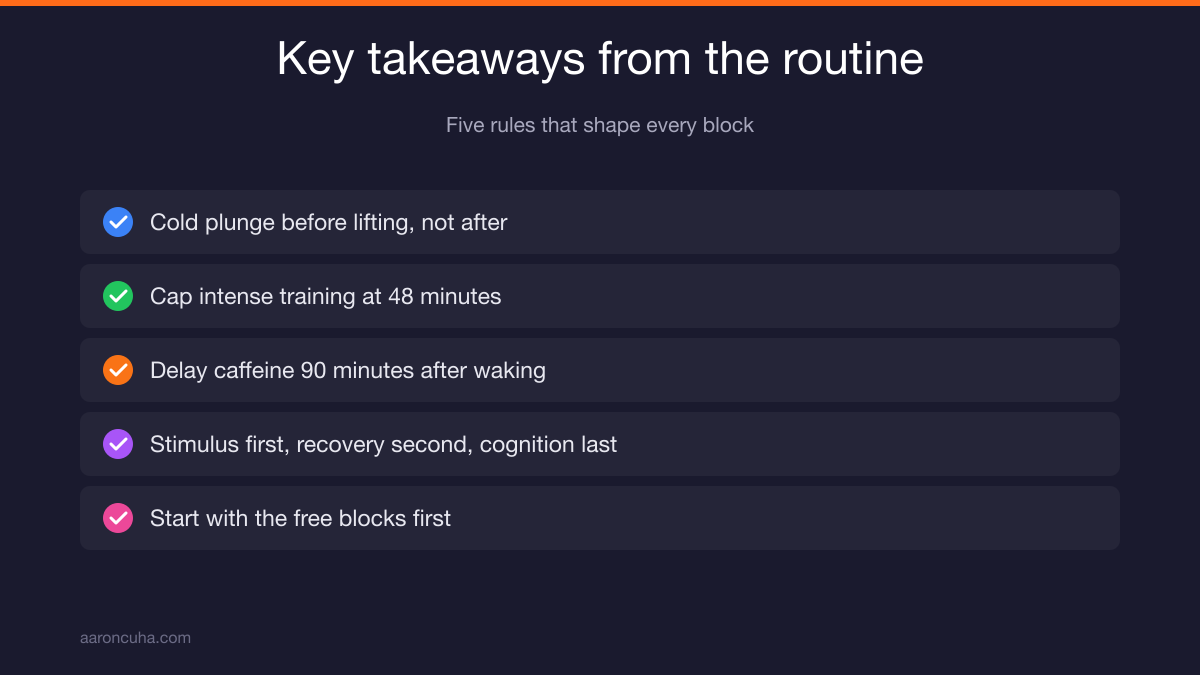
- Cold plunge before lifting, not after, to protect muscle protein synthesis.
- Cap intense resistance training at 48 minutes before cortisol outpaces testosterone.
- Delay caffeine 90 minutes so the cortisol awakening response finishes its job.
- Order matters: stimulus first, recovery second, cognition last.
- Start with the free blocks before you buy a single piece of equipment.
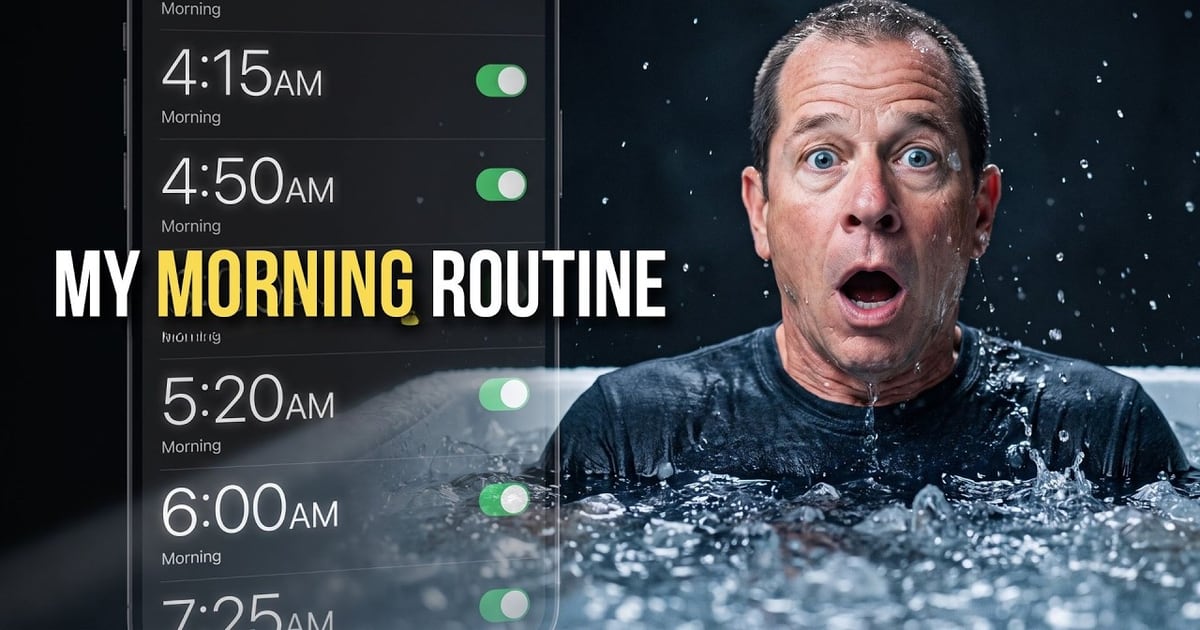
This is a science-backed morning routine I have been running for about 12 months. Every block has peer-reviewed research behind it. Not blog posts. Not podcast opinions. Actual studies. Most of what the internet tells you about morning routines is either incomplete or made up.
I am going to walk you through what I do, why each step exists, and why the sequence matters as much as the practice itself.
Want a system for your business that runs with the same precision? Start with a Channel Audit and Plan and see where your content is leaking energy.
Why My Morning Routine Starts at 3:45 AM
I wake at 3:45 because my first coaching call is at 6:00. That gives me 2 hours and 15 minutes of biological preparation before I open my mouth.
I am a business coach. On a full day I run 23 calls with one 30-minute break. That is 12 hours of output, and I have to hold high energy the entire time.
You cannot fake that with willpower. You can build it with a protocol.
The wake time is not the point. The deadline is the point. My 6:00 AM call is a hard anchor. Everything upstream of it gets scheduled backward from that moment. That is what turns a routine into a system instead of a daily negotiation with yourself.
If your morning has no anchor, you will drift. If it has one, the routine builds itself.
The Science-Backed Morning Routine Timeline at a Glance
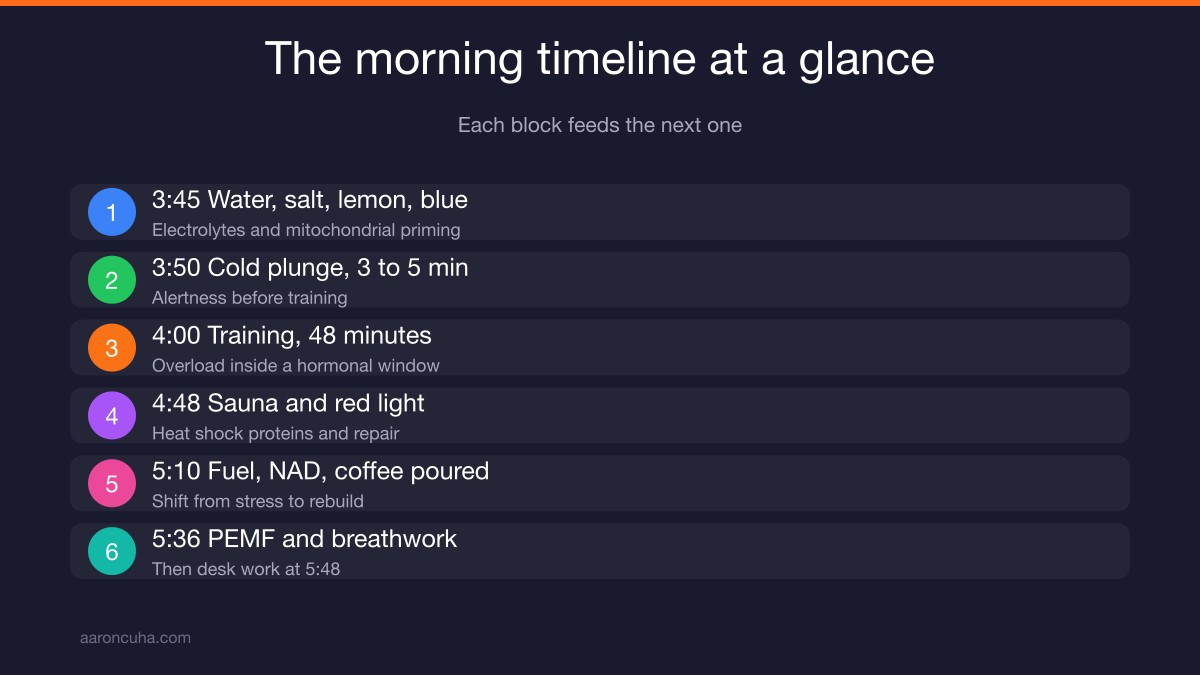
Here is the full sequence with times and purpose. Each block feeds the next one, which is why the order is not random.
| Time | Block | Purpose |
|---|---|---|
| 3:45 AM | Water, salt, lemon, methylene blue | Electrolytes, Krebs cycle support, mitochondrial priming |
| 3:50 AM | Cold plunge, 45 degrees, 3 to 5 minutes | Alertness and sympathetic activation before training |
| 4:00 AM | Resistance training plus conditioning | Progressive overload inside a hormonal window |
| 4:48 AM | Sauna and red light panels | Heat shock proteins, growth hormone, mitochondrial payoff |
| 5:10 AM | Fuel, NAD, coffee poured | Shift from stress adaptation to rebuild |
| 5:28 AM | Warm shower | Sympathetic to parasympathetic gear shift |
| 5:36 AM | PEMF mat plus Wim Hof breathing | Recovery and stress regulation in one block |
| 5:48 AM | Desk, affirmations, gratitude, call prep | Neurochemical priming for performance |
| 6:00 AM | First coaching call | Peak state on demand |
Notice the pattern. Stimulus first. Recovery second. Cognition last. That is the entire architecture.
Step One: Salt, Lemon, and Three Drops of Methylene Blue
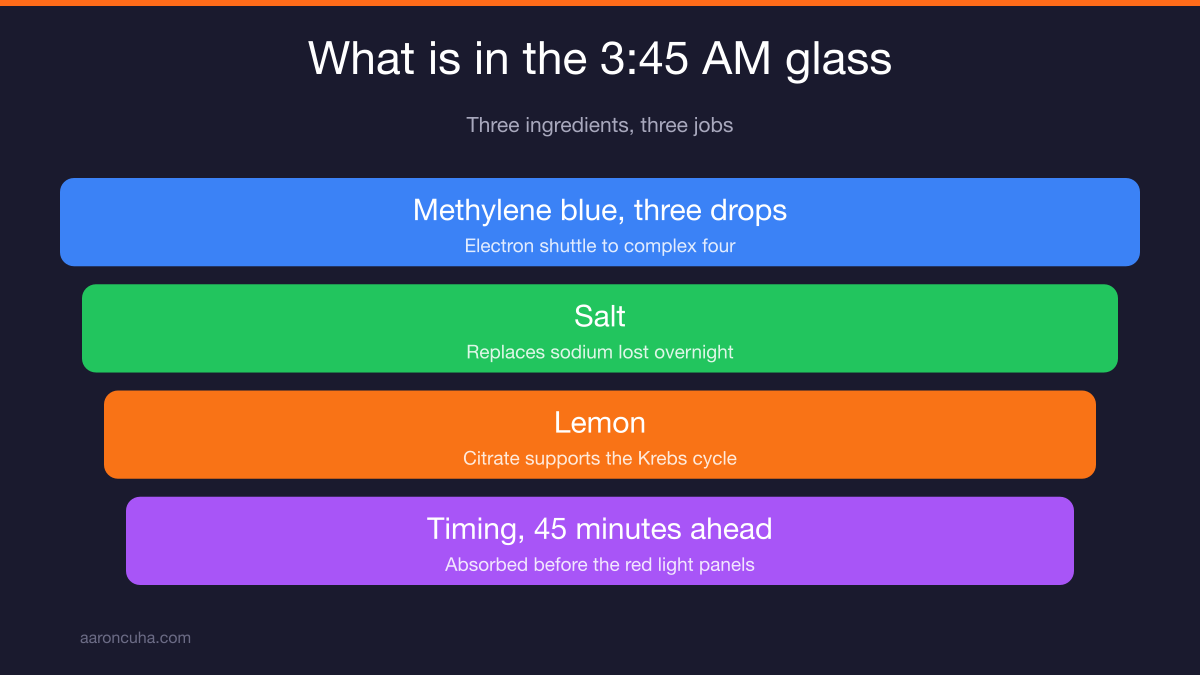
At 3:45 I drink water with salt, lemon, and three drops of methylene blue. No food. I stay fasted for a while longer.
Methylene blue acts as an electron shuttle in your mitochondria. It donates electrons directly to complex four of the electron transport chain, which boosts ATP production independent of your normal metabolic pathways.
But the timing is the real play. I take it roughly 45 minutes before I sit in the sauna with my red and near-infrared panels running.
A 2014 study by Gonzalez-Lima and Auchter in Frontiers in Cellular Neuroscience showed that methylene blue combined with near-infrared light creates a synergistic effect on mitochondrial function. The methylene blue supplies the electrons. The 670nm and 880nm light activates cytochrome c oxidase to use them.
Now the salt and lemon.
- Sodium is the primary electrolyte you lose overnight through respiration and sweat. Without enough of it, your cells cannot hold proper voltage gradients.
- Lemon supplies citrate, which supports the Krebs cycle.
That is not a wellness trend. That is basic cellular biochemistry. You can read the underlying research on cellular energy production through PubMed yourself.
Why I Cold Plunge Before My Workout, Not After
At 3:50 I get into 45 degree water for 3 to 5 minutes. Straight in. No breathing protocol. If I lose my breath I will use box breaths, but that is it.
Most people cold plunge after their workout for recovery. I do it before, and I am not guessing.
A 2023 study in Biology found that just 5 minutes of cold water immersion increased self-reported alertness, attentiveness, and what the researchers called inspired activation.
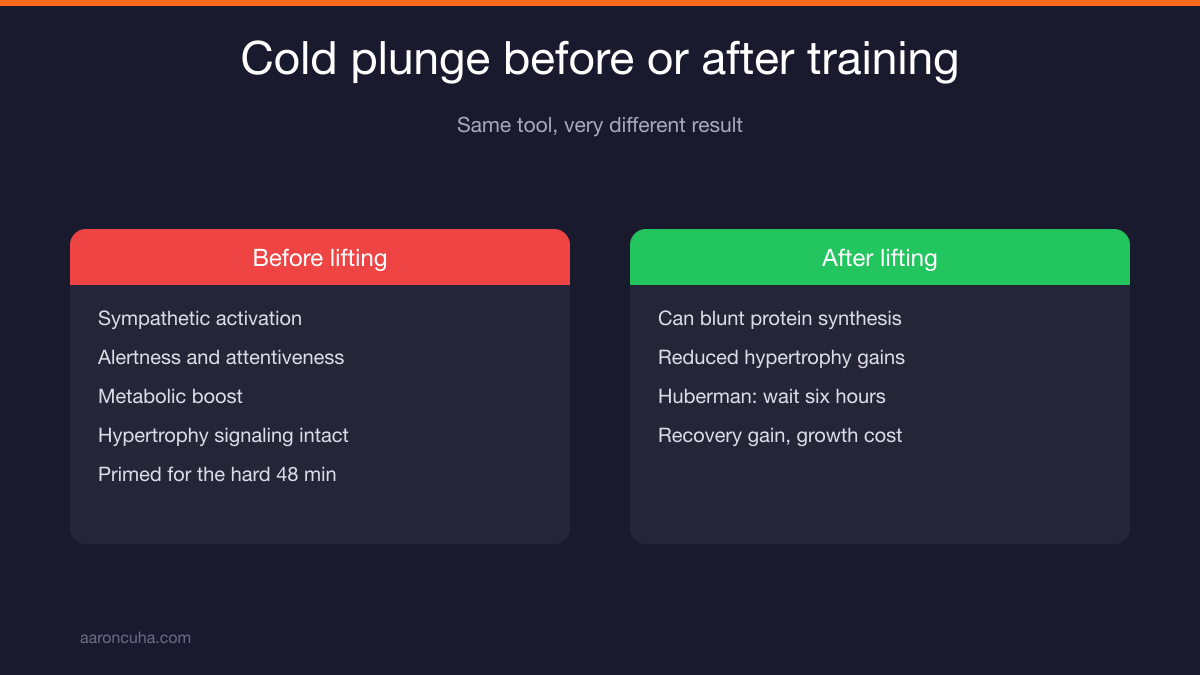
More importantly, cold water immersion before resistance training activates your sympathetic nervous system without blunting the hypertrophic signaling you need after training.
A Cochrane review of roughly 17 to 19 studies confirmed that post-workout cold immersion can blunt muscle protein synthesis and reduce hypertrophy gains. Stanford neuroscience professor Andrew Huberman recommends waiting at least six hours after strength training before cold exposure for that exact reason. You can review the methodology behind those reviews at Cochrane Library.
The fix is simple. Move the cold before the lifting. You get the spike, the mental activation, and the metabolic boost without sabotaging your gains.
By the time I step out, I am neurochemically primed for the hardest 48 minutes of my day.
The 48-Minute Hard Cap on Training
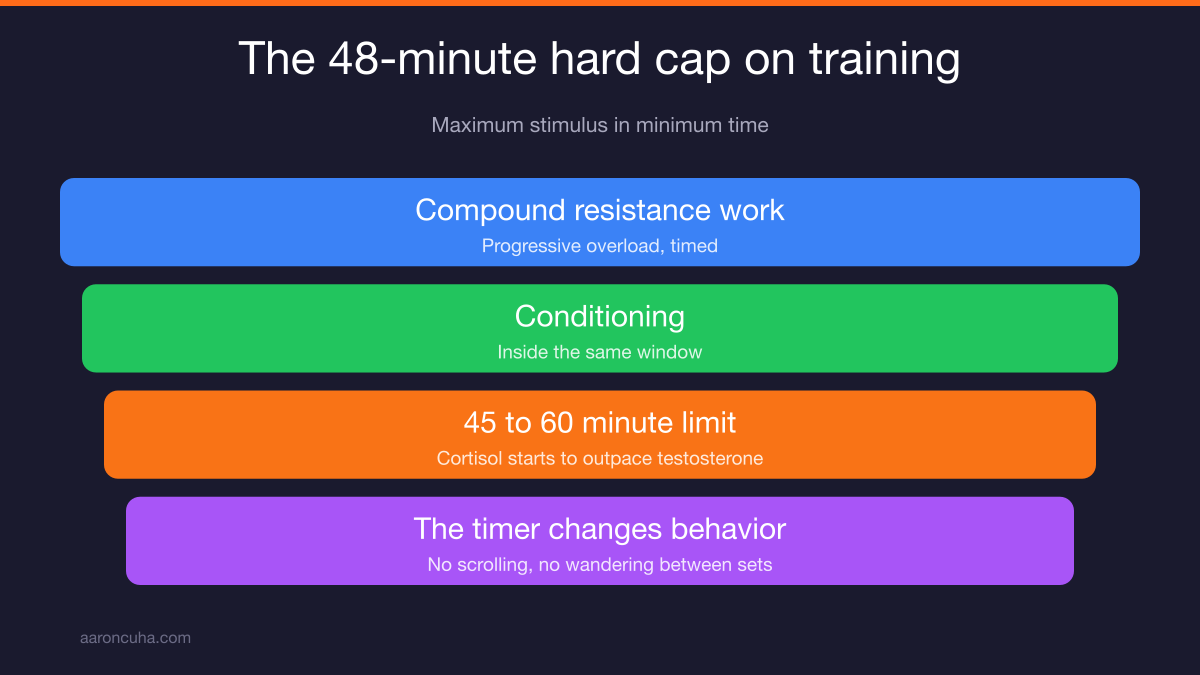
At 4:00 AM I train. Compound resistance plus conditioning with progressive overload, and I put a 48-minute hard cap on it. I am timed.
Why 48 minutes? Because after roughly 45 to 60 minutes of intense resistance training, cortisol begins to outpace testosterone. At that point you stop building and start breaking down.
The goal is maximum stimulus in minimum time. Get in, overload the tissue, get out.
This is the same principle I teach in business. More hours is not the answer. Better structure inside fewer hours is. That is the core of Systems Over Hustle, and it applies to your body exactly like it applies to your calendar.
A timer changes behavior. When you know you have 48 minutes, you stop scrolling between sets. You stop wandering. You work.
The Sauna and Red Light Stack
At 4:48 I walk into the sauna sweaty, straight from training. That is intentional, and it is where two protocols collide.
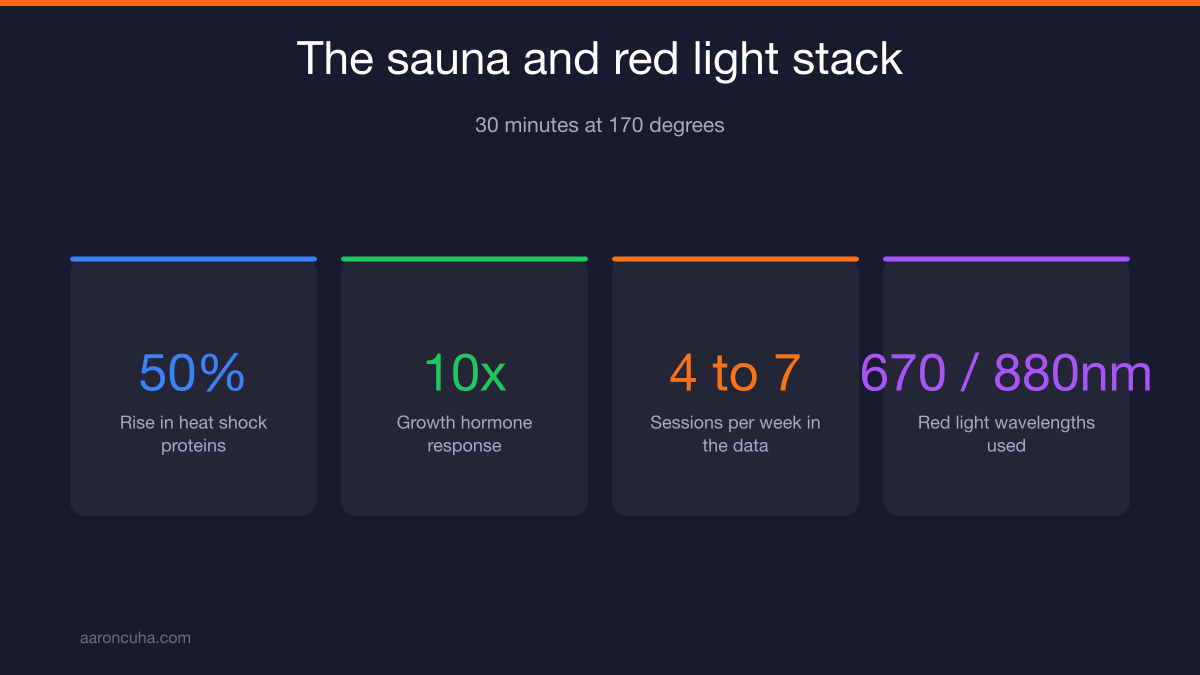
A single 30-minute sauna session at 170 degrees Fahrenheit raises heat shock protein levels roughly 50% above baseline. It also drives a large growth hormone response, on the order of ten times.
Heat shock proteins are your cellular repair crew. They rebuild damaged proteins and direct amino acids to muscle damage sites, which accelerates recovery.
The longevity data is what sold me. Dr. Rhonda Patrick's analysis of Finnish sauna studies showed that four to seven sauna sessions per week is associated with reduced all-cause mortality risk. The HSP70 gene variant linked to regular heat exposure is associated with one to two additional years of lifespan. That is published epidemiological data, not wellness fluff. You can go deeper at FoundMyFitness.
Now the methylene blue from an hour earlier pays off. It has been absorbed and is circulating. My panels run at 670nm and 880nm, the exact wavelengths that activate cytochrome c oxidase.
Three details I follow every time:
- Eyes to the panels for 5 to 7 minutes for the ocular pathway, then let the body absorb the rest.
- No screens. Fully present in the sauna.
- Towel in hand. I wipe sweat off fast because I am sweating out metals and other compounds I do not want sitting on my skin.
Fuel, NAD, and Why I Give No Peptide Advice
At 5:10 I move to fuel and compounds. I start with NAD because morning timing aligns with my natural circadian rhythm.
NAD serves as the co-substrate for sirtuins and PARPs, the two primary families of cellular repair enzymes. Your levels decline as you age. Supplementing in the morning, when levels are lowest, may improve conversion efficiency.
Be honest about the state of the evidence here. Long-term human outcome research is still developing. The mechanistic science on mitochondrial support is solid. Those are two different things.
Depending on where I am in my protocol I may include peptides. I am not a doctor and I am not giving you peptide advice. Talk to a physician before you add anything to your routine.
My first meal lands in this block too. Usually A2 yogurt with a spoon of protein powder and berries. A little granola on a good day. This is the point where the body shifts from stress adaptation to fuel and rebuild.
Why I Wait 90 Minutes for Coffee
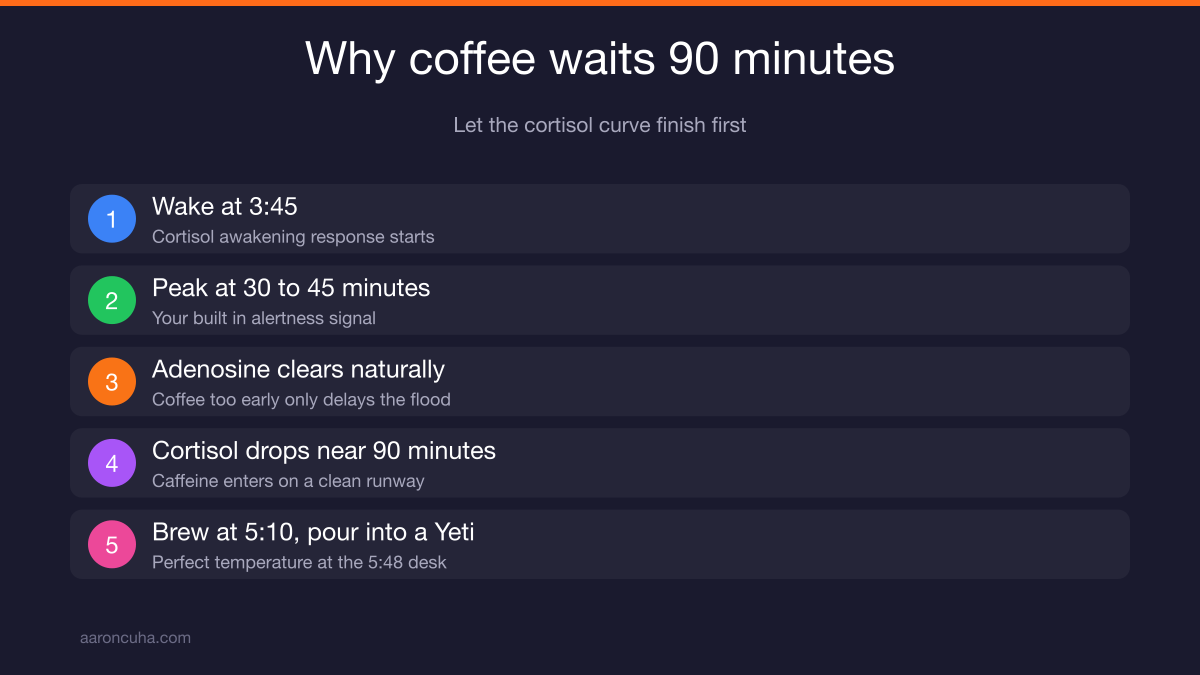
I do not touch caffeine until roughly 85 to 90 minutes after waking. That is deliberate, and it is the single easiest change most people can make.
When you wake up, your body is already running the cortisol awakening response, a natural spike that peaks about 30 to 45 minutes after you get up. Cortisol is your built-in alertness signal.
If you slam caffeine into that window, two things happen:
- You stack a stimulant on top of a process already doing its job, which dulls your caffeine sensitivity over time.
- When the cortisol spike drops off around the 90-minute mark and you have nothing in reserve, you get the mid-morning crash most people blame on needing more coffee.
Wait, and the curve gets clean. The cortisol response finishes. Caffeine enters right as cortisol declines. You get sustained alertness with no crash.
There is adenosine science behind it too. Caffeine works by blocking adenosine, your brain's sleepiness signal, but adenosine keeps building in the background. Drink coffee too early and you delay the flood instead of clearing it. Waiting lets your body clear some naturally so the caffeine has a clean runway. Huberman has covered this extensively at the Huberman Lab.
Practical detail: I brew at 5:10 and pour it into a Yeti. It hits perfect drinking temperature right when I sit at my desk at 5:48.
If you want the same kind of engineered sequence applied to your content instead of your kitchen, grab a YouTube strategy session and we will map it out together.
The 60-Second Habit With the Biggest Return
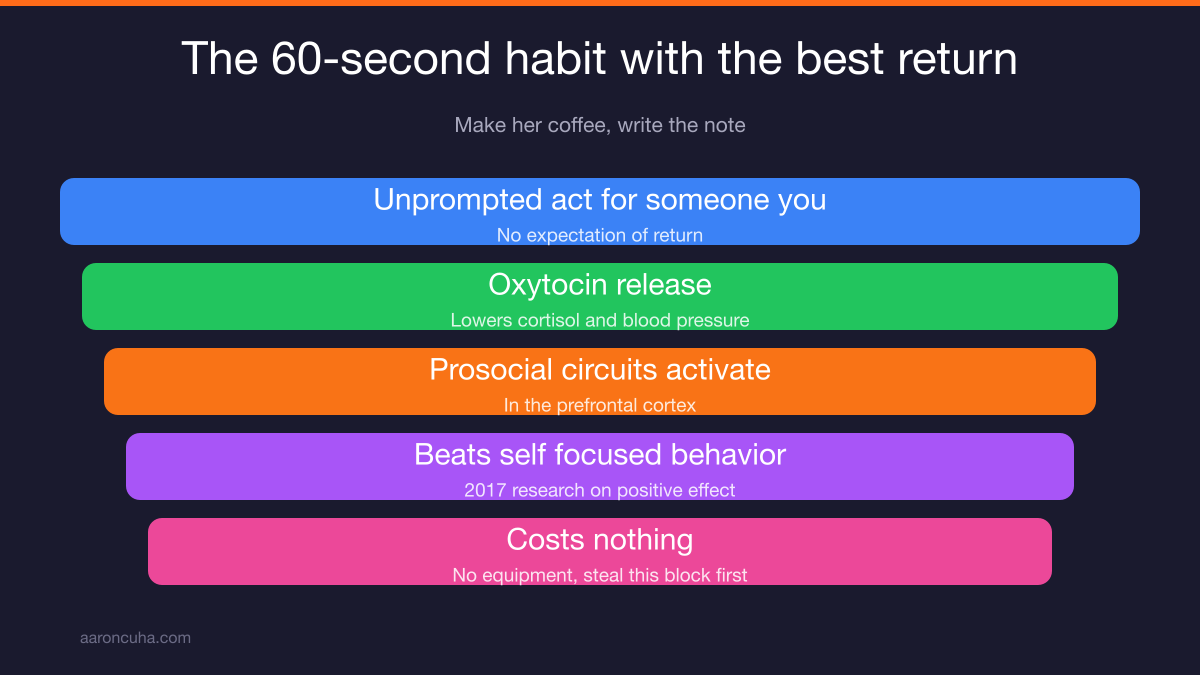
While I am in the kitchen, I make my wife Debbie's coffee and write her a note. Every single morning. It takes about 60 seconds and it outperforms every supplement I take.
This is not just being a good husband, although it is that.
Doing something for someone you love, unprompted, with no expectation of return, triggers oxytocin release. Oxytocin lowers cortisol, reduces blood pressure, and activates prosocial bonding circuits in your prefrontal cortex.
Research from 2017 showed that prosocial behavior, meaning doing things for others, produced measurably greater positive effect than self-focused behavior.
Sixty seconds. Massive neurochemical return. And knowing she wakes up to that note is fuel no compound can replace.
If you are going to steal one block from this entire routine, steal this one. It costs nothing and requires no equipment.
The Warm Shower Gear Shift
At 5:28 I shower. Warm, not cold. All my cold exposure is already done, so there is nothing to gain from repeating it.
This is a deliberate gear shift from sympathetic flight mode to parasympathetic think mode.
The gradual temperature drop afterward signals to your nervous system that the physical preparation phase is complete. The cognitive phase is starting.
People miss this. They stack stimulation on stimulation all morning, then wonder why they feel wired and scattered on their first call. You need a transition, not just more input.
The shower is that transition. It is short, it is free, and it tells your body which mode to enter next.
PEMF Plus Wim Hof Breathing: Two Protocols, One Block
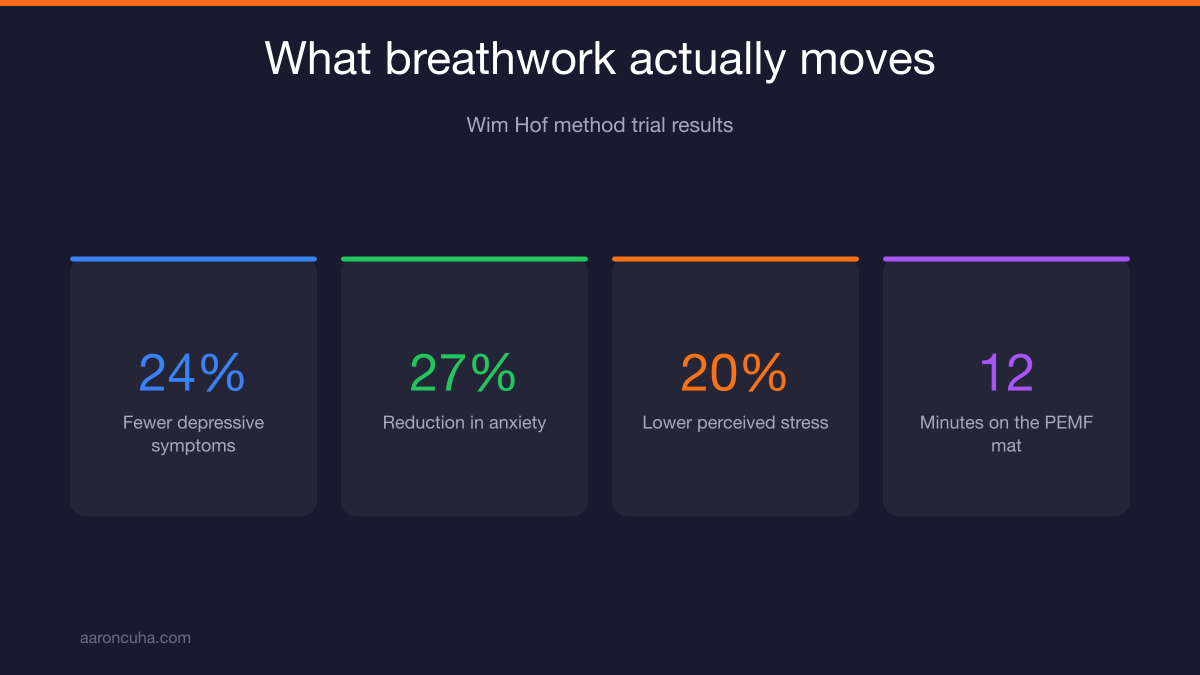
At 5:36 I lie on a PEMF mat and do Wim Hof breathing at the same time. Two protocols, one block, one 12-minute window.
A 2023 review in PMC covering the clinical evidence showed that pulsed electromagnetic field therapy influences DNA synthesis, gene expression, and cell migration. It mobilizes ion flow across cell membranes through depolarization, repolarization, and hyperpolarization.
Studies show statistically significant pain reduction and improved athletic recovery, including reduced delayed onset muscle soreness and shortened recovery time. You can find the review through PubMed Central.
Here is the breathing structure I run:
- Three to four rounds total.
- 30 to 40 deep inhales per round.
- Exhale and hold. I start near 60 seconds.
- Recovery breath, hold 15 seconds.
- Second hold targets 90 seconds. I do not always make it. I try.
A systematic review on the Wim Hof method found it significantly increases epinephrine levels, which triggers interleukin 10 production and suppresses pro-inflammatory cytokines.
A randomized controlled trial reported a 24% reduction in depressive symptoms, a 27% reduction in anxiety, and a 20% reduction in perceived stress. The breathing group also showed significant reductions in rumination, those repetitive negative thought loops that kill performance.
Breathwork is not pseudoscience. If you are not doing it, start today. It costs zero dollars.
Affirmations and Gratitude as Neurochemical Priming
At 5:48 I sit at my desk. The Yeti is at perfect temperature. I run affirmations, gratitude, and call prep in that order.
Do not skip this because it sounds soft.
fMRI studies from UCLA published in Social Cognitive and Affective Neuroscience showed that self-affirmation activates the ventromedial prefrontal cortex and the ventral striatum, your brain's reward and self-processing regions. That neural activity predicted actual behavior change in the days that followed.
Affirmations program your subconscious mind. So when the hard day shows up, you are already loaded and ready to take it.
Then gratitude. Gratitude practice triggers dopamine and serotonin release, the same neurotransmitters targeted by most antidepressants. It activates the hypothalamus, which improves sleep quality the following night. Regular practice reduces cortisol and improves heart rate variability.
Here is the connection people miss. That note I wrote to Debbie was not separate from this block. That was gratitude in action.
Thinking grateful thoughts activates one set of neural pathways. Physically doing something grateful for another person activates those pathways plus your motor cortex plus oxytocin plus the prosocial circuits.
Gratitude with a multiplier. This is not journaling for feelings. It is neurochemical priming for performance.
How to Build Your Own Version Without Copying Mine
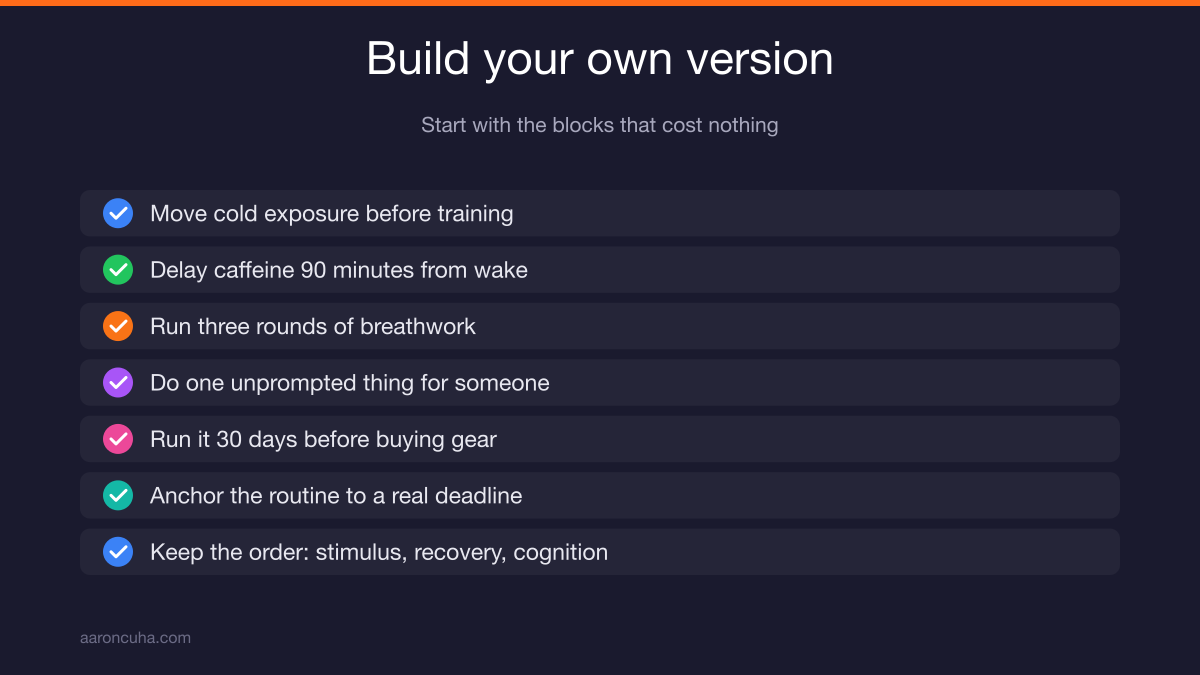
Do not copy my times. Copy the architecture. Stimulus first, recovery second, cognition last, anchored to a real deadline.
Most people fail at morning routines because they treat them as a list of nice habits. A routine is a sequence. Each block should set up the one after it.
Start with the blocks that cost nothing:
- Move cold exposure before training instead of after.
- Delay caffeine 90 minutes from wake time.
- Run three rounds of breathwork before you open your laptop.
- Do one unprompted thing for someone you love every morning.
Those four require zero equipment. Get them running for 30 days before you buy a sauna, a plunge, a PEMF mat, or a single supplement.
Then anchor the whole thing to a real commitment. My anchor is a 6:00 AM client call. Yours might be a school drop-off or a standing team meeting. Without an anchor you are relying on discipline, and discipline is a terrible operating system.
This is the same logic behind content systems for entrepreneurs. Build the machine once, then let the machine carry the load.
By 6:00 AM I have 2 hours and 15 minutes of preparation behind me. Ask my clients on that first call. I am about as high energy as I can get without exploding.
It is not motivation. It is not discipline porn. It is targeted, science-backed biological optimization designed to put me in a peak state before I coach anyone on their business, their life, or their YouTube channel.
One last thing. Do not take my word for any of it. Read the research yourself, and talk to a doctor before you add any compound to your routine.
If you want more on how I structure the rest of my day, read my breakdown of the morning routine that helped me build multiple businesses, then join the Systems Over Hustle community to build your own protocol with people doing the same work.
Frequently Asked Questions

Written by
Aaron CuhaAuthor of Crazy Simple YouTube, keynote speaker, and executive coach with 20,000+ hours logged. ICF PCC, NLP Master Practitioner, and DISC Certified. Aaron helps entrepreneurs replace hustle with AI-powered systems that generate leads, content, and revenue on autopilot.