Most agents write a plan in January and never look at it again. This real estate business plan template uses the GPS model: one big goal, three priorities, five strategies under each. Then the numbers that turn it into a business instead of a hobby.
This real estate business plan template skips the 30 page document entirely. You get one page, the GPS model, numbers you know cold, and accountability you cannot escape. It is also the fastest way to build your real estate business plan 2026 without burning an entire afternoon on something you will never open again.
Key Takeaways
- Use the GPS model: one goal, three priorities, five strategies under each.
- Every strategy needs a deadline. No deadline means it is a prayer, not a goal.
- If you do not know your numbers, you have a hobby, not a business.
- Tracked and measured improves. Tracked, measured, and reported improves exponentially.
- Compress the plan to one page and tape it where you see it daily.
Want help turning this into a working plan for your market? Book a strategy session and we will map your goal, your priorities, and your numbers in one sitting.
The GPS Model: A Real Estate Business Plan Template Built on One Goal
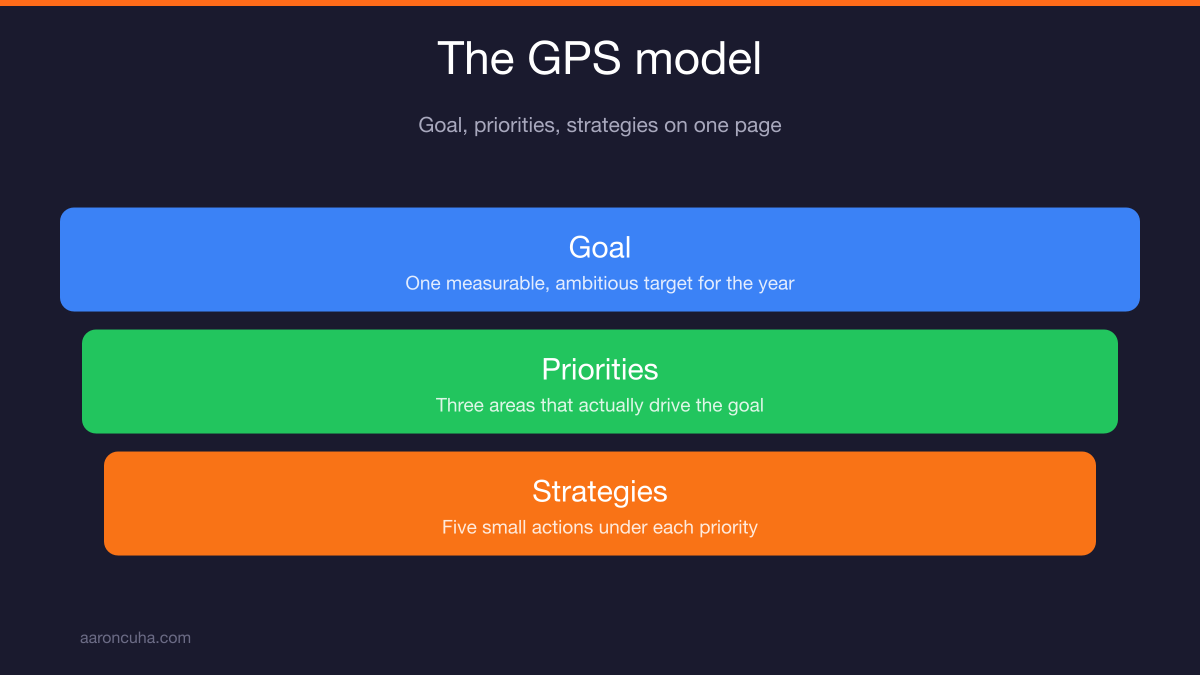
GPS stands for Goal, Priorities, Strategies. One big clear goal for the year. Three priorities that drive it. Five strategies under each priority. That is the entire real estate business plan template.
This is the best model I have ever taught for planning. It is simple enough to hold in your head and specific enough to actually move numbers.
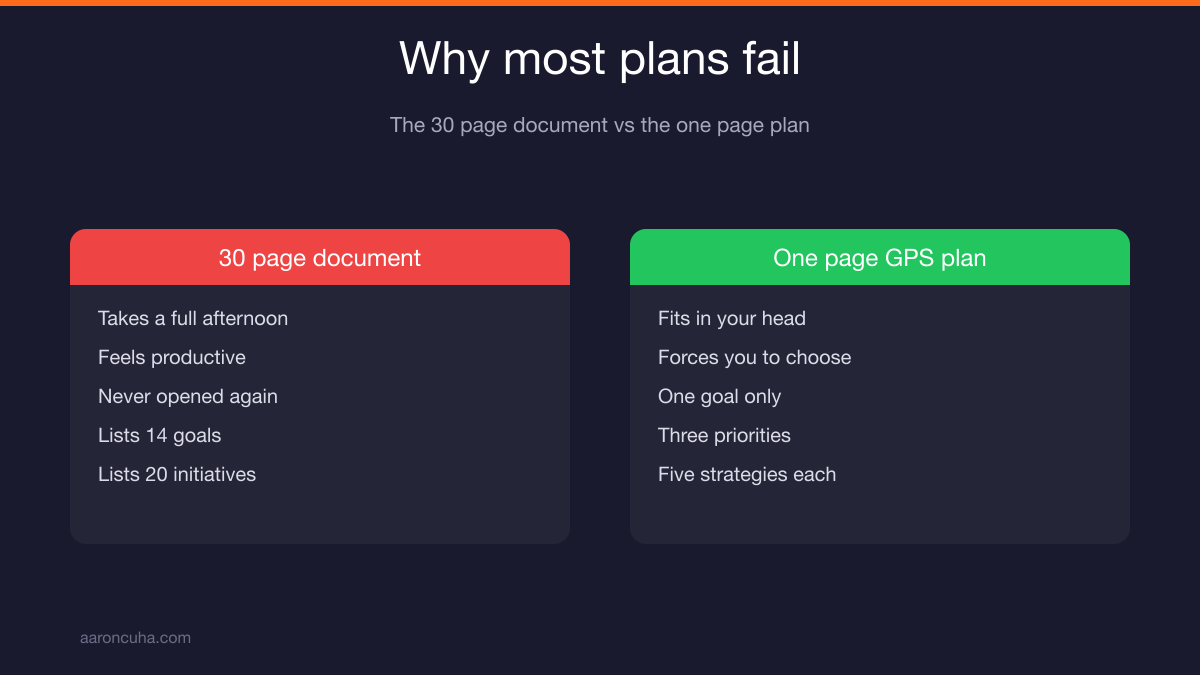
Most business plans fail for one reason. They are too long. You spend an afternoon building a 30 page document, you feel productive, and then you never open it again.
GPS fixes that. It forces you to choose. You cannot list 14 goals. You get one. You cannot list 20 initiatives. You get three priorities.
| Layer | What it is | How many |
|---|---|---|
| Goal | One measurable, ambitious target for the year | 1 |
| Priorities | The key areas that actually drive that goal | 3 |
| Strategies | The small actions under each priority | 5 each (sometimes 2, sometimes 10) |
Everything below sits inside that frame. Goal first. Then priorities. Then strategies. Then math, accountability, and mindset to hold it together.
Start With One Big Clear Goal
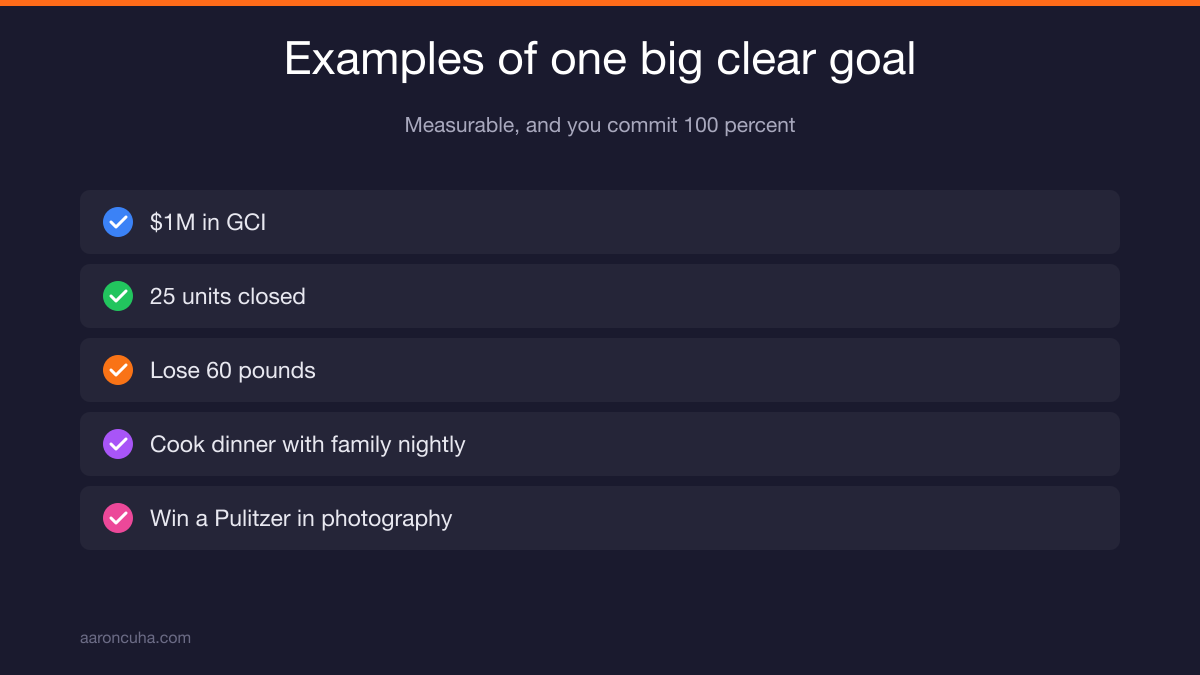
Pick one measurable, ambitious target for 2026. Write it down. Commit to it 100 percent. You will have other goals, but only one gets to be the big one.
This sounds counterproductive. You have more than one thing you want next year. I know. But when everything is a priority, nothing is.
Your one goal might be any of these:
- $1M in GCI
- 25 units closed
- Lose 60 pounds
- Cook dinner with your family every single night
I do not care what your goal is. I care that it is measurable and that you commit to it.
One of my long term goals is winning a Pulitzer Prize in photography. It is not happening this year or in the next five years, because I will need to retire and travel the world taking pictures to do it. But it is on the marker. It is going to happen.
That is the energy you want on your one big goal. No ifs, no ands, no buts.
Pick the Three Priorities That Actually Drive the Goal
Choose the three focus areas that will move your goal the most. Those are your big rocks. Everything else is sand.
Here is where most coached agents get it wrong. You assume the priority is always conversation count. More dials. More conversations. More appointments. Sometimes it is. Sometimes it is not.
Your real priority might be time management. It might be skills. If you keep the same conversation count but close twice as much, you get to the goal.
Your priority might be an evening routine. It might be eight hours of sleep. If you sleep eight hours a night, you walk into the office alive and full of energy. That changes everything downstream. Could losing 50 pounds get you to 50 transactions? It absolutely could.
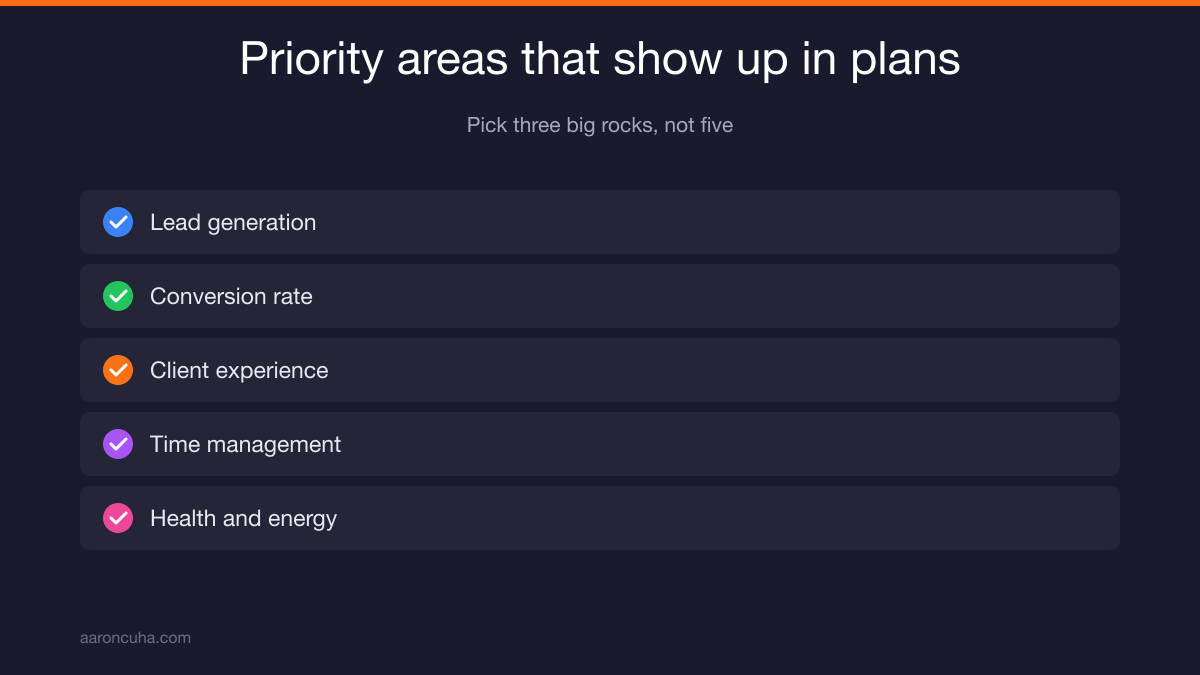
Common priority areas that show up in real plans:
- Lead generation
- Conversion rate
- Client experience
- Time management
- Health and energy
Pick three. Not five. Three. Then be honest about whether they actually drive the number you wrote down.
If you are not sure how to separate the rocks from the sand, that is exactly what a coach does. My take on how that works is in what actually works in business coaching.
Put Five Specific, Time Bound Strategies Under Each Priority
Under each priority, list five strategies. These are the small, boring, specific actions. Sometimes there are ten. Sometimes two or three. The point is that they are concrete.
Say your priority is time management. Your strategies might look like this:
- Read a book on time management
- Learn to time block and defend the blocks
- Work on your habits
- Set up accountability with someone
- Build the processes that make it repeatable
Nothing exotic. It is never about one heroic move. It is dozens of small ones stacked together. Last year I started a new YouTube channel with a goal of 100,000 subscribers in a year. I am at 130,000 now. Underneath that goal were three areas: video, editing, and skills. Under those, scripts, on camera delivery, thumbnails, structure. That is what strategies are. Not "post content." The specific mechanics underneath.
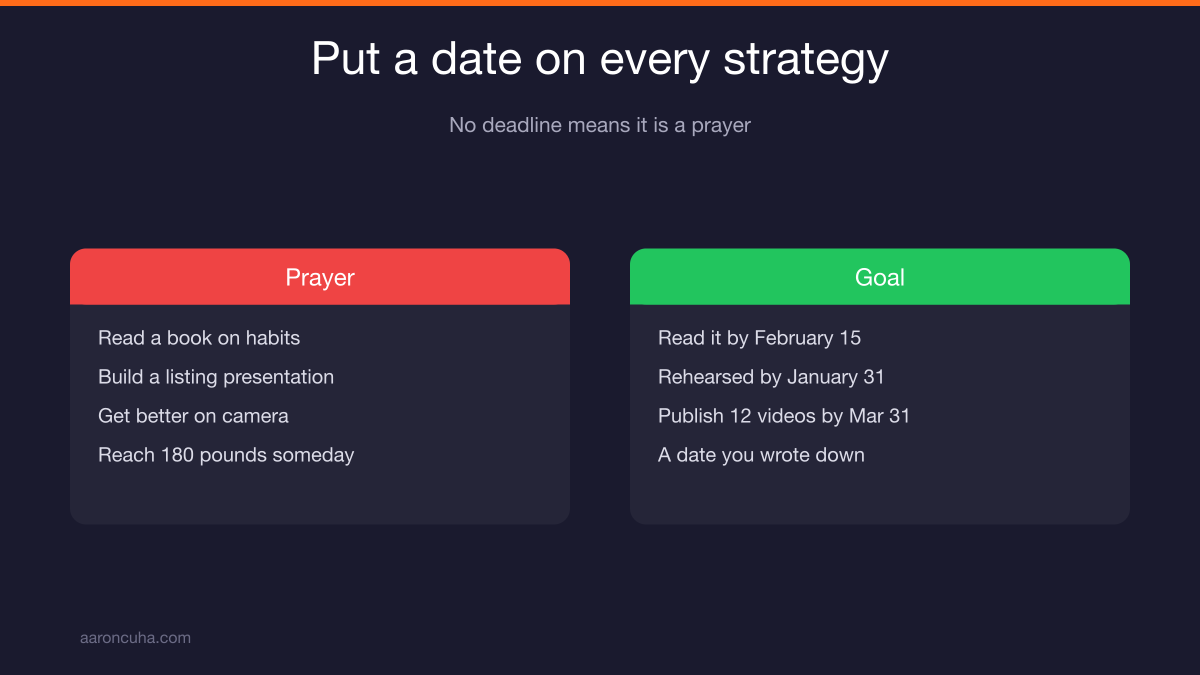
Then put a date on every one of them. Use SMART: specific, measurable, actionable, results oriented, and time based. If there is no time on your goal, it is not a goal. It is a prayer.
"I want to get to 180 pounds someday." Someday is when you die. I can promise you that at some point you will weigh 180 pounds. That is not a goal.
Without a deadline there is no urgency, and without urgency the excuse is always available. I can have tacos today because I will start dieting tomorrow. I live in Mexico half the year and I love tacos. There is always a tomorrow if you never wrote down a date.
- Not "read a book on habits." Read it by February 15.
- Not "build a listing presentation." Finished and rehearsed by January 31.
- Not "get better on camera." Publish 12 videos by March 31.
The date turns intention into a commitment. Everything else is decoration. If content is one of your priorities, my breakdown of the four content pillars that turn a channel into a lead machine gives you a strategy list you can copy.
Shrink It to a One Page Plan You Actually See
Build the full detailed plan. Then compress it to one page. The long version is for thinking. The one pager is for living.
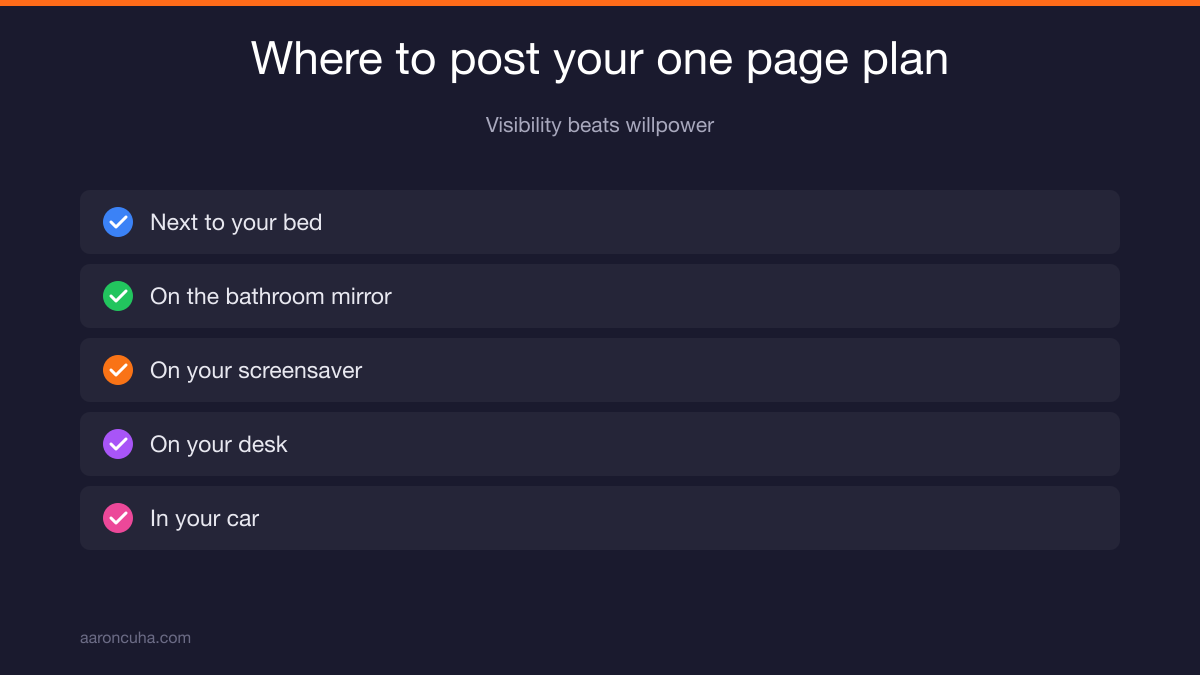
We all know what happens otherwise. You spend the afternoon on your plan, you feel great, and you never look at it again. So take the base of it, put it on a single page, and put that page where you cannot avoid it:
- Next to your bed, so it is the first thing you see when you open your eyes
- On the bathroom mirror, so you stare at it while brushing your teeth
- On your screensaver
- On your desk
- In your car
Every time you see it, you reinforce the actions you need to take. That repetition is the whole point.
At our peak we lived in a multi million dollar house on the water. I taped my plan all over the walls. My wife said, "You cannot tape that all over our walls." I said, "Last I checked, I make the payment on this sucker."
It does not matter where you put it. It matters that you see it every single day. This is the same principle behind building content systems that keep you consistent. Visibility beats willpower.
If You Do Not Know Your Numbers, You Do Not Have a Business
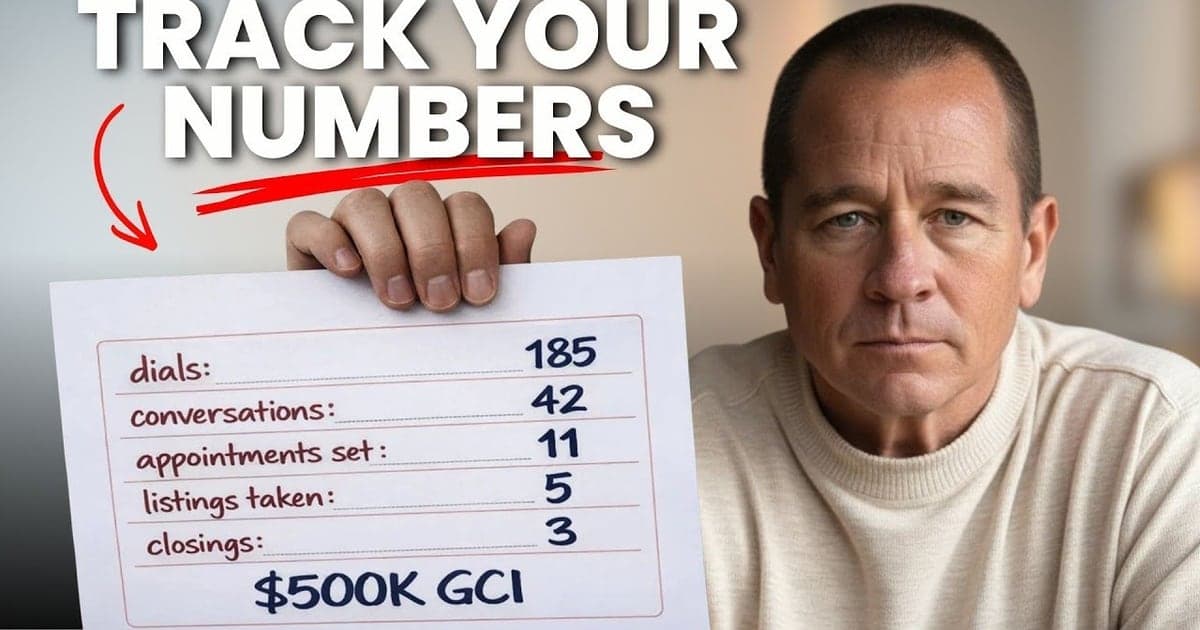
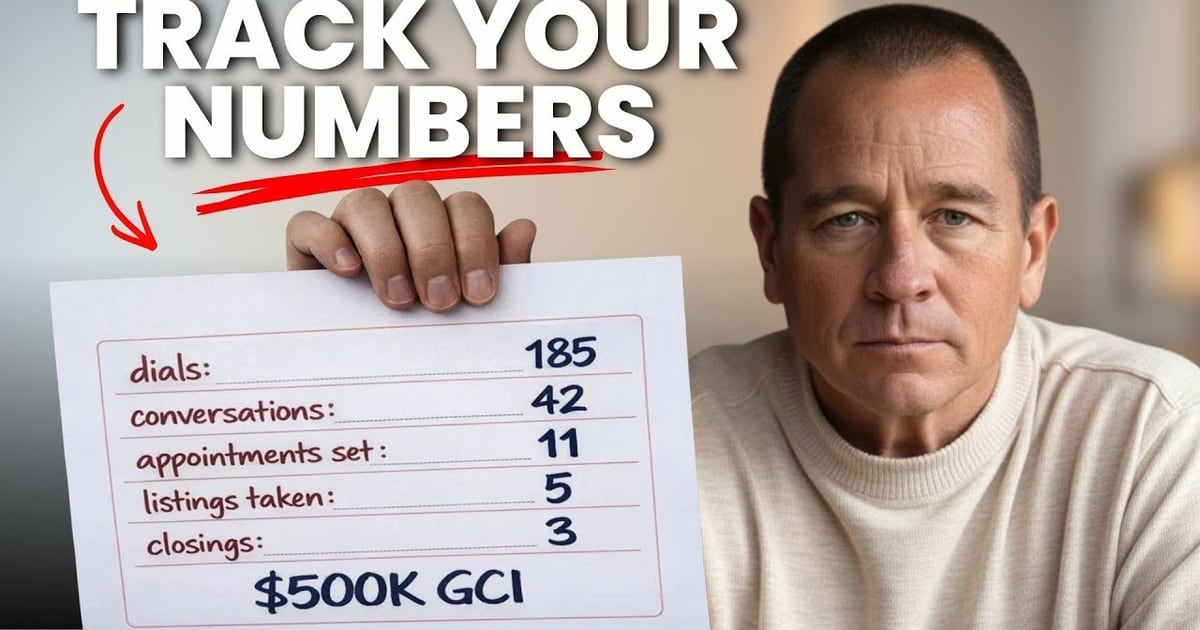
You have a hobby. Numbers do not lie. Turn your goals into concrete metrics and track them every week.
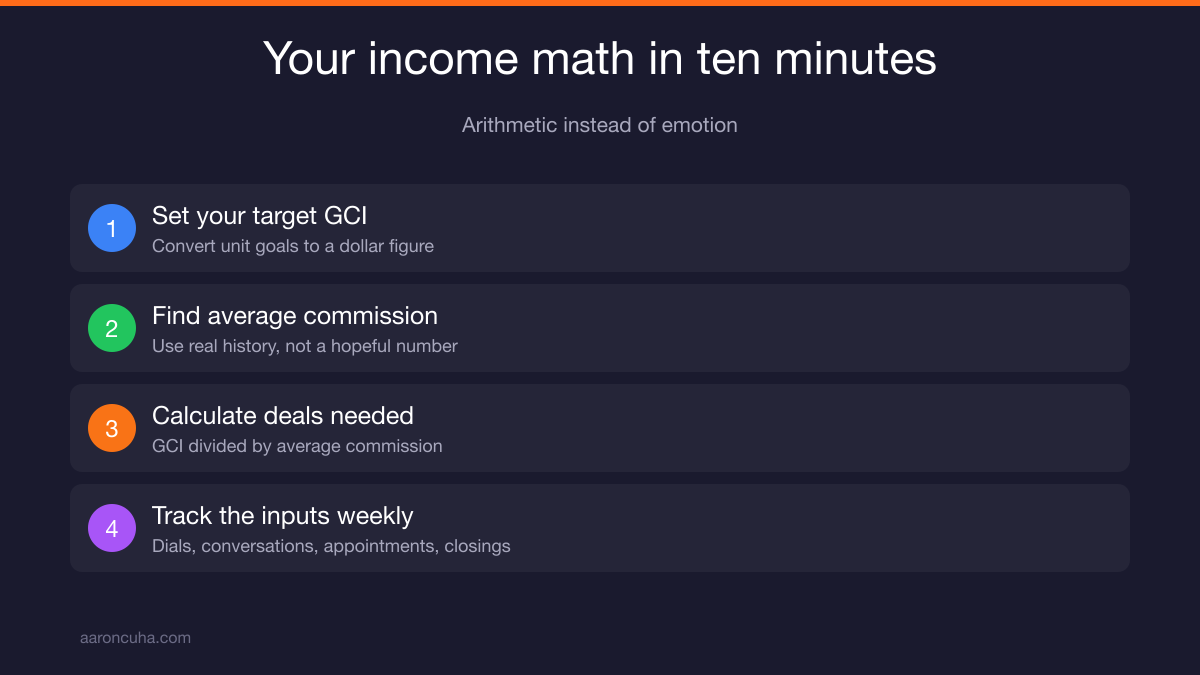
Start by defining your income math. It takes about ten minutes:
- Set your target GCI. Even if your big goal is units, convert it to a dollar figure.
- Determine your average commission per deal. Use your real history, not a hopeful number.
- Calculate how many deals you need to hit the goal.
Now you have a target that is not emotional. It is arithmetic. Pressure test your assumptions against real market data before you lock it in. The National Association of Realtors research center publishes the transaction and price data you need for that.
Then track the inputs. I can tell you how many dials, how many conversations, how many loan applications, and how many closings I had from the very first day of my career. I can give you those numbers today.
When I ask a room of agents who is currently tracking their numbers, three or four hands go up. That is the gap between the people who hit their plan and the people who talk about it.
Every week I had a little board. I tracked my numbers, then put them in a spreadsheet with a running total for ten years. Track your progress with your coach, your teammates, a friend, or your spouse. Just track it with someone.
The Conversion Math: 200 Conversations to 20
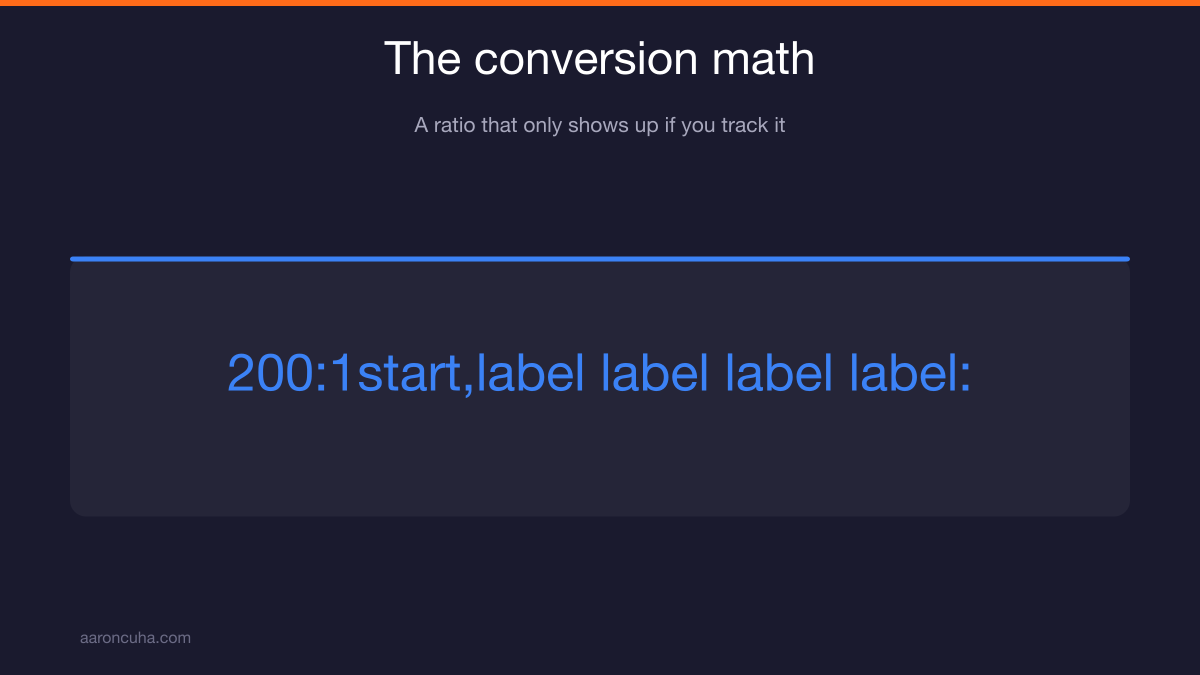
When I started selling real estate, it took me 200 conversations to set one appointment. By the end of my career I was at 20 to 1 and stayed there for a decade. That progression only shows up if you track it.
My first 25 listing appointments produced zero listings. For six months I made calls and got no business. My dad owned the office. He came to me one day and said, "Junior, I could go on these listing appointments with you. We will split it 50/50." I was on a 40 percent split at the time, so he was offering me a raise and closing the listing.
Six months later I was at 30 conversations to an appointment, setting two appointments a day, and my dad was closing every one. I went with him every time. I was learning. Another six months and I was at 20 conversations to an appointment, and by then I was probably better on listing appointments than he was, because I was practicing scripts every day.
Knowing that ratio is what makes rejection meaningless. I could go 200 conversations without setting an appointment and it affected me zero, because I knew the next 10 conversations were 10 appointments. That is not positive thinking. That is math. I had ten years of data.
When you call expireds, people tell you where you can go. I would be sitting there saying, "And you too," and I could hear the whole office laughing. They would come to my door and ask if it bothered me. No. That is the best thing that can happen to me. They did not waste my time.
What bothered me was a ten minute conversation that ended with no appointment set. Ten minutes gone, no result. Your mindset is powerful and it can stop you fast. Numbers are the seatbelt.
Ready to build a system instead of grinding harder? Read Systems Over Hustle and see why working harder is not the answer.
Pearson's Law: Track, Measure, Report
Anything you track and measure improves. Anything you track, measure, and report improves exponentially. That is Pearson's law, and it is the cheapest performance upgrade available to you.
Karl Pearson was a statistician and mathematician who worked alongside Albert Einstein. Use your imagination on how sharp you have to be to be a coworker of Einstein. You can read about his work through the Encyclopaedia Britannica.
The first half of the law is well known. Measure something and it gets better. Period. The second half is where the leverage lives. Report it to someone. That is what turns improvement into acceleration.
When I get off the treadmill, I send my dad a picture of what I did. Burned 600 calories. Score of 450. Beating you today. I dare you to beat me. That is exactly how I operated in real estate. As long as I was at the top of the board, I was happy.
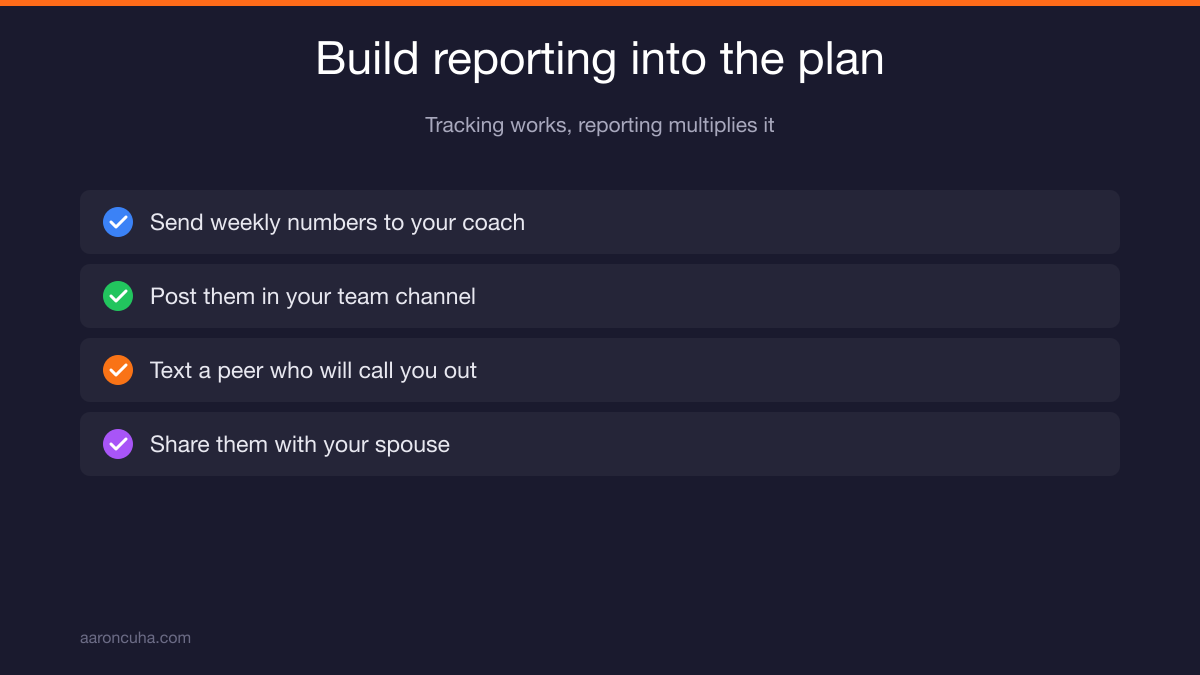
So build reporting into your plan:
- Send your weekly numbers to your coach
- Post them in your team channel
- Text them to a peer who will call you out
- Share them with your spouse
Tracking alone works. Reporting multiplies it.
Mental Rehearsal and the Vision Board
Top athletes visualize before they compete. You should too. Drive to a listing appointment thinking, "I am not going to get this $4 million listing," and you will not get it. Drive there thinking, "I own this. I would want to work with me," and you will.
Here is the story that proves it. I had a brand new client who had never sold a house and never represented a buyer. His first listing appointment was a $30 million property that had been listed multiple times and never sold. He was going up against two other agents, one coached by Bill Pipes and one coached by Tom Ferry, both doing $200 to $300 million a year.
We mapped exactly what each competitor would pitch in that room. Then we built a plan against it and role played it over and over. Did we role play until he got it right? No. We role played until he could not get it wrong. He got angry with me. "I have got this." You are not even close. Again.
He walked in with a plan that shocked them and won the listing. His very first one. Rehearsal is not a soft skill. It is preparation you can measure.
Pair that with a vision board. Mine lives on my monitor backdrop and I look at it every morning. It is normally about work life balance. Italy. Dogs. Not money. The center image right now is a little farmhouse in Tuscany.
There were challenges in the Tom Ferry ecosystem this year, and most of my clients asked whether I was still going to Italy after losing 20 percent of my income. I said not only am I going, I canceled all my reservations and rebooked the best hotels I could find. Five star instead of Airbnbs. I am going so far into debt for those 45 days that I will have to work incredibly hard next year to recover. That is the point. Motivation is a design choice. Build it into the plan.
Build Accountability Even When Nobody Is Watching
If you set real accountability, you get there. The best accountability has a consequence attached, and sometimes the only person who knows about it is you.
I do not normally shave my head. The only time I shave it is when I break my own accountability. At Summit, a coach took us to a steak dinner and told the restaurant it was my birthday, which it was not. They brought out a giant cake. I thought one bite would not break my diet, then the whole table pushed, and I ate the piece.
I shaved my head. Nobody knew why. Not even her. I had made a commitment to myself that if this happens, I do this. It did not matter that nobody else knew about it.
External accountability works too, and I use plenty of it:
- Five clients get a daily photo or video of my workout. If I miss, I pay $100 that day.
- My wife held my numbers hostage. We loved a little bar called Chamayos on Friday afternoons. I would tell her I had to hit my numbers or we were not going. She would call the office and ask if I had hit them. If I said no, she said, "Do not come home. We are going to the bar tomorrow." That is a support structure.
- The Italy version of the same deal. If I hit these numbers, we go. Do you think she was letting me come home early?
Most spouses ask when you are coming home. Mine told me to sleep at the office.
If you want that kind of structure without having to marry into it, join the Systems Over Hustle community and report your numbers to people who will hold you to them.
Putting the 2026 Plan Together This Week
Block one afternoon. Build the detailed plan, then cut it to one page. Add your numbers, your deadlines, and one person who gets your weekly report.
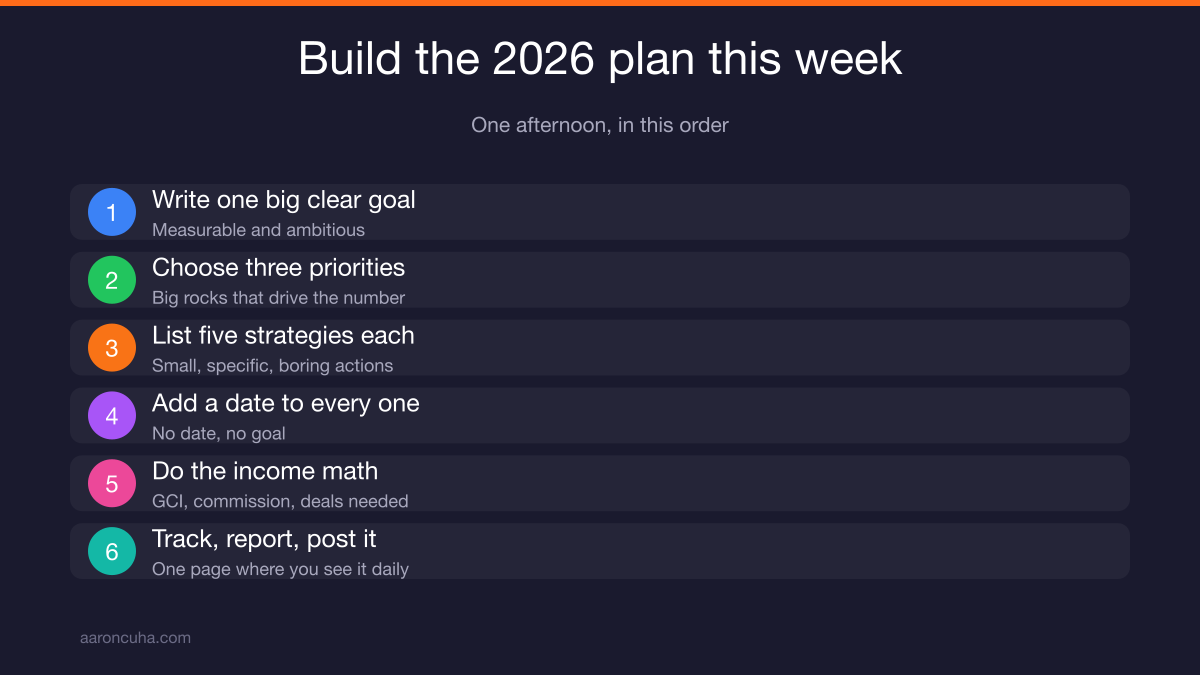
Here is the order of operations:
- Write your one big clear goal. Measurable and ambitious.
- Choose three priorities. Big rocks only. Be honest about which ones actually drive the goal.
- List five strategies under each. Small and specific.
- Add a date to every strategy. No date, no goal.
- Do the income math. Target GCI, average commission, deals needed.
- Set up tracking. A board on your wall and a spreadsheet with a running total.
- Pick your reporting partner. Coach, teammate, friend, or spouse.
- Compress to one page and post it everywhere.
Before you lock in your assumptions about rates and buyer demand, spend twenty minutes with the Federal Reserve economic releases. I built a mortgage company to 280 offices and lost it in 2008 because I made the hard decisions slowly instead of early. Plan for the market you might get, not just the one you want.
That is the whole system. It fits on a page and it will run your year.
If lead generation is one of your three priorities, video is the highest leverage strategy you can put underneath it. Start with the complete guide to YouTube for real estate agents, and if you want a second set of eyes on what you already have, grab a Channel Audit and Plan.
Frequently Asked Questions

Written by
Aaron CuhaAuthor of Crazy Simple YouTube, keynote speaker, and executive coach with 20,000+ hours logged. ICF PCC, NLP Master Practitioner, and DISC Certified. Aaron helps entrepreneurs replace hustle with AI-powered systems that generate leads, content, and revenue on autopilot.