Most manager one on ones fail because they become project updates. After 20,000 hours of coaching, these are the one on one meeting questions and the four part structure that actually change behavior between meetings.
Most one on ones fail for one reason. They turn into status updates. The right one on one meeting questions fix that. Here is the four part structure that makes them work.
Key Takeaways
- Open with their agenda, not yours. Ownership starts with the first question.
- Every direct report needs one number they can influence weekly.
- Work one obstacle to one next action. Not five problems and no owner.
- The commitment must be spoken by them, with a date they choose.
- Meet weekly for new or ramping people, biweekly for steady performers.
If your team meetings run on habit instead of structure, you are leaving performance on the table. Book a strategy session and we will map your leadership operating rhythm, or start with the free downloads and templates and build it yourself this week.
Why Most One on One Meetings Change Nothing
Most one on ones fail because the manager brings a project list instead of a performance question. The meeting becomes a status report. Nothing gets decided, nobody owns a next step, and behavior stays exactly the same.
I have logged more than 20,000 hours of one on one coaching. The pattern is always the same when the sessions are not working.
The manager talks most of the time. If you are speaking for the majority of a 30 minute meeting, you are running a briefing, not a coaching conversation.
The agenda belongs to the manager. You walk in with your list of five open items. Your direct report walks in with nothing, because they learned there is no room for their agenda anyway.
The meeting ends without an owner or a date. "Let's keep an eye on that" is not a commitment. It is a way to end a conversation politely.
Here is the test. Look at the last three one on ones you ran with the same person. Can you name one behavior that changed as a result? If you cannot, the meeting is a ritual, not a tool.
The good news is that this is a structure problem, not a people problem. Structure is fixable today.
What a One on One Is Actually For
A one on one exists to move one person one step forward on the one thing they own. That is the entire purpose. Everything else belongs in a different meeting.
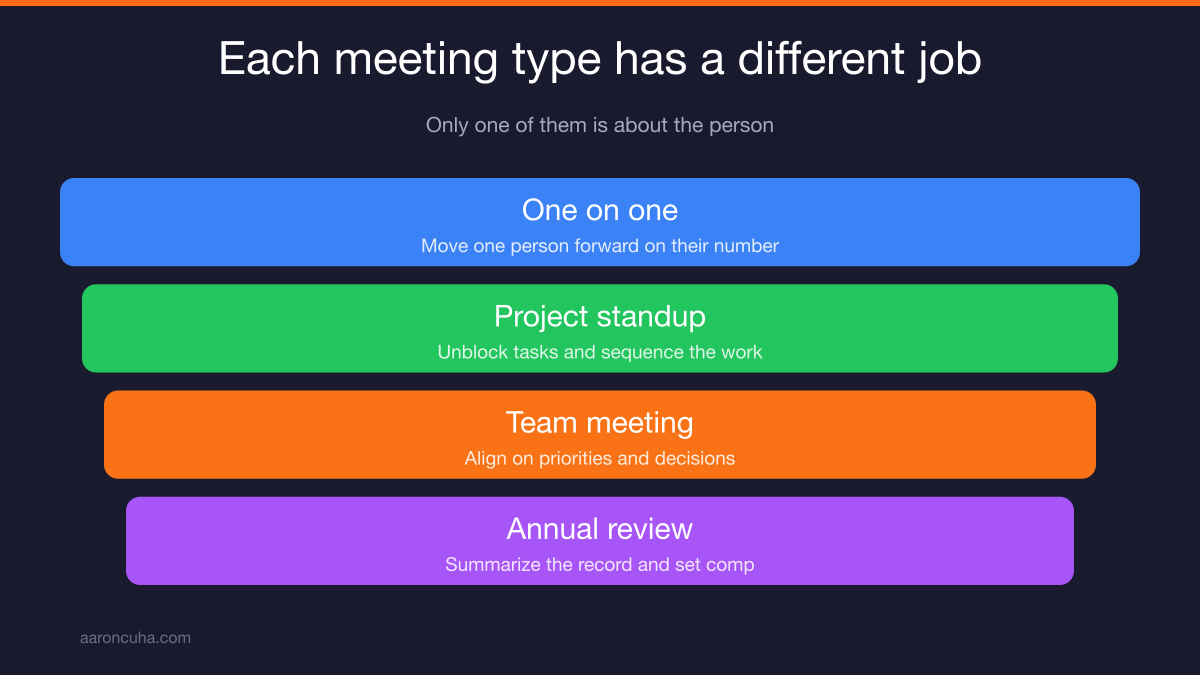
Managers blur meeting types constantly. They use the one on one to check project status, then wonder why development never happens. Each meeting type has a different job.
| Meeting Type | Purpose | Cadence | Who Owns the Agenda |
|---|---|---|---|
| One on one | Move one person forward on their number | Weekly or biweekly | The direct report |
| Project standup | Unblock tasks and sequence work | Daily or weekly | The project lead |
| Team meeting | Align on priorities and decisions | Weekly | The manager |
| Annual review | Summarize the record and set comp | Yearly | The organization |
Notice the second column. Only one of these meetings is about the person. If you steal that time for project updates, the person never gets developed.
The one on one is the only meeting where your direct report is the subject. Protect it accordingly.
This is also where the difference between managing and coaching shows up. If you want the broader comparison, read executive coaching versus group coaching for how development formats differ.
The Four Part One on One Structure
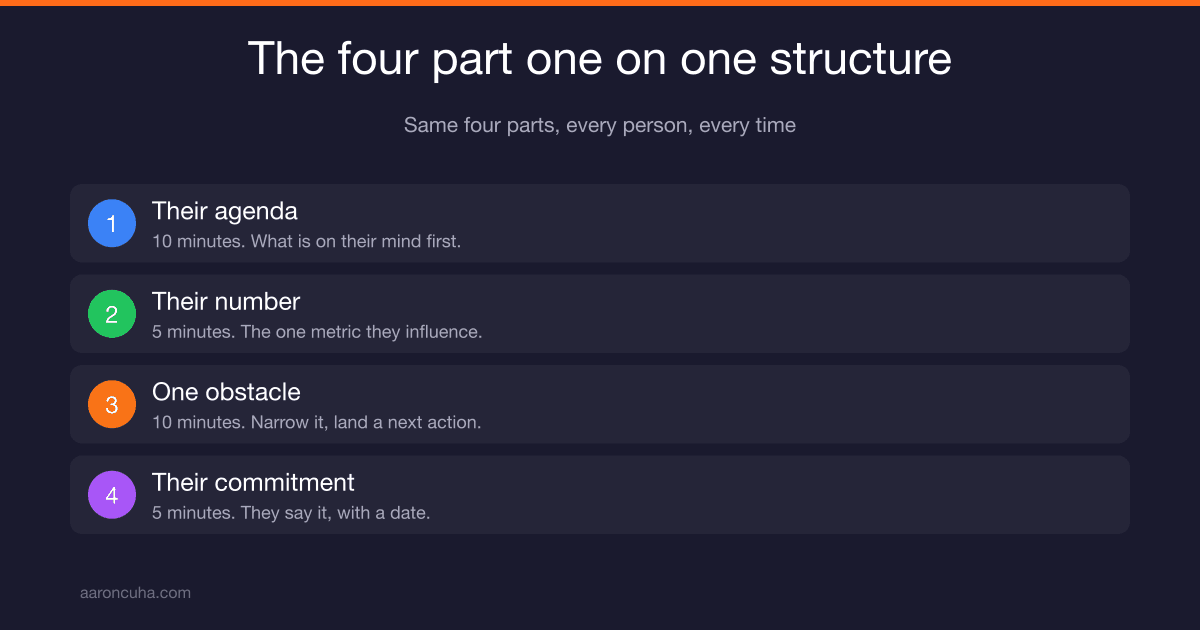
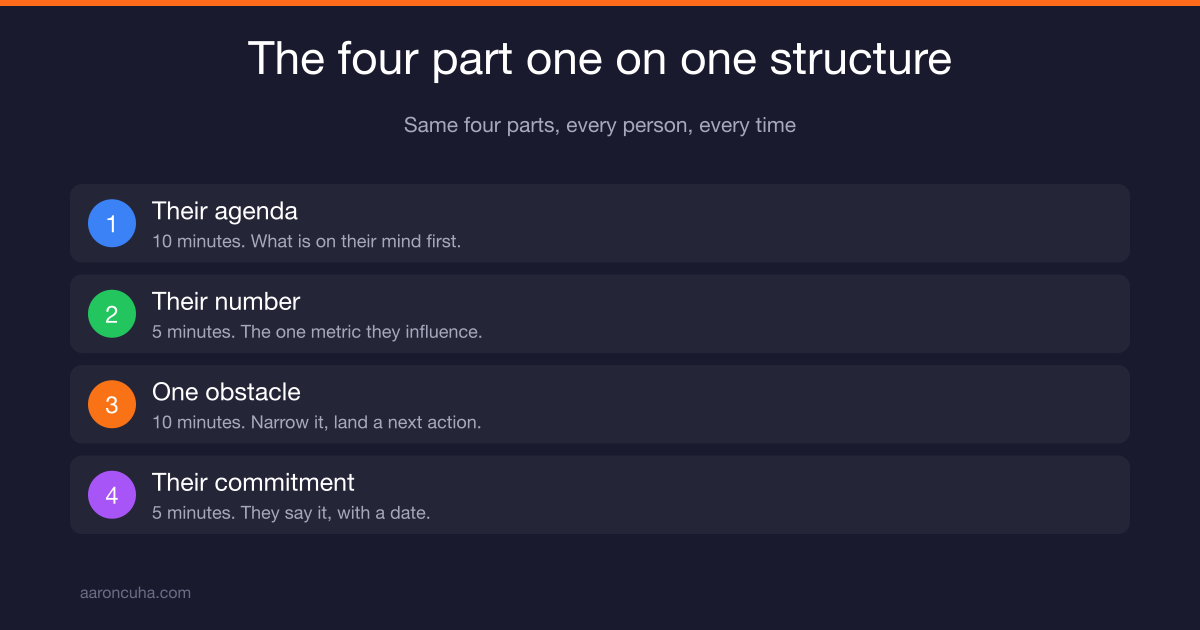
Run every one on one in four parts: their agenda, their number, one obstacle worked to a next action, and a commitment they say out loud. Same four parts, every time, every person.
Here is the time budget for a 30 minute meeting.
- Their agenda: 10 minutes. What is on their mind before anything is on yours.
- Their number: 5 minutes. The one metric they influence weekly.
- One obstacle: 10 minutes. Narrow, ask, and land on a next action.
- Commitment and your items: 5 minutes. They speak the commitment. You add anything you parked.
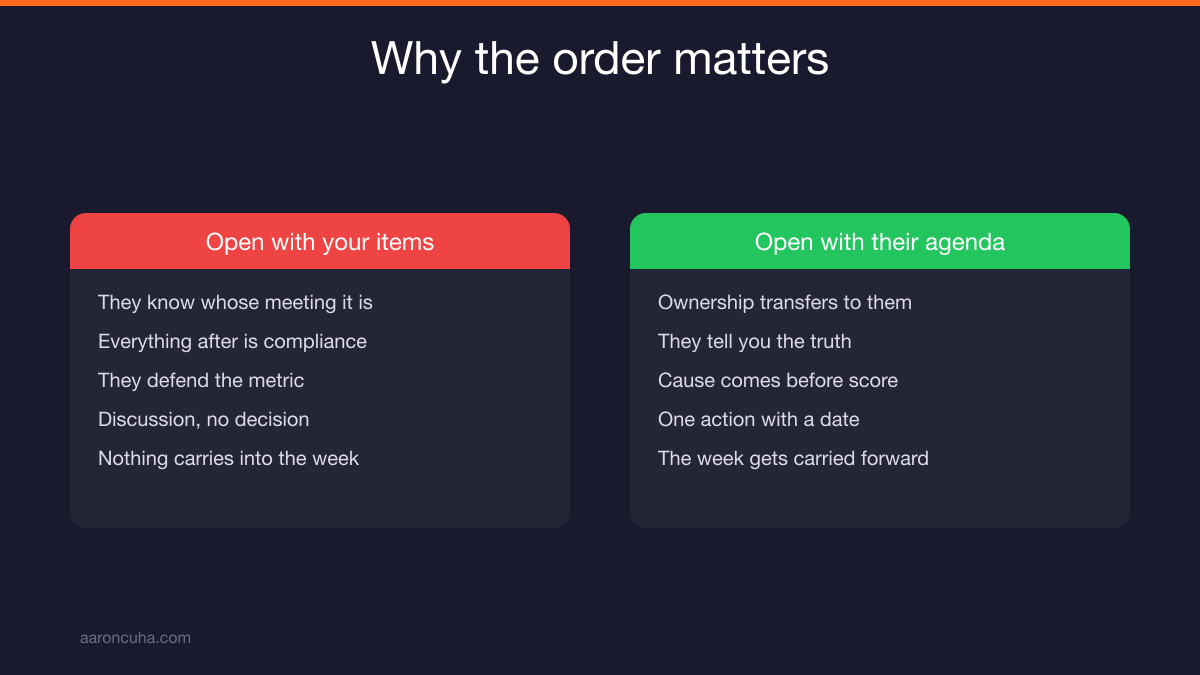
The order matters more than the timing. If you open with your items, you have already told them whose meeting this is. Everything after that is compliance.
If you review the number before hearing their agenda, they spend the first ten minutes defending a metric instead of telling you the truth.
And if you skip the spoken commitment, you get a discussion instead of a decision. The commitment is what carries the meeting into the week.
Do not customize the structure per person. The repeatability is the point. Same four parts means you stop improvising and they stop guessing.
Part One: Open With Their Agenda, Not Yours
Open every one on one by asking what they want to use the time for. This one habit transfers ownership of the meeting from you to them, and ownership is what produces change between sessions.
Use one of these openings. Say it, then stop talking.
- "What do you want to get out of this thirty minutes?"
- "What is the most useful thing we could talk about today?"
- "What is stuck right now that you have not been able to move?"
Then hold the silence. Count to ten in your head. Most managers cannot survive four seconds of quiet and fill it with their own agenda, which trains the person to wait you out.
Silence is a tool, not an accident. The first answer is usually the safe one. The real answer arrives after the pause.
Your items still matter. Park them. Write them at the bottom of your page and bring them in the last five minutes.
If something of yours is genuinely urgent, say so up front: "I have one item I need three minutes on at the end. Everything before that is yours." Now they know the boundary and they still own the open.
After a few weeks, people start showing up prepared because they know the first question is coming. That is the behavior change you actually want.
Part Two: Review the One Number They Own
Every direct report should have one number they can influence with their own effort every week. Review it in five minutes. Not five numbers. One.
The number does not need to be revenue. It needs to be something they control, something they can see weekly, and something that moves the business if it moves.
Examples by role, stated as categories rather than targets:
- Sales: conversations started with new prospects
- Marketing: pieces of content published on schedule
- Operations: files cleared without rework
- Service: issues closed on first contact
- Recruiting: qualified candidates advanced to interview
Set the number together in one conversation. Ask: "If only one number moved this quarter, which one would tell us you are winning?" Then ask whether they can influence it weekly without waiting on anyone else.
If they cannot influence it weekly, it is the wrong number. A number that depends on three other departments teaches helplessness.
Review it with two questions. What is the number this week? What made it that number? You are looking for the cause, not the score.
When they do not know their number, that is your entire agenda for the meeting. Do not lecture. Ask where they would find it, and have them bring it next week. Knowing your own number is a job requirement, not a favor to you.
Part Three: Work One Obstacle to a Next Action
Pick one obstacle and work it all the way to a specific next action. Not four obstacles discussed at surface level. One, taken to the point where the next step is obvious.
Start by narrowing. "You named three things. Which one, if it were solved, would make the other two smaller?" Let them choose. Their choice tells you where their energy actually is.
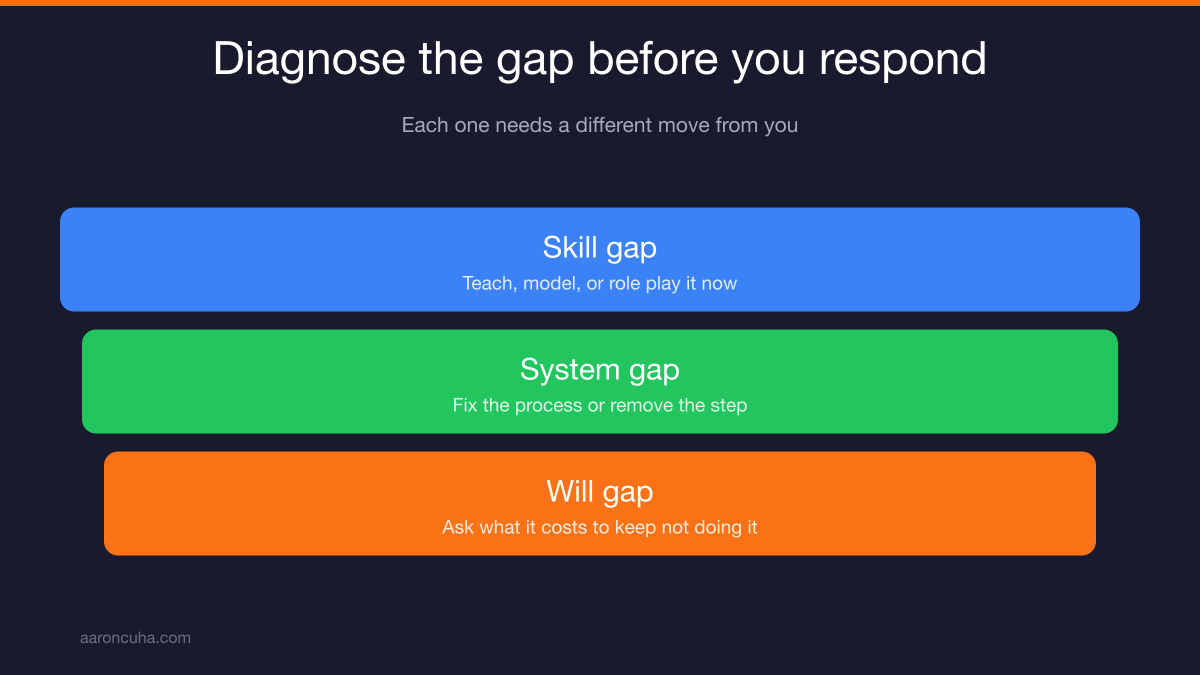
Then diagnose which of three gaps you are dealing with, because each requires a different response from you.
| Gap Type | What It Sounds Like | Your Response |
|---|---|---|
| Skill gap | "I do not know how to handle that call." | Teach, model, or role play it now |
| System gap | "It takes me an hour to pull that report." | Fix the process or remove the step |
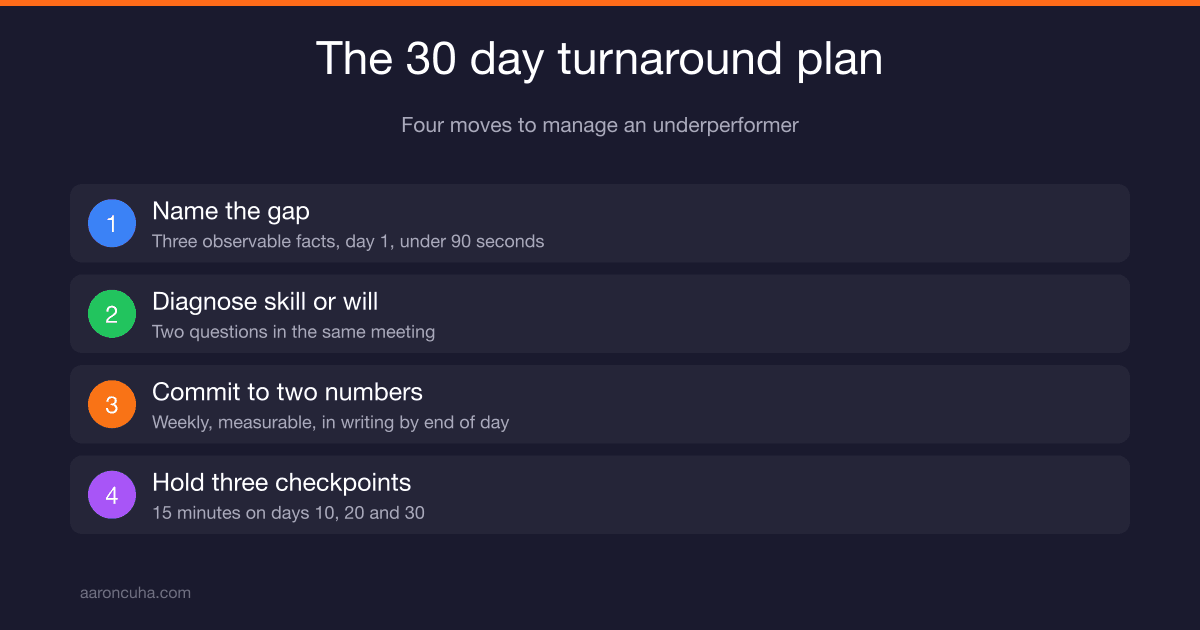
| Will gap | "I know what to do, I just have not done it." | Ask what it costs to keep not doing it |
Most managers treat every gap as a skill gap and explain harder. If it is a system gap, your explanation is noise. Fix the system and the behavior follows.
Will gaps are the ones people avoid. Do not moralize. Ask what makes the task hard to start, and what would make it easier to start tomorrow. Usually you find a hidden system gap underneath.
End this section with an action, not a conclusion. "So what is the first move, and when?" If the answer has no verb and no date, keep working.
This is the same logic behind delegating without becoming the bottleneck. You are transferring ownership of the solution, not just the task.
Part Four: Close With a Commitment They Say Out Loud
End every one on one with the direct report saying the commitment in their own words and naming the date. If you say it for them, it is your commitment, not theirs.
The script is short. "Say back to me what you are going to do and by when."
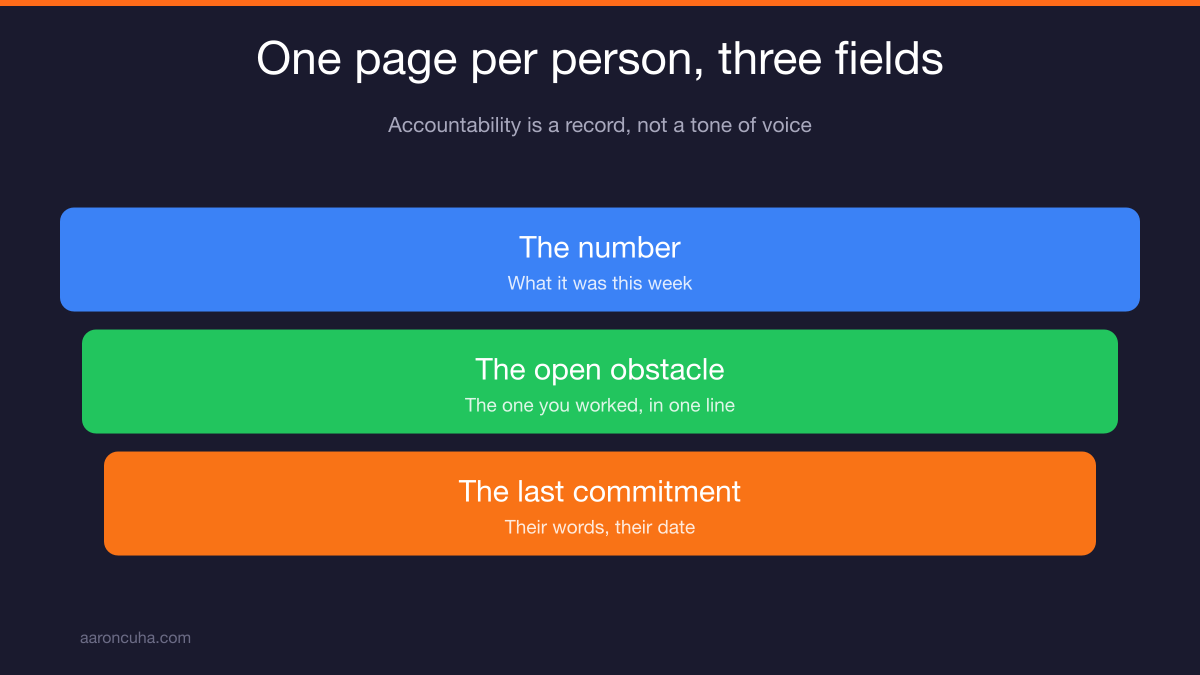
Then write it down. Your one page per person needs exactly three fields.
- The number. What it was this week.
- The open obstacle. The one you worked, in one line.
- The last commitment. Their words, their date.
Open the next meeting by reading the last commitment back. Not to shame anyone. To close the loop.
Accountability is not a tone of voice. It is a record. When people know the commitment gets read back next week, follow through improves without a single hard conversation.
If the commitment did not happen, do not react emotionally. Ask one question: "What got in the way?" You are back in part three, diagnosing skill, system, or will.
Three missed commitments in a row is not a coaching problem anymore. That is a role fit conversation, and it needs its own meeting.
The One on One Meeting Questions That Surface Real Problems
The best one on one meeting questions are short, open, and about the person rather than the project. Here is the question bank I use, organized by the four parts of the structure.
Opening questions
- What do you want to get out of this time?
- What is stuck that you have not been able to move?
- What did you decide not to do this week, and why?
- Where did you spend time that you wish you had not?
Number questions
- What is your number this week?
- What made it that number?
- What would have to be true for it to be higher next week?
- Is this still the right number to be measuring?
Obstacle questions
- Which one of these, if solved, makes the others smaller?
- What have you already tried?
- Is this a skill thing, a system thing, or a starting thing?
- What would you do if I were not available to approve it?
- What is the smallest version of this you could do this week?
Commitment questions
- What are you going to do, and by when?
- What would stop you from doing that?
- What do you need from me to make it happen?
Trust questions, used sparingly
- What is something you have been hesitant to bring up with me?
- Where am I making your job harder?
Use the last two once a quarter, not weekly. Asked too often they become routine and get routine answers.
Want the structure installed in your leadership rhythm instead of sitting in a doc? Explore executive coaching and we will build the cadence, the questions, and the accountability loop together.
The Questions to Stop Asking
Some questions guarantee a useless answer. They are polite, comfortable, and completely empty. Replace them with a version that forces specificity.
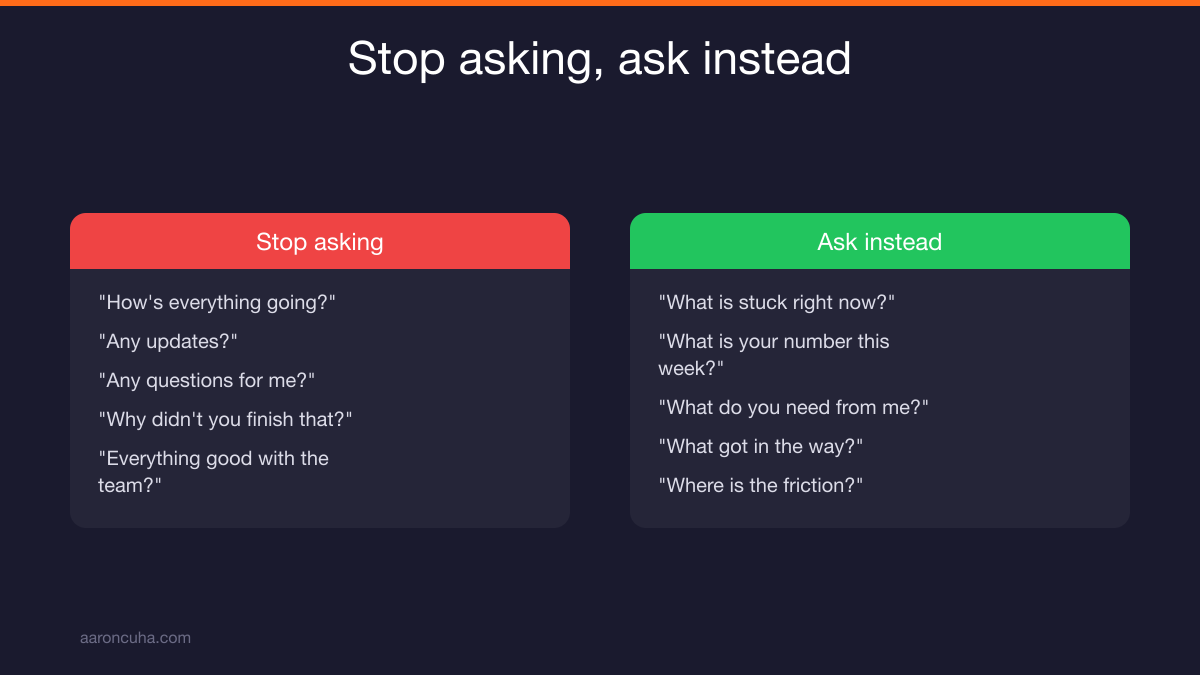
| Stop Asking | Ask Instead |
|---|---|
| "How's everything going?" | "What is stuck right now?" |
| "Any updates?" | "What is your number this week and what caused it?" |
| "Do you have any questions for me?" | "What do you need from me this week?" |
| "Why didn't you finish that?" | "What got in the way?" |
| "Don't you think we should just call them?" | "What are the options as you see them?" |
| "Everything good with the team?" | "Where is the friction on the team right now?" |
Look at the left column. Every one of them can be answered with "yes," "fine," or "nope." That is not a conversation, that is a toll booth.
"Why didn't you" is the most damaging question on the list. It puts the person on defense and you get a justification instead of a cause. "What got in the way" gets you the same information without the armor.
Leading questions are the subtle killer. When you ask "Don't you think we should just call them," you have already given the answer. They will agree, and you will believe you got buy in. You got compliance.
Fix this by asking for options before you offer yours. Your opinion always lands louder than you think it does.
How Often to Meet Based on Tenure
Cadence depends on tenure and situation, not on your calendar pressure. New people and ramping people need weekly. Steady performers can go biweekly. Anyone on a performance plan gets weekly, no exceptions.
| Situation | Cadence | Length | Focus |
|---|---|---|---|
| First 90 days | Weekly | 30 minutes | Clarity, standards, early wins |
| New role or new territory | Weekly | 30 minutes | Skill building and system gaps |
| Steady performer | Biweekly | 30 minutes | Number, obstacle, growth |
| Performance plan | Weekly | 30 minutes | Commitments and documentation |
| Senior leader | Biweekly | 45 minutes | Strategy, their team, their own development |
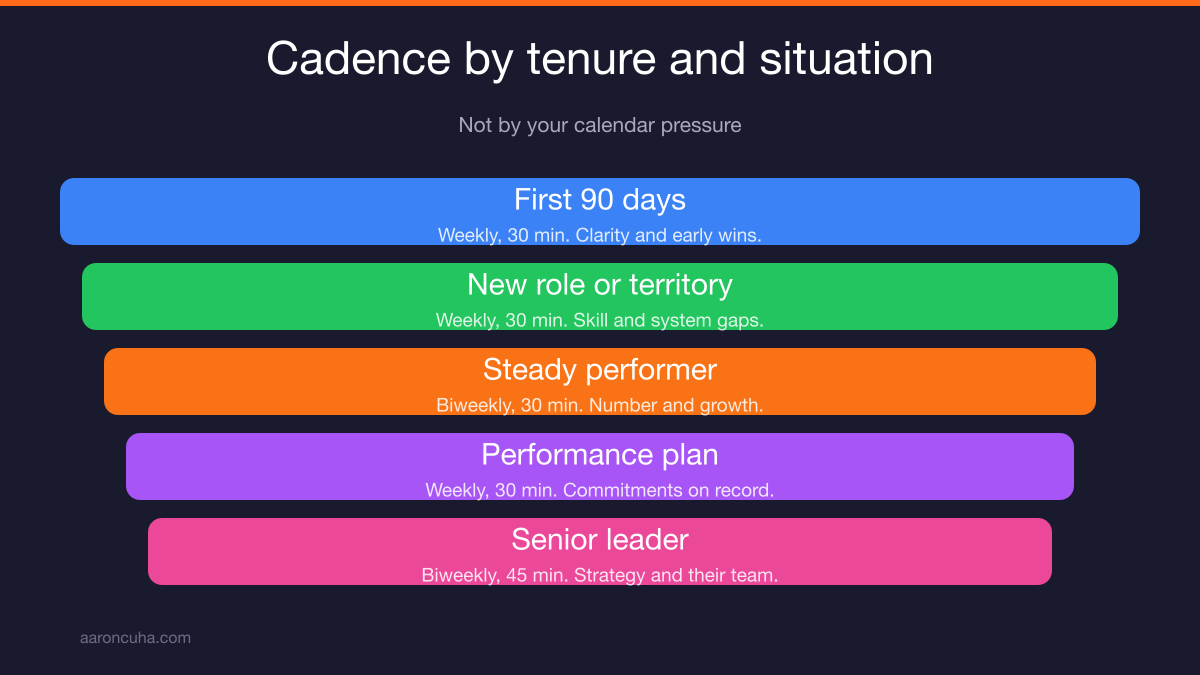
Thirty minutes is enough when the structure is fixed. Sixty minutes with no structure produces less than thirty with one.
Do not cancel a one on one to take a client call. Cancel it once and it is a scheduling issue. Cancel it twice and you have taught your team that they rank below everything else on your calendar.
Reschedule instead. Move it in the same week, and tell them why. That small habit says the meeting matters more than any speech about culture.
If your calendar cannot hold five weekly one on ones, your calendar is the problem, not the meetings. That is a systems over hustle issue, and it is solvable.
How to Handle the Person Who Has Nothing to Discuss
When someone says they have nothing to discuss, there are three possible causes: an unclear number, low psychological safety, or genuine flow. Diagnose before you fill the silence.
Cause one: they do not know what they own. If nobody has defined their number, they have nothing to report on. This is the most common cause and it is entirely on you.
Script: "Let's use today to set your number. If one metric proved you had a great quarter, what would it be?"
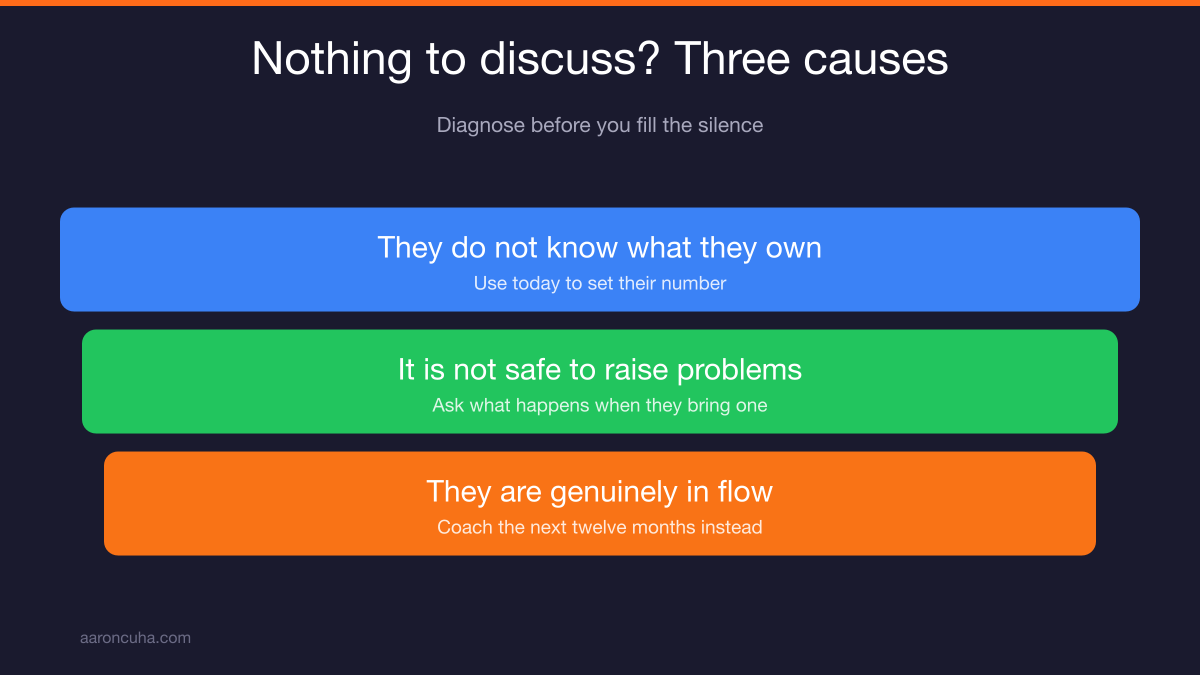
Cause two: it is not safe to bring up problems. Somewhere along the way, raising an issue cost them something. Now silence is the safer play.
Script: "I want to check something. When you bring me a problem, what usually happens next?" Then listen without correcting. According to Harvard Business Review, teams that surface problems early outperform teams that hide them, and that starts with how leaders react in the moment.
Cause three: they are genuinely in flow. Some strong performers really are unblocked. Do not manufacture a problem to feel useful.
Script: "Sounds like execution is clean. Let's use the time on where you want to be in twelve months." Then coach the future instead of the week.
The one thing you must not do is fill the silence with your own updates. Do that twice and the pattern is permanent: they show up empty, you talk, everyone leaves on time and nothing changes.
Make It a System, Not a Good Intention
Consistency here is not a discipline problem. It is a system problem. Build the calendar blocks, the one page per person, and the same four questions, and the meetings run themselves.
I learned this the hard way. I built DirectLender to 280 offices and 3,000 employees, and I lost it in the 2008 collapse. What survived scale was never the motivation. It was the repeatable structure. That lesson became the Systems Over Hustle framework and it sits at the center of my next book, The Willpower Lie.
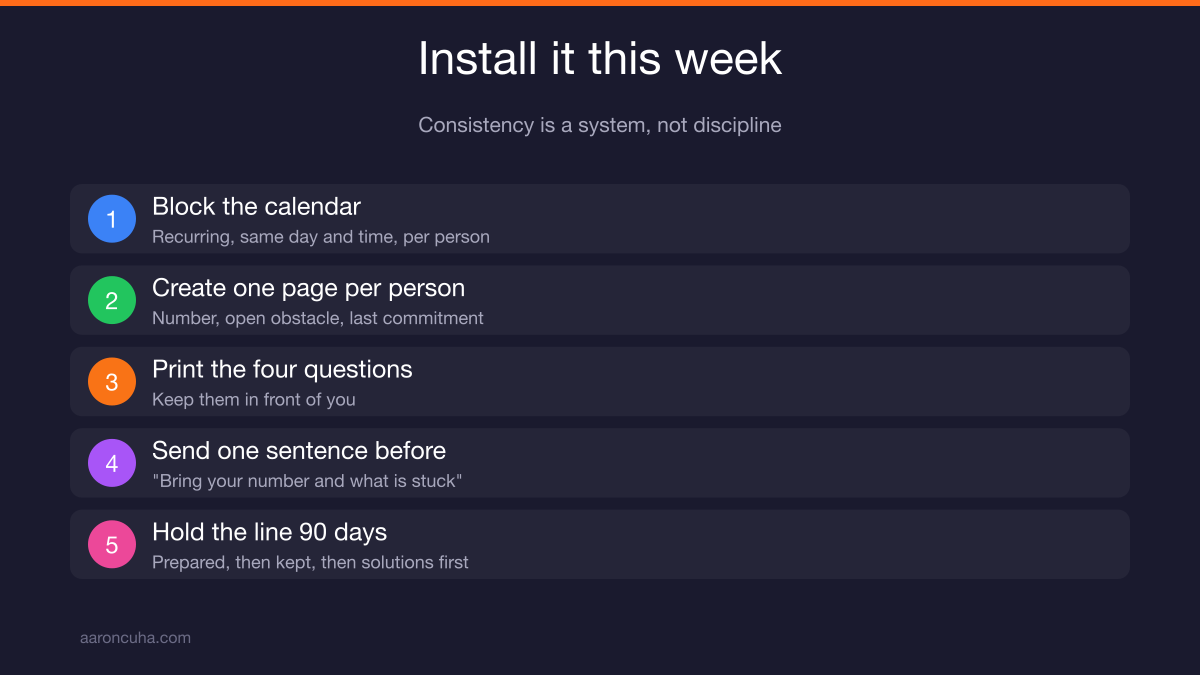
Here is the install, in four steps you can do today.
- Block the calendar. Recurring, same day, same time, per person. Make them non negotiable.
- Create one page per person. Three fields: number, open obstacle, last commitment.
- Print the four questions. Keep them in front of you until you stop needing them.
- Send one sentence before each meeting. "Bring your number and the one thing that is stuck."
What to expect if you hold the line:
- After 30 days: people start arriving prepared because they know the first question.
- After 60 days: commitments start getting kept, because they get read back.
- After 90 days: you stop solving their problems and start hearing solutions before you ask.
The Gallup body of work on engagement has pointed at manager quality for years, and the Society for Human Resource Management publishes practical guidance on performance conversations if you want more depth on the HR side.
One last note on leverage. The same discipline that makes a one on one work makes content, delegation, and automation work. If you want more of that thinking, see content systems for entrepreneurs and AI business systems.
Your first step today: open your calendar, block one recurring 30 minute meeting for each direct report, and write their three fields on one page. Then join the Systems Over Hustle community and get the accountability that keeps the cadence alive after week three.
Frequently Asked Questions

Written by
Aaron CuhaAuthor of Crazy Simple YouTube, keynote speaker, and executive coach with 20,000+ hours logged. ICF PCC, NLP Master Practitioner, and DISC Certified. Aaron helps entrepreneurs replace hustle with AI-powered systems that generate leads, content, and revenue on autopilot.