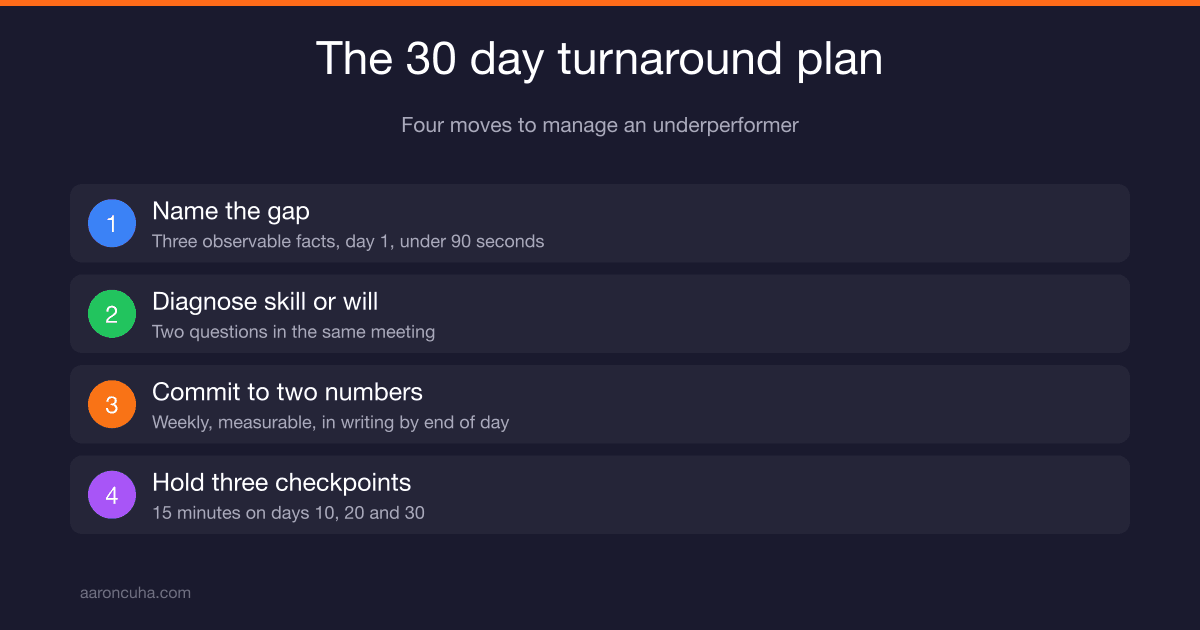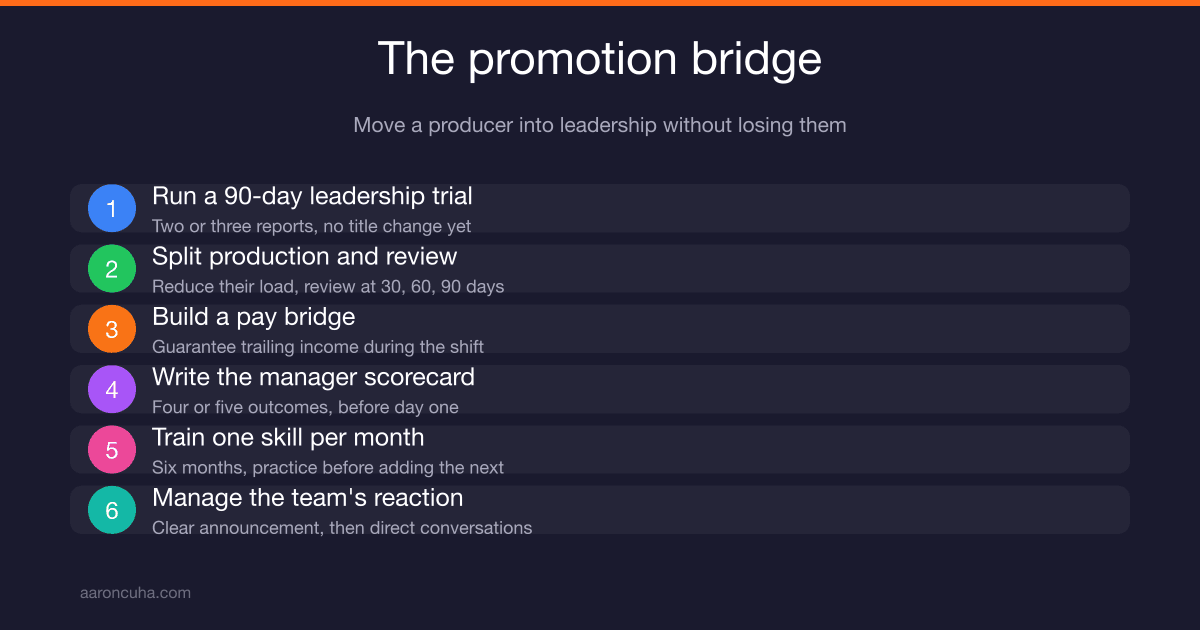
Leading a team through a downturn is not a strategy problem, it is a communication problem. When you go quiet, your people fill the silence with worst-case stories and start looking for the exit. Here are the five conversations you cannot hand to anyone else.
Leading a team through a downturn starts with one hard fact: your people are not waiting for information. They are inventing it. And the story they invent is always worse than the truth you are avoiding.
Key Takeaways
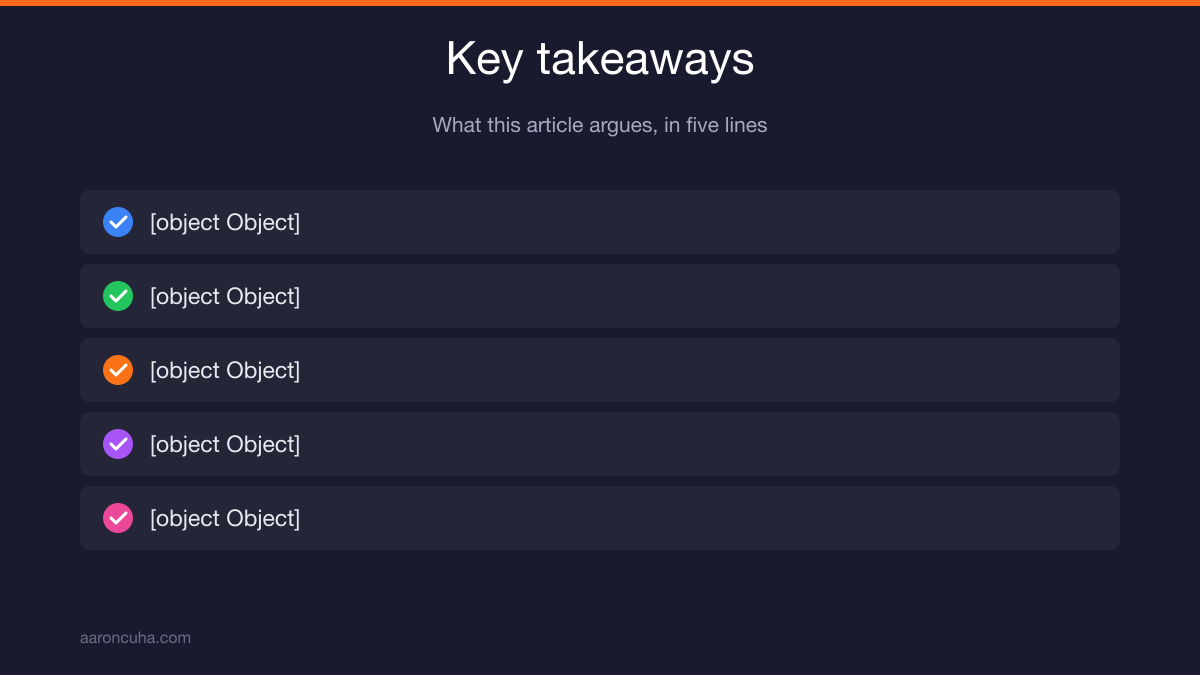
- Silence from a leader in a downturn always reads as bad news.
- Most owners lose their best people before they lose their revenue.
- Run five conversations in order, starting with the honest state of the business.
- Replace lagging revenue goals with a scorecard of controllable weekly activity.
- Set one standing weekly update, same day, same time, even when nothing changed.
If you are staring at a shrinking pipeline and a nervous team right now, I built the executive coaching program for exactly this moment. Bring me the real numbers and we will script these five conversations together before your next team meeting.
Why Silence Reads as Bad News
People do not tolerate an information vacuum. They fill it. When leadership goes quiet during a contraction, the team writes the worst possible version of events and starts acting on it.
Here is what actually happens inside your business while you are "waiting until you have a plan."
Your top producer notices you stopped walking the floor. Your operations lead sees a canceled meeting. Someone spots a recruiter's email in a colleague's browser. None of that is information. All of it becomes a story.
And the story spreads faster than any memo you were drafting.
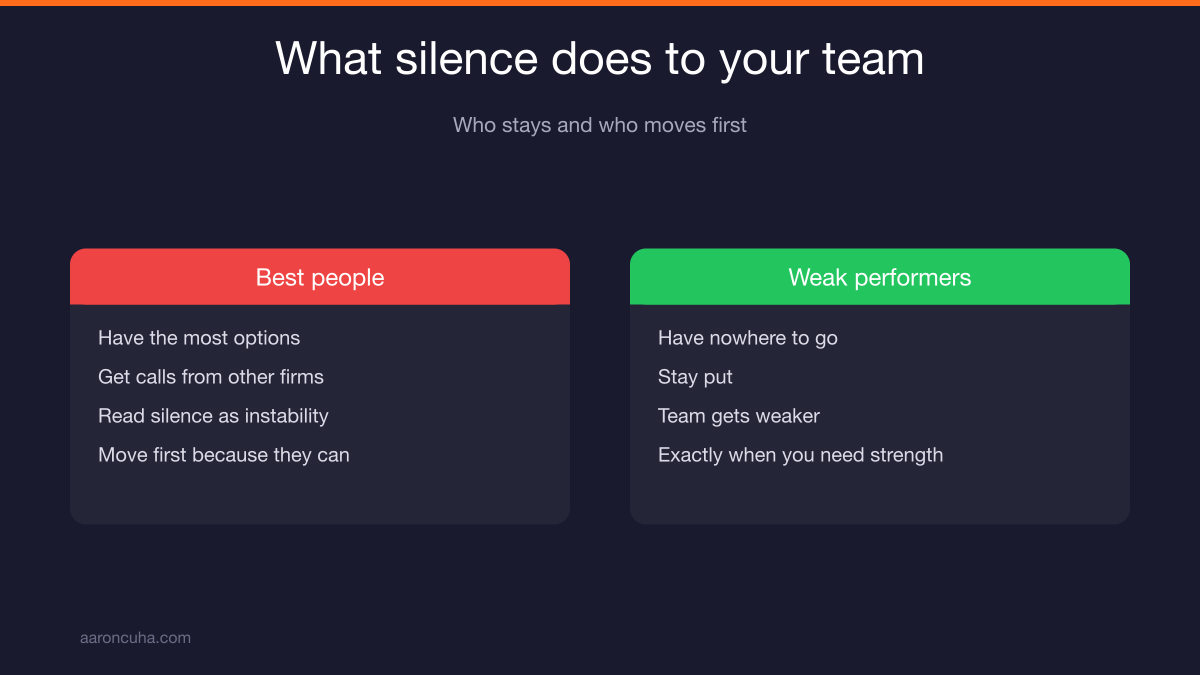
Leaders lose their best people before they lose their revenue. Your strongest performers have the most options. They are the ones other companies call. They are also the ones who read silence as instability and move first, because they can.
The weak performers stay. They have nowhere to go. So the natural result of leadership silence is a team that gets weaker exactly when you need it to get stronger.
That is the whole argument for this article. In a downturn, communication is not a soft skill. It is a retention system.
Research groups that study workplace engagement, including Gallup's workplace division, have spent decades pointing at the same lever: people need to know what is expected of them and where they stand. A contraction destroys both unless you rebuild them on purpose.
What I Got Wrong in 2008
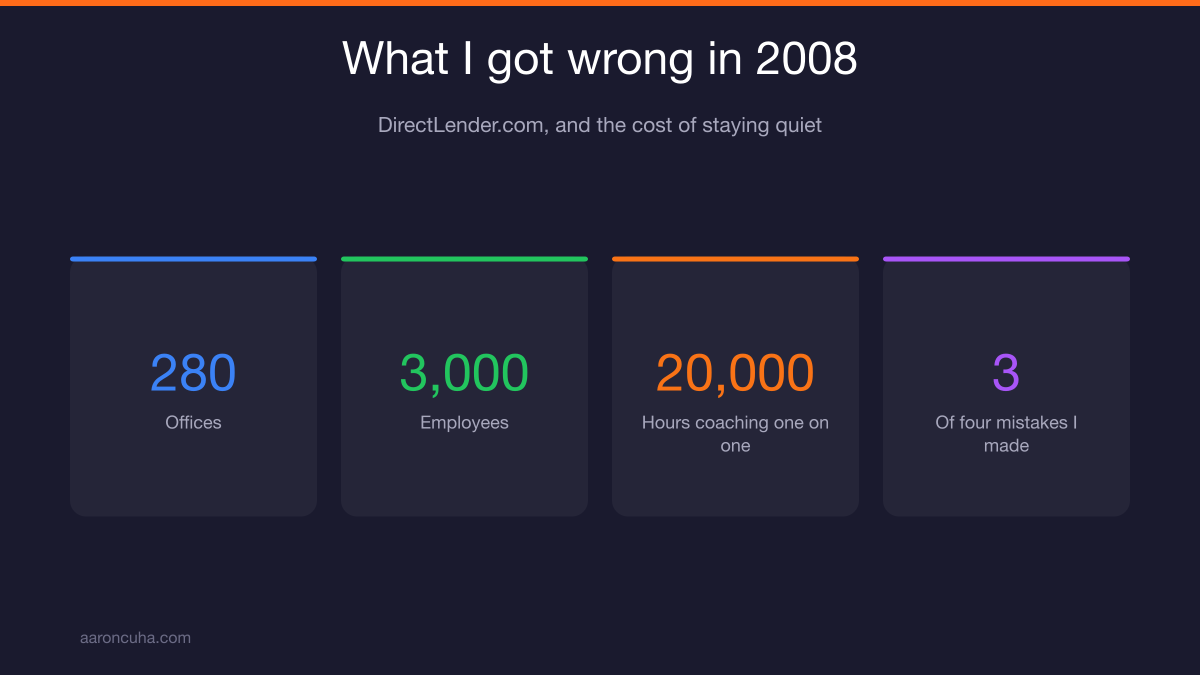
I ran DirectLender.com with 280 offices and 3,000 employees. When the market turned, my instinct was to protect people by staying quiet until I had answers. That instinct cost me the team long before it cost me the company.
I told myself I was being responsible. Why alarm 3,000 people over something I might fix in three weeks?
What I was actually doing was hoarding uncertainty so I would not have to feel it in front of anyone.
Meanwhile the news was public. Everyone could read what was happening to lending. So my silence did not create calm. It created a gap between what the market was screaming and what their leader was saying, and that gap is where trust dies.
By the time I spoke, I was not delivering information. I was confirming rumors. There is no leadership in confirming rumors.
I also made a second mistake. I cut in waves. A few here, a few there, month after month, because each round felt smaller and kinder. It was neither. Every survivor spent the next four weeks wondering if they were in the next batch.
I spent the decade after that doing humanitarian work in Nepal, and then twenty thousand hours coaching one on one. The lesson I teach now is the reverse of what I did then: speak early, speak short, speak again on a schedule. You can read more about how that collapse reshaped my approach.
The 5 Conversations Framework for Leading a Team Through a Downturn
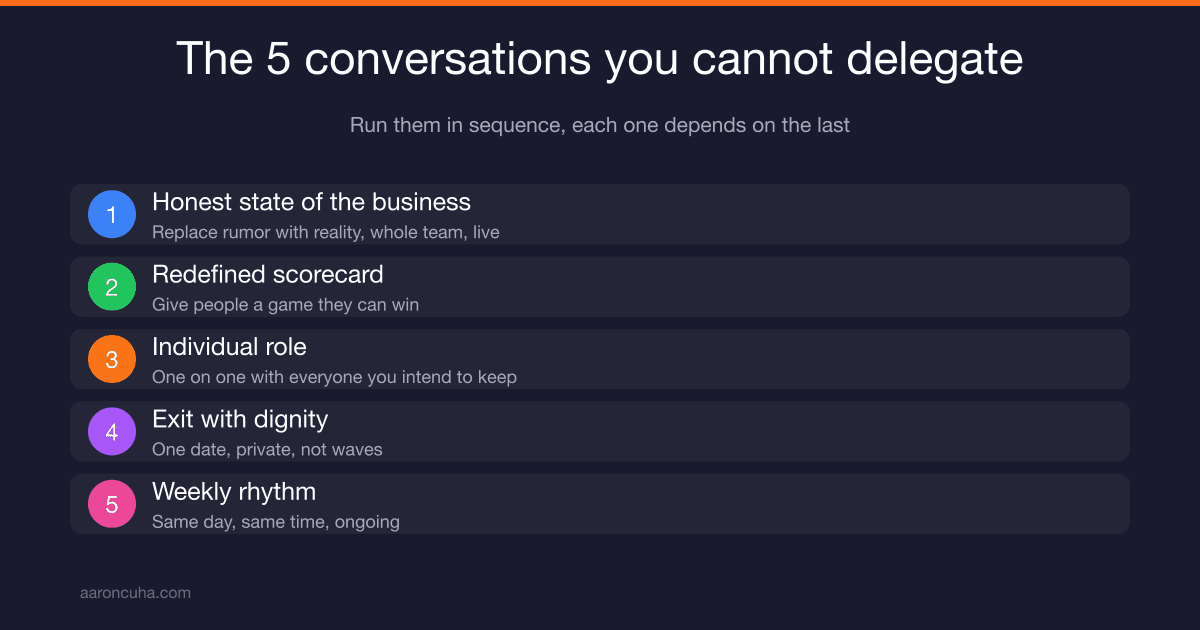
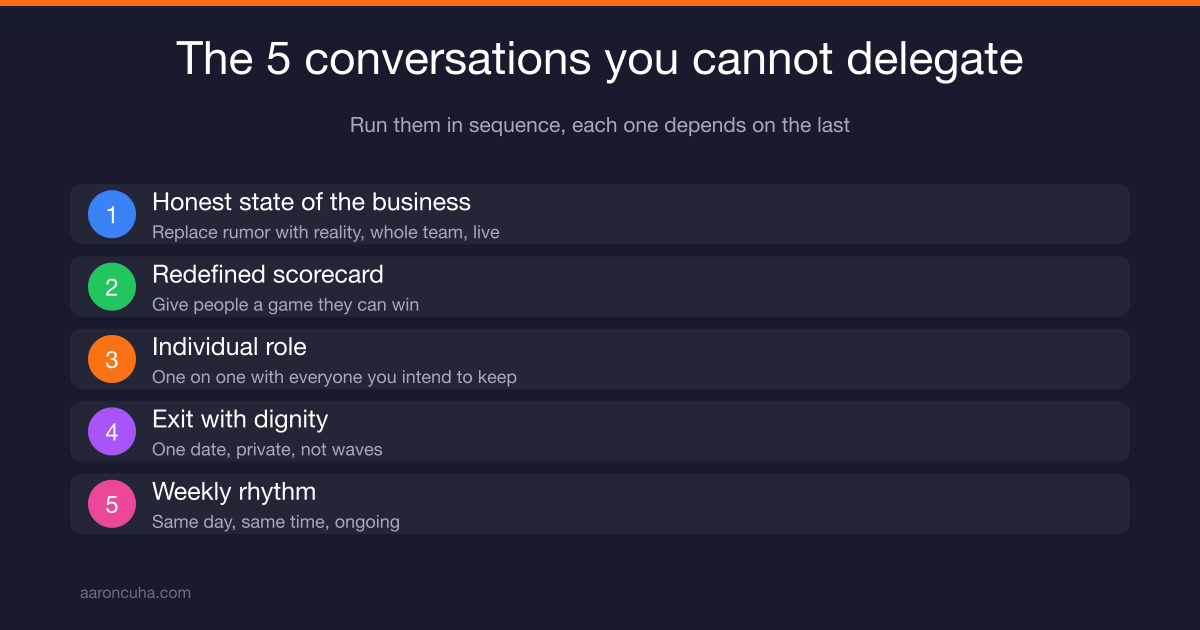
Leading a team through a downturn comes down to five conversations you cannot hand to anyone else. Run them in sequence: state of the business, redefined scorecard, individual roles, exits with dignity, then a weekly rhythm.
The order matters more than the wording. Each one fails if the one before it did not happen.
| Conversation | Purpose | Who hears it | When |
|---|---|---|---|
| 1. Honest state of the business | Replace rumor with reality | Whole team, live, together | This week |
| 2. Redefined scorecard | Give people a winnable game | Whole team, then by role | Within 7 days of #1 |
| 3. Individual role | Retain the people who matter | One on one, everyone you intend to keep | Within 14 days |
| 4. Exit with dignity | Cut once, cleanly, respectfully | Individuals, private, same day | One date, not waves |
| 5. Weekly rhythm | Kill rumor permanently | Whole team | Same day and time, ongoing |
Notice what is not on this list. There is no motivational speech. There is no "we just need to work harder" rally.
Effort was never the constraint. Structure is. That is the same principle behind Systems Over Hustle, and it applies to leadership communication as much as it applies to operations.
Conversation 1: The Honest State of the Business
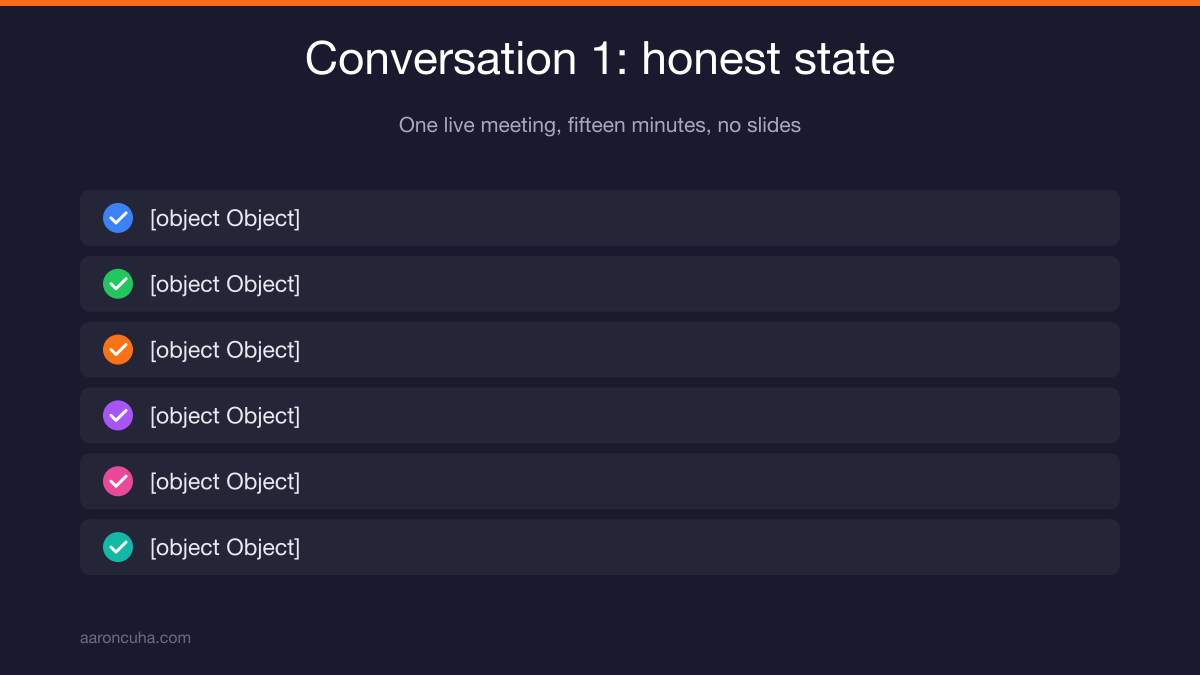
Hold one live all-team meeting. Deliver four things: what is true, what you do not know, what you are doing about it, and exactly when they hear from you next. Fifteen minutes, no slides.
Do it live and together. Not by email. Not by manager relay. People need to watch your face while you say hard things, because your steadiness is half the message.
Use this structure:
- What is true. Name the condition plainly. Volume is down. Closings slipped. The market changed. No euphemisms.
- What I do not know yet. This is the part most leaders skip, and it is the part that buys you credibility.
- What we are doing. Two or three specific decisions already made. Not intentions. Decisions.
- When you hear from me next. A date and a time. Then keep it.
On numbers, share direction and share what affects them. Pipeline trend, activity levels, runway in general terms, hiring status.
You are not obligated to publish your personal finances or every line of the P and L. Share enough that nobody has to guess, and no more.
Two rules I hold hard. Never promise "there will be no layoffs" unless you can guarantee it, because one broken promise erases ten true statements. And never end the meeting without the next date.
Then take questions in the room. Silence in the Q and A is not agreement. It is fear. Ask a question yourself to break it open: "What is the rumor you have heard that you want me to address?"
Conversation 2: The Redefined Scorecard
In a slow market, revenue goals become morale weapons. Move the scorecard to activity your team fully controls, so effort produces a visible win even when the market does not cooperate.
Think about what a lagging goal does in a contraction. Your agent hits every call, every appointment, every follow up, and still misses the closing target because buyers paused.
You just taught a great performer that good work does not count. Do that for two months and they leave.
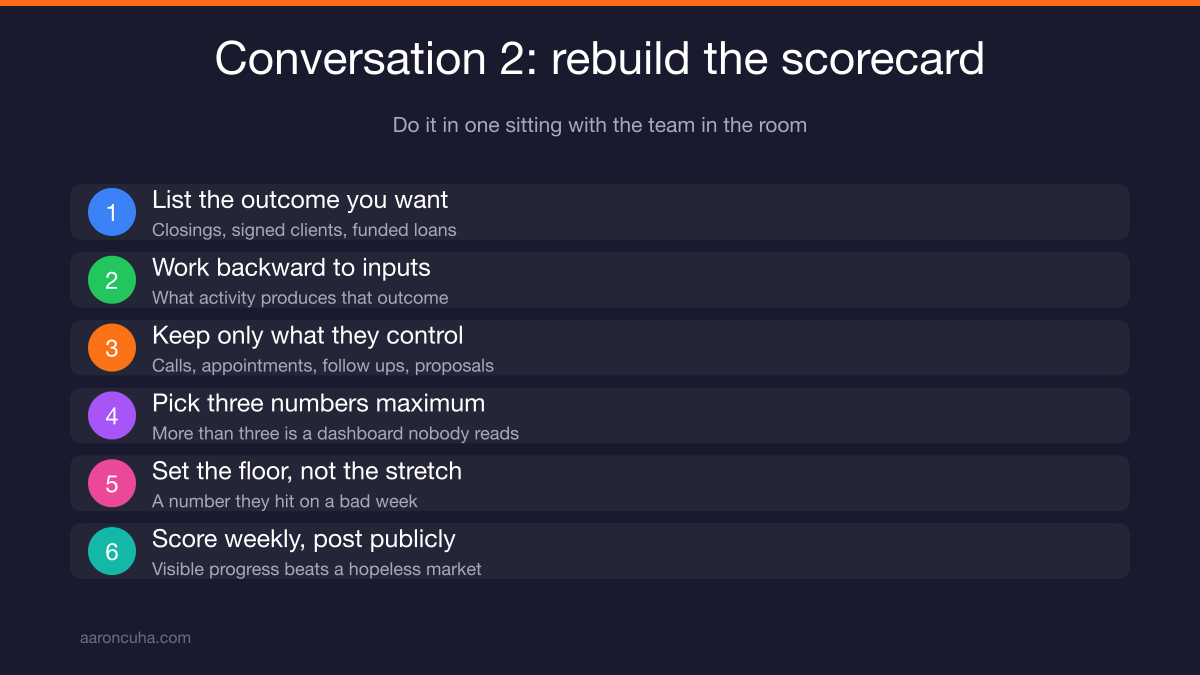
Rebuild the scorecard in one sitting, with the team in the room:
- List the outcome you want. Closings, signed clients, funded loans. Write it once, then set it aside.
- Work backward to inputs. What activity actually produces that outcome in your business?
- Keep only what the person controls alone. Conversations, appointments set, follow ups completed, videos published, proposals sent.
- Pick three numbers maximum. More than three is a dashboard nobody reads.
- Set the floor, not the stretch. A number they can hit on a bad week, not a hero number.
- Score it weekly and post it publicly. Visible progress is the antidote to a hopeless market.
Keep tracking revenue at the leadership level. Just stop making it the only measure of whether a person is winning.
This is also the moment to fix broken process, not add pressure. If your team is drowning in manual work, look at what AI systems can absorb so their three numbers stay reachable.
Conversation 3: The Individual Role Conversation
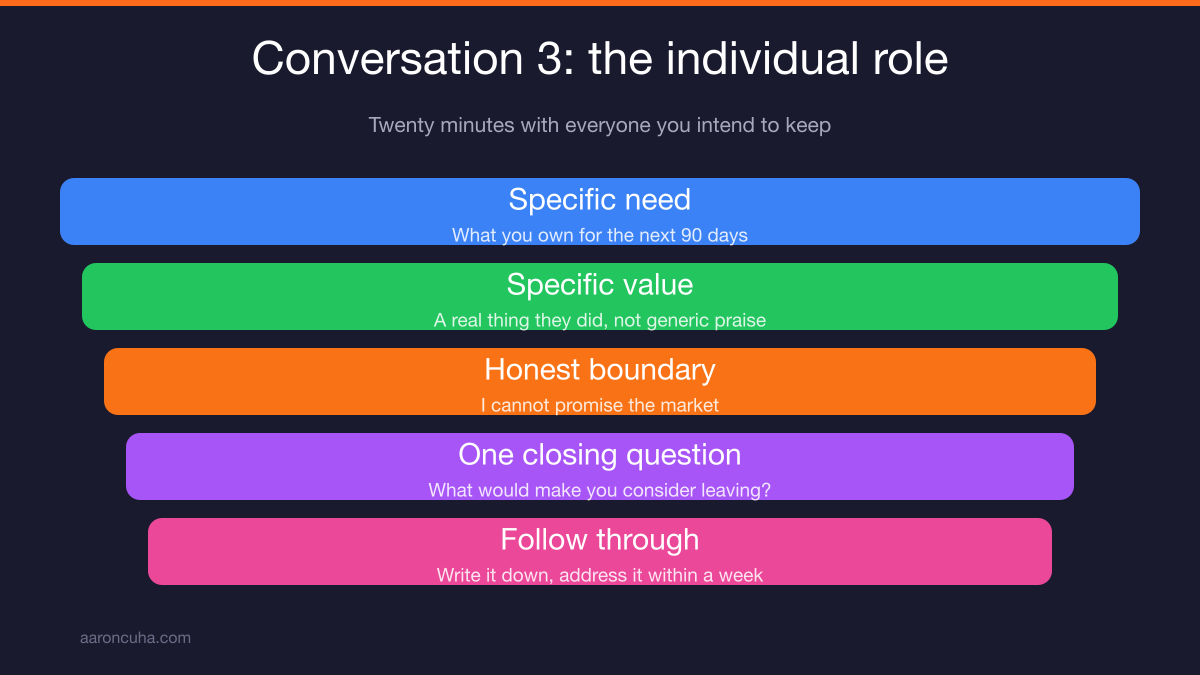
Sit down one on one with every person you intend to keep. Tell them what you need for the next 90 days, why they specifically matter, and what you can and cannot promise. Twenty minutes each.
This is the highest-return retention move available to you, and almost nobody does it. Owners assume their best people know they are valued. Their best people assume the opposite, because they have not heard anything.
Run it in three parts:
- Specific need. "For the next 90 days I need you owning X. Here are the two numbers I will hold you to."
- Specific value. Name a real thing they did. Generic praise reads as a setup for bad news.
- Honest boundary. "I cannot promise the market. I can promise you will hear the truth from me first, and you are in my plan for the year."
Do not use these meetings to fish for reassurance. You are not asking them to comfort you.
Ask one closing question and then be quiet: "What would make you consider leaving?" Whatever they say, write it down and address it within a week.
The people you skip will assume they were skipped on purpose. So decide in advance who is on the list, and understand that the list is effectively your plan.
If you manage a real estate team and your producers are quietly interviewing elsewhere, my real estate coaching work covers this conversation script agent by agent. Bring your roster and we will sequence it.
Conversation 4: The Exit Done With Dignity
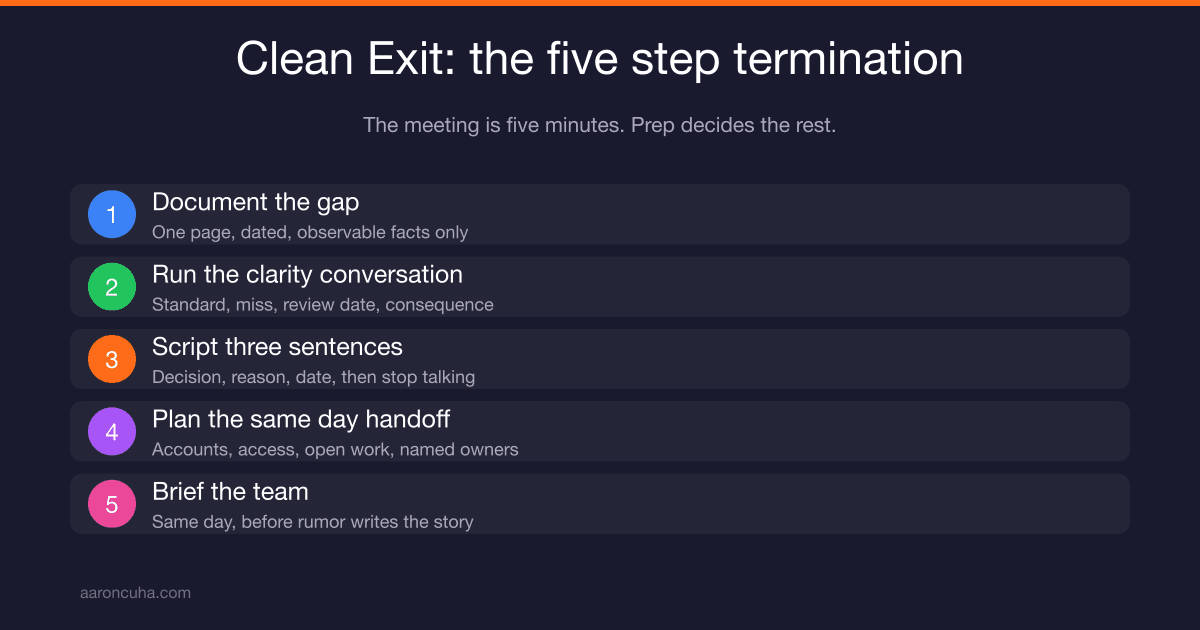
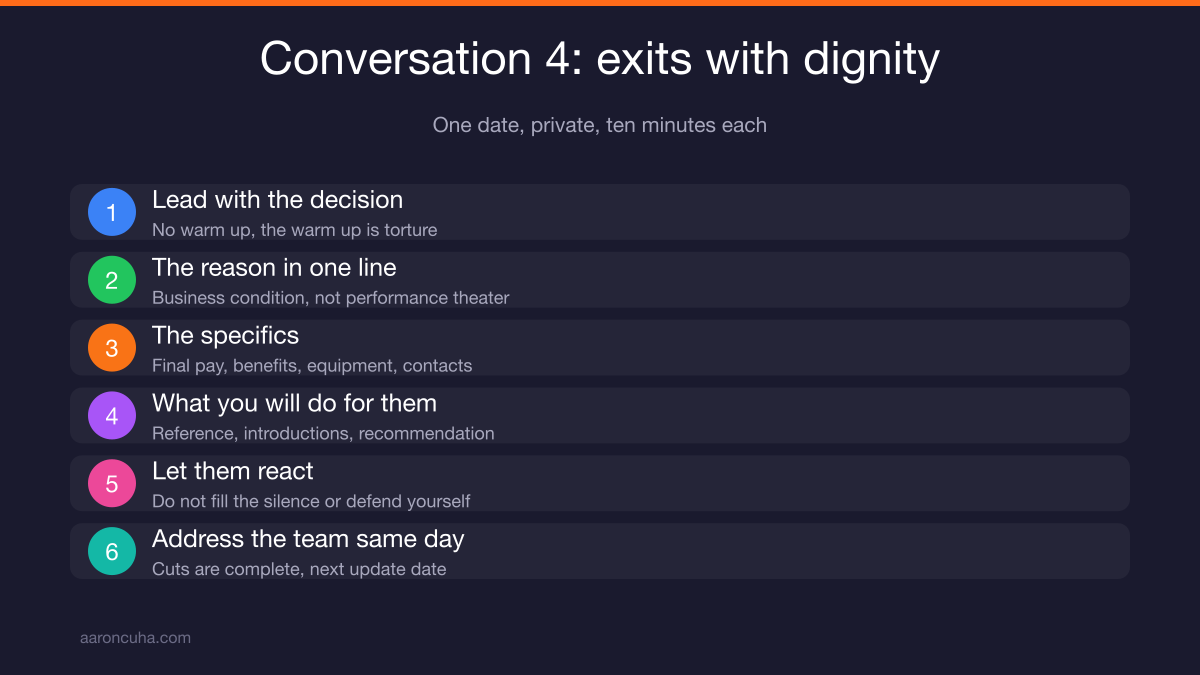
If you must cut, cut once, on one date, in private ten-minute meetings. Everyone who stays is watching how you treat the people who go, and they will price their loyalty accordingly.
The trickle layoff is the cruelest version of kindness. Every wave resets the fear clock for everyone left. Make the hard decision fully, then execute it in a single day.
Structure the meeting like this:
- First sentence is the decision. "I am eliminating your role, effective today." Do not warm up. The warm up is torture.
- Second, the reason in one line. Business condition, not performance theater.
- Third, the specifics. Final pay, benefits end date, equipment, references, who they contact.
- Fourth, what you will do for them. A written reference, three introductions, a LinkedIn recommendation, whatever you will genuinely deliver.
- Fifth, let them react. Do not fill the silence. Do not defend yourself.
What not to say: "This is harder for me than it is for you." "I fought for you." "You will land somewhere better." All of it centers you.
Get the legal and payroll details right before the day. Notice requirements can apply depending on your size and location, and the U.S. Department of Labor publishes guidance worth reviewing with counsel. Organizations like SHRM also cover practical process standards.
Then address the team the same day, in person. Tell them the cuts are complete, tell them the shape of the team going forward, and tell them the next update date. An unexplained exit is the single fastest way to start a rumor cycle.
Conversation 5: The Weekly Rhythm That Kills Rumor
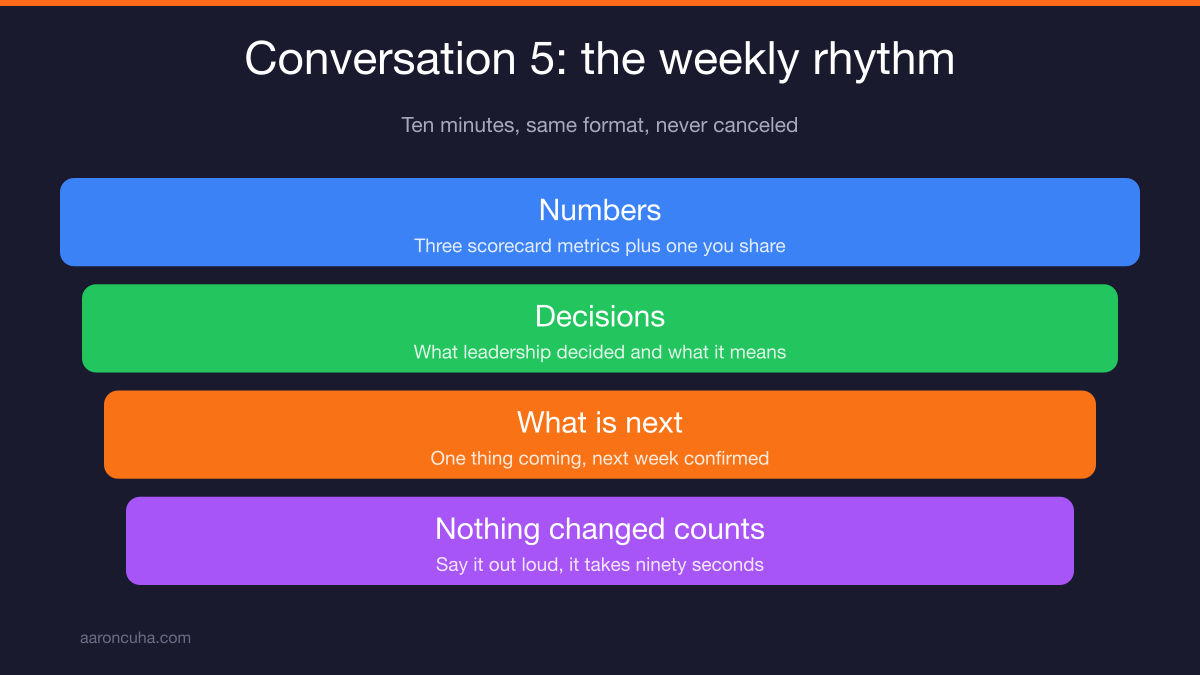
Set one standing weekly update. Same day, same time, same three-part format, ten minutes. You hold it even when nothing changed, because "nothing changed" is information too.
Rumor grows in the gaps between updates. Close the gaps and rumor starves.
The three-part format:
- Numbers. The three scorecard metrics, plus one business-level number you have chosen to share.
- Decisions. What leadership decided this week and what it means for their work.
- What is next. One thing coming, and confirmation of next week's slot.
Never cancel it. The week you cancel is the week everyone assumes something is wrong, and they are usually right, which is exactly why you should not cancel it.
If you have nothing new, say that out loud: "Three updates. Numbers held. No new decisions. Same time next Monday." That takes ninety seconds and buys you a quiet week.
Record it or write a short recap for anyone who missed it. Consistency is the product here, not polish. Publications like MIT Sloan Management Review have long argued that predictable communication cadence, not eloquence, is what stabilizes teams under stress.
Want the meeting templates, the scorecard sheet, and the exit script in one place? Grab them from the free downloads library and run the first meeting this week.
Which Parts You Can Delegate and Which You Cannot
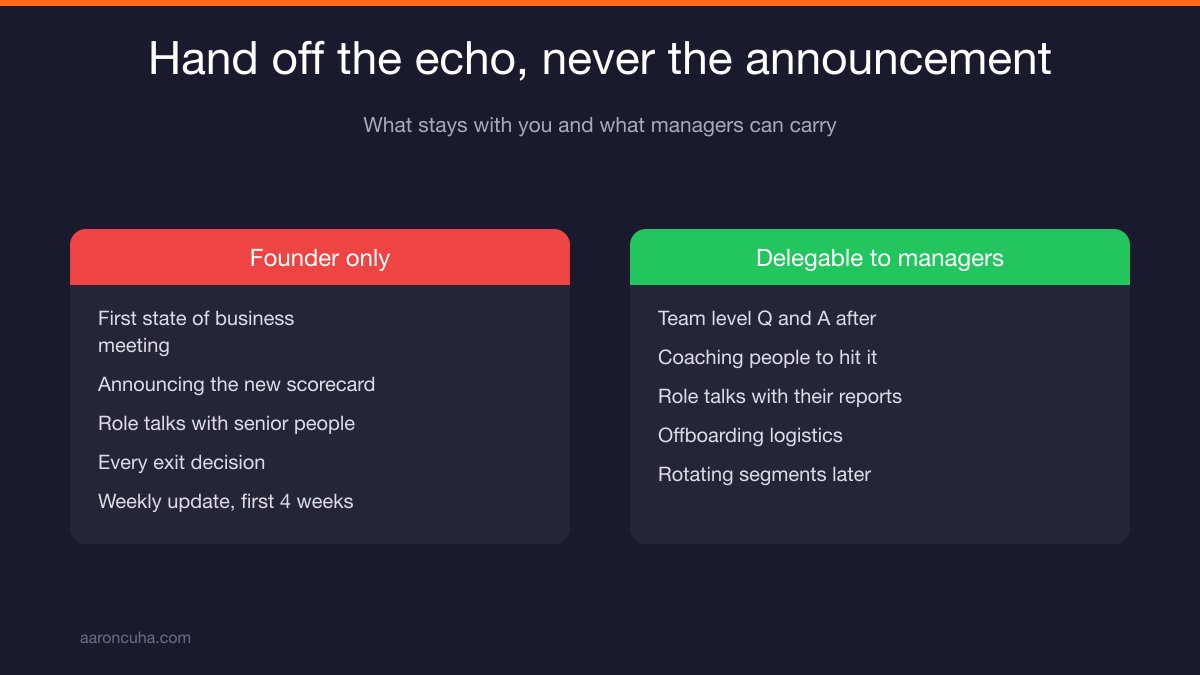
You own every first telling. Your managers own repetition, reinforcement, and follow through. Hand off the echo, never the announcement.
Delegation is normally the whole point. I have written plenty about how to stop being the bottleneck in your business. A downturn is the one place where the rule flips for a narrow set of moments.
| Founder only | Delegable to managers |
|---|---|
| The first state of the business meeting | Team-level Q and A afterward |
| Announcing the new scorecard | Coaching individuals to hit it |
| Role conversations with senior people | Role conversations with their direct reports |
| Every exit decision and the exits themselves | Offboarding logistics and equipment |
| The weekly update the first four weeks | Rotating segments after that |
Your managers are amplifiers, and they can only amplify what they actually have. So brief them first, before the all-team meeting, with the same information and the same words.
A manager who learns the news alongside the team loses authority instantly. A manager who is briefed an hour early becomes a second steady voice in every hallway conversation for the rest of the week.
Give them one script, one set of numbers, and permission to say "I do not know, I will ask." That sentence protects them and protects you.
The Four Mistakes That Cost You Your Best People
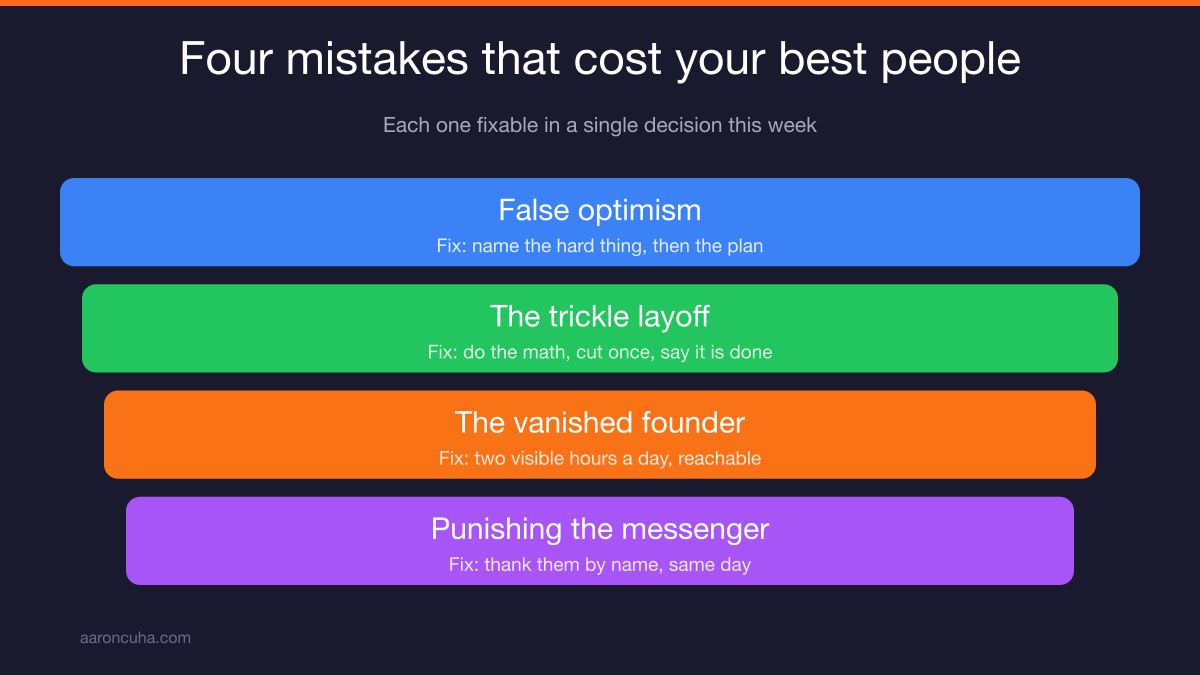
Four patterns do most of the damage: false optimism, the trickle layoff, the vanished founder, and punishing the messenger. Each one is fixable in a single decision this week.
False optimism. You tell the team it is fine when they can see it is not. Fix: name the hard thing first, then name the plan. Credibility before confidence.
The trickle layoff. Cuts in waves, each one framed as the last. Fix: do the full math, cut once, announce that cuts are complete.
The vanished founder. You retreat into spreadsheets and calls, and the floor reads absence as abandonment. Fix: block two visible hours a day where you are reachable and walking around, in person or on camera.
Punishing the messenger. Someone brings you a lost client or a broken process and you react badly. Fix: thank the person by name in front of others the same day. You need bad news to travel up fast, and it only does that if it is safe.
I made three of these four in 2008. The one I got right was staying visible, and it is the only reason some of those relationships still exist.
Business writing on crisis leadership from outlets like Harvard Business Review keeps circling the same finding I learned expensively: people forgive hard decisions and remember dishonest framing.
Lead Yourself First: Steadiness Is a System
Your team does not need you inspired. They need you predictable. Predictability under stress comes from structure, not from willpower, because willpower is the first thing a downturn takes.
This is the core of the book I am finishing, The Willpower Lie. Under pressure, discipline does not scale. Defaults do.
So build a few anchors your team can see:
- Same start time. You arrive when you always arrived. People read your calendar as a signal.
- One decision block. A fixed 60 minutes daily for the hard calls, so they stop leaking into every hour.
- Two visible hours. Floor time, doors open, no laptop.
- One outside voice. A coach, peer group, or board you tell the truth to, so your team is not carrying your fear.
- A hard stop. A time you go home. Exhausted leaders make waves of small cuts instead of one clean decision.
That last one is not self care language. A tired leader defers hard conversations, and every deferred conversation gets more expensive.
Talking to peers who are living the same market helps more than reading about it. That is what the Systems Over Hustle community exists for, and it is where a lot of these scripts get pressure tested before anyone uses them on a real team.
Your First 72 Hours
Do four things in the next three days: book the all-team meeting, write the three numbers you will share, list your one-on-ones, and put the weekly update on the calendar as a recurring block.
Day one. Send the meeting invite. Title it plainly, something like "Business update, all team, 15 minutes." Vague invites create the exact anxiety you are trying to end.
Day one, later. Write your four sentences: what is true, what you do not know, what you are doing, when they hear from you next. Read them out loud. If a sentence needs a paragraph of explanation, rewrite it shorter.
Day two. Brief your managers. Same numbers, same words, one hour before the team hears it.
Day two. Build the new scorecard with the team in the room. Three controllable numbers, a floor for each, posted where everyone sees it.
Day three. Write the list of people you intend to keep and block twenty minutes with each of them over the next two weeks. Put the meetings in the calendar now, before something else fills the space.
Day three. Create the recurring weekly update slot. Same day, same time, no expiration date.
None of this requires a better market. It requires you to speak first, speak short, and speak again on schedule.
If you would rather not run these five conversations alone, that is exactly what I do all day. Reach out and tell me what your team is facing, and we will build your first meeting, your scorecard, and your weekly rhythm before the rumors write your story for you.
Frequently Asked Questions

Written by
Aaron CuhaAuthor of Crazy Simple YouTube, keynote speaker, and executive coach with 20,000+ hours logged. ICF PCC, NLP Master Practitioner, and DISC Certified. Aaron helps entrepreneurs replace hustle with AI-powered systems that generate leads, content, and revenue on autopilot.