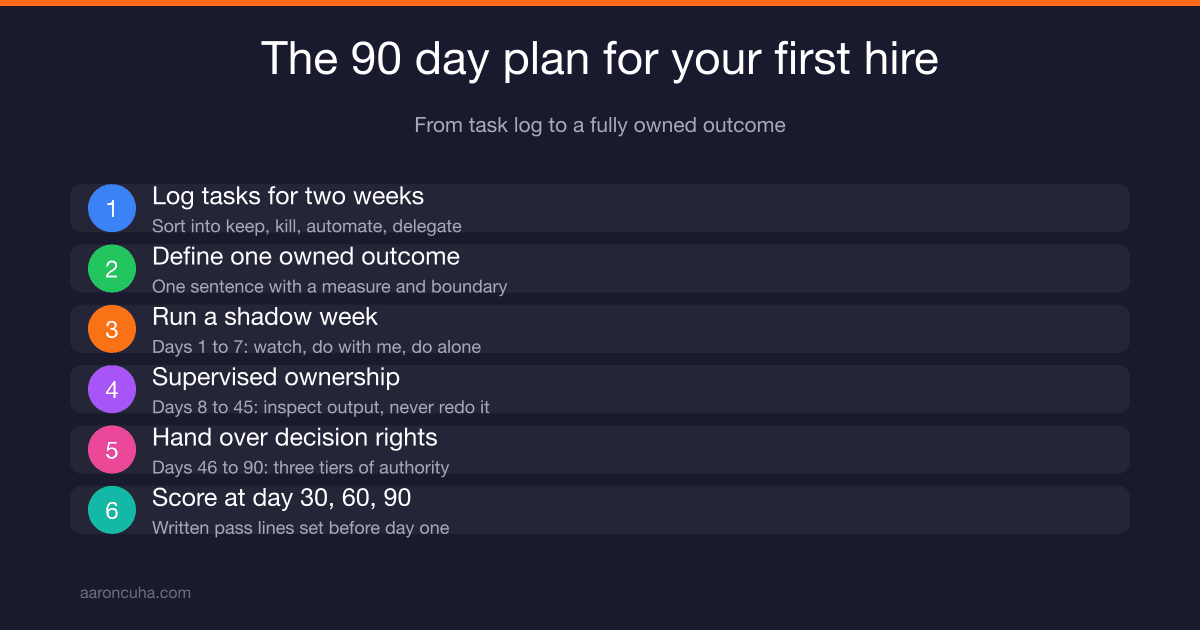
Most owners quit on delegation after one bad experience. The problem is rarely the person. Hiring a virtual assistant for small business only works when you define the first 90 days before you post the job. Here is the four phase plan.
Most first hires fail in the first 90 days. Not because the person was wrong, but because nobody defined what winning looked like. Here is the plan that fixes it.
Key Takeaways
- Log every repeatable task for two weeks before you post a job.
- Hire for one owned outcome, not a scattered pile of small tasks.
- Run a shadow week first. Record every session as your first SOPs.
- Hand over decision rights in three tiers between day 46 and day 90.
- Score the hire at day 30, 60, and 90 against written pass lines.
If you want a second set of eyes on where your time is leaking before you hire, book a strategy session and we will map your first delegation plan together.
Why Most First Hires Fail (It Is Not the Person)
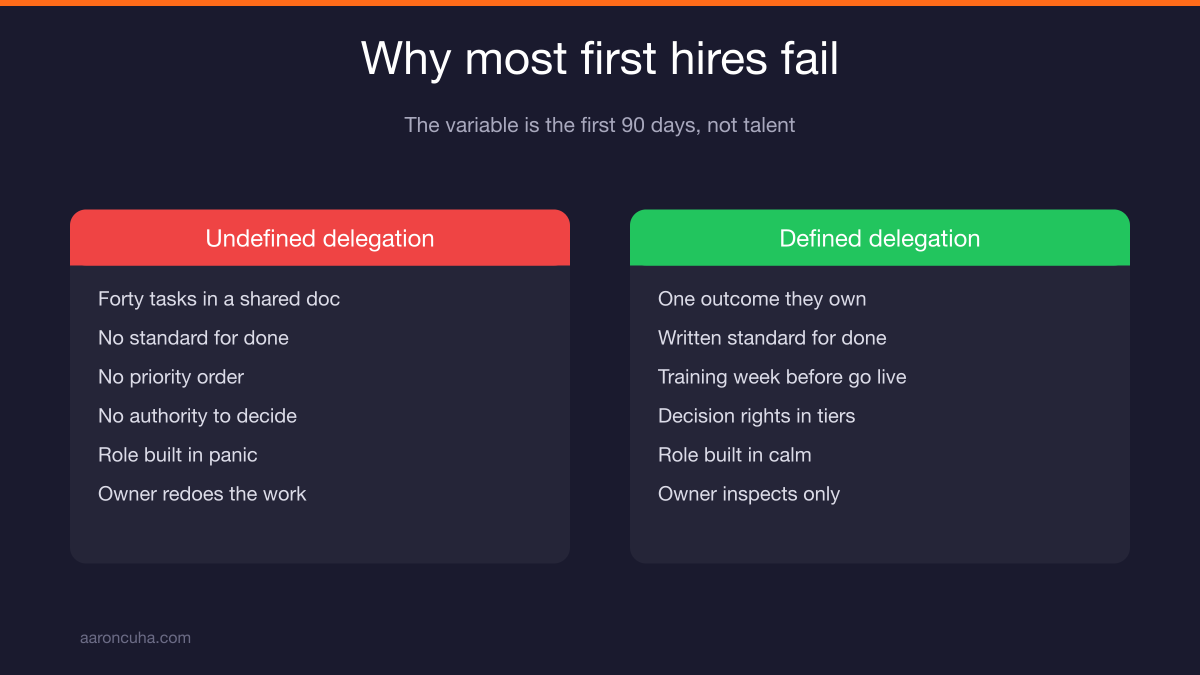
Hiring a virtual assistant for small business owners fails for one reason. You hand over a vague pile of tasks with no defined outcome, no training week, and no scorecard. The person never had a chance.
I have coached owners for more than 20,000 one on one hours. The story is almost always identical.
They wait until they are drowning. They hire fast. They dump forty random tasks into a shared doc. Three weeks later they are re doing the work themselves and telling anyone who will listen that delegation does not work for their business.
Delegation works fine. Undefined delegation does not.
Think about what you actually gave that person. A list of chores with no context, no priority order, no standard for done, and no authority to make a single decision. You gave them a maze and got frustrated when they hit walls.
The variable is not talent. The variable is the first 90 days.
When I built DirectLender to 280 offices and 3,000 employees, the thing that scaled was never my personal effort. It was defined roles with defined outcomes. People knew what they owned. That is the whole trick, and it works exactly the same at a team of two.
The Hidden Cost of Waiting Too Long to Hire
Waiting to hire does not save money. It converts your highest value hours into your lowest value work, and it caps your business at the size of your own calendar.
Here is the pattern I see in almost every coaching call.
The owner is the salesperson, the fulfillment engine, the bookkeeper, the scheduler, and the content team. Revenue is fine. Growth is flat. Because every new client adds admin, and admin comes out of the same twenty four hours.
You become the bottleneck. Every decision waits on you. Every follow up waits on you. Your best opportunities die in your inbox.
The discipline I learned building at scale was this: build the role before you desperately need it. A role built in calm gets documented, trained, and measured. A role built in panic gets improvised, and improvised roles fail.
There is a second cost nobody talks about. The longer you do the low value work, the more your identity fuses to it. You start believing only you can do it. That belief is the real ceiling, and I wrote about that trap in depth in how to delegate as an entrepreneur.
So the question is not whether you can afford help. It is whether you can afford to keep being the cheapest employee in your own company.
Phase 1: Capture the Tasks Before You Hire Anyone
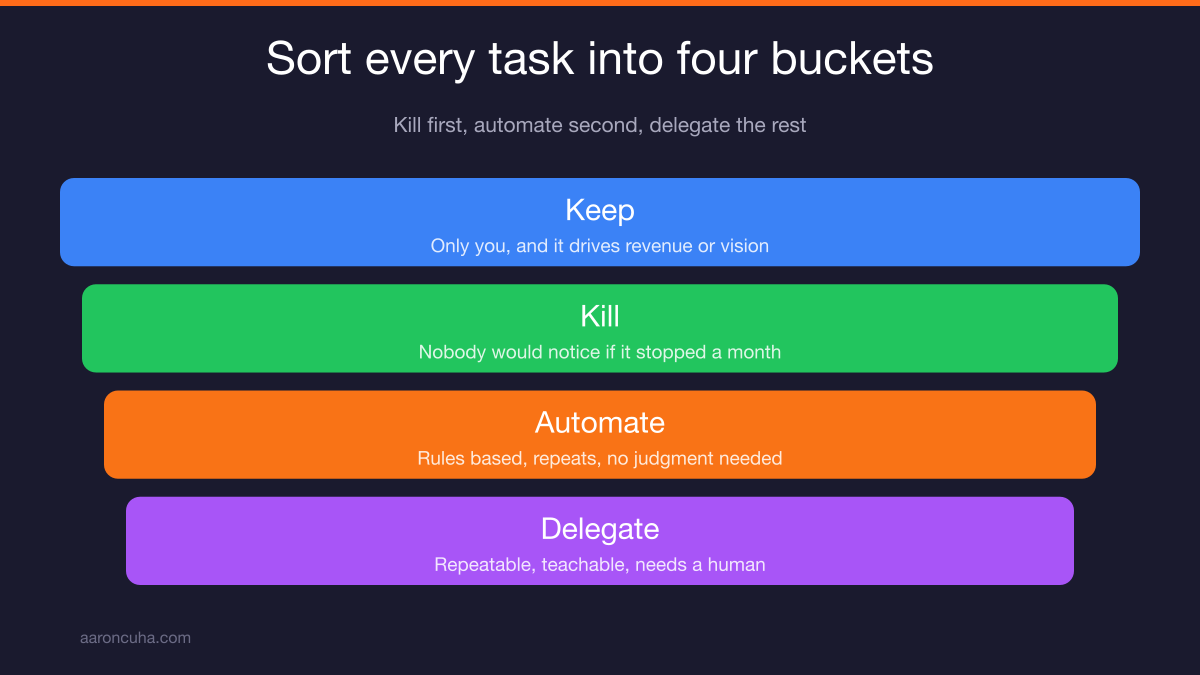
Before you post a job, log every repeatable action you take for two weeks. Then sort each one into four buckets: Keep, Kill, Automate, Delegate. You cannot hand off work you have not named.
The log is simple. Keep a running note on your phone or a spreadsheet. Every time you do something, write one line: what it was, how long it took, and whether it repeats.
Do not clean it up. Do not judge it. Just capture it.
Two weeks catches the weekly and biweekly work, not just the daily noise. Most owners are shocked by how much of their week is repeatable, low judgment work they never counted.
Then you sort.
| Bucket | Decision Rule | Examples |
|---|---|---|
| Keep | Only you can do it, and it drives revenue or vision | Sales conversations, strategy, key relationships, final creative calls |
| Kill | Nobody would notice if it stopped for a month | Reports nobody reads, meetings with no decision, redundant check ins |
| Automate | Rules based, repeats often, no judgment required | Appointment reminders, invoice sending, lead routing, file backups |
| Delegate | Repeatable, teachable, needs a human but not you | Inbox triage, scheduling, CRM updates, content upload, client onboarding steps |
Kill first. Automate second. Only then delegate what is left. Otherwise you are paying a person to run a broken process.
This sorting step is the heart of my Systems Over Hustle framework. Systems come before staffing, always.
Define One Owned Outcome, Not a Pile of Tasks
A task list produces a task rabbit. An outcome produces an owner. Write one sentence that says what this person is responsible for producing, not what they are supposed to do all day.
The difference sounds small. It is not.
When someone owns tasks, they wait for you. When someone owns an outcome, they solve problems in front of that outcome without asking permission for every step.
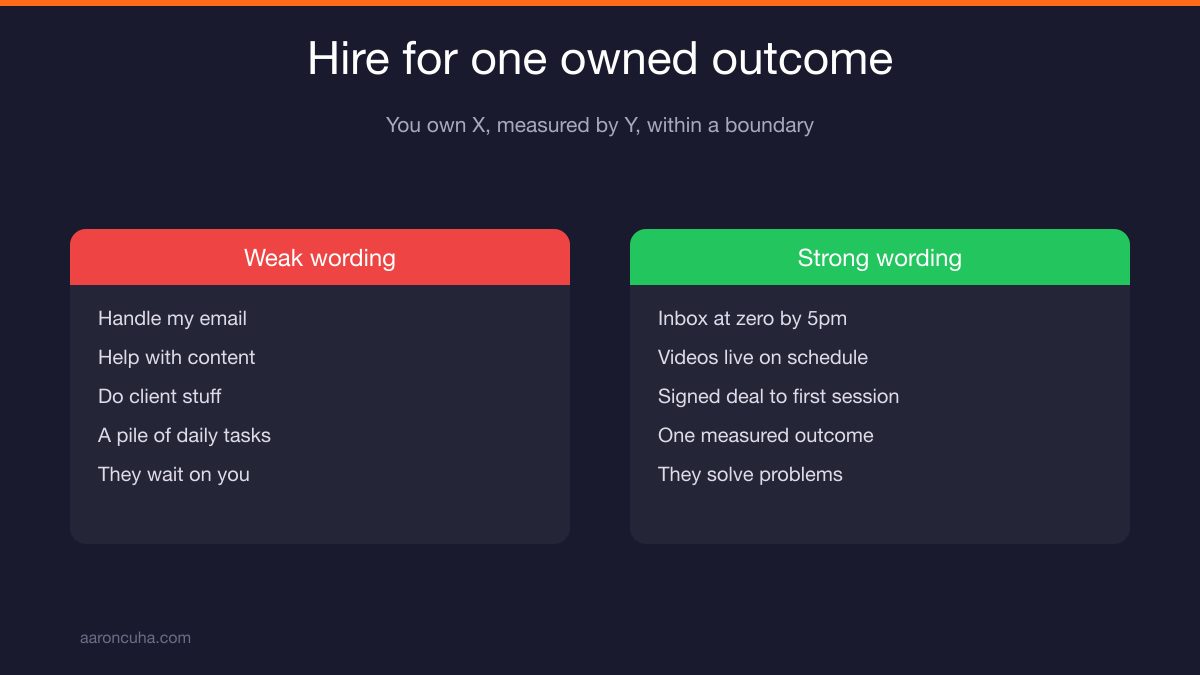
Here is the format. "You own [outcome], measured by [indicator], within [boundary]."
Three examples of weak versions and strong versions:
- Weak: "Handle my email." Strong: "You own my inbox reaching zero by 5pm daily, measured by unread count and response time under 24 hours."
- Weak: "Help with content." Strong: "You own every published video going live on schedule with title, thumbnail, and description in place, measured by on time publish rate."
- Weak: "Do client stuff." Strong: "You own new client onboarding from signed agreement to first session booked, measured by days to first session."
One outcome to start. Not three. Not five.
You can expand scope later, and you will. But a first hire who nails one outcome is worth more than a first hire who half does five.
Write the outcome before you talk to a single candidate. It becomes your job post, your interview script, and your scorecard.
Where to Find and Screen Your First Assistant
Source from a few channels at once, then run a short paid test project before you commit. Screen for three things: follows instructions, communicates proactively, and tolerates repetition without drifting.
Where to look:
- Your own network. Ask other owners in your industry who they use. Referrals skip most of the risk.
- Established freelance marketplaces. Filter by reviews and hours worked, not by the lowest rate.
- Virtual assistant agencies. More expensive, but they handle replacement if it does not work out.
- Industry communities and groups. People who already understand your vocabulary need less training.
Then run the test. Pay for a small, real project with a clear deliverable and a deadline. Two to four hours of work is plenty.
Build one small, deliberate instruction into the brief. Something like naming the file a specific way, or including a specific word in the reply. You are not being cute. You are testing whether they read carefully, because that single trait predicts most of what follows.
Watch for these three filters during the test:
- Follows instructions. Did they do exactly what you asked, including the small detail?
- Communicates proactively. Did they tell you they were stuck before the deadline, or after?
- Tolerates repetition. Do they seem energized by consistency, or already bored?
If you are hiring in the United States, get the classification right from the start. The U.S. Department of Labor and the IRS both publish guidance on the difference between an employee and an independent contractor. Read it before you sign anything, and talk to your accountant.
Phase 2: Run a Shadow Week Before They Touch Anything
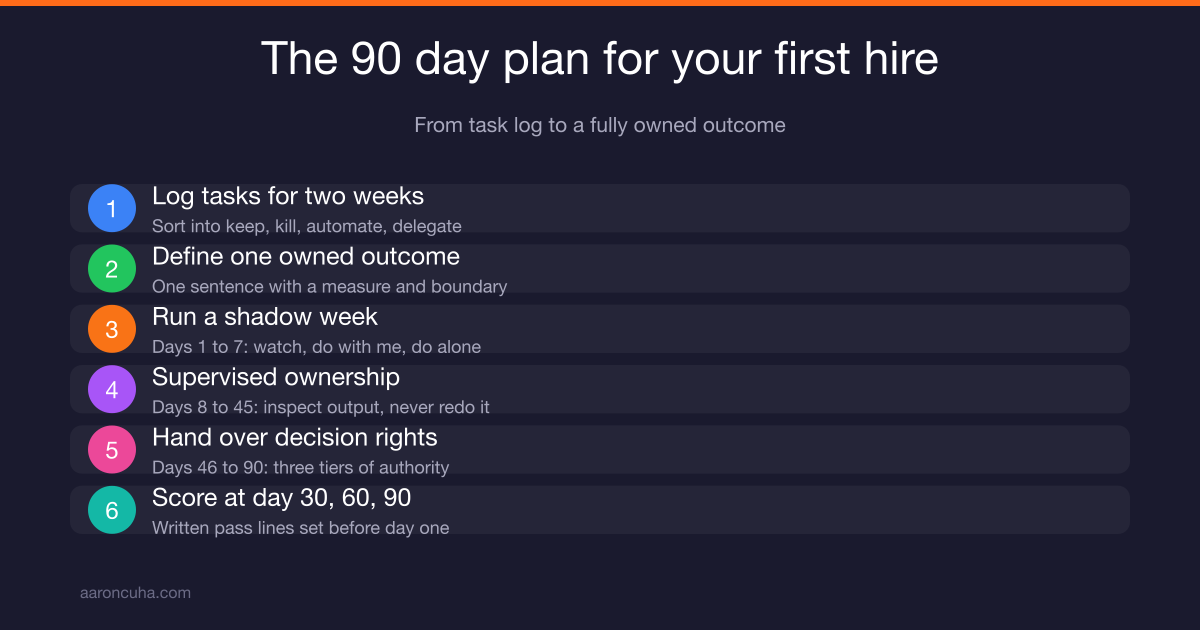
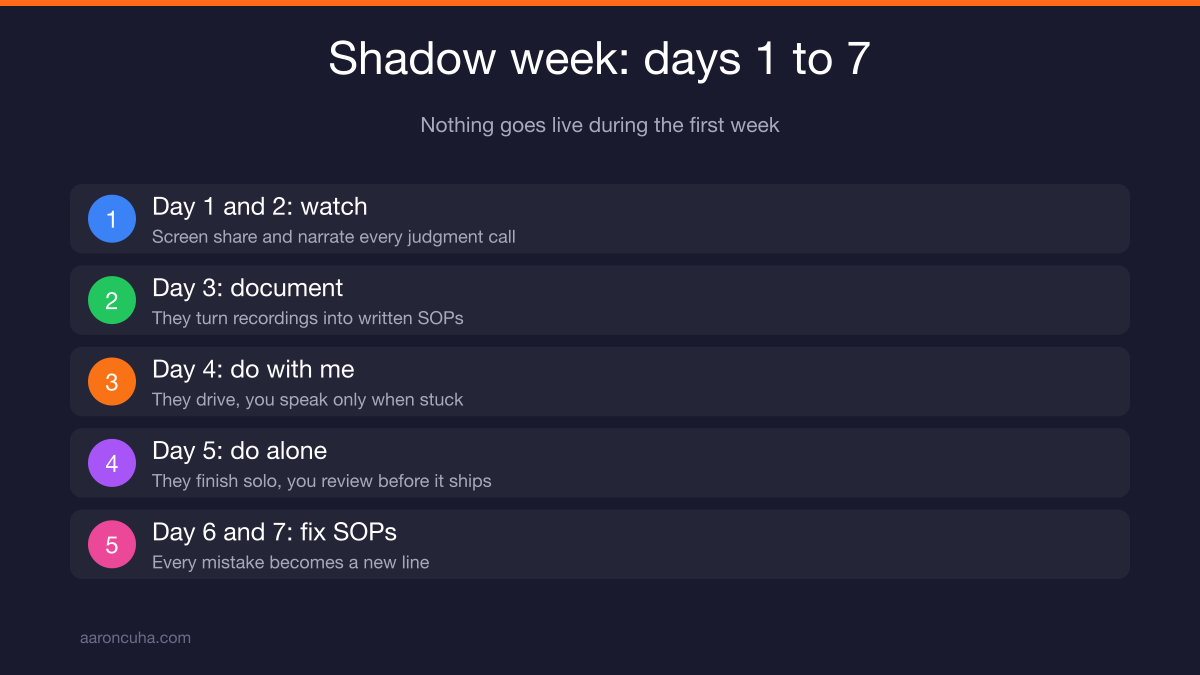
Days 1 through 7, they watch you work. You narrate every decision and record every session. Nothing goes live in week one. Those recordings become your first SOP library.
Most owners skip this. It feels slow. It is the single highest return week of the entire hire.
The loop is: watch, do with me, do alone. Every task passes through all three stages before it becomes theirs.
Here is the five step shadow week schedule:
- Day 1 and 2: Watch. Screen share while you do the work. Narrate your reasoning out loud, especially the judgment calls. Record everything.
- Day 3: Document. They turn each recording into a written step by step SOP in their own words. If they cannot write it, they did not understand it.
- Day 4: Do with me. They drive, you watch. You only speak when they get stuck or go off track.
- Day 5: Do alone, reviewed. They complete the work solo. You review before anything goes out the door.
- Day 6 and 7 (or the next Monday): Fix the SOPs. Every mistake from day 5 becomes an added line in the document. The SOP absorbs the error so it never repeats.
Notice who writes the SOPs. They do, not you. This is the part that saves you months.
You get documentation without doing the documenting, and you get a reliable read on comprehension. A person who can write a clean SOP from a recording will handle almost anything you throw at them next.
By the end of week one, you have a trained assistant and a written system. Most owners get neither in six months.
Phase 3: Supervised Ownership in Days 8 to 45
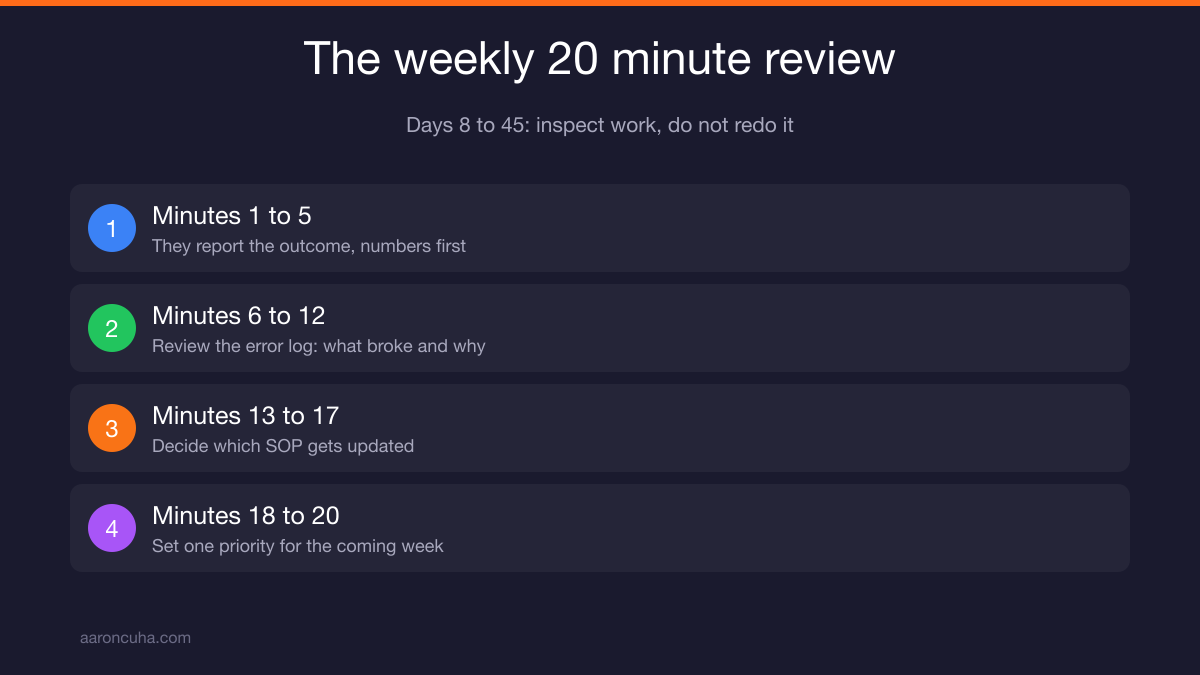
They own the outcome now. You inspect the work, you do not redo it. One 20 minute review each week, and every error becomes a system upgrade instead of a lecture.
This is where most owners quietly sabotage the hire.
They see something done at 85 percent, fix it themselves in two minutes, and say nothing. It feels efficient. It is the fastest way to train someone to stay at 85 percent forever.
Do not silently correct work. Either send it back with a note, or update the SOP so it cannot happen again.
Run the weekly review the same way every time:
- Minutes 1 to 5: They report on the outcome. Numbers first, story second.
- Minutes 6 to 12: Review the error log from the week. What broke, and why.
- Minutes 13 to 17: Decide which SOP gets updated to prevent each error.
- Minutes 18 to 20: Set the one priority for the coming week.
Keep an error log from day one. Not to build a case against them. To find the holes in your system.
Nearly every mistake in the first 45 days traces back to a missing instruction, not a missing skill. When you treat errors as system gaps, your assistant stops hiding problems and starts reporting them early. That shift alone is worth the hire.
By day 45 you should be checking output, not process. If you are still watching how they do it, the SOP is not finished.
Ready to build the systems layer under your team instead of just adding bodies? Explore AI systems and automation and see what should never touch a human at all.
Phase 4: Hand Over Decision Rights in Days 46 to 90
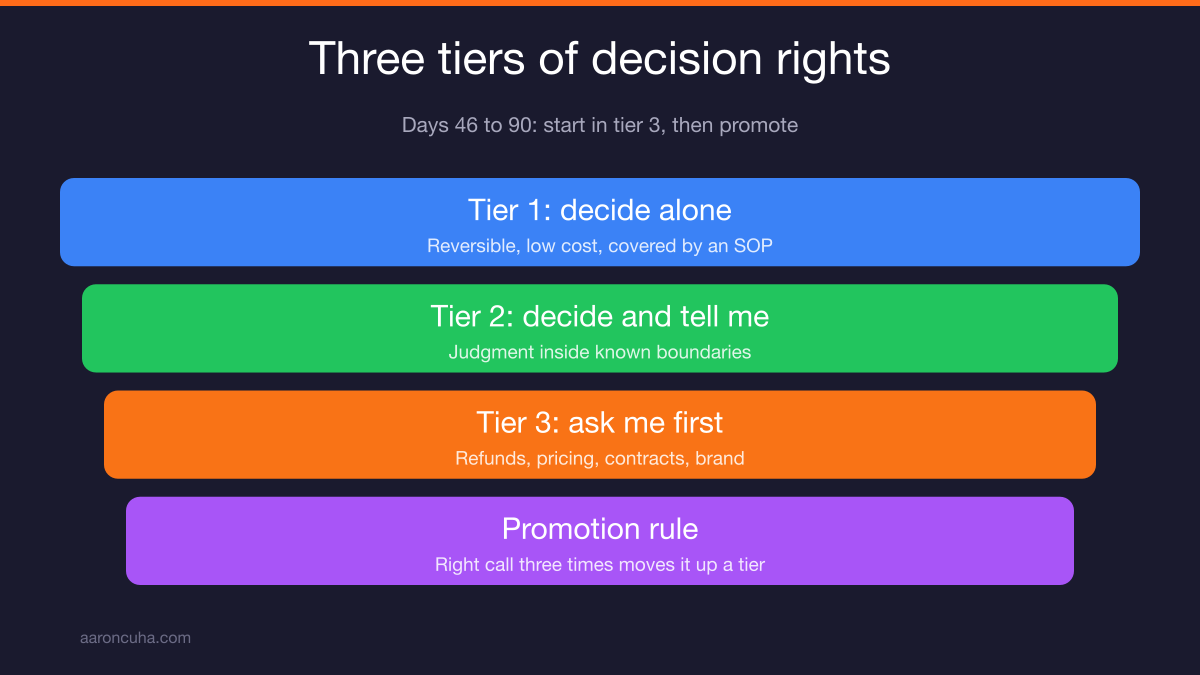
Real leverage arrives when you transfer decisions, not tasks. Use three tiers: decide alone, decide and tell me, ask me first. Move work up the tiers as trust is earned.
An assistant who has to ask about everything is a slower version of you. An assistant with clear decision rights is a multiplier.
Here is how the tiers work.
| Tier | Rule | Typical Examples |
|---|---|---|
| Tier 1: Decide alone | Reversible, low cost, covered by an SOP | Scheduling, routine replies, file organization, standard follow up |
| Tier 2: Decide and tell me | Reversible, moderate impact, judgment inside known boundaries | Rescheduling a client, small vendor purchases, adjusting a template |
| Tier 3: Ask me first | Hard to reverse, affects money, brand, or relationships | Refunds, pricing, contracts, public statements, hiring subcontractors |
Start almost everything in Tier 3. Then promote.
The promotion rule is simple. When someone brings you the same type of decision three times and recommends the right answer each time, move it up a tier. Tell them you are doing it and write it down.
Set the dollar and impact boundaries in writing. Vague authority creates hesitation, and hesitation looks like incompetence when it is really just fear of overstepping.
Only expand scope after decision rights are stable. Adding a second outcome while the first still requires constant approval is how you break a good hire.
The 90 Day Assistant Scorecard
Write the pass lines before day one, not after. Review at day 30, 60, and 90 against the same outcome you defined in Phase 1. No surprises for either of you.
A scorecard is not corporate theater. It is a promise that you will judge fairly and consistently.
| Checkpoint | What You Measure | Pass Line |
|---|---|---|
| Day 30 | SOPs written, tasks completed to standard, questions asked before deadlines | Core SOPs documented, work delivered on time, errors logged not hidden |
| Day 60 | Outcome indicator trending right, rework rate falling, Tier 2 decisions handled | You inspect output only, not process. Rework is rare. |
| Day 90 | Outcome fully owned, most decisions in Tier 1 or 2, proactive improvements suggested | You have reclaimed hours and stopped thinking about this outcome daily |
Two cadences run underneath the checkpoints. A daily written check in of five lines or less, and the weekly 20 minute review. That is it. Do not add meetings.
The five line daily check in covers: what I finished, what I am doing next, what is blocked, what I decided, what I need from you.
If someone misses a pass line, do not wait. Name it that week, in writing, with a specific correction. Silent disappointment is the cruelest management style there is.
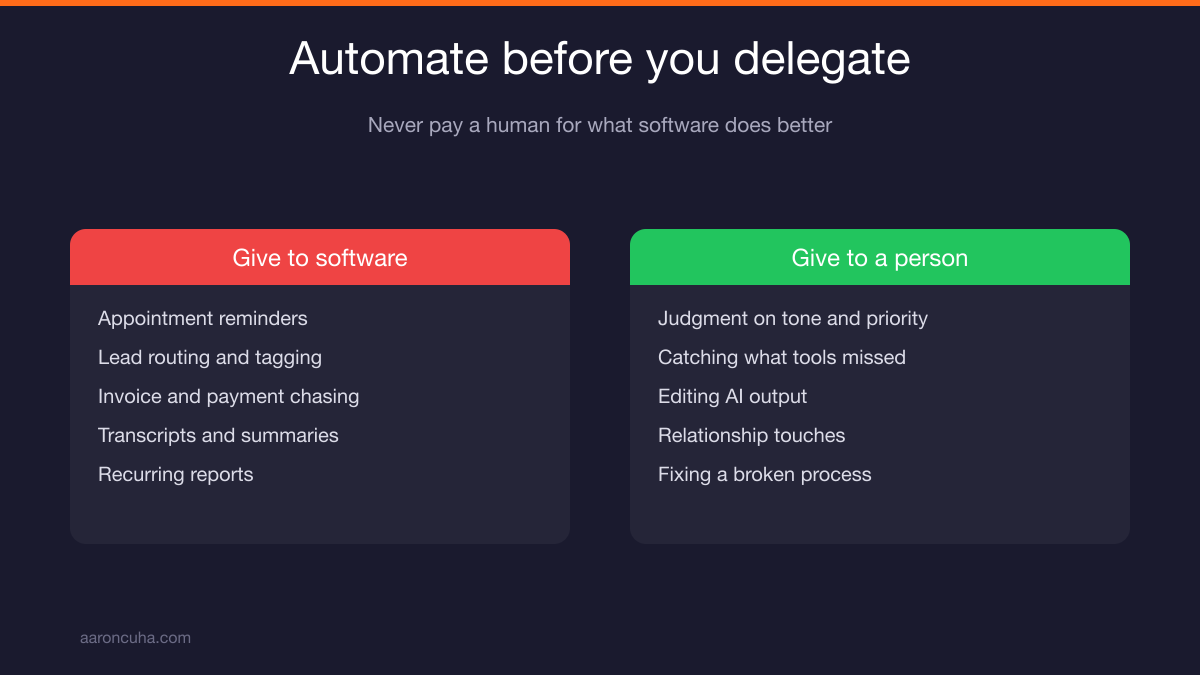
Where AI Fits: Automate Before You Delegate
Never pay a human to do what software does better. Automate the rules based work first, then hire a person for the judgment work that remains. The combination beats either one alone.
Go back to your two week task log and be honest about the Automate column.
Work that should be automated, not delegated:
- Appointment reminders and confirmations
- Lead routing and tagging in your CRM
- Invoice sending and payment follow up
- First draft transcription and summaries
- Recurring reports pulled from the same sources
Work that needs a person, often with AI helping:
- Judgment calls on client tone and priority
- Catching the thing the automation missed
- Editing AI output into something you would actually send
- Relationship touches that must feel human
- Fixing the process when reality does not match the SOP
The best assistants I see today are AI operators. They do not do the work by hand. They run tools, check output, and escalate exceptions.
Train your hire on your tool stack during the shadow week, the same way you train them on your process. I go deeper on the tooling side in AI business systems and in AI will not replace you.
For a broader view of how automation is reshaping the work itself, the World Economic Forum publishes ongoing research on skills and job design worth reading.
Five Mistakes That Kill the First 90 Days
Almost every failed first hire traces back to one of five errors. Each has a one line fix, and each fix costs you nothing but discipline.
- Hiring for tasks instead of an outcome. Fix: write the one sentence outcome statement before you post the job.
- Skipping the shadow week. Fix: block days 1 through 7 on your calendar before their start date, and record every session.
- No written standard for done. Fix: define what finished looks like inside every SOP, with an example of good output attached.
- Silent feedback. Fix: never fix their work without telling them. Send it back or update the SOP, every time.
- Expanding scope too fast. Fix: no second outcome until the first one runs for 30 days without your daily involvement.
Read that list again in 60 days. You will recognize whichever one you slipped into.
The reason these mistakes repeat is that they all feel like efficiency in the moment. Skipping the shadow week saves a week. Fixing their work yourself saves two minutes. Adding a second outcome feels like getting more value.
Every one of them trades a small short term gain for a permanent ceiling. That is the same trap I write about in content systems for entrepreneurs, where owners keep doing the fast thing instead of the repeatable thing.
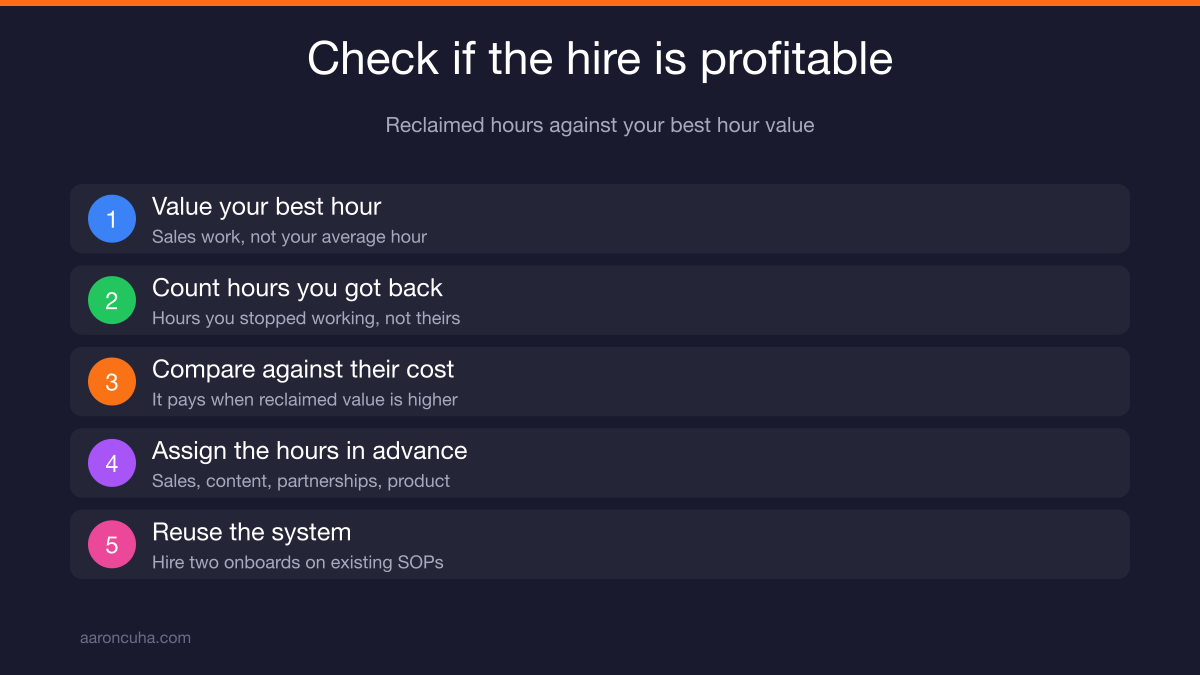
How to Know the Hire Is Profitable
Compare the hours you bought back against what those hours produce when spent on revenue work. If reclaimed time goes to sales, strategy, or content, the math works. If it goes to more admin, it does not.
Do this in principle, with your own numbers, not mine.
Take your best estimate of what one hour of your revenue producing work is worth. Not your average hour. Your best hour, the one spent on sales conversations or the work that generates them.
Now count the hours the hire actually returned to you each week. Not the hours they worked, the hours you stopped working.
The hire pays for itself when reclaimed hours times your revenue hour value exceeds their cost. That is the entire calculation.
Here is where owners get it wrong. They buy back ten hours and immediately fill all ten with different low value work. The hire produced nothing because the owner never changed behavior.
Decide in advance what the reclaimed hours are for. Write it down before day one. Sales calls. Content. Partnerships. Product. Something with an obvious revenue line attached.
Then there is the compounding effect nobody prepares you for. Your first successful hire produces the SOPs, the scorecard, the review cadence, and the decision framework. Your second hire onboards in a fraction of the time because the system already exists.
That is how a solo operator becomes a small team, and how a small team becomes something that runs without the owner touching every piece. It is the same sequence I used to build to 280 offices, and the same one I rebuilt with after losing it all in 2008 and spending a decade doing humanitarian work in Nepal.
Systems first. People second. Hustle never.
If you want the full framework for building a business that does not depend on your personal effort, start with Systems Over Hustle, then join the Systems Over Hustle community where owners share the SOPs and scorecards that actually worked.
Frequently Asked Questions

Written by
Aaron CuhaAuthor of Crazy Simple YouTube, keynote speaker, and executive coach with 20,000+ hours logged. ICF PCC, NLP Master Practitioner, and DISC Certified. Aaron helps entrepreneurs replace hustle with AI-powered systems that generate leads, content, and revenue on autopilot.