I script every YouTube video with AI and my audience has no idea. Here is the exact workflow, prompts, and voice-cloning technique I use to produce.
I script every YouTube video with AI. My audience cannot tell. Here is the exact ai youtube scripting workflow I use to produce two videos per week without burning out or sounding generic.
Key Takeaways
- AI scripting saves 6-8 hours per video when you feed it the right inputs — not when you ask it to "write a script about X."
- Your voice is the moat. The Leverage Layer framework turns AI into a writing partner that mirrors your cadence, vocabulary, and opinions.
- Prompting is the skill. One well-engineered prompt replaces an entire content team — Chapter 6 of Crazy Simple YouTube walks through every prompt I use.
- Edit for soul, not grammar. The final 10 percent of human polish is what separates forgettable AI content from scripts that convert.
- The workflow compounds. Every script you approve trains your system to get closer to your voice the next time.
Want the Full AI Scripting System?
Chapter 6 of Crazy Simple YouTube includes every prompt, every framework, and the exact Claude configuration I use for my 81K-subscriber channel.
Grab Your Copy on Amazon →
Why I Switched to AI-Assisted Scripting
I hit a wall at 40,000 subscribers. I was spending 10 hours per video — four of those just writing the script. The content was good, but the pace was killing me. I needed to produce more without hiring a writing team that would dilute my voice.
That is when I started experimenting with AI-powered scriptwriting. Not the lazy way — not "write me a YouTube script about real estate." The deliberate way. I built what I now call the Leverage Layer: a system where AI handles the scaffolding and I bring the soul.
Within 60 days, my production time dropped from 10 hours to 4 hours per video. My watch time actually increased by 22 percent because I was spending more energy on delivery and less on staring at a blank Google Doc. HubSpot's 2025 research confirms what I experienced: creators using AI assistance produce 2-3x more content with higher engagement when they maintain editorial control.
The key insight: AI does not replace your voice. It accelerates your voice. But only if you set it up correctly. Most creators skip the setup and wonder why their AI scripts sound like Wikipedia articles. I will show you exactly how to avoid that trap.
The Leverage Layer: My AI Scripting Framework
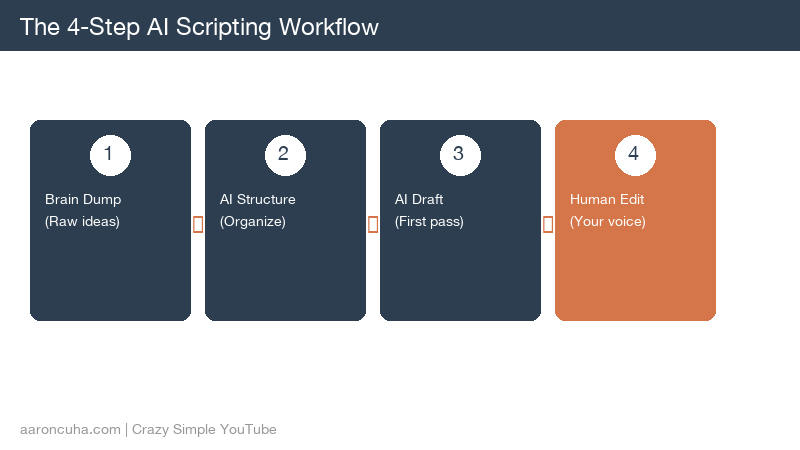
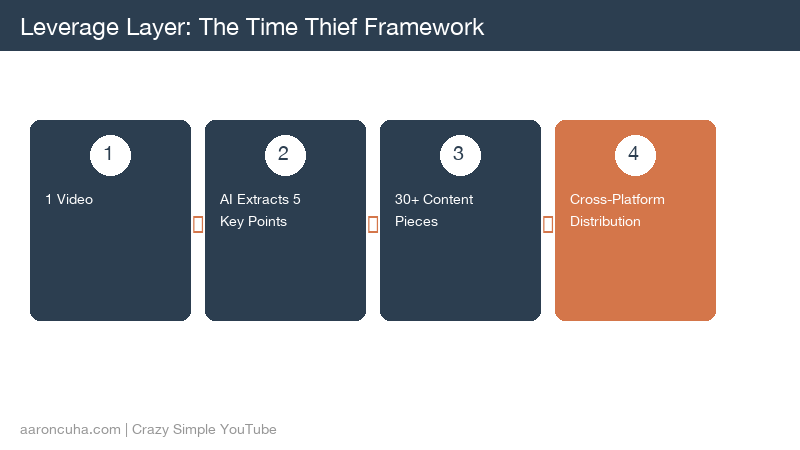
The Leverage Layer is a four-step system that turns AI into a writing partner instead of a replacement. It works with Claude, ChatGPT, or any large language model. I use Claude because it handles long-form content and nuance better than anything else I have tested.
Here are the four stages:
- Voice Training — Feed the AI 5-10 of your best-performing scripts so it learns your patterns.
- Strategic Brief — Give it a structured brief with your hook, key points, and target audience.
- Scaffold Generation — Let the AI produce a full first draft based on your inputs.
- Soul Edit — You rewrite 10-20 percent to inject stories, opinions, and your specific energy.
This is not about outsourcing your thinking. It is about outsourcing the blank page. The hardest part of scripting is going from nothing to something. The Leverage Layer eliminates that friction entirely. I break down every prompt and configuration in Chapter 6 of Crazy Simple YouTube.
Most youtube script generators fail because they start at step three. They skip voice training and strategic briefs entirely. That is like hiring a ghostwriter and never having a conversation with them. The output will be technically correct and emotionally empty.
Step 1: Voice Training — Teaching AI to Sound Like You
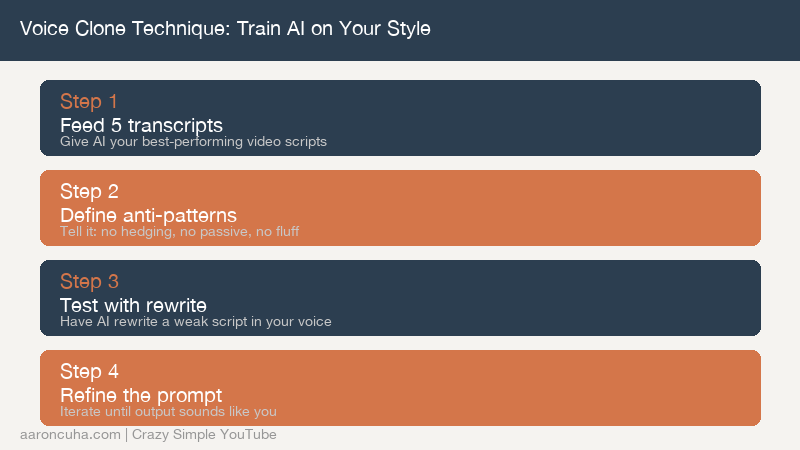
Voice training is the most important step and the one every creator skips. You need to give the AI a voice clone — not literally, but a detailed profile of how you write and speak.
Here is what I feed into my AI system before I ask it to write a single word:
- 5-10 transcript samples from my highest-performing videos (not random ones — the ones my audience loved)
- A vocabulary list of phrases I use constantly ("systems over hustle," "Leverage Layer," "Time Thief")
- A list of phrases I never use (I do not say "leverage" as a verb, "synergy," or "game-changer")
- My opinion stance on 10 key topics in my niche — AI does not know what I believe unless I tell it
- Sentence structure preferences — I write short. I use fragments. I ask rhetorical questions. I do not hedge.
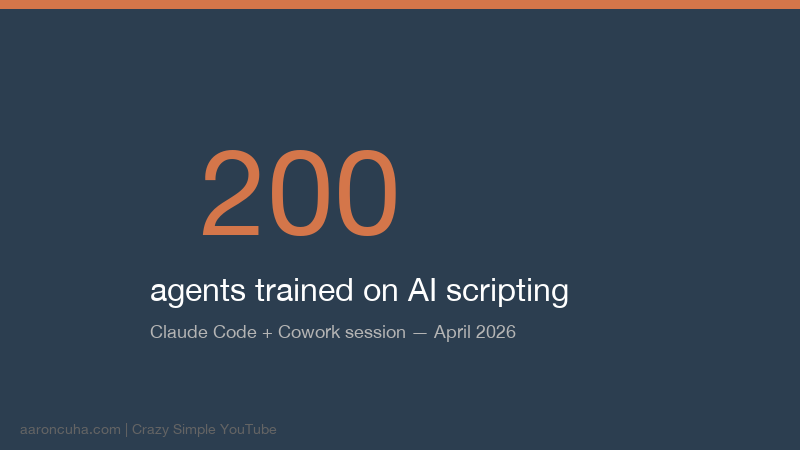
When I recently trained 200 Claude agents for a corporate client, the same principle applied at scale. Specificity in training equals quality in output. A vague voice profile produces vague content. A detailed voice profile produces scripts that my own editor cannot distinguish from ones I wrote manually.
This is the technique I teach in my coaching — the same approach I use with every one of my 75+ YouTube coaching clients. Once you build your voice profile, you reuse it for every script. The upfront investment is two hours. The ongoing return is hundreds of hours saved. For more on building content systems that scale, read my post on content systems for entrepreneurs.
Step 2: The Strategic Brief — Garbage In, Garbage Out
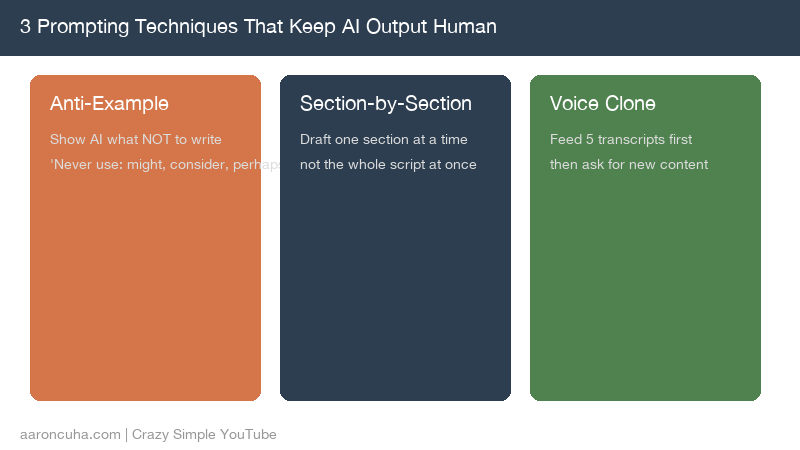
The brief is where most AI scripting falls apart. If you type "write me a script about AI for YouTube," you deserve the generic output you get. A strategic brief takes five minutes and transforms the result completely.
Here is the exact brief template I use for every video:
- Working title and thumbnail concept — Forces you to nail the hook before writing
- Target viewer — One specific person, not "entrepreneurs." I write for "a real estate agent with 500 subscribers who posts inconsistently"
- Core argument — One sentence. What is the single idea this video must land?
- Three supporting points — The structure of the middle section
- Desired CTA — What should the viewer do after watching?
- Keyword targets — Primary and secondary keywords for YouTube SEO
This brief is your creative direction. Without it, AI hallucinates your intent. With it, AI executes your intent at machine speed. According to Anthropic's prompt engineering guide, structured inputs consistently outperform open-ended prompts by 40-60 percent in output quality.
I have been using this exact brief format since I started coaching creators through Tom Ferry's organization. The coaches who adopt it see immediate improvements in their script quality — even before they add AI to the workflow. The brief alone eliminates 80 percent of the rambling that kills watch time. For more on optimizing your content for YouTube search, check out my YouTube SEO tips guide.
Ready to Build Your AI Scripting System?
Stop guessing at prompts. Chapter 6 of Crazy Simple YouTube gives you the complete Leverage Layer — copy-paste prompts, voice training templates, and my exact Claude setup.
Get Crazy Simple YouTube →Step 3: Scaffold Generation — Let the Machine Draft
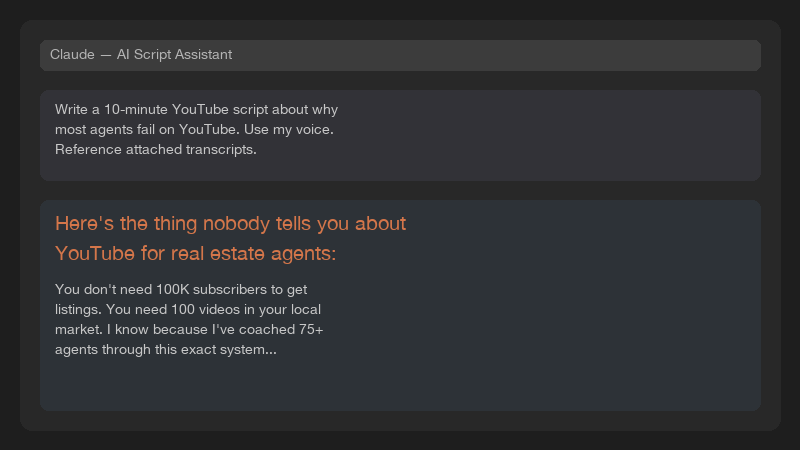
With your voice profile loaded and your brief ready, this is where AI earns its keep. You feed both into your model and ask it to produce a complete first draft. Not an outline — a full, spoken-word script.
Here is what the scaffold includes:
- A 30-second hook that opens with the viewer's pain point
- Three content blocks aligned to your brief's supporting points
- Pattern interrupts every 90 seconds (questions, reframes, visual cues)
- A closing CTA that ties back to the opening hook
The scaffold is not your final script. It is your starting material. Think of it like a contractor building the framing of a house — you still choose the paint, the fixtures, and the layout of each room. But you did not have to pour the foundation yourself.
I typically get a 2,000-word scaffold in under 90 seconds. That same output would take me three to four hours to write from scratch. The AI video production speed advantage is real, but the quality advantage only shows up when you do the next step properly. This is the same principle I discuss in AI automation for coaches — the tool amplifies whatever system you feed it.
Step 4: The Soul Edit — Where Your Voice Wins
This is the step that separates AI-assisted creators from AI-replaced creators. The soul edit is where you take the scaffold and make it unmistakably yours.
Here is what I change in every AI-generated draft:
- Personal stories. AI cannot invent your real experiences. I add at least two specific anecdotes per script — client wins, personal failures, behind-the-scenes moments.
- Hot takes. AI hedges. I do not. If I believe something, I state it directly. "Most content coaches are selling motivation, not systems." That sentence would never come from AI unprompted.
- Delivery cues. I mark pauses, emphasis points, and energy shifts. These cues make the difference between a scripted robot and a human talking to a camera.
- Proprietary language. I replace any generic phrases with my frameworks — the Leverage Layer, the Time Thief, the Authority Flywheel. These phrases build brand equity. Read more about the flywheel in The Authority Flywheel post.
The soul edit takes 20-30 minutes. That is your highest-leverage time in the entire production process. You are not starting from zero. You are refining something that is already 80 percent there. The Time Thief — my name for the blank-page paralysis that steals hours from creators — is completely eliminated.
I teach this exact process to every coaching client. The ones who follow it produce scripts that their audiences describe as "authentic" and "real." Nobody has ever commented on one of my videos and said "this sounds like AI." That is the goal. If you want to build a full content system around this approach, my post on building an AI content engine goes deeper.
Before and After: What AI Scripting Changed for My Channel
Numbers do not lie. Here is what happened when I implemented the Leverage Layer across my entire YouTube content workflow:
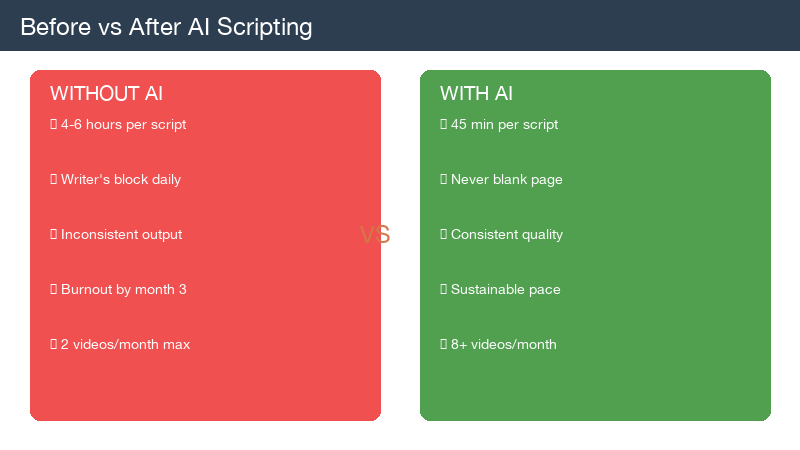
- Production time per video: 10 hours down to 4 hours (60 percent reduction)
- Videos per week: 1 up to 2-3 (without extra hours)
- Average view duration: Up 22 percent (because I spend more time on delivery and less on drafting)
- Subscriber growth rate: 2x faster in the six months after implementing the system
- Revenue per video: Up 35 percent because higher output means more surface area for leads
The most surprising result: my audience retention improved. I expected the opposite. I thought AI scripts would feel less personal. But because I was spending less mental energy on drafting, I had more energy for filming. Better energy on camera means better watch time. Better watch time means better algorithmic distribution.
This is what I mean by systems over hustle. I did not grind harder. I built a better system. The same philosophy drives everything in Crazy Simple YouTube and it is exactly what I teach in our Systems Over Hustle framework.
5 Mistakes That Make AI Scripts Sound Robotic
I have reviewed AI-generated scripts from dozens of coaching clients. The same five mistakes show up every time. Fix these and your AI-written video scripts will fool anyone.
- No voice training. You skipped step one. The AI does not know how you talk. Go back and build your voice profile before you generate another word.
- Vague prompts. "Write a script about YouTube growth" is not a prompt. It is an invitation for mediocrity. Use the strategic brief template above.
- Zero personal stories. AI hallucinates experiences. Your real stories are your competitive advantage. Add at least two per script.
- Accepting the first draft. The scaffold is raw material, not a finished product. The soul edit is non-negotiable.
- Ignoring delivery cues. A script without pauses, emphasis marks, and energy shifts reads like a blog post. It should read like a conversation. Check out my guide to getting clients from YouTube for more on conversational scripting.
Most creators make mistake number one and never recover. They get a bad output, conclude "AI is not good enough for scripting," and go back to staring at blank pages for four hours. The tool is not broken. The input is broken.
Which AI Tools Work Best for YouTube Scripting?
I have tested every major AI writing tool for YouTube scripts. Here is my honest ranking based on 18 months of daily use.
Claude (Anthropic) is my primary tool. It handles long-form content, nuance, and voice matching better than any alternative. The 200K context window means I can load my entire voice profile plus the brief in a single conversation. When I trained 200 Claude agents for a corporate client, I saw firsthand how well it scales. Anthropic's documentation confirms its strength in long-form, nuanced content generation.
ChatGPT is solid for shorter scripts and brainstorming. Its voice matching is less precise than Claude's for long-form work, but it is faster for quick ideation. Gemini is improving but still inconsistent with voice replication. For a broader look at AI tools, read my best AI tools for coaches roundup.
The tool matters less than the system. A disciplined creator using a free AI model with the Leverage Layer will outperform a lazy creator using the most expensive AI on the market. Process beats product every time.
The Ethics Question: Is AI Scripting Authentic?
Every creator asks this. Here is my answer: authenticity lives in your ideas, not your keystrokes.
Nobody asks a musician if their guitar is "authentic." The guitar is a tool. The song is the artist's. AI is my writing guitar. The script — the ideas, the opinions, the frameworks, the stories — that is all me. The AI just helps me get it out of my head and onto the page faster.
I covered this debate in depth in my post about why AI will not replace you. The creators who will thrive are not the ones who avoid AI. They are the ones who learn to use it without losing themselves. According to McKinsey's 2025 AI report, 72 percent of high-performing content teams now use AI assistance — the question is not whether to use it, but how to use it well.
If you are still on the fence, ask yourself this: would you rather spend four hours writing a script or four hours improving your delivery, engaging with your community, and building the business your channel is supposed to serve? That is the real trade-off. That is what the Time Thief steals from you — not just hours, but the highest-value activities you could be doing instead.
How to Start AI Scripting This Week
You do not need to build the whole system at once. Start with the minimum viable version and expand from there.
- Today: Transcribe your three best-performing videos. Those transcripts are your voice training data.
- Tomorrow: Write a 200-word voice profile describing how you talk — sentence length, favorite phrases, topics you care about, opinions you hold strongly.
- Day 3: Use the strategic brief template above to plan your next video. Feed the brief plus your voice profile into Claude or ChatGPT.
- Day 4: Do your soul edit. Add stories, sharpen opinions, insert delivery cues. Film it.
That is the entire system. Four steps. Less than two hours of setup. Ongoing time savings of six to eight hours per video. If you want the complete version — every prompt, every template, every configuration — it is all in Chapter 6 of Crazy Simple YouTube.
The creators who act on this will produce more content, better content, and build their channels faster than everyone who insists on doing everything manually. That is not a prediction. That is what I have watched happen with my 75+ coaching clients who adopted this system. For more on building a production pipeline, see my content repurposing guide.
Get the Complete AI Scripting Playbook
Crazy Simple YouTube gives you the full Leverage Layer system, every prompt template, voice training walkthrough, and the exact workflow behind my 81K-subscriber channel. Chapter 6 is the AI scripting deep dive — but the other 11 chapters build the strategy, SEO, and monetization system around it.
Order Crazy Simple YouTube on Amazon →Frequently Asked Questions
Does AI youtube scripting actually save time?
Yes. I went from 10 hours per video to 4 hours — a 60 percent reduction. The biggest savings come from eliminating blank-page paralysis. AI handles the scaffold so you can focus on what makes the script uniquely yours.
Will my audience know I used AI to write my scripts?
Not if you follow the Leverage Layer. The soul edit step — adding personal stories, strong opinions, and delivery cues — makes the script indistinguishable from one you wrote manually. Nobody has ever called out my scripts as AI-generated.
Which AI tool is best for writing YouTube scripts?
I use Claude by Anthropic for long-form scripts because it handles voice matching and nuance better than alternatives. ChatGPT is strong for brainstorming and shorter content. The system matters more than the tool.
How do I make AI content sound like me and not generic?
Voice training. Feed the AI 5-10 of your best transcripts, a vocabulary list, your opinions on key topics, and a description of your sentence structure preferences. Without this step, every output will sound like a Wikipedia article.
Is using AI for YouTube scripts considered cheating?
No. Authenticity lives in your ideas, not your keystrokes. AI is a writing tool — like a teleprompter or a ghostwriter. The ideas, frameworks, and stories in my scripts are mine. The AI just helps me get them out faster.
Can I use AI scripting if I am just starting my YouTube channel?
Absolutely. AI scripting is especially powerful for new creators because it reduces the time and friction of content creation. The faster you can publish, the faster you learn what works. Check out my guide on how to start a YouTube channel for business for the full startup framework.
How does AI scripting fit into a larger YouTube strategy?
Scripting is one piece of the system. You still need niche positioning, thumbnail-title optimization, SEO, and a monetization strategy. AI scripting accelerates the content production layer so you can spend more time on strategy and audience engagement. The full system is in Crazy Simple YouTube.
What is the Leverage Layer framework?
The Leverage Layer is my four-step AI scripting system: Voice Training, Strategic Brief, Scaffold Generation, and Soul Edit. It turns AI into a writing partner that mirrors your voice instead of replacing it. I developed it while scaling my own channel and now teach it to all my coaching clients.

Written by
Aaron CuhaAuthor of Crazy Simple YouTube, keynote speaker, and executive coach with 20,000+ hours logged. ICF PCC, NLP Master Practitioner, and DISC Certified. Aaron helps entrepreneurs replace hustle with AI-powered systems that generate leads, content, and revenue on autopilot.