Most people avoid accountability because it hurts. But accountability systems are what separate the people who hit their goals from the people who talk about them. Here is how to build stakes, streaks, and check-ins that actually change your behavior.
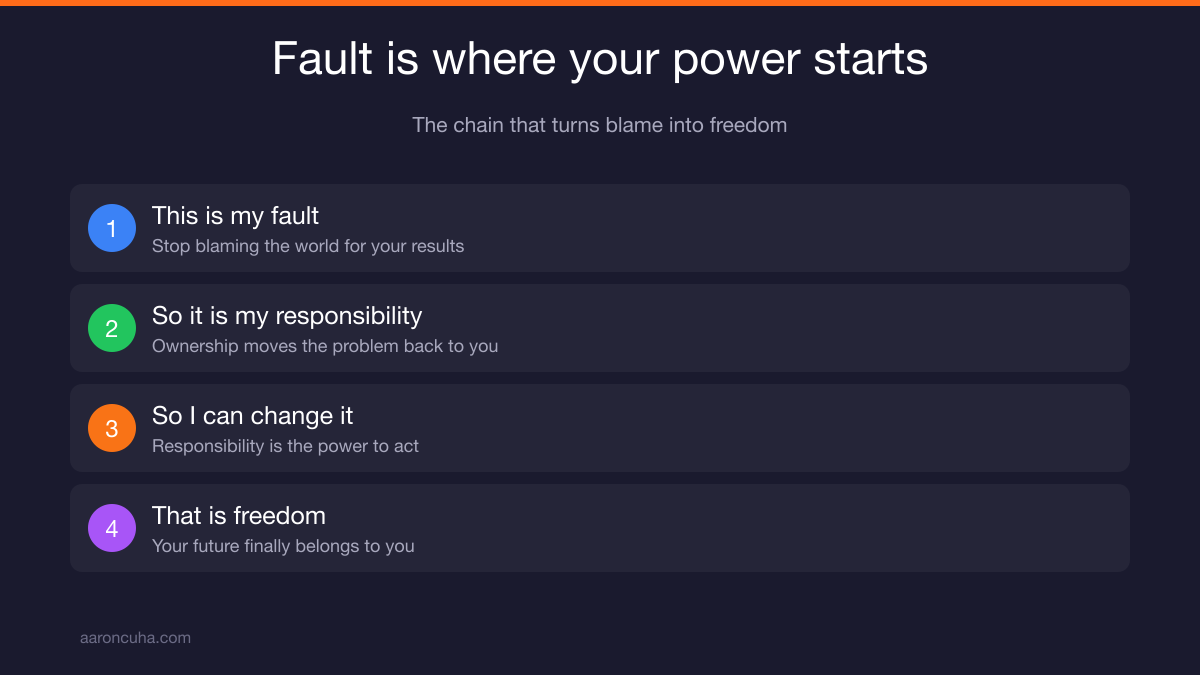
Accountability hurts. It means looking at your life and saying, "This is my fault." But that sentence is where your power starts. If it is your fault, it is your responsibility. And responsibility means you can change it.

Key Takeaways
- Accountability systems are freedom, not punishment. Fault equals power to change.
- Build one habit until it is consistent, then stack the next one.
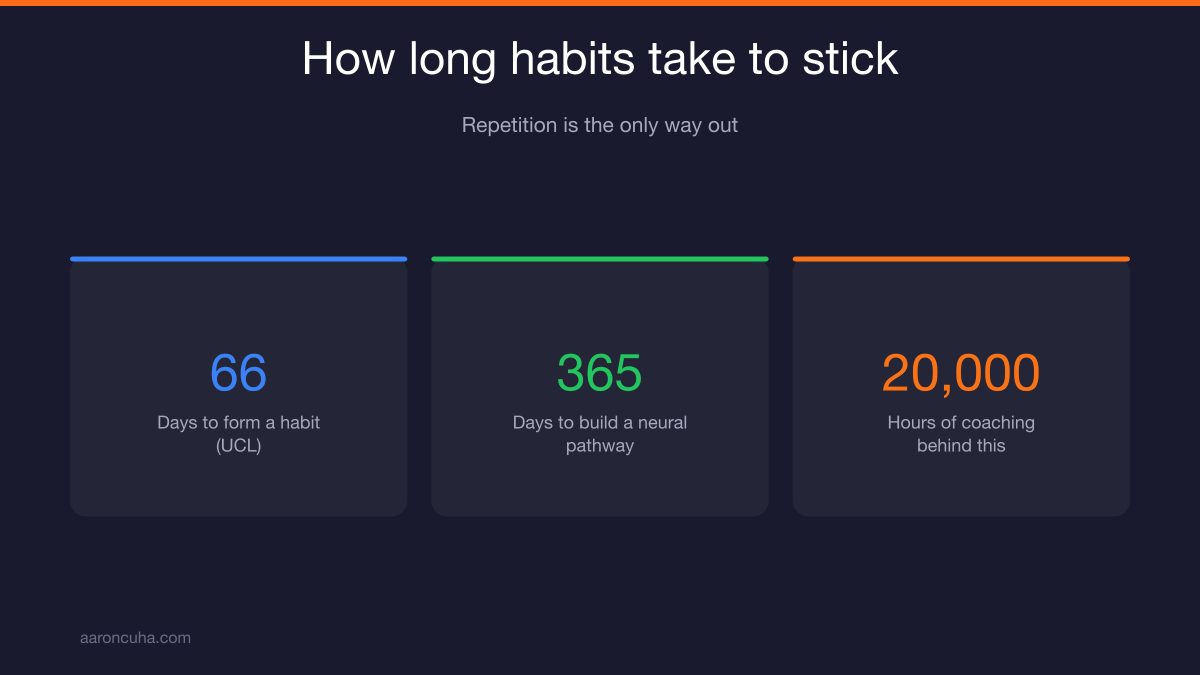
- Habits take 66 days. Neural pathways take 365 days of repetition.
- Every million dollar client I coach prospects daily and has multiple accountability layers.
- Set consequences that sting and rewards that pull. Use both engines.
If you want help building accountability systems into your business instead of guessing at them, start with a strategy session and leave with a plan you can actually run.
Accountability Is Not Punishment, It Is Freedom
Accountability is a word most people avoid because it hurts. It forces you to admit your results are yours. But the moment you stop blaming the world is the moment your future belongs to you.
Here is the chain. If it is my fault, it is my responsibility. If it is my responsibility, I have the power to change it.
That is not a punishment. That is the only real freedom you get.
Most people would rather be a victim than be uncomfortable. Being a victim feels safe because nothing is expected of you. Nothing improves either.
I have coached for over 20,000 hours. The people who grow fastest are not the smartest people in the room. They are the ones who stop negotiating with themselves about whose fault it is.
Why Stacking Five New Habits on January 1 Fails
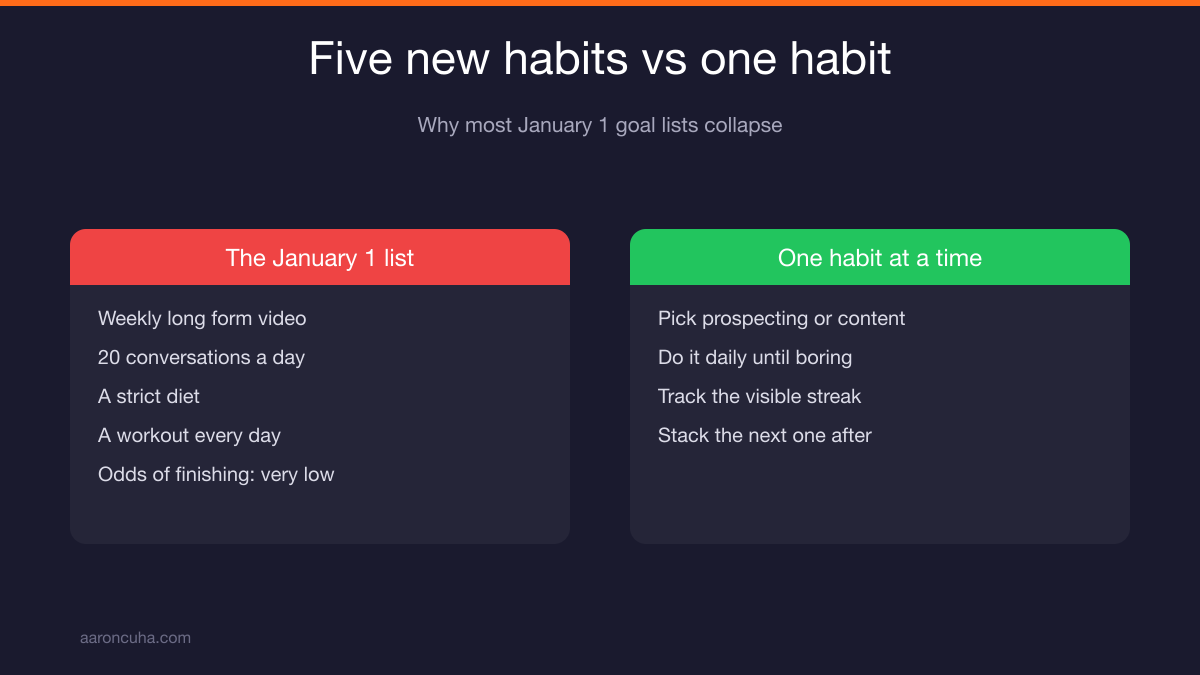
Most goal lists fail because people stack too many new habits at once. Pick one habit. Get it consistent. Then add the next one. That is how success actually gets built.
Here is the January 1 version I hear every year. You have never made a social media post in your life. Now you are going to shoot a long form video every week.
You are also going to have 20 conversations a day, even though you have not had five conversations a day all year. Plus a strict diet. Plus a workout every single day.
What are your odds of completing any of it? Very low.
With real leverage and real training behind it, you can get one or two of those things to stick. Not all five.
- Pick one. If it is prospecting, it is prospecting. If it is content, it is content.
- Do it daily until it is boring. Consistency is the goal, not intensity.
- Track your streak. Visible streaks turn intentions into actions.
- Then stack. Add the second habit only after the first runs itself.
This is the same principle behind content systems for entrepreneurs. One repeatable action beats five heroic ones you abandon by February.
From 66 Days to 365: How Habits Become Automatic
A habit takes about 66 days to form, according to research from University College London. At 365 days, your brain converts that habit into a neural pathway. The behavior stops being easy and starts being automatic.
The science on this is encouraging. You can build new neural pathways until the day you die. Being 50 or 90 does not close the door.
I am not there yet with my own health routine. I will get there. Once I do, it will just be the path.
Have I been there before? I have. So what happened?
I built a bad pathway on top of a good one. I did something bad long enough, like not working out for a year, and that became the new default.
The same thing happens with diet, relationships, and business. Do something poorly for a long stretch and it becomes the easy path.
Your brain always takes the easiest path. That is not weakness. That is biology. You can read more on how the brain wires repeated behavior from the National Institutes of Health.
So the only way out is repetition. Do the right thing over and over until the easy path is the good one.
Interested Versus Committed: The Chicken and the Pig
When you are committed, you find a way. When you are interested, you find an excuse. That is the whole difference.
Here is my favorite way to explain it. When I had bacon and eggs on Saturday, the chicken was interested and the pig was committed.
Committed means you do it even if it costs you something real. Interested means you do it when the conditions are perfect.
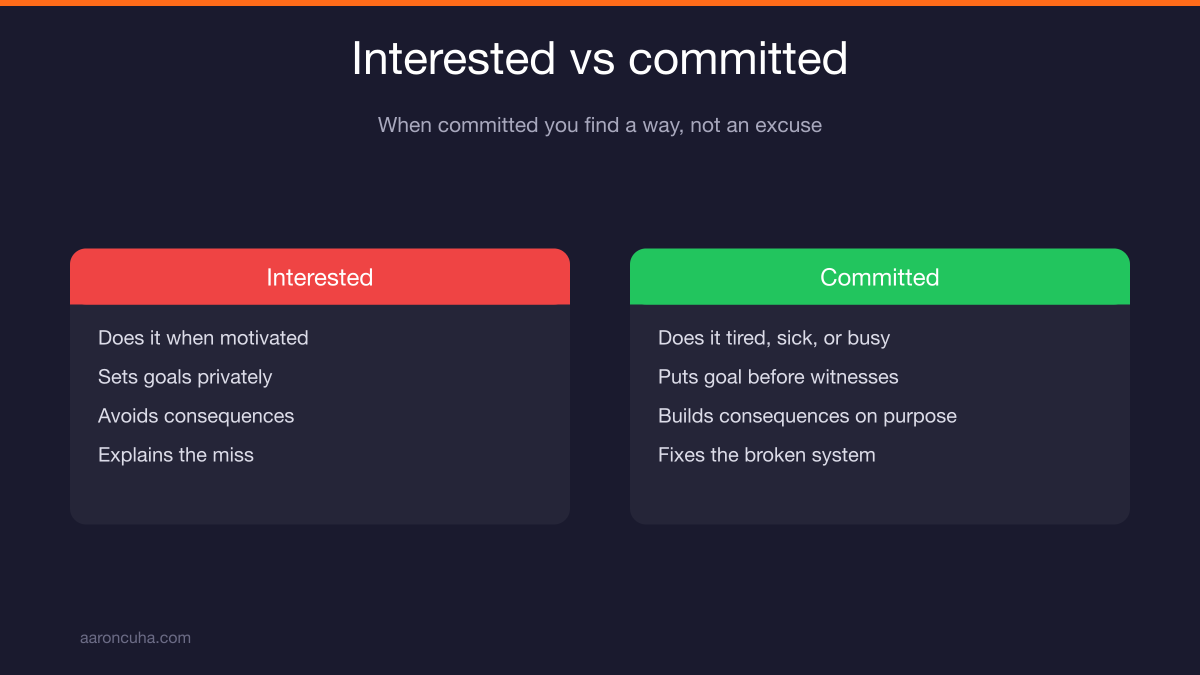
| Interested | Committed |
|---|---|
| Does it when motivated | Does it when tired, sick, or busy |
| Sets goals privately | Puts the goal in front of witnesses |
| Avoids consequences | Builds consequences on purpose |
| Explains the miss | Fixes the system that allowed the miss |
If you are not willing to be held accountable, you are not committed to the activity. You are interested in the outcome.
That distinction shows up everywhere, including in why working harder is not the answer. Commitment is not effort. It is structure.
The Cat Food Deal That Changed Everything
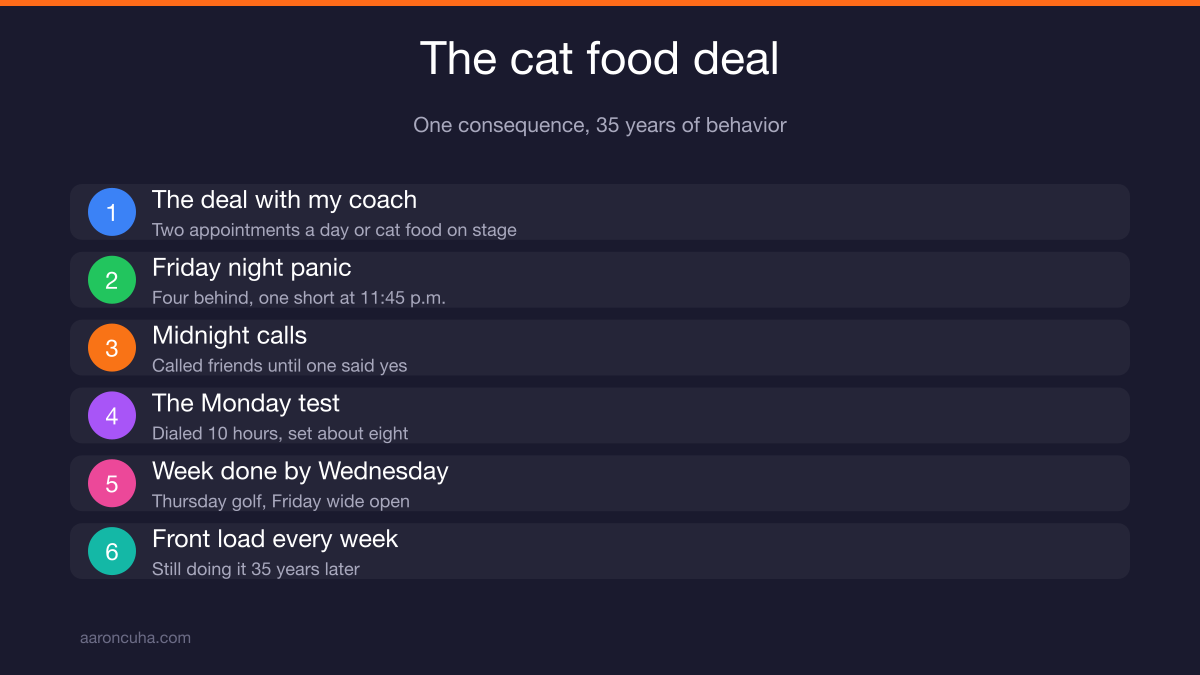
My coach Bill Pipes and I had an agreement. I set two appointments every single day or I ate cat food on stage at Mike Ferry's Superstar Retreat in front of 6,000 people.
Understand something. Cat food in the '90s was not what cat food is today. It was Friskies with bones in it. There was no gourmet option I could dress up on stage.
I had been hitting two appointments a day for months. I was well into my career by then. Then one week went sideways.
It was Friday and I was four appointments behind. At 10:00 at night I was still one short.
By 11:45 I was panicking. So I started calling friends. "We need to have lunch tomorrow. Or breakfast. Or dinner. And we need to talk about your house."
Most of them said the same thing. "It is 11:45 at night. You have lost your mind." Click.
Finally one friend said yes. I went on the appointment the next day, told him the whole story, and we laughed about it.
Everything you have ever heard me say about scheduling started that night. Something rewired in my brain that said I never want to do that again.
What Happened the Monday After
That Monday I decided to find out how many appointments I could set in one day. I dialed for 10 hours and set about eight. I had never worked past two appointments in a day in my life.
Think about that. Five or ten years in real estate and I had never pushed past my daily minimum. I would set my two and go do something else.
Tuesday morning I set my other two. Then I filled Tuesday afternoon and all of Wednesday.
By Wednesday night my week was done. Thursday and Friday were wide open.
I told my wife we were going to the bar early on Friday and I was golfing Thursday. She asked what happened. I told her I finished my appointments early.
Something clicked. I decided I would front load every week from that point forward.
Here I am 35 years later, still doing it with coaching every day. One night of real consequence changed three and a half decades of behavior.
What Every Million Dollar Client Has in Common
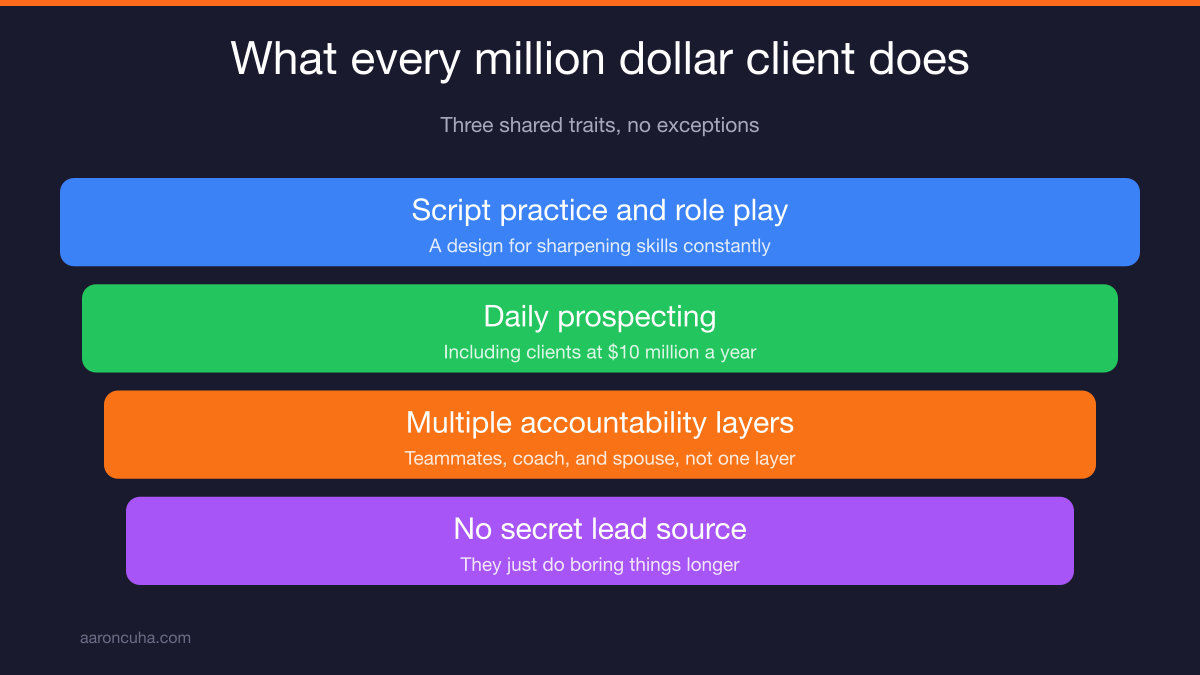
I coach a lot of high producers. Every single client I have who earns more than a million dollars a year shares three traits. No exceptions.
Here they are.
- Script practice and role play. They have a design for it. They are constantly learning and constantly sharpening their skills.
- Daily prospecting. Every one of them. Including my clients doing $10 million a year, and I have multiple clients at that level.
- Multiple levels of accountability. Teammates, coach, and spouse. Not one layer. Several.
Notice what is not on that list. No secret lead source. No magic script nobody else has.
The people at the top do the boring things longer than everyone else, and they build systems that make quitting inconvenient.
If you want to see what that looks like applied to a coaching practice, look at what actually works in business coaching and the client case studies.
Want a second set of eyes on your numbers and your daily activities? Book a Channel Audit and Plan and I will tell you exactly where the gap is.
Fear Versus Reward: Two Engines That Drive You
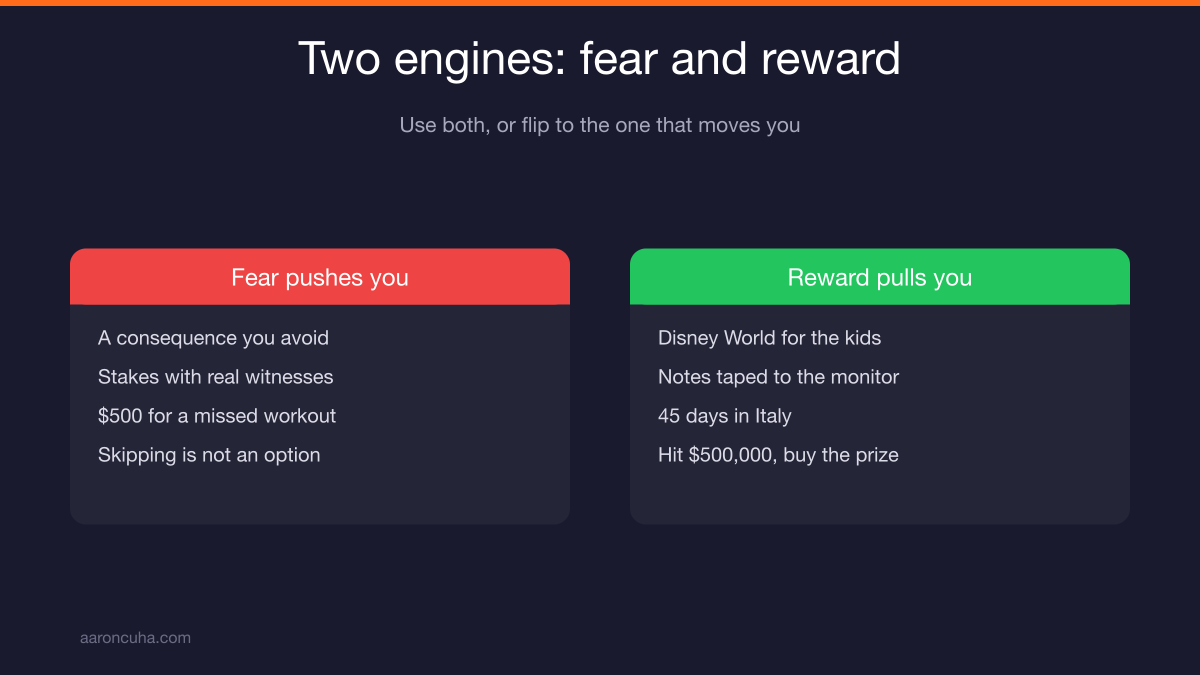
Some people run from fear. Some people run toward pleasure. Accountability works with either engine, and it works best when you use both.
I have a client right now with two young kids. She has a daily call requirement.
She told her kids that if Mommy makes her calls every day, she is taking them to Disney World.
Now she sends me pictures of her monitor. Her kids leave notes taped to it. "Mom, you can do it. Do it for us."
She is crying when she sends them. Her accountability is simple. She is not going to let her children down.
My version this year was Italy. Forty five days.
If you think there was no accountability behind that trip, you are wrong. I used that reward to enforce my skills, my scripts, and my daily activities all year.
So if the punishment side scares you off, flip it. Make the consequence light and make the reward huge.
Hit $500,000 next year and you buy the car, or the investment property, or the trip. Now two forces are pushing you. One pulls you toward the prize. One pushes you away from the pain.
Stakes That Actually Sting: Head Shaving, Snow Shoveling, $500 Fines
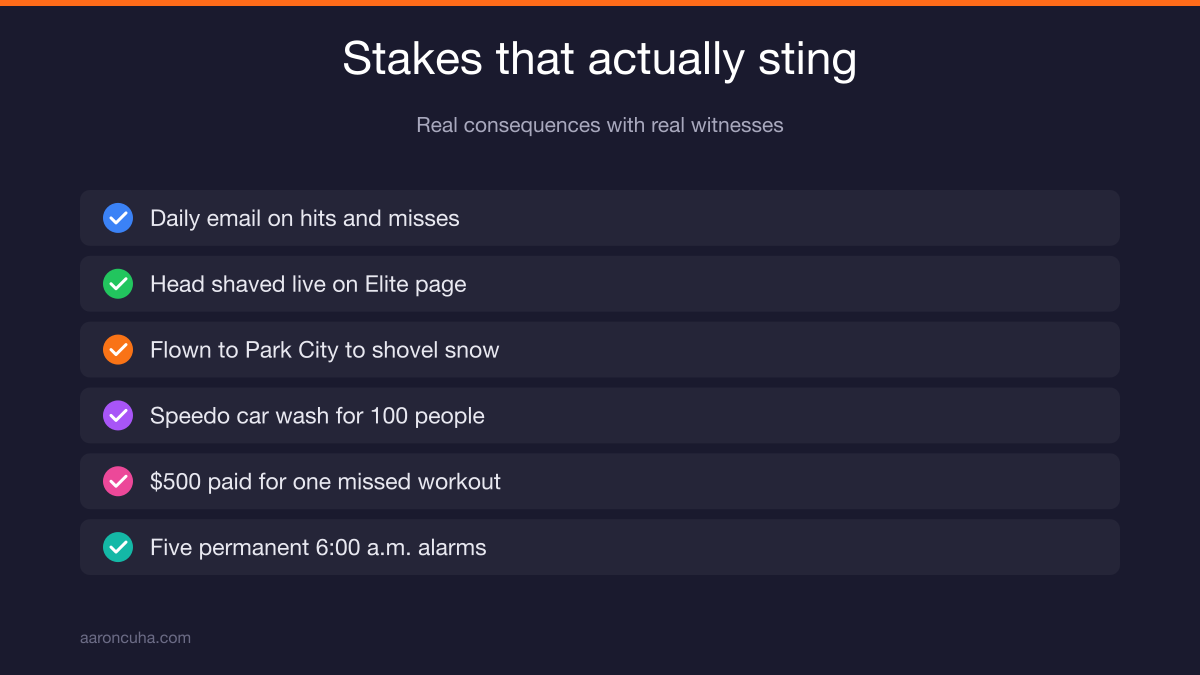
Accountability only works when the consequence stings. Vague promises to yourself do nothing. Real stakes with real witnesses change behavior fast.
I have a client who runs a big brokerage in Vancouver with over 300 agents. His accountability was simple. Email me a daily update on what he got done and what he did not.
That is about as easy as it gets. The consequence for missing was shaving his head live on the Tom Ferry Elite page. He had a big, beautiful full head of hair.
He forgot to email. They shaved his head live.
His partner is a jokester like me, so they only shaved half. Then they handed the clippers to an agent, and the agent walked out of the office.
The whole office was laughing on the Facebook page. This guy makes millions of dollars, so I am watching it thinking I am about to get fired.
Instead he got in his car, still laughing, and drove to a barber shop to have them finish the job. That is accountability.
Other real ones I have used:
- I have flown clients to Park City to shovel snow in my driveway. More than once.
- I made Bill wash all of our cars in a speedo while I catered lunch for 100 people.
- I paid $500 for one missed workout.
Here is what I want you to hear about the $500. I did not skip that workout on purpose. I planned to do it in the afternoon, laid down around 6:00, and fell asleep. I literally forgot.
Now my phone has five alarms at 6:00, 6:05, 6:10, and 6:15. They are permanent. If it hits 6:00 and I have not trained, I go train.
Last night I got in after 1:00 a.m. knowing I had a full day today. I still went to the gym this morning. I did not want to.
Without the accountability, I do not work out that day. I put myself in a position where skipping is not an option.
I do not expect you to go as far as I do. I do expect you to build multiple layers if you are serious.
How to Build Your Own Accountability System
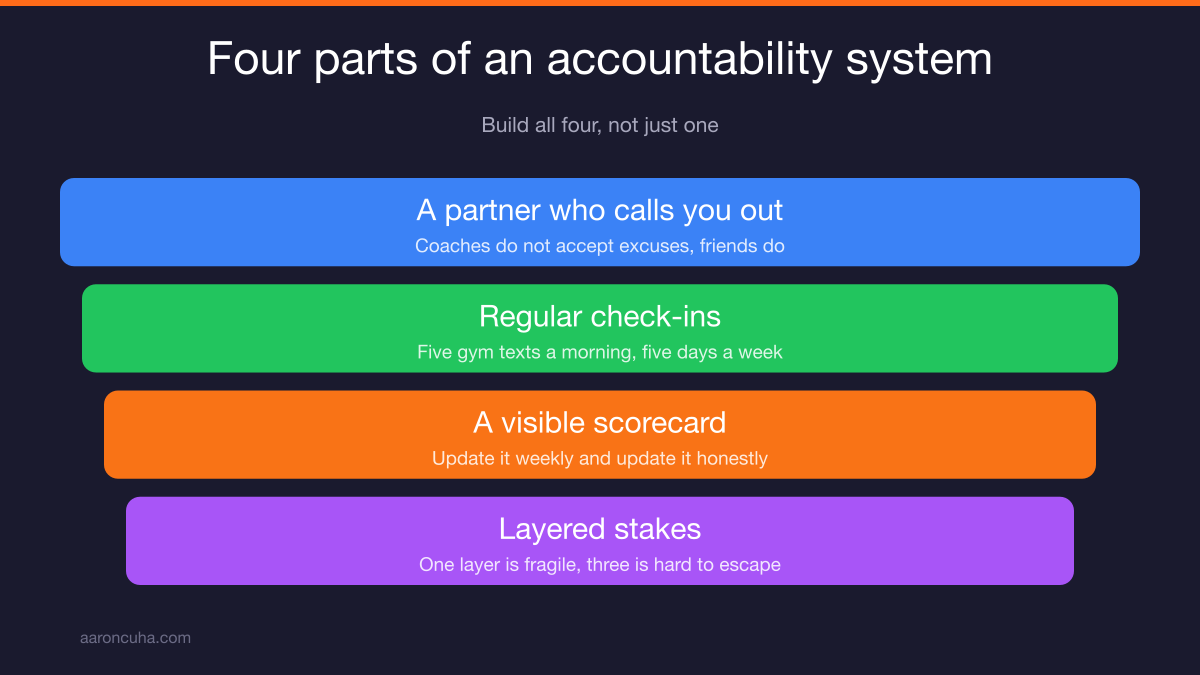
Accountability systems have four parts. A partner who calls out your excuses, regular check-ins, a visible scorecard, and layered stakes. Build all four, not just one.
Start with the partner. Friends accept excuses. Coaches do not.
You want someone who calls you on your nonsense, not a cheerleader who tells you it is fine that you had a rough week.
Then set the check-in rhythm. Mine is five text messages from the gym every morning, five days a week.
I am two pounds away from retiring that requirement. That is 60 pounds of texting.
Iron sharpens iron. The right partner pushes you and you push back.
Then make it visible. Keep a scorecard. Update it weekly. Update yourself honestly.
Celebrate the wins out loud and confront the gaps without excuses. Both matter.
Finally, layer it. Teammates, coach, spouse. One layer is fragile. Three is hard to escape.
If you want structure around this, the Systems Over Hustle community exists for exactly that reason. Weekly check-ins with people who will not let you slide.
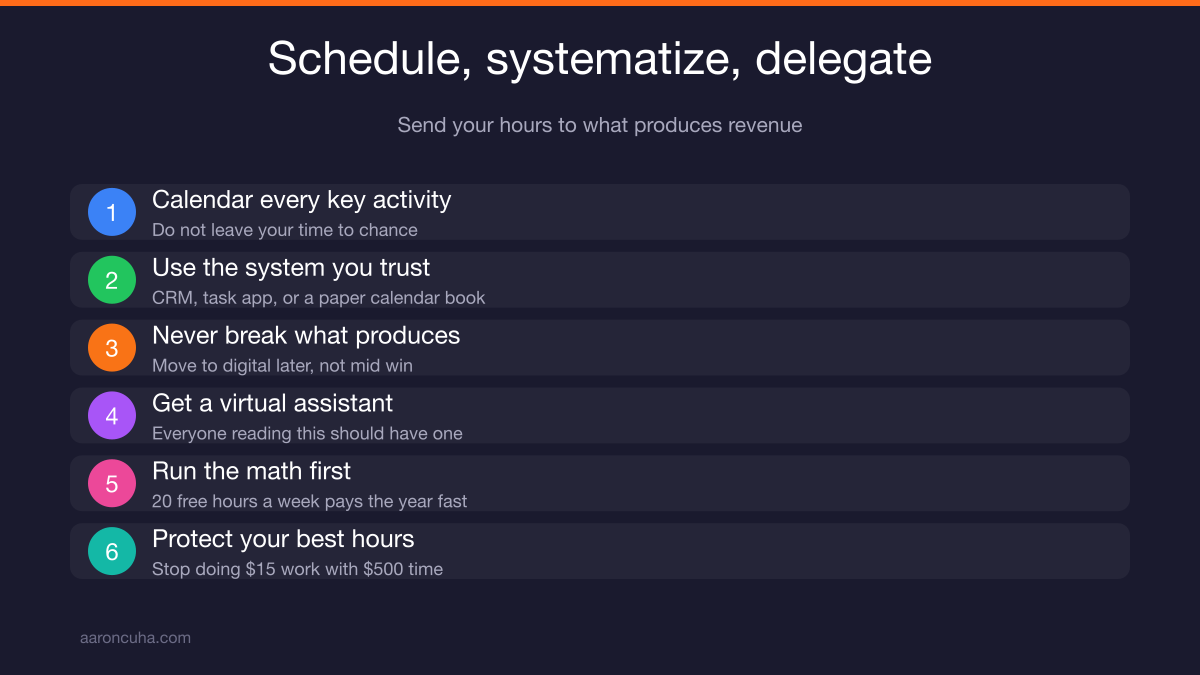
Schedule, Systematize, Delegate
Put every key activity in your calendar. Do not leave time to chance. Then automate or delegate the low value work so your hours go to what actually produces revenue.
Use whatever system works for you. Your CRM, task apps, checklists, whatever you already trust.
I have clients who still run a paper daily calendar in a book. Do I give them a hard time? No. It works.
Should we eventually move them into something digital? Sure. But that is a different conversation. Never break a system that is producing.
Now the delegation piece, which Harvard Business Review points to as one of the hardest skills leaders have to learn. In my opinion, everybody reading this should have a virtual assistant.
Here is the objection I hear every time. "I cannot afford a virtual assistant."
Run the math instead. If you freed up 20 hours a week for the rest of the year, and you applied those 20 hours correctly, would you cover the VA's entire annual cost in a single month?
For sure you would. The cost is not the VA. The cost is you doing $15 an hour work with $500 an hour time.
I go deeper on this in how to stop being the bottleneck and in building AI business systems. Tools like Google AI and modern automation platforms have made this cheaper every single year.
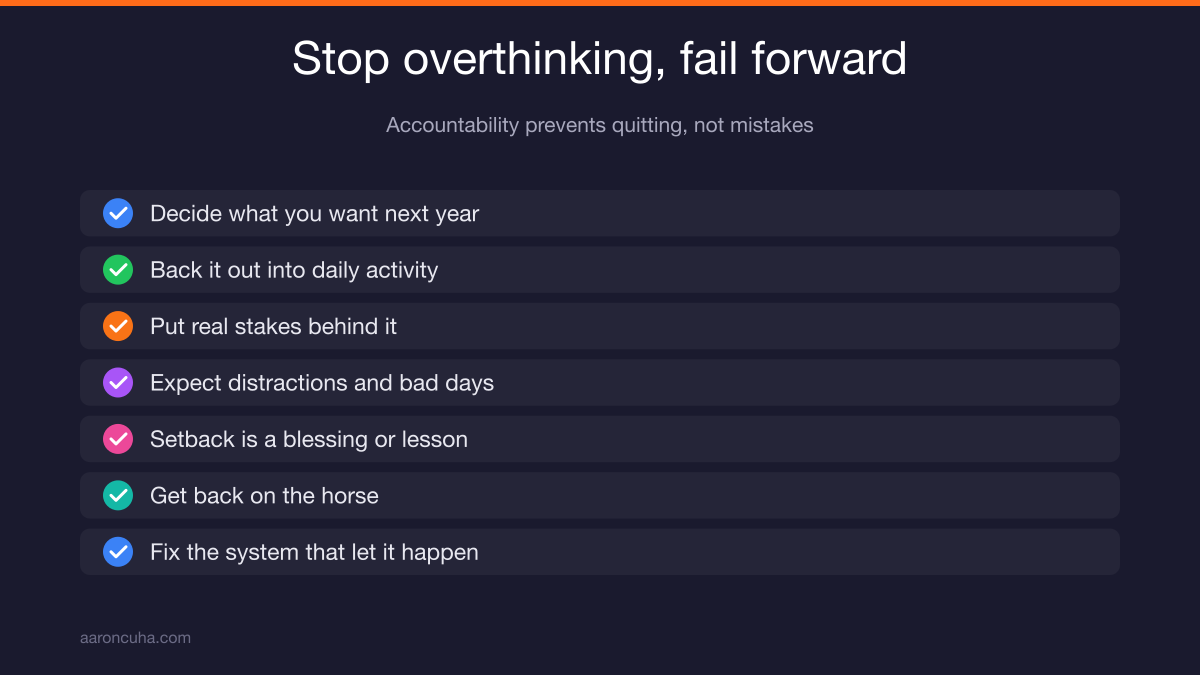
Stop Overthinking and Fail Forward
Your fatal flaw is not lack of ability. It is talking yourself out of the goal before you start. Accountability is not designed to prevent mistakes. It is designed to prevent quitting.
Everyone reading this will overthink it. You will tell yourself it is too hard, or that it works for other people but not for you.
Stop. Every one of you can hit your goals.
There will be distractions. There will be days you get punched in the face. You get back on the horse.
Every setback is either a blessing or a lesson. That is the only two options you are allowed.
Remember why I ate the consequence. I shaved my head. I paid the $500. I made the midnight calls.
None of that stopped me from ever making another mistake. It stopped me from quitting, and it fixed the system that let the mistake happen.
So decide what you want next year. Or in five years. Or ten. Back it out into daily activity and put stakes behind it.
When I say I want to win a Pulitzer Prize in photography, people look at me sideways. I just have to put myself in the right spot. That is not everybody's goal. Find yours.
Ideas are worthless without action. Imagine what you are actually capable of.
The only one who can stop you is you.
Ready to put real structure behind your goals this year? Book a one-on-one strategy session and we will build the accountability system, the daily activities, and the stakes that make quitting impossible.
Frequently Asked Questions

Written by
Aaron CuhaAuthor of Crazy Simple YouTube, keynote speaker, and executive coach with 20,000+ hours logged. ICF PCC, NLP Master Practitioner, and DISC Certified. Aaron helps entrepreneurs replace hustle with AI-powered systems that generate leads, content, and revenue on autopilot.