Time management for real estate agents is the one skill that decides whether your business plan works or collects dust. Aaron Cuha breaks down the habits, the science behind willpower, and the simple timer trick his clients use to get more done in a week than they did in years.
If you do not control your time, your time controls you. That is the whole game. Most agents never hit their goals because they never blocked the hours to do the work.
Key Takeaways
- Habits without time management fail. Time management without habits fails too.
- Do the hardest task first, when willpower is roughly ten times stronger.
- Your brain makes about 35,000 decisions a day and burns glucose doing it.
- Sixty-six days of consistency turns effort into automatic habit.
- Four habits saving 15 minutes each equals six extra weeks a year.
Ready to build a schedule that actually produces business? Start with a 90 minute strategy session and we will map your week around the activities that pay.

Why Time Management for Real Estate Agents Decides Everything
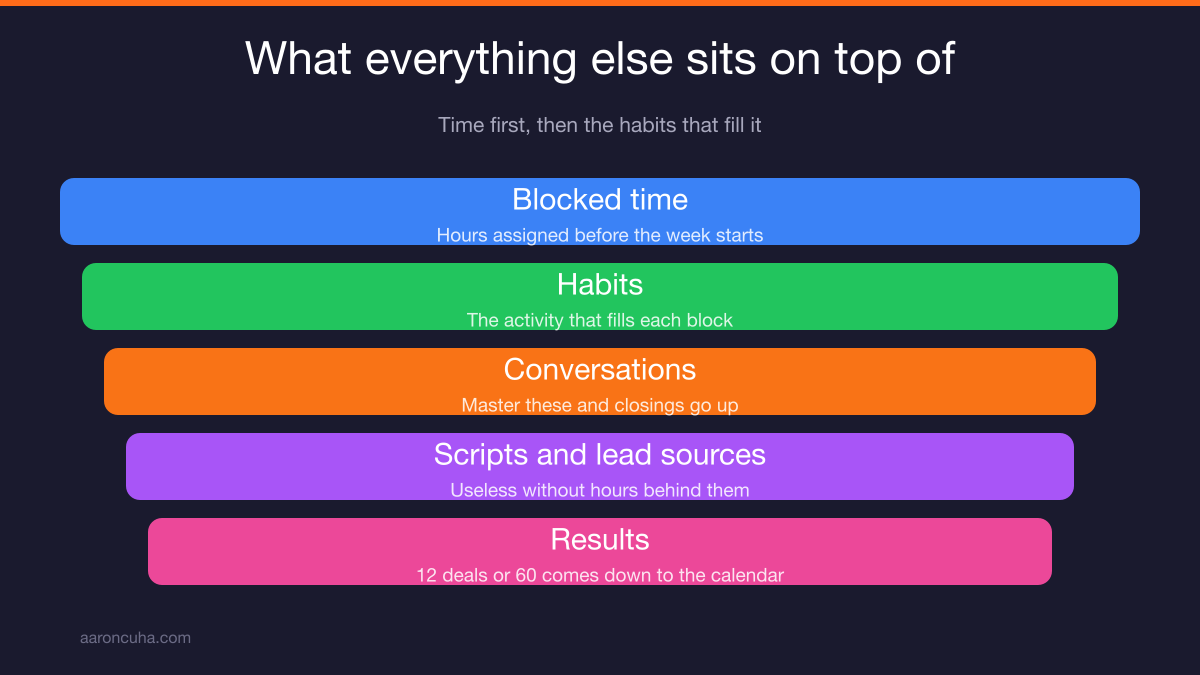
Time management for real estate agents is the single most important thing you will ever put into your business. Not scripts. Not lead sources. Time. Everything else sits on top of it.
Here is the part most agents miss. If you do not develop the habits to hit your goals, you will never hit your goals. But habits without time management are useless. And time management without habits is equally useless.
They only work together. You block the time, then you build the habit that fills it. One without the other collapses inside a month.
I have coached for over 20,000 hours one on one. The gap between the agent doing 12 deals and the agent doing 60 is almost never talent. It is calendar control.
The National Association of Realtors reports that the typical agent works this business full time, yet income spreads are enormous. Same hours available, wildly different results. The difference is what those hours were assigned to do.
When you get good at your business, everything gets easier. Become a master of conversations and your closings go up, your mindset goes up, your income goes up. Become a master of time and you get to do all of it in fewer hours.
That is the promise. Not grinding harder. Structuring better. It is the same idea behind Systems Over Hustle: the system produces the result, not the effort you feel.
Why Bad Habits Are Harder to Fix Than No Habits
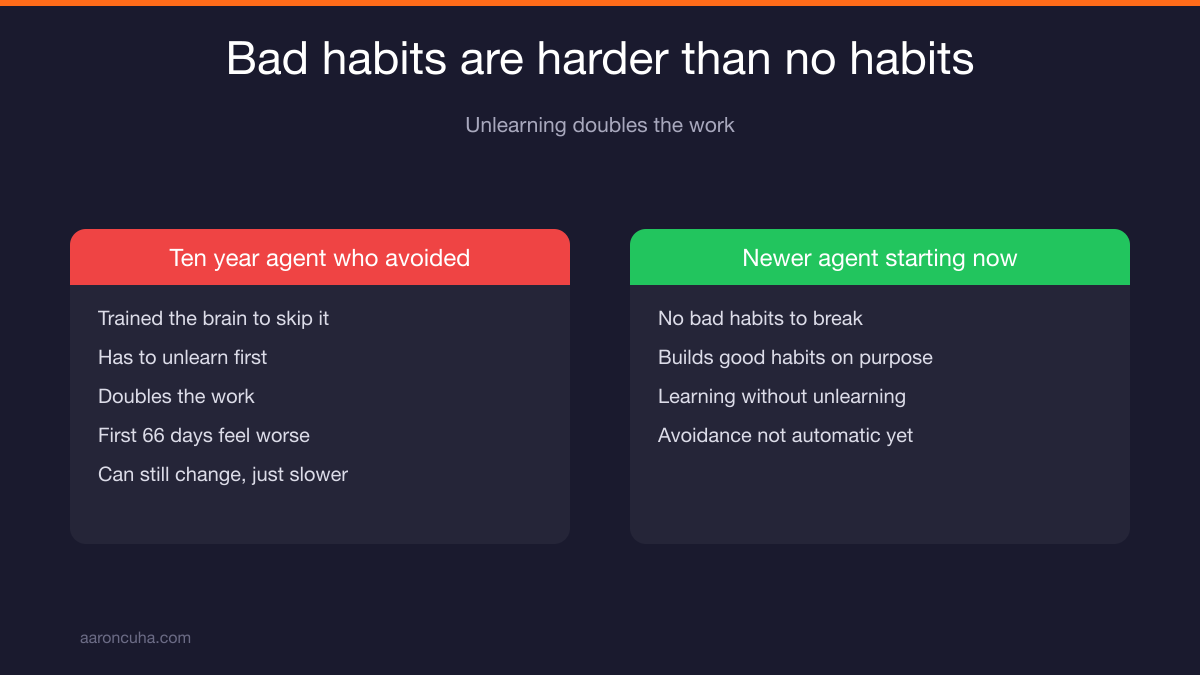
Breaking bad habits is the most difficult work you will ever do. I would rather train someone selling speakers out of the back of a van than a real estate agent who has been licensed for ten years and never did the activities.
Think about the vacuum cleaner salesperson going door to door. He puts his foot in the door. He throws a handful of dirt on the carpet and starts his demo. That person will make the calls. He already has the habit of talking to strangers who did not ask to hear from him.
Now take the agent with ten years of experience who has avoided prospecting the whole time. For a decade he has trained his brain that the hard activity is optional. Changing that is a recipe for disaster.
It is not that he cannot change. It is that he has to unlearn before he can learn. That doubles the work.
So if you are newer, that is an advantage. You have no bad habits to break. Build the right ones now, on purpose, before avoidance becomes automatic.
And if you are the ten year agent reading this, do not quit. Just accept that the first 66 days will feel worse than they do for a rookie. That is normal. Push through it anyway.
The Morning Routine That Runs My Day
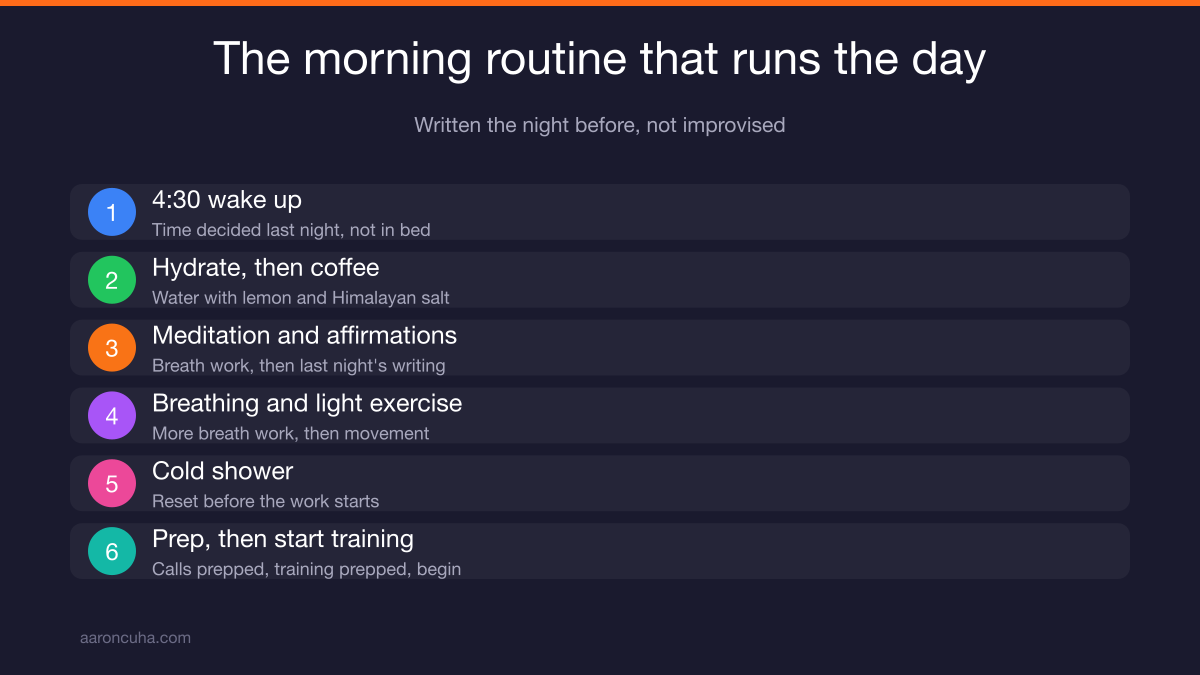
My day starts before anyone is asking anything of me. Here is the actual sequence, written on my calendar the night before, not improvised in the moment.
- 4:30 wake up. The time is decided the night before, not negotiated in bed.
- Hydration. A full glass of water with lemon and Himalayan salt.
- Coffee.
- Meditation and affirmations. A brief session focused on breath work, then the affirmations I wrote last night.
- More breathing exercises.
- Light exercise.
- Cold shower.
- Prep for today's calls.
- Prep for today's training.
- Begin today's training.
I boil my day down like that every single morning. It changes daily depending on whether I am coaching, training, or speaking.
I do not expect you to be here yet. I share it so you can see what deliberate looks like when it is fully built out. You can copy two pieces of this and be ahead of where you were last month.
The point is not the lemon water. The point is that zero decisions get made in the first hour. Everything is already decided. My brain spends nothing.
If you want a deeper look at how the first hour shapes output, I broke it down in the morning routine that helped me build multiple businesses.
The Night Before Is Where Tomorrow Gets Won
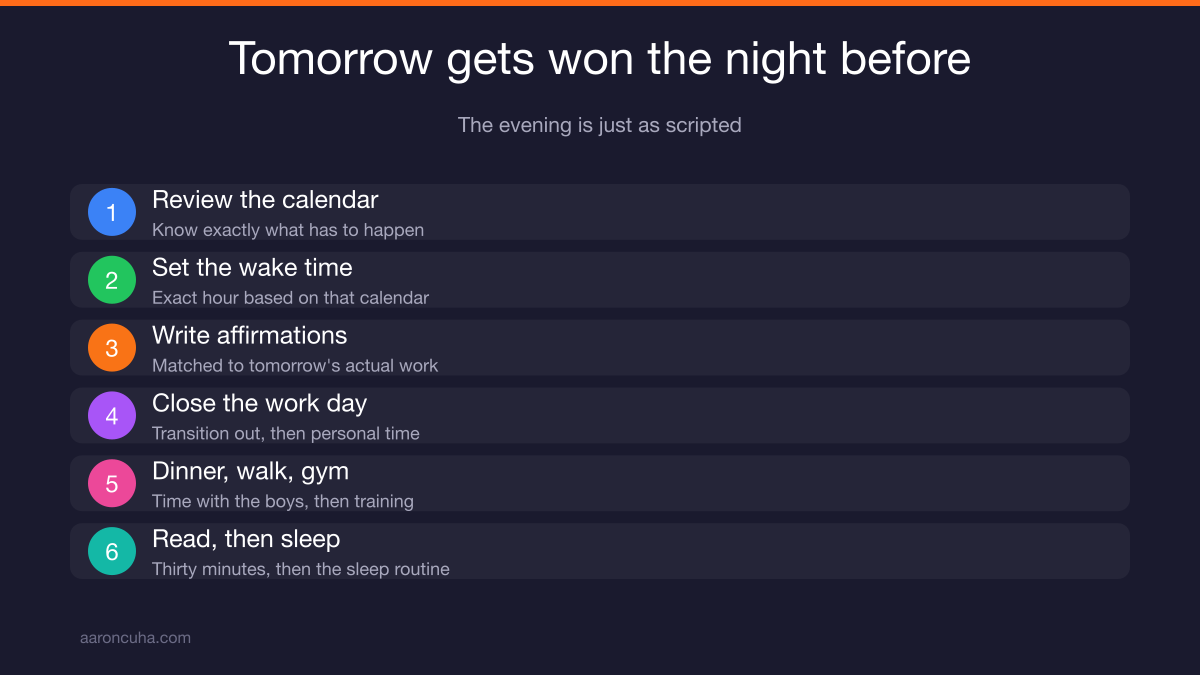
Tomorrow is not built tomorrow. It is built tonight. My evening routine is just as scripted as my morning.
Here is what tonight looks like:
- Calendar review. Look over tomorrow's schedule and know exactly what has to happen.
- Set the wake time. Determine the exact hour I need to be up based on that calendar.
- Write affirmations and gratitude for tomorrow.
- Transition out of work. Take a moment to mentally close the day.
- Personal time. A mindfulness exercise with deep breathing.
- Dinner with the boys.
- Post dinner walk.
- Gym.
- Review the deck for tomorrow.
- Thirty minutes of reading and learning.
- Begin the sleep routine.
Notice the affirmations get written the night before. And they change every night.
Why? Because I write my affirmations based on what I am actually doing that day. Tomorrow I am delivering an AI training at the board of realtors. Those affirmations look nothing like the ones I write on a coaching day. Even my gratitude shifts a little.
Your mental prep should match the work in front of you. Generic affirmations produce generic energy.
Agents skip this step and then wonder why mornings feel chaotic. You cannot win a day you never planned.
Protecting One Day a Week Is Part of the System
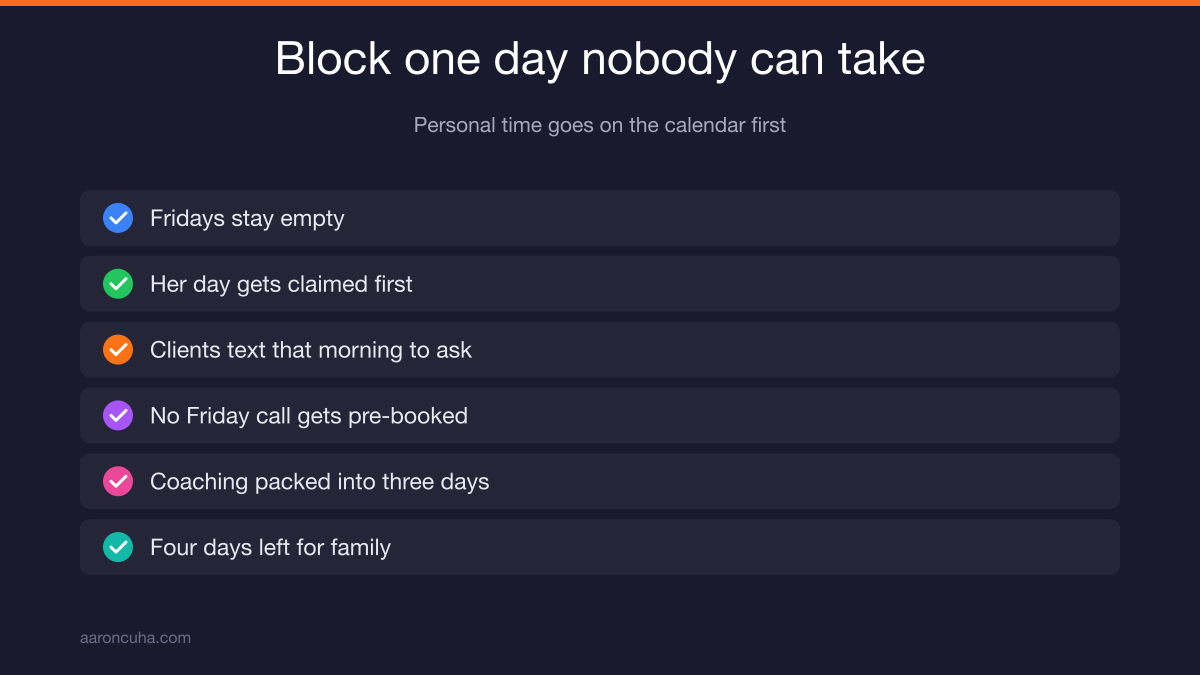
Guess what is on my calendar on Fridays. Nothing. Fridays are her day, and nothing gets booked on them.
If she wants pancakes and breakfast in bed, that is what we are doing. If she wants a hike with the dogs, that is what we are doing. The day belongs to her before anyone else can claim it.
Clients ask all the time. "Can we do a call on Friday?" Yes, absolutely. What time? You have to text me that morning and ask.
They push back. "Why can't we just schedule it?" Because on Friday, it is her day. The good news is she is not a morning person and I am up before everyone. Text me early and we will have a long, great call. Wait until she is awake and we may not be talking at all.
That sounds extreme to most agents. It is not. It is the reason I compress my coaching into three days so I get four days with my family.
Guarding personal time is not the reward you get after the work is done. It is a block on the calendar that everything else has to build around.
Put your day on the calendar first. Then fill in the business. Not the other way around.
35,000 Decisions a Day and Why You Crash at 3 p.m.
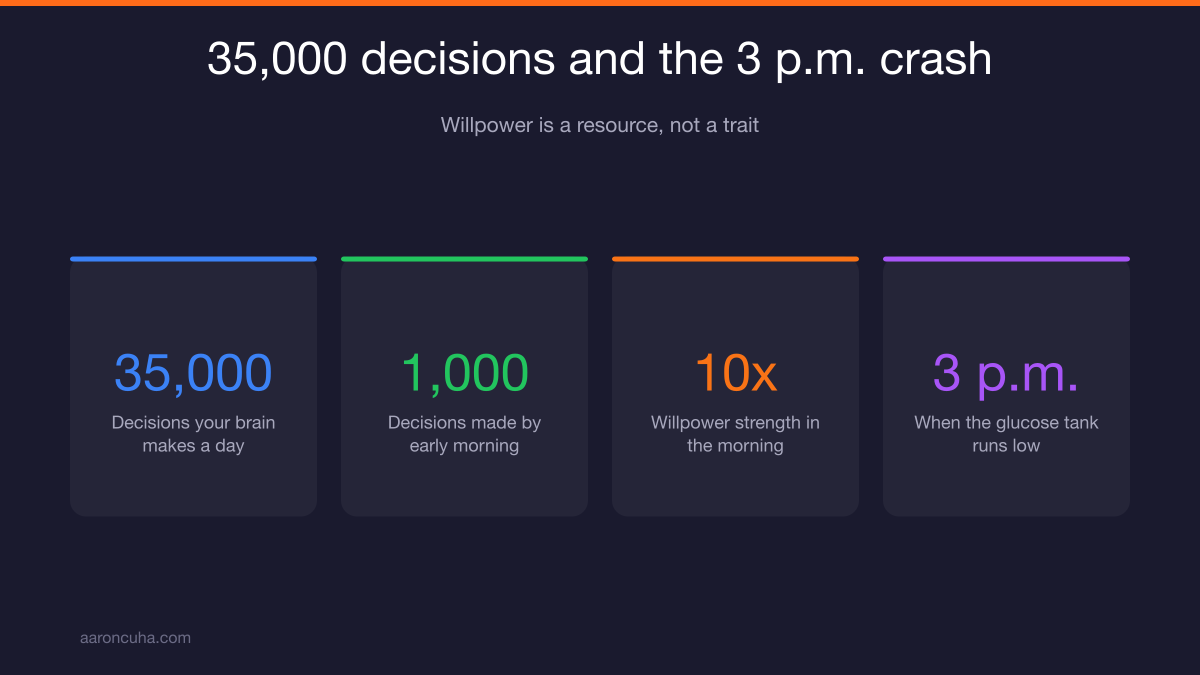
Your brain makes roughly 35,000 decisions every day. Every decision burns stored glucose. That is why you crash in the afternoon.
Here is the mechanism. Your brain stores glucose the way a battery stores charge. Every time it makes a decision, it consumes some of that store. What should I wear. What should I eat. Do I answer this text. Which lead do I call first.
By 3 or 4 p.m., if you have not been deliberate about your decision making, the tank is low. Whatever you were fully committed to this morning, you are no longer committed to.
This is why willpower is not a character trait. It is a resource with a schedule. It is highest when you wake up and it declines all day.
The American Psychological Association has published extensively on self regulation and how it depletes with use. The practical takeaway for agents is simple.
Stop scheduling your hardest work for the hour when your tank is empty. That is not a discipline problem. That is a design problem.
Eat the Frog: Do the Hardest Thing First
Brian Tracy wrote a great book called Eat That Frog. The idea is simple. Do the hardest thing first, every single day, and get it out of the way. For agents, that is almost always prospecting.
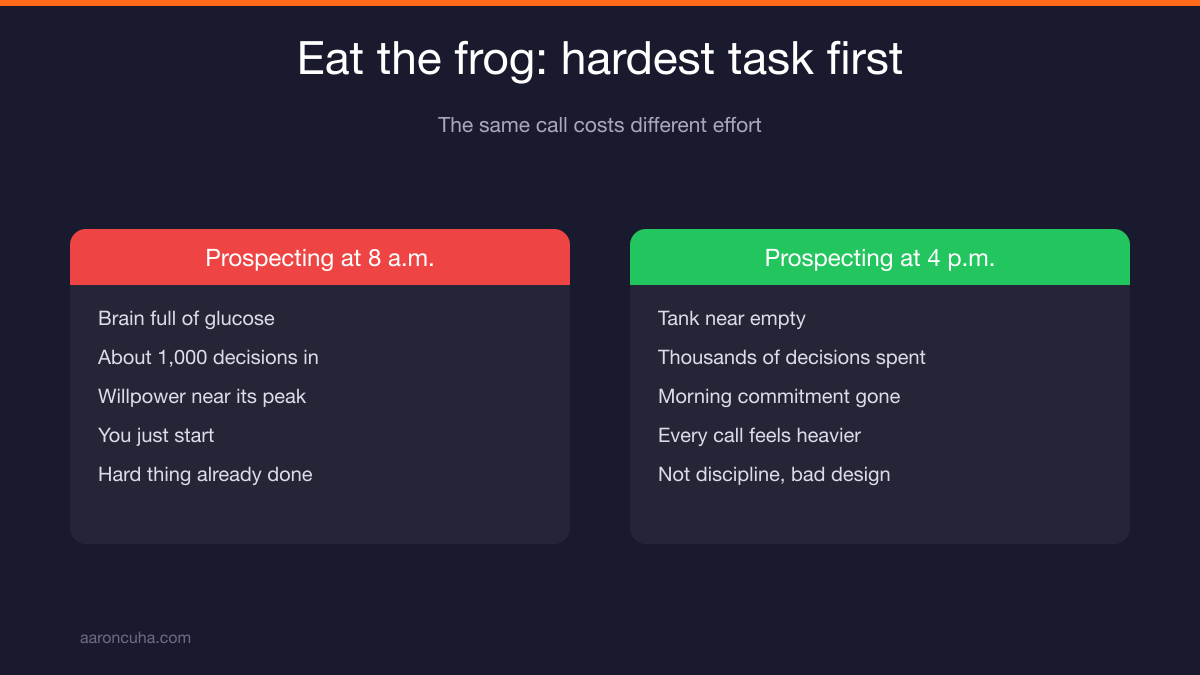
Now add the science. When you sit down in your office in the morning, you have made a thousand decisions instead of 35,000. Your brain is full of glucose.
Your willpower is roughly ten times stronger at that hour. The exact same call, made at 8 a.m. versus 4 p.m., costs you a completely different amount of internal effort.
I got this wrong myself for years. I coach from 5 a.m. to 5 p.m. By the end of the day I am so drained I have to close my eyes for 30 minutes to reset. I told everyone there was no possible way I could work out on a coaching day.
For the last 12 weeks I have worked out every morning at 3:30 before I start. My workouts actually give me more energy. I was wrong. I was an idiot for years and I could have been doing this the whole time.
Do I want to get up at 3:30 and train? No. I am not crazy. But I want my coaching done in three days so I get four days with my family. For that, it is worth it.
Ask yourself what you have decided is impossible without ever testing it.
Want the same structure applied to your lead generation, not just your calendar? Get a Channel Audit and Plan and see where your hours are leaking.
The 66-Day Habit Rule and the Six Weeks You Get Back
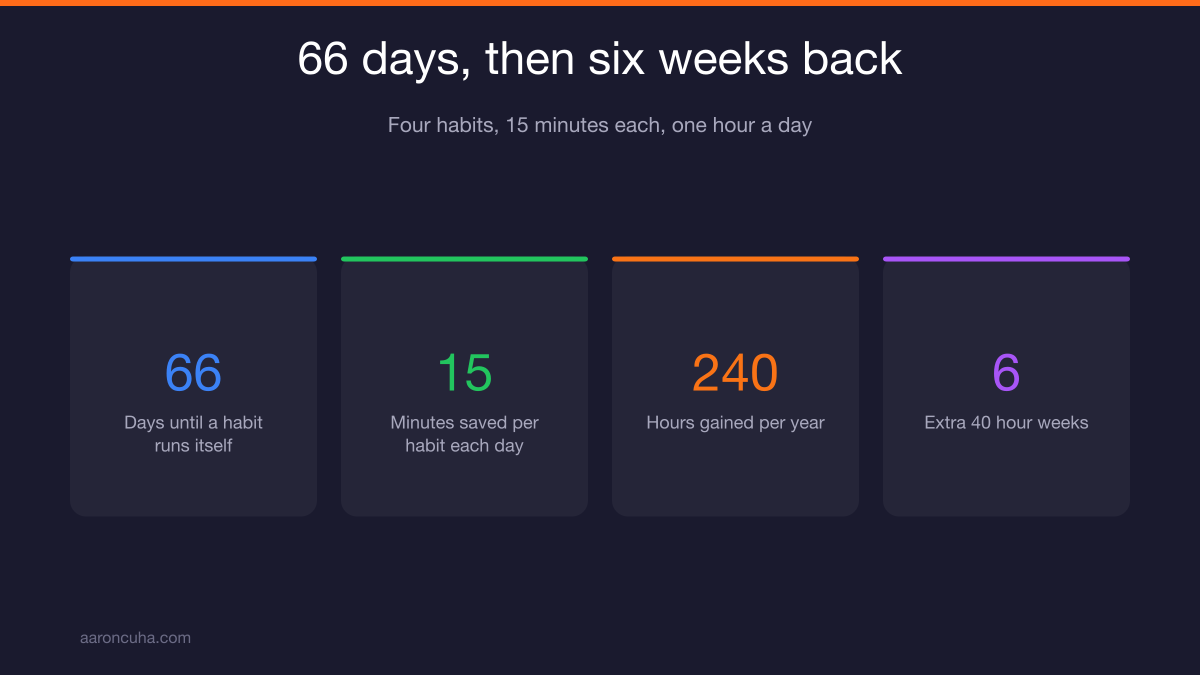
Research out of MIT and other institutions puts habit formation around 66 days. Do something steadily for 66 days and it stops requiring force. It becomes automatic. If you want the underlying science, MIT News has covered how the brain builds and stores habit loops.
Here is the beautiful part. Once it is a habit, the time, energy, and effort your brain spends getting into it is cut in half. The 15 minutes you used to spend procrastinating disappear. You just start.
Now run the math. Say you build four habits and each one saves you 15 minutes of procrastination.
| Input | Number |
|---|---|
| Habits built | 4 |
| Minutes saved per habit | 15 |
| Time gained per day | 1 hour |
| Working days per year | 240 |
| Hours gained per year | 240 |
| Extra 40 hour weeks | 6 |
Six full weeks that nobody else got. You are bending time and space, and all you did was block four things and repeat them for 66 days.
What would you do with six extra weeks? More listing appointments? More time with your kids? Both?
How much better will you be at your craft with 240 extra hours of practice? And how much easier will everything feel once the friction is gone?
That is what happens when you decide to control your time. If you do not control it, it controls you.
The December 31 Test
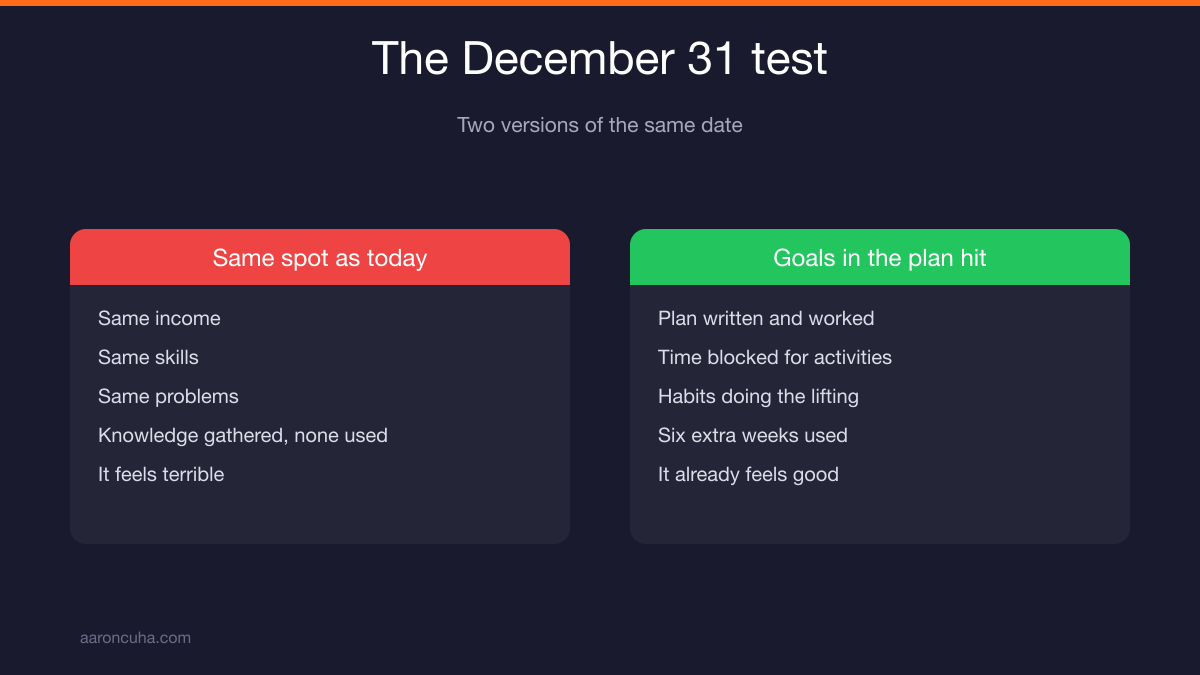
Picture December 31, 2026. You are in the exact same spot you are today. Same income, same skills, same problems. How does that feel?
It feels terrible. And it should. You gathered all this knowledge this year and used none of it.
Now flip it. It is December 31, 2026, and you actually hit the goals in your business plan. How does that feel? You have not even written the plan yet and it already feels good.
That gap in feeling is your motivation. Everything in this article is the bridge between those two versions of December 31.
Here is the part I say to every room I speak to. Do not let your coach work harder for your business than you do. When I show up to train agents, I am not the one who benefits from the information. You are.
If you do not block the time and build the habits, you will end 2026 exactly where you ended last year. The business plan does not do the work. The calendar does.
Write the plan. Then immediately open your calendar and put the activities in it. A plan without blocked time is a wish.
Schedule Big Rocks, Then Guard the Calendar
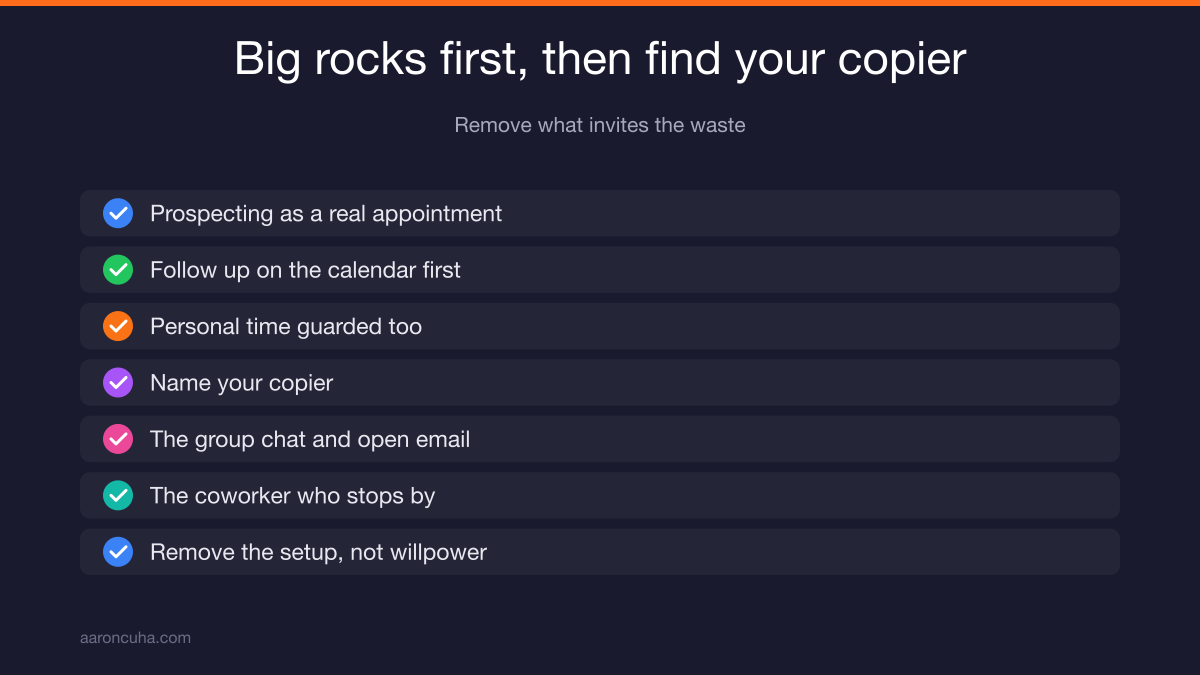
Schedule your big rock tasks first. Treat prospecting and follow up like important appointments, not like things you will get to. Then protect your personal time with the same seriousness.
This is your livelihood. This is how you survive and how you thrive. This is how you put food on the plate. Treat it that way, because if you do not, you lose every time.
Guarding the schedule also means removing the things that invite waste. Let me tell you about the copier.
At my mortgage company we were closing around a thousand loans a month. We bought a massive copier. Forty thousand dollars, bigger than a Volkswagen Beetle. We actually called it the Beetle. It ran hundreds of copies in seconds.
Two or three months in, production dropped dramatically. I could not figure it out. We had the fastest machine money could buy and output was falling.
One of my team members told me to go look at the copier. There were about 30 people standing around it. The copier had become the water cooler. Everyone was waiting their turn and chatting while they waited.
I asked what they were doing. "We're just waiting to use the copier." That is not how this works. The machine was supposed to make us more efficient, not less.
I pushed that copier out the front door and put a small one in every cubicle. Production went through the roof. People went back to work.
Look around your office and your day. What is your copier? The group chat, the open email tab, the coworker who stops by. Remove the setup that invites the waste instead of trying to out-discipline it.
The Pomodoro Technique for Agents Who Cannot Focus
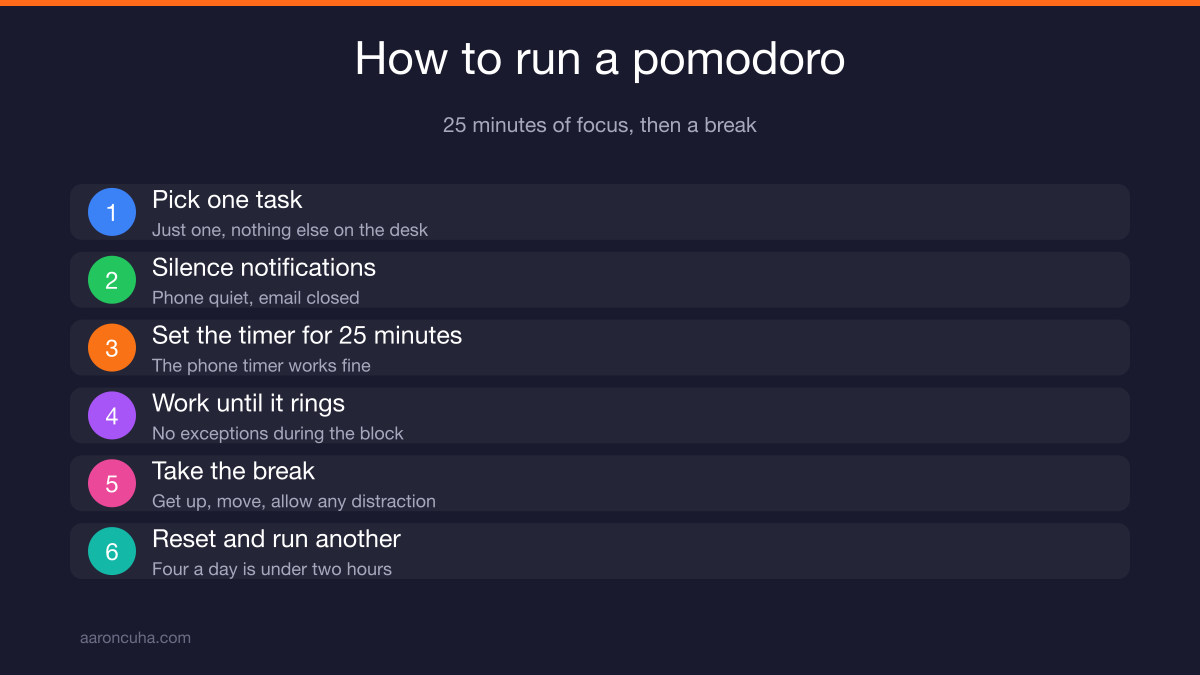
The Pomodoro technique is 25 minutes of focused work with every distraction turned off, followed by a short break. It works especially well if you struggle with attention.
The name comes from Italy. In Italian kitchens, the nonnas use a wind up kitchen timer shaped like a tomato. Tomato in Italian is pomodoro.
The finding behind it is that almost anyone, no matter how scattered, can hold focus for 25 minutes. So you set the timer, turn off email, turn off text, and work on one thing.
When it goes off, you allow any distraction you want for a few minutes. Then you come back and set another one.
Here is how I run it:
- Pick one task. Just one.
- Silence your phone notifications and close email.
- Set the timer for 25 minutes. I use the timer on my phone.
- Work until it rings. No exceptions.
- Get up, move, do whatever you want.
- Reset and run another one.
I had a client with over 20 years in real estate start using it. He texted me: "Coach, I did four pomodoros a day every day this week. I got more done this week than I have gotten done in the last 10 years combined."
I have at least a dozen clients running pomodoros daily with big results. You can read more about the method at the official Pomodoro Technique site.
Four pomodoros is under two hours. That is not a big ask. It just has to be protected.
Build Your Own Time System and Let AI Coach It
There are a dozen techniques like Pomodoro. Your job is to find the one that fits your brain, not to force yourself into mine.
Use ChatGPT for this. Ask it to walk you through the major time management methods, explain the tradeoffs, and help you pick based on how you actually work. Then ask it to hold you accountable on a daily check in.
Whatever your challenge is, you can overcome it with a little research and a little work. The tools are free now. That is a real advantage, and it is the same reason I keep saying AI will not replace you, but someone using AI will.
If you want the systems side handled properly, look at how I build AI systems for real estate teams so the calendar work stops depending on memory.
Here is your challenge for this week:
- Run four pomodoros a day for the next five business days.
- Put your hardest task first on the calendar and do it for 66 straight days.
- Write tomorrow's affirmations and wake time tonight, not in the morning.
- Block one day a week that nobody gets to schedule over.
- Find your copier and push it out the door.
None of this requires talent. It requires a decision made once, then repeated.
Time management is the key to the bank account. Habits are the next key. Neither one works alone, and both are completely within your control starting tomorrow morning.
If you want help installing this in your business instead of doing it alone, look at one on one real estate coaching and let's build the calendar that gets you to December 31 with your goals hit.
Frequently Asked Questions

Written by
Aaron CuhaAuthor of Crazy Simple YouTube, keynote speaker, and executive coach with 20,000+ hours logged. ICF PCC, NLP Master Practitioner, and DISC Certified. Aaron helps entrepreneurs replace hustle with AI-powered systems that generate leads, content, and revenue on autopilot.