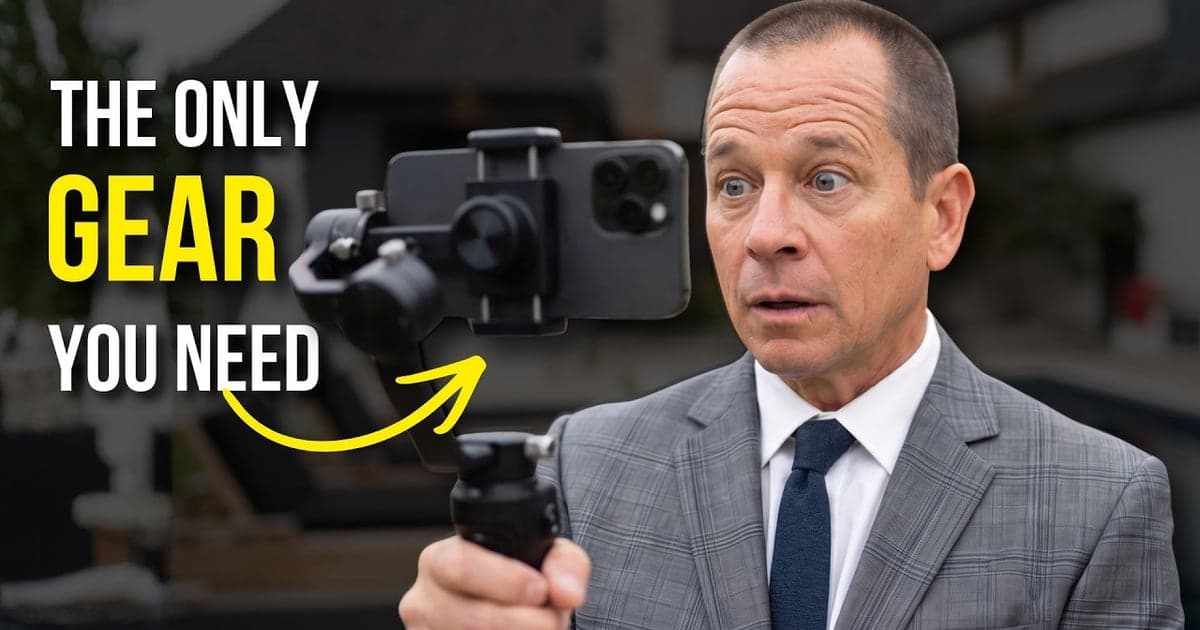
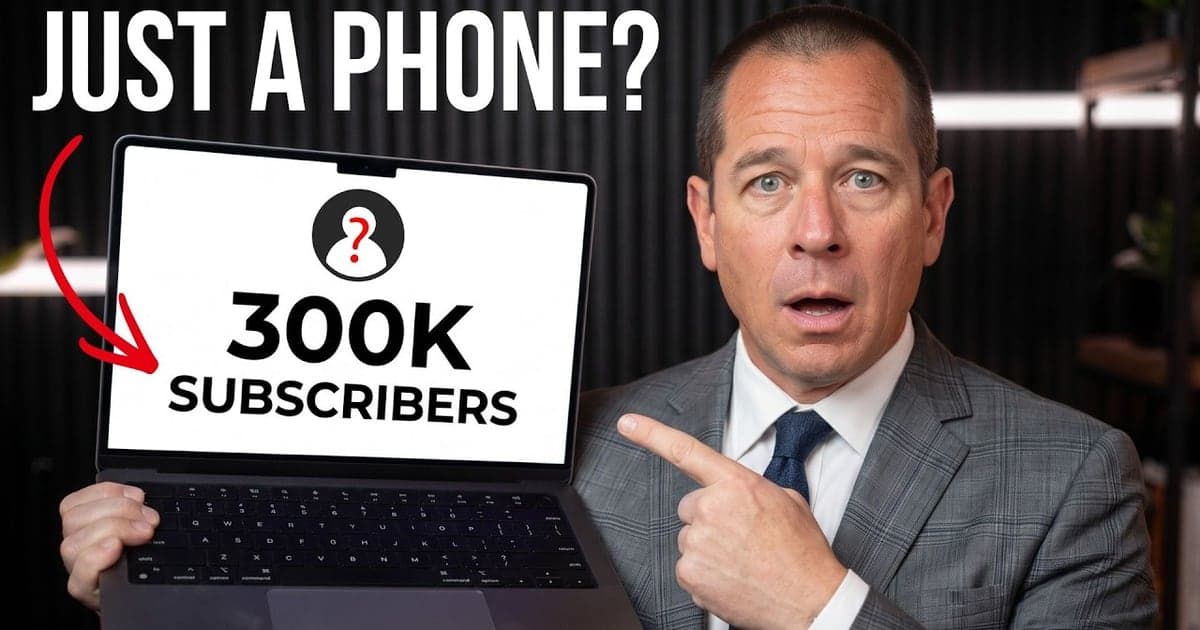
Billed as How to Win on YouTube and built as Press Record Anyway: the Tom Ferry Success Summit 2026 main stage keynote was three stories, one lesson and one action each, four rules, and ten seconds in which 5,000 people filmed their first video. Here is what it covered, from the deck and the script.
The Tom Ferry Success Summit 2026 YouTube keynote was three stories and four rules, delivered from the Anaheim main stage to 5,000 people in the room and thousands more on the live stream. It was billed as How to Win on YouTube. It was built as Press Record Anyway, and it ended with the whole room filming a ten-second video at once.
Key Takeaways
- The talk ran 30 minutes plus a 20-minute panel, built on three stories. Each story ended with one lesson and one action, nothing else.
- Lesson one: perfection is fear wearing a costume. A good video published beats a perfect video in progress.
- Lesson two came from a nine-word cardboard sign in a Kathmandu airport: say exactly the right words to exactly the right person. That is what YouTube now rewards.
- The four rules: press record before you are ready, quantity beats quality, never miss a week, and say the exact words your one viewer is searching for.
- The close moved to a satellite stage in the middle of the floor, where 5,000 people flipped their phone cameras and recorded their name and what they help people with.
- Three agents who hated the camera, from Big Bear, Anacortes and Long Beach, finished the session on a panel, with a free AI tool on screen that tells you whether your next video idea is built or bullshit.
What was the Tom Ferry Summit 2026 YouTube keynote about?
On paper it was a YouTube talk. In the room it was a talk about fear, aim and the cost of waiting. I am writing this from my own deck and my own script, so this is the version I prepared and walked out with, not a transcript. Where a number was on a slide, I say so and give the number as it stood that day.
The frame was announced in the first three minutes: "Who am I to stand up here? I am going to answer that with just three stories. That is the whole talk. No pitch deck. No forty-seven bullet points." Every story ended with one thing to steal and one thing to do that night. The deck was twenty slides, almost all of them full-bleed photographs or a single phrase, and the screen went to a blank navy page whenever a story needed to hold. When the screen carries nothing, the room has one place to look.
If you only want the system, it is the same one in Crazy Simple YouTube and in the YouTube for real estate agents guide. The keynote exists to get people past the part that a book cannot: actually pressing the button.
How was the keynote structured?
Three zones, one grammar. Stories were told on the audience's left, lessons were delivered planted at center, and the application pointed to their right. The audience reads a stage like a page, past to future, and within minutes they learn where each kind of content lives without being told.
- The confession and story one (minutes 0 to 5:30): a full camera crew, eight hours, zero usable footage, and the years of waiting that followed. Lesson: press record anyway.
- Story two (5:30 to 16:30): DirectLender.com, 2008, a plastic fork, Nepal, a cardboard sign. Lesson: the right words aimed at one person, which is what semantic listening rewards.
- Story three (16:30 to 20:45): the rebuild. Travel channels, still hiding, finally on camera, the receipts, and a brand new channel started from a house in Cabo six weeks before Summit. Then the four rules.
- The collection (20:45 to 24:00): a walk down the center aisle to a satellite stage in the middle of the floor, the fear problem versus the aim problem, and the activation.
- The handoff (24:00 to 26:00) into a 20-minute panel with three agents, and a QR code that stayed on screen for the rest of the session.
For meeting planners reading this to understand the format: the talk is designed for a big room, it uses one walk into the audience and one satellite moment, and it needs house lights that can come up for sixty seconds. It also works without the satellite stage. The fallback is a direct assignment to film ten seconds before bed.
Why did I wait years to press record?
The talk opened with three seconds of silence and three sentences: I am embarrassed. I am embarrassed to share this with you. I am embarrassed that it is true.
The first time I decided we would be a video-first company, I did not buy a camera. I hired a videographer and a full crew, booked them for a whole day, and planned to shoot a library of content. Every time the camera rolled, I froze. Two sentences in, stop. Five sentences in, stop. I hated how I sounded and how I looked. Eight hours, thousands of dollars, a professional crew, and zero usable footage.
That is not the embarrassing part. The embarrassing part is what I did next, which was nothing. I waited years before I pressed record again. The camera cost me a day. The fear cost me years.
Lesson one, delivered planted and still: perfection is not a standard, it is fear wearing a costume. It dresses up like professionalism. I will start when the lighting is right, when I have lost twenty pounds, when I sound better. Under the costume it is the same scared guy who could not say five sentences to a crew. A good video published beats a perfect video in progress. Your audience does not need you polished. They need you present.
What does a plastic fork have to do with YouTube?
Story two went back to the beginning. I left home at fourteen. The same year my motorcycle died outside Bakersfield with nobody coming, so I sat on the curb, took it apart and figured it out. That became the operating system: nobody is coming, figure it out. By the mid-2000s I had figured it into DirectLender.com, a mortgage company with 280 offices, 3,000 employees and eight figures a year. We sponsored an IndyCar that won the Indy 500. Bear Stearns came to buy us and I said no. I thought I was untouchable.
Then 2008. In about ninety days it was gone. The banks took the planes, the boats, the properties, the savings. We sold the house. Families who lost their homes sued us personally, and I did not blame them. In the middle of it, my father died. The image I have never shaken is me on a dog bed on the floor of a house that was no longer ours, surrounded by boxes, eating takeout with a plastic fork, because in my head that fork was one of the only things they had not taken.
I called my lawyer to file the bankruptcy. He said no, we were about to win the first case, and then he said: come to Nepal with me and help me start an orphanage. I was being sued by half of California and my attorney's legal strategy was orphans in the Himalayas. It was the best advice I ever got. I got on the plane.
I lived at that orphanage for over a month. One day we got a call about two sisters, five and three, living alone by a river where the sewage runs, surviving off a trash heap. I had spent months in self-pity, and I was standing in front of a five-year-old who had spent her whole life protecting her baby sister with no house, no parents, and not even a dog bed. We took them in and put them in the best school in the country. People say we saved those girls. No. They healed me.
Up in the Himalayas I spent time in a one-room shack twenty minutes from the nearest human, no electricity, no running water. A man who owned airplanes a year earlier, and for the first time maybe ever I felt rich, because it was quiet enough to think. I made better decisions in that shack than I ever made in a boardroom. Clarity does not come from equipment. Remember that the next time you tell yourself you need a better camera.
Then I brought my wife Debbie, thirty-five years together, a woman who had toured Egypt with her own Egyptologist and never camped a day in her life. When we walked into the arrivals hall the kids were holding a handmade sign: "Welcome Debbie ma'am, will you please be our mom?" She never stood a chance. We grew that orphanage to eighteen kids. Our two youngest just graduated high school. We have underwritten six medical camps in those mountains, two thousand people a day, people who walked for days to see a dentist for the first time. The man on the dog bed did that. He just started before he was ready.
What is semantic listening, and why did a cardboard sign explain it?
Lesson two was the biggest one. That sign was nine words, handwritten on cardboard. No fonts, no graphics, no production budget, and it is the most effective piece of communication I have ever seen, because it said exactly the right words to exactly the right person. That is all great communication is. YouTube simply rewards it. Not lighting, not cameras, not editing. The right words, aimed at one real human being.
Everything I lost in 2008 had one thing in common: it looked successful. Views that never become a real person calling your business are the plastic fork. They look like something and are worth nothing.
What changed on the platform is that YouTube now listens to every word you say and compares it to what real people type into the search bar. I walk through what that means for titles and descriptions in the video above, and the deeper version is in AI for real estate agents in 2026. On stage the point was simpler: stop trying to impress the algorithm. Help the person. Answer the question. Serve one viewer, and say the exact words they are searching for, like a sign held up in an airport aimed at one heart.
The action was concrete. That night, write down the exact question your best client asked you this week, word for word. That is your next video title.
What happened when I finally pressed record?
In 2016 I became a coach, and Debbie and I spent three years on the road. I coached from forty-five countries, including once from the top of a water tower in South Africa because it was the only place with reception. We built travel channels along the way. The slide that day put the social accounts at more than 800,000 followers combined with tens of millions of views. Our dogs have fifty thousand followers. The dogs.
Here is the confession inside the confession: through all of it I was still hiding. Photos, captions, clips of everything except me. Hundreds of thousands of followers and I still was not on camera, still scared of my own face talking. So I finally did it with no crew, no lights, no script, just a phone. I pressed record, and this time I kept pressing it. Badly at first. Weekly, always weekly.
The receipts slide, with numbers confirmed in July 2026, showed @VanLife at 138,000 subscribers and the coaching channel @aaroncuha at 107,000. The man who froze after five sentences in front of a film crew now has nearly a quarter of a million people choosing to watch him talk every week. What changed was not my face or my voice. I did not become Morgan Freeman. I simply became consistent enough for confidence to catch up.
Then the wake-up for anyone thinking that took years. Everywhere I go I hear the same three sentences: that worked back then, you have a team, I do not have time. Between eighty coaching calls a week, a construction company in Park City, another book, two months in Italy and six weeks in Cabo, I have earned the no-time excuse as well as anyone. So six weeks before Summit I started a brand new real estate channel from zero, from a single house in Cabo, filmed in the gaps between coaching calls, on a five hundred dollar promotion budget. The slide read: over 10K in six weeks, 20 buyer guide downloads. Leads for a real business, not views.
What are the four rules from the Summit keynote?
Every channel on that screen was built on the same four rules and nothing else.
| Rule | The excuse it kills | What to do this week |
|---|---|---|
| 1. Press record before you are ready | "When the lighting is right." You will never be ready. | Film ten seconds tonight: your name and what you help people with. |
| 2. Quantity beats quality | "I only post when it is good." I know that stings. | Publish the next one before you are happy with it. Repetition is the editor. |
| 3. Never miss a week | "I will batch when things calm down." Feast or famine kills more channels than bad content. | Pick the publishing day and put it on the calendar for the next twelve weeks. |
| 4. Say the exact words your one viewer is searching for | "My channel is about me." Nobody is searching your name. | Write your best client's question word for word. That is the title. |
That is the entire crazy simple system. It rebuilt my life after the dog bed, it built an orphanage in the Himalayas, it built the channels, and it works in the gaps between phone calls. The reason it is four rules and not forty is covered in systems over hustle: a system you can keep in a bad week beats a strategy you can only run in a good one.
What did 5,000 people do in the last ten minutes?
At minute twenty I stepped off the main stage and walked the center aisle to a small satellite stage in the middle of the floor, screen black, spotlight following. On the way: you hate how you look on camera, so did I. You hate how you sound, so did I. You are waiting until you are ready. I waited years. Years of leads I never got and clients I never met, a business I kept small because I was scared of a lens. How long have you been waiting, and what has the wait already cost you?
Then the diagnosis. Nobody in the room had a camera problem. Some had a fear problem dressed up as a quality problem: never pressed record, or press it and delete it. About half were already recording, some a lot, and the needle still was not moving. That is not fear. That is an aim problem: wrong topics, wrong words, no rhythm. Two different diseases, one prescription in two parts.
Part one, house lights up: phones out, everyone, veterans included. Flip the camera around. That cringe you feel is the years-of-waiting feeling, and that is the enemy, not the camera. One sentence, your name and the one thing you help people with, ten seconds, on three. Five thousand people pressed record at once. Ten seconds earlier half the room had a fear; now they had footage, with five thousand witnesses in the room and more online. And because I was standing in the center of the floor, I am in the background of thousands of first videos. Post it and tag me.
Part two fixed aim. I brought out three agents who had sat where the audience was sitting, from three markets and three businesses, all of whom hated the camera and started before they were ready: Rachael Smith from Big Bear, Leah Courage from Anacortes, Washington, and Gia Silva from Long Beach. They told the room themselves what happened next, for twenty minutes. Leah is the agent whose channel reached 20,000 subscribers in eight weeks, a result she gave permission to share and one I always pair with the caveat that it is the fast case, not the norm.
On the screen behind the panel, and never taken down, was a QR code for The Proof Test. The book, every framework I teach and years of coaching calls, trained into an AI. You tell it your next video idea and it tells you the truth before you waste a weekend filming: built, or bullshit. When it says bullshit it tells you what to shoot instead. It is free to use and it costs me money every time someone scans it, which was the deal I put to the room: I am willing to pay to get you on track. Are you willing to take action?
What should an agent do with the keynote this week?
If you were in the room, you already filmed ten seconds, and the first one will never be that hard again. The next steps are the same whether you were there or not.
- Record the client question. Word for word, the exact question your best client asked this week. Film the answer in one take with a phone, under twelve minutes, and publish it with that question as the title.
- Name the channel after the search, not yourself. Nobody is searching your name. The place and the decision go first.
- Put a publishing day on the calendar. One video a week. Twelve to fifteen consistent uploads is what I see before YouTube starts testing a channel with new viewers, so the calendar matters more than any single video.
- Pick one lead magnet and say it out loud in every video. The Cabo channel's twenty buyer guide downloads in six weeks came from one guide named in every video and linked first in the description.
- Measure the fork. Views that never become a person are the plastic fork. Track conversations booked, not views.
Agents who want this coached inside their whole business, with someone watching the calendar every week, come through Tom Ferry International, where I have coached since 2016. Ask for Aaron.
Can this keynote be booked for another room?
Yes. How to Win on YouTube is the talk I give most, and the Summit version is the largest room it has run in: 5,000 people in the seats and 5,000 to 10,000 on the live stream. It scales down to a 40-person mastermind without losing the structure, because the structure is three stories and four rules, not a production. The same talk ran as a keynote for Coldwell Banker's Latin America conference in Mexico City in 2025 and as an intensive with luxury agents in Cabo San Lucas in 2026.
What a planner gets is on the keynote speaker page for real estate events: a framework the audience can start on Monday, the activation built in, and a room that leaves with footage on their phones instead of notes they will not read. Fees, formats and the Summit show reel are on the speaking page.
To bring How to Win on YouTube to your conference, sales organization or leadership team, book the keynote here.
Frequently Asked Questions

Written by
Aaron CuhaAuthor of Crazy Simple YouTube, keynote speaker, and executive coach with 20,000+ hours logged. NLP Master Practitioner and DISC Certified. Aaron helps entrepreneurs replace hustle with AI-powered systems that generate leads, content, and revenue on autopilot.