Most people spend hours making a beautiful video and thirty seconds on the title. That is backwards. Here is the exact YouTube SEO keywords process I run with clients using TubeBuddy and Keywords Everywhere, plus how to turn those rankings into booked appointments.
Most agents spend eight hours editing a video nobody finds. The winners spend one hour on keywords and get found every day for the next two years. Here is how you pick the right ones.
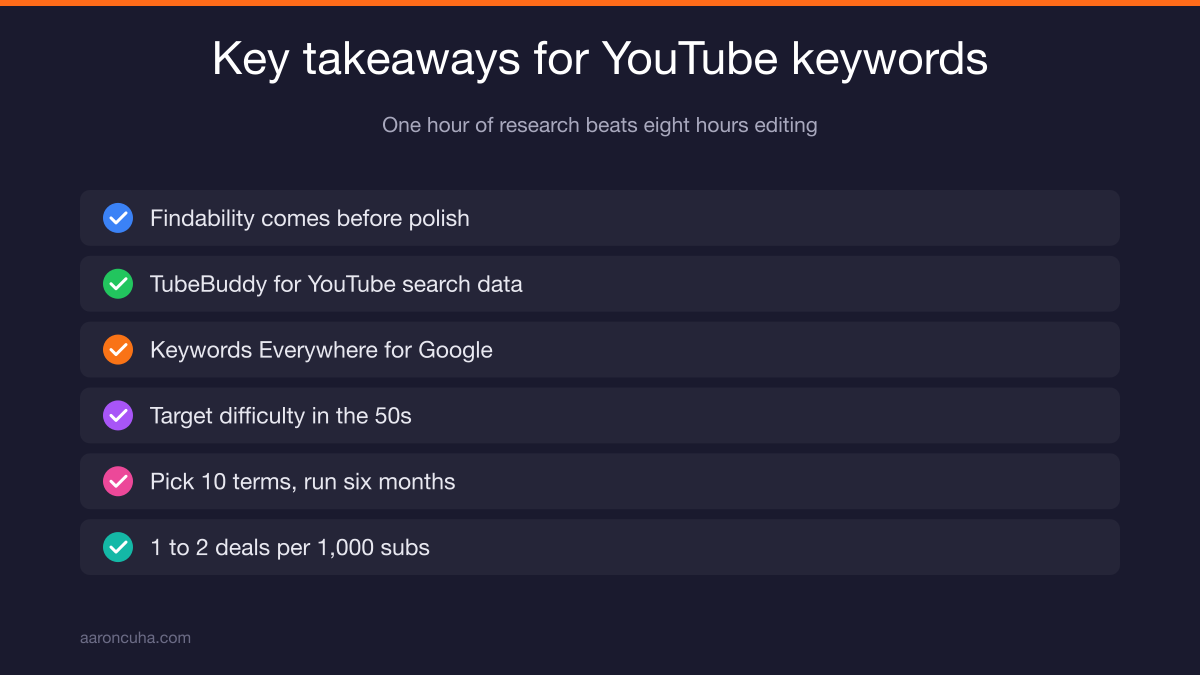
Key Takeaways
- YouTube SEO keywords beat production value. Findability comes first, polish comes second.
- Use TubeBuddy for YouTube search data and Keywords Everywhere for Google data.
- Target ranking difficulty in the 50s or lower. Those terms are winnable.
- Pick 10 keywords and dominate them for six months across every channel.
- Good conversion is one to two deals per 1,000 subscribers per month.
Want a second set of eyes on your channel before you start? Grab a Channel Audit and Plan and I will tell you exactly which keywords you are already close to owning.
Why YouTube SEO Keywords Decide Who Gets Found
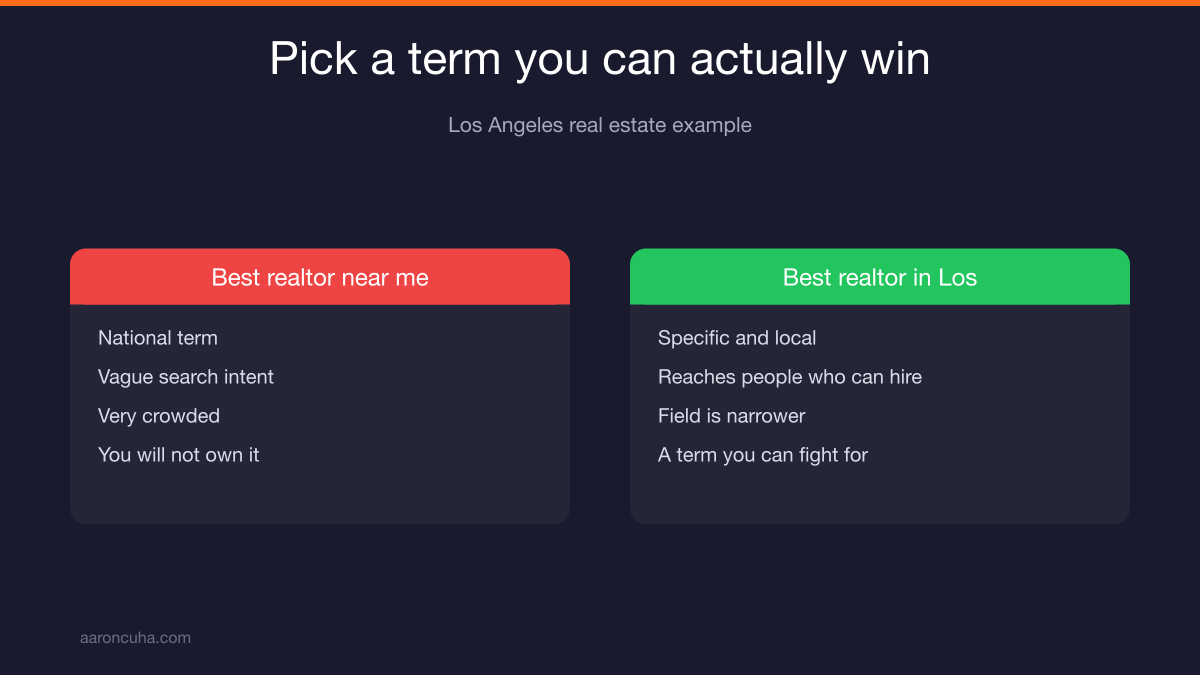
Keywords are how people find you. There is no perfect keyword and no right or wrong answer. There is only the difference between a term you can win and a term you cannot.
If you sell real estate in Los Angeles, the "best" keyword on paper might be best realtor near me. People in Los Angeles type it. But it is a national term, it is vague, and it is crowded. You will not own it.
Now flip it. Best realtor in Los Angeles is specific. It is local. It narrows the field to people who can actually hire you. That is a term you can fight for and win.
Here is the part most people get backwards. They spend hours on videography, editing, and color grading, then they upload with the property address as the title. Beautiful video. Nobody finds it.
The most important thing you can do is have a channel people can find. Everything else comes after that. If you want the bigger picture on why channels stall out, read why most YouTube channels fail.
The Two Tools You Actually Need
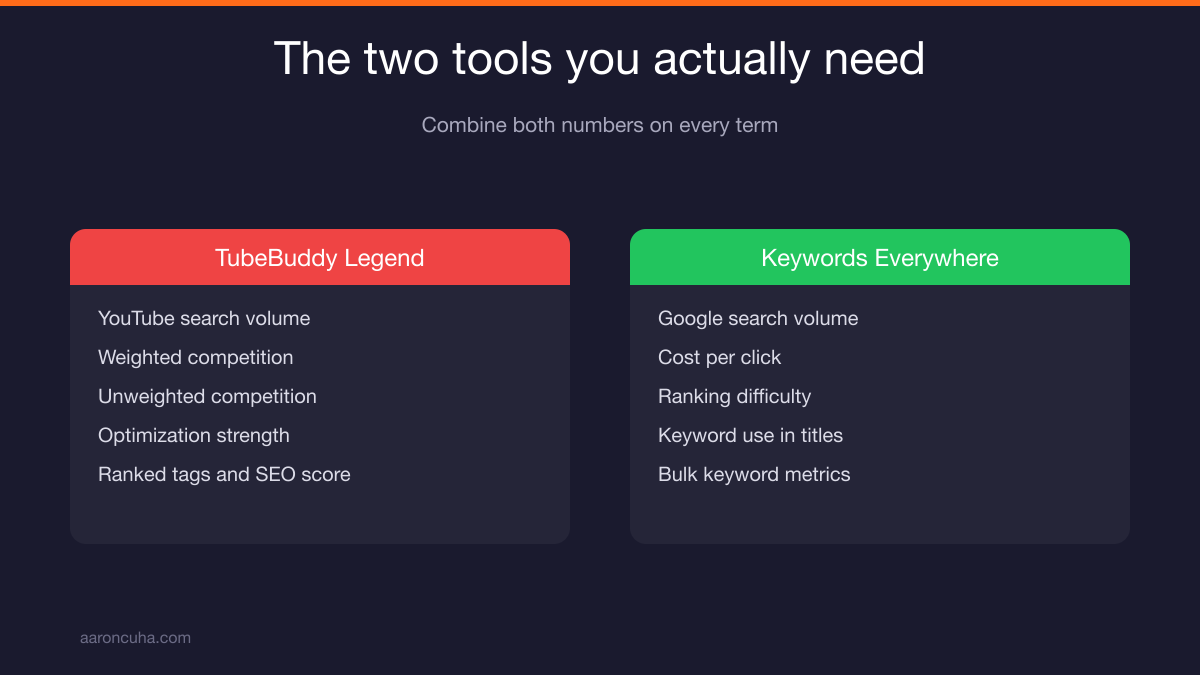
You need TubeBuddy and Keywords Everywhere. That is it. Those are the two tools my team has used for years, and together they give you both sides of the picture.
If you are building on YouTube, TubeBuddy is a must, and you need the Legend tier. The lower tiers do not give you the competition data that makes this whole process work.
Keywords Everywhere is a Chrome plugin and it is one of my favorite tools in the business. It sits on top of your searches and feeds you volume, cost per click, and difficulty right inside the page.
If you are not doing YouTube and you only want these keywords for Instagram, Facebook, TikTok, or your website SEO, you can skip TubeBuddy entirely. Keywords Everywhere covers all of that.
| Tool | What it tells you | Who needs it |
|---|---|---|
| TubeBuddy (Legend) | YouTube search volume, weighted and unweighted competition, optimization strength, ranked tags, SEO score | Anyone posting on YouTube |
| Keywords Everywhere | Google search volume, cost per click, ranking difficulty, top channels, keyword usage in titles and descriptions, bulk metrics | YouTube, Instagram, Facebook, TikTok, website SEO |
You are going to combine both numbers on every term. Google volume tells you one story. YouTube volume tells you another. The truth sits between them.
Start With One Basic Search Term
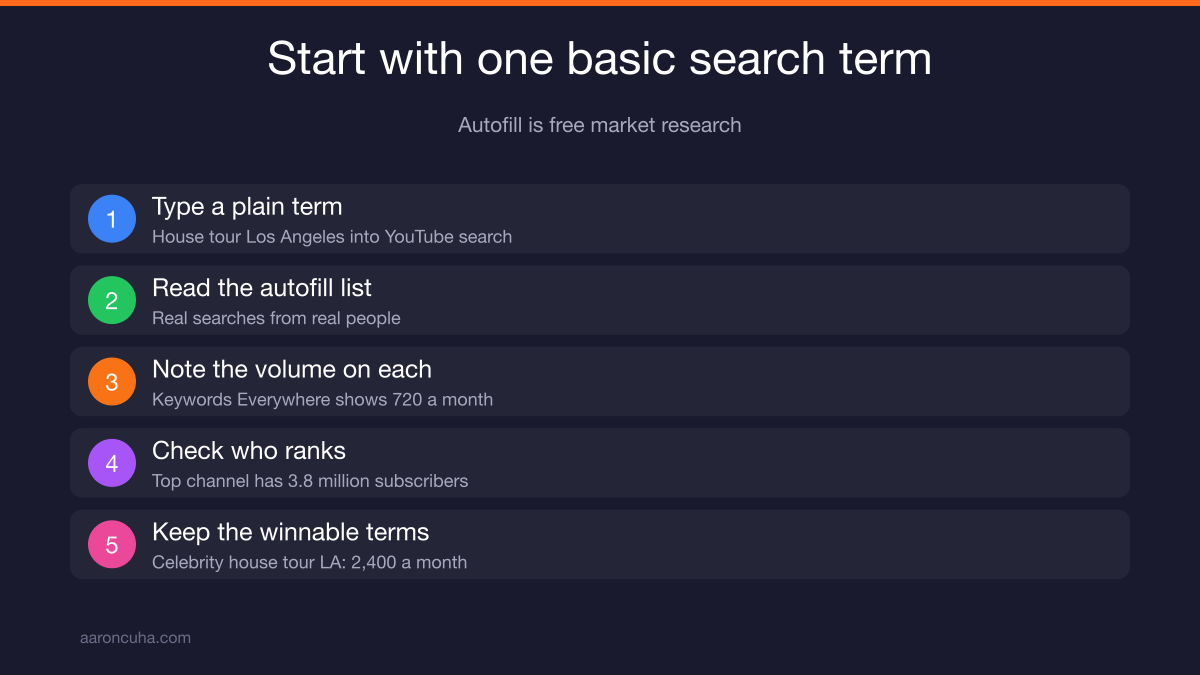
Type a plain term into YouTube search and read what autofills. YouTube completes your query the same way Google does, and those suggestions are real searches from real people.
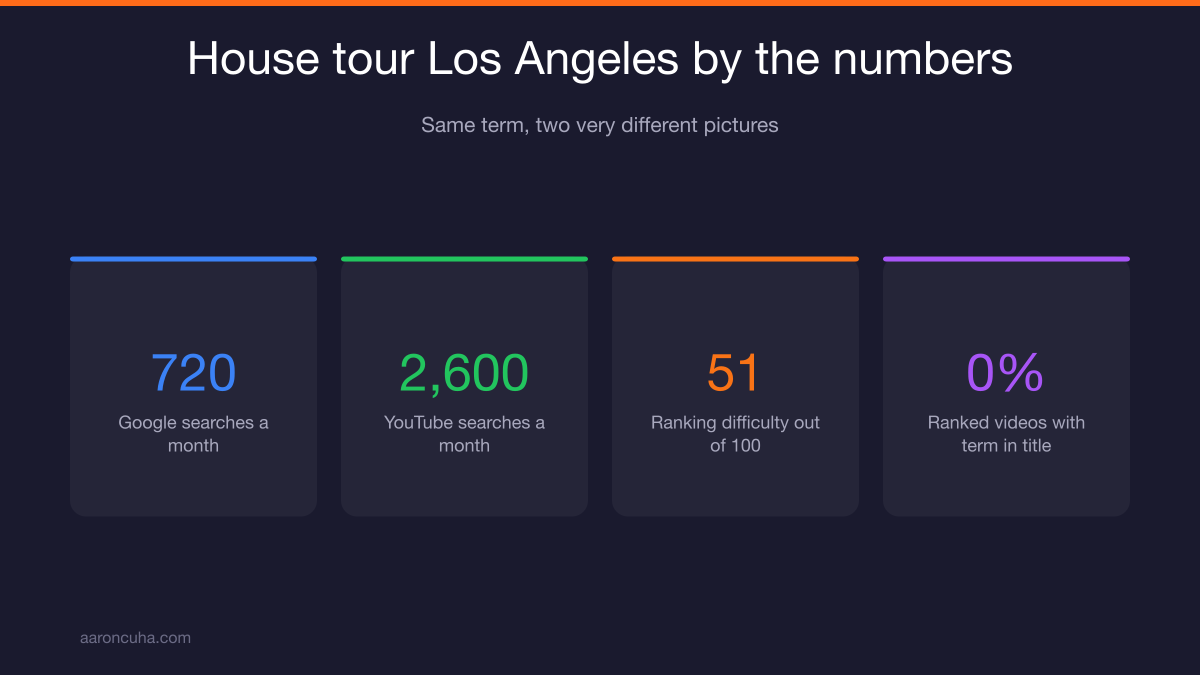
Let me walk you through a live example. I type house tour Los Angeles into YouTube. Keywords Everywhere pops up and tells me there are 720 searches a month, with a cost per click of about 87 cents if I wanted to buy that traffic through Google.
Then I read the autofill list. That list is free market research:
- House tour Los Angeles, 720 searches a month
- Home tour Los Angeles, 720 searches a month
- Luxury house tour, 10 searches a month
- Celebrity house tour Los Angeles, 2,400 searches a month
Look at that last one. The channel dominating it has 3.8 million subscribers, and these days it costs roughly $4,000 to have him tour your listing and put it on his channel. He is not even an agent.
That should tell you something. There is real money and real attention sitting in these terms, and most agents are not touching them because they never bothered to look.
How to Read the Keywords Everywhere Data
Look at three things: search volume, ranking difficulty, and how many of the ranking videos actually use the keyword. That third number is where the opportunity hides.
For house tour Los Angeles, Keywords Everywhere shows me this. Search volume is 720 a month on Google. The top channel is Architectural Digest with five videos, and the max views on those is 54 million.
Now here is the good part. Keywords in description: 6 percent. Keywords in titles: 0 percent. Of all the videos ranking for that term, almost none of them actually say the term.
Ranking difficulty comes back at 51 out of 100. My rule is simple. Anything in the 50s or lower is a good target. If you do the work properly, you can rank on it.
Think about what that means. A term with real search volume, a giant brand at the top, and nobody bothering to put the keyword in their title. That is a door standing wide open.
For more on how the ranking side works under the hood, see my breakdown of how the YouTube algorithm really works in 2026.
TubeBuddy Weighted vs Unweighted Competition
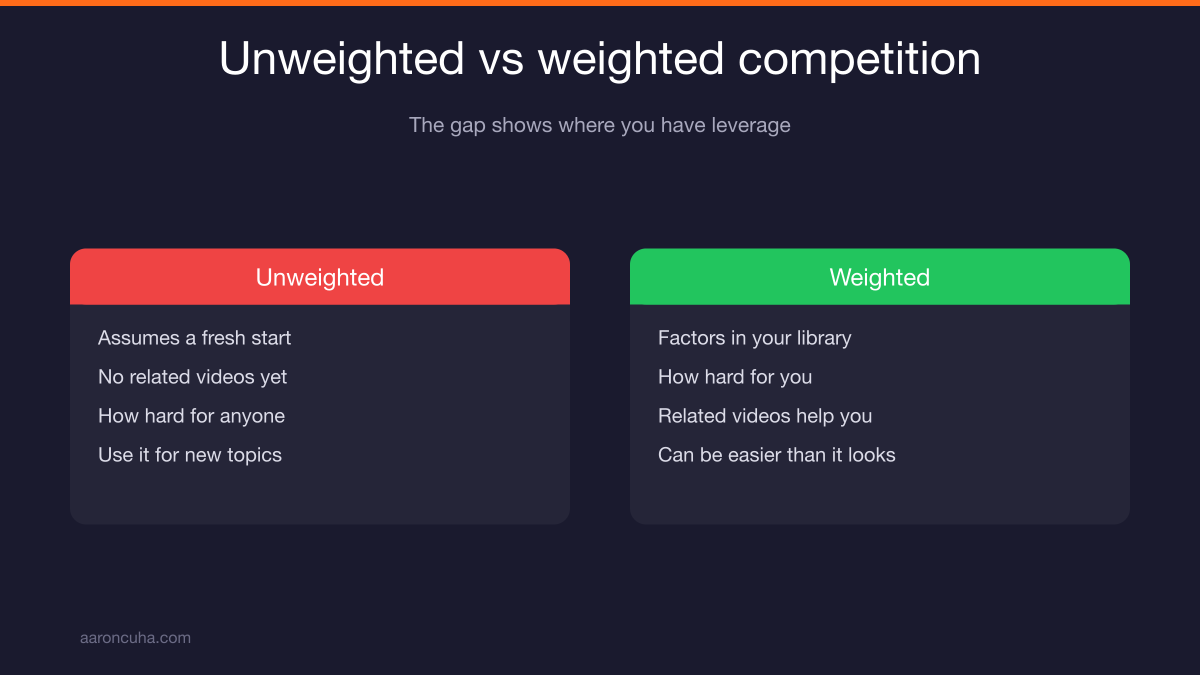
Unweighted tells you how hard a term is if you have never covered it. Weighted factors in the videos already on your channel. Both matter, and the gap between them tells you where you have leverage.
On that same search, I scroll down and open TubeBuddy's keyword score. TubeBuddy gives me some of the same data, plus one number Keywords Everywhere cannot see: 2,600 searches a month on YouTube itself.
So Keywords Everywhere told me 720 on Google. TubeBuddy told me 2,600 on YouTube. Same term, very different picture. Always combine the two.
Here is how to use weighted and unweighted:
- Unweighted: If I have never made a video on this, how hard will it be to rank?
- Weighted: Given the videos already on my channel, how hard will it be for me specifically?
If you already have a library of related videos, weighted might tell you a term is much easier than it looks. Flip between the two before you commit.
TubeBuddy also shows 741 million videos in the overall search pool. That number sounds scary until you look at the actual page one results. On house tour Los Angeles, I found two videos with the exact search term in the title. Some of the rest had part of it. Most had none.
That is why the optimization strength meter sits in the green. If 80 videos all had the exact term in the title, that meter would be buried in the red and I would move on. Green means page one is realistic if you do it right.
Now run the math. If you made 10 or 15 videos, each one leading with house tour Los Angeles, and you landed three or four of them in the top 10, then 2,600 people a month would search that term and see your face multiple times. What does that do to your business?
Using ChatGPT to Expand Your Keyword List
Use a custom SEO keyword generator GPT to produce a seed list, then verify every single term with real data. AI gives you volume of ideas. The tools tell you which ideas are real.
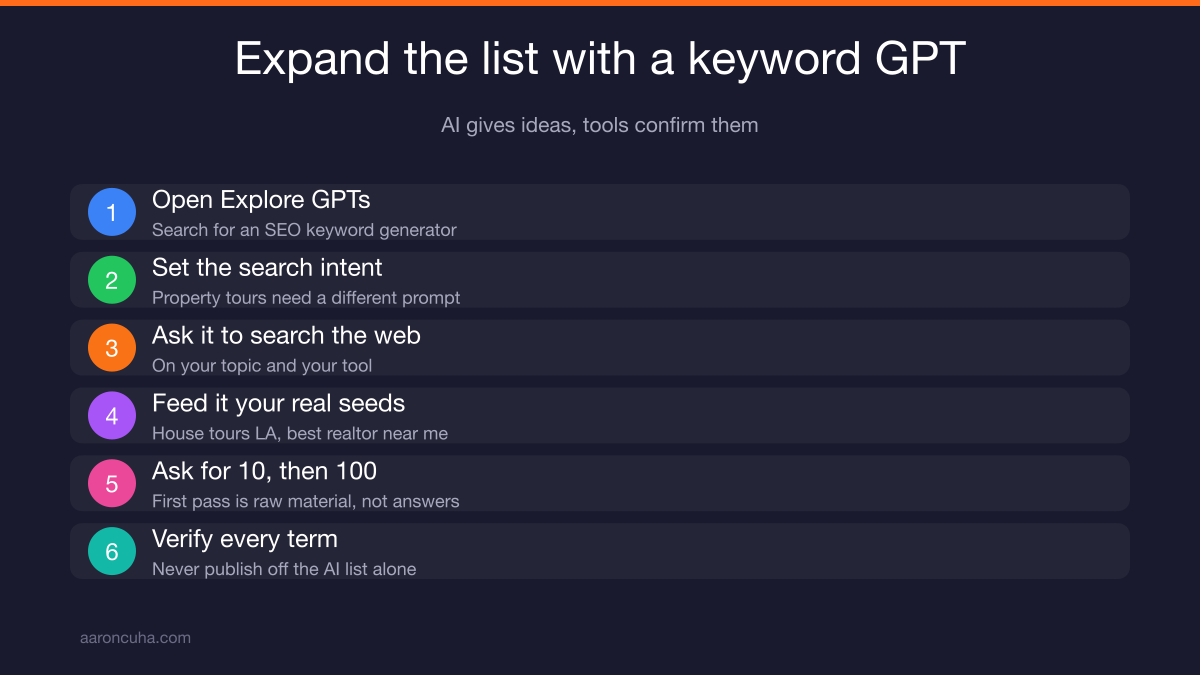
I expect you to have a paid ChatGPT account. If you do not, you are missing the boat. Go to Explore GPTs and search for an SEO keyword generator. The one I use was built by the person who taught me most of what I am showing you here.
The prompt matters more than the tool. Mine is basic, and then I customize it for the exact search intent every time. A prompt for a training video is different from a prompt for property tours in Los Angeles.
A working version looks like this:
- Tell it to run an internet search on your topic and tool.
- Ask it to generate a list of high ranking keywords for specific seed phrases.
- Feed it your real seeds: house tours Los Angeles, real estate agent Los Angeles, best realtor near me.
- Ask for 10 terms to start, then rerun asking for 100.
The first pass gave me terms like home tour, house tours, real estate tour, real estate virtual tour, and best home tour. Some are generic. That is fine. You are building raw material, not final answers.
Never publish off the AI list alone. Every term goes into the bulk tool for verification. If you want more on wiring AI into your workflow without losing your judgment, read how to build an AI content engine.
Run Bulk Metrics and Score the List
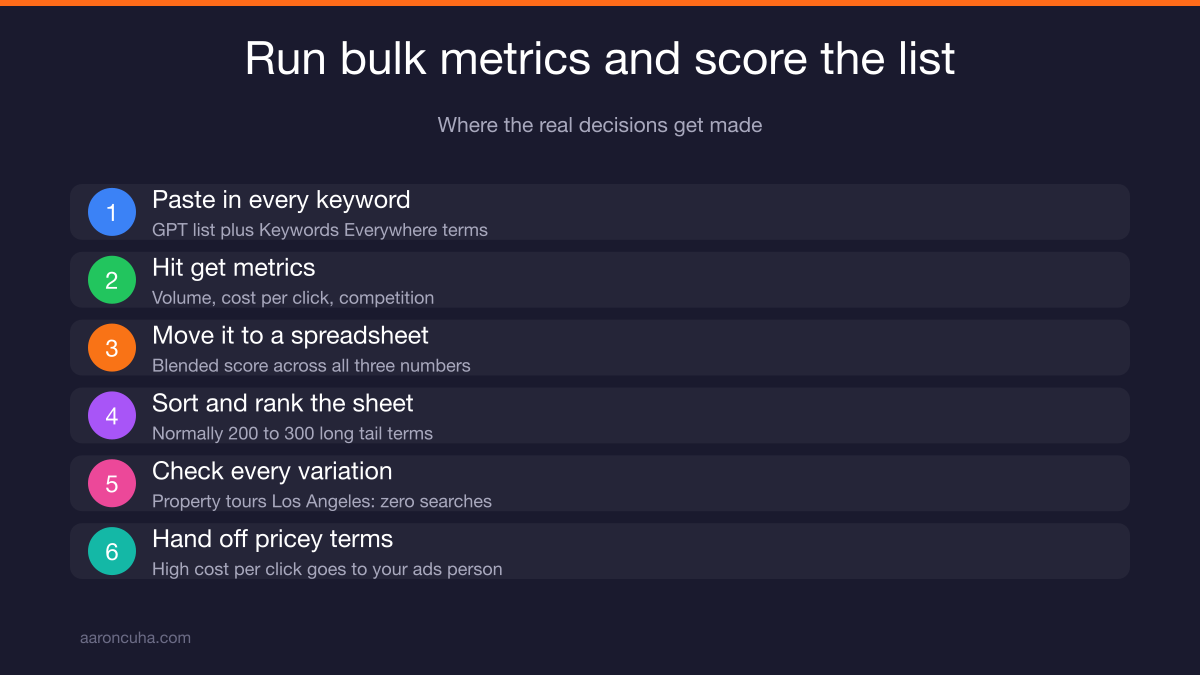
Dump every keyword into the Keywords Everywhere bulk tool, pull metrics, then move the whole thing into a spreadsheet and rank it. That is where the real decisions get made.
I take the ChatGPT list, plus the terms Keywords Everywhere generated from the original search, and I paste them all into the bulk keywords tool. Then I hit get metrics.
The tool spits back search volume, cost per click, and competition for every term. I copy that into my analysis spreadsheet and run a blended score across all three, then sort A to Z.
Here is what that surfaced in the demo:
- Houses in Los Angeles: 12,100 global searches a month, and global competition is very low
- House in Los Angeles, buy house in Los Angeles, buying a home in Los Angeles: all strong local intent terms
- Property tours Los Angeles: zero searches, which surprises almost everyone
- House tour vs home tour: identical search volume, so pick either one
That zero on property tours is the reason you check variations every time. Property tour, house tour, home tour. They feel the same to you. They are not the same to the search bar.
What I showed here is a mild version. Normally I am working with 200 to 300 long tail keywords in that sheet. You rerun the GPT and ask for 100 more. It goes for days.
One more use for the sheet. Sort by cost per click and hand the expensive terms to whoever runs your Google PPC. Chances are they are nowhere near as detailed as you just were.
If you want me to build this list with you and map it to a publishing calendar, book a YouTube strategy session. Ninety minutes, and you leave with your ten terms and a plan.
Pick 10 YouTube SEO Keywords and Dominate Them for Six Months
Choose your top 10 and commit to them for six months across every channel you own. Not six weeks. Six months. That is how domination works.
Target one or two keywords per video. Use the rest in your tags and description. Every video uses almost all of them in some form, but only one or two are the star.
Then take the same 10 terms everywhere else:
- Blogs: feed them to ChatGPT and write real posts for your website
- Instagram: work them into your captions and story descriptions
- Facebook: same terms in your post copy
- Just listed and just sold posts: stop writing the address, write the keyword
- Google PPC: hand the high cost per click terms to your ads person
The goal is that when somebody types one of those terms into Google or YouTube, you are on page one either way. Same words, every surface, six straight months.
This is exactly what I mean by systems over hustle. You did the research once. Now the system runs while you go sell houses.
Hit a TubeBuddy SEO Score of 80 or Higher
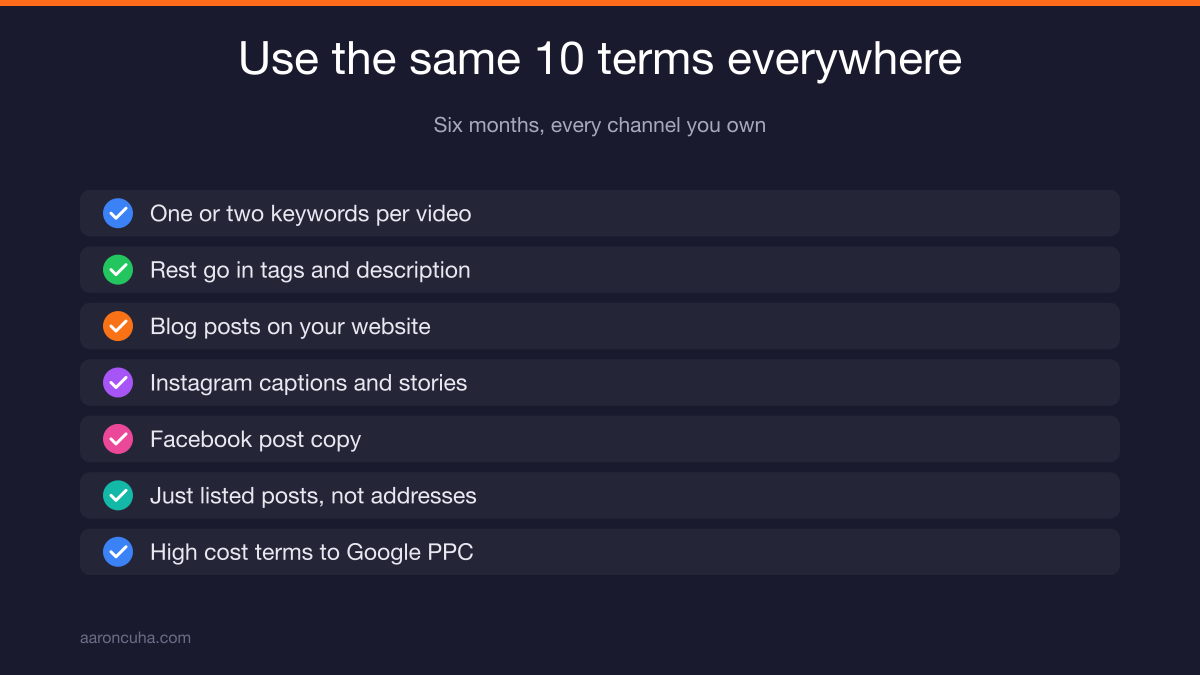
Put your top keyword in the title, and all three target keywords in the description and the tags. That is the baseline. My clients start at 80 and push toward 100.
The title has 70 characters, and the first 30 matter most. So you lead with the keyword. House tour Los Angeles comes first, then the interesting part about the Bel Air property.
Here is the checklist I run:
- Top keyword sits at the front of the title
- All three target keywords appear in the description
- All three target keywords appear in the tags
- Use the ranked tags first, because TubeBuddy tells you which ones rank
- Check TubeBuddy's suggested tags and add any ranked ones you missed
- Total tag characters hit 20 out of 20
- Your exact title words appear again in the description
Tag rankings change every day. A video that had 10 ranked tags at upload might show five today. That is normal. Do not chase it. Set it right at upload and move on.
Remember this: keywords and ranked tags are the same thing. Stop treating them as separate jobs. For a deeper walkthrough on ranking mechanics, see my YouTube SEO tips for ranking videos. You can also cross check anything here against the official YouTube Blog and the YouTube Help Center.
Quantity Beats Polish: Three Real Channels
Posting frequency outruns production value every time. I opened three client channels side by side to prove it, and the numbers are not close.
Alex posts about one video a month. His optimization is strong. His Keywords Everywhere score sits around 76, engagement around 4 percent, roughly 212 views a day, which is genuinely good. In two years he has built 7,380 subscribers.
So if you post once a month and optimize properly, expect around 3,500 subscribers a year. That is more than most people realize.
Levi posts three videos a week in the same market. He is at 35,000 subscribers. His video quality and editing are excellent, but his optimization was weak in year one, and he was not doing property tours at all.
His real growth started the moment he added property tours. That is what people search for. Before that, he was making good videos nobody was looking for.
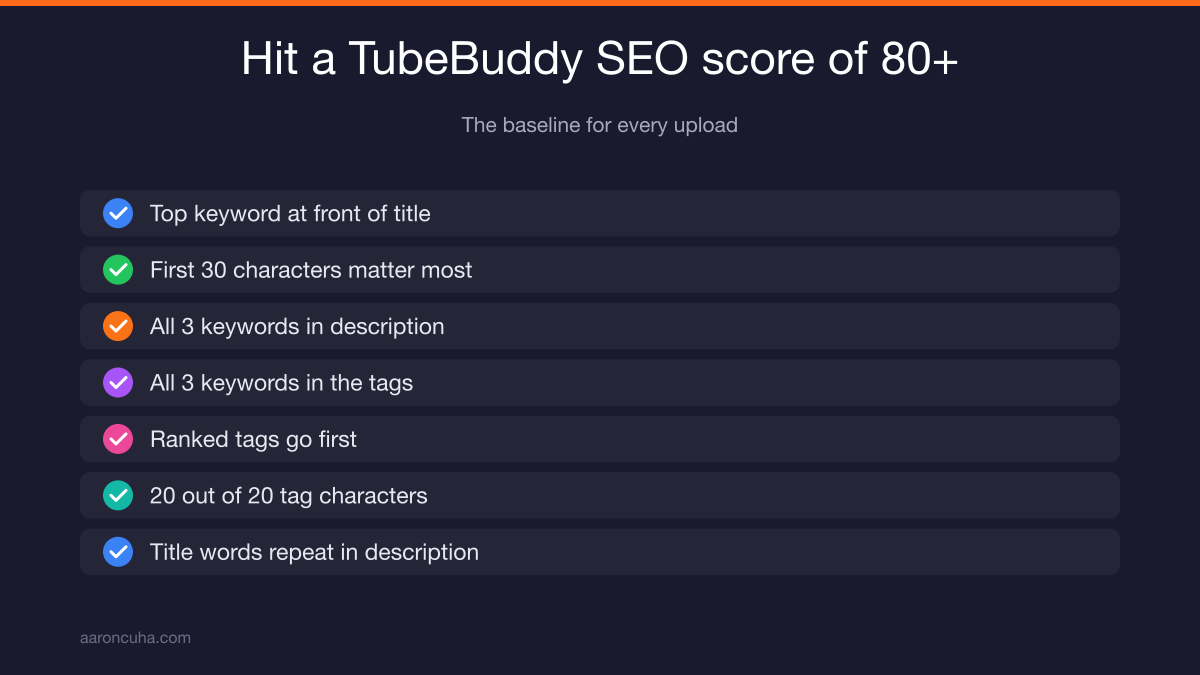
Then there is Armando. Five videos a week. Started around the same time as the others. 225,000 subscribers. Over 20 agents working for him. He now covers all of Texas.
Shot on a cell phone. By himself. No editing. No marketing. And he is not dialing in his SEO at all. If he hired a VA and went back through his library to fix it, he would probably add another 200,000 subscribers.
| Channel | Posting rate | Production | SEO | Subscribers |
|---|---|---|---|---|
| Alex | 1 video a month | Good | Strong | 7,380 in 2 years |
| Levi | 3 videos a week | Excellent | Weak year one, better after | 35,000 |
| Armando | 5 videos a week | Cell phone, no editing | None | 225,000 |
That is the whole argument. Keywords are not always the most important thing. But if you post often and use keywords, you are twice as powerful as anyone doing one or the other. If publishing volume is your bottleneck, read my guide to content systems for entrepreneurs.
The Tour Brings Them In, the Talking Head Sells Them
Search driven videos build the audience. Business development videos convert it. You need both, and you need to know which is which.
Look at Levi's numbers. A property tour pulls 6,000 views. A market update pulls 2,000. The property tour wins on traffic, no contest.
But the market update is what gets him business. Nobody searches for your market update. Its optimization score can be decent and the search volume will still be near zero.
Here is the sequence. Somebody searches house tour Los Angeles. They land on your property tour. They watch, they like you. Then they click your market update, your loan officer interview, your home inspection walkthrough, your buyer representation meeting. And they decide to hire you.
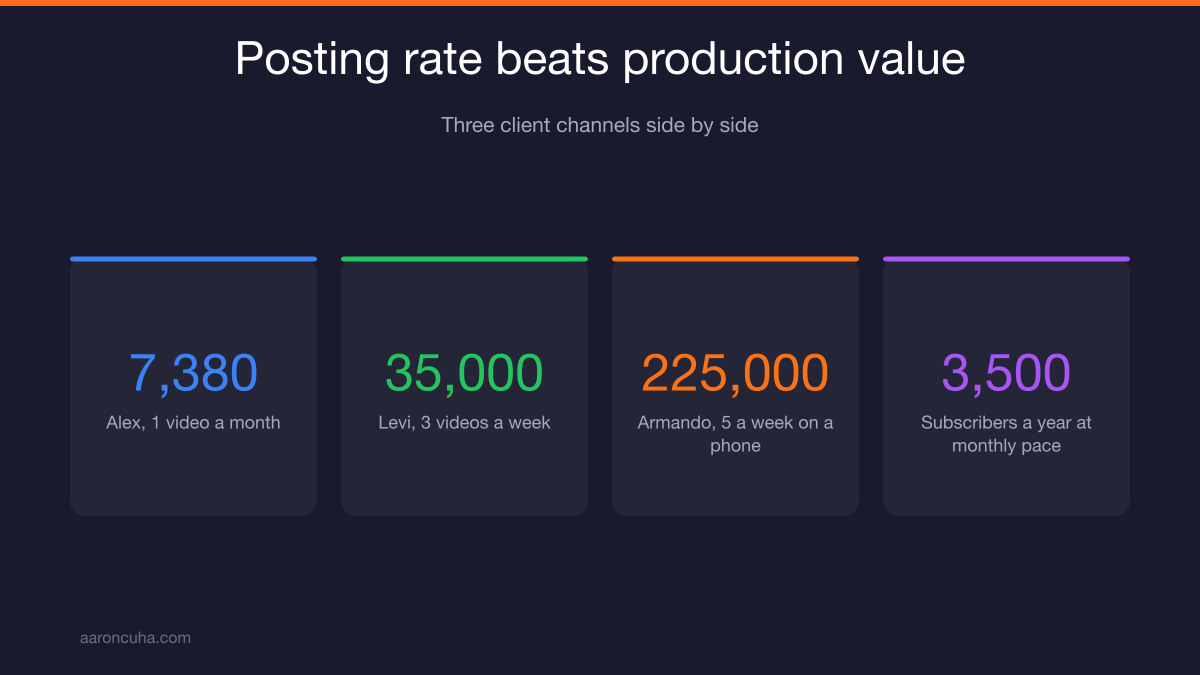
The tour brings them to the channel. The talking head sells them. Structure your channel around both and stop apologizing for the videos that get fewer views.
This is the same structure I lay out in the four content pillars that turn a channel into a lead machine and in my complete guide to YouTube for real estate agents.
Converting Subscribers Into Deals
Bad conversion is one to two deals per 1,000 subscribers per year. Good conversion is one to two deals per 1,000 subscribers per month. The gap is a strong call to action and a landing page.
Read that again. Same subscriber count. Twelve times the business. Nothing changed except what happens after somebody watches.
Here is what my clients actually do:
- Alex: description link goes straight to a Calendly booking page
- Levi: description link goes to a simple landing page with a Typeform, testimonials, and a name, phone, and email capture
- The upgrade: offer a free 60 page guide on everything you need to know about new construction homes in your market, capture the contact, then register that buyer with every builder
That last one is a lot of work. It is also how you turn a viewer into a closed transaction instead of a subscriber count you brag about.
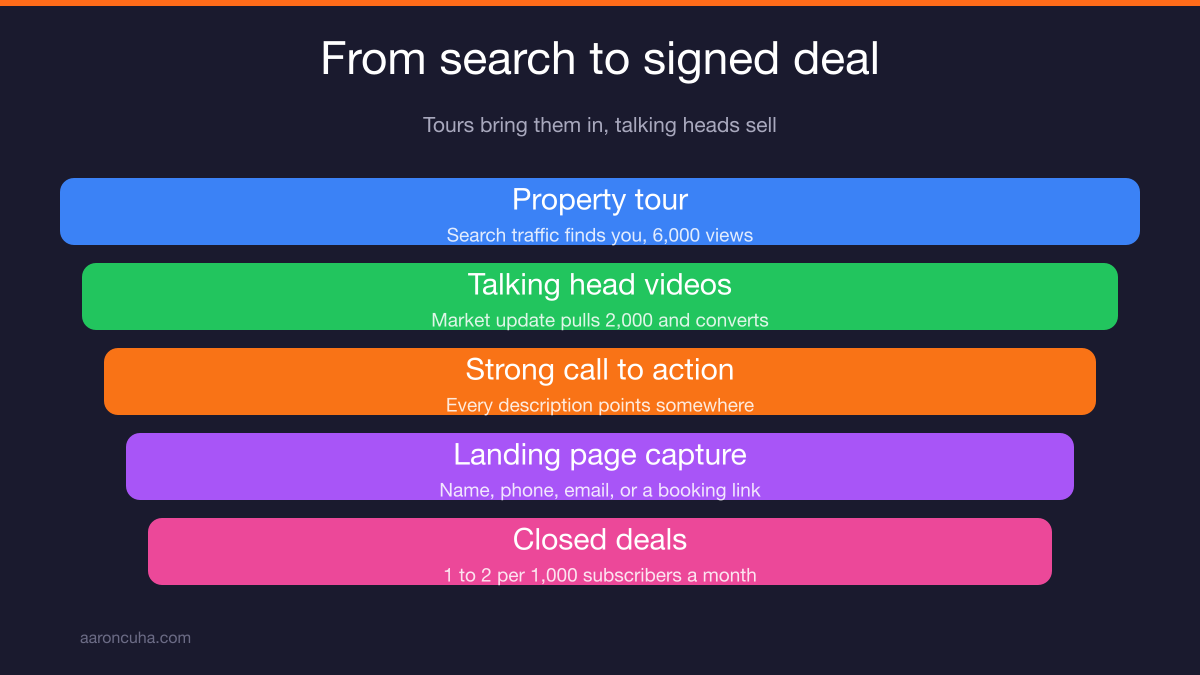
I have a channel less than a year old that just crossed 22,000 subscribers. Grow a channel to 22,000, add a strong call to action and a landing page that captures names, phone numbers, and emails, and that is somewhere between $250,000 and $1 million a year.
Across all my clients we have roughly a million subscribers. I have at least four or five people who are the mayors of their city. You cannot walk into a restaurant with them without someone asking for a photo. That is what YouTube is capable of doing for you.
I have about a dozen clients who came to me with good channels that were not converting. The channel was never the problem. The exit was. If that sounds like you, read how to get clients from YouTube.
Where to Start This Week
Do the research once, then publish against it for six months. Do not redo the list every Monday. That is procrastination wearing a productivity costume.
Your first week looks like this:
- Install Keywords Everywhere and upgrade to TubeBuddy Legend if you are on YouTube
- Type your most obvious term into YouTube and write down every autofill suggestion
- Check ranking difficulty on each one and keep anything in the 50s or lower
- Run a keyword GPT to expand the list to 100 terms
- Push all of it through the bulk tool, score it, and pick your top 10
- Publish your first video with the top keyword leading the title and an SEO score of 80 or better
Then increase your posting rate. One video a month gets you 3,500 subscribers a year. Three a week gets you tens of thousands. Five a week on a cell phone got Armando to 225,000. The math is not subtle.
For more on keeping the pipeline full without burning out, look at how to repurpose YouTube content into 30 assets. And if you want the full system in book form, it is all in Crazy Simple YouTube. For ongoing platform changes, keep an eye on Search Engine Land and the National Association of Realtors.
If you are ready to stop guessing and want a coach who has done this with hundreds of agents, take a look at my real estate coaching program and let us build your ten keywords together.
Frequently Asked Questions

Written by
Aaron CuhaAuthor of Crazy Simple YouTube, keynote speaker, and executive coach with 20,000+ hours logged. ICF PCC, NLP Master Practitioner, and DISC Certified. Aaron helps entrepreneurs replace hustle with AI-powered systems that generate leads, content, and revenue on autopilot.