On January 14, ranking moved to Gemini, and the youtube gemini ai algorithm now transcribes and weighs Shorts differently than long-form. Here is what actually changed, why Shorts carry more weight than ever, and the simple posting system that turns one long-form video into five Shorts a week.
On January 14, YouTube handed ranking to Gemini. The youtube gemini ai algorithm now decides what gets pushed, and it weighs Shorts differently than long-form. Almost nobody adjusted. That gap is the biggest opportunity in your market right now.
Key Takeaways
- The youtube algorithm 2026 runs on Gemini and transcribes everything you say on camera.
- 73% of buyers and sellers now start their search on YouTube.
- Shorts and long-form run two separate algorithms with different goals.
- Post one long-form video a week and five Shorts cut from it.
- YouTube optimizes for watch time and average view duration, not views.
Want a second set of eyes on your channel before you change anything? Grab a Channel Audit and Plan and I will show you exactly where your content is losing the algorithm.
The Algorithm Changed on January 14 and Nobody Adjusted
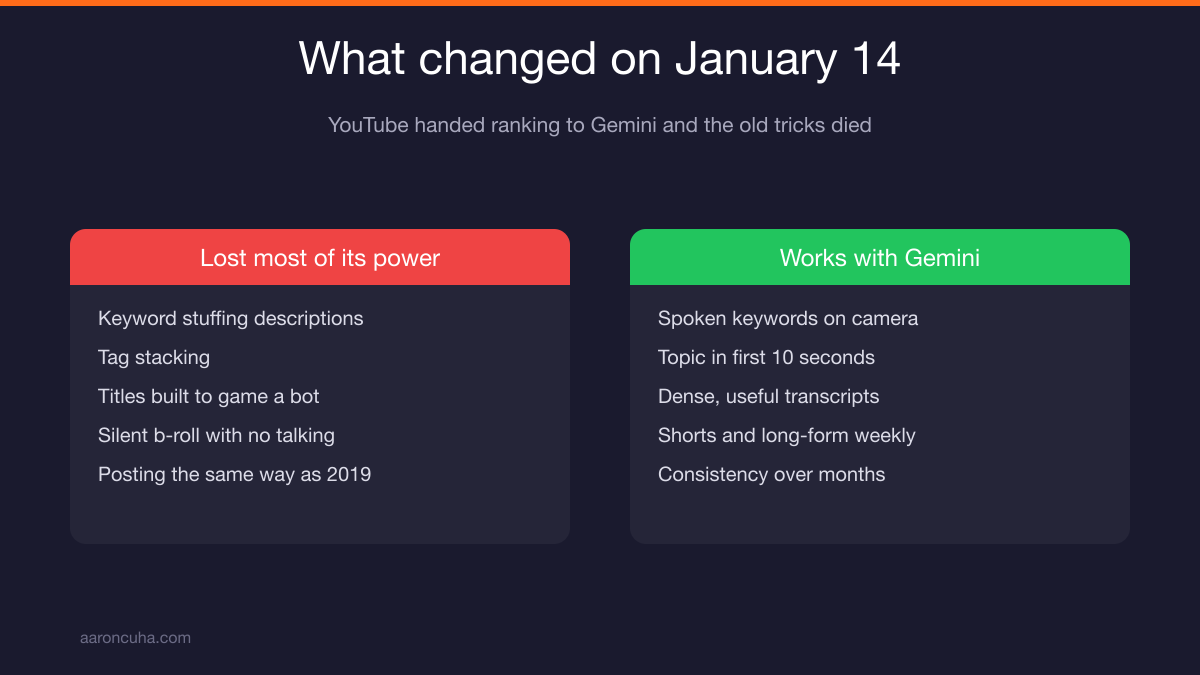
On January 14, YouTube launched a new algorithm governed entirely by Gemini. They gave it a brain. The change was public. Most creators kept doing exactly what they did before.
Think about what that means. If a platform tells you the rules changed, you should change with it. We do not know the algorithm line by line. Nobody outside YouTube does. But we have data, and the data points in one direction.
Smarter algorithm means smarter inputs. The old tricks stopped working overnight. Keyword stuffing in the description. Tag stacking. Tweaking titles to game a machine that could not understand context. All of it lost most of its power.
Here is the part that should get your attention. Almost nobody in your market adjusted. I ask rooms full of agents who has a YouTube channel and hands go up. I ask who posts more than two long-form videos a week and the number drops to about 1%. I ask whose entire team is required to film video and the room goes quiet.
That silence is your lane. I break the mechanics down further in my post on how Gemini AI changed YouTube on January 14, 2026.
Why 73% of Buyers and Sellers Start on YouTube
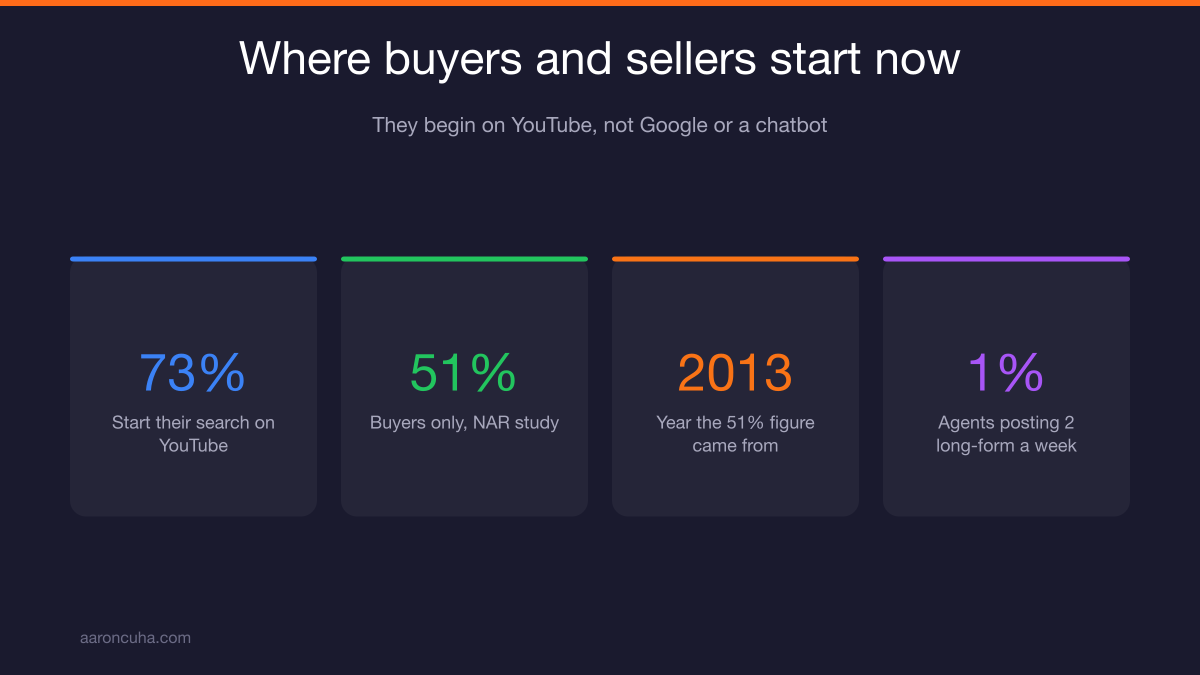
73% of buyers and sellers now begin their search on YouTube. Not Google. Not an AI chatbot. YouTube. That number used to be 51%, and it only counted buyers.
The 51% figure came from a National Association of Realtors study back in 2013. Sit with that for a second. In 2013, half of all buyers were already starting on YouTube. Imagine where your channel would be today if you had started then.
Today the number is higher and the audience is wider. It covers buyers and sellers both. Sellers are watching you before they ever pick up the phone.
Why do they choose video? Because they do not want to read. They want to watch. They want to listen. They want to hear your voice and decide whether you are their person before they risk a conversation.
That is rapport at scale. A blog post cannot do it. A postcard cannot do it. A listing site cannot do it. Video does it while you sleep.
If you sell real estate and you are not producing video, you are invisible to three out of four people in your market. I go deeper on this in my guide to YouTube for real estate agents.
The YouTube Gemini AI Algorithm Listens to Everything You Say
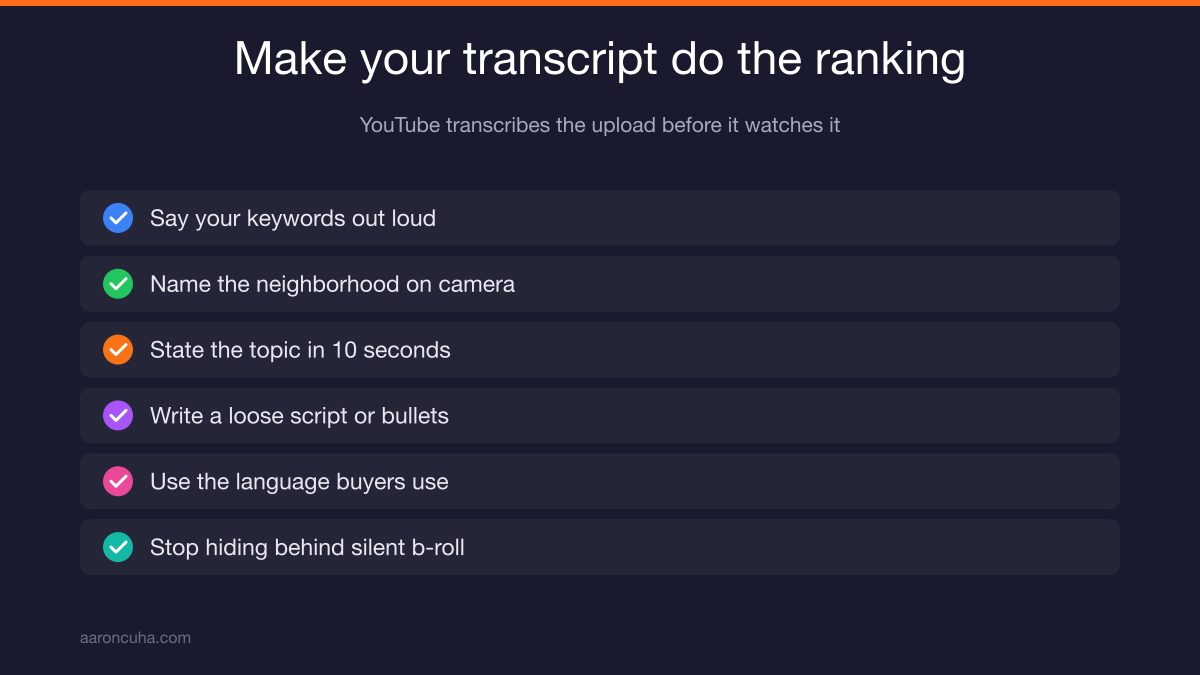
The first thing YouTube does with your upload is transcribe it. Then it watches it. The words coming out of your mouth are now a primary ranking signal. Tags and keyword stacking are no longer the lever.
This is the single biggest shift most people missed. You used to be able to fix a weak video with a strong title and a wall of tags. That door closed.
Now the machine understands your content the way a person understands it. It knows if you said "Palm Beach waterfront condo." It knows if you explained closing costs or just rambled. It knows if your Short delivered on its hook.
So what do you do about it?
- Say your keywords out loud. If you want to rank for a neighborhood, say the neighborhood name on camera.
- Front-load the topic. Tell the viewer in the first ten seconds exactly what they are about to get.
- Write a loose script or bullet list so the transcript is dense with the language your buyer uses.
- Stop hiding behind b-roll. If nobody is talking, there is nothing to transcribe.
Google has published guidance for years about creating content for people first, and the Google Search blog keeps repeating the same message. Gemini running YouTube is that philosophy applied to video.
For a deeper breakdown of ranking mechanics, read my YouTube SEO tips for ranking videos.
Two Separate Algorithms: Shorts and Long-Form
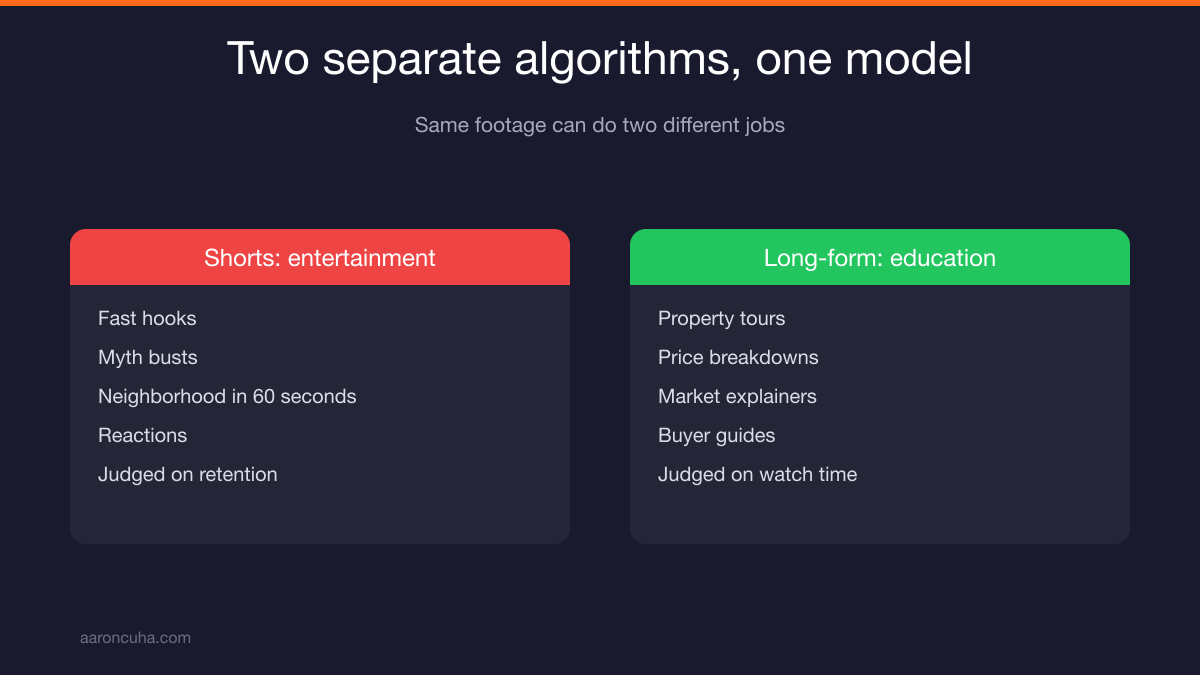
Shorts and long-form run on two completely separate algorithms. Both are governed by Gemini. Both look for different things. Shorts lean entertainment. Long-form leans education.
This is where most agents get it wrong. They chop a teaching moment out of a long video, slap it up as a Short, and wonder why it did nothing.
A Short is not a mini lecture. It is a hook, a payoff, and a reason to stay. Your long-form video is where you teach, walk the property, explain the numbers, and build trust over ten or more minutes.
| Format | Algorithm goal | What to shoot |
|---|---|---|
| Shorts | Entertainment and retention | Fast hooks, myth busts, neighborhood in 60 seconds, reactions |
| Long-form | Education and watch time | Property tours, price breakdowns, market explainers, buyer guides |
When you generate Shorts from a long-form video, edit for entertainment, not for information. Same source footage, different job.
The official YouTube blog has been consistent that Shorts is its own surface with its own behavior. Treat it that way.
More tactics here: YouTube Shorts strategy.
How Shorts Trained Gemini and Why That Matters for Google
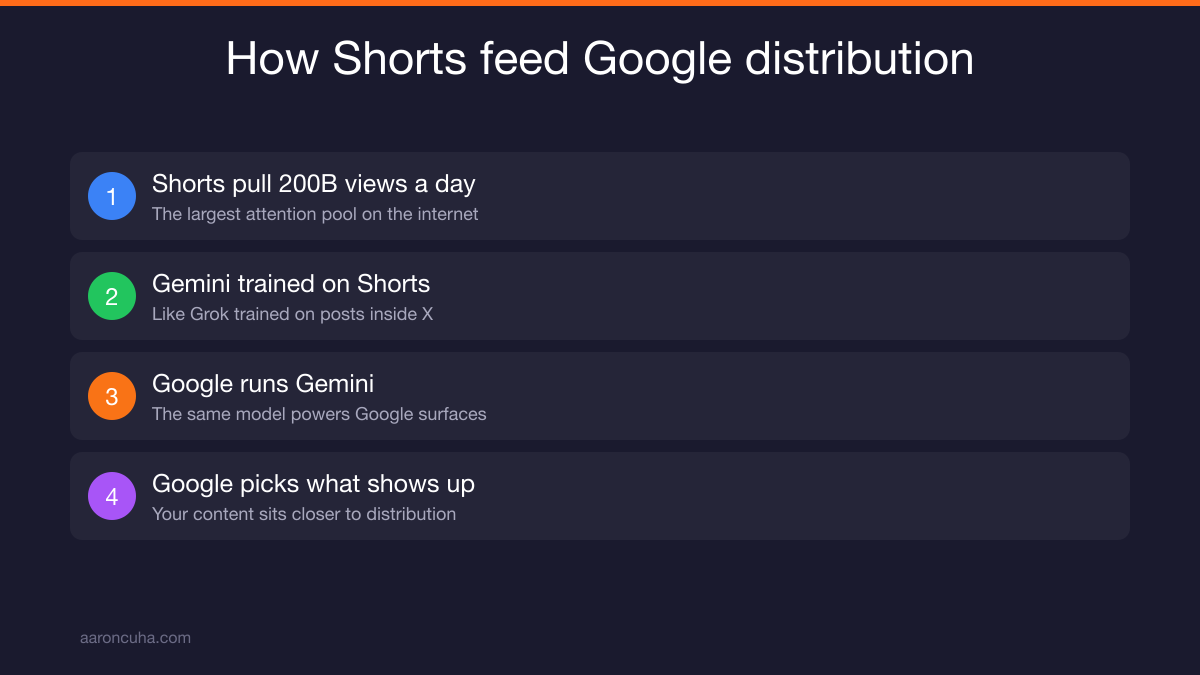
Grok was trained on the posts inside X. Gemini was trained largely on YouTube Shorts. If your Shorts help train the model that powers Google surfaces, your content sits closer to the source of distribution.
Shorts pull roughly 200 billion views a day. That is not a niche format. That is the largest attention pool on the internet.
Now follow the chain. Gemini trains on Shorts. Google runs Gemini. Google decides what shows up when someone asks a question. Where do you want your content to live?
Most agents hear this and nod. Then they go back to posting one property tour a month. The people who actually act on it will own the recommendation layer in their market for the next few years.
If you want the broader context on how AI is reshaping who gets found, read AI will not replace you but someone using AI will.
The Wide Open Lane Nobody Is Taking
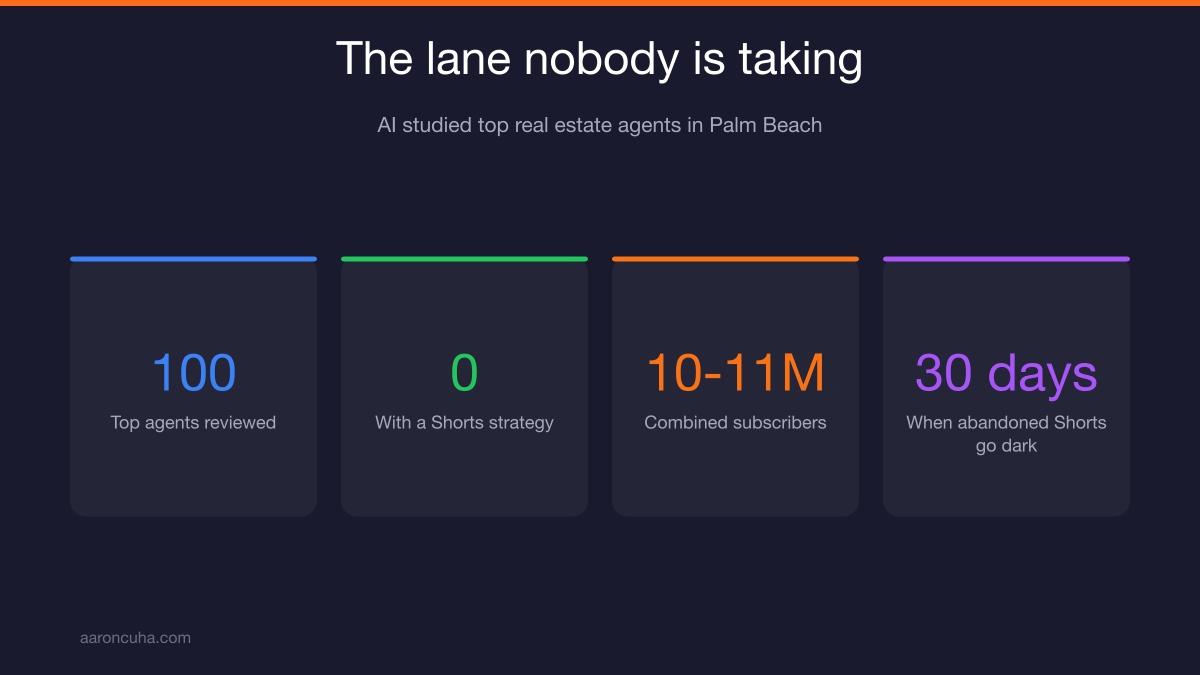
I had AI study about 100 of the top real estate agents in Palm Beach. Not one of them had a Shorts strategy. Combined, those channels hold 10 to 11 million subscribers and zero Shorts plan.
Think about what that means for you. The biggest names in one of the most competitive luxury markets in the country left the front door open.
Here is the other thing your competitors do. They post twice, get discouraged, and quit. Their Shorts die at around 30 days and never get pushed out again.
Clients tell me all the time, "My competitor just got on YouTube. He is going to beat me." I tell them the truth. He is not going to beat you. He is going to quit. That is what competitors do.
Consistency is the whole moat.
- Post consistently and the algorithm keeps pushing you out.
- Post consistently and your long-form grows off the back of your Shorts.
- Post consistently and your competitors' content goes dark while yours compounds.
And while you are at it, push the same content to TikTok, Facebook, and Instagram. I know you do not want to be on TikTok. You should be. I know Facebook feels like it is only your parents now. You should still be there. With the right setup it is one button and it goes everywhere.
Real Results: What Shorts Did for Two Clients
Shorts do not just grow Shorts. They feed your long-form. I have watched it happen inside client channels within a single week.
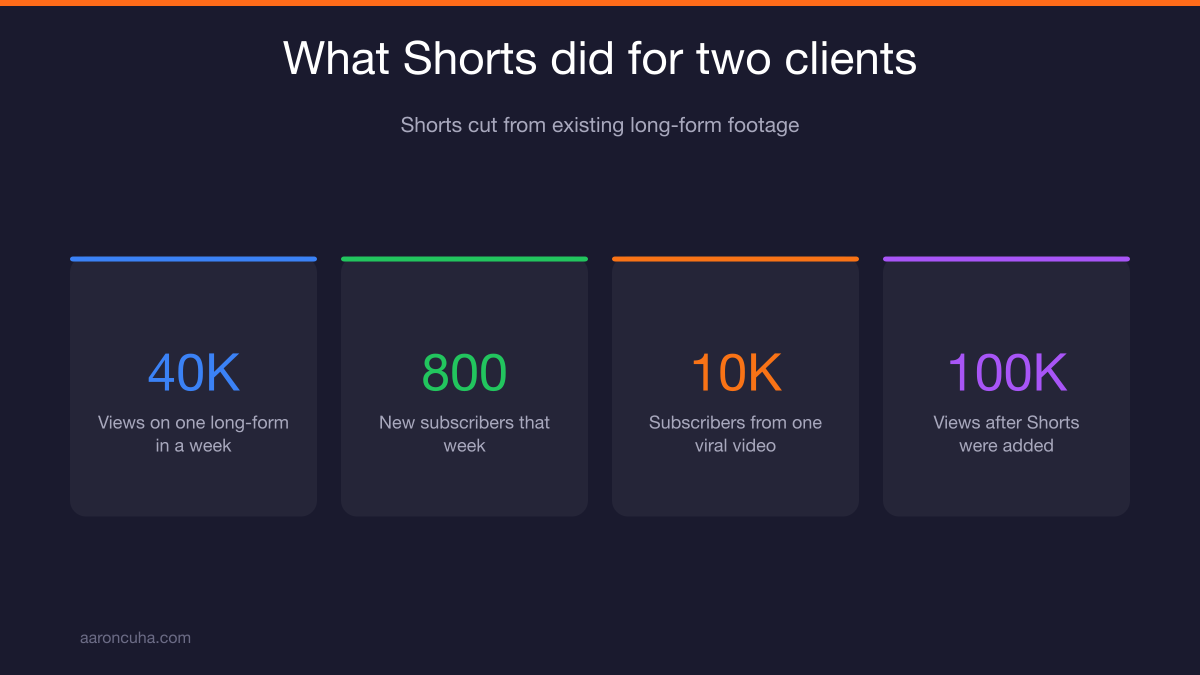
The first agent was stuck at about 200 views per long-form video. We got him posting a few Shorts a day, all cut from his existing long-form content. Within a week, one of his long-form videos hit 40,000 views.
His baseline doubled to 400 views. He picked up 800 new subscribers. The whole channel changed direction.
The second story is bigger. A client posted a video that went viral. It pulled 40,000 views and 1,800 comments. It brought in 10,000 new subscribers, 30 leads, and six listings from that one video.
Then we cut Shorts from that same video and posted them. The long-form climbed from 40,000 views to 100,000.
The Shorts did that. Same footage. Same message. Different distribution surface feeding the main channel.
This is not complicated work. It is repeatable work. See more examples in my client case studies.
The Three-Channel Test: Shorts Only, Long-Form Only, Both
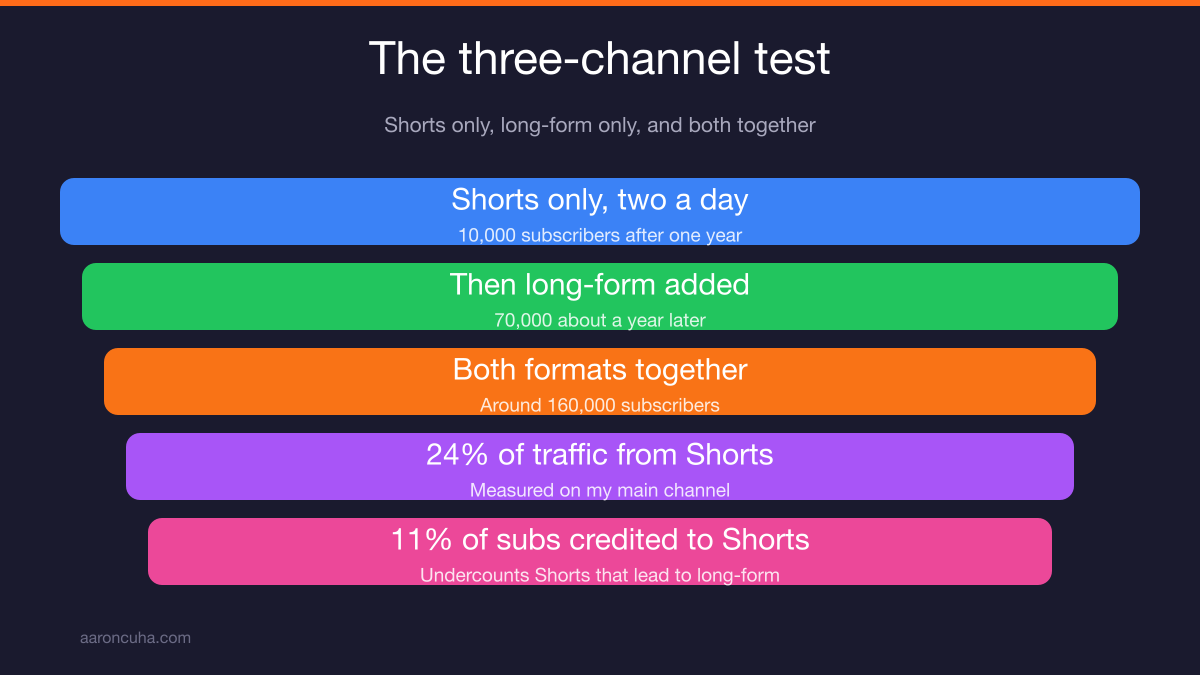
I ran three channels to test this myself. Shorts only. Long-form only. Both together. The channel running both is around 160,000 subscribers.
Here is the first test. I ran one channel on nothing but Shorts, two a day, for an entire year. It grew to 10,000 subscribers. Then I added long-form. About a year later it sits at 70,000.
The Shorts built the audience. The long-form built the depth. Neither one did the job alone.
On my main channel, 24% of all traffic comes from Shorts. Only about 11% of subscribers are attributed to Shorts, but that number is misleading. A lot of viewers find a Short, jump to a long-form video, and subscribe there. The algorithm credits the long-form.
So the real contribution is higher than the dashboard shows. If you are reading your numbers without understanding that, you will undervalue Shorts and cut the thing that is working.
Learn to read the right metrics in my YouTube analytics guide.
Ready to build this properly instead of guessing? Book a YouTube strategy session and we will map your next 90 days of content together.
The One Plus Five Posting System
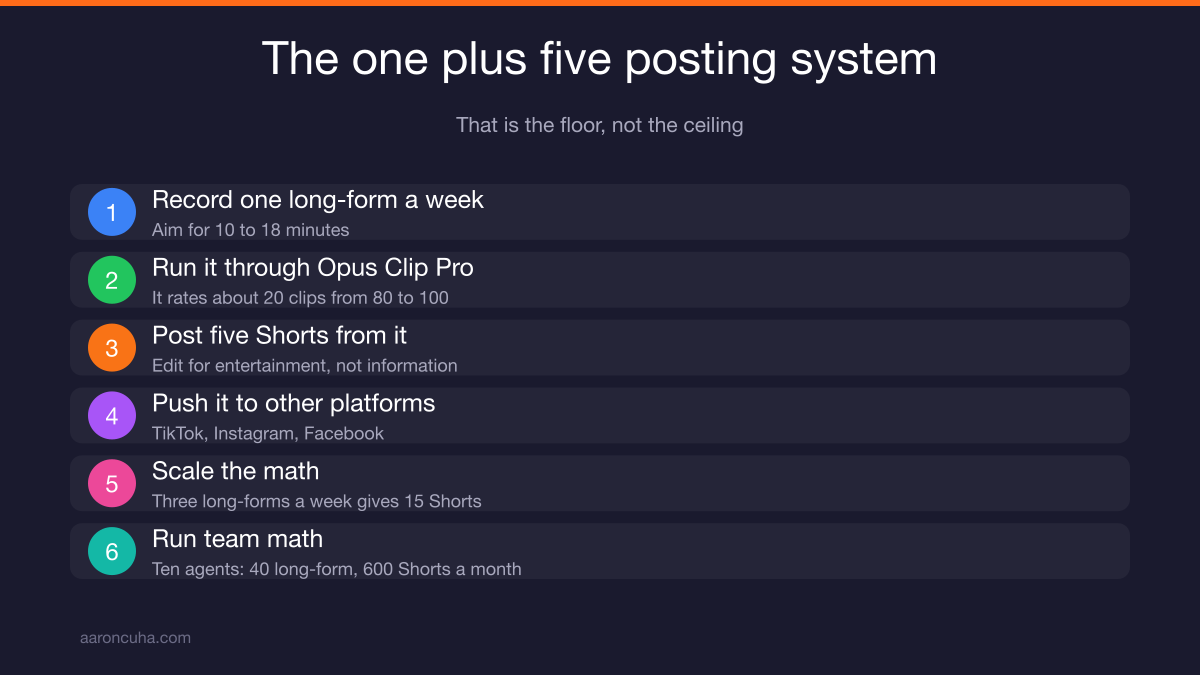
Here is the minimum ask. One long-form video a week. Five Shorts cut from that video. That is the floor, not the ceiling.
On length, aim between 10 and 18 minutes. Over 10 minutes gets you a real organic bump. Eighteen is the sweet spot. Every TED talk is 18 minutes. The classic sermon runs 18 minutes. There is a reason.
The workflow is simple. Record one solid long-form video. Run it through Opus Clip Pro. Generate your Shorts. Post.
Now scale the math:
- One long-form a week gives you five Shorts a week.
- Two long-forms a week gives you ten Shorts a week.
- Three long-forms a week gives you fifteen Shorts a week. That is where things start moving fast.
I start you at one for a reason. It is not because I am a soft coach. It is because if I tell you three, you will do zero. I need you moving. Once you move, the results pull you forward.
Now run team math. Ten agents, each posting one long-form and five Shorts a week. That is 40 long-form videos and 600 Shorts a month. You are publishing thousands of pieces of content a year and you are omnipresent in your market.
Your competitors will complain that it is not fair. Let them. Build the system anyway. I explain the philosophy behind it in Systems Over Hustle.
Engine Content vs Authority Content: What to Actually Shoot
The number one complaint I hear is "I do not know what to shoot." The answer depends on where your channel is. Small channels need engine content. Established channels need authority content.
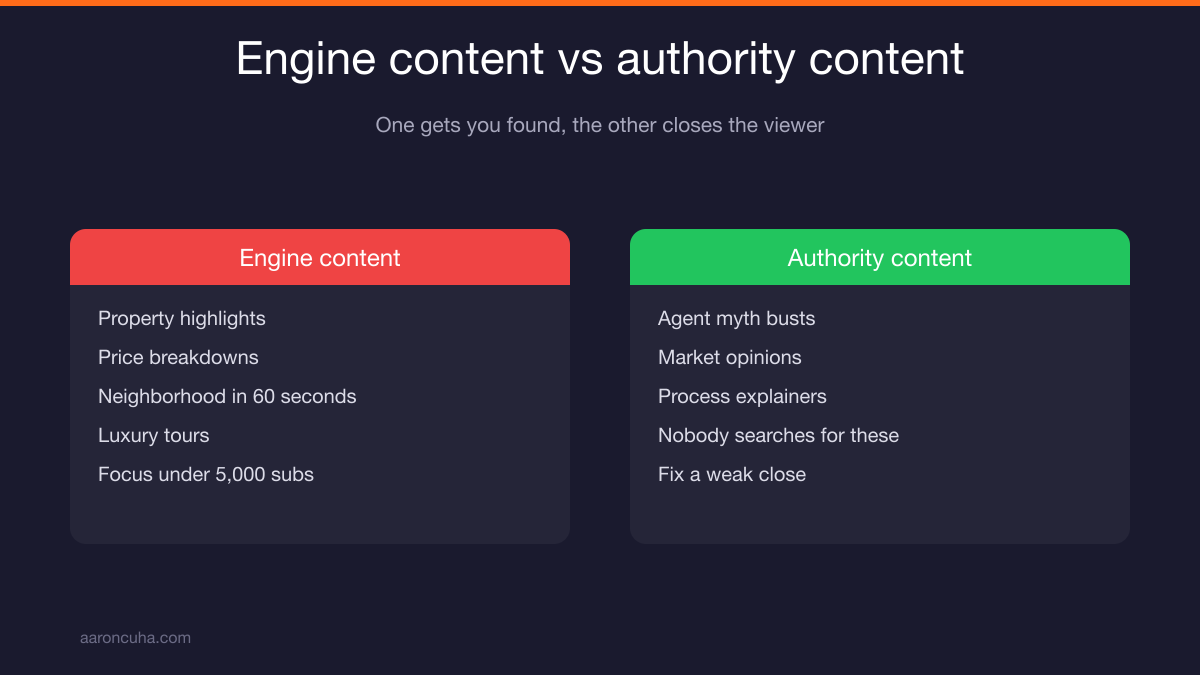
Engine content is what people search for. Property highlights. Price breakdowns. Neighborhood in 60 seconds. Luxury tours. It gets found.
Authority content is what converts. Agent myth busts. Market opinions. Process explainers. Nobody searches for these, but once someone lands on your channel, this is what makes them call you.
Here is how to weight the mix:
| Channel stage | Primary focus | Why |
|---|---|---|
| Under 5,000 subscribers | Heavy on engine content | You need discovery before you need persuasion |
| Established with weak conversion | Shift toward authority | The engine already runs, so fix the close |
If you have been on YouTube for four or five years with a big subscriber count that never converted, stop adding more engine content. Your engine is running. Your authority is missing.
The more agent myth-bust content you produce, the more conversion you get. People do not find those videos. They find the engine content, then the authority content closes them.
Map your topics with the four content pillars that turn a channel into a lead machine.
Views Are Irrelevant. Watch Time Wins.
YouTube does not care about views. It cares about watch time and average view duration. A 50-view video that produces 10 leads beats a 50,000-view video that produces none.
I get this complaint weekly. "Aaron, I posted daily and this one only got 50 views." Then I look at the leads. Fifty thousand views and nothing on one video. Fifty views and ten leads on another.
Which one do you want?
Here is the part that surprises people. YouTube does not need viewers to finish the video. It measures average view duration. A 15-minute video where people watch five minutes beats a three-minute video where people watch all three.
So stop cutting your videos short out of fear. Go longer, hold attention, and let the duration math work for you.
Judge every video by three questions:
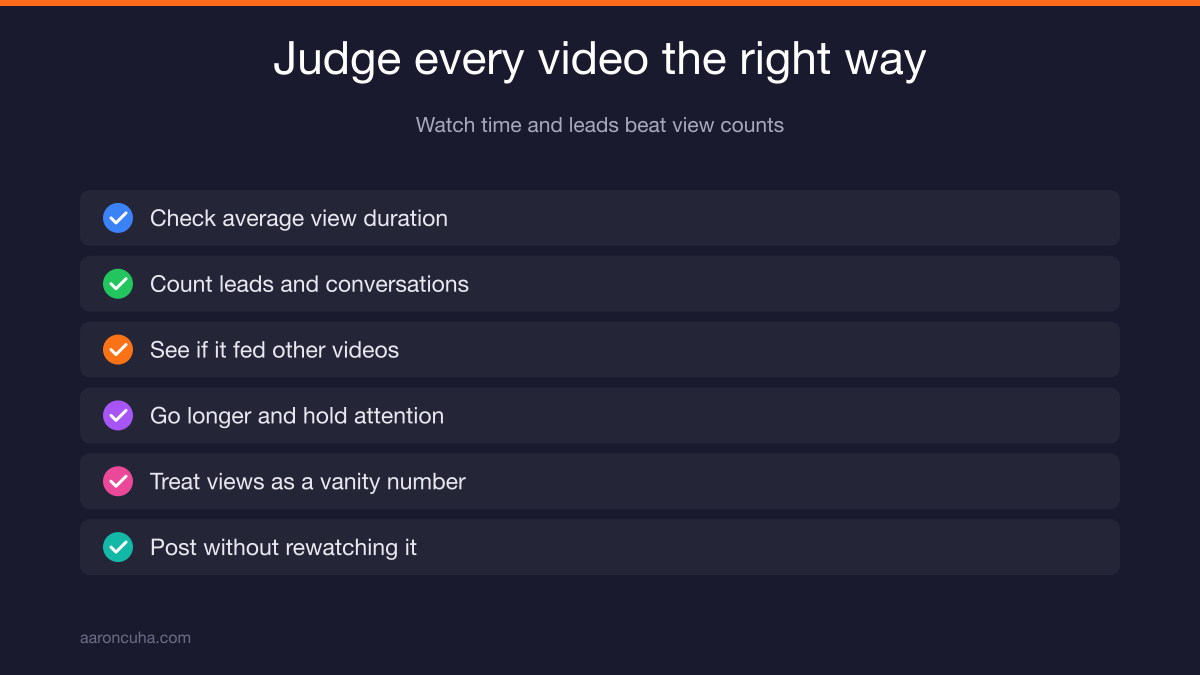
- What was the average view duration?
- How many leads or conversations came from it?
- Did it feed traffic to other videos on the channel?
Views are a vanity number. Duration and leads are the business. Turn attention into pipeline with my YouTube lead generation strategy.
The No Time Excuse and the AI Workflow That Kills It
You do not have time. Your agents do not have time. In the old days, that was a real answer. With AI, it is not.
Here is the workflow. Run your long-form through Opus Clip Pro. While you take a call, it produces about 20 Shorts and rates them from 80 to 100. You open the list and post the top ones.
Then do the hardest part. Do not watch them.
I do not watch my own videos before posting. If I watch them, they never go up. I will find something to fix, something to clean, something to re-record. My brain will talk me out of publishing.
Posting beats perfection. Always.
I see videos I made years ago that I would never post today, and they are pulling millions of views. People like your mistakes. People like natural. One of the agents I work with does zero editing. She films and posts. Her numbers are excellent and her bank account reflects it.
Get your team to the point where they can record a Short in 60 seconds and edit it in 60 seconds. If they have time to scroll social media, they have time to film and post on social media. The excuse engine has left the building.
For more on stacking AI into your daily operations, read how to build an AI content engine for your business. Tools like Opus Clip handle the clipping so you can stay in front of clients.
Your Choice: Move or Wish You Had Moved
73% of buyers and sellers are already on YouTube. The algorithm is smarter and it knows what you are saying. So say the right things, consistently, in both formats.
Nothing here is complicated. One long-form a week. Five Shorts from it. Engine content to get found. Authority content to convert. Watch time over views. Post before you feel ready.
The people who act on this in the next 90 days will look untouchable in twelve months. The people who wait will watch someone with half their experience take their market.
You either move or you wish you moved. That is the whole decision.
If you want the full system in writing, start with Crazy Simple YouTube, then join the Systems Over Hustle community to build it alongside people already doing the work.
Frequently Asked Questions

Written by
Aaron CuhaAuthor of Crazy Simple YouTube, keynote speaker, and executive coach with 20,000+ hours logged. ICF PCC, NLP Master Practitioner, and DISC Certified. Aaron helps entrepreneurs replace hustle with AI-powered systems that generate leads, content, and revenue on autopilot.