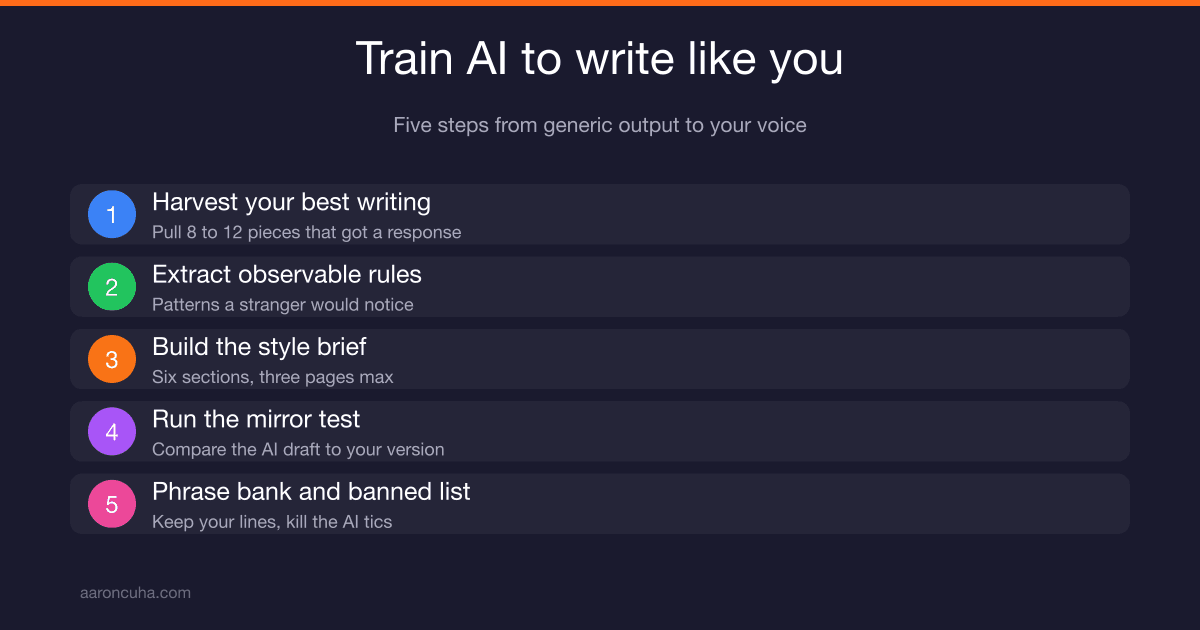
Generic AI output is not a model problem, it is an input problem. Here is the five step process I use to train AI to write like you, built from writing five books and coaching owners for 20,000 hours. You get a reusable voice profile, a test that proves it works, and clear rules for what you should still write yourself.
Your AI writing sounds generic because you gave it almost nothing to work with. Three sentences of context cannot produce a voice. Here is the five step process I use instead.
Key Takeaways
- Generic AI output is an input problem, not a model problem.
- Harvest 8 to 12 real samples before you write a single prompt.
- Turn vague adjectives into observable rules a stranger could verify.
- Run the mirror test: rewrite something you already wrote, then mark the tells.
- Keep a phrase bank and a banned list, and update both monthly.
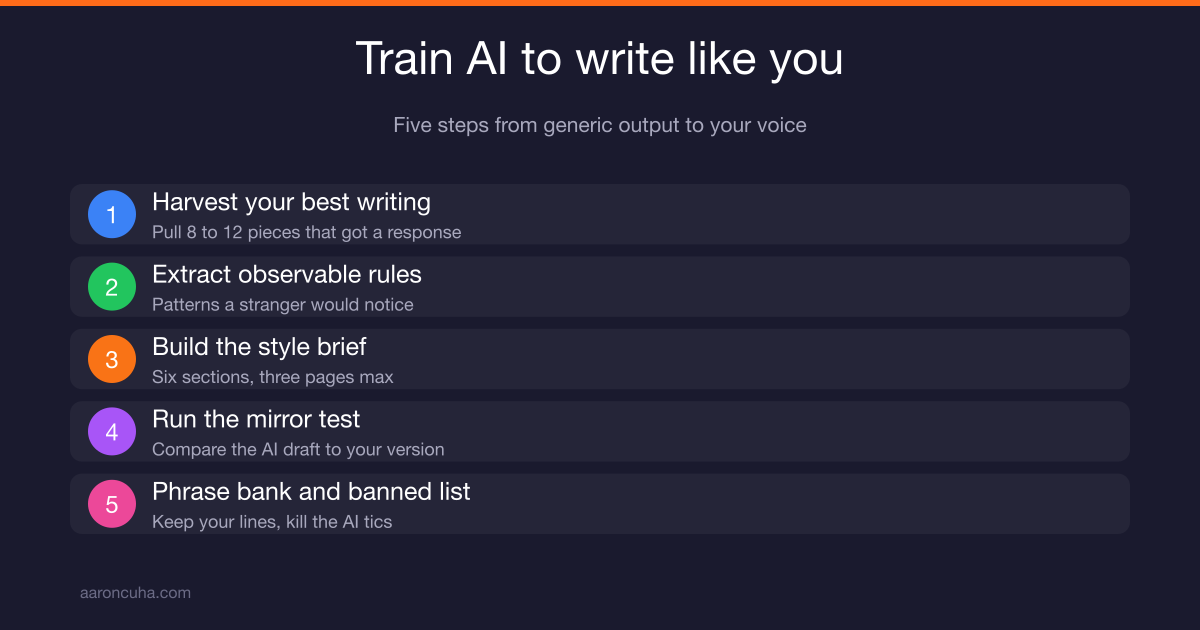
If you want to train AI to write like you, start by accepting that the tool is not the bottleneck. You are. Most owners I coach type a topic, hit enter, read the result, and decide AI cannot do voice.
The model did exactly what you asked. You asked for words about a topic. You did not ask for your words about that topic.
I have written five books. I know what my sentences look like when they are working and what they look like when they are not. That knowledge is the raw material. Until you extract it and hand it over, the AI is guessing from an average of the internet.
Want a system for the whole content pipeline, not just the voice piece? Start with the AI content engine framework, then come back here to make the output sound like a human wrote it.
Why AI Sounds Generic (It Is Not the Model)
AI sounds generic because you fed it generic input. It averages every piece of writing on your topic and returns the middle. Your voice lives at the edges, and you never showed it where your edges are.
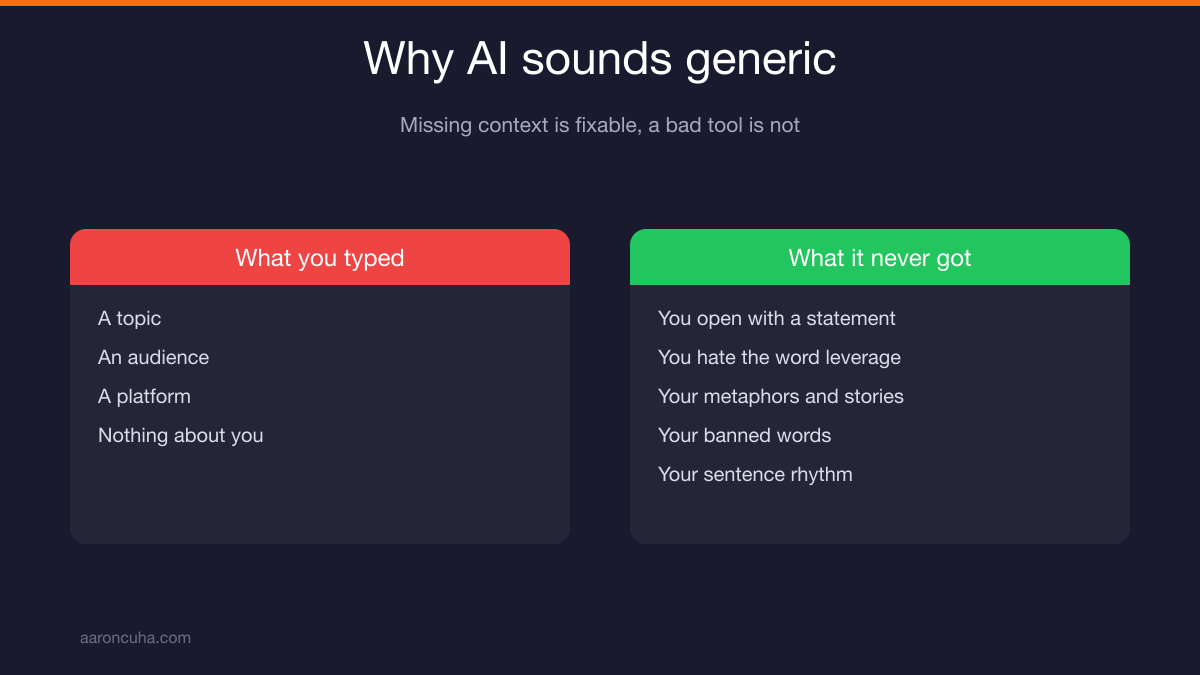
Think about what you actually typed. "Write a LinkedIn post about follow up for real estate agents." That is a topic, an audience, and a platform. Nothing about you is in there.
The model has no idea that you open with a blunt statement. It does not know you hate the word "leverage." It does not know you tell stories about mountains because you spent a decade in Nepal.
Every generic sentence is a piece of context you did not provide. That is good news. Missing context is fixable. A bad tool is not.
I watched this exact pattern during the DirectLender years, long before AI. We had 280 offices and 3,000 employees, and the loan officers who complained the marketing department produced junk were almost always the ones who submitted a one line request. The ones who submitted their own notes got material they were proud to send.
Same principle. Different decade.
What a Voice Profile Actually Is
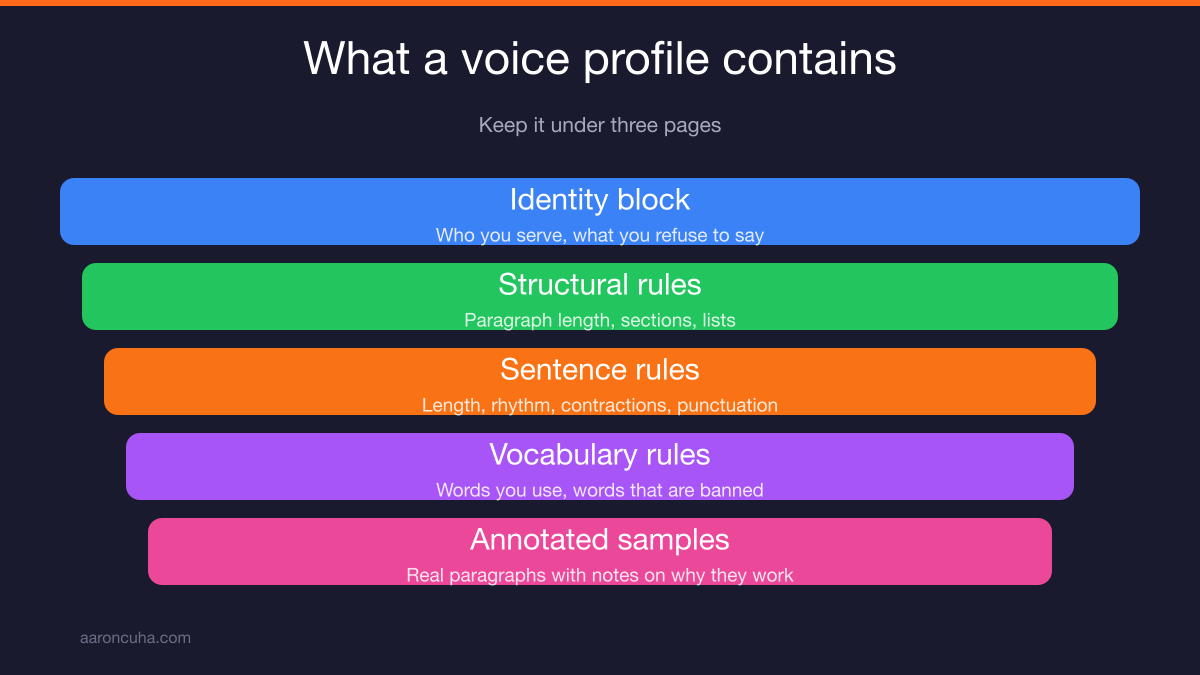
A voice profile is a reusable document containing observable writing rules, three to five annotated samples, a phrase bank, and a banned list. It is not a list of adjectives like "warm but direct."
Adjectives fail because they are unfalsifiable. Tell me what "authentic" looks like at the sentence level. You cannot, and neither can the model.
Observable rules work because a stranger could check them. "Average sentence under 14 words" is checkable. "Never open with a question" is checkable. "Use contractions everywhere except in the final line of a section" is checkable.
Here is what belongs in the document:
- Identity block. Who you are, who you serve, what you sell, what you refuse to say.
- Structural rules. Paragraph length, section length, how you handle lists.
- Sentence rules. Length, rhythm, contractions, punctuation habits.
- Vocabulary rules. Words you use constantly, words that are banned.
- Annotated samples. Real paragraphs with notes explaining why they work.
Keep it under three pages. If it grows past that, you are describing preferences instead of patterns.
Step 1: Harvest Your Best Writing
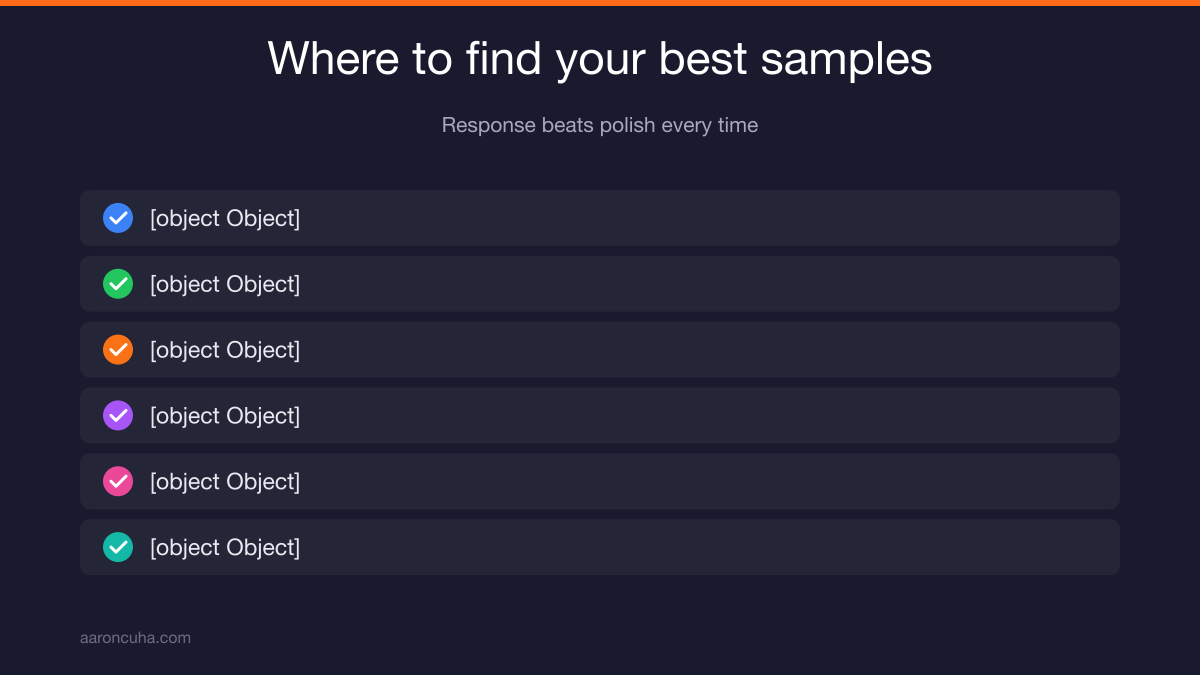
Pull 8 to 12 pieces of writing that got a real response. Emails people replied to, posts that started conversations, book passages readers quote back to you. Response beats polish every time.
Do not pick your most edited work. Heavily edited writing has had the personality sanded off. Pick the writing that made someone act.
Go hunting in these places:
- Sent mail. Search for your longest replies to clients. That is you thinking on paper.
- Text threads with your team. Blunt, fast, unguarded. Extremely useful.
- Social posts with real comment threads. Not likes. Comments.
- Book or newsletter passages people have quoted to you.
- Proposals or offers that closed.
If your writing samples are thin, use your mouth instead. Record yourself answering ten client questions out loud, then run the audio through a transcription tool.
Spoken transcripts are the fastest voice source most owners own and never use. You already talk like yourself. The transcript captures your rhythm, your filler patterns, your metaphors, and the exact way you explain things when nobody is watching.
Strip the ums. Keep everything else.
Step 2: Extract the Rules a Stranger Would Notice
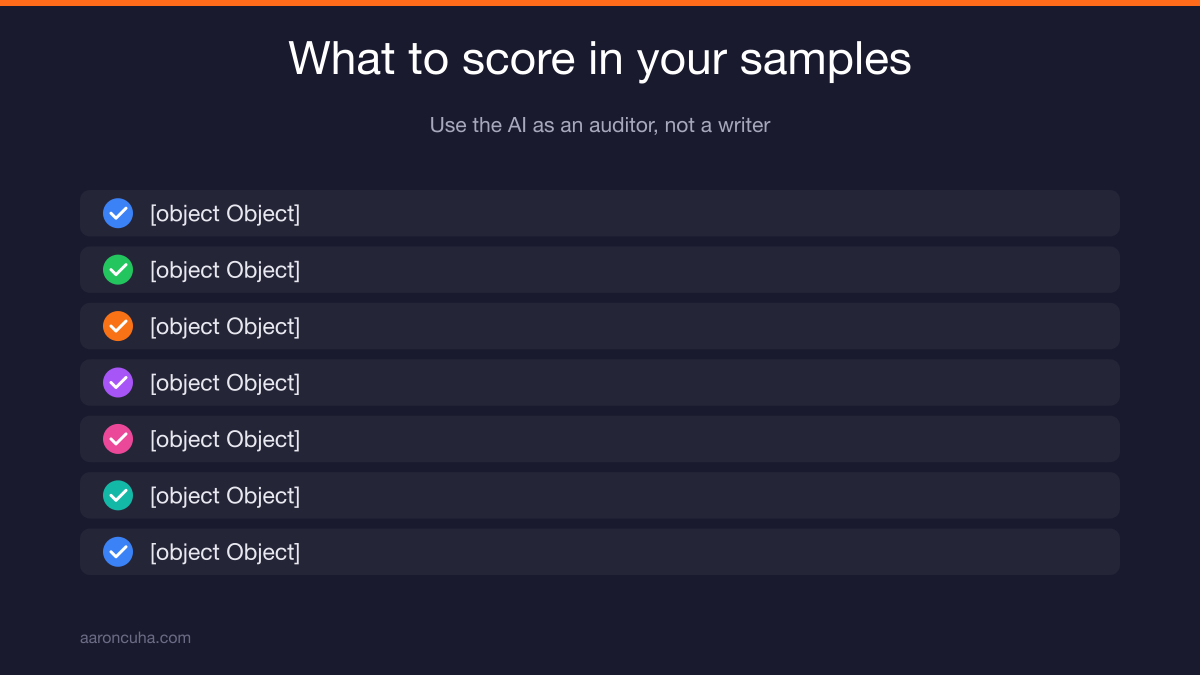
Score your samples across eight dimensions and write down what you find. You are looking for patterns a stranger would notice reading three of your pieces back to back, not qualities you wish you had.
The eight dimensions:
- Sentence length. Short and clipped, long and rolling, or deliberately mixed.
- Contractions. Always, never, or situational.
- Openings. Statement, question, story, number, or objection.
- Structure. Numbered steps, loose essays, or short blocks stacked.
- Metaphor source. Sports, construction, cooking, travel, military, music.
- Punctuation habits. Colons, parentheses, sentence fragments, one line paragraphs.
- Formality. Do you say "folks" or "individuals." Do you swear. Do you use jargon.
- Closings. Command, question, callback to the opening, or hard stop.
Now use the AI as an auditor instead of a writer. Paste your samples and ask it to describe the patterns it observes, with examples pulled from the text.
Ask it this way: "Here are ten samples of my writing. Describe the observable rules a stranger would notice. Quote the specific lines that prove each rule. Do not use adjectives, use rules."
You will disagree with some of what it says. Good. The disagreement is where the real profile forms.
One caution. The audit tells you what you do. It does not tell you what you should do. If it flags a habit you dislike, that habit goes on the banned list instead of the rules list.
Step 3: Build the Reusable Style Brief
Turn your audit into a single document you paste at the start of any writing task. The brief has six sections and stays under three pages so the model can hold all of it at once.
Structure it like this:
- Who I am and who I serve. Three sentences. Include what you sell.
- How my sentences work. Length, rhythm, contractions, fragments.
- How my pieces are built. Openings, section length, list usage, closings.
- My vocabulary. Words I use constantly. Words that are banned.
- Three annotated samples. Real paragraphs with a note on why each works.
- Output rules. Format, length, what to never do.
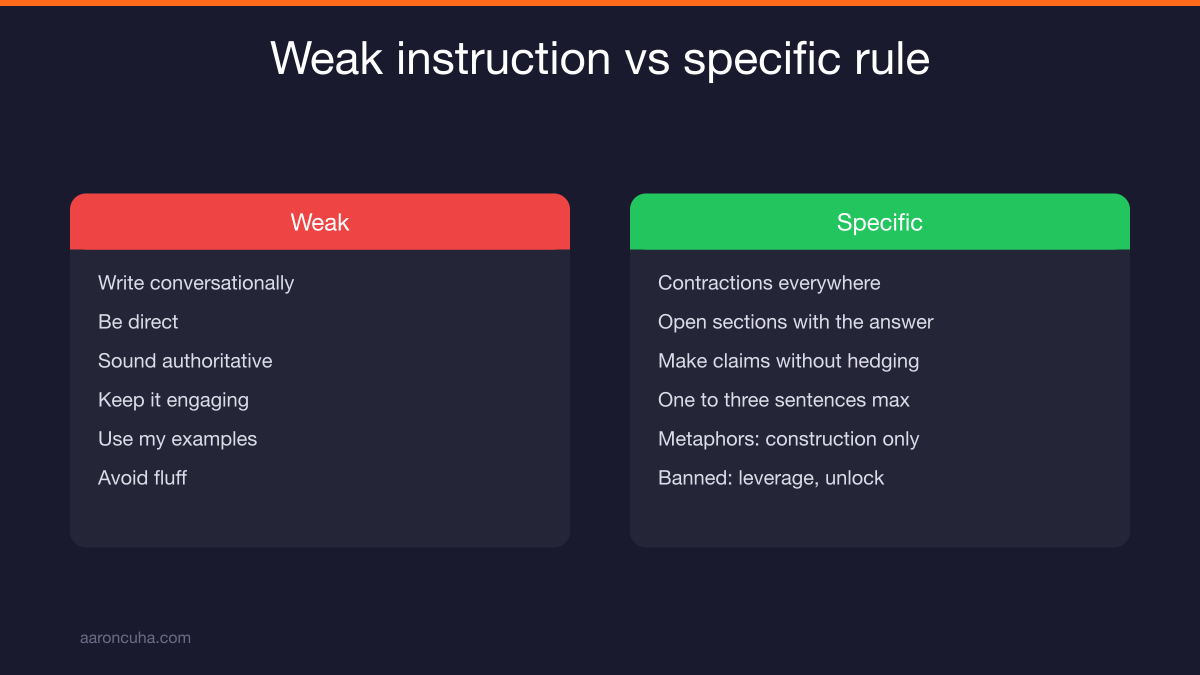
The difference between a brief that works and one that does not is specificity. Look at the gap:
| Weak instruction | Specific rule |
|---|---|
| Write in a conversational tone | Use contractions in every sentence. Average sentence under 14 words. |
| Be direct | Open every section with the answer. Supporting detail comes after. |
| Sound authoritative | Make claims without hedging. Never write "it could be argued." |
| Keep it engaging | Paragraphs are one to three sentences. Never more. |
| Use my examples | Pull metaphors from construction and mountaineering only. |
| Avoid fluff | Banned: leverage, unlock, game changer, in today's landscape. |
Every row on the left produces average writing. Every row on the right produces yours.
If you want the same discipline applied to your publishing schedule instead of your sentences, read the breakdown on content systems for entrepreneurs.
Step 4: Run the Mirror Test
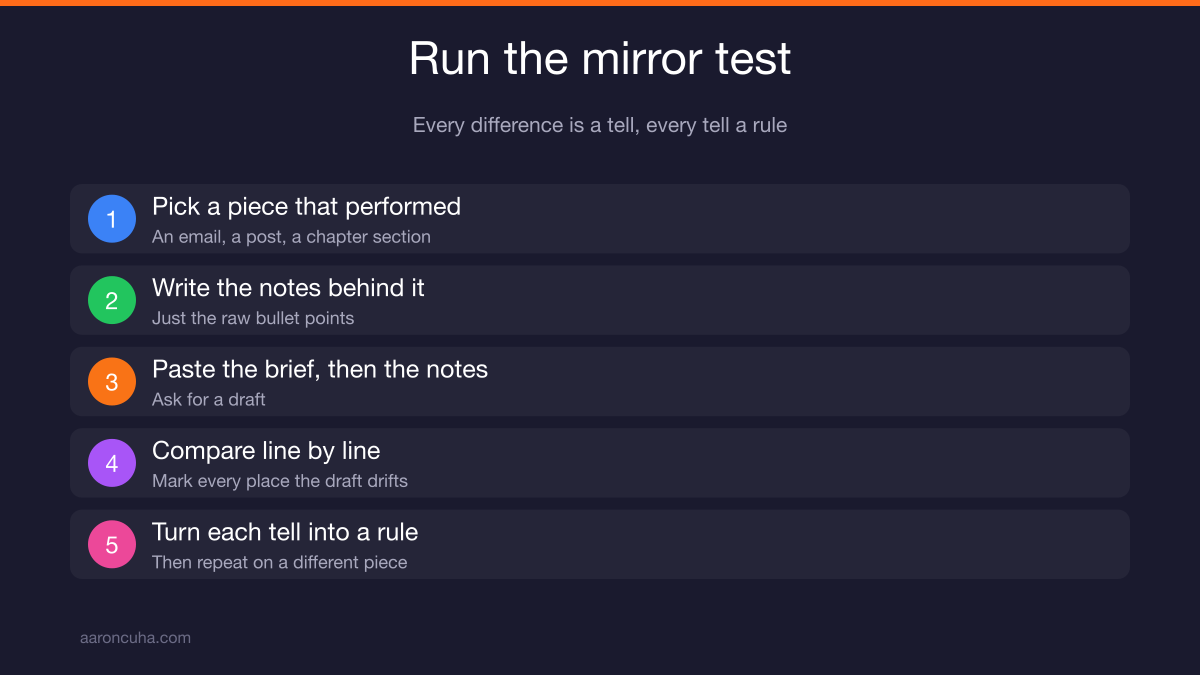
Take something you already wrote well. Feed the AI only the notes behind it, plus your style brief. Compare its version to yours line by line. Every difference is a tell, and every tell becomes a rule.
This is the step almost everyone skips, and it is the step that does the work.
Here is the sequence:
- Pick a piece you wrote that performed well. An email, a post, a chapter section.
- Write down the bullet notes you would have started from. Just the raw points.
- Paste your style brief, then the notes. Ask for a draft.
- Put both versions side by side.
- Highlight every place the AI version drifts from yours.
Typical tells I see: the AI opens with a question when you open with a statement. It uses three word lists where you use two. It adds a summary sentence at the end of every paragraph. It reaches for abstractions where you would name a thing.
Write each tell as a new rule and add it to the brief. Then run the test again on a different piece.
Two or three rounds is usually enough. By round three the drift gets small and stylistic rather than structural, which means the brief is holding.
Do not chase perfection here. You are aiming for a draft you can finish in ten minutes, not a draft you can publish untouched.
Ready to put a system like this around your entire content operation instead of one prompt at a time? Book a 90 minute strategy session and we will map the build.
Step 5: Build a Phrase Bank and a Banned List
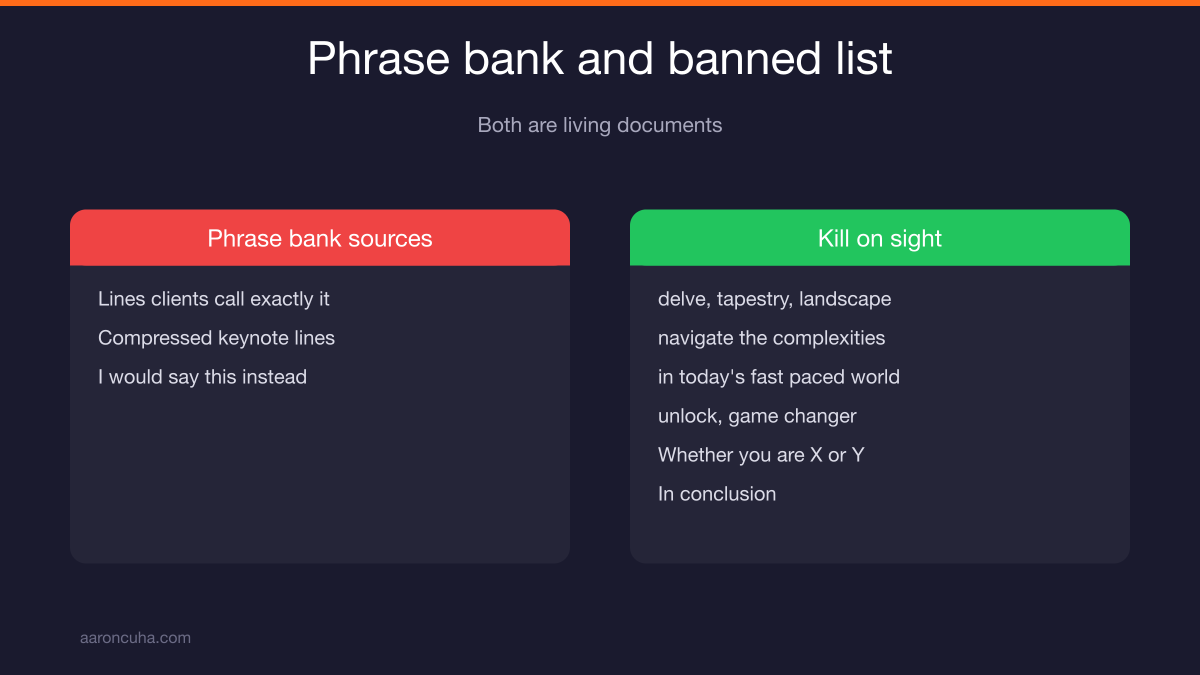
The phrase bank holds the lines only you say. The banned list holds the words you never use plus the AI tics you want dead. Both are living documents you add to weekly.
Your phrase bank is the signature layer. Mine holds things like "systems over hustle" and the way I frame willpower as a lie people were sold. Those phrases carry my positioning inside them, so when the AI uses one correctly, the whole paragraph lands closer to home.
Gather phrase bank entries from three places:
- Client calls. When you explain something and the client says "that is exactly it," write down what you just said.
- Live teaching. Keynotes and workshops force compression. Compressed lines are your best lines.
- Your own reactions. When you read a draft and think "I would never say that, I would say this," capture "this."
The banned list has two halves. Half one is your personal list, the words that are technically fine but not yours. Half two is the universal AI tic list.
Kill these on sight: delve, tapestry, landscape, navigate the complexities, it is important to note, in today's fast paced world, unlock, game changer, elevate, robust, seamless, and any sentence that begins with "In conclusion."
Also ban the structural tics. No sentence that starts "Whether you are a X or a Y." No paragraph that ends by restating the paragraph. No triple adjective stacks.
Review both lists monthly. Ten minutes. Add what you caught, delete what you no longer need.
Where to Store and Version Your Profile
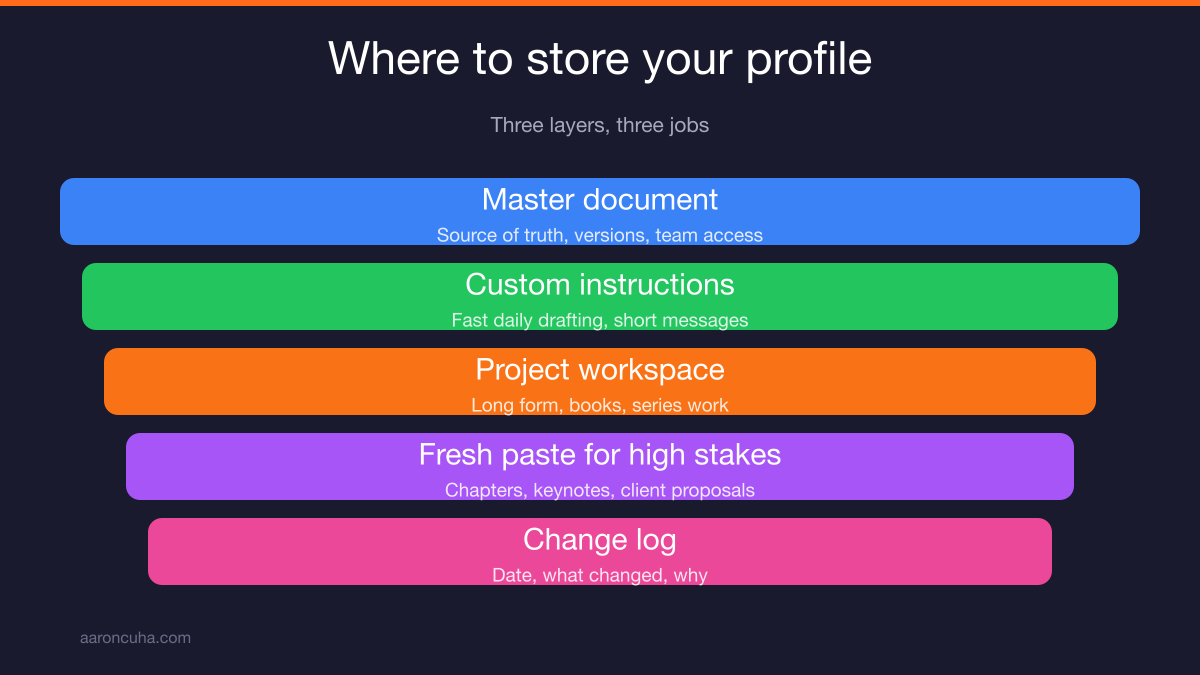
Keep the master brief in a plain document you control. Push a trimmed version into custom instructions or a project workspace for daily speed. Paste the full brief fresh for anything high stakes.
Three storage layers, three jobs:
| Location | Best for | Watch out for |
|---|---|---|
| Master document (Docs, Notion, plain text) | Source of truth, versioning, sharing with your team | Goes stale if you never open it |
| Custom instructions or saved memory | Fast everyday drafting, short messages | Character limits force you to cut rules |
| Project or workspace with files attached | Long form, books, series work | Context can get diluted across long threads |
Both OpenAI and Anthropic ship changes to memory and project features often, so check what your tool supports before you build a workflow that depends on it.
Run a change log at the bottom of the master document. Date, what changed, why. Three lines per entry.
That log matters more than it sounds. Six months in, you will wonder why a rule exists. The log tells you whether it came from a real tell or a bad mood.
For high stakes work, always paste the brief fresh. Book chapters, keynote scripts, client proposals, anything with your name on the cover. Stored instructions get compressed and partially ignored in long sessions. A fresh paste does not.
Where Voice Training Legitimately Fails
Voice training fails on original thinking, emotionally loaded messages, first person story, and judgment calls. The AI can express a thought. It cannot have one. Everything that requires having one stays with you.
Let me be specific about the four categories.
Original point of view. If your take contradicts what most people in your industry believe, the model will soften it back toward consensus. It was trained on consensus. You have to hold the edge yourself.
Emotionally loaded messages. Firing someone. Apologizing. Telling a client the deal died. The stakes are in the relationship, not the prose, and readers can feel the difference.
First person story. The AI can rewrite a story you tell it. It cannot supply the detail that makes a story true. When I lost DirectLender in 2008, the detail that matters is not the number of offices. It is what the building sounded like at the end. No model has that.
Judgment calls. Should you take this client. Should you kill this offer. Is this good enough to ship. The AI will give you a balanced answer, and balance is exactly wrong when the job is to decide.
Here is the rule I coach: AI expresses thoughts, it does not have them. Bring the thought. Let the machine help you dress it.
If you want the broader argument on where the line sits between human work and machine work, I laid it out in AI will not replace you.
What to Always Write Yourself
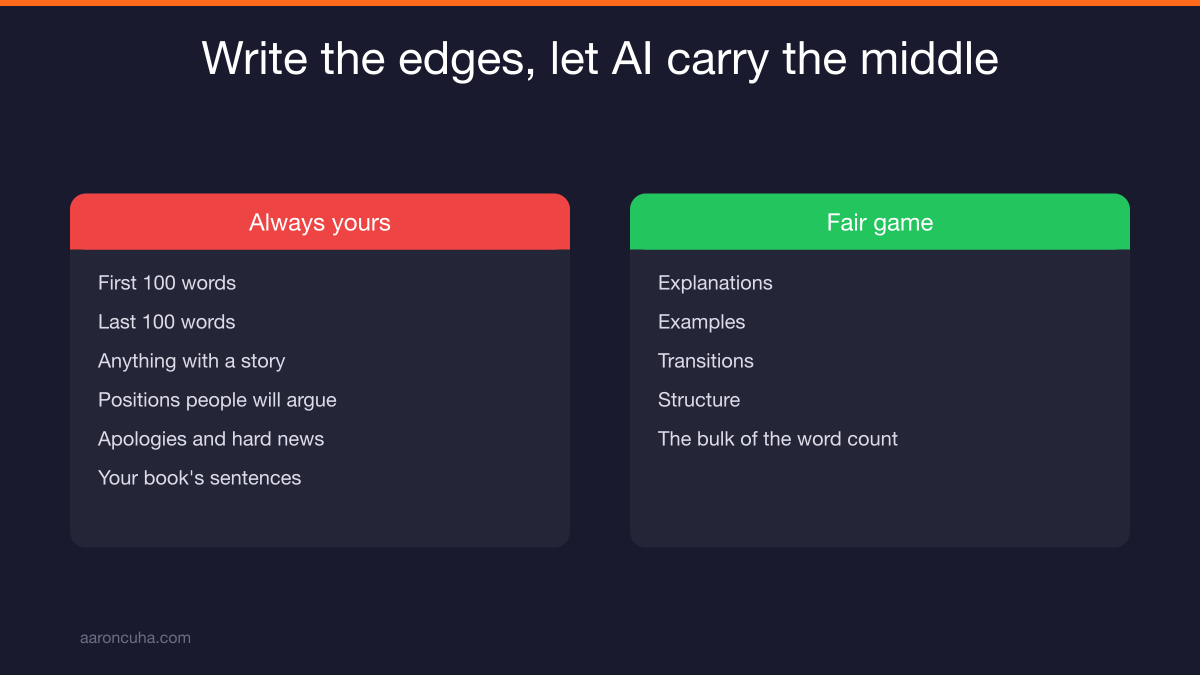
Write your first 100 words and your last 100 words by hand, every time. Openings set the voice and closings carry the ask. Those are the two places readers decide whether you are real.
The non-negotiable list:
- Anything with a personal story in it. You have the details. The model does not.
- Anything where you take a position other people will argue with.
- Apologies, condolences, and hard news.
- The first message to someone who matters. New client, new partner, new hire.
- Your book. Notes and outlines are fine. Sentences are yours.
The 100 word practice does something people underestimate. When you write the opening yourself, you set the rhythm, and the AI continues rhythms far better than it invents them.
Same at the end. The close is where you ask for something. If the ask sounds borrowed, the reader will not act on it.
The middle is fair game. Explanations, examples, transitions, structure. That is the bulk of the word count and the part that drains you.
Let the machine carry the middle so you have energy for the edges. That is the trade, and it is a good one.
Keeping Your Voice From Drifting as Your Positioning Changes
Review the profile every quarter. Replace rules instead of stacking them, and watch for a brief that keeps pulling you back toward an offer you no longer sell or an audience you no longer serve.
Voice profiles rot in a predictable way. You build one around your current offer. Twelve months later your offer changed, but the brief did not, so every draft quietly argues for the old business.
The quarterly review is four questions:
- Is the identity block still true? Same audience, same offer, same promise.
- Which rules did I override in the last 90 days? Overridden rules get rewritten or deleted.
- What is in the phrase bank that I have stopped saying? Cut it.
- What new phrases have shown up in my client calls? Add them.
Stacking is the failure mode to avoid. Every time a draft goes wrong, the temptation is to add a rule. Twenty additions later the brief is six pages, contradicts itself, and the model follows whichever half it noticed.
When you add a rule, delete a rule. Keep the count flat.
My own brief changed hard between the DirectLender era, the Nepal decade, and coaching. Each shift needed a rewrite, not a patch. If your business has moved that much, so should your document.
If your positioning itself is the unsettled part, work through picking a niche that actually pays before you rebuild the brief.
The Same-Day Implementation Plan: Train AI to Write Like You in 90 Minutes
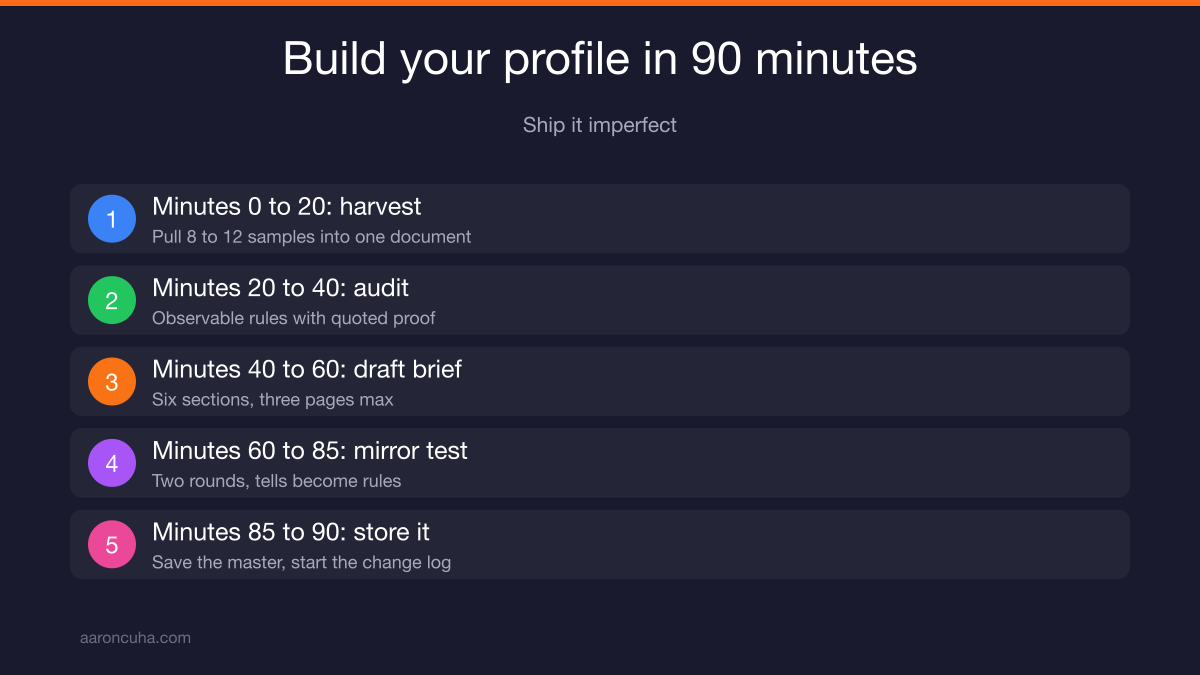
You can build a working voice profile today in 90 minutes. Harvest for 20, audit for 20, draft the brief for 20, mirror test for 25, and clean up for 5. Ship it imperfect.
The sprint:
- Minutes 0 to 20. Harvest. Pull 8 to 12 samples into one document. Sent mail, texts to your team, posts with real comments. If you are short, record three spoken answers and transcribe them.
- Minutes 20 to 40. Audit. Paste the samples. Ask for observable rules with quoted proof, no adjectives. Delete anything you disagree with.
- Minutes 40 to 60. Draft the brief. Six sections. Identity, sentences, structure, vocabulary, three annotated samples, output rules. Three pages max.
- Minutes 60 to 85. Mirror test. Pick a piece you already wrote. Feed only the notes plus the brief. Compare, mark tells, convert tells to rules. Two rounds.
- Minutes 85 to 90. Store it. Save the master document. Start the change log with today's date.
Here is the metric for knowing it is good enough to publish with. Read the draft out loud. If you can get through it without stopping to fix a sentence that is not yours, ship it.
Not perfect. Not indistinguishable. Just close enough that a ten minute edit finishes it.
That threshold matters because the real win is not a flawless imitation of you. It is publishing every week instead of every other month. Consistency is what builds authority, and I made that case in detail in how to become a thought leader.
One last note on judgment. The FTC business guidance on endorsements and claims applies to AI assisted content the same way it applies to anything else you publish. You own what goes out under your name. Check the facts yourself.
Voice work is one piece of a larger build. If you want the operating system behind it, the Systems Over Hustle framework shows why capacity comes from structure, not effort, and AI business systems covers the automation layer that sits underneath.
Want me to look at how you are publishing right now and tell you what to fix first? Grab a Channel Audit and Plan and I will show you where your voice is leaking.
Frequently Asked Questions

Written by
Aaron CuhaAuthor of Crazy Simple YouTube, keynote speaker, and executive coach with 20,000+ hours logged. ICF PCC, NLP Master Practitioner, and DISC Certified. Aaron helps entrepreneurs replace hustle with AI-powered systems that generate leads, content, and revenue on autopilot.