YouTube shifted its algorithm to prioritize watch time and session duration over raw clicks. Learn the exact frameworks, retention tactics, and content.
YouTube's 2026 algorithm no longer rewards clicks. It rewards watch time. Here is exactly how to restructure your content to win.
Key Takeaways
- Watch time and session duration now outweigh click-through rate as the primary ranking signal in the YouTube algorithm 2026.
- The first 15 seconds determine whether 70 percent of viewers stay or leave — nail your hook structure.
- Retention-optimized content structure beats high-CTR clickbait every single time in the current recommendation system.
- Average view duration above 50 percent is the threshold that triggers algorithmic promotion to Browse and Suggested feeds.
- Session stacking — keeping viewers on YouTube longer — is the hidden lever most creators ignore entirely.
I wrote the complete playbook for building a YouTube channel that generates leads, clients, and revenue on autopilot.
The YouTube Algorithm 2026: Why Watch Time Dethroned Clicks
Watch time is now the single most important metric in YouTube's recommendation engine. The algorithm deprioritized raw click-through rate because creators gamed it with misleading thumbnails and sensational titles.
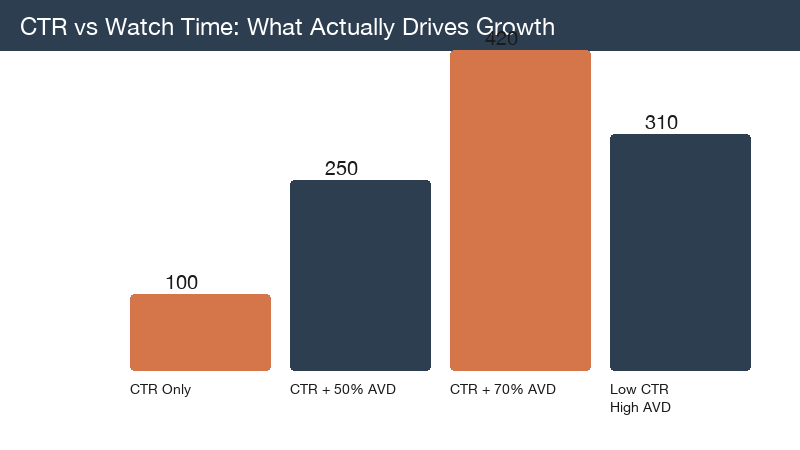
YouTube confirmed this shift in their official recommendation system documentation. The platform's machine learning models now weigh total minutes watched, average view duration, and session time far more heavily than whether someone simply clicked. A video with a 4 percent CTR and 65 percent average view duration will outperform a video with an 8 percent CTR and 30 percent average view duration every single time.
This is a massive win for creators who focus on quality. If you have been doing the right things — delivering value, structuring content for retention, building trust — the algorithm is finally catching up to your effort. I break this down in Chapter 2 of Crazy Simple YouTube, where I map out the exact signals the algorithm evaluates frame by frame.
The creators who relied on clickbait thumbnails and bait-and-switch titles are seeing their channels decline. The creators who invested in viewer satisfaction and watch time optimization are seeing their recommended traffic explode. This is the most creator-friendly algorithm update in years.
What Watch Time Actually Measures (And Why It Matters)
Watch time is the total number of minutes viewers spend watching your video. It is not the same as views. One thousand views with 30-second average watch time is worth far less than 200 views with 8-minute average watch time.
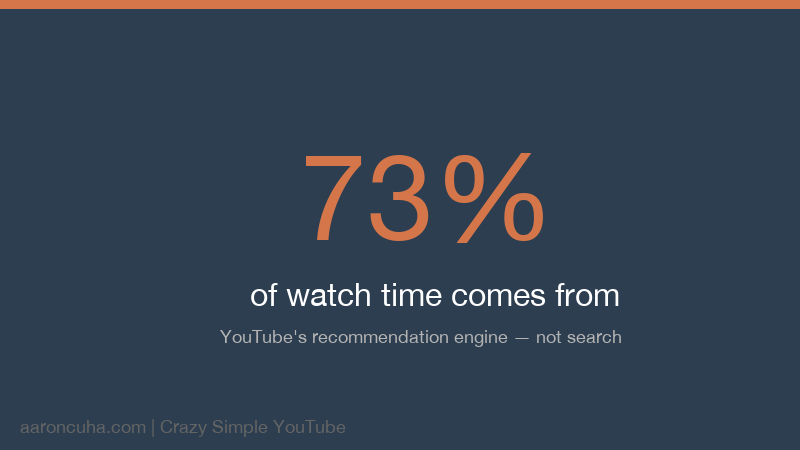
YouTube's algorithm uses watch time as a proxy for content quality. The logic is simple: if people keep watching, the content is delivering value. If they leave early, it is not. According to YouTube Creator Academy, watch time directly influences how often your videos appear in three critical surfaces:
- Suggested videos: The sidebar and end-screen recommendations that drive 40-60 percent of total views for most channels
- Browse features: The homepage feed where YouTube proactively recommends your content to subscribers and new viewers
- Search rankings: Higher watch time signals relevance, pushing your videos above competitors for the same keyword
There is also a secondary metric that matters enormously: session duration. This measures whether your video keeps people on YouTube longer. If someone watches your video and then watches three more videos, YouTube rewards you for initiating that session. This is why end screens, playlists, and content series are more powerful than ever. I teach my clients to think of every video as the start of a viewing session, not a standalone piece of content.
The First 15 Seconds: Where Watch Time Is Won or Lost
Seventy percent of viewer drop-off happens in the first 15 seconds. Win those 15 seconds and you win the algorithm.
I have analyzed retention graphs across hundreds of channels I coach — from real estate agents to financial advisors to ecommerce brands — and the pattern is always the same. The audience retention curve drops sharply in the opening seconds, levels off for engaged viewers, then gradually declines. Your job is to minimize that initial cliff.
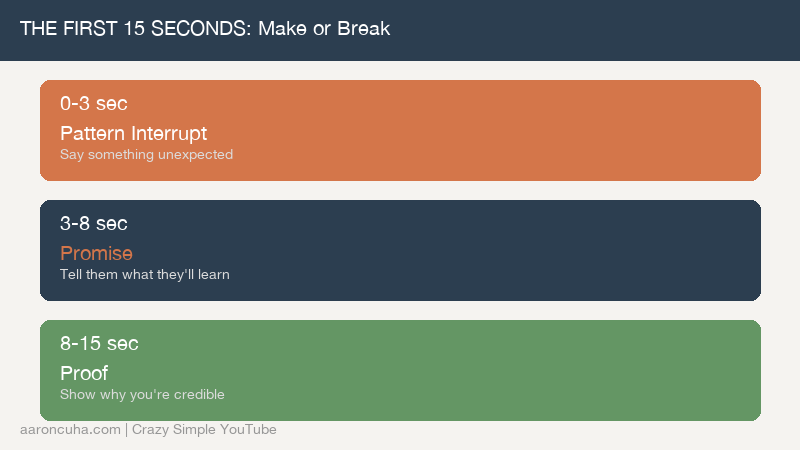
Here is exactly what your first 15 seconds need to accomplish:
- Seconds 1-3: The pattern interrupt. Say or show something unexpected. Break the viewer's scroll momentum. This is not clickbait — it is relevance signaling.
- Seconds 4-8: The promise. Tell viewers exactly what they will get from this video. Be specific. "I am going to show you the three retention tactics that doubled my client's watch time in 30 days."
- Seconds 9-15: The credibility stamp. Give one reason they should trust you. A result, a credential, a number. "After coaching 75 clients and growing two channels past 100K subscribers, here is what I know works."
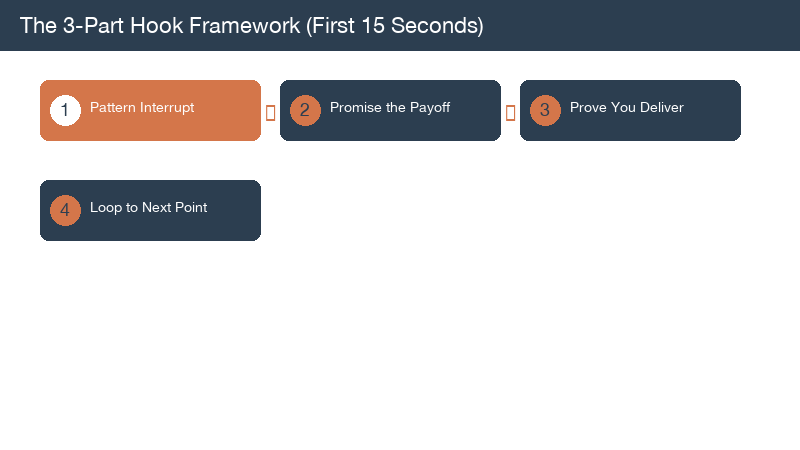
This is what I call the 3-Part Hook Framework, and it is one of the most replicated frameworks from my coaching program. Every client who implements it sees their average view duration increase within the first two weeks. If you want the full breakdown with script templates, I cover it in Chapter 5 of Crazy Simple YouTube.
How to Read Your Retention Graph Like a Pro
Your YouTube Studio retention graph is the most underused tool on the platform. It tells you exactly where viewers engage and where they leave.
Open any video in YouTube Studio, go to Analytics, then Engagement. The audience retention graph shows second-by-second data. Here is what to look for:
- Steep early drop: Your hook is not landing. Rewrite your first 15 seconds using the 3-Part Hook Framework above.
- Gradual decline: Normal and expected. As long as it stays above 50 percent past the halfway mark, you are in strong territory.
- Spikes upward: Something grabbed attention. Study those moments — they reveal what your audience values most.
- Sharp mid-video drops: You lost them. Usually caused by tangents, slow pacing, or a segment that does not deliver on the video's promise.
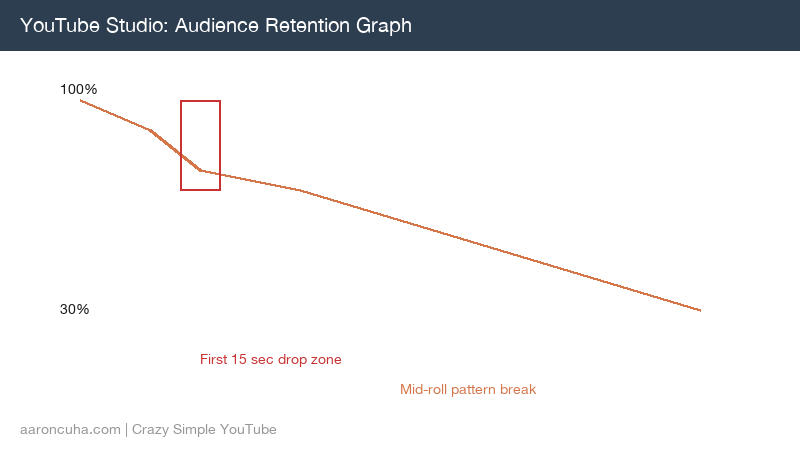
I review retention graphs with my clients every single week. Over 15,000 coaching hours, the pattern is clear: creators who study their retention data improve two to three times faster than creators who just upload and hope. This is the analytics feedback loop I describe in my post on YouTube analytics — and it is non-negotiable if you want to grow.
Content Structure That Keeps Viewers Watching
Retention is not about energy or charisma. It is about structure. The right content structure keeps viewers engaged even if you are not the most dynamic person on camera.
Here is the content structure I teach through the Reciprocal Proof Method — a framework where every claim you make is immediately backed by proof, creating a cycle of trust that keeps people watching:
- Hook (0-15 seconds): Pattern interrupt, promise, credibility stamp
- Context (15-45 seconds): Why this matters right now. Tie it to a trend, a pain point, or a shift in the industry.
- Core teaching (45 seconds to 70 percent of video): Deliver 3-5 distinct points. Each point follows the Reciprocal Proof Method: make a claim, show proof, give the action step.
- Recap and CTA (final 30 percent): Summarize key takeaways. Direct viewers to the next step — another video, a lead magnet, or a call booking.
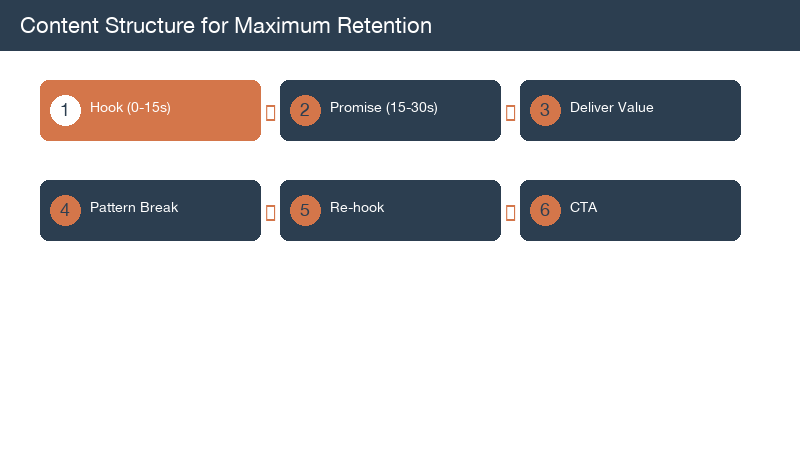
Notice the structure has built-in re-engagement points. Every time you transition to a new teaching point, you create a micro-hook: "The next tactic is the one that moved the needle the most." These transitions prevent the gradual viewer bleed that kills average watch time. This is the same structure I use on my own channels — @aaroncuha (81K subscribers) and @vanlife (133K subscribers) — and it is the backbone of my approach in content systems for entrepreneurs.
The 2026 Algorithm Ranking Factors: A Complete Breakdown
The YouTube recommendation algorithm evaluates multiple signals simultaneously. Here is how they stack up in 2026 based on creator data and YouTube's own disclosures.
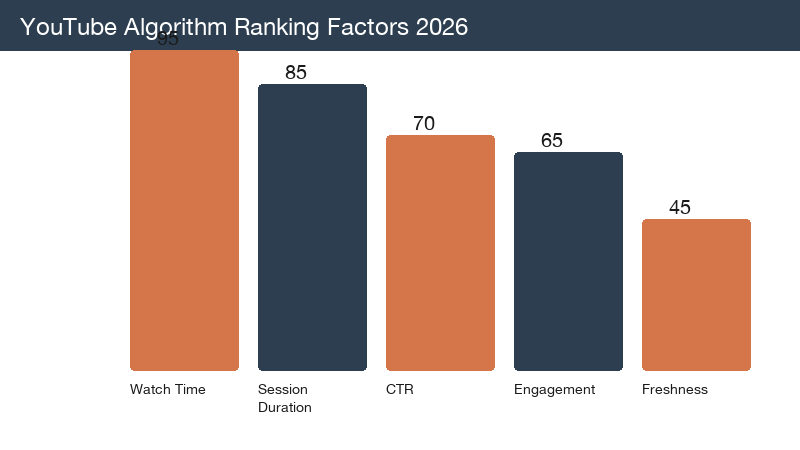
Primary signals (highest weight):
- Average view duration (percentage of video watched)
- Total watch time (cumulative minutes)
- Session duration (time spent on YouTube after watching your video)
- Viewer satisfaction surveys (the "rate this video" prompts YouTube shows to a sample of viewers)
Secondary signals (moderate weight):
- Click-through rate from impressions
- Engagement actions (likes, comments, shares, saves)
- Upload frequency and channel consistency
- Topical authority (how consistently you publish on one subject)
Tertiary signals (lower weight but still relevant):
- Video metadata (titles, descriptions, tags)
- Closed captions and transcript relevance
- Channel age and subscriber count
Notice that CTR is now a secondary signal, not a primary one. That is the fundamental shift. Research from vidIQ's creator research lab confirms that channels optimizing for watch time over CTR saw 35 percent more recommended traffic in Q1 2026 compared to CTR-focused channels. This aligns with what I teach in the Authority Flywheel framework — build depth, not breadth, and the algorithm rewards you. For the full framework, read my post on The Authority Flywheel.
Want the exact systems I use to coach 75+ clients to YouTube growth? Everything is in the book.
Session Duration: The Hidden Lever Most Creators Ignore
Session duration measures how long a viewer stays on YouTube after watching your video. It is one of the most powerful and least understood ranking signals in the algorithm.
YouTube is an advertising business. The longer people stay on the platform, the more ads YouTube serves. If your video initiates a long viewing session — even if the viewer watches other creators' videos afterward — YouTube credits you for starting that session. This is why playlists, end screens, and content series are not optional anymore. They are algorithmic levers.
Here is how to optimize for session duration:
- Create content series where each video naturally leads to the next. "In my next video, I will show you how to implement this step by step."
- Use end screens aggressively. Link to your most relevant video, not your most popular one. Relevance drives clicks.
- Build playlists around viewer intent. Group videos by the problem they solve, not by upload date. I cover playlist strategy in depth in my zero to 10K growth guide.
- Avoid dead ends. Every video should point somewhere. A viewer who finishes your video and leaves YouTube is a missed session opportunity.
My coaching clients who implement session stacking consistently see a 20-40 percent increase in recommended traffic within 60 days. It is the single fastest lever I have found for algorithmic growth, and it is a core part of the Leverage Layer framework I teach — where every piece of content works harder by connecting to your broader ecosystem.
Seven Proven Tactics to Increase Watch Time Today
These are the specific, actionable tactics I use with clients. No theory. Just what works right now in the current algorithm environment.
1. Open loops. Tease something coming later in the video. "I will show you the exact template in a minute, but first you need to understand why this works." Open loops create curiosity that keeps viewers watching through slower sections.
2. Pattern interrupts every 60-90 seconds. Change the visual, cut to B-roll, add a graphic, shift your camera angle. The human brain habituates to sameness. Pattern interrupts reset attention. I learned this from studying the highest-retention creators on the platform and now it is standard in every video my clients produce.
3. Delete your intro. If you have a branded intro longer than 3 seconds, cut it. Intros are retention killers. The data from Think with Google is clear: branded intros cause an average 8-12 percent drop in the first 10 seconds.
4. Front-load value. Give your best insight in the first two minutes. Do not save it for the end. When viewers get value early, they trust that more value is coming and keep watching. This runs counter to what most creators believe, but the retention data does not lie.
5. Use chapter markers strategically. Chapters let viewers skip to what they care about — but they also reduce bounce rate. A viewer who skips to minute 8 is still a viewer. Without chapters, they might leave entirely. Chapters also help with YouTube SEO and search visibility for long-tail keyword variations.
6. Script your transitions. The moments between teaching points are where you lose people. Script those transitions intentionally. "Now that you understand the hook, let me show you the structure that keeps them watching past the first minute." Every transition is a micro-pitch for the next section.
7. End before you are done. Cut your video 10 percent shorter than you think it should be. Leave viewers wanting more, not checking the progress bar. A slightly shorter video with high retention outperforms a longer video with a steep drop-off every single time.
Clickbait Is Dead — Quality Packaging Is Not
The death of clickbait does not mean thumbnails and titles stopped mattering. It means misleading packaging stopped working. Quality packaging — thumbnails and titles that accurately represent compelling content — matters more than ever.
Here is the difference. Clickbait: "I Made $1 Million in 24 Hours (You Won't Believe How)." Quality packaging: "The YouTube Strategy That Generated $1M in Client Revenue Last Year." Both are compelling. Only one delivers on its promise.
The thumbnail-title test I describe in my post on why most YouTube channels fail still applies. Design your thumbnail and title before you film. If the packaging is not compelling enough to click, the idea is not strong enough to produce. But now there is an additional filter: can you deliver on this promise for the full video? If the answer is no, rework the concept until you can.
Your thumbnails should pass the postage stamp test — readable and compelling at the smallest size. Your titles should pass the promise test — the viewer should know exactly what they will learn and believe you can teach it. For more on this, check out my thumbnail optimization guide.
How Shorts Fit Into the Watch Time Equation
YouTube Shorts have their own algorithm, but they feed directly into your long-form watch time strategy. Shorts build awareness. Long-form builds the relationship and drives the algorithm signals that matter.
The play is simple: use Shorts as a discovery engine. A viewer finds your 30-second Short, visits your channel, and watches a 12-minute video. That 12-minute view is where the real algorithmic value lives. I teach my clients to treat Shorts as trailers for long-form content, not standalone pieces. Every Short should drive curiosity about a longer video.
This is exactly the approach I outline in my YouTube Shorts strategy guide. The creators who treat Shorts and long-form as separate strategies are leaving massive growth on the table. They work together as a video marketing funnel: Shorts capture attention, long-form captures trust, and your offer captures revenue.
How to Measure Whether Your Watch Time Strategy Is Working
Numbers do not lie. Here are the benchmarks I use with every client to track whether the watch time optimization strategy is working.
Average view duration targets by video length:
- Under 5 minutes: Target 60 percent or higher
- 5-10 minutes: Target 50 percent or higher
- 10-20 minutes: Target 45 percent or higher
- Over 20 minutes: Target 40 percent or higher
If you are hitting these benchmarks, your content is performing well in the YouTube recommendation system. If you are below, go back to the retention graph and diagnose where viewers are dropping off. The analytics feedback loop is the fastest path to improvement — I walk through it step by step in my YouTube analytics guide.
Track these metrics weekly. Compare video to video. Look for patterns. The creators who treat their channel like a data-driven business — not a creative hobby — are the ones who win consistently. This is the systems-over-hustle mindset I teach in every program, and it is the difference between channels that grow and channels that stall. Read more about this philosophy in Systems Over Hustle.
Frequently Asked Questions
Does click-through rate still matter for the YouTube algorithm in 2026?
Yes, but it is now a secondary signal. CTR gets people to your video. Watch time determines whether the algorithm promotes it. A video with moderate CTR and high retention will outperform a video with high CTR and low retention every time. Focus on delivering on the promise your thumbnail makes.
What is a good average view duration on YouTube?
For videos under 10 minutes, aim for 50 percent or higher. For videos over 10 minutes, 40-45 percent is strong. The absolute number matters too — an 8-minute average on a 15-minute video is more valuable than a 2-minute average on a 3-minute video because total watch time is higher.
How do I increase watch time without making longer videos?
Structure and pacing matter more than length. Use the 3-Part Hook Framework to nail your opening. Add open loops and pattern interrupts every 60-90 seconds. Script your transitions between teaching points. Delete your branded intro. Front-load your best insight. These tactics increase retention percentage on any video length.
How long does it take for watch time improvements to affect the algorithm?
YouTube evaluates videos in real time, but it takes 5-10 new uploads with improved retention before you see a meaningful shift in recommended traffic. Most of my clients see noticeable changes within 30-60 days of implementing the Reciprocal Proof Method and 3-Part Hook Framework.
Should I delete old videos with low watch time?
No. Old videos do not drag down your channel. YouTube evaluates each video individually. Instead of deleting, focus on making your next 10 videos better. The algorithm responds to your recent content trajectory, not your historical average.
Does YouTube count watch time from YouTube Shorts?
Shorts have their own algorithm and their own watch time metrics. Shorts watch time does not count toward your long-form analytics or monetization thresholds. However, Shorts can drive viewers to your long-form content, which then generates the watch time signals that fuel algorithmic growth.
What is session duration and why does it matter?
Session duration measures how long a viewer stays on YouTube after watching your video. YouTube rewards creators who keep viewers on the platform. Use playlists, end screens, and content series to extend sessions. This is one of the most underutilized algorithmic levers available to creators.
Stop guessing. Start building a YouTube channel with a proven system.
Crazy Simple YouTube gives you the complete blueprint — from your first video to your first 10,000 subscribers and beyond.

Written by
Aaron CuhaAuthor of Crazy Simple YouTube, keynote speaker, and executive coach with 20,000+ hours logged. ICF PCC, NLP Master Practitioner, and DISC Certified. Aaron helps entrepreneurs replace hustle with AI-powered systems that generate leads, content, and revenue on autopilot.