Trading time for money is the trap that keeps most coaches stuck below six figures. Here is the product ladder framework that transforms your expertise.
Here is the hard truth about coaching: if your only revenue comes from one-on-one sessions, you do not have a business. You have a job. And it is a job with a hard ceiling — there are only so many hours in a week, and you cannot coach during all of them. After logging more than 20,000 coaching hours and helping hundreds of coaches build scalable businesses through our executive coaching program, I have seen this ceiling crush talented people over and over.
The fix is not working more hours. It is productizing your coaching — turning your expertise into products and systems that deliver value without requiring your real-time presence. This is the difference between a $100K coach and a $1M coaching business.
The Time-for-Money Trap
Let me show you the math that makes this urgent. A coach charging $200 per hour who books 25 sessions per week earns $5,000 per week, or roughly $250,000 per year. That sounds great until you realize it requires 25 hours of active coaching every week, plus preparation, admin, and marketing time. You are working 50-plus hours, you have zero leverage, and if you get sick or take a vacation, revenue drops to zero.
Now compare that with a productized coaching business: a $2,000 group coaching program with 20 members generates $40,000 per cohort. A $497 digital course selling 50 copies per month generates $24,850 monthly. A $97 per month membership with 150 members generates $14,550 in recurring revenue. Stack those together and you are generating $79,400 per month — over $950,000 per year — with dramatically less time commitment than 25 one-on-one sessions per week.
This is not theoretical. These are the kinds of models I help coaches build every day. The key is the product ladder.
The Product Ladder Framework
A product ladder is a tiered set of offerings at increasing price points, each delivering more access and personalization. Here is the framework I teach, from bottom to top:
Rung 1: Free Content (Authority Builder)
YouTube videos, podcast episodes, blog posts, and social media content. This is how you attract your audience and demonstrate expertise. It costs you time but generates trust at scale. Every piece of free content should naturally lead to Rung 2. This is the Authority Flywheel at work.
Rung 2: Low-Ticket Digital Product ($27 to $197)
An ebook, mini-course, template pack, or workshop recording. This is your entry point — the first time someone pays you. The goal is not profit; it is to create buyers who are now invested in your ecosystem. A buyer at $47 is 10 times more likely to purchase a $2,000 program than a free follower.
Rung 3: Mid-Ticket Course or Membership ($197 to $997)
A comprehensive self-paced course or a monthly membership community. This is where leverage lives. You create the content once and sell it thousands of times. A well-built course with strong positioning can generate $10,000 to $50,000 per month on autopilot. Read my guide on how to create digital products for the full creation process.
Rung 4: High-Ticket Group Coaching ($1,000 to $5,000)
Small group programs with 10 to 20 participants, running 8 to 12 weeks. You deliver your framework in a live setting with group interaction and accountability. This is where you get the highest revenue-per-hour because you are coaching 15 people simultaneously instead of one.
Rung 5: Premium One-on-One ($5,000 to $25,000+)
Reserved for clients who want maximum personalization. With a product ladder beneath it, your one-on-one coaching becomes a premium offering that commands premium pricing. Instead of charging $200 per hour because that is all the market will bear, you charge $10,000 for a 3-month engagement because the client has already seen your expertise demonstrated through lower rungs.
How to Build Your First Product
Start with your group coaching program. Not a course. Not an ebook. A group program. Here is why: you already know how to coach. A group program lets you take what you do in one-on-one sessions and deliver it to a small group. You do not need to create a fancy platform or record 40 hours of video. You need a Zoom link and a curriculum.
Here is the step-by-step process:
- Identify your repeatable framework. What do you teach every one-on-one client? What are the common steps, milestones, or transformations? Write them down in order. This is your curriculum.
- Structure it into 8 to 12 weekly sessions. Each session covers one step of your framework. Include teaching, group discussion, and hot-seat coaching.
- Price it at 50 to 70 percent less than your one-on-one rate. If you charge $5,000 for 3 months of one-on-one coaching, price your group at $1,500 to $2,500. The per-person rate is lower, but your total revenue and hourly rate are higher.
- Launch to your existing audience first. Email your list, post on social media, and personally invite past clients. You only need 5 to 10 people for a successful first cohort.
- Record everything. The recordings from your first group program become the foundation for your self-paced course (Rung 3). Two products from one effort.
Pricing Strategy for Productized Coaching
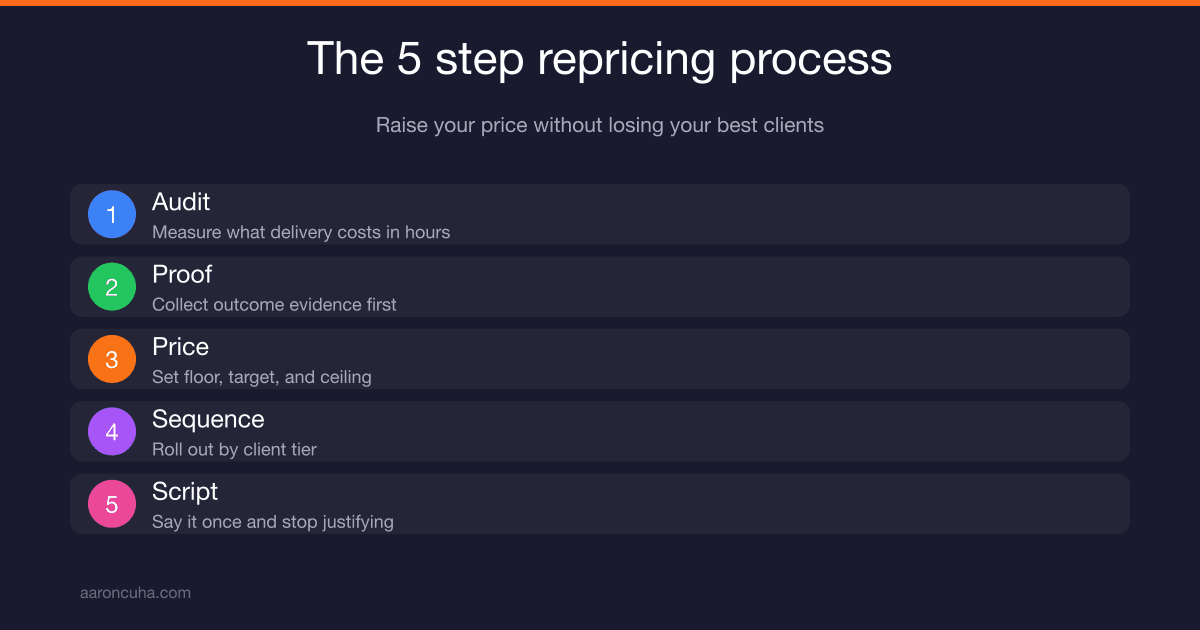
Most coaches underprice because they anchor to hourly rates instead of transformation value. Here is my pricing philosophy: price based on the outcome, not the input.
If your coaching helps a business owner generate an additional $100,000 in revenue, a $5,000 coaching program is a 20x return on investment. That is an easy yes for any rational buyer. The coach who charges $150 per hour for the same outcome is leaving massive revenue on the table and actually making it harder for the client to say yes — because hourly pricing feels like an ongoing expense, while outcome-based pricing feels like an investment.
According to Coach Foundation research, the average ICF-credentialed coach earns $62,000 per year. Coaches with productized offerings earn 3 to 5 times that. The credential I hold — ICF PCC — is valuable, but it is the business model that determines income, not the certification.
Automate the Business Side
Productizing your coaching only works if you also systematize the business operations around it. You need automated systems for enrollment, onboarding, payment processing, content delivery, and client communication. Without these, you just replace coaching hours with admin hours.
I use AI-powered automation systems to handle most of this. Automated email sequences nurture leads. AI scheduling tools handle bookings. Payment platforms process recurring membership fees. CRM systems track client progress. The goal is to spend your time coaching and creating content — everything else should be automated. For a deeper dive, read my post on AI automation for coaches.
Your 12-Month Scaling Roadmap
Here is the roadmap I give to every coach who wants to productize:
- Months 1 to 3: Continue one-on-one coaching while documenting your framework. Launch your first group coaching cohort with 5 to 10 people.
- Months 4 to 6: Run your second group cohort. Use recordings from the first to build your self-paced course. Launch the course.
- Months 7 to 9: Add a membership community for ongoing support. Create low-ticket entry products. Start reducing one-on-one client load.
- Months 10 to 12: Full product ladder operational. One-on-one coaching reserved for premium clients only. Majority of revenue from scalable products.
This is not about abandoning one-on-one coaching. It is about choosing when and how you deliver it, instead of being trapped by it. If you are ready to build your product ladder, book a strategy call and I will help you map out the roadmap for your specific expertise.
Frequently Asked Questions
Will clients pay for group coaching when they can get one-on-one?
Absolutely. Many clients actually prefer group coaching because they benefit from peer interaction, accountability partners, and hearing diverse perspectives. Position group coaching as a premium format, not a downgrade from one-on-one.
How do I create a course if I have never done it before?
Record your group coaching sessions. Edit them into structured modules. Add worksheets and resources. That is your course. You do not need a Hollywood production — you need clear, actionable content that delivers a transformation.
What platform should I use for digital products?
Start with Kajabi or Teachable for courses. Use School (community) for community. Use Stripe for payments. Do not over-engineer the tech stack. The content matters more than the platform.
How long does it take to see revenue from productized coaching?
Most coaches see meaningful revenue from their first group program within 60 to 90 days of launch. Course revenue takes 3 to 6 months to build momentum. Membership revenue compounds over 6 to 12 months as your member base grows.

Written by
Aaron CuhaAuthor of Crazy Simple YouTube, keynote speaker, and executive coach with 20,000+ hours logged. ICF PCC, NLP Master Practitioner, and DISC Certified. Aaron helps entrepreneurs replace hustle with AI-powered systems that generate leads, content, and revenue on autopilot.