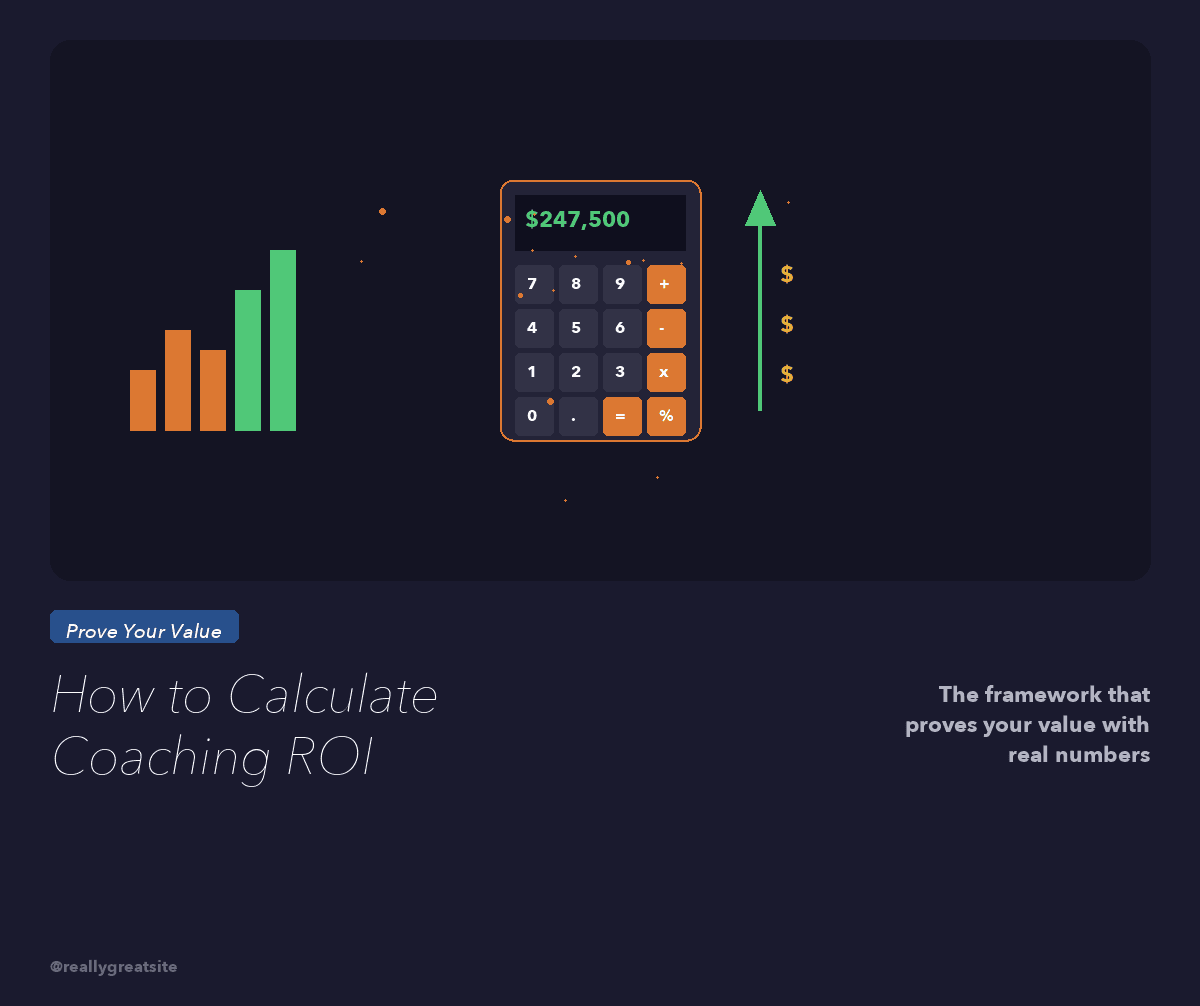
Most coaches cannot prove their value because they track the wrong metrics. Here is the battle-tested framework for calculating coaching ROI that closes.
If you cannot calculate coaching ROI with real numbers, you are leaving money on the table every single day. After coaching more than 400 entrepreneurs and executives across industries, I have watched the same pattern play out: coaches deliver massive transformations but cannot quantify them. Their clients feel the results. Their bank accounts reflect the results. But when renewal time comes or a referral asks "what kind of return will I get?" — the coach fumbles. According to the International Coaching Federation, the coaching industry hit $4.56 billion in 2023, yet fewer than 23 percent of coaches have a system for tracking client outcomes.
Key Takeaways
- Most coaches track vanity metrics instead of revenue-linked outcomes — fix this with a three-layer ROI framework
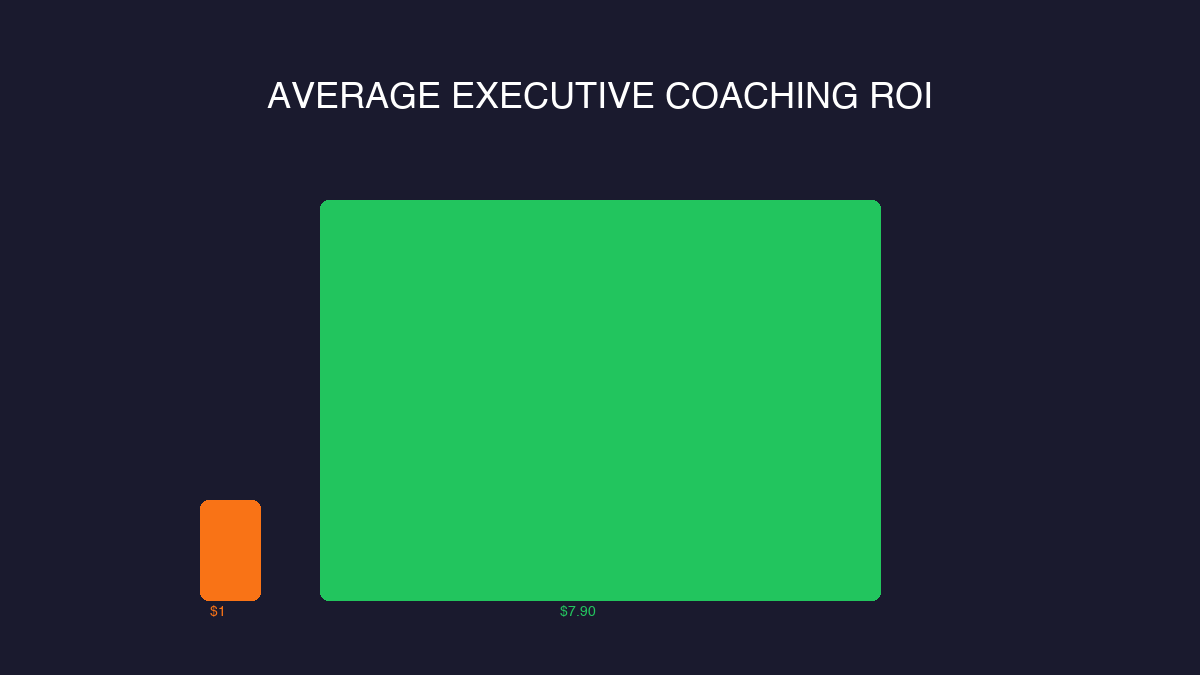
- The average executive coaching engagement returns $7.90 for every $1 invested when measured correctly
- You need leading indicators (activity metrics), lagging indicators (revenue metrics), and intangible multipliers to capture full ROI
- A 90-day baseline measurement before coaching starts is non-negotiable for proving value
- Clients who see documented ROI renew at 3.2 times the rate of clients who "feel" the results but cannot see the numbers
Want to see exactly what ROI looks like for your specific situation? Use our free calculator to model your numbers.
Book a Strategy SessionWhy Most Coaches Get ROI Wrong
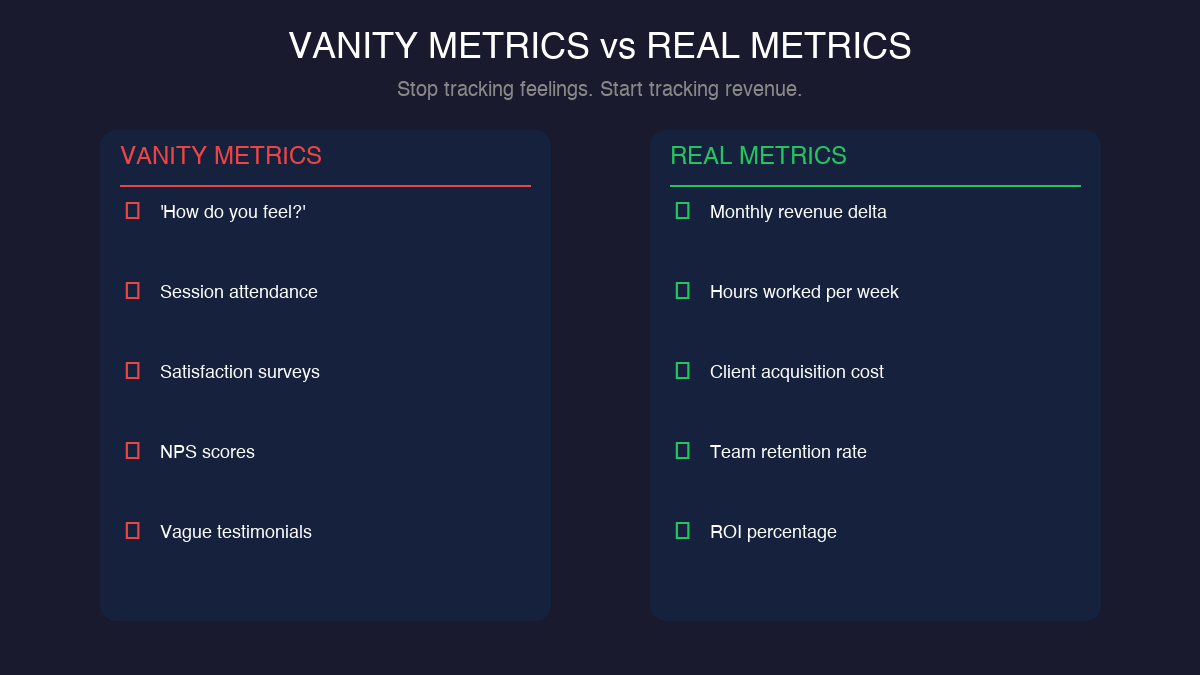
Here is the uncomfortable truth: most coaches measure ROI the same way they measure feelings — vaguely. They ask clients "how do you feel about your progress?" and call that data. That is not ROI. That is a mood check.
The problem starts with how coaches frame their offer. They sell transformation, which is correct. But they fail to attach numbers to that transformation before the engagement begins. Without a baseline, you have no comparison point. Without a comparison point, you have no proof. Without proof, you have a testimonial at best and a cancellation at worst.
I have seen coaches generating $50,000 per month in real, measurable results for their clients — and still losing those clients because they could not show the math. Meanwhile, a mediocre coach who tracks three key metrics keeps clients for years. The difference is not skill. It is systems. This is exactly why I built the tracking framework inside our executive coaching program.
Research from Harvard Business Review found that 86 percent of companies reported recouping their coaching investment and then some. But the coaches who can demonstrate that recoupment in real time? They charge two to five times more than those who cannot.
The Three-Layer ROI Framework
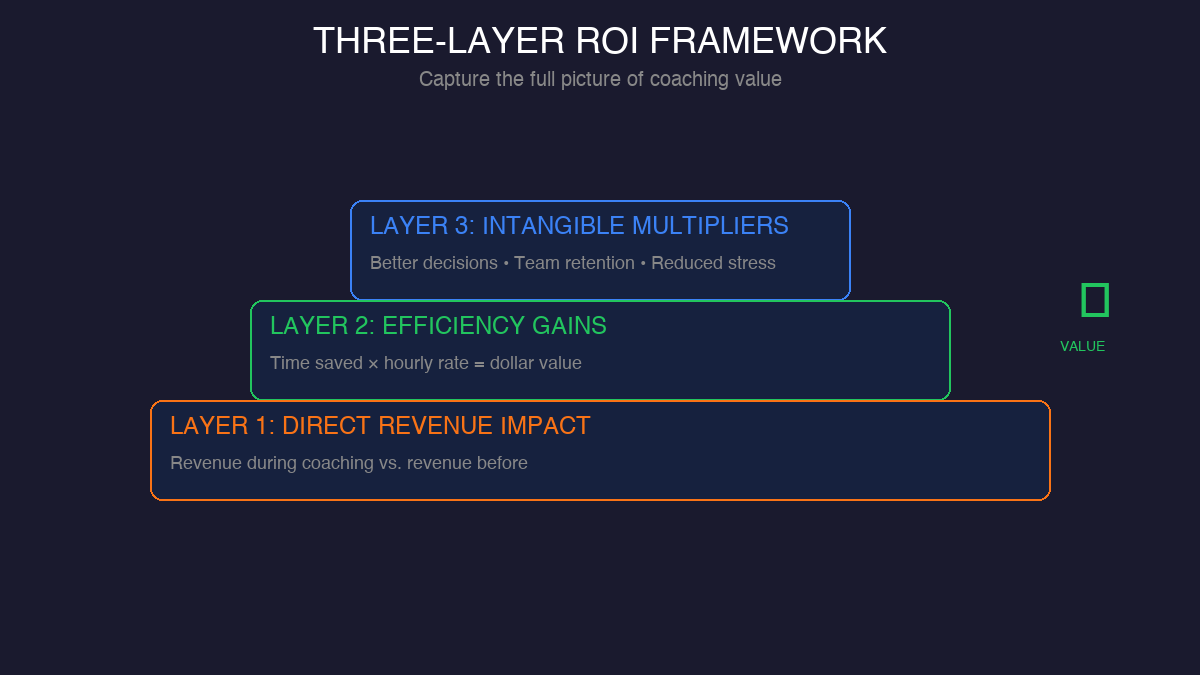
After years of testing, I landed on a three-layer system that captures the full picture of coaching ROI. Most coaches only look at one layer. That is why their numbers always feel incomplete.
Layer 1: Direct Revenue Impact. This is the easiest to measure and the hardest to argue with. How much additional revenue did the client generate during the coaching engagement compared to the same period before? If a client was doing $80,000 per month before coaching and $120,000 per month six months in, the direct revenue impact is $40,000 per month — $240,000 annualized. Simple math. Powerful proof.
Layer 2: Efficiency Gains. Revenue is not the only financial metric. If your coaching helped a client reduce their workweek from 60 hours to 40 hours while maintaining the same output, that is a 33 percent efficiency gain. Assign a dollar value to those hours. If their effective hourly rate is $200, that is $4,000 per week in reclaimed time — $208,000 per year. Most coaches never measure this layer, and it is often larger than the revenue layer.
Layer 3: Intangible Multipliers. Better decision-making. Reduced stress. Improved team retention. These are harder to quantify but not impossible. Team turnover alone costs 50 to 200 percent of an employee's salary according to Gallup. If your coaching helped retain two key employees who would have left, that is a six-figure save.
Setting Up Your Baseline Measurement
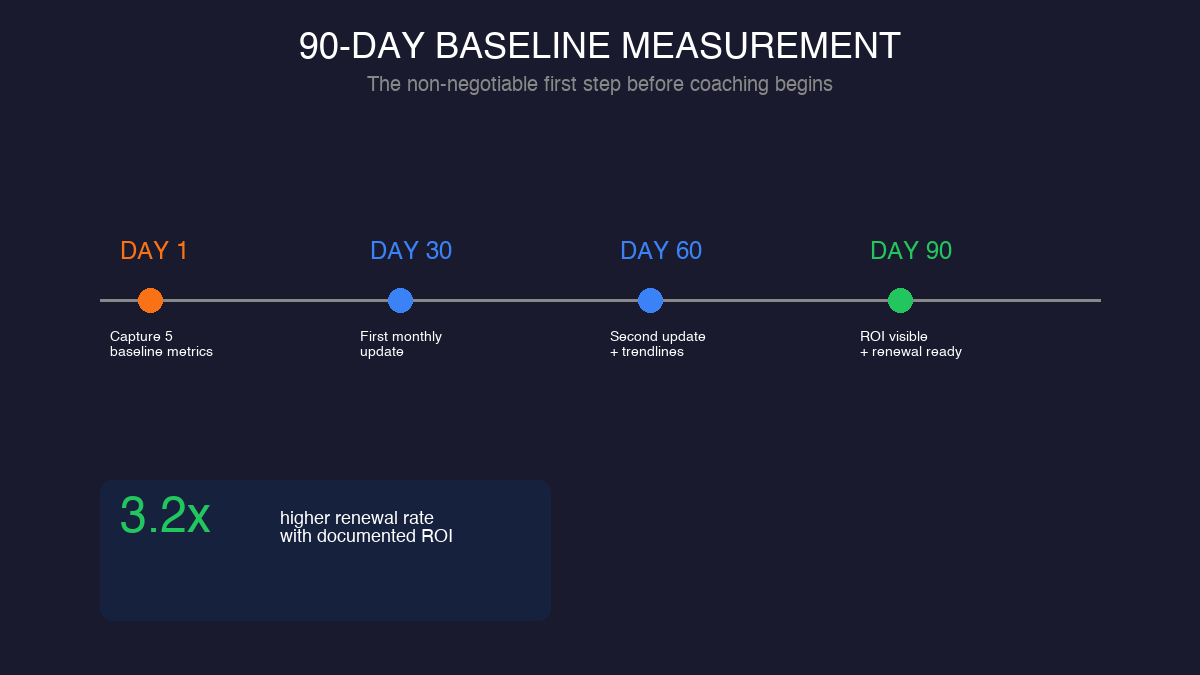
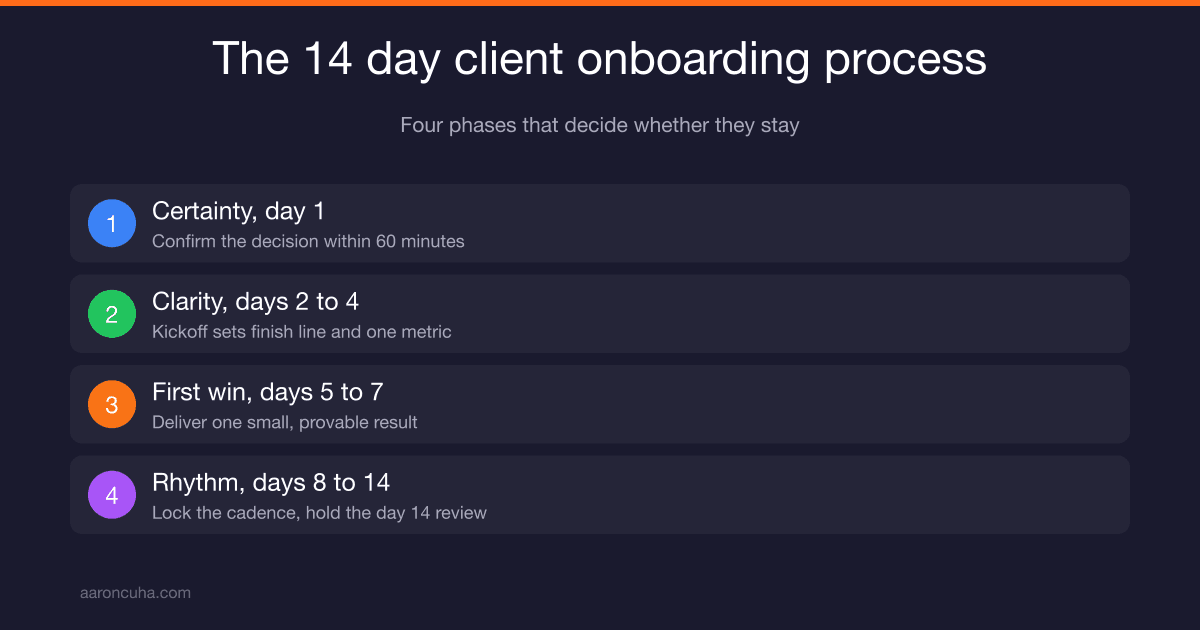
You cannot prove ROI without a starting point. Before any coaching engagement begins, I require clients to document five baseline metrics. This is non-negotiable. If you skip this step, you are building on sand.
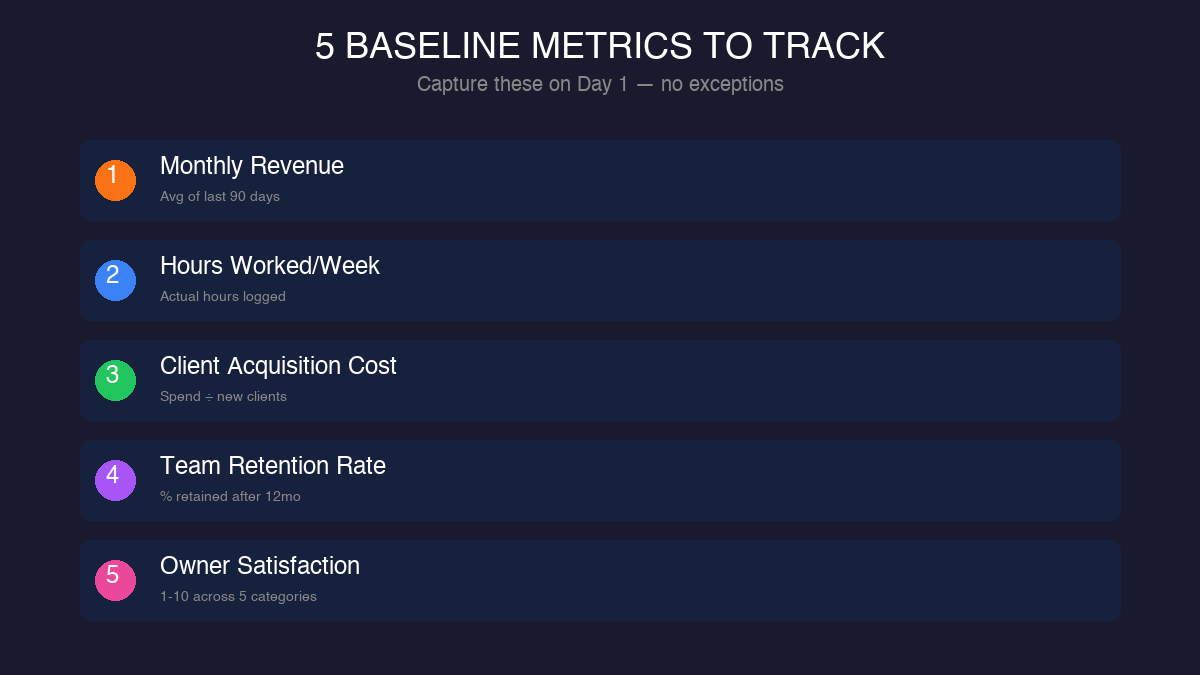
The five baseline metrics I track:
- Monthly revenue — average of the last 90 days, not just last month
- Hours worked per week — actual hours, not what they tell their spouse
- Client acquisition cost — total marketing spend divided by new clients
- Team retention rate — percentage of team still employed after 12 months
- Owner satisfaction score — a 1 to 10 self-rating across five life categories
I capture these in a shared dashboard on day one. Every 30 days, we update the numbers together. By month three, the trendlines tell the story better than any testimonial ever could. Clients see the trajectory. They see the gap between where they were and where they are. That gap is your ROI, and it renews contracts on autopilot.
If you want to see how this baseline system works in practice, explore real examples on our case studies page. The numbers speak louder than promises.
The Exact Formulas You Need
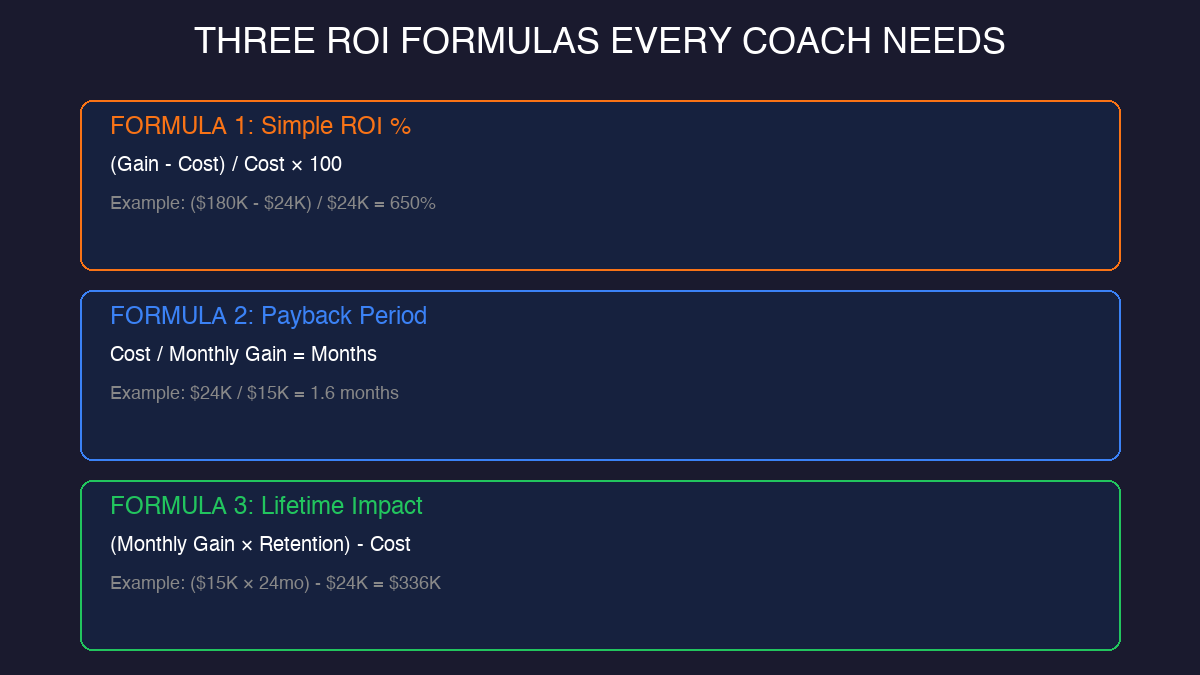
Here are the three formulas I use in every coaching engagement. Save these. Build a spreadsheet. Hand them to every prospective client during your sales conversation.
Formula 1: Simple ROI Percentage
(Gain from coaching - Cost of coaching) / Cost of coaching x 100 = ROI %
Example: Client gained $180,000 in new revenue. Coaching cost $24,000. ROI = ($180,000 - $24,000) / $24,000 x 100 = 650 percent. That is a real number from a real client in our executive coaching program.
Formula 2: Payback Period
Cost of coaching / Monthly gain = Months to break even
Example: $24,000 coaching investment / $15,000 monthly revenue increase = 1.6 months to payback. After month two, everything is profit. When you frame it this way in a sales call, the objection evaporates.
Stop guessing at your coaching ROI. Our calculator runs these exact formulas on your numbers in under 60 seconds.
Book a Strategy SessionFormula 3: Lifetime Client Value Impact
(New monthly revenue x Average client retention in months) - Coaching cost = Lifetime impact
Example: $15,000 monthly increase x 24 months average retention = $360,000. Minus $24,000 coaching cost = $336,000 lifetime impact. Now your $24,000 coaching package looks like the bargain it is.
Tracking Leading Indicators That Predict ROI
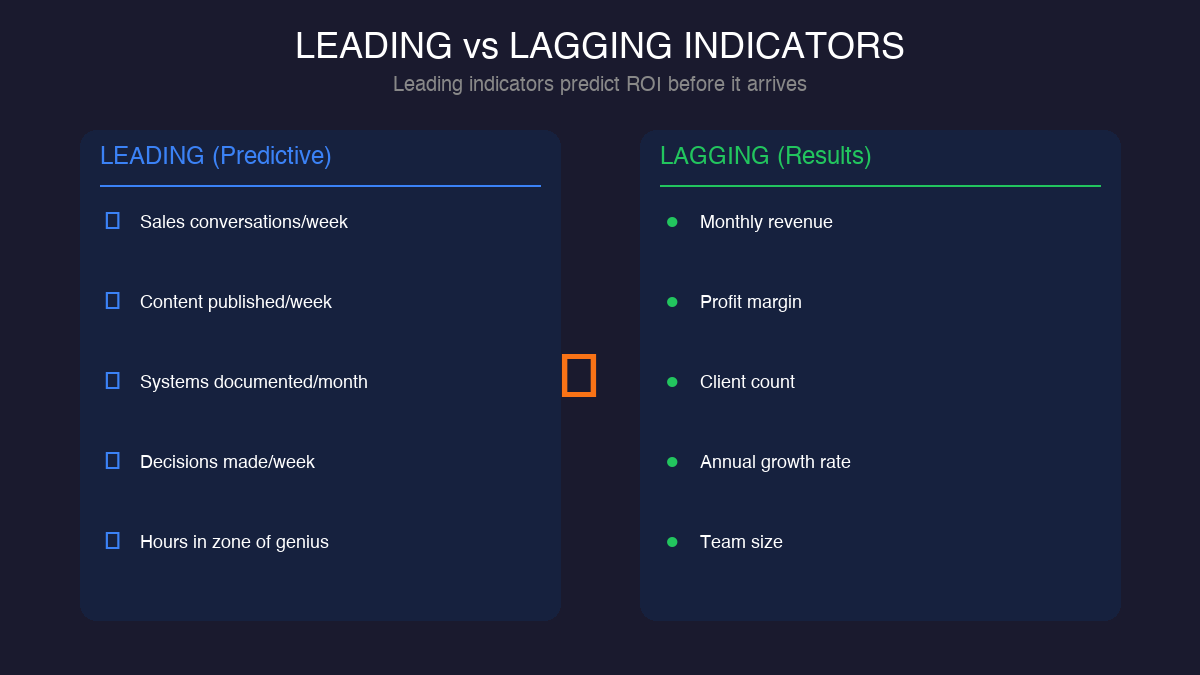
Revenue is a lagging indicator. By the time you see it, the work happened weeks or months ago. If you only track revenue, you are always looking in the rearview mirror. Leading indicators tell you whether ROI is coming before it arrives.
The leading indicators I track for coaching clients:
- Number of sales conversations per week — more conversations means more revenue is coming
- Content published per week — visibility precedes revenue
- Systems documented per month — every documented system is a future time save
- Decisions made per week — indecision is the most expensive habit in business
- Hours spent in zone of genius — time in high-leverage activities predicts revenue growth
When a client's leading indicators are trending up, I know the lagging indicators will follow within 30 to 60 days. This also gives me early warning signals. If someone stops having sales conversations in week three, I do not wait until month three to address it. I catch it in real time because the system surfaces it automatically. Learn more about building these tracking systems in my post on business coaching ROI.
How to Present ROI to Clients and Prospects
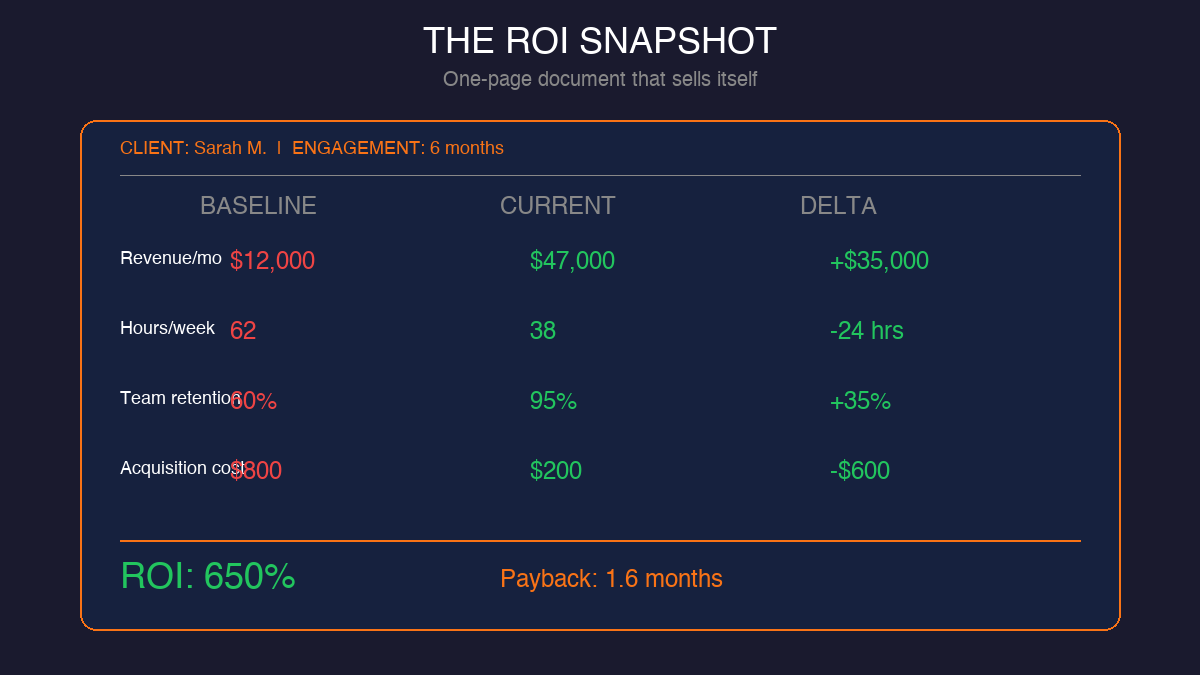
Knowing your ROI numbers is half the battle. Presenting them is the other half. I have tested dozens of formats and landed on what I call the ROI Snapshot — a one-page visual that every client gets monthly and every prospect sees during the sales conversation.
The ROI Snapshot includes:
- Baseline metrics from day one (left column)
- Current metrics (right column)
- Delta between the two (highlighted in green)
- ROI percentage calculated using Formula 1
- Payback period calculated using Formula 2
- One client quote that puts an emotional face on the numbers
This single document has generated more referrals than any marketing I have ever done. When a client can hand someone a page that shows 650 percent ROI with clear before-and-after numbers, the referral sells itself. No pitch needed. No awkward ask. The numbers do the talking.
For coaches who want to automate this reporting, our AI automation services can build dashboards that generate ROI Snapshots automatically from your CRM data. No manual number crunching. No forgetting to update the spreadsheet. The system runs itself.
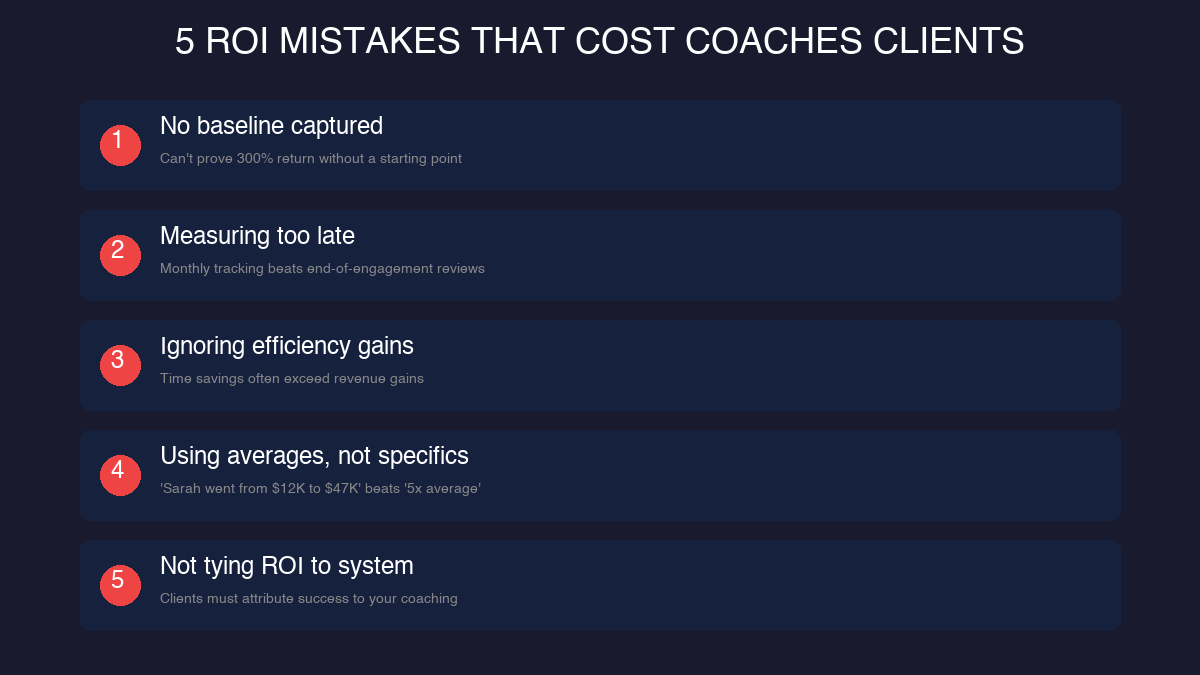
The Five ROI Mistakes That Cost Coaches Clients
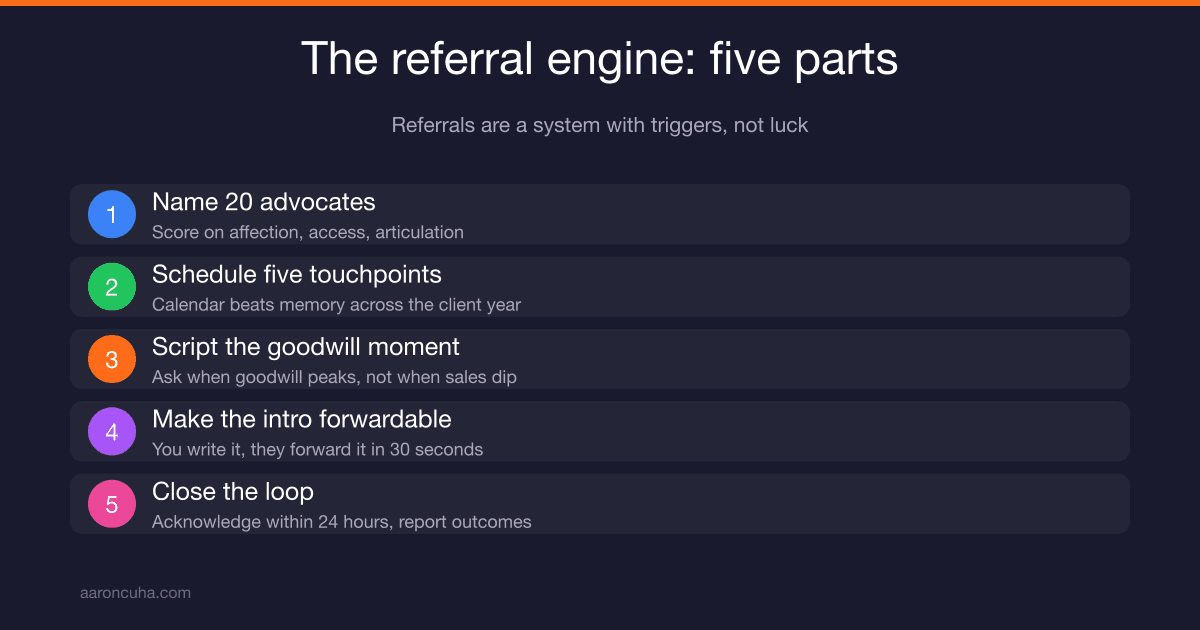
After working with hundreds of coaches through our programs, I see the same five mistakes on repeat. Fix these and you will retain more clients, close more deals, and charge higher prices.
Mistake 1: No baseline. You cannot prove a 300 percent return if you never documented the starting point. Capture baselines on day one, every time.
Mistake 2: Measuring too late. If you wait until the engagement ends to calculate ROI, you have already lost the renewal conversation. Measure monthly. Share the numbers monthly. Keep ROI visible at all times.
Mistake 3: Ignoring efficiency gains. Revenue is obvious. Time savings are invisible unless you track them. A client who reclaims 20 hours per week has experienced a life-changing transformation — but only if you put a dollar value on those hours.
Mistake 4: Using averages instead of specifics. "Our clients see an average 5x return" is weak. "Sarah went from $12,000 to $47,000 per month in 90 days" is undeniable. Specifics sell. Averages bore. Check out our case studies for how we present specific client results.
Mistake 5: Not tying ROI to the coaching system. Clients need to understand that the ROI came from the system, not from luck or market timing. When you connect every result back to a specific framework or process you taught, the client attributes the success to your coaching — not to external factors. That attribution is what drives renewals and referrals.
Ready to build a coaching practice where every client sees undeniable ROI? Let us map out your measurement system together.
Book a Strategy SessionFrequently Asked Questions
What is a good ROI for coaching?
The ICF reports an average return of $7.90 for every $1 invested in executive coaching. In my experience, well-structured coaching engagements consistently deliver 300 to 800 percent ROI when measured across all three layers — direct revenue, efficiency gains, and intangible multipliers.
How long does it take to see ROI from coaching?
Most clients see measurable leading indicator improvements within 30 days. Revenue-level ROI typically becomes visible within 60 to 90 days. Full ROI realization, including efficiency gains and intangible multipliers, usually takes six months to fully materialize.
How do you measure intangible coaching benefits?
Assign proxy values. Reduced stress correlates with fewer sick days and better decision-making. Improved team retention avoids replacement costs of 50 to 200 percent of salary. Better work-life balance reduces burnout risk. Each of these has a calculable financial impact when you use the right proxies.
Should I guarantee coaching ROI?
I do not recommend guaranteeing specific dollar outcomes because too many variables are outside your control. Instead, guarantee the system and the process. Guarantee that you will track metrics, provide accountability, and deliver proven frameworks. That is a guarantee you can always keep.
What tools should I use to track coaching ROI?
At minimum, a shared spreadsheet updated monthly. At scale, a CRM dashboard that pulls data automatically. I use a combination of Airtable for tracking and automated reporting tools that generate monthly ROI Snapshots for every client without manual work.
How do I talk about ROI in a sales conversation?
Lead with a specific client example. "One of my clients invested $24,000 and generated $180,000 in new revenue within six months — a 650 percent return." Then walk through the three-layer framework so they understand that revenue is just the first layer. Finish by offering to calculate their projected ROI using the formulas in this post.
What if my coaching is not producing measurable ROI?
Then your coaching has a systems problem, not a value problem. If you are delivering good coaching but cannot measure the results, start with the baseline system in this article. If the results genuinely are not there, it is time to audit your coaching methodology — and that is exactly what our executive coaching program helps coaches do.
How does coaching ROI compare to other business investments?
The average S&P 500 return is roughly 10 percent annually. The average coaching ROI is 790 percent according to the ICF. Even a conservative 300 percent coaching ROI outperforms virtually every other business investment. The key is proving it with numbers, not just claiming it with words.

Written by
Aaron CuhaAuthor of Crazy Simple YouTube, keynote speaker, and executive coach with 20,000+ hours logged. ICF PCC, NLP Master Practitioner, and DISC Certified. Aaron helps entrepreneurs replace hustle with AI-powered systems that generate leads, content, and revenue on autopilot.